
Drying up the Okanagan
Thirsty region is 'canary in coal mine' for BC and water.
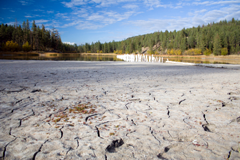
Mud pond near Kelowna, B.C.
[Editor's note: "Rough Weather Ahead," Chris Wood's series on what British Columbians can expect from global warming, is funded by a Tyee Investigative Reporting Fellowship. Today we publish the third of his reports, with two more to appear on consecutive Thursdays. To learn more about Wood, his series and Tyee fellowships, go here.]
On the hottest day of the year, Deana Machin meets me in the welcome air-conditioned coolness of a converted house in Westbank that serves as an office for the Okanagan Nation Alliance. Deana is fisheries program manager for the Alliance, which represents seven First Nations bands whose traditional territories stretch from north of Vernon, south to the U.S. border and west into the Similkameen Valley. If the beleaguered native coho, kokanee, cutthroat trout and other species struggling to survive in this interior Eden have a voice, Deana is it. And she is worried.
"We've been here forever," Deana says, leaning forward across a dark wooden table. "We'll be here forever. You hear elders speak about our 'grand-children's children.' And I'm very concerned about how rapidly development is happening. People aren't thinking very far ahead. Water is one of the big issues: water for food, water for people, water for fish, and fish seem to be on the losing end."
There are competing views of course. Orchardists and vineyard owners have their own feelings of entitlement: it was their predecessors who turned much of the arid Okanagan green, damming small lakes above the valley and piping water down to irrigate the lower benches and flatlands. An expanding high-tech sector asserts its importance to the region's prosperity. Then there all those active retirees, for whom a condo near the golf course represents the "golden years" dream come true. To say nothing of vacationers who annually flock to hotels and campgrounds to soak up sun, sip the local vintages and frolic in the lakes that lace the 180 km valley.
The Okanagan, in short, is a microcosm of British Columbia: lovely, productive, a magnet to immigrants, hedonistic -- and heedless of the climate threat hanging over its lifestyle.
"We're in a crisis," says Kim Stephens. "That hasn't sunk in yet." A second-generation water engineer and self-described "son of a dam builder," Kim now spends his days as sustainability coordinator for the B.C. Water and Waste Association trying to undo the myth of the "wet coast."
"We all think we're water rich," he observes. "But it's all time and place." Last winter's record stretch of rainy days, that is, does not rule out water shortages during this hot, dry summer -- or outright droughts next year.
Shrinking snowpacks
The reason, Stephens explains, is that here in British Columbia, "we're snowpack dependent." It is the water captured in snow on our fabled white-capped peaks that keeps our rivers flowing and valleys green through July, August and September. But even as our enviable environment attracts more and more people, and British Columbians waste more water per capita than almost anyone else on the planet, a warming climate is tending to deliver less and less winter snow. As a result, Kim says, "The safety factor now is pretty thin."
And, he adds, "The Okanagan is the canary in the coal mine for British Columbia and water." Nowhere are explosive growth and soaring water use in the face of higher temperatures on a more direct collision course with vanishing snow.
That's something Bob Campbell understands well. He's another water engineer, with the particular task of keeping the water flowing in Vernon. He manages a century-old water system that collects each spring's snowmelt in a series of artificial lakes above the town, then distributes it to homes, businesses and a few remaining farms. Two dates dominate his calendar: the last day in spring when melting snow overflows the dams on Aberdeen, Haddo and Grizzly lakes, and the day the first autumn rain arrives. Between those two dates, whatever is in the reservoirs when the dams stop "spilling" is all there is to maintain the wildlife in downstream creeks, satisfy lowland farmers and ensure that Vernon's taps and fire hydrants don't run dry. "Our money in the bank," Bob calls it.
Each year, it seems the first date comes sooner -- three weeks earlier than it did in the 1950s -- and the second later. That means Bob's water "in the bank" has to last longer too. And that's not all: as early summers get warmer, farmers and lawn-owners turn their sprinklers on earlier.
"That goes with what the climatologists are telling us," Bob tells me, as we bump down the rugged track back from Aberdeen Lake in his Jeep. "They're telling us to expect longer growing seasons. You're looking at the demand for water starting earlier and extending later into the fall. So when you start taking [water] out earlier, and your users are wanting it longer, you've got a real potential for shortages."
Thirsty developments
Meanwhile, developments marketed under names meant to evoke the region's natural beauty keep popping up. "Lakeshore Gardens," "Pinnacle Point" and "Greata Ranch Vineyard Estates" are among those currently signing up new residents. "Housing starts in Kelowna have more than doubled this year from the same seven-month period last year," the city's real-estate board boasted on Aug. 2. The valley's population of 300,000 is predicted to grow by a third by 2020.
Deana Machin isn't the only one worried about where the water will come from for all the new en-suites, gardens and golf courses to keep the condo-dwellers occupied. "It's a horror show," snorts Lorraine Bennest. Petite, grey-haired and salty in speech, Lorraine's a second-generation orchardist whose lovingly tended high-end apple trees occupy a hillside overlooking Summerland. She's proud of the computer in her small barn and the pipes buried along each tree row that dispense programmed sips of water and fertilizer, making the most of each litre. "We're spoon-feeding our plants," she says.
That parsimony didn't stop her from taking sides in the dry summer of 2003. That was the year fire crested Okanagan Mountain and destroyed more than 200 Kelowna homes. As Summerland's upland reservoir neared the bone-dry stage, growers like Lorraine faced off with federal biologists and First Nations over whether to save the last water for fish or keep crops alive. Acrimonious bargaining hammered out a tense compromise then.
Ten years to 'tipping point'?
Lorraine believes it's only a matter of time before the next crisis. Summer is getting longer and hotter; as temperatures rise, crops demand more water. And Summerland, like everywhere else in the valley, is adding homes. "My community has added users in anticipation of more water being available. Now they're looking at a golf course. The thinking is, 'It'll all be OK in the future.' Why will it be OK in the future? It's not OK now. I don't know what we're going to do. The areas that irrigate are in trouble."
Experts agree. Geographer Stewart Cohen is one of North America's top climate scientists -- a lead researcher for Environment Canada's Adaptation and Impacts Research Group and an adjunct professor at UBC. His latest study of the Okanagan's water future may be the most thorough look at how climate change will affect any region in Canada.
The bottom line? "If we don't do anything, demand will outstrip supply by the 2050s." That's in normal years and across the entire Okanagan. For individual communities, or for the whole valley in dry years, "that tipping point would happen a lot sooner. We could be passing that balance in the next ten years."
'We're in trouble'
The water that flows through Lorraine's orchard, like that spilled from Vernon's reservoir and flushing Kelowna toilets, ends up eventually in Okanagan Lake. A hundred kilometres long and 250 metres deep, it constitutes the region's ultimate reservoir. That makes Brian Symonds, a provincial Environment Ministry employee based in Penticton, Bob Campbell's counterpart for the whole valley. "I'm the guy with his hand on the tap," he jokes when we meet. Make that several "taps" -- there are control structures at the exit of each of the valley's five lakes, although the last is south of the 49th parallel and under U.S. control.
"A system like this is managed for multiple objectives," Symonds explains. The first is to contain flooding. But he also answers to agricultural users and municipal utilities, like Kelowna's, that draw water from the lakes. Owners of expensive shorefront property, meanwhile, want the lake level kept within steps of their docks. Looming behind all of these is the likelihood that the Okanagan Alliance or its member bands will increasingly assert title to a larger share of the water originating on their territories.
Those diverse demands "are often in competition with each other," Symonds says. It's hard to keep everyone happy all the time. And if the critical upland snowpacks continue to shrink, as Bob Campbell has observed them doing, as Lorraine Bennest fears and as Stewart Cohen predicts? "We're in trouble."
Hard choices
The Okanagan, Symonds and others believe, faces some hard choices. A few long-time residents would like to "close the door" -- stop development in its tracks. Most accept that's not in the cards. But other measures may be. They include:
- Stricter control on who can build what, and where.
- Universal water metering -- for agriculture as well as homes and businesses, within and beyond municipal limits.
- Separated water systems, so that only drinking water gets fully disinfected, and so "grey" water (waste that doesn't include human waste) can be recycled for irrigation, a technique already practiced in Vernon and Oliver.
- Penalties for planting certain kinds of thirsty shrubbery.
- At the extreme, augmenting the Okanagan system with water diverted from neighbouring watersheds.
The valley has already taken a cautious but promising first step. Earlier this year, its three municipal districts augmented the resources of the Okanagan Basin Water Board, a hitherto rather toothless vestige of a campaign to rid the lakes of a nuisance milfoil infestation in the 1980s. They also established a new Water Stewardship Council, to consult widely with residents, farmers, experts and other interests and advise the board. The council's objective, says its chairman, former federal cabinet minister and now Okanagan retiree Tom Siddon, is to determine, "How can we sustain this paradise?" All options, he says, are on the table.
Deana Machin is encouraged -- up to a point. The new council, on which she sits, reflects a dawning awareness that things must change and those changes must involve the whole valley. "Everybody's really talking a good game," she says. "But we still don't get any consensus. People are still coming to the table with positions rather than solutions."
I ask for hers. She's silent a while. "It's tough," she says at last. "Let me think."
At least in the Okanagan, thinking has begun. That is more than is true for most British Columbians. And even thinking must not be an excuse for inaction. The weather is changing -- on a timetable that cannot be entirely predicted, but that also will not be stayed merely by our wish to avoid hard choices.
Veteran journalist Chris Wood is recipient of a Tyee Fellowship for Investigative Reporting, which provided the funds necessary to do the in-depth reporting in this series. Tyee Fellowships for Investigative and Solutions-oriented Reporting are supported by donations from Tyee readers and intended to support independent journalism to educate the public about critical issues facing British Columbia. If you are interested in making a tax-deductible donation, please go here. If you are interested in applying for a fellowship, please go here. Wood is working on a book, Dry Spring: When the Water Runs Out, forthcoming from Raincoast Books.



109
Login or register to post comments
G West
5 years ago
Comments on "Drying up the Okanagan"
The canaries have to start dying first.
massromantic
5 years ago
i was really interested in this story until i realized it was yet ANOTHER story about kelowna & the north okanagan.
there's more to the okanagan valley than just kelowna
maybe the south okanagan, for example, which is where the highest concentration of vineyards lies, and is also the only desert in canada.
they've had their share of fires and woes, consistently hitting temperatures above 40 in the summertime
kelowna has it easy.
also one of the biggest residential booms is currently happening in the south, with more people flocking to the towns to raise their families and partake in the growing economy
it's sad really how so many pieces and articles are written about the okanagan, from highlighting its attraction to uncovering its environmental concerns & weak spots, yet barely any of them stray past kelowna & its general area.
shame that little piece of BC, the southern okanagan, is overlooked.
it's a lot nicer, in my opinion, anyways.
snert
5 years ago
How many more people are using that reservoir capacity than in the 50s?
RickW
5 years ago
mass romantic:
The whole of the Okanagan is connected when it comes to water consumption. I see the thousands of housing units being built in Kelowna, and the very large expansion of vineyards, along with the huge Nk'Mip ( http://www.nkmipcellars.com/about/default.asp ) resort development in the southern Okanagan, and ALL of this requires huge amounts of water.
No one gives it a thought though, because that great long lake gives the impression there is limitless water. And as one resident of Kelowna remarked: "We'll just tap another lake....." as he indicated the hills surrounding the valley.
On the other hand, what confounds me is how the construction that is happening in this region is doing so without any significant regard to energy conservation either. All the malls and houses are being built assuming limitless electricity for both heating and airconditioning, and so small regard is being made for energy-saving construction. No rammed earth housing ( http://www.sirewall.com/ ), no buried or semi-buried housing ( http://www.gluckman.com/CooberPedy.Australia.html ), no nuthin' except more "california-style" conspicuous consumption units.
Grumpy
5 years ago
This is the end, my friend, the end. Global warming and liberal corruption will destroy this province.
relayer
5 years ago
Just a niggling point, I know, but for the record- the south Okanagan is NOT Canada's only desert. Osoyoos would like you to believe thats so, but the Sonoran desert, of which the OK valley is a part, extends pretty much all the way to Spences Bridge. I live about 5 hours north of Osoyoos, and I have prickly pear cactus growing in my yard, tumbleweeds are a constant nuisance, and coyotes and rattlesnakes are common around here.
Personally, I wouldn't live in the Okanagan Valley if you paid me. In a few more years, it'll be one big strip mall from Vernon to the border. Enjoy.
notamused
5 years ago
I find some of the reader comments more alarming than the story itself. Water shortages are a reality in the Okanagan and will be increasingly so. In Armstrong this spring, we had a 3-week boil water advisory because too many people ignored watering restrictions. If you don't want to read the entire 75-page study that is quoted in the article, at least read the summary at http://www.statcan.ca/Daily/English/031203/d031203a.htm. Among other things, you'll learn that the Okanagan has the highest ratio in Canada of population per square km of surface water.
jesterjogger
5 years ago
Hail rona ambrose!!!!!
17 spotted owls left and good ol' rona says the population is healthy!!!
thank god our prayers have been answered and we finally have someone who takes the endangered species act seriously.
Re this story I guess all those rich albertan oil millionaire friends of rona and harper will just have to start building smaller swimming pools.
climber
5 years ago
[OFFENSIVE COMMENT REMOVED.
[OFFENSIVE COMMENT REMOVED. -MODERATOR.]
Alcibiades
5 years ago
climber
I know it's tough on dialup, but, if you haven't already - google Aral Sea; when you've done that, check out Oglala Aquifer.
Another pdf file you might want to investigate is here:
http://www.fromthewilderness.com/free/ww3/FTW-07_2004.pdf#search=%22oglala%20aquifer%22
Moat
5 years ago
climber posted
Whoa! That's crazy talk man.
Let's look at the many salmon runns in small streams that have gone extinct. We need logging in BC, but in some areas the costs are way to high.
If your attitude is "fuk the spotted" owls, I sort of feel bad for you.
Maybe you would like to save some some of your posts for your great-great grandchildren to read.
climber
5 years ago
Moat, Salmon are not extinct, none of the different versions, I just bought a whole bunch the other day. Like I said, name me a species that has been made extinct, just one. My attitude isn't "fuk the owls" just said it to ruffle feathers, not hard to do here. And we are talking about a water shortage, what about my idea of pumping water in from the Arrow Lakes, is that a viable option? I know it could be built, is there enough water to make it work?
Moat
5 years ago
climber,
Certain runs are extinct.... yeah, sure there is lots of salmon, but the genetic variation has been reduced and utimately the species ability to adapt to climate change or disease.
The exinctions are regionalized. It is kind of like saying the grizzly bear is gone, but we still have them in Russia!
Back to the water shortage.... well, pumping water is a dangerous proposition, as conservation behavior does not change until it is too late (hitting the pocket book!).
Look at the way California continues to waste water, although there is a "shortage", they continue to waste water, because they can continue to buy and build their way out of the problem.
Rhea
5 years ago
That's great, as long as the snowpack feeding the Arrow Lakes stays high. When those lakes run low, what do you do? You're back at square one without addressing the root problem of high consumption/low resource level. You're just prolonging the problem with that kind of solution. They need to drastically revamp building codes and enforce stricter water restrictions all over BC, not just in the dry areas. All new construction should be built with greywater systems for outdoor irrigation (which also cuts down on sewage treatment costs), rainwater collection and other passive conservation and collection methods. Water should be metered, even if it's not charged for, and people should see a graph on their tax bill for what their consumption was and what it cost to provide it. maybe even set a ceiling - consume more than X, and you get charged $$$ for it.
Good luck getting a government with the guts and political will to push this through in the face of howls from developers, though. Much easier for them to wring their hands and do nothing until it's way too late.
notamused
5 years ago
Isn't our use of the water in the Arrow Lakes encumbered by that great deal we have with the Americans called the Columbia River Treaty? (See http://en.wikipedia.org/wiki/Columbia_River_Treaty)
climber
5 years ago
Some runs are no more, but the species that composed those runs is still here, in other runs, whether they were sockeye or pinks or whatever. It is not the same as saying that the grizzly is gone but they are still in Russia. I said in B.C. And, the grizzly is far from gone here, far from it, despite the hysterical rantings of some. Black bears are everywhere, don't get on the bear B.S. with me. So I'll take it that you cannot name a single species that has gone extinct in B.C. due to logging? Now, about pumping water, is it dangerous because the Arrow Lakes cannot supply water because of legitimate concerns, or what? I ask this because more water is needed in the Okanagan, even with conservation measures.
ubiquitous
5 years ago
No. But it is a good analogy. Rather than continually asking for someone to name a species that has gone extinct due to logging (species extinction is never due to just one thing, so your question cannot be answered), why is it that you believe that as long as a species still has at least one member, who cares? Look at the signs climber and address the problems before they become irreversable.
climber
5 years ago
I figured I would ask, question answered thank you. It is a favored "fact" advanced by some orginizations to further thier cause or funding, the fact is that no species has actually gone extinct here, in reality. Many also predicted that we would run out of food, oil, wood, one thing or another would get us by now, blah, blah, blah. I am not saying that everthings just peachy, just that facts are better than some of the bullshit out there. And it all started out because I let Jesterjoggers yapping get to me, I haven't heard from him, maybe there is some extinct beast he can tell us of.
jesterjogger
5 years ago
"Corporate polluters, their phony think tanks and POLITICAL TOADIES like to marginalize environmentalists as tree huggers or radicals. But there is nothing radical about clean air or water. Environmentalists are battling for the very mainstream values that right-wing fanatics so often herald in their rhetoric: property rights, law and order, local control and free market capitalism. Too often these are only hollow facades that mask the radical agenda ()of doublespeakers whose only real value seems to be corporate profit taking." RFK Jr.
I don't have much good to say because if everthing was fine, as I pray for everyday, then I WOULDN'T HAVE TO KEEP POSTING ON THIS FCUKING WEBSITE.
As for species which are now extinct exclusively due to logging in BC I'll defer to my learned colleages.
Anyone?
Moat
5 years ago
climber,
We are not arguing the same thing here. I am saying that certain runs of salmon are extinct - they no longer exist. Each run of salmon has a slightly different variation, and that makes the species better able to evolve. I am not a biologist, so I don't wish to travel too far down that road here.
As for the bear arugment, that was just an example. I agree that the black bear population in BC in fairly healthy. But when a species of salmon or trout no longer exists in a certain stream, then it can be considered "extinct" from that system.
As for the conservation measures.... they are laughable as long as people are able to maintain their bright green lawns.
climber
5 years ago
http://gristmill.grist.org/story/2006/1/6/193649/7888 Speaking of RFK Junior, another fuking hypocrite like Al Gore. What do you have to say J.J.? Yourself that is? Learned colleages (sp.?) can you help out here?
climber
5 years ago
Moat, I saw on tv where down in the southwestern U.S. they are ripping up lawns and replacing them with rock and desert plants that can live with very little water. They are making a big effort to eliminate non-essential uses of water, maybe this can be done in the Okanagan.
jesterjogger
5 years ago
I must say that I admire the shear ferocity with which you defend the status quo of destructive, greed-based, unsustainable capitalism.
Perhaps we will see each other in hell?
G West
5 years ago
climber,
the question about logging and species extinction is a favourite of Patrick Moore, at least it seems to have become part of his usual riff. Maybe that's where you heard it too - it's certainly where I remember it from.
Here's a piece from the University of Western Ontario about bird species that are in grave danger:
http://www.fims.uwo.ca/olr/apr1502/birdsandloggers.html
According to the WWF its a big problem in Borneo:
http://www.ecologyasia.com/news-archives/2006/apr-06/star_060404_1.htm
Some endangered or threatened species in Canada would seem to include: The Vancouver Island marmot, the beluga whale, the peregrine falcon, the leatherback turtle, the Acadian whitefish, the prairie orchid, the wood poppy, the wood bison, the harbour porpoise, the white-headed woodpecker, and the trumpeter swan - according to my reading there is also some concern about bull trout.
Of these, I'd say only the trout and the marmot would be possible answers to your question - species threatened with extinction by logging or activities associated with logging.
Fair enough?
G West
5 years ago
And of course there's this:
http://www.arts.mcgill.ca/anthro/chapman_files/CWeb/Pdf/90_SeedConservAJP.pdf#search=%22species%20rendered%20extinct%20by%20logging%22
From the American Journal of Primatology - again not particularly relevant to BC.
inkioko
5 years ago
climber: diverting rivers is ridiculous. i hope people like you go extinct... oh and by the way...
how about:
sage grouse
cascade mtn. wolf
yellow billed cuckoo
catenifer gopher snake
western pond turtle
pigmy short horned lizard
altifrontalis long tailed weasel
gilia sinuata
tons more if you actually research it.
inkioko
5 years ago
of course, as ubiquitous has pointed out, there is ambiguity when it comes to trying prove any one thing resposible for an extinction.
climber
5 years ago
G.West-Actually its not from Patrick Moore, that "quisling, turncoat, traitor" to the movement, who I tend to agree with, for the most part. It comes from Gary Shelton, the bear expert. As far as extinctions, nothing leaps right out at us anyways, thats for damn sure. Inkioko, I never said to divert rivers, I asked if water could be sucked out of the Arrow lakes. Where does the water for the GVRD come from? Rivers that were damned, that never would be damned now. Think about this, if the present day mindset of the general public was used to make decisions back in W.A.C. Bennets time, this province wouldn't have the massive hydro power it has. The site C project is getting slagged, the Vancouver Island power project was shitcanned, every one wants power, wants water, wants, wants, but they cry and whine whenever someone tries to give them what they want.http://gristmill.grist.org/story/2006/1/6/193649/7888 This takes the cake.
climber
5 years ago
http://www.usu.edu/saf/moore.html Here is the traitor spewing forth.
G West
5 years ago
You can see why I thought it was Moore - the dreaded spotted owl controversy - he's now a convert to nuclear power - working I think as a lobbyist promoter for the industry.
Didn’t Ken Keasey write a novel that satirized a certain kind of ‘attitude’ in the forests of Oregon and toward the fierce independence of logger types? I think it may have been called ‘Sometimes a Great Notion.’ Damn fine writer, Keasey.
doggone
5 years ago
Is loggin automatic now?
Becoming aware in the early '50s in the north Okanagan I recall what "winter" meant:
1) Snow. solid on the valley floor for the months of november to february certainly
2) spring melt (march) and creek floods in june predictable
during recent visits to the few relatives and friends I have left there I see no significant snow on the floor of the valley even in the coldest part of the year.
Now I have to admit that this study is totally personal and only covers about 50 years to the present - maybe some others have noticed?
I'm guessing now: living on Vancouver Island and watching the logging trucks roll up and down the Island Highway (Why they haul both directions beats me)
Maybe "Island TimberFeast" knows that the timber is gonna burn if they don't fall it first.
Earth, Water, Fire and Air
Met together in a Garden fair
Put in a Basket bound with skin
If you answer this riddle
You'll NEVER begin!
(Robin Williamson)
RickW
5 years ago
climber:
Don't think small, climber:
http://www.schillerinstitute.org/economy/phys_econ/phys_econ_nawapa_1983.html
"The North American Water and Power Alliance—NAWAPA—is the most comprehensive of a series of plans developed during the 1950s and 1960s to capture and redistribute fresh water in Alaska and Canada. NAWAPA would deliver large quantities of water to water-poor areas of Canada, the lower forty-eight states of the United States of America, and Mexico."
Or this:
http://www.answers.com/topic/great-recycling-and-northern-development-canal
IAMC
5 years ago
Remember the FAMOUS story about "The Canadian Lynx"
There was a very large land mass in the Midwest area of the US, that enviro-frauds were trying to shut down, using the rare Canadian Lynx as a vehicle.
A group of EPA, that's right, Govt. employees, found hair tufts on a tree within this multi million acre area.
They did the DNA and firmly established that the rare Canadian Lynx was habitating the area.
Now, if they could prove that this rare species was indeed there, the whole area could have been deemed inaccessible to anyone.
That's the power they had.
Well some diligent Govt, employees took a DNA sample from these tufts of hair.
They then compared it to a stuffed Canadian Lynx that was displayed at a Govt. building within the affected area.
They found a DNA match.
The Govt. employees had planted the fur tufts on a tree within this area.
Busted.
The economic effects of this thwarted fraud would have cost the economy of the US billions of dollars.
You have to be wary of these eco-frauds.
G West
5 years ago
Ron
This is a story about imminent water shortages in the Okanagan.
What are you smoking tonight?
IAMC
5 years ago
G; it's a parallel to the BS that is spewed by other frauds in the environmental field.
The Okanogan is dry.
We have known this for all of our lives.
If an eco-fraud can point this out as evidence of global warming, that's fine.
But there is another area of earth that is getting their rain.
Do you want me to explain the environment to you?
G West
5 years ago
You really can't read can you?
What kind of comfort do you get from living in cloud cuckoo land Ron? Must be pretty thin gruel when you go home each night and turn out the lights and realize your whole life is a lie.
climber
5 years ago
G West, I checked out those links, the one about the orangutans said they only had 2% of their old forest left, so good thing its preserved. The birds Ontario are being impacted negatively, no doubt, maybe the gypo outfits could be subsidized so they can wait, like the big guys. Rick W, I remember La Roushe from the 80s, hey at least he thought big, I'm just asking about a 4' pipe, childs play in comparison. That link I posted about Moore speaking on forestry is very interesting, if you guys could pinch your noses and read it you might be suprised.
G West
5 years ago
climber.
I've read a lot of what Moore's written, including that piece you posted - which is why I was so familiar with the business about the disconnect between logging and extinction.
I don't even disagree with a lot of what he says and I'm all in favour of Scandinavian forest management and sustained harvest.
I do have a bit of a problem with Moore as a straight shooter because he seems to change his stripes pretty frequently, is all.
Have you read the Keasey book? I bet you'd love it.
doggone
5 years ago
Yes please Iamc
Explain the "environment"
"a child shall lead them"
G West
5 years ago
Should read 'Scandinavian-style' forest management.
doggone
5 years ago
Don't miss keasey's "Garage Sale"
Somewhat more appropo the "Sometimes"
IAMC
5 years ago
Thanks doggoone for giving me the opportunity to explain the environment.
" What goes up, must come down. "
Do you want me to go on?
doggone
5 years ago
I'm not sure.
Lemme think
Space shuttles?
Empires?
Species?
What the hell?
Go ahead
G West
5 years ago
doggone
Don't disagree about 'Garage Sale'; I suggested 'Sometimes a Great Notion' for climber. He seems the type who'd appreciate the Stampers, don't you think?
And I don't mean that critically either.
doggone
5 years ago
Definitely loosing the thread. The point in question seemed to me to be the dwindling resource of fresh water in the Okanagan (and a few other locations on the planet).
Should the trend continue I propose we "circle the wagons" and hunker down together near a fairly large body of "fresh" water
G West
5 years ago
heh heh
i don't disagree with that either.
but despite the fact i think he's partly wrong, i like climber, - he wants to cut through all the bs and come up with something that'll work - like the Stampers - fiercely independent and probably obsolete - but still somehow honourable and, in his way admirable.
the only thing that'll save the Okanagan is a cap on population and severe limits on consumption. how do we do that and still cater to every rich Albertan who wants to move there to get away from the mess they've created in Calgary?
how do you bring such factors together in a democracy? if real change and progress is possible, progressives have to find a way to make common cause with the Stampers of the world again.
cosmo
5 years ago
Climber,
There are no Salmon in the Arrow Lakes. That is drastic. It is not a matter of "a run". There are no Salmon for the entire Columbia River in Canada, nor the Slocan etc.
And no, there is no way in Hell that us Kootenay folk are going to pipe water over the Monashee to feed the Albertans in the Okanagan.
A final thought. I remember being in a logging camp in Phillips Arm, where there was a recipe on the wall for Spotted Owl Soup. But the loggers there were actually extremely concerned and pissed off at the ignorance of Mac Blo (at the time) for building a bridge during Salmon spawning season.
You are off the spectrum my friend.
kenl
5 years ago
If You Choose To Live On A Fault Line Or In The Path Of A Forest Fire Or On A Flood Plain Or In The Path Of An Imminent Tsunami
Or On The Top,side Or Bottom Of An Unstable Mounatain,,,,,and ,,,if You Are Not Okay With You And/or Your Home, Being, Shaken To Pieces,burning,washed Away In Flood Waters,being Shattered In The Tsunami Wave, Having The Mountain Either Slide Out From Underneath You Or Come Down On Top Of You. If You Think Any Of The Above Might Ruin Your Day,,,move!!!!
notamused
5 years ago
So, kenl, all of us who live in the Okanagan and who are worried about water shortages should just move somewhere else and let the capitalists fight over the remaining resources and destroy anything reeking of nature, until WalMart owns the entire valley and cheap goods are plentiful but there is no meaningful work for us or our kids? That's not my idea of a society in which I want to live and, rather than run away, I'm going to do my damndest to change it.
kenl
5 years ago
The point I was making is that if you live in an artificial enviroment, ie reclaimed land from a river delta or the sea, land irrigated from remote or finite sources, building on a fault line etc. etc. you are courting eventual problems,,,and when these problems of your own making come about do not come crying to me.
The fires in Kelowna were a great example of my point, I recall a news item about 5-10 years prior to the fires, where the good citizens of Kelowna were protesting the forestry departments plan to do controlled burns in the areas of the same subdivisions that were worst hit by the out of control forest fire. Some of the good citizens were complaining about how the controlled burns would affect the quality of the view from their properties.
giantartificial...
5 years ago
Yes, the Okanagan has always been a dry place. Now that it's becoming critically dry, it's not all the fault of those who decided to live there in the first place. The climate is changing. The snowpacks are smaller. (I remember more snow in the winter when I was a kid, too). The thing to do now (other than ban the rich Albertans from moving there, tempting as that might be) is to focus seriously on conservation. That means, among other things, that developers should be forced to adhere to strict building codes and even to use xeriscapes instead of lawns in landscaping. And by the way, kenl, except for a few hermits out in the woods, we ALL live in artificial environments. What's with the holier-than-thou attitude towards those in the Okanagan?
RickW
5 years ago
Heaven forbid we should put restrictions on moving to places because of a finite amount of resources to draw on.
Would sure knock hell out of all the major and not so major cities on this planet.
Hmmmm........
RickW
5 years ago
climber:
A measley 4" pipe is like pulling a single pebble out of the bottom of a pile a gravel..........
Why not use water diversion money to encourage orchardists in the OKanagan to install sub-surface watering systems? And why not get that money in thew first place by putting a tax of water consumption, to reflect the real cost of providing the resource?
I read sometime ago that the real cost of providing water to the average user is about 10 cents a gallon, taking everything connected with water and its disposal into account. As the average residential user uses an average of 350 gallons per day, that wolld be a tax of $35/day. Instead, we pay about that every three months (or so).
Alcibiades
5 years ago
RickW
I may be wrong, but I think climber was suggesting a 4 foot pipe.
RickW
5 years ago
Oops! Fly spec on the desktop...........better make that "a shovelful of pebbles".......
climber
5 years ago
Yes, a four foot, 4' wide pipe. About Sometimes a Great Notion, I have not read the book which is probably better than the movie but I don't like the Stampers because they didn't stand with thier fellow loggers. Hi-ball Gyppos running a haywire show anyways.
Alcibiades
5 years ago
climber - you've only seen the movie dude, read the book.
climber
5 years ago
Maybe I will, I read some Keroac (Spelling) and liked that stuff when I was a teen. The merry jesters, the bus, before the dream died in '66. I liked Hunter Thompsons take a little better, its all good, from a time before I was born and when I was a child. Killer cars, awesome music, no aids, no aircare. I guess the pot is better, the chainsaws better, the cars are bland, the music mostly sucks, people are meaner, you can't just buy a rifle at Sears etc. I think I would have liked it then a lot.
rob
5 years ago
The people in Kelowna, where I live, are the worst water wasters in the world, using about 520 litres per person per day compared to the national average of 350. At the same time we get the lowest amount of water , per person of anywhere in Canada.
RickW is correct when he talks about the rampant development with very little water conservation or recycling designed into the buildings.
I got the shock of my life last week while visiting Dawson Creek. We drove up , through Jasper, to sell the acreage we have owned up there since 1979. The dugout I built was low and the renter said there was no snow last year to help fill it. This is a 1/2 million gallon dugout that filled up in three days when it was built in 1987. The snow in the bush on our acreage used to be up to my chest, but last year there was no snow.
Crops in the Peace region failed because the water to grow them did not show up. The area is in a serious drought. The mighty Peace River is at the lowest level on record. The Athabasca river is being sucked dry by the Tar Sands.
The North Thompson, the Thompson and the Fraser are also at very low levels.
Ok, that means that the major rivers on both sides of the continental divide are very low so something is happening that could be quite serious.
No matter how much money you have or who you vote for or what you may believe or do not believe is happening regarding global warming - there is no substitute for WATER.
The Okanagan is in denial and that big lake will be sucked dry so fast if it is not replenished from snow melt high up in the watershed. How much water do the fifty golf courses in Kelowna use?
RickW, you are correct that we should pay more for water. Developers are getting a public resource for very little and then are making a huge private profit. This passes for capitalism but is actually just the transfer of wealth from the many to the few. I call this slash and burn capitalism -
make a profit - trash the environment - move on and do it again.
The water conference in Kelowna earlier this year pointed out that any future development would depend on water saved by conservation since almost all the current flow was already committed. Farmers need water to grow food and there could be improvements in how it is used. Nobody seems to challenge the rampant golf course expansion which is a luxury use of a dwindling resource.
We need city bylaws which require water collection, recycling and conservation to be designed into buildings. Even the developers would agree to this as long as they knew what was expected of them. The extra cost would be paid back quickly once the actual price of water was used because these houses would use less.
There are some hopeful signs with the new councils elected throughout the Okanagan bioregion. My concern is that we may not have enough time.
Moat
5 years ago
You are right on, rob.
The problem is, is how much effort we wish to put into conservation. I live in a house with single pain windows. Heat also flies out of my mailslot. I know I should fix these problems, but I don't because the cost/effort/guilt/reward ratio just is not there. My whole goal is too be less of an environmental hypocrite than my neighborhors. And that is pretty easy to do - just buying a 4cyl vehicle without air conditioning was enough! Now to go burn some fossil fuel on another driving vacation....
Same thing with the Okanagan. People are in denial as long as they see ohhers wasting more water than they do.
Now, many of us wait until the "government" comes in to "govern" and set some rules, policy changes, etc. However, those who call themselves "capilatists" scream and shout at the "socialist" objectives. Even though we all know that pure socialism or capitalism are rotten for the environement.
Then we give Bush, Campbell, and finally Harper a mandate. Running out of time? You bet.
IAMC
5 years ago
Water doesn't simply get wasted and disappear. It cannot escape. It can only be repositioned.
There is no escape for H2O. What goes up, must come down.
They have not taken H2O and blasted it into space.
Water always comes back somewhere.
It may not be here, but it's going somewhere.
Let there be no mistake about it.
H2O is not going anywhere soon.
climber
5 years ago
How about the big pipe sucking water out of the Arrow Lakes? Water from elsewhere is the last "hard choice" presented in this article. All you people in the GVDR and Victoria where the fuk does your water come from? ask yourselves before beaking off about denying that to the Okanagan.
Skookum1
5 years ago
And just to niggle even further, the desert doesn't stop at Spences Bridge; it curves around through Lytton to Lillooet and northwards from there to at least Big Bar; and also includes Cache Creek-Ashcroft and Walhachin/Savona.
There's some debate, perhaps, as to whether the Thompson-Fraser Canyon desert is, in fact, an extension of the Sonoran Desert, as Osoyoos is. Why? Because the Thompson and Fraser desert areas are not continguous with the South Okanagan (Sonoran) desert and do have a different ecology/zoology, although also having cactus and, at least as far as the Thompson goes, rattlesnakes. What's in between is semi-desert - the North Okanagan-Monte Creek-Kamloops belt, or on the southern arc the Similkameen-Nicola.
That's a side point. I see while scrolling/scanning through the comments already posted someone brought up California's insatiable thirst for water. What's always struck me about the Okanagan is the rate at which California-style suburbanization has overtaken the local landscape; with much the same problem - the water needed to support such growth will have to come from other watersheds; namely the Shuswap-Thompson and, perhaps, even the Columbia/Arrow. But the Columbia can't be diverted because of the Columbia River Treaty, and the politics around diverting any of the Fraser watershed (i.e. the Shuswap-Thompson) are immense, and probably insurmountable.
On the flip side, while urbanization/suburbanization has overtaken the Okanagan desert, it's completely bypassed the Thompson-Fraser, despite there being more water there (sort of). Bruce Hutchison in his book The Fraser opined that the Lillooet area was the most suitable for vine-growing in the whole of the province, and thought (as many did) that the hydroelectric development then underway (when his book was being written) would provide the power to help irrigate the benchlands and hillsides of the Lillooet and Big Bar country for wine, orchards, and other crops. Didn't happen, because of course the Bridge River Power Project was built to supply power not for local development, but to help Vancouver - and especially Seattle - grow and grow and grow. It's a classic case of a resource from one area being used for the benefit of another, but not for the area doing the producing.
This isn't to say that power isn't available in the Lillooet area, as of course you can get hooked up nearly anywhere, provided you can handle the rates. In that area, the main problem has to do with pumping the water supply up to the benchlands, as the creeks and tributary rivers of the Fraser south of Prince George are very seasonal and not all that reliable. Lillooet does have aquifers - but very mineraline, as anyone in East Lillooet knows who turns on the tap water and can deal with the brown colour and smell (probably improved since that area was drawn into the municipality in recent decades). Ditto with Spences Bridge, where the falls on Murray Creek at times are as brown as the cliffs that form it, and at other times is a mere trickle. And it's not like the Nicola is all that of a raging source either, nor the Bonaparte (at Cache Creek). Walhachin's big problem, other than all the menfolk marching off to the Great War, was also irrigation. And that was just for agriculture, not urbanization.
Skookum1
5 years ago
Point is that development is going in all the wrong places; not where the resources are, but where people want to build their houses. In this case the Okanagan. Not that I want to see the Fraser Canyon and Thompson areas urbanized; but it's always struck me as odd that the Okanagan has been allowed/encouraged/promoted to urbanize in the same reckless way as LA's five counties (or is it six?), given the issue of water in overtly desert-like climates/terrain. Sure, we'd all like to have more sunshine than you get in Lynn Valley or Delbrook or Mission or wherever in the Lower Mainland; but the price for making that choice is the relative lack of water.
I suppose we could operate on the Californian model....and divert the Stikine, Liard and Yukon with huge southward canals to feed the hungry south. Mind you, California is already eyeing the Columbia and Fraser basins for more water, so.....
doggone
5 years ago
Forget piping water from one drainage system to the other - all systems are suffering now and likely to get much worse in the near future.
Thanks Iamc for the thermodynamics lesson but it simply does not apply here: If you or I run out of water it does not matter where rain falls.
I asked a known expert on Orcas the other day to sum up the ecological situation in two words: "We're Fucked, and if I could use three words I'd say: Too many people."
So I'm busy trying to get used to this concept
bob the cat
5 years ago
fuk the okanagan..whats up there?
a bunch of rattlesnakes and sagebrush and piles of honky albertans and old age pensioners and retired mailmen.
a few dried up alkaline lakes and some apple trees.. who gives a fuk about the okanagan..just let it go..
fuk the okanagan..dusty, stupid and boring place.
Skookum1
5 years ago
I was being ironic....
IAMC
5 years ago
There are huge lakes in the Okanagon. There are huge reserves of water in the Sooke River Dam.
It's all political.
Watering restrictions in Victoria? The City of Gardens?
For no good reason the town is going dry?
This preemptive tactic by misguided bureaucrats is redundant.
Let the desert bloom, I say.
Say goodbye to the sponges.
Alcibiades
5 years ago
Ron, every time you post something that makes me look at you in a mildly sympathetic way - like you did tonight on the Bowering thread - you turn around and spoil it by posting something so totally incoherent and irrational - not to say completely off the subject - that I have to go back to my original assessment of your character. And that is not good. Why do you do it?
RickW
5 years ago
rob:
the corollary to charging the true cost for water, would be to ration it, as there are always those who think that, just because they have money, they think that entitles them to....everything.
The average Israeli uses some 350 litres of water per day (92.5 gallons), while we squander 350 gallons in the same time period! And Israel is quite willing to go to war over water. So the 350 litre amount seems to be a good benchmark
RickW
5 years ago
Oops! Hit the wrong button.......
http://www.zmag.org/content/Mideast/McCallin_blooms.cfm
So why not GIVE the Canadian people, regardless of circumstance, a 350 litre allowance per day, and charge a dollar a gallon for consumption over that amount? Seems reasonable to me......
giantartificial...
5 years ago
I agree with the idea of a water allowance. But wouldn't charging people extra for overconsumption of water simply allow the wealthy to keep overconsuming? Maybe they are a minority in the Okanagan, but it doesn't seem right that because they have the means, they can wash their cars every second day while farmers have to be careful with every drop.
I think there should be an equal standard for everyone. If you use up your allotment, the tap gets shut off.
RickW
5 years ago
I suppose I "softened" up here, in case of some genuine emergency (fire?), where an application for extended water use would not be quick enough, and the water needed NOW.......
We all know that there will be people who will abuse any law, but laws need to have a certain flexibility. Perhaps though, it would behoove people to put in cisterns on their properties, to collect runnoff or rainwater.....
Something needs to spark the latent ingenuity of the average user, and money seems to be the only sure thing, especially if some method can be devised whereby there can rebates for under-consumption........
climber
5 years ago
B.C. is a huge place, look around some time. There should be conservation measures enacted, but water can be brought in from somewhere else. It can be, only whining by the usual subjects will oppose it. Vancouver and its suburbs sometimes have water restrictions and shortages. This puzzles me, someone is not doing thier job, its a fuking rainforest!. Who cares about Israel or L.A., this is B.C. we have the water. I see no one in Van. or Vic. is saying where thier water comes from, wonder why?. And Skookum, I like Lilloet, Seton Portage, Cache Creek, that whole area, has the Okangan beat anyday. I'm glad it hasn't changed all that much since the '70s.
Skookum1
5 years ago
It has actually, but you have to be from there to see it...and don't get me wrong, I'd rather see this area kept from overdevelopment, although that it's sunbelt and fairly close to the Lower Mainland means it's pretty well doomed in the long run, as also most of the South Cariboo and Nicola.
Driving up and back through the Thompson on the August long weekend, it struck me that the landscape between Spences Bridge and Ashcroft-Cache Creek should be made a "heritage landscape", with viewshed protection to keep it from being...well, you know...the biggest threat at the moment is the plan to convert the Ashcroft Manor/Boston Flats area to the next big landfill to handle everybody else's garbage. Apparently more to the liking of planners than using the old Logan Lake stripmine, which seems a far better place to put all that crap. And it came out over my long weekend, from a guy who's bought up the old Opera House in Ashcroft (http://www.ashcroftoperahouse.com/Ashcroft%20Opera%20House/Welcome.html ), that a lot of the garbage headed for the Ashcroft area is Whistler's; apparently "out of sight, out of mind" is the modus operandi for the resort; you'd think the IOC's environmental policies would come into play; but apparently the view in the "most beautiful valley in BC" is that the Thompson can be defiled so that people in Whistler don't have to deal with the products of their excess consumption....
climber
5 years ago
The Highland Valley copper mine, yes, a huge place, great for a landfill. Worked slashing powerlines there in'88, at that time Logan Lake was a hurting little place, plywood on many windows. We used to stop at the bar there and buy beer to pound on the drive back to Kamloops. We found old shacks at that mine with core samples on racks, place was full of deer and moose, so much for the mining destroys bs. The places you want protected should be, there were bronze information signs put on monuments along the way, back 30-40 years ago. Seems to me we could do a little more for such a big part of B.C. history.
RickW
5 years ago
Yeah, except for the missing trees.....you ever take a peek at what happens in the Amazon rain forest when the trees disappear......? Seems the water disappears as well. Funny how that works, ain't it....?
RickW
5 years ago
And nbow to address some serious readers......
Seems to me the issue, in generalized terms, is more about centralization as opposed to decentralization. With this water issue, we tend to think of pipelines and dams, and reservoirs, all run by some central authority. But central authority is the hallomark of socialism, and as a democracry, we should be looking for ways to decentralize, not to give further power to some bureaucrat. It's the same with hydro.
I posted earlier that perhaps property development ought to include cisterns to catch rain water, snowmelt, runoff, whatnot. But if we continue to think of our water as being "free", because there is such a disconnect between us and the money we fork over to pay for it, then no one will give much practical thought to water consumption and waste.
rob
5 years ago
Rick, the idea of decentralizing water is a good one. The CMHC has done some great work at researching houses that catch the water they need, treating and recycling it. There are houses like this in Vancouver and Toronto and a unit designed for the North.
The idea that you can divert water from one place to another, like California does, is possible but very expensive and does not deal with the fact that Canadians are the biggest water wasters in the world.
Everyone in Canada should have to carry all the water they need each day for about a week, it would give people a whole different perspective. This is what most people on Earth have to do. It makes you realize how much you use and what an effort it is to get this using your own efforts everyday.
We need to think about this in a different way because if the rivers which flow North and South are very low and this trend continues we are in trouble.
Yes, wealthy people can afford to pay more for water but there should be limits placed on water people can use and this needs to be done at the municipal or regional level so that it is consistent.There are already water restrictions all over the Okanagan.
Since this is Canada and we do not seem to do anything until there is a problem, perhaps things need to get much worse before people wake up.
Designing water conservation into everything seems like a good option to me but I do not see this happening in the Okanagan unless it is required through bylaws.
Moat
5 years ago
climber wrote:
Crap climber... BC is not that large. Really, it is not. I have been everywhere in BC - From Atlin, Grand Forks, Holberg, Tumbler Ridge, whatever.... you know what, it is not that big.
And then you go on to say...
Well, I have not been to Israel, but I have been to LA a few times.... and I understand that those regions affect us.
climber, you actually have some good posts, and put some thought into them, unlike some other crap artists we have here. I even think you are even a little "left wing" at times.
But I think you are having difficulty recognizing that the earth is a system, politcal boundaries do not matter to storm systems, droughts, and yes, to salmon.
Skookum1
5 years ago
Well, decentralization of a lot of things would help - power generation, which can be incorporated with sewage processing and recycling in fact as in Linkoping and Vaxjo, Sweden, for anyone who saw the recent doc on The Journal (Swedish-produced doc, not a CBC-produced one, thankfully). But this falls in the same line of argument as my other ramblings about transit-oriented development: it needs a wholesale overhaul of the priorities of the political and economic infrastructure, including how people are raised to think, i.e. what they're sold on the boob and in the papers. And we know who owns the boob and the papers; those who prefer centralized control.
Which brings me to my main point in this response: the blather than centralized control means socialism. That sure explains the Bush White House, all right, as also it explains absolute monarchy. Brilliant!! I would never have thought that Louis XIV, a control freak extraordinaire, was a socialist! Thanks for making that clear to me. Er, not.
Centralized control is the hallmark of megacorps. Unless you want to pretend that Bell, Wal-Mart, MacDonald's, Jimmy Pattison, Microsoft and any other world-bloating corporation are socialist in their intent. Ditto with governments, which are run by monomaniacal control-freaks, including Maggie Thatcher and Jacques Chirac (neither one of them socialists, as I hope you know).
The anti-socialist cant from the deluded is boring enough; that it's so clearly uneducated makes it quite laughable. Sorry, but if you didn't want to be laughed at, you shouldn't go and say stupid things like "central authority is the hallomark (sic) of socialism".
Central authority is the hallmark of the nation-state, as opposed to the county-state (e.g. the cantonal system in Switzerland).
climber
5 years ago
RickW-The missing trees, what the fuk?, not missing for long, when almost anywhere in the coastal B.C. rainforest gets logged they come back. Look at the article presently about the logging around Port Alberni, that is all second growth wood, how could this be? Fact is the trees come back fast and furious, why do they do brushing and spacing? Why does B.C. Hydro spend millions of dollars every years cutting down trees under powerlines?, cause they grow back. Today at work high on a mountain with a killer view I could see for many miles. Looking over old growth, recent fresh small clearcuts, huge clearcuts from the 70s and 80s covered with small trees and best of all the shorelines in the inlet. Clearcut logged by hand and yarded with an A-frame steam yarder back in the old days, never replanted or touched by man, now big trees, if you didn't know better you would, (and many do) think it was old growth. Educate yourself, you are wrong to compare us to the Amazon.
RickW
5 years ago
I believe you mentioned that Vancouver was a "fuking rain forest". So, show me the trees.............
BTW, with the (very) thin topsoil present in forest lands in B.C., the nutrients the new trees need must necessarily come from the deadfalls, generation after generation. By removing the old growth and second growth, the soils become nutrient deficient. The trees that grow there are nowhere near as strong as the first growth that was logged.
http://www.pfc.cfs.nrcan.gc.ca/silviculture/lodgepole/visual_deficiency_e.html
I would suggest you educate yourself, and I am right in comparing us to the practices in the Amazon....
climber
5 years ago
Vancouver is located in a rainforest region, logging does not destroy the forest, logging it and then building on it does. The mountains that surround Vancouver contain watersheds which supply the GVRD. Look up sometime, all you can see is trees, almost everthing you can see from downtown was clearcut in the past. How do you think they fed the mills in False Creek, why is Hastings St. called skid row? You probably have never been into these restricted areas Rick, I have, after pissing in a bottle for the GVRD and getting a card. They actually log in these watersheds, not well known. Most of the land in those places behind what you can see from downtown was clearcut many years ago, bigtime, now it is healthy second growth and being patch clearcut again, is your water clear or not?. Now a little more education, the link you provided is for the B.C. interior, not the coast, it states that nutrient deficiency is caused by a variety of things, no where does it say logging is to blame, in fact it says that repeated fire causes loss. As you may know the province spends millions fighting fires. Further, it rains much less in the interior than the coast, the ground is not as steep, both things that can lead to rains removing soil. And, in the article about Port Alberni the NDP critic was whining about how much slash (branches, tops, cull logs etc.) the loggers leave behind, sounds like nutrients to me, left to rot. The forest lands of BC cover a pretty huge area, the soil is not uniform everywhere. In the Amazon they log to clear land for agriculture, big difference. I wonder if you have ever left the city, you sound like someone who has swallowed bullshit by the yard. Care to speak of your experience in the bush of this fine province, like off the pavement (on a logging road, of course, like they all are or were).
IAMC
5 years ago
It always amazes me when enviro's talk about water.
Like they think we don't understand that there are no rocket ships, filled with water dumping H2O into outer space.
Water may disappear from one area, only to turn up in another area.
Parts of Antarctica have huge chunks of ice breaking away, yet the ice build up elsewhere in Antarctica is thickening.
Lower hurricanes this year than enviro's warned us about.
I soon to be released report will explain that 20% of the heat built up in the oceans has dissipated. The surface temp. of the Atlantic Ocean is lower that expected.
Our Sun apparently gave us such a blast 10 years ago, we are still suffering the heat.
I don't know. It just seems to me that to blame mankind and effect economic damage to the West, is a dangerous game.
Those that want to destroy our standard of living through enviro means, also seem to love Middle East terrorists.
What does that tell you?
RickW
5 years ago
Sounds like you think a green tree is a healthy tree....tsk! tsk!
I believe I posted once that you should try to generalize. Give it a try.....
climber
5 years ago
Rick W-Generalize, ok, all people who object to clearcut logging are useless hippies on welfare. Not true, not accurate, thats what you get from generalizing. Do you care to answer any questions I asked of you at all? Especially about your experience in the bush that gives you "knowledge". Green trees, hmmm every green tree I have ever cut down was alive, you can tell, they are not like dead trees, ever cut down a tree, ever ran a saw?
RickW
5 years ago
And would you care to address the subject of mineral deficiency (in general) and trees in particular, especially as it relates to healthy growth? Perhaps you've spent too much time in the woods, and should do a little empirical research.........
http://www.hbci.com/~wenonah/min-def/
roo
5 years ago
Climber, I'm sorry to have to tell you this but the water in the Arrow Lakes has already been signed over to the Americans. Thanks to gordo and his gang the Yanks control our water levels not bc hydro.
mgeoghegan
5 years ago
Having just returned from the Okanagan, and having grown up there as a kid, I can tell you that the climate is changing. Yes there is less snow in the winter but much more rain during the summer.
In fact the summers there instead of being dry and hot are now starting to be warm and even a bit humid.
rkewen
5 years ago
I just got here, 5 days late and most likely am alone, very alone.
But who was it that had the bit (Rick Mercer) whose grandfather's job down in the mines was to go in to make sure it was safe for the canary.
climber
5 years ago
RickW, can't answer any of my questions, I already answered questions regarding nutrients persuant to your last link. Now you post a link about crop plants in the U.K. written in 1943. Grasping at straws. Roo, thank you for that information, I wonder if the Okanagan could get any water or is it all spoken for?
RickW
5 years ago
Ah yes, the typical "can't see the forest for the trees" syndrome at work here. I will answer yours if you answer mine.
2nd growth and 3rd growth plants (yes, trees ARE plants!) do not have the same nutrients available to them as so-called "old" growth (aka mature) trees. These nutrients, especially minerals, can only be replaced through the breakdown of previous growths, or the leaching of minerals from the underlying rock. The former process is interrupted when the trees are removed from the local site, and the latter takes 1000's of years.
http://www.chiroweb.com/archives/16/23/23.html
According to a paper read at the 1994 meeting of the International Society for Systems Sciences, this century marks the first time that "mineral content available to forest and agricultural root systems is down 25-40 percent." Less forests means less topsoil. In the past 200 years, the U.S. has lost as much as 75 percent of its topsoil, according to John Robbins in his Pulitzer-nominated work Diet for a New America. To replace one inch of topsoil may take anywhere from 200-1000 years, depending on climate
Aside from hacking down rain forests to raise beef cattle or build condos, one of the main reasons for the dying forests is mineral depletion.
According to a paper read at the 1994 meeting of the International Society for Systems Sciences, this century marks the first time that "mineral content available to forest and agricultural root systems is down 25-40 percent."
http://www.treesforlife.org.uk/forest/ecological/mycorrhizas.html
The effects of mycorrhizas are not limited to the fungus and its host. One of the many ways in which they maintain the health of the soil is by acting as a 'safety net', preventing nutrients from being leached away. The overall ecosystem can benefit from higher plant diversity and improved soil structure. Research in temperate forests in the Pacific Northwest of North America has revealed that the networks of mycorrhizas in the forest allow the transfer of significant amounts of carbon between trees, even those of different species.
climber
5 years ago
What about the slash, do you know what that is Rick W? In the past the slash was massive, they didn't even yard all the logs, only the money ones and they left tops under a foot, or more. Do you understand that the slash is branches, tops, stumps, cull logs, small whole trees? What is this, if not parts of trees, just cause the saw logs are gone I guess you figure its all gone. Now kindly answer my questions, like have you ever been in the bush, really?
Right to Bear
5 years ago
climber said: "Do you understand that the slash is branches, tops, stumps, cull logs, small whole trees"?
...climber, I was wondering if "slash" also includes all black bear parts, being as "money ones" are where the bears sleep??
Jasper Creek
"I was up in Jasper Creek
falling a stand of big rotten cedars,
you know how cedars swee at the butt and
then spread out their roots,
Well, these was like that:real big
and hollow like wood caves.
It was first thing in the mornin'.
I starts up the chain saw
and lets her roar into the wood
making it bite deep to break through
the the shell, ya know,
and then it goes into soft stuff.
I figured it's just rot
but the saw jerks back hard
and starts choking and throwing up blood and meat with cedar chips.
Scared the shit outa me!!
Anyhow, thats how I killed that she-bear.
She was holed up inside one of them damn cedars.
I pulled the saw back
and sees the damn thing is smoking
with all this red blood running down the blade..."
David Day
Peace
RTB
climber
5 years ago
Yeah, I guess the slash does include animal parts, never heard of a bear being sawn up before, thats a funny poem. Anyways that reminds me of the imaging Fox news uses, instead of talkng about the facts. Here is something to think about seing as you started the gross out stuff. Adult male bears often kill cubs, usually male and often the sows that try and defend them. Imagine a huge bear grabbing a litle cub, tossing it around, ripping its guts out and crushing its head in its jaws. Then maybe eating it, maybe not, pissing on it to mark its territory and walkng away. Quit the emotional BS, pathetic, stick to the facts.
Right to Bear
5 years ago
bob the cat said,"a bunch of rattlesnakes and sagebrush and piles of honky albertans and old age pensioners and retired mailmen".
Not my favorite place neither btc, and clearly, with global heating, this little mini California will not be able to sustain life at all. It barely could in the first place imo.
Hey, how is your bob the cat doin'?
What ever climber...
If trees grow back so fast, then they shouldn't cut anything more than 100 years old on the coast, right climber? This should be done sustainably and selectively with, for an example, as you say, heli logging. I say again, they should not be clear cutting the forests as it homes for many animals and it is completly disrespectful and nonselective.
climber, why cut the 500 year old and up trees...?? I was told the resin in these old trees is the reason for Old growth logging. The wood does not break down.
I guess then cedar siding last longer then the house...imagine that...
Peace
RTB
RickW
5 years ago
May 30th:
Just moved to THE SUNNY OKANAGAN. NOW THIS IS THE PLACE TO LIVE..
Beautiful sunny days and warm balmy evenings. What a place! It is beautiful. I've
finally found my home. I love it here.
June 14th:
Really heating up. Got to 100 today. Not a problem. Live in an
air-conditioned home, drive an air-conditioned car. What a pleasure to
see the sun everyday like this. I'm turning into a sun worshipper.
June 30th:
Had the backyard landscaped with western plants today. Lots of cactus
and rocks. What a breeze to maintain. No more mowing lawn for me. Another
scorcher today, but I love it here.
July 10th:
The temperature hasn't been below 100 all week. How do people get used
to this kind of heat? At least it's kind of windy though. But getting
used to the heat is taking longer than I expected.
July 15th:
Fell asleep by the community pool. Got 3rd degree burns over 60% of my
body. Missed 3 days of work. What a dumb thing to do. I learned my
lesson though. Got to respect the ol' sun in a climate like this.
July 20th:
I missed Lomita (my cat) sneaking into the car when I left this morning.
By the time I got to the hot car at noon, Lomita had died and swollen up
to the size of a shopping bag and stunk up the upholstery. The car now
smells like Kibbles and shits. I learned my lesson though. No more pets in
this heat.
July 25th:
The wind sucks. It feels like a giant freaking blow dryer!! And it's
hot as hell. The home air-conditioner is on the fritz and the A/C repairman
charged $200 just to drive by and tell me he needed to order parts.
July 30th:
Been sleeping outside on the patio for 3 nights now. $300,000 house and
I can't even go inside. Why did I ever come here?
Aug. 4th:
Its 115 degrees. Finally got the air-conditioner fixed today. It cost
$500 and gets the temperature down to 85. I hate this stupid city.
Aug. 8th:
If another wise-ass cracks, "Hot enough for you today?" I'm going to
strangle him. Damn heat. By the time I get to work the radiator is
boiling over, my clothes are soaking wet, and I smell like baked cat!!
Aug. 9th:
Tried to run some errands after work. Wore shorts, and when I sat on
the seats in the car, I thought my ass was on fire. I lost 2 layers of
flesh and all the hair on the back of my legs and ass. Now my car smells like
burnt hair, fried ass, and baked cat.
Aug. 10th:
The weather report might as well be a damn recording. Hot and sunny! Hot
and sunny! Hot and sunny! It's been too hot to do shit for 2 damn months
and the weatherman says it might really warm up next week. Doesn't it
ever rain in this damn desert?? Water rationing will be next, so my $1700
worth of cactus will just dry up and blow over. Even the cactus can't live in
this damn heat.
Aug. 14th:
Welcome to HELL!!! Temperature got to 115 today. Forgot to crack the
window and blew the damn windshield out of the car. The installer came
to fix it and said, "Hot enough for you today?" My sister had to spend
$1500 to bail me out of jail. Freaking OKANAGAN!! What kind of a sick demented
idiot would want to live here??
Will write later to let you know how the trial went.
Right to Bear
5 years ago
rotfalmao RickW...!!!!!! So sadly true.
Peace
RTB
giantartificial...
5 years ago
Ha! Maybe that Death Valley scenario will actually be realistic in a few decades if something isn't done soon about climate change.
Not sure why others of you are trashing the Okanagan, but if you don't like it, stay out. It could barely sustain life in the first place? Come on. Surely you know more about ecosystems than that?
Right to Bear
5 years ago
Sorry giantartificiealmonkey... I mean it could barely sustain human life in the first place. I am concerned about the ecosystems in this area due to it's climate changes though...
Peace g
RTB
RickW
5 years ago
Not trashing it at all. Trashing those who live there and don't give a damn about the power and water it takes to sustain this particular piece of heaven......
giantartificial...
5 years ago
Sorry, RickW, I didn't mean you. (I did enjoy your diary of hell.) Yes, many of the people who live there, particularly those moving in from other places, don't seem to realize that water doesn't just magically appear. Maybe that's because many of them come from larger urban centres where the relationship between humans and the environment is disconnected. I think a vigorous campaign to educate people might help (along with some new regulations and enforcement).
Lots of people do realize there is a problem, especially when there are extreme water shortages, as there have been in Summerland in recent years. This is a relatively new phenomenon though, so up until now nobody though much about sustainability. We always had plenty of water when I was growing up.
As for the Okanagan being barely able to sustain life (human or otherwise), well that's just not true. People have lived there for hundreds, if not thousands of years. Even in the last hundred years, cities and towns have thrived. It's only now, with the huge population growth coinciding with smaller snowpacks that we've hit a crisis. And that is a problem we need to solve, but not by shrugging and saying, "Well, what do you expect? Nobody should live there, anyway." Nonsense. It's a great place to live. We just have to be smart about it.
Right to Bear
5 years ago
O.K giantartificalmonkey...lets split hairs. I do appoligize for being flipent as it is too important of an issue to be so... but it is hot, and getting hotter. It will require more energy to sustain, shall we say, a comfortable human existence if conditions do not get turned around. Most certainly, if this warming trend continues, there will be a change in what animals live where you are, and what animals do not... This is actually my true concern...
Basicly, we are using energy to mitigate a problem that our use of energy has created... Not good. We are heading towards the tipping point "giant".
Peace
RTB
RickW
5 years ago
http://www.waterbucket.ca/wcp/index.asp?sid=49&id=24&type=single
The Okanagan's Changing Climate
Excerpt:
Observations show the valley's climate is changing. It appears there is a definite shift to a warmer and wetter climate, making it more rainfall-dominated. Some monitoring stations have registered significant winter and spring temperature increases. Daily maximum temperatures have increased, however, daily minimum temperatures are rising more rapidly. During the last century, the number of frost-free days has increased by about 3.1 days per decade. Regional scenarios developed using different Global Climate Models show that winter and summer mean temperatures will increase by two to four degrees Celsius in the coming decades.
Precipitation patterns are also changing. Previous decades have seen an increase in spring and summer rainfall. Monitoring stations at lower elevations have shown a lower percentage of precipitation falling as snow, and the snow water equivalent was reduced in previous decades. Snowmelt also seems to be occurring earlier than previously observed. Scenarios suggest that mean winter precipitation will increase by five to 25 percent. Summer mean amounts are projected to decrease by five to 20 percent or perhaps even more.
Beggy J
5 years ago
A large percentage of Australia's agricultural land is under threat from salinisation (as noted by the Australian Academy of Science). This is due to the removal of drought-tolerant plants and the planting of "thirsty" ones (such as fruit orchards). The irrigation of these crops not only reduces the water available from the watershed but increases the natural level of the water table and so salts which were previously immobile below the water table become mobile. The land will soon become infertile. Not only do we have to worry about water shortages for the populations living in this fragile ecosystem, but also the possiblity that we are creating an infertile landscape which is very hard to remediate (perhaps impossible). Many science journals will have articles on this if you fancy reading more. (I am a soil scientist - just to boost my credentials).
Alcibiades
5 years ago
That line, (was it here that someone brought it up) about the alleged non-issue of water shortages in and around rain forests - I wonder if anyone who was suggesting that we have no water problems in this province was planning a trip to Tofino this Labour Day weekend?
Moat
5 years ago
Alcibiades,
Totally, but as long as there is water flowing in the Fraser and rain falling from the sky, people don't see it. However, I am writing from my four bedroom home, so I a bit of a hypocrite when it comes to writing about resources.
Scorch the earth till the earth surrenders! Ugh.
ShortSummer
5 years ago
Fight fight fight, argue argue argue, but do not atttempt to find a solution. That way we can all continue to blame everyone else.
I took a drive through the province this month - yep - using gasoline 96.5 L / 100 km). Regualr 87 octane.
What did I see? Water, water, water. Sprinklers, irrigation systems, and pools. Why do people continue to irrigate and water lawns during the day - when a huge percentage of the water evaporates before it does any good - and I understand, the water on the leaves can actually damage the plants.
Why not use the water at night when evaporation rates are lower. Why not use drip, underground, and other more efficient methods? (hey, and about all those leaking joints spewing forth water that is totally wasted?)
Water is too cheap in Canada 9and the USA). And the major users are not your average homeowner - time to bill the big volume users for the real value of the resources they waste.
I repeat - water is too cheap in Canada and the USA.
God forbitd we attack industrial users (or farmers) - as they will all go out of business or move to Mexico. (Oops, sarcastic comments here, sorry). The costs will be passed on, and we'll have to pay the real costs - go figure.
So really, we don't want to really face the issue do we? We just keep pretending to do something about it.
Sleep well folks.
I'm thirsty - think I'll run the tap a few minutes to get fresh water. (oops, sarcasm again)
Sorry. Water is just too cheap.