

 SHARE:
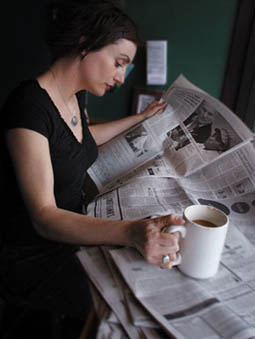
Catherine Orenstein likes metaphors. When the journalist and writer founded The Op Ed Project in 2008, with seed money from the social entrepreneurship fund Echoing Green, she had a particular metaphor in mind. Op-eds, Orenstein believes, aren't just about writing. They're a form of participation in the nation's public discourse -- a highly visible, highly influential form of participation. The people who write op-eds aren't just writers, but "thought leaders," whose written ideas often serve as the catalyst for political and social change. The op-ed, then, is a metaphor for engagement and influence, a symbol of whose ideas are heard and acted upon.
The Op Ed Project runs seminars that teach women how to write and pitch op-ed pieces. Why just women? Because if the op-ed is an indication of who speaks and who is listened to in our culture, only a tiny fraction of the people we listen to -- an alarmingly small percentage of our thought leaders -- are women. In 2005, only 15 per cent of the op-eds in the New York Times and 10 per cent of those in the Washington Post were written by women. In 2009, the percentage of women-penned op-eds in the Times had increased to approximately 21 per cent, while the percentage at the Post increased to approximately 25 per cent.
Half the U.S. population, it hardly bears noting, is female. Far more than half the nation's graduating college seniors and in 2009, for the first time, more than half its labour force, is female. And yet, Congress is 84 per cent male. Men represent 84 per cent of guests on Sunday morning political talk shows, 85 per cent of New York Times nonfiction bestseller authors and 85 per cent of Hollywood producers. Evidently, it's not just on the op-ed pages that women are underrepresented. Orenstein sees a direct connection between the lack of women writing and submitting op-eds and the lack of women's participation in other forms of public discourse.
Orenstein also believes that for more than 50 per cent of the population to be absent in so glaring a way from the nation's public discourse is undesirable for the quality of that discourse -- and for women. She believes America's public discourse should reflect the diversity of America's experts, and that the country would be better served by a national conversation in which women experts were more frequently included.
And so, she founded The Op Ed Project.
Expert? Who, me?
The purpose of the workshops is not simply to teach women how to write and pitch an op-ed. Orenstein, who teaches or co-teaches most of the workshops, encourages the women gathered around the conference table -- usually between 15 and 20, of varying ages, races and socioeconomic backgrounds -- to embrace the idea of the op-ed as a metaphor for thought leadership. As Orenstein explains, op-ed forums, be they in print, online, on television or on radio, drive the nation's public discourse. The issues discussed there are implicitly endowed with importance. Equally importantly, the people discussing those issues, so few of whom are women, are implicitly positioned as experts.
By far the greatest hurdle of the Op Ed Project workshop is the expertise exercise. It sounds simple enough: each participant introduces herself to the group with the phrase, "My name is ___, and I'm an expert on ___ because ___." And yet, this exercise is often the most difficult and certainly the most time-consuming of any in the workshop. Women find it enormously challenging to describe themselves as experts; many express feelings of discomfort and feel themselves to be undeserving of the title.
One of the pernicious effects of the gender imbalance on the op-ed pages is the absence of visible women experts contributes to a widespread cultural belief that experts are rarely women, and that women are rarely experts. The result is that, when asked to lay claim to their own expertise, individual women feel presumptuous or unqualified to do so.
It is in part this very feeling -- that they do not know enough to speak publicly and with authority on their area of expertise -- that prevents women from submitting op-eds in the first place. For example, an overwhelming majority of the roughly 5,000 people who entered the recent America's Next Top Pundit contest held by the Washington Post were men. At other papers, submission ratios are similar. And while it's possible that editors are sometimes influenced by gendered ideas about whose op-eds ought to be published, the problem seems to be one of supply, rather than of demand. That is, the reason there are so few op-eds by women published in our newspapers is that women are far less likely to submit.
The Op Ed Project, by training women to write compellingly on the issues on which they are experts, hopes to increase the supply of women-penned op-eds being submitted, and by doing so, increase the number of women-penned op-eds being published. The workshops don't simply teach women how to write and pitch; the Op Ed Project's mentor-editor program also matches aspiring op-ed contributors with an established and experienced writer, who edits their submission and advises them on where they might most successfully pitch it. Among the ranks of the mentor editors are former members of the New York Times editorial board, contributors to The New Yorker and a number of nationally syndicated columnists.
Voices we need
To date, more than 3,000 women have been through the Op Ed Project workshop, and Orenstein has taught her curriculum all over the continental United States, from upstate New York to Utah. But, according to Op Ed Project estimates, tipping the scales of gender participation in public discourse will require an enormous injection of women's voices into op-ed journalism. In order to reach a tipping point at which one-third of the op-eds in American publications are written by women, an additional 15,000 women-penned op-eds will need to be submitted every year.
This is obviously an enormous task, one to which there are many barriers. Women need the time to write and the knowledge and encouragement to submit. They need a culture that provides them with role models and mentors, a culture in which women experts are visible and audible, sending the message that women are just as capable and entitled to contribute to civic debate.
Women need to be heard. But above all, we need to hear them. After all, how can any society expect to flourish and progress while it continues to ignore the voices and expertise of half of its population? ![[Tyee]](/design-article.thetyee.ca/ui/img/yellowblob.png)
Read more: Labour + Industry, Gender + Sexuality, Media



Tyee Commenting Guidelines
Comments that violate guidelines risk being deleted, and violations may result in a temporary or permanent user ban. Maintain the spirit of good conversation to stay in the discussion.
*Please note The Tyee is not a forum for spreading misinformation about COVID-19, denying its existence or minimizing its risk to public health.
Do:
Do not: