- Ms Kaye is a Tyee Builder. You can be, too.
- Mary Carlisle is a Tyee Builder. You can be, too.
- Prem Gill is a Tyee Builder. You can be, too.
- Nancy Flight is a Tyee Builder. You can be, too.
- Justin Everett is a Tyee Builder. You can be, too.
- John Westover is a Tyee Builder. You can be, too.
- Nora Etches is a Tyee Builder. You can be, too.
- Edward Henderson is a Tyee Builder. You can be, too.
- Bharadwaj Chandramouli is a Tyee Builder. You can be, too.
- Dean Chatterson is a Tyee Builder. You can be, too.
- Marius Scurtescu is a Tyee Builder. You can be, too.
- Robert Parkes is a Tyee Builder. You can be, too.
- James Murton is a Tyee Builder. You can be, too.
- Susan Doyle is a Tyee Builder. You can be, too.
- Vincent Strgar is a Tyee Builder. You can be, too.
- Helen Spiegelman is a Tyee Builder. You can be, too.
- Subir Guin is a Tyee Builder. You can be, too.
- Kimball Finigan is a Tyee Builder. You can be, too.
- Joanne Manley is a Tyee Builder. You can be, too.
- David Leach is a Tyee Builder. You can be, too.
What Do Women Want in a Newspaper?
Certainly not the drivel 'targeted' at us. And if you think female editors would do better, think again.
TheTyee.caUNESCO might want to reconsider its annual Women Make the News campaign. The March 8 event is built on the notion that putting women in the power positions currently dominated by men, even for just a day, would improve content.Or as their mission statement phrases it: "For the media to accurately mirror our societies, to produce coverage that is complete and diverse, it is critical that the news reflect the world as seen through the eyes of women as well as men."Nice sentiment. But it reminds me of the argument suffragists made that giving women the vote would put an end to war and create a more compassionate government. I have two words for that: Maggie Thatcher.So before the UNESCO folks put too much stake in the notion of women as the saviours of newspapers they might want to have a look at Vancouver's two dailies where women hold the top job of editor-in-chief. The Vancouver Sun, a broadsheet, and the tabloid Province look much the same as their sister publications in the CanWest-Global chain. For that matter, they look much like most of North America's dailies.Good copy is 'virile'When it comes to the content designed to attract women -- from the celeb photos and gossip to the advertiser-driven sections that are short on information but long on enthusiasm for new homes, new fashions, and new cars -- it's fair to say that newspaper publishers have an undisguised contempt for the intellect of women readers. They treat them as nothing but consumers.Now that attitude can't be coming from women editors who, in order to have succeeded in the business, must be thinking about something other than shopping.But traditions die hard, and the newspaper industry's love-hate relationship with women has altered little since the birth of the modern, advertiser-supported daily in the 19th century. Journalists of the day despised women to such an extent that they actually wrote textbooks arguing that good copy was "virile" -- a quality women's writing lacked for obvious reasons -- and warning would-be scribes to avoid university because it could make a man's writing "womanish."But while they worried about a "feminine army" storming the newsroom barricades, publishers were slipping "sob sisters" through the back door, via the women's pages, because they found that advertisers wanted women readers, and for that they needed "women's news."So the society pages were born, containing gossip columns, arts and literature criticism, and food and fashion stories as a sop to the feminine audience. But editors ran them begrudgingly. And the emphasis was usually on women as consumers not citizens -- which, to be fair, they weren't since they couldn't vote.When the Province added women's news in 1898, it was the paper's ad manager who was quoted in the story celebrating this advance: "Woman is the pivot of trade turning," he enthused. Editorial was silent.It's not that much different today: women are still the pivot of trade turning and the copy intended for women treats them as compulsive shoppers. But when it comes to determining what women actually want, the newspaper marketers are having about as much success as Freud. Maybe because their ideas about women hail from the same era?A Koky theoryIn 2000, the Thomson Newspapers chain was positioning itself as an expert on how to attract women readers with its Successful Practices: Women, a 16-page tabloid it circulated through various editors and publishers conferences. It reminded managers of the significance of women readers -- they control 80 percent of household spending, and buy 65 percent of all cars; 53 percent of stocks, and 50 percent of computers. The tab offered some tips for producing papers with the kind of estrogen-appeal that would help deliver this market to advertisers.According to the folks at Thomson women "have a natural affinity for good design." "Koky" Dishon writes that, "By the time they're ready to buy that perfect black dress, they know very well where to wear it and that it stands out when the most expensive pearls one can afford or wangle are added, a la Channel (sic)."Apparently Koky, despite being a member of this fashion-savvy sex, isn't up on the subject herself. Still, she's keen on the metaphor. "Women, I have noticed, enter a newspaper, and immediately become aware of the whole. It may not be a conscious thought, but, deep down, the idea rules that the dress, the hat and the shoes must fit together."Since this was written in 2000, I'm not sure why Koky envisions women as fem-bots from the '50s. Who wears matching hats and shoes? For that matter, who wears hats except to keep out the cold? Oh, sure, there's the odd Annie Hall moment, but there's a reason "hat hair" is a derogatory term.Incidentally, what kind of self-respecting grown-up calls herself "Koky?"But I digress. Back to girl-getter tips.Satisfying a woman's needsIn the same Thomson report, Ruth Moore writes that a good way to attract women readers is by promoting the number of coupons the newspaper contains, and adding up their value. She also recommends listing advertisers by product; and listing the best TV shows for children.Can't you just see one of those grey-suited business execs from another era giving her a paternal pat her shoulder: "That's right Ruth: women are Stepford wives with credit cards and they never think about anything but consuming."Nary a word is mentioned about the quality of the writing, except to note that women want to see more stories that recognize young people who do "good things" -- a phrase that they ought to know has been unusable since Martha hijacked it a decade ago.One of the few guys to weigh-in, Boris Hrybinsky does note that that women seem to want pretty much the same thing as men -- timely, well-written stories -- but it's not long before he too, is launching into some bizarre advice."Women want their newspaper to truly understand their needs, wants and values," Hrybinsky writes.Huh? Did the research company confuse the newspaper survey with the what-women-want-in-a-mate questionnaire? As for meeting women's "needs,"what needs are they talking about?The research that led to these conclusions seems to have come from some mighty dubious sources: a couple of marketing surveys, and some Thomson employees phoning up some women in their Rolodexes. Yet the authors were on the conference circuit peddling these retro-images of women to every newspaper manager in North America. And if you look in whatever newspaper you're reading today (other than this one) you'll see signs of the influence of that research -- not to mention the decades of similarly suspect research on which it was built.That's because it's a rare paper in which journalists of either sex shape the news. Since the 1970s -- the era when women started abandoning newspapers in droves -- the industry has been depending on market research to save it. Papers are re-made according to whichever guru holds sway his year, and the results have been less than stellar: now it's not just women who are abandoning dailies, it's men too, and everyone under 30, and of course older readers with the newspaper habit are dying. All-in-all it's not a pretty picture.Where did She come from?But women, who are seen as society's compulsive consumers, are still the favoured prey, which is why readers are treated to so many flimsy snares -- passe fashion supplements, Fabulous Homes! sections, and misguided attempts at contemporary women's pages.Local scribes recall that in 2000, the Vancouver Sun developed a prototype for a new women's section called "She," that was obviously connected to the stereotypes about women that were making the rounds at the time. Shopping advice was, of course, at the core, but the launch included such scintillating features as a photo-spread of women whose butts looked bad in capri pants and advice on how to avoid this disaster. And management was apparently agitating for a "sexy" section, which prompted someone to suggest a consumer piece comparing vibrators -- apparentlyirony was taken literally. Either that, or they thought they had a handle on the mysterious "needs" that the Thomson writer mentioned.Some of the women journalists who were charged with executing this vision groused about it to colleagues. They didn't dare criticize it openly to the powerful female uber-editor who had translated the market research into this blueprint for "She". They put their doubts aside because, as one of them explained: "The Sun had done MUCH market research and it seemed to point toward a female section being a good thing."Uh-huh, did anyone actually check the quality of that research? Did anyone ask why women would want more of the kind of drivel that's already available in down-market women's magazines? Which, by the way, have better photos and don't leave ink on your hands.She died when the Hollinger papers were sold to CanWest-Global, but it's obvious that the thinking that sparked it is still circulating. The Sun's February 22 editorial cartoon featured a scene from the Garden of Eden with Eve protesting: "But Adam, this isn't paradise -- there are no shoe shops."That's about as funny as the alternative cutline I'm proposing: "But Adam, this isn't paradise -- there's no one to have an intelligent conversation with."You see: reverse sexism is never the answer, which is why I think UNESCO is on the wrong track. Putting more women in senior editorial positions doesn't necessarily improve the content of newspapers; but firing all those marketing wonks just might.Shannon Rupp lives in Vancouver and is a regular contributor to The Tyee. ![]()


21
Login or register to post comments
Laura (not verified)
8 years ago
Yes, thank you for this article. I do read the Sun, and extremely rarely the Province, and I do not let students use the Province as a source for essays. Newspapers in general are far too generic, corporate and advertisement driven. I do have hopes for this one though.
Jerry (not verified)
8 years ago
Definitely better than the average take on the subject, Shannon-, from my viewpoint. For both men, and I assume, women, like in the economy generally, it is a question of "power" and "control. Whose viewpoints prevail, and decided what is important to "the masses", and what is not? With the prevailing "power paradigm" being that it is the interests of the "movers and shakers" in the marketplace that should decided all matters of substance. It is a kind of relationship between "them" and "us" that seeks to keep us all, men and women, in a permanent condition of dependance and child-like naivete. The typical pablum for men is sports, while for women it is makeovers and issues of "celebrity". It is all essentially the product of an "elite" controlled model of the economy and the decisions that are made there, in the board rooms, including the "editorial board rooms". Fundamentally, what is needed, in my view, to at least "begin" to get a serious handle on the problem of the role of the economy and in whose interests decisions there are made, is to expand the reach of "popular democracy", for workers, communities and interest groups, into the decision making processes of enterprises, especially the ones with a major societal impact, the big corporations. And journalists are no less workers than are machinists,bus drivers or burger flippers. It might even improve the quality of the stories that come out of our collective culture, and the ideas and human morality that occurs there.
Darren (not verified)
8 years ago
Apparently nobody wants to read a newspaper, regardless of gender. From the USC Online Journalism Review:
The points is being rendered increasingly moot.
Kurt (not verified)
8 years ago
While it's good to see more women in senior editorial positions, the power of an editor is very limited these days. The marketing experts employed by publishers have made a hash of what used to be called journalism, ergo the declining readerships of many dailies. What CanWest needs is real competition in this backwater, then they might figure out why their two dailies are so awful.
FMaxwell (not verified)
8 years ago
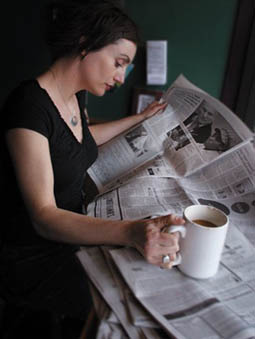
Nice photo! That's about as real as it gets- or maybe, a woman sitting at her laptop with her dog at her side, reading...The Tyee!!!
Shirin (not verified)
8 years ago
The point is well taken - though it took quite a few words to make it. I did find it interesting that the example of a woman in power was the only example in which a Western country actually elected a very "masculinized" female to lead - Margaret Thatcher makes Gordo look social. I put forward the proposition that it is the socialization of women in Western/"Developed" nations that breeds the consumerism gene into them - for the survival of the society. - Money makes the West go round and the woman is centre of this universe. However, India, Pakistan, and Malaysia have had female leaders that epitomize what a leader (either female or male) should embody. It is a little ironic that these nations are looked upon as being backward when it comes to acknowledging women's rights and place in society. We promote feminsim in the context of frivolty - "girl power" in the season's best colour and the right to beautify and tighten the thigh. Perhaps it is time we concentrate more on what is lacking in our socialization of young girls rather than smugly feel that we lead the game when it comes to women's rights.
Jerry (not verified)
8 years ago
Shirin wrote, "Perhaps it is time we concentrate more on what is lacking in our socialization of young girls rather than smugly feel that we lead the game when it comes to women's rights." Oooo! A number of really good points simply and incisively made, Shirin. I would only add, that while we are looking at the socialization of young girls, though I'm one who enjoys the "differences", thank you very much, as opposed to the currently flavoured "androgenous" models that seek to be applied to both sexes from those same quarters, there is as well a need to take a serious and "in depth" look at the socialization of young males. Here, as much as men do, looking at women, women as well tend to slide into shallow assumptions and stereotypes when making conclusions about men, frankly. In general, in my view, both need some serious work on their symbiotic, working relationship and mutual socialization. There is a great "quiet" amongst hetero-sexual males, in particular, at the current time on this front. I'm not entirely sure what it means, but it "could" be a serious mistake, for all concerned, to misread it as contentment with the state of their lives. I know at the level of society wherein I move and live, many working class males at least doing the dirtiest, most "grunt" but socially essential work right now, and it's still largely a male world there, at the pointy end of the economic front lines, for longer hours and diminishing return, are doin what they feel they have to do, largely without comment. There is a look in the eye evolving, however. Certainly working class women and men have some work to do on and with each other, quickly, and the society increasingly out of control all around them. We still need each other, and the supporting socio-economic structures. One of the reasons folks may just not be reading all those newspapers that seem so important to some, about which I have doubts of their current relevance, most of them, might just be that, in the Brave New World in which everyone works, including the kids very often, out of need, we're all just too damn tired and preoccupied with more important survival shit. Newspapers, hrrumph! Not even good asswipe.
KWD (not verified)
8 years ago
In the age of instant global communication, the only reason newspapers exist at all is to satisfy commercial interests. Open any newspaper and ‘read’ the layout. With the exception of the front page and pages that are direct commercialism and statistics (sports stats are well disguised commercialism), the ‘news’ actually occupies a very small part in the center of the page. This is no accident. Readers are trapped by ‘savings’, ‘truckload sales’, ‘play and win’, ‘earn 10 – 15 % on your money, etc, etc, ad nauseam. The notion that “newspaper publishers have an undisguised contempt for the intellect of women readersâ€, and that “They treat them as nothing but consumers†is only part of the story. The drivel is directed at both sexes. Men are not immune from commercial conspiracy. As Jerry correctly notes, male fascination with sports stats is a case in point. Men AND women, looking for ‘news’, want more balance and less slant. To pretend that women want something different is simply perpetuating stereotypes and plays to the male mentality that thinks it’s superior and in control. And allows the perpetuation of (Jean) Pelltierian misogyny. Jerry is correct, in part, when he says that we need “to at least "begin" to get a serious handle on the problem of the role of the economy and in whose interests decisions there are made, is to expand the reach of "popular democracy". We also need to actively seek alternate media if we want some balance. Shirin's notion that women are the center of commercialism in the in Western/"Developed" nations and that they have “the consumerism gene†bred into them – “for the survival of the societyâ€, is being willfully blind. In this era of globalization, money makes the World go round, not just Western developed countries. The age of Oral Cultures, where women were the centre of 'news', is history.
FMaxwell (not verified)
8 years ago
The planet is simply covered with little consumer monsters breeding more consumer monsters...not much you can do about it unless you pack your bags and move to a self-sufficient hut in the mountains, without a Starbucks in sight. But I agree with Shirin in that girls need to be better socialized- team sports/ mixed sports are the answer to that. For everyone. Get fit, get out there...achievements made at an early age stay with you through life. Sports promote better mental focus, strength, confidence, eating habits ...I mean, the list goes on and on. Most importantly, the "high" or the satisfaction comes from the action you are performing, the community you belong to when playing a sport- not how many things you bought in a given day. We all need to be socialized to look to OURSELVES first, not to material things, for fulfillment.
Shirin (not verified)
8 years ago
I am in total agreement with the concept of looking to the self for satisfaction - or as FMaxwell put it - contentment. However, in our little consumer driven society (with which we seem to harbour a love-hate relationship) - we are led to believe that such contentment is obtained from something outside ourselves - preferably by buying it. Is it not remarkable the number of ways we have developed (movies, TV, videogames, war, food, shopping - and newspapers) to distract ourselves from the whole uncomfortable state of existing in a conscious state? We loath the aspect of the drudgery of life and need distraction - but at the same time we want to prolong this life in our quest for eternal youth and medical miracles. I admit I wear blinders when it comes to contemplating what makes the world go round - as a scientist I like the notion it is the gravitational pull between our earthly mass and the sun - and not the subjectively determined worth of the dollar. Perhaps the biggest sham is not that we are bred to consume everything to the point we are sick (mentally, spiritually, and physically) with overconsumption - but the thought that we are powerless against changing the status quo. This listlessness - be you male or female - is giving up your power and self-responsibility.
ohwellherewegoagain (not verified)
8 years ago
the interesting thing is the author and everyone else is talking (without clearly stating it) about european minded women (mostly white) and or middle class well educated ones. no where the article addresses how newspapers don't write/research the needs of the under class females and males. The only time the needs of the under class is addressed is when the "druggies" are stealing, vandalizing, or terrorrizing a neighbourhood. Then there is a story to be told, because fear is generating actions. Due to the great number of people becoming part of the under class (and growing by leaps and bounds on account of mulroney,chretien, paul martin and gordon campbell's policies of low wages and unrestrained rights to profiteers) one of these days no one can afford to buy the paper (large numbers of people already stopped doing it, that is why the community newspapers has increased readership) then these stultifying pushers of no news will be well pensioned and the rest of us will continue to buy the notion that we are powerless to change anything, unless is presented by a testesterone or slender looking driven body with impecable credentials, because otherwise no one will listen. so who wants to read the post or vancouver sun and the province or the globe and mail for that matter, when you can read online the tyee, guardian unlimited, le monde, der spiegel and complement with community newspapers where local coverage is actually pretty good? can't wait to see the vancouver sun go belly up! have written to the guardian to have a canadian guardian, just like the time magazine has a so called canadian edition. :)
B. Jones (not verified)
8 years ago
As someone who rarely notices ads in newspapers, only glances at the fashion pages and doesn't list "shopping" as either a hobby or obsession, I agree that newspapers focus too much on the stereotypical "female shopper". In fact, this article is a prime example of the type of article I'd like to see in my daily newspaper.
Jay Currie (not verified)
8 years ago
Great piece. Women, kids, guys not interested in sports - all are deserting papers in droves. Which the papers know but are cluess about turning round. Instead we get "style" sections about shopping and dim bulbs like Angele Yanor, Rebecca Eckler and she who must not be mentioned at the Globe and Mail withering on about the lives of really vapid young women. Too dumb.
Susanne Shaw (not verified)
8 years ago
A timely article! I also enjoyed the discussions here -- in depth! We need to change the focus of our youngsters, for TV, MTV and the likes of Britney Spears have washed our kids' brains squeaky clean. Alas, most of our teachers -- unlike the first comenter above -- are as brainwashed and as naive as their students.
the truth (not verified)
8 years ago
as mentioned somewhere in all the words above, the news today is advertisting-driven. money talks, hard news walks. male or female is not the issue.
Mieka (not verified)
7 years ago
hey, yanor was no "dimbulb" - i'm tired of everyone putting her down. we all read her and miss her rants on van's dating scene. but you're probably just bitter b/c she is out of your league. good article, sharon. you're spot on, but you should consider changing your last name if you want a career in writing.
anonymous (not verified)
7 years ago
"The Manipulation of Information" at http://www.watchtower.org/library/g/2000/6/22/article_02.htm
Truman Green (not verified)
7 years ago
Truman Green (not verified)
7 years ago
Have you watched channel W lately. It's all kitchen and bath makeovers. Is this all women are interested in? What's going on here? I'd really like to know.
Reply to Mieka! (not verified)
7 years ago
I know your post was up long ago...and yes, I suppose, in theory, you would miss Yanor's rants on Vancouver's dating scene -- had they actually existed and not been rants on the dating scene in Colorado, New York, and who-knows-where-else. It is fun to read about people's dating trials and tribulations..too bad a number of Yanor's "people" never existed. Fabricating people, fabricating quotations, borrowing plotlines from other articles. Ick. Yes, it reflects badly on all journalists. It also reflects badly on publications that check neither facts nor the existence of people they quote. Sad, sad, sad. And what is wrong with Sharon's last name? I think her article was very well written.
Carlyn (not verified)
7 years ago
Great piece by Shannon Rupp. Looking forward to a follow-up critique after the women-targeted 'free' commuter dailies Metro, 24 Hours and Dose hit Vancouver streets in the coming weeks. Sometimes you feel like you've got a target tatooed on your forehead, Except everyone keeps missing.