
Life

A Tyee Series

Why We Pay Too Little for Well Travelled Food

Charging the true cost of "food miles" could change the way people eat. Fourth in a series

By Alisa Smith and J.B. MacKinnon, 12 Aug 2005, TheTyee.ca

Allen Christian

Walk into a supermarket and look at the pile of tomatoes. Maybe they're from BC or Washington; maybe they're from Mexico. Chances are, either way, they're about $3 per pound. How does produce that has travelled thousands of kilometers end up retailing for no more than the local goods-and sometimes for even less?

There are a lot of complicated equations at work here, from economies of scale to labour costs to the pricing power of trend-setting agricultural giants like California. One area that is often overlooked, however, is the realm of "externalities"-the term economists use to describe the costs (or benefits) of producing an item that affect people other than the producers themselves. Externalities are typically not reflected in prices. The Economist magazine calls this a form of market failure, as well they might.

In terms of our sample tomato, those hidden costs might include government tax breaks and subsidies to oil companies (which reduce costs of chemical fertilizer, shipping and packaging); government-funded water diversion projects; subsidies to industrial agriculture; support of expensive highway systems; and the downstream costs of agrochemical pollution, such as health care and water purification.

Who pays the price for all of that? We all do, though our taxes. Where we don't pay for it is at the supermarket till when they ring through our $3-a-pound tomato.

Hidden costs paid later

Call it the Mxyztplk Economy. You remember Mr. Mxyztplk from the old comic books-the super-villain from a different dimension where everything was the reverse of what it ought to be. That parallel universe is the industrial food system. Instead of each of us paying the true cost of our food choices up front, we buy our food cheap and pay the hidden environmental and social price later as a society.

In March, James and I started a yearlong experiment in local eating that we call the 100-Mile Diet. The distance that food typically travels to get to our plates was a major motivator, and sure enough, "food miles" are a seriously see-no-evil externality. In fact, despite the gas-pump rage that many of us now feel, subsidies continue to keep transportation costs artificially cheap-right now they amount to only 10 percent of the retail price of a tomato that's been shipped halfway across the continent, says a 2001 study by the Leopold Center for Sustainable Agriculture.

No one seems to have calculated what an imported tomato should cost in an honest economy, but I'll make a guess based on recent British research. A 2002 Worldwatch study shows that the British government spends CAN$3.2 billion fixing farming-related problems, such as purifying drinking water polluted by agrochemicals and containing mad-cow disease. This is nearly the amount of all British farmers' annual income-in other words, the present wholesale price of produce. Then there are the many other expenses the British people bear to keep industrial farmers afloat, most notably $6.4 billion in annual subsidies (a situation paralleled in North America). Transfer these tripled expenses from taxpayers and onto tomatoes, and they could cost $9 a pound.

Suddenly, an imported, chemically treated tomato would cost far more than a local, organic variety. We have escaped from the Mxyztplk Economy.

China's agro ambitions

In July, the British government made a move in that direction by promising to reduce by 20 percent the environmental and social costs of food transport by 2012. Closer to home, Capers markets recently began working to consolidate produce deliveries from local growers, saving fuel costs to the farmers and externalities to all of us, and Small Potatoes Home Delivery lists food miles on its receipts. Unfortunately, this is not necessarily the direction that the global food system seems to be heading-if anything, we're digging deeper into a world where the cost of our choices is hidden from us until everybody has to pay them.

"China has committed to being the world's biggest supplier of produce," says Rich Pirog, the marketing and food systems program leader at the Leopold Center in Iowa. Externalities in this case will include massive government damming and irrigation projects, dislocation and relocation of millions of people, and devastating environmental impacts as the world's most populous nation expands farmland and turns more aggressively toward agrochemicals. If China succeeds in its aims, it will also increase the average distance the food on North American plates travels (let us mention again that it's already 2,500 to 4,000 kilometres), further revving up global warming.

Fortunately, a countercurrent also exists. In those parts of the world that matter least to the global marketeers, local eating is still the norm. In North America and Europe, a bioregional philosophy is being revived. Consider the Broad Street Restaurant in Dorset, England, which pledged to use only produce grown within a 30-kilometre radius; the 15th-century Red Lion pub near Canterbury serves lamb and beef raised 90 metres from its door.

Vancouver bright spots

Vancouver has its own adherents. James and I pulled into the cool calm of the Raincity Grill while the Mardi Gras of the Pride parade streamed by on Denman Street. As we read the brunch menu-preserved tomato and goat cheese frittata, Dungeness crab omelette-James said incredulously, "This looks like what we eat at home." He didn't mean the sumptuous dishes themselves, but rather the ingredients: hazelnuts, daikon radish, lettuce, local cheeses and sea foods, lots of potatoes. Almost everything seasonal and local. According to chef Andrea Carlson, the menu right now focuses on the nearby farming community of Agassiz. She's proud of the role restaurants like hers play in helping local producers grow.

"I met a woman who makes phenomenal cheeses and I put them on the menu. People loved them, and things just took off for her," says Carlson.

Raincity has even given farmers seed money to ensure a steady supply of organic lamb, which is too large a start-up investment for many small-scale producers. Good will aside, she has been forced to be innovative by the global marketplace. "It's surprising how hard it is to get produce from local growers," Carlson says. "They want to sell cooperatively to big distributors, and then you don't know where stuff came from."

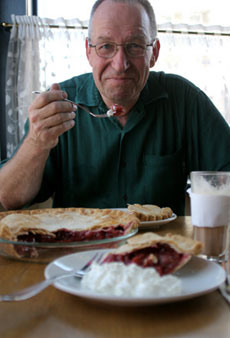
That's much less of a problem for Aphrodite's Café on West Fourth Avenue, where owner Allan Christian estimates that more than 90 percent of the food he is currently selling comes from the 50-acre Glen Valley Organic Farm Cooperative in Langley and its immediate neighbours. The reason? He calls the place home.

"To me, this is not a concept," he says of the local menu for his two-year-old restaurant, which began as a pie shop. "I grew up on a farm and I live on a beautiful farm and I just thought-I'll do it the way I live." His Saskatchewan roots show through when he tells us that even in winter he can call on cellared, ground-stored or winter-growing vegetables like squash or kale. Even in the early spring, when the new year's crops are nothing more than sprouts, he figures that 50 to 60 percent of Aphrodite's menu is from the cooperative.

Buying from a restaurateur who might have cut the kale leaves himself that morning? By gosh, it sounds like something from a parallel universe.

Alisa Smith and J.B. MacKinnon will be writing twice a month for The Tyee about their attempt to eat well on the 100-Mile Diet. For more information on finding locally produced food visit the web site of FarmFolk/CityFolk.

Read the rest of the 100-Mile Diet Series.  [Tyee]

Read more: Local Economy

41  Comments:

Login or register to post comments

  • anarcho

    7 years ago

    Comments on "Why We Pay Too Little for Well Travelled Food&

    Good story. Capitalist globalization is built on these externalities. Imagine what those made in China Walmart goods would really cost if the true cost of shipping existed and China was not a dictatorship so the Chinese could form trade unions and environmental groups. Globalization and so-called free trade are frauds built with statism and subsidy backed ultimately by military might. Lets hear it for local produce!

  • Fiat lux

    7 years ago

    The sordid fact is that we don't know the real costs of anything, as all costs start and end in infinity. The monetary/oil economy has completely destroyed all logical and acceptable economic systems and replaced them with the never-never worlds of various ideologies, all designed for exploitation by self appointed ruling classes.

    The only logical economic theory should be the provision of the needs of the largest number of sectors with the least amount of energy/resource inputs. Which means a totally new monetary system under strict public control to reward phyisically efficient production of foods and all goods.

    Also the recognition that human labour doesn't cost anything to an economy.

    Businesses are NOT the economy and large, especially multinational corporations are detrimental to sustainable and logical economic development through the distortion of paradigms that permits them unlimited expropriation rights and control through the imaginary power of artificial capital. Ed Deak, Big Lake

  • skeptikool

    7 years ago

    More power to China if it is able to produce enough food to export - of course, after feeding its own people.

    The trend toward agrochemicals is disturbing. I've always felt that the agricultural use of night soil was more civilized than the alternatives methods of handling used in most of the "modern" world.

    I have this theory that if everything compostable, including human waste, was in fact composted, that ultimately there is no desert that could not be turned into productive land.

    Should this occur there would be much less need to transport food. The bigger danger, to some, would be gluts of produce - though much of that reclaimed land would be given to forestry and/or rangeland.

  • freebear

    7 years ago

    Articles like this and the posted comments give me some optimism that maybe, just maybe, "we" will change how we live, work and eat.

    Perhaps rising oil prices will finally tip the balance to a real economy, one where people and the environment do matter and not considered "externalities"!

  • Ron Erwin

    7 years ago

    I think a better question is how can French farmers efficiently grow wheat ? They can't in fact. The only way that this can occur is to starve millions of Africans. The French Govt. , in fact Italian and German as well, subsidize farmers to maintain totally in efficient farms, in order to atrificially prop up their operations. The result is that there is no market in Europe for the products produced in Africa.
    I know it's fashioable to balme the USA for everything bad happening in the world, but it's the Europeans that are the evil empire in fact.

  • Martin

    7 years ago

    The rich world's subsidies paid to its own farmers are one of the main reasons that the developing world (Africa, mainly) has been kept in poverty. Maybe African food would travel "more miles" than food grown in Canada, but it would lift millions out of poverty. We need to eliminate the distorting effects of farm subsidies paid to those who are comparatively well-off, especially the corporately owned farms.

  • clubofrome

    7 years ago

    Hello Ed,
    I sure enjoy reading your posts, they have a clarity to them that's uncommon in these parts. You are a visionary. Do you have a favorite author or publication you use for reference? Thanks for your contributions here.
    Rob

  • teen

    7 years ago

    Awesome story. More people have to get a grasp on how the argriculture industry works, as well as the externalities. Society has to realize sustainable argriculture means local purchasing!
    Well done,

  • SMitchell

    7 years ago

    Umm, that wasn't Mxyztplk who was from the reverse world, it was Bizarro.

  • mbraun

    7 years ago

    Sorry, this is going to off topic, but since this is the current headlining article...

    With respect the US and our usual suspects of trolls who linger and spout off about the glory of uncle sam and gwbush. I just finished this excellent article and thought that I'd share it with the rest of y'all. Have a great weekend...

    http://www.commondreams.org/views05/0812-27.htm

  • Birch

    7 years ago

    The focus of the growing problem that these articles address is an important one. Kudos to the authors for trying to direct our attention past the smiling muzak-spouting face of our superindustrial food markets, whose inefficiencies are at least as bizarre as their efficiencies. For example, our local Safeway was designed in California for a California climate. Result? The checkout workers practically freeze in winter as the flow-through breeze (at -40 windchill) ventilates the front area of the store.

    Another absurdity that was recently pointed out to me is the amount of oil we burn trucking water around the continent and shipping it around the world. Yes, I like Australian wine, but I'm sure I'd survive quite well on the Okanagan products. Beer trucks bring thousands of cases from all over the globe. Why not simply license small breweries in local communities with suitable recipes and use the local water?

    My grandfather used to say, "Always keep a pig. It eats garbage and it gives you bacon." This philosophy might not fit Vancouver's west end, but it might be quite suitable in small towns with greater land area around the margins that could support this kind of activity.

    Lettuce, tomatoes, various herbs, and so on can all make attractive parts of flower gardens or be grown in windowboxes (even on highrise balconies).

    There are lots of options to pursue that don't require massive jolts to our lifestyles and that would provide real cost and health benefits. Thanks, Tyee, for raising this issue and creating a clearinghouse for ideas that your readers can use, potentially to great benefit.

  • Fiat lux

    7 years ago

    Ron, I pick up stuff wherever I can. Started reading economics by accident in 1982 at the age of 55. After reading the first page of a textbook I couldn't help exclaiming: "Does anybody believe this crap?" It was an interview with the American economist Herman Daly that opened my eyes that something is badly wrong here. Daly was a professor in the '70s, sent to Brazil, where he realized that the present system of economics is a major fraud and wasn't afraid to say so, unlike many of his clan, who know it, but are saving their necks and jobs by going along with this crime wave.

    From there it was downhill for economics and economists all the way for me. It has always been and still is a garbage science that has no redeeming values for humanity. My definition is :" Neoclassical economics are the science for the alchemic conversion of silk purses into sows' ears"

    In reality, I haven't invented anything new, just applied simple physical laws, we all learn in highschool, and a bit of logic to economics and write on this basis. No other laws can overrule the laws of physics, regardless of the claims of priesthoods and economists, the priesthood of the Mony God.

    I write a biweekly column in the Gold River "Record", editor, Jerry West and my stuff is all over the Web. If you go to Google and type in my name, or my name with "Big Lake BC Canada" , you can bore yourself to sleep with tons of it. Ed Deak, Big Lake.

  • darcy.mcgee

    7 years ago

    Eating local is a good choice, and one I've made whenever possible. I was a bit of a whore for Small Potatoes at one point - telling everyone I met about them.

    Firstly, the fundamental problem is that people who live in large cities will continue to push prices down. Cities such as Vancouver are wonder wonderful places that contribute enormously to the economy; unfortunately, I can't eaty my mutual funds.

    We all pay farmers their living wage whether its in the form of a fair price for their food, or a combination of too low a price plus government subsidies plus seasonal Employment Insurance benefits or welfare payments. It's short sighted to suggest otherwise, and it would be better to simply pay the real cost up front so this essential component of our society can survive.

    I'd pay more for food, if I knew it was going to its actual source. This is why I like shopping at farmer's markets and farm gates. I know where my money ends up.

    What about societies where getting ANY food is difficult? We - by which I mean people in Vancouver, Canada and North America at large - are very very priveleged and able to make choices. There are places in the world where just GETTING food is difficult.

    Should we be using GMO's to grow food in these regions? Africa, as a continent, could gain tremendously from being able to produce their own food rather than relying on Canadian C130's dropping crated bags off.

    It's been said the world has more than enough food to feed it's population, it's just distribution that's the problem. I'd argue it's not distribution, it's distribution of arable land.

  • Budd Campbell

    7 years ago

    Eating local makes sense and is usually better.

    But I don't agree with an attempt to turn it into another secular religion to be practiced rigidly.

    This article does what so many environmental treatises do. It starts with an Econ 100 moment, and mentions the concept of externalities. Then, it's off to the races, once again finding big oil and huge government subsidies simultaneously destroying Mother Earth and all her offspring. Good cartoon stuff, but without some numbers it's pretty goofy.

    The example of $9 for tomatoes if frankly too ridiculous for words. But for the sake of argument, say it were so, and similarly for other foods. Would it necessarily be bad government policy to subsidize agricultural production in order to keep food prices low? If the public is too conservative to accept higher support payments to the indigent and the working poor, might sensible governments not try subsidizing food production as an alternative?

    That this possibility isn't even mentioned in the article is what tips me off to it's stern ideological tilt.

  • jamez

    7 years ago

    And from what I hear we pay too much for produce grown here. An orchardist told me that even after everyone has received their cut, apples sould still be under a dollar a pound.

  • clubofrome

    7 years ago

    So you want some numbers eh Budd? The article gives you some simple math which you disregard as ridiculous so I don't know what numbers you would believe anyway. How much were tomatoes 20 years ago? Not $3 a pound. Lets just for the sake of argument, assume they were $1 a pound. That's the same as $3 to $9, the cost tripled. The question raised by this piece should be how to move towards local produce and not try and fix the current system of existing subsidies and inefficiencies. But it sounds like you don't buy into that premise. I think you'll find that you are the cartoon here. Not the good people concerned about Mother Earths offspring. Think about that the next time you sit down on the porch to open your next Heineken (Blaaa) or California Zinfindel (PFFTTTT) munching on New Zealand lamb burgers (Ho Hum) served on authentic stoneware from Taiwan (not dishwasher safe) and then some of that yummy imported cheese that can't be made locally. But please whatever you do THINK!

  • chuckstraight

    7 years ago

    It was interesting to watch the price of local hot house tomatoes rise (last spring?) when the crops in Florida had weather problems. How could that be?
    I enjoyed the article, and am pleased that Ron Erwin at least didn`t blame it all on high union wages, as he usually does. It does make sense to grow more food locally, and there are many applications where lost heat from manufacturing processes could be recaptured and used in the winter to heat greenhouses for food production. I know where I work, there is a lot of BTU`s going out of the building from boilers etc, that could be reclaimed. I note that the link to the farm in Aldergrove has some history with one Gregor Robertson- that is the kind of thinking we could use in our legislature.

  • willy

    7 years ago

    One of the problems to getting enough local produced food is quotas. Up north here if a farmer is producing and selling to the local market he is restricted to a quota. If he exceeds that quota he can be fined. He may be able to sell everything he produces up here, but then the farmers down south start complaining and he is restricted. So now the food is trucked in for hundreds or thousands of miles.

    There are greenhouses being developed up here now, it will be interesting to see how much they are allowed to grow. But seeing how the lower mainland is being cemented over they may do well.

  • runningdog

    7 years ago

    Fiat Lux (let there be light?) or Ed:

    I have a more generous view of economics: I see it as a fledgling science, kind of like physics was 400 - 500 years ago. All the wrong paths have to be explored (sometimes in some detail) and eventually rejected or modified/accepted.

    I get the sense that many of these free market idealogues that pay lip worship to Adam Smith haven´t read Adam Smith. Those who advocate the free market (which shares a separate universe with the tooth fairy) the loudest seem to be those who want to eliminate all real competition.

    J.K.Galbraith suggests that an economic theory is developed to explain the world of 20 years earlier. This explanation becomes the

    Quote:
    conventional wisdom

    and the hammer with which to hit future nails. For instance, microeconomics of 150 years ago was an economics of scarcity while today in the west we should be using an economics of plenty (which is underpinned by different assumptions about needs and behaviours).

    Herman Daly was one of the first to try to incorporate so-called external costs (ecological costs). Others are working on this as well. I find Doughthwaite (The Growth Illusion) to be convincing.

    A Vancouverite named Frank Rotering is trying to develop an economic theory that incorporates ecology as a fundamental component (not an external cost). See
    http://members.shaw.ca/needsandlimits/index.html

    Quote:

  • skeptikool

    7 years ago

    Willy,

    You are talking about marketing boards - whose main reason for existence, we have been led to believe, is "orderly marketing". There is surprisingly little mention of them in these "food" columns given the power these boards exercise over production, distribution and pricing.

    Over the past 15/20 years Delta has gained many acres of greenhouses. Most, if not all, built on flat agricultural land. I don't doubt that some of the owners are hoping to get a jump on the legalization of marijuana.
    Probably tastier than some of their tomatoes. ;-)

  • Fiat lux

    7 years ago

    Willy,

    Funny thing you should mention the historical state of economic thinking. Years ago I wrote in a number of my articles that the present state of economics is at the same mental level physical sciences were at the time of Galileo.

    There always have been good economists, like Odum, Veblen, Daly, et al, who have seen the light, but their voices have always been drowned out by big money controlling the information system and now owning the universities.

    Maynard Keynes came the closest to success, even Nixon declared himself a "Keynesian", but his success was also the downfall of the theory. The powers realized that unless they destroy it, "too much democracy" will destroy them. So they invented the neoclassical theory, brought Friedman out of the woodwork, took control of the media and now we have globalization, business friendly governments, growing poverty, destitution and environmwental destruction, because "Wealth can not be created, only taken from other sectors and the ecology".

    I do have Adam Smith's "Wealth of Nations" and know how Friedman et al, have distorted his "self interest and invisible hand" theory, both in the same short paragraph, into the justification of unlimited greed, backed up with fraudulent mathematics.

    What Smith said means the opposite of what is being quoted by neoclassical economists. The most idiotic and criminal distortion I've seen so far is: "In competition individual ambition serves the common good".

    Smith was a professor of moral philosophy, not of criminal behavour. The best interpretation of Smith's theories I've seen was by John Ralston Saul, in his book "The Unconscious Civilization", based on his Massey Hall lectures.

    Another fraud is the glorification of so called
    "Social Darwinism", claiming the "survival of the fittest" Darwin never advocated such nonsense. It was Herbert Spencer who took and falsified Darwin's words, the same way Friedman falsified Smith's.

    Apart from their philosophical content, the economic theories of the old masters are irrevelant and useless in our age. They worked under strict gold standards, while today our deregulated banks are permitted to create unlimited amounts of imaginary capital, licencing the collectivization of the globe into the hands of a special interest sector.

    I have no scientific background, but have worldwide contacts with scientists with the appropriate PhDs, whom I can contact and get their advice. With their help, before the Net and fax, it took me 6 years, between 1985, when I discovered the fraudulent definition of economic efficiency and 1991, when I copyrighted the correct version to establish the date. Not for monetary purposes.

    It is is based on simple physical laws, exposed to thousands of economists on the Net on various forums, it remains unbreakable. We have long established that an economic system can be based on strict physical laws totally outside any philosphical, ideological and religious theories justifying the establishment of self appointed ruling classes. Every philosophical theory can be distorted and twisted around to justify crime and murder, but physical laws are unbreakable and undistortable. Even if fish farmers, logging and mining companies are pretending to do so.
    Ed Deak, Big Lake.

  • skeptikool

    7 years ago

    Ed,

    You make that dismal science quite interesting.
    It seems I should have been reading other than Sinclair Lewis, Lawrence Sanders and John Grisham etc.

  • skeptikool

    7 years ago

    Literally, s**t really does happen, as evidenced by a story out of Lowville N.Y. where after a farm animal-waste lagoon broke releasing 11-million litres of liquid waste toward Lake Ontario. The containment was serving one of the Lewis County's largest farms, Marks Farms.

    Already hundreds of thousands of fish have been killed including perch, bass, catfish, shiners and walleye.

    Now, there is one hell of an "externality" for you.

  • Fiat lux

    7 years ago

    This is the price we pay for the "cheap food" by corporate agribiz farms and feedlots.

    "Costs can not be cut, only transferred on other sectors, the environment and the future"
    Ed Deak, Big Lake.

  • apollyon

    7 years ago

    One of the most interesting things that came to mind for me when I read this article is that while I agree with it almost 100% the explicit and implicit proposals of such a diet are (perhaps) more supported by the right-wing and not the left-wing. Which, when reading the comments of most posters here slamming capitalism and agro-biz, makes it somewhat humourous.

    Extremely right-wing pundits from the Fraser Institute, etc. have been calling for the elimination of agricultural subsidies and a lot of the government intervention which is often the work of more "socially-minded" politicians, ie. leftwingers. Factoring in all externalities is actually part of the core philosophy of those liberal (ie. free-trade) economists who see pure capitalism as pure heaven.

    Moving beyond the simple restrictions of left and right however, embracing new ways of thinking which I believe this series of articles have brought up is extremely important and really shows the problems in traditional ideologies (such as socialist support of big government and government spending or right-wing support of large scale agriculture).

    This, is why I read the Tyee. Good job cutting through the bull! This sort of diet is something I will seriously consider. I hope the Tyee's very own crew of daily commentators and ideologues think about that sort of praxis too (instead of grabbing their side's holy grail and yammering on like always)...

  • Bailey

    7 years ago

    Jeez, I really hesitate to chime in here, you guys are having such a good natter about philosophies and economies and such. But I really want to point out that this is Canada here. West Siberia.

    For, oh say, 90% of the country, for 9 months of the year, the only thing we're growing is colder.

    Look back a century or so and you'll see what the hundred mile diet is in Canada. Potatoes, onions cabbage, some apples for a while, carrots until they sprout pork, chicken, sealflippers and salt cod. Dried peas, Canned tomatoes,um....Anyway, not a long list.

    This is the same kind of theory you hear from people who say shame on us for using more energy than anybody else, without explaining what else but energy will let us keep our living and work spaces 60 degrees above ambient temperature for months and months and February every bloody year.

    It sounds good, but ignores certain crucial realities inherent in the situation.

  • Bailey

    7 years ago

    Um... Should probably be a comma between sprout and pork there. Carrots are not known to sprout pork.

    Talk about misrepresenting crucial realities!

    Sorry.

  • skeptikool

    7 years ago

    Most of us writing here would, I imagine, have it otherwise, but there is an undisputed connection between modern agriculture and oil.

    I therefore feel comfortable mentioning this today's news item in this thread:

    A Prius owner has turned his vehicle into a "plug in" hybrid that uses less than a litre of gas per 100 kilometres. He added extra batteries and fully recharges from a wall socket at 25 cents US or less.

    Reported:

    "They have support not only from environmentalists but also from the Conservative U.S. foreign policy hawks who say Americans are fuelling terrorism through their gas-guzzling reliance on Middle East oil."

    Now, if only they'd pass that message on to their warmongering U.S. President and his oilpatch friends.

  • runningdog

    7 years ago

    Bailey:

    point taken re: Canada being cold and having a short growing season, but i think that we do the 100 mile diet when and where we can. When we cannot be completely locally self-sufficient we have to spend on energy and food transport. However, we must be aware of and try to compensate for the full cost of the so-called externalities required by life in the great white north. We should be choosing our resource use carefully so that we incur only the most acceptable (social and environmental) costs possible. ie. Any resource use has consequences - the question is which consequences are most acceptable.

    I really dislike the use of the term ¨external¨. The externalities that economists often refer to are really intrinsic costs. Terming a cost external implies that it doesn´t deserve the same attention as the narrowly defined economic costs.

  • skeptikool

    7 years ago

    Bailey,

    Re. Your post three hours back:

    I don't think the authors are presenting the 100 mile thing as a hard-and-fast rule to live by but as something we might strive toward - plus, of course, to initiate some interesting discussion. I am not prepared to forego bananas and don't recall when locally-grown appeared in the produce section of my farmers' market or supermarket.(Delta BC)

    Despite the punishing winter climate, (in which I feel we should vacate or emulate the bears) I believe the indigenous peoples lived very well before the invaders came.

    Given today's food preserving methods and the added "growable" items to the native menu of that time, I have no doubt that we WOULD thrive on produce grown in that 200 mile diameter circle - even bearing in mind the missing buffalo and other reduced species.

    Labrador tea, I'm told gives one quite a high.
    Oops! Don't want Uncle Sam on my back.

  • duffybear

    7 years ago

    This is one of those syncronicity things - I became interested in the Agricultural Land Reserve (for various personal reasons), which led me to food-related things, which is leading me to articles like those in this series. This is great, and as with others, this gives me hope.

    (Please bear with me if I repeat something someone else has said; I'm at work and have only had time to skim these posts, and I haven't read all the articles.)

    We all need to be concerned about what is happening with the Agricultural Land Reserve in BC - we won't be able to do the 100-mile diet if the ALR doesn't exist, and given that they just pulled 900 acres out of the ALR to make way for an industrial park outside Abbotsford, and that the Agricultural Land Commission is government-appointed and very profit/business focussed, it's quite worrying. (There's an interesting website re protecting the ALR - greenbelt.bc.ca.)

    Anyway, two books some people might find interesting: "Not On The Label" - a book about the global agricultural industry and other grim, related things - from England (it's in the Vancouver Public Library) and a book that just got reviewed in the Sun (yes, I do read it...sometimes...) "Garbage Land" (it's on order at the library - this is not to say that we shouldn't buy books, I just can't afford to a lot of the time.)

  • foggybottom

    7 years ago

    Attempts to analyse humanity's interaction with the earth in economic terms are fundamentally flawed.

    We are the earth and the earth is us

    There is NO valid 'exchange rate' or other relationship between money and that which sustains us.

    It is as impossible to place an economic value on food as it is to put a price on the relationship between mother and child.

    Until we accept that nature has no responsibility to behave economically we will remain prisoners of a flawed ideology.

    When we acknowledge the nurturing abundance and perfection of nature, and accept our place in the cycle of life there is an overwhelming inner calm and sense of ...... belonging or oneness.

    While this may seem like a long way from the topic of eating local food, I believe it is the awareness that provides a foundation on which humanity can function as a responsible member of 'nature's social union'.

  • ktkat1949

    7 years ago

    i agree with eating local food. i also think we should eat food ONLY IN SEASON as we had to in the long ago days of my youth. you did not
    get strawberries,corn and watermelon every month. when you did get it was a special treat. i grew vegetables including corn on my
    apartment balcony for 19 years. four years ago i was able to buy a house and i grow all my own herbs, vegetables, berries etc which i freeze. again when i was a child most people had a backyard vegetable garden. it was organic
    one used sprays we all used compost which we made ourselves in the backyard which saved the
    garbagemens' backs. if people are really interested in 'saving the planet' they could do this.but they are not. they would rather go to a store and buy organic and then complain
    about the price.

  • clubofrome

    7 years ago

    That would be nice but the reality is only first nation peoples ever had that sense of belonging or oneness. The vast majority of humanity has spread itself all over the globe, displacing any of the remaining indigenous peoples who may have taught us how to co-exist with Mom. It's gone and were not going back. You can't slow the snowball of 6 billion humans gathering wealth "as seen on TV," and in magazines and on line. The marketing plan is very deep and part of our culture. How do you break that habit? The population will assuredly hit 8 Billion as our chances to move to sustainabilty are also lost forever. At least with any resemblance of society as we know it today. The only way out of this mess is to scare the living bejesus out of the working class and the working poor and even then, how do you tell someone that they were sold a bill of goods? The house/car/cabin at the lake/2.5 kids/happy shiney people in suburbs.......all wrong. No they won't like it then and they don't like it now. Maybe some will open their eyes and get made as hell, but with 8 billion diverse and individual problems, we have an organizational nightmare. The more you think about it, the more you realize it's time for action. They are taking away your life support system so that they can have giga yacht's (A mega yacht is up to 300') I hope some of them have the foresight to make them out of gingerbread....

    Save the planet??! Save yourselves! Mother earth will be around for another 5 billion years. You and your kin are down to decades left.

  • freebear

    7 years ago

    Club of Rome:

    I agree with you and the coming oil shock will hasten the demise, but I do think people can make a go of it provided that we change our way of living, learn to grow our own food, share, trade, fiah, trap, etc.

    Look how desparate America is to hang on to the lie of the American/Canadian (yes we have to mimic American dreams too!)Dream (? The house/car/cabin at the lake/2.5 kids/happy shiney people in suburbs......)

    Of course not everyone will manage-but hey nature, or Mom, will reclaim them and make better use (e.g. fertilizer!).

    Of course the avian flu pandemic (see stories on planning for the pandemic), may come first-who knows.

    I do know that if the planet/gaia/Mom is not blown up first, the coming crash is survivable, but by how many who knows.

    I am stocking up on books on how to feed, clothe, shelter yourself-all skills that everyone had for the most part until the ideology of specialization and "expert" overtook the value of being a generalist.

    Looking forward to other commentators' thoughts.

  • clubofrome

    7 years ago

    Hello freebear, (any relation to freebeer!)
    I hope you are right and there is a chance for a new beginning. Where I am highly skeptical and suspicious is in the area of the money/power/military advantage that is held over us. Did you ever see the movie Dr. Stangelove? In the end, after the "doomsday bomb" goes off they talk of preserving the human race by retreating into the deeper mine shafts.... for a hundred years or so. Call it the back up plan. I believe we have more to worry about than incineration, I think it will come as a plague. It would be too easy not to do it. The idea being that most infrastructure would remain in place just 90% of the people would be gone. I only see chaos and savagery if we are left to sort this out ourselves. When the food runs out, that's when the panic will set in, once that happens it's over.... release the gas. Grim? It's my own little pet conspiracy theory! It explains the hoarding of wealth by the super powers, oil, gas etc... No one knows what the reserve estimates are anymore, they were all screwed with many times over. At least, that's what I get from reaserching peak oil. They just don't know, but it's pretty likely to be within the next 10 years. Even if there was a possible energy alternative, add up all the debt vs. credit. Our only hope might be technology, but that's kind of why were here. On the deficit side... Loss of diversity, major food sources gone (fish), pollution, pestilence, famine, weather, fires, corporate fraud... the list is endless. I don't see us balancing this account. Hence the plague...

    Sorry, I like to ramble on....

  • freebear

    7 years ago

    Hey Club of Rome:

    Maybe living on an island will help, think of it as a moat, which may discourage the armed anarchists from pillaging food!

    Also the climate is relatively mild, so less energy for heating your shelter.

    Accessible seafood, wild game, etc. Of course we may just mismanage those resources just like we do while oil is relatively cheap.

    Whatever the outcome, I am sure mother earth would do well to throw some of us of its "back"

  • RickW

    7 years ago

    skeptikool:

    Quote:
    there is no desert that could not be turned into productive land

    What, pray tell, is "productive" land? Are we looking out at the world through homocentric eyes, to generate this kind of stsatement? Is a rainforest that is not logged, and the land not turned into pasture for cattle, considered "useless"?

  • skeptikool

    7 years ago

    RickW,
    Perhaps seeking brevity led to lack of clarity.

    When I spoke of turning deserts into productive land perhaps "returning" might better have explained my intention, since many deserts have been man-made.

    And yes, unlogged rainforests are productive - of wildlife, plants for food and medicine, habitat and improved climate.

    I'm not naive enough to believe that humans can survive without leaving a footprint. While doing so increasing numbers, it is hoped, are striving to leave this world a better place for those who follow.

  • RickW

    7 years ago

    skeptikool:

    Quote:
    When I spoke of turning deserts into productive land perhaps "returning" might better have explained my intention, since many deserts have been man-made.

    Gotcha! I shoulda thunk of that.

    Quote:
    I'm not naive enough to believe that humans can survive without leaving a footprint.

    But I think the footprint could be a little neater........

  • BrianWhite

    7 years ago

    How about a swop? You buy local food in preference to imported stuff and you get airmiles? If the average kg of food travels 2100 km, then the stuff that travels 100km to market gets 2000 kgkm of airmiles. Then when you step on a plane you and your luggage gets the air kgkm to wherever you want to go. Say, you go to columbia (cos you miss banannas) you can eat them there. It promotes health too because the heavier you are, the shorter your transport distance.
    Anyways, it might be food for thought. I know, it is probably a subsidy for local stuff but, hey! When you go into it, the entire economy in like an ecosystem and in normal ecosystems, short range food usage is not disadvantaged in relation to long range food usage.

    • No best comments selected by an editor for this story yet. To see all comments, click the All Comments tab, above.
    • The discussion for this story is closed. No more comments can be added.