
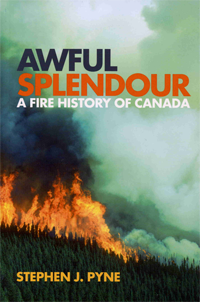
- Awful Splendour: A Fire History of Canada
- UBC Press (2007)
Canada has no wilderness. Fire set by humans has shaped virtually every hectare of the country. The process has been going on for more than 10,000 years, making our country a very old artifact.
Stephen J. Pyne has documented the world's fire history in a series of remarkable books. Now he's turned his attention to us, and the result is a chronicle covering thousands of years -- from the vanishing of the glaciers to the "interface" fires that scorched Kelowna in 2003.
Pyne describes the country as a set of "fire rings" focused on Hudson Bay: the tundra, the boreal forest, the Prairies and Great Lakes forests, the hill forests of Acadia and the mountain forests of the Rockies, and the coastal forests of Cape Breton, Newfoundland, and B.C. Each region is highly complex, burning only when conditions are right. Lightning has always been a factor, but human fire has been far more influential.
Prairie by fire
We often have a vague idea that the First Nations used fire to maintain deer pasture. That was often true, but only part of the story. By careful application, fire could control where animals would migrate by giving them fresh green vegetation to browse on or driving them into convenient traps. Such techniques were so common west of the Great Lakes that the Prairies themselves may be an artifact of human fire.
Farther east, native peoples burned forests to clear land for slash-and-burn agriculture, imported from Mexico. When the Europeans arrived, they often did the same thing. Clearing land was far easier with fire.
But European attitudes were complex. Fur traders didn't want to ruin the habitat of beavers and other animals. Colonial officials began to see timber as a source of revenue, and despaired of natives and settlers alike when they let fires get out of control.
A cost of nation-building
Towns burned across British North America for generations. The Miramichi fire of 1825 started in the slash piles of pioneer settlements in New Brunswick, and eventually burned an estimated 6,000 square miles, including many settlements. When Vancouver burned to the ground in 1886, it was part of a long tradition.
Major fires seemed to be a cost of nation-building. Fires broke out repeatedly in newly cleared farmlands. Logging operations left piles of slash. Railways opened access to new forests, but sparks from coal-burning steam locomotives ignited those forests.
Here in B.C., politicians and bureaucrats worried about the fire hazard posed by trains, and urged conversion from coal to oil. Fire protection focused on rail lines, since logging, mining and farming couldn't exist far from those lines.
Yet huge areas of crown land also needed protection, which would have to be paid for by development. The provincial government adopted the concept of public ownership of the forests: it would lease them to logging companies, and the revenues would pay for fire protection.
As early as 1918, the B.C. Forest Branch was experimenting with airplanes as a means to patrol the forests and fight fires. But by the mid-1920s, the timber business was in trouble and firefighting costs were rising -- in part due to the growing dependence on aircraft. Underfunding was chronic, except when big fires broke out. And those fires were increasingly expensive to fight. They still are.
Pyne follows the complex plot of politics and science in the last half-century, as agencies changed names and missions, bureaucrats maneuvered, and scientists did research.
Conflicting philosophies of fire
Some scientists, like Charlie Van Wagner, exerted huge influence on forest fire science and Canadian policy. Van Wagner consistently pushed for field studies, while his American colleagues emphasized lab work. It was a critical difference: "The best Canadians could do was to predict events over which they had scant control; Americans assumed they could influence those outside forces."
Pyne's history of ancient disputes is sometimes more complex than most readers might like, but he's very good on the gradual evolution of fire politics. Since at least the horrendous North American fires of 1910, policy had been to suppress fires, always and everywhere possible. The parkland forests created by First Nations fire were soon choked with underbrush. When fire did break out, it was far worse thanks to that extra fuel.
By the 1960s, scientists were thinking about leaving some fires to burn freely, and even about setting some purposeful fires just as the First Nations and early settlers had. The national parks became a focus of such controlled burns as part of "active management":
"Here was prescribed burning tied not to logging but to the administration of preserved landscapes, burning that would emulate the historical conditions under which the biota had evolved with a goal to 'duplicate nature as closely as possible.'"
A return to artificial landscapes
Ironically, this return to "nature" is a return to the artificial landscapes the First Nations designed, and it's not politically popular any more:
"At the beginning of the twentieth century," Pyne writes, "the public had favoured burning, and professional foresters had condemned it; now forestry and wildlife management wanted it, and the public was hostile to it."
The public didn't like the stink of slash burning, or the threat to homes built close to forest. Pyne notes that after the horrendous 2003 B.C. fires, "although official doctrine pleaded for more controlled fire, the money went into sparkling new suppression tools."
Pyne concludes that Canada as a "fire power" is "more big than important." We build and sell pumps and firefighting aircraft, but we do not originate "new ways to live on a fire-prone land" as the Americans and Australians do.
But we may have to invent such ways in future: "A warming Earth could only enhance the habitat for fire. However Canadians might wish to conceive their relationship to fire, the future promised more flame, not less."
![[Tyee]](/ui/img/ico_fishie.png)
Read more: Environment