- Ms Kaye is a Tyee Builder. You can be, too.
- Mary Carlisle is a Tyee Builder. You can be, too.
- Prem Gill is a Tyee Builder. You can be, too.
- Nancy Flight is a Tyee Builder. You can be, too.
- Justin Everett is a Tyee Builder. You can be, too.
- John Westover is a Tyee Builder. You can be, too.
- Nora Etches is a Tyee Builder. You can be, too.
- Edward Henderson is a Tyee Builder. You can be, too.
- Bharadwaj Chandramouli is a Tyee Builder. You can be, too.
- Dean Chatterson is a Tyee Builder. You can be, too.
- Marius Scurtescu is a Tyee Builder. You can be, too.
- Robert Parkes is a Tyee Builder. You can be, too.
- James Murton is a Tyee Builder. You can be, too.
- Susan Doyle is a Tyee Builder. You can be, too.
- Vincent Strgar is a Tyee Builder. You can be, too.
- Helen Spiegelman is a Tyee Builder. You can be, too.
- Subir Guin is a Tyee Builder. You can be, too.
- Kimball Finigan is a Tyee Builder. You can be, too.
- Joanne Manley is a Tyee Builder. You can be, too.
- David Leach is a Tyee Builder. You can be, too.
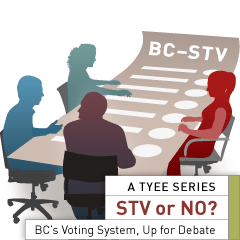
Change the Way We Elect? Round Two of the Debate
Which is better, First Past Post or Single Transferable Vote?
[Editor's note: Welcome to round two of The Tyee's Great How-We-Elect Debate between David Schreck of NoSTV and Shoni Field of BC-STV. You'll find round one's two questions posed and debated here. And an explanation of STV here.]
QUESTION THREE: Won't the massive ridings under the proposed BC-STV system be too large to represent properly? Is there anywhere in the world where they have an electoral map like the one being proposed for BC-STV?
Shoni Field, who is for STV, answers:
The current first-past-the-post system fails to provide effective local representation. BC-STV fixes this serious flaw.
Wilf Chelle, Citizens' Assembly member from Peace River, North says "I have no doubt that BC-STV will significantly improve the quality of local representation by making our MLAs accountable to local voters".
The districts will be no larger than federal ridings -- significantly smaller in the far north. But, each district will have more than one MLA. STV is particularly well suited to B.C. because of the ability to customize the number of MLAs in each riding to suit the population density.
A quick comparison will show why Chelle and others from the North and Interior recommend BC-STV.
FPTP: All but a handful of seats are "safe." Candidates are virtually guaranteed election after receiving the party nomination. Their loyalty is to the party, not the voter. The winner is known; parties usually ignore these seats.
BC-STV: voters have the final say on which candidates they prefer. If an MLA doesn't serve, voters choose another without even having to switch parties. Competition amongst district MLAs provides a powerful incentive to represent voters. There are swing seats in every district; parties can't take anybody for granted.
FPTP: MLAs are subject to iron-clad party discipline. MLAs cannot bring forward important local issues. They represent their party to their constituency, not their constituency in the legislature.
BC-STV: Knowing that popular MLAs can run successfully as independents gives MLAs some leverage to exercise independence on critical local issues.
FPTP: The same party will often receive the most votes across a whole region. When it's the opposition, that region has no voice in cabinet.
BC-STV: Most districts would elect at least one member from the governing party, so every region will have a voice at the cabinet table.
FPTP: 50 to 60 per cent of us don't have an MLA we voted for. With so few votes needed to elect somebody, MLAs are usually from larger centres and ignore outlying areas.
BC-STV: an impressive 80 to 90 per cent of voters will have an MLA they chose. When so many votes count, smaller communities cannot be ignored. MLAs will come from across the district, not just the largest centre. Most of us will have an MLA to represent our point of view.
BC-STV provides voters with greater choice locally. It gives MLAs the incentive and opportunity to represent their constituents. British Columbians want effective local representation; that's what BC-STV will give us.
David Schreck, who is against STV, answers:
With STV, constituencies would not only be geographically large, some larger than many countries, but they would all be large in terms of population.
STV supporters will no doubt point out that the number of MLAs is the same under STV as under our current system, hence roughly 50,000 people for every MLA, but despite claims by STV supporters, voters expect to be able to deal with every representative that is elected in a multiple-MLA area. MLAs shouldn't tell constituents to go see one of their other representatives, but that is precisely what STV supporters suggest would happen. That means less representation and less accountability.
In the Green Party submission to the Citizens' Assembly, it reported that in response to the question: "How do you have all candidate meetings when there are so many candidates in multi-member ridings vying for attention?" the Irish Green Party replied:
"All-candidate meetings are not that common here (perhaps for that reason). Special interest groups would often invite all candidates to a meeting and let them fight for attention from the floor. The main activities are leaflet-drops, door-to-door canvassing and standing at shopping-centres, church gates, etc. Many candidates for the larger parties are of such low calibre that their party will actively discourage them from debating with their opponents!"
In terms of population, electoral areas in British Columbia under STV are more than twice the size of areas in Ireland, so if the Irish have problems, imagine the nightmare we would have.
If BC-STV were adopted, the constituency boundaries that would be used are those recommended by the B.C. Boundaries Commission as amended and shown on the Elections BC website.
Under BC-STV, Kamloops would be part of Cariboo-Thompson, an enormous 5-MLA electoral area reaching from Quesnel all the way to the U.S. border, an area of 141,000 sq. km. – twice the size of Ireland. With almost 200,000 people living in the riding, voters would still have just one vote to elect 5 MLAs for the region. In North Island – South Coast, a 4-MLA area, Powell River and all of the Sunshine Coast would be in the same riding as Port Alberni and Ucluelet.
For much of the province BC-STV is not workable in terms of geography, and for all of the province it is not workable in terms of constituencies with over 200,000 people.
QUESTION FOUR: Doesn't the current first-past-the-post system shut out smaller parties? The Greens, for example, got nine per cent of the vote in the last election but their supporters have nothing to show for it.
David Schreck, who is against STV, answers:
Our current electoral system, first-past-the-post (FPTP), has elected smaller parties since its inception, and many believe that an independent will be elected on May 12th in Delta South.
In 1996, two members of the Reform Party and one Progressive Democratic Alliance member were elected. In 1991, 17 Liberals (under Gordon Wilson), 52 New Democrats and seven Social Credit MLAs were elected. In 1975, one Liberal, 18 New Democrats, 35 Socreds and one Conservative were elected. In 1972, five Liberals, 38 New Democrats,10 Socreds and two Conservatives were elected.
It is not the fault of our electoral system that from time to time some of the parties coalesce for what they think is their common electoral interests.
It is worthwhile to compare the difference in the success of the Greens in the Republic of Ireland under STV with their electoral record in B.C. In 2005 the Greens ran a full slate of 79 candidates, but they only spent $281,448 in the campaign -- $43,901 centrally. In 68 of the 79 local campaigns, the Greens spent less than $4,000.
In 2007 in Ireland, the Greens spent $832,000 (443,858 Euros). Small parties have succeeded in B.C. in the past, but it appears they have been better organized and better financed than the Greens.
The Green Party's 2004 submission to the Citizens' Assembly, presented by the late Colleen McCrory, was harshly critical of STV. It included information the B.C. Greens obtained from the Irish Greens who said: "The Green Party would rarely have one quota (except in some town councils with nine or twelve seat constituencies) so we rarely run more than one candidate."
In British Columbia with 9 per cent, or even 12 per cent, of the vote, the Greens would not meet the necessary quota to elect a candidate on the first round of the STV count in any of the 20 multiple-MLA electoral areas.
The only hope for the Greens, based on 2005 results, would be to receive large numbers of transfer votes, but as STV advocate Dennis Pilon admitted in a debate on CKNW recently, most people vote party with STV. Since voters have their one vote split into fractions, but they cannot control the size of the fraction that is allocated to any preference, receiving a tiny fraction of a vote as the third or fourth preference from a Liberal or New Democrat won't necessarily be enough to elect a Green.
Perhaps that is why Jane Sterk argued for MMP (Mixed Member Proportional) and not STV when she made her submission to the Citizens' Assembly.
Shoni Field, who is for STV, answers:
The majority of British Columbians, including those who never vote Green, believe that we'd benefit from having them in the legislature. It offends our sense of fairness that a party can earn nine per cent of the vote and those 161,842 voters not elect even one MLA.
There are scaremongers who suggest that the Green Party is the thin end of the wedge, that before too long we'd have a fragmented legislature with the Marxist Nudist Vegan Party holding the government hostage. Nonsense!
B.C.'s political culture is polarized, not fragmented. And single transferable vote has a natural threshold that prevents extreme, single-issue parties from achieving success. A candidate needs around 20,000 votes in a district to win a seat. While a party earning 9 to 10 per cent will win close to that in seats, very small parties are unlikely to win a seat.
Moreover, as the Irish experience has shown, the need to attract second preferences works against extreme parties. In recent Irish elections, Sein Fein got more first preference votes than the Green Party, but the Green Party won more seats. The Green Party is a moderate party with support across the political spectrum that earns lots of subesequent preferences. Sein Fein isn't and doesn't. STV rewards candidates who build bridges.
Some politicians tell us that the only problem with the electoral system is us -- the silly voters. If provincially we'd all just vote Liberal and NDP then, hey, presto, problem solved. Likewise on the federal stage, clearly the NDP, Greens and Bloc should just go home leaving politics to the Conservatives and Liberals.
The truth is, larger parties will always campaign against electoral reform. They want to be the only alternative in town. When scandal fells the other party; there they are, the government in waiting.
But, democracy isn't about crowing the heir apparent, and it certainly isn't about deciding who gets a voice and who doesn't. The problem with our current system stretches far beyond the nine per cent of Green Party voters who are left unrepresented. An astonishing 50 to 60 per cent of British Columbians do not have an MLA they elected. In contrast, BC-STV will give 80 to 90 per cent of voters an MLA of their choice.
Democracy is about giving people the representation they choose. A majority of British Columbians has chosen to vote for alternatives to the governing party (whoever that might be at the time), it is our democratic responsibility to find a way to give them that representation.
Related Tyee stories:
- Clip and save: The STV voting system, explained
- Weee! Easy As STV!
Only a deranged math nerd could like the new vote scheme those Citizens Assembly keeners picked for us. - Sharing the STV Pie
UVic's Dennis Pilon serves up his reasons for changing the way BC elects.


40
Login or register to post comments
midnightsimon
3 years ago
Great debate!
Great debate! I've forwarded this and the first half around my email network and I encourage other readers to as well!
For me, the biggest issue is choice - I want to have meaningful choice between parties (that is, the knowledge that should I choose to support a green or a BC Conservative, they'd have a fair shot at winning) but also choice within parties. I'm sick and tired of both major parties arrogance and the dead wood they feed us in safe seats.
By allowing voters to choose amongst candidates from the same party STV forces MLAs to be responsive to their constituents and keeps them working for US, not just their party leader.
freebear
3 years ago
Moot article as Referendum has only one choice
Whatever; the referendum question is yes or no to STV!
And whatever the flaws I am choosing change (STV)!
I hope will force a new politic and hopefully force out status quo thinking MLAs, lobbyists, eco ego maniacs, political profiteers and wanna be MLAs and bring a range of perspectives to governance to face the challenges and bring about a sustainable present; which we are far from despite the glorification of the SYMBOLIC Carbon Tax David!
Grumpy
3 years ago
There is nothing to fear.........
.....but fear itself.
The STV (sounds like a disease) and first past the post (sounds like a fixed horse race) debate is one of power, not democracy.
We do not live in a democracy, but an autocracy, where the voters trundle out like sheep and vote for a party or person and then expected not to utter a word until the next showcase election.
STV may, and I stress may, give some power back to the people. but the current system absolutely will not.
It is my belief that the current system is so broke, so discredited that Carree criminals now hold the reigns of power. A completely neutered media just glad hands the criminal elites running the show, in hopes of an "order of Canada' or a Senate seat comes their way.
Voting for STV is a vote for change, a change we so desperately need!
politico
3 years ago
Change
It should be clear that the only reason this is on the ballot is the Libs know people want change. So they will offer you a venue that does not actually result in changing government.
Don't be fooled. The only change a vote can actually wield is changing government.
I am not dissing Pro Rep I am only talking Liberal tactics.
PR is great, but, as everyone knows, we held hostage by a small group of highly manipulative, highly resourced political fixers. BC STV only changes the goal posts for these guys and in so doing also obfuscates who is actually responsible for reaping the hardship upon us.
You want change? Change the government first, then vote for STV if you like what it offers.
midnightsimon
3 years ago
politico
You've got it backwards!
Changing the clowns in office won't do anything until we change the underlying system of how we elect them!
More choice between parties and between candidates - THEN maybe we'll see some change.
Bison Ravi
3 years ago
two-party politics / Western Australia
David Schreck writes:
> It is not the fault of our electoral system
> that from time to time some of the parties
> coalesce for what they think is their
> common electoral interests.
Actually, that is precisely the fault of our electoral system. In political science, this is known as Duverger's Law, "a principle which asserts that a plurality rule election system tends to favor a two-party system."
http://en.wikipedia.org/wiki/Duverger's_law
Neither respondent answered the question about whether any jurisdiction in the world has a map "like" the one proposed for BC-STV.
In some sense, the answer is "no" -- BC-STV is unique in allowing such a great range, from 2 seats to 7, to take account of our considerable variations in geography.
But if the question means, "is there an STV jurisdiction which is as large as BC?", then the best example is the upper house in Western Australia:
http://en.wikipedia.org/wiki/Western_Australian_Legislative_Council
Western Australia is larger and more sparsely populated than BC, but the two jurisdictions are similar in that they are remote from their national capitals, and have a population heavily concentrated in one built-up area. Western Australia uses 6 regions. At one time it was six 6-member regions; at another, four 5s and two 7s.
BC's map is, in my view, better than Western Australia's, because it has more regions, and in the north they are much smaller.
Bison Ravi
3 years ago
Irish Greens
This is, indeed, a very educational debate. I did not realize that the reason the Irish Greens were more successful than the BC Greens was that they spent more money!
I had obviously been mislead by the fact these better-funded, better-resourced Greens in Ireland were only able to mobilize 4.7% of the vote (2007), whereas the less-organized, under-funded Greens in BC managed to draw 9.2% of the vote.
But I suppose if they had had as much *money* as the Irish Greens, they would somehow have found a way to turn their 9.2% into seats???
mmphosis
3 years ago
Gerry Mandering
Check out the BC-STV ranking system in action:
http://bc.demochoice.org/
I am not pleased with either of the so-called choices being offered in this referendum. I think BC-STV smells the least worst of the two, but I don't really know enough about it.
Some things coming out of Elections BC seem suspect. I think that Elections BC is Gerry Mandering as the boundaries can change up to 25% or more in "special" circumstances regardless of which system is used. My so-called "local" candidates are unknowns because they are no longer from where I live.
This process wreaks of manipulation.
frank2
3 years ago
Good debate. One STV
Good debate. One STV advantage that I didn't see mentioned is that the politicians under that system don't particularly like it, and have proposed return to FPTP or other proportional system. Only one problem: the public prefers it, so it stays. This safeguard doesn't exist for other systems.
Another advantage which has been referred to eliptically is that under the present system, voters sometimes have to hold their noses and vote for their party's candidate, even if that candidate is inferior. Under STV, I can vote for competent people who support my party -- and either give up my other choices, or even support really good people who aren't party members.
Another advantage which has been referred to is that under STV members have much more incentive to examine issues and vote their conscience or their electors' views. By the same token, parties have to spend more effort reaching agreements with opponents to get things done. I am tired and sick of a situation in which one man (increasingly) takes all the decisions. Only a saint could resist the tendency to be corrupted by this. I've yet to see any saints elected.
midnightsimon
3 years ago
Even John Cleese supports
Even John Cleese supports STV - check this out!
http://www.youtube.com/watch?v=NSUKMa1cYHk
badinfinity
3 years ago
how is this aspect of Irish politics different from BC?
"Many candidates for the larger parties are of such low calibre that their party will actively discourage them from debating with their opponents!"
This could also be said of the BC Liberals and the federal Conservatives. It doesn't seem to be something unique to STV.
ReeferMadness
3 years ago
Schreck's strange take on the Irish Greens
Mr. Schreck's invocation of the Irish Green Party as defenders of FPTP is bizarre. In Ireland, the Green Party manages to win seats with less than 5% of the popular vote. Here, the Green Party can't even land a seat with 12%. Does Mr. Schreck seriously expect us to believe that the Irish Green Party would prefer a system that would deny it representation? Or is perhaps Mr. Schreck taking the quotes out of context?
And what are we to make of Schreck's claim that the BC Green Party would get no seats under STV? The BC Green Party has endorsed BC-STV. Does Schreck know something they don't? Or is this just more disinformation from the anti-STV campaign?
Party insiders like Mr. Schreck like to protect the privileged position the current system gives them. Examine what he says carefully for double-talk.
Dan the socialist
3 years ago
No to STV!
Is STV really pro rep? It may be marginally but not like what the 'spin' portrays it. Even the Greens would have trouble winning seats under STV as seats are not guaranteed even if a party gets 10% like 'list pro rep' or 'mmp'.
If people do not want majorities why not either proper full pro rep or a mixed mmp system that works well in New Zealand?
MMP was also on the table but the citizen committee picked STV. Why not let us vote on all alternatives then vote on the final 2? Let the people decide, all of us, not just a group.
I would of voted Yes for Mixed Member Proportional or Out right full pro rep (list Pro Rep). I think they are way better than STV.
Plus how long will we have to wait for the results?
Unlike here , New Zealand got to vote for what system they wanted, there were more than two choices and MMP smoked STV.
ReeferMadness
3 years ago
Yes, Dan, STV really IS pro-rep
STV is proportional representation. That is according to Dr. Dennis Pilon, a political scientist. If you're arguing otherwise, perhaps you could cite some evidence.
In Ireland, the Greens get seats with 5% of the popular vote. You really think the BC Greens going to get shut out with twice that much? Or are you just repeating Schreck?
If you really wanted MMP, you should have convinced the citizens assembly. STV is on the ballot. MMP is not an option.
BTW, for those observers who might be thinking that STV is somehow second best, it isn't. With STV, you vote for people, not parties. And you can vote for as many or as few as you like.
Vote yes to BC-STV.
anarcho
3 years ago
STV is a lamentable choice.
STV is a lamentable choice. We should have a form of proportional ballot. The rulers like FPTP because it allows a minority to dominate the rest of us. With proportionality all governments would have to reflect the will of the majority and thus it would be far more difficult for the reactionaries to shove their policies down our throats. Furthermore, it would allow smaller parties of the left to have seats in parliament/legislature which could then put pressure on the NDP to remain true to their platform rather than waffle to the right.
Rick
3 years ago
Political Homesteading.
My friend from Dublin thinks we're nuts, do you think these guys and I say "guys" because no women are involved, this looks pretty comfortable not accountable.
Longest service (in one role)
List of longest-serving members of Dáil Éireann, just a few:
Paddy Smith 53y 11m as TD
Frank Aiken 49y 6m as TD
Neil Blaney 46y 10m as TD
Tom McEllistrim, Snr 45y 10m as TD
Séamus Pattison 45y 8m as TD
Seán MacEntee 45y 6m as TD
James Ryan 45y 2m as TD
Seán Lemass 44y 7m as TD
James Everett 44y 4m as TD
Oliver J. Flanagan 43y 8m as TD
No safe seats?
This is a joke!
STV? BIG MISTAKE!
Rick
3 years ago
No small parties under FPTP?
Exerpt from Gordon Wilson paper:
What the STV provides is a venue for the lazy or ill-informed voter to choose a marginal or fringe candidate, who will then have a shot at being elected. If a candidate is top-notch, hard-working, and espouses a vision that resonates with the majority or a strong plurality of the electorate he or she WILL get elected. Oh and as for who does or does not get into Cabinet, that is the choice of the Premier and this electoral system won’t change that, nor should it.
The next point that the proponents of the STV put forward is that “The current first past the post system doesn't hold the government responsible to the voters: When 40% of the votes can win 60% of the seats and 100% of the power, the government believes it has a mandate to do what it likes, rather than what the voters want.” This is a very tired, old argument that has everything to do with effective opposition of those elected under our current system and nothing to do with putting out a smorgasbord of candidates and providing “hedge your bet” voting. With an effective opposition, change can happen regardless of the breakdown in the seats.
Then there is the argument from proponents of STV that our current system “favors political parties over voters: Where parties have "safe seats", nomination meetings count more than elections. And political parties would rather keep a weak, elected MLA than risk replacing one”. Answer to that, get off your ass and get involved in the political process rather than weaken our electoral system so that we can have a government made up of second and possibly third choices. Talk about weakening government: let’s fill the Legislative government with a bunch of people whom few wanted as their first choice to represent them.
Andrew Coyne writes in support of a change to an STV system that small start up parties such as the Green Party knows what it’s like to run and not get elected. Come on Andrew. They don’t get elected because they haven’t put forward any policy or candidates that are electable.
And, to be clear on this point, in 1991 I was the leader of a party in British Columbia that had not elected anybody to the Legislative Assembly for almost two decades despite contesting every election, it was called the Liberal Party. Through hard work, yes very hard work, door knocking, good candidate recruitment and solid policy work, the Liberal party not only elected members but formed opposition. And we did it using the current system. If that isn’t proof enough that the current system works if you are prepared to get off your ass and work hard, I helped found a party that didn’t exist in 1994 called the PDA. We ran candidates in the 1996 election and I was elected as its leader in the riding of Powell River-Sunshine Coast. The Green Party has been running candidates for over 20 years; if people wanted to elect any of them, they would have.
Frank
3 years ago
Sounds good
"with the Marxist Nudist Vegan Party holding the government hostage"
Its about time, bring it on!
frenchy mcswede
3 years ago
"... the quality of candidates is so bad that
parties actively discourage their candidates from attending debates for fear that they will display their ignorance and stupidity." Which brings up the interesting point that the bc liberals are discouraging most of their candidates from attending debates icluding the debate at the senior's 411 center in downtown vancouver, as I read somewhere today...
As to stv my objections are manifold and may require two posts in a row.
First off, I would NOT care to pick ANY bc liberal candidate as my trillionth choice, let alone as my fourth or fifth; forcing a voter such as myself to endorse even a micron of support for such a reactionary, undemocratic pack of, in my opinion, parasites, is profoundly UNDEMOCRATIC.
Second, it's really not nude vegans that worry me(we should be so lucky!) it's the possibilty of electing candates even farther to the extreme right than the bc liberals, candidates who would need only 12% of the vote to stay in office in perpetuity. If you think this can't happen in beautiful bc then you have never read some of the posts in the comment section of the province newspaper where astonishingly reactionary and racist commenters post regularly and often get at least three agreements. Imagine 3 such mlas holding the power in a minority rightwing government, then imagine their demands...
frenchy mcswede
3 years ago
Objections to stv part 2.
Then there are stv's highly troubling bc origins...I mentioned the extreme right manipulating the choice of stv over much more democratic proportional representation systems. I was thinking in part of gordon gibson, who can make rich coleman sound like a communist. Gibson was present from the start at the selection of stv over other systems, and gary lunn supporter bruce hallsor (sp?) is also a big fan. Which brings up the question, what's in stv for the right? Is their support based on the facts that their pockets are so much deeper than the pockets of progressive parties? Could not the enormous amount of money neccesary to mount a campaign in the huge 8 member ridings we'll be seeing under stv be a major factor in their support for stv? American politics has become such that only those with access to tens or even hundreds of millions of dollars have a voice...do real progressives really want that for bc? Prove me wrong...
Bison Ravi
3 years ago
facts
I find it very telling that opponents of BC-STV frequently can't even get basic facts straight.
Frenchy McSwede wrote:
> huge 8 member ridings
There are *no* 8-member ridings under BC-STV. The *limits* of the allowed range are from 2 to 7. And the boundaries commission, which has already produced the map which *will* be used if BC-STV is adopted, has used those very sparingly. There is only one 7, and one 6. Most voters will live either in a 5-seater or a 4-seater.
The rest of what Frenchy says is just as wrong. Gordon Gibson may have designed the seating chart for the Citizens' Assembly (I mean, how many members, from what parts of the province, etc.) but he didn't tell them what to think. You would know this if you made even a cursory attempt to observe how the Citizens' Assembly actually functioned.
ReeferMadness
3 years ago
"First off, I would NOT care
"First off, I would NOT care to pick ANY bc liberal candidate as my trillionth choice, let alone as my fourth or fifth; forcing a voter such as myself to endorse even a micron of support for such a reactionary, undemocratic pack of, in my opinion, parasites, is profoundly UNDEMOCRATIC."
You're right. If there were a system that forced you to endorse a candidate you didn't like, that would be undemocratic. Fortunately, STV doesn't force you to vote for anyone. You can choose to vote for just one candidate or many. You have *choice*. Compare that with the current system.
neilsmith
3 years ago
safe seats etc
Listing the long-serving Irish MPs does not prove safe seats under STV. Maybe it means these are the politicians who consistently get the support of their constituents over other candidates from the same party because they have proven themselves trustworthy and hard-working.
Also, Frenchy let me reassure you, you do not have to mark anyone down as your trillionth choice even. STV allows you to rank as many or as few as you feel comfortable with. You don't have to rank anyone you don't want to represent you.
Van Isle
3 years ago
We can argue and make points
We can argue and make points all day long about which system is better (or worse). My points are; 1) is that the system we have now is corrupt where all the power is in the Premiers office and all the other MLAs are just fence posts with hair who nod or shake their heads when their great leader tells them what to do. 2) if we don't change now, the whole issue of election reform will never raise it's head for at least a generation. If we do vote for change, and a number of years down the road we feel it doesn't fit, we wouldn't be so shy to try something else. Also the citizens forum, with no political interference, was the body who reviewed all the options and in their opinion the STV was the best fit for BC. 3) as for this business of having too many political parties in the legislature depends on what persentage of the popular vote that we allow whether it's 3%, 5% or 7%.
ReeferMadness
3 years ago
STV supporters come from all sides
"Which brings up the question, what's in stv for the right? Is their support based on the facts that their pockets are so much deeper than the pockets of progressive parties?"
frenchy mcswede, your paranoia is showing. Go look at the people endorsing STV on the website stv.ca. They include such "radical right wingers" as David Suzuki, Naomi Klein, Maude Barlow and (count 'em) 4 federal BC NDP members of parliament.
The unifying force behind the STV campaign is not political ideology, it's a desire for positive change. It's a grassroots organization. That's why the yes side has hundreds of volunteers and thousands of lawn signs.
Which leads me to the question: "What is it that makes the no side so fearful?"
Frank
3 years ago
I agree with Van Isle
I'm a supporter of STV but even so I think it would be good to have a referendum on it again in 2017 or 2021.
That would give us just 2 or 3 elections to decide for ourselves if its what we want and this time we'd have the real world to talk about.
The important thing is, as Van Isle says, that we break from FPTP and that we keep the idea of electoral reform going.
If in 2021 we decide to switch to MMP or even back to FPTP that would be fine too.
But if we vote No to STV now then there's no chance of electoral reform being back on the agenda at any time in the next 20 years.
freebear
3 years ago
STV naysayers
Funny how those that support the un-effective carbon tax say you should vote Liberal to keep the Symbolic Green Wash Carbon Tax, yet...
many say you should vote no against STV because it is not effective enough
If you want it both ways you should bend over and open your mouth!
H87
3 years ago
Fair and Democratic
Whatever else BC-STV will do, it will certainly bring more fairness to our electoral system. I think many people have been living with our current disastrous system so long, they cannot imagine how this kind of change can work or be good for us. I look forward to the first election with BC-STV.
frenchy mcswede
3 years ago
So I'm paranoid, are my critics sure that
they're not naive? If we have another campbell government what makes you think he won't tweak the final form of the ballot. And I have never seen any data whatsoever indicating that if stv gets chosen, that voters will have a choice whether or NOT to rank their ballot. Post that info on the tyee or give a link proving it. And then get campbell to post $500,000 of his own money that voters under an stv system will NEVER be forced to rank candidates or have a spoiled ballot.
And, van isle, it isn't first past the post that's allowed the premier to concentrate power in his own office, it's the actions he's undertaken since he first got elected. Your argument doesn't make sense, or under our system all power would have been concentrated in the premier's office long before campbell got elected.And every article I've ever read on stv, both pro and con states that ridings of 6 or more mlas will be the rule, not the exception.
Believe me, I understand people's longings for more democracy and I am in favour of a JUST proportional representation system, but stv, is highly tweakable, and has so many flaws it will not bring more democracy than first past the post, but less.
ReeferMadness
3 years ago
The Facts are:
frenchy, a couple of facts:
Elections BC has already mapped out the STV ridings as they would be if this election were held under STV rules. You can see the map on the Elections BC website. The breakdown is
1 riding of 7 MLA's (capital region)
1 riding of 6 MLA's (West Vancouver)
5 ridings of 5 MLA's
9 ridings of 4 MLA's
3 ridings of 3 MLA's
1 riding of 2 MLA's
The second thing I should point out is that if STV were a Liberal plot, Campbell didn't need a second referendum (or even a first one for that matter). The government has the power to change it without a referendum. Campbell could easily have just claimed the results last time were close enough.
Vote yes to BC-STV. Giver power back to the voters.
TooManyChoices
3 years ago
Local Representation
The STV gives proportional party representation but it falls short in local representation.
I am from Victoria and say for example the next election turned out as 3 Liberal, 3 NDP and 1 Green.
I live in Sidney and am Liberal. It is quite possible that all the Liberal MLAs elected live in Victoria or Oak Bay. How can they represent me if they do not know my issues? What do I have in common with someone from Jordan River? Victoria's main issues are crime and homelessness; Oak Bay's is taxes. Even in such a small area there are many different issues.
Another issue is contact with my MLA. under FPTP I would have 1 representative and I would be certain who to talk to. Under STV there would be 7. How should I choose if I have an issue? Even if I chose by party line it still could triple my choice. How often would that MLA be available? Possibly less than now as they have a larger constituency. Is it possible that the good MLAs would be overwhelmed while others ignored?
TooManyChoices
3 years ago
Federal ridings not a good comparison
Comparing a provincial riding size to a federal riding sizes is misleading. Federal ridings are larger because there is a limit to the number of MPs. It is understandable that local representation is less but MPs are supposed to be concerned with national not local issues.
Provincial politics is different in that local issues under provincial control are dealt with by local MLSs. Under STV there would only be regional MLAs.
Another difference is that the Federal MLA would be elected by FPTP.
TooManyChoices
3 years ago
Green Party
Considering the quota percentages and if people marked preferences along party lines, which is probably what would happen, no Green candidate would have been elected in the last election.
I combined the vote for the capitol region and came up with a 10.83% vote for Green. That is still below the 12.5% quota to be elected. It would require 1.67% of the unused votes from other parties to be elected. Considering that 1.53% of the vote went to Democratic Reform BC I doubt that would happen.
All other regions in BC have a higher quota and I doubt a Green would be elected.
Frank
3 years ago
TooManyChoices
The thing is, many of those against STV are so because it might mean the end of two party dominance and lead to more parties in the legislature.
Their reasoning is that the bar will be lowered and people will stop voting strategically as in "I'd like to vote for so and so but they have no chance so I'll vote NDP".
You're assuming that there is no strategic voting now and that everyone will continue to vote the same way.
VivianLea Doubt
3 years ago
Marxist Nudist Vegan Party
Finally, a political party I can really get behind: I'm inspired! I believe the conventions would be a lot of fun. All that earnest debating taking place in the nude while eating healthy food - how could anyone not enjoy the portrait painted here?
Now, imagine the legislature...no longer the exclusive domain of men in dark suits...making shadowy deals with insider friends...a little transparency, so to speak, is suddenly injected...
The most compelling reason for voting for STV, to my mind, is to bring a little more diversity to a chamber rather noted for being devoted to maintaining the status quo - but how could it not? Our system of representation was designed long before women even got the vote, and the entirety of its structure represents thinking a couple of hundred years old.
I suspect that nothing less than voting for STV will destroy the complacency of those who figure they have it down pat. Either that, or a few nudists in those beautiful seats...
Bison Ravi
3 years ago
Green Party
TooManyChoices wrote:
"I combined the vote for the capitol region and came up with a 10.83% vote for Green. That is still below the 12.5% quota to be elected."
Yes, TMC, but you only counted the *first preferences*. The Green Party candidate (Jane Sterk, probably?) would have a chance to add votes in subsequent rounds, and reach quota later. From a base of 10.8%, this would certainly happen.
Suppose the NDP vote share in the same district is 54%. That's *four full quotas*, plus 4%. If even half of that 4% comes to the Green Party candidate, it will boost her from 10.83% to 12.83%, and she's in.
In Ireland, the experience is that if you start with around 0.6 of a full quota in the first-preference count, you are about 50-50 to make quota, with this probability increasing rapidly as you move up toward 1.0.
ThisCanadian
3 years ago
BALLOT COUNTING
yeah
I *absolutely* agree with the improved systems that will empower citizens to feel comfortable casting a vote for 'under-recognized' parties.
I JUST DON'T BELIEVE THAT COMPLICATING THE BALLOT SYSTEM MAKES CORRUPTION LESS DIFFICULT by the same sorts of SOBs that STOLE 2 US ELECTIONS.
IN PLAIN SIGHT of the World
TRANSPARENCY is crucial...
obfuscating the direct 1:1 relationship of ballot makes it easier for excuses for BLACK BOX electronic systems to 'speed it up' or
worse
for direct malfeasance in THE DESIGN
you think I'm kidding. Within the lifetimes of some contemporary Canadians, we couldn't prove our elections weren't fraud-riddled.
Look at Developing Nations... like Haiti's (recent election!) ...or the USA.
& LOOK at the horrorshow they've created!
ONLY TWO global meltdowns in under a single century.
Canada can have a better system....
but WE NEED CLEAR PROCESSES DEFINED long before we let the Fed Conservative Gov't loose on the case to 'privatize' the 'improvements'
pay attention pholks!
NEW ain't better if its 'touched by a NeoCon/Lib'!
here's my point:
people have to BELIEVE that the election represented a segment of the populations...
if a voting citizen can't get a general FEELING that her vote was genuinely counted, because she cast *multiple* ballots for the same position... we will eventually erode confidence in the ballot counting.
DO NOT HAND THE CONSERVATIVE HARPER GOV'T Carte Blanche TO REDESIGN & SUB-CONTRACT OUR ELECTORAL PROCESSES!!
perspective, people.
Perspective.
The Jeff Farias Show: streams FREE & LIVE Mon-Fri, 6-9pmEST
FREE podcast
dsturdy
3 years ago
Votes required to be elected
There has been some concern expressed for the "low" percentage of votes required to be elected, some cite 15 - 20%. They are forgetting that that number is for a riding of around 200 000 voters. In the original, smaller ridings, of around 50 000 voters This % would translate into a much higher percentage.
E.g. if 60% of the voters in the 200 000 voter riding voted, 60 000 votes cast, then 12 000 votes would be required to win a seat. This, applied to the old riding of 50 000 voters with 60% voting, 30 000 votes cast, would translate into 40% of the votes cast. This is the kind of % that earns a seat in our present system.
wiley
3 years ago
Large ridings can be subdivided later
With population growth, smaller ridings under STV would be inevitable. Right now it's all based on the limited seating capacity of an old building in Victoria. Some neo-Rattenbury and a crew of stone masons with big hammers can fix that limitation quite easily, right?
ReeferMadness
3 years ago
STV is genius
When I first read about STV, I thought it was weird. But the more I think about it, the better I like it. Other proportional systems make you vote for a party to produce proportionality. STV produces it as a natural outcome of voting for *real people*.
Other systems limit you to voting for a single individual and leave you with no opinion on the rest. STV allows you to vote for as many people as you like.
I would much rather have the opportunity to deal with an MLA I like who lived across town than a useless so-and-so who lives around the corner.
Riding size? Who cares? I don't even know where my MLA's office is because 95% of my communication is by phone or e-mail.