Opinion

Save Our Rivers, Indeed

Why the private power battle is so critical.

By Rafe Mair, 14 Apr 2008, TheTyee.ca

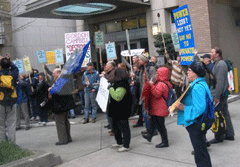
Save Our Rivers Protest

Save Our Rivers protest in Vancouver, March 11.

I must, in fairness, tell you that I support, and have publicly spoken for the Save Our Rivers Society, which, along with other groups and countless British Columbians, is actively opposing the privatization of our power and the abuse of up to 750 of our rivers and streams to make great wads of cash for the private sector. I'm sure you will bear my prejudice in mind.

Let's look briefly how we got public power. W.A.C. Bennett, when he became premier in 1952, was horrified that British Columbians would soon have to import power from the United States and in 1962 bought most of the power companies in B.C. and formed BC Hydro and Power Authority, which then went on to implement Bennett's "two rivers policy" with dams on the Columbia and the Peace. He paid a high political penalty for this as he outraged both the business community and the residents in the Kootenays who, seeing the Columbia changed forever more, left the Social Credit Party and voted NDP.

Changing us from homeowners to tenants

The question is asked, why shouldn't the private sector take over power? After all, no one suggests that the government run all the mines, cut down the trees or drill for gas and oil. If the extraction of natural resources is in private hands, why not power?

The answer basically goes to the nature of electricity and the social and economic reasons it must be supplied in sufficient quantities to meet the demand.

If we were dependent on fossil fuels or nuclear power, for example, I could understand government looking at private power producers as long as they had to put the needs of British Columbia first.

But as we all know, that's not how it works.

Private companies must be able to make a profit and the private power producers propose to do just that with a sweetheart deal with BC Hydro on the Campbell government's orders. Hydro will, in addition to adding more private power to the B.C. grid, export this power from the private plants into the United States. From a practical point of view this means much higher electricity prices for British Columbia homes and businesses. The result will be that the most important part of the B.C. economic engine will be controlled by a few private companies taking away what used to be our power and our profits and exporting them to the United States.

All this by a government that, without a suggestion of a public mandate to do so, wants to change us from homeowners to tenants.

Power purchase switcheroo

They justify privatization because, they say, we're short of electricity even though this can only be demonstrated by ignoring the fact that Hydro imports "dirty energy" from Alberta but then exports power thus made available to the U.S. and makes a very handsome profit. To tell "the truth, the whole truth and nothing but the truth" is not a popular notion either in the cabinet room, the premier's office or industrial boardrooms.

The questions we must ask ourselves are these: Do we want private companies -- many of them large American outfits -- to develop our hydro power and make huge profits for largely offshore shareholders?

Or do we want to develop our own power and set our own course?

BC Hydro may have made mistakes in the past and no doubt will in the future but those mistakes were made with the B.C. government as owners and directors of Hydro's actions. We will have no such control over the policies of private power suppliers. W.A.C. Bennett, a thorough-going capitalist, saw BC Hydro, BC Ferries and BC Rail as agents for implementing government economic policy for the good of all. The Campbell government has moved all three into the private sector whose boardrooms couldn't care less about economic or social policy.

Damage to nature

Then there's the environment. Every single one of the rivers to be handed to the private sector requires a power plant, access by road and transmission lines. The power plant -- be it a dam, tunnels or whatever -- changes the flow of the river, and thus is an ever present threat to fish. It's been suggested that the Ministry of Environment and Department of Fisheries and Oceans will police these plants. How can anyone believe this?

I suggest to you that the governments are as interested in keeping run-of-river plans environmentally sensitive as they are in keeping Atlantic salmon fish farms from slaughtering our wild salmon. The Ministry of Agriculture, Food and Fish, the Ministry of Environment, and the Ministry of Economic Development, on their individual and collective record have absolutely no credibility when it comes to safeguarding our environment. The Federal Department of Fisheries and Oceans, long a shill for fish farmers, can't even save clams and geoducks on nearby beaches from destruction. Does anyone for a second believe that they'll hold up or police private power plants on remote rivers and streams?

British Columbians are part way down the road to the "run of river" policy and have never been given a hearing. The result will be rivers and streams opened up all around the province, the wilderness that once prevailed will no longer be wilderness, with more than fish at risk.

The wildlife and flora of the areas affected will be severely at risk if not destroyed outright so that private companies can supply the power that BC Hydro has supplied us for over 40 years, and do so at a huge profit thanks to high sale prices fixed by the Campbell government.

Here ya go, Americans

What we're effectively doing is exporting our environment as well as our energy to the United States while allowing corporations, often foreign, to make money -- our money -- doing it!

The Campbell government maintains that we will need more power and it's either "run of river" projects or fossil fuel fired energy. This simply isn't true. According to a secret memo from BC Hydro, most if not all of our needs could be met by simple conservation. It's not an either/or situation at all.

One of the effects of the "run of river" policies will be the weakening and effective privatization of BC Hydro, which will pay high rates for private electricity so that it will be reduced to the power sources, mostly dams, they now have. This despite Gordon Campbell's oft made promise to leave Hydro alone.

For God's sake don't buy the barnyard droppings that somehow this policy is competitive private enterprise. There isn't any competition at all, just private monopolies who will put dividends to its shareholders miles ahead of any obligation to British Columbians or concern for the environment. If there's one thing free enterprise hates, it's true competition.

Admittedly there is a need to make decisions as to how we keep our power supply matching our needs. From my perspective, destroying wilderness and adversely affecting our fish shouldn't even be on the list.

But there is one question that overrides all else. Were you consulted on this matter of enormous consequences? Was this even an election issue?

The answer is, of course, no. This has been policy by stealth.

I have never voted NDP and likely won't. What I will do, however, is deny my support to any candidate who won't stand firmly in favour of public power and firmly against demolition of our out-of-doors and thus destroy the essence of "super natural" British Columbia. A simple test and if no Liberal candidate can meet it, too bad.

Related Tyee stories:

 [Tyee]

69  Comments:

Login or register to post comments

  • Luke Skywalker

    4 years ago

    IPPs and BC Hydro ... RORs and Dams...

    Rafe:

    Quote:
    The wildlife and flora of the areas affected will be severely at risk if not destroyed outright

    If all of the streams held by water licencees were developed for RORs(extremely unlikely), that would represent .001% of BC's streams.

    OTOH, the environmental cost of WAC Bennett's 1960's "two rivers policy" for the Peace and Columbia was astronomical compared to any of these small ROR projects of today.

    If those same large BC Hydro dams were proposed today, they would not likely be built based upon today's environmental consciousness and likely intense public opposition.

    I'm also sure that Rafe would be at the forefront of such opposition.

    Would BC Hydro have the right to destroy the environment with the large environmental footprint caused by such massive dam construction because it's a crown corporation?

    Rafe:

    Quote:
    From a practical point of view this means much higher electricity prices for British Columbia homes and businesses.

    Not according to the recent and excellent Vancouver Sun article entitled "Dam Numbers - The Cost of making Electricity in BC" which states, in part:

    Quote:
    Documents on file with the B.C. Utilities Commission also show that a recent upgrade to the Alberfeldie Dam in southeastern B.C., an older Hydro-owned facility, has pushed the cost of electricity production there to $62 per megawatt hour - same as an IPP.

    Rafe:

    Quote:
    Private companies must be able to make a profit and the private power producers propose to do just that with a sweetheart deal with BC Hydro on the Campbell government's orders.

    Vancouver Sun:

    Quote:
    since 2001, the failure rate on IPP projects accepted by Hydro for power sales to the Crown has averaged about 50 per cent.

    Hydro documents on file with the B.C. Utilities Commission show that attrition has already cost BC Hydro about half the expected power from the 2006 call for new electricity production - and that the situation is causing enough concern within Hydro and government that the Crown corporation now requires bidders to post bonds which are forfeited if the projects fail.

    Purely from a consumer's standpoint, the attrition rate suggests that the rates Hydro is offering IPPs are too stingy to make many projects economic.

    Rafe:

    Quote:
    Admittedly there is a need to make decisions as to how we keep our power supply matching our needs. From my perspective, destroying wilderness and adversely affecting our fish shouldn't even be on the list.

    But it's OK if BC Hydro did the same so-called environmental damage if they built the RORs (not IPPs) which are under the same regulatory regimes?

    BTW, here's a good website answering the myths and facts of RORs:

    http://www.greenenergybc.ca/bccge_myths_and_facts.html

  • Luke Skywalker

    4 years ago

  • Moat

    4 years ago

    Globalization of everything...

    I know that this does not directly relate to this article, but the them sure does.

    Have a read of this article from a Chilean news source.

    Region XI Organization Lambastes Government For Defending “The Indefensible”

    www.santiagotimes.cl/santiagotimes/2008041313427/news/enviromental-news/chile-aysen-fishermen-salmon-industry-boycott.html

    Same stuff is going on all over the place, along with similar government denial.

    I know, I know.... it is obvious.... however, I thought it is funny just to replace the names of the places and people involved, that is British Columbia for Chile, etc.

  • Moat

    4 years ago

    Ack

    the above url is not working. No matter... here is a quote from the article.

    Quote:
    The AGO and other critics of the once booming salmon industry claim it runs roughshod on workers’ rights and on the environment. Highly concentrated fish farms create tremendous amounts of organic pollution (feces and excess feed) that create “dead zones” in the surrounding waters. Lack of serious regulation has also allowed salmon companies to pump their fish with antibiotics at levels unheard of in other salmon producing countries. Those and other environmental consequences take a major toll on native fish species, on which local, small-scale fishermen rely for survival.

  • ME2

    4 years ago

    Figures don't lie but.....

    Pardon me, but I'd like an answer to this question/statement:

    My understanding has been that the BC Columbia River dams store water and hold it until low water times, at which time it is released to ensure US facilities downstream can keep their generators running.

    For this, we are traded cheap power during the high-water times when the US has a surplus. I've read that we make a lot of money on this deal.

    If we are now forced to buy Alberta power, it seems to me that somewhere along the line, there's been some new deals made.

    And re the installation of new generators on the Mica or Peace dams being more costly that ROR, the biggest cost by far in generating power is found in the dams themselves, not the generators.

    Large dams require enormous amounts of moved materials and cement in their construction. That cost is so high that they are always financed by govenments which have access to low enough interest rates to make the 50-year payback times viable.

    This slow payback rate and inability to access preferential interest rates makes such ventures unattractive to private capital, which usually sets a 20-year payback time as the maximum.

    I suspect the higher payments for Hydro guaranteed by Campbell throws all those normal calculations - heretofore calculated only with the public interest in mind and not with only private capital in mind - into a cocked hat.And so I question whether Campbell-style ROR is REALLY cheaper than large dams.

    And it seems logical to me that if the economies of scale found in most everything else also hold true for generators, the cost of these per Mw should be much less than smaller ones. Thus, with no costs for an impoundment structure, their installation should be much cheaper than ROR, and rate of return greater, not less.

    Given the proven ability of Campbell's accountants to play fast and loose with figures, I seriously question the truthfulness of the actual costs AND the projected cost per Mw we've been offered re the Alberfeldie generator installation.

    Too much trust has been lost to make any of the figures we've been given acceptable.

    And that's without even considering our gov'ts allowing the Kemano power to be shipped out of BC.

  • Jeffrey J.

    4 years ago

    Deficit in Democracy Increasing

    The destruction of our rivers and wild salmon under Gordon Campbell is a travesty not just for the environment, not just for your children and grandchildren, but for democracy itself. When a majority of citizens oppose the destruction of our environment, in a proper democracy our elected officials would respond accordingly.

    People have tried everything to speak out, including writing letters, sending emails, forming societies, protesting, objecting, launching legal actions, and so on. But with the neo-conservative plutocracy, citizens are dismissed with contempt. Why? Because said "officials" are happily selling off BC to US interests in exchange for a few trinkets and beads for themselves, and nothing for their people. And unlike the past when First Nations were defrauded in such a fashion, here Mr. Campbell et al know exactly what they are doing.

    The moral righteousness of this party is really quite disturbing. As is the silence of our corporate media.

    What a travesty for a great province with the most pristine environment in the world.

    Thank you Rafe Mair and the Tyee for continuing to have the courage and principles to speak out.

  • City Person

    4 years ago

    More Accurately

    Quote:
    Hydro imports "dirty energy" from Alberta but then exports power thus made available to the U.S. and makes a very handsome profit.

    More accurately, Rafe, Hydro buys power at off peak times and keeps water in dams to export power at peak times. Power exports bring in cash. This is the cash that pays for the nice stuff people like such as education and health care. As a former minister, you should know that.

    Quote:
    According to a secret memo from BC Hydro

    Show me, Rafe, otherwise it is hearsay. The fact is, there has not been a major power development in BC for 50 years. The power has to come from somewhere.

    If people are really serious about conservation, I suggest they:

    1. Not turn their computer on for a month, and then on alternating months only.

    2. Take one major appliance out of their home.

    Difficult, isn't it? So tell me, Rafe, what is better, to cease power exports to the USA or to build more hydro generation in BC. Then, tell me where you are going to make up the lost revenue or what services you are going to cut. We are not talking small beer here.

    You were a cabinet minister. You should know how to do both.

  • Luke Skywalker

    4 years ago

    The Alberta Perspective

    ME2:

    Quote:
    If we are now forced to buy Alberta power, it seems to me that somewhere along the line, there's been some new deals made.

    And the view from Alberta?

    Quote:
    B.C. has made windfall profits -- more than half a billion dollars -- selling its cheaply produced hydro electricity on Alberta's power market at prices that rocket to nearly $1,000 per megawatt hour (MWh) -- or $1 per kilowatt hour -- when supply is short.

    By contrast, John Calvert, an associate professor of public policy at Simon Fraser University in Burnaby, B.C., says BC Hydro produces electricity at a cost of about 0.6 cents per kilowatt hour (KWh) and sells it to B.C.'s 1.7 million customers for around 6.4 cents per KWh to cover transmission, distribution and other costs.

    Quote:
    Calvert said B.C.'s electricity can be produced cheaply because most of its dams were built in the 1960s and 70s.

    "We're paying prices that are 30 to 40 years old," he said.

    Quote:
    "It's like BC Hydro won a lottery -- only they get a prize on an annual basis,"....BC Hydro uses the Alberta revenue to keep its electricity prices amongst the lowest in Canada while Alberta prices are heading in the opposite direction.

    Quote:
    BC Hydro has the ability to close its spillways in the early morning hours and purchase power from Alberta's coal-fired plants when market prices are low. It then taps its recharged reservoirs when demand peaks and sells power into the Alberta grid at prices as high as $999 per MWh.

    Quote:
    NDP Leader Brian Mason said ...
    "We're buying more power from B.C. [Hydro] at prices that must be a world-record mark-up," he said. "They are making out like bandits."

    http://www.canada.com/edmontonjournal/story.html?id=c4dfeb43-b0ca-4af7-a98a-1e5315ee1f4e&k=56566&p=2

  • Skywalker

    4 years ago

    There's a reason I don't read the Sun

    I have not cracked open a Vancouver Sun in more than ten years. I refuse to read their crap. It is one reason I log on to the Tyee. Now I have Luke posting the Vancouver Sun's writings on here. Do you suppose that Luke is simply one of the Sun's staffers?

    Rafe is dead on this issue and ME2 asks questions that need answers before we swallow these government lies. The are too many private interests looking for an easy way to make a quick buck selling something essential to the population for me to not think there is something fishy about the people promoting ROR.

    The possibility of profits like this bring out the worst in greedy free enterprise.
    BC Hydro should be the only agency developing hydro electricity.

  • Luke Skywalker

    4 years ago

    Kootenay Politics... Before/After BC Hydro

    Rafe:

    Quote:
    ...Bennett's "two rivers policy" with dams on the Columbia and the Peace. He paid a high political penalty for this as he outraged both the business community and the residents in the Kootenays who, seeing the Columbia changed forever more, left the Social Credit Party and voted NDP.

    The provincial political configuration of the Kootenays before (and after) the nationaization of BC Hydro and the "two rivers policy" was as follows:

    1960 Election:

    Columbia: Social Credit
    Cranbrook: NDP (CCF)
    Fernie: Liberal
    Grand Forks-Greenwood: NDP (CCF)
    Kaslo-Slocan: NDP (CCF)
    Revelstoke: NDP (CCF)
    Rossland Trail: Social Credit

    NDP (CCF): 4 seats; Liberal: 1 seat; Social Credit: 1 seat;

    http://www.elections.bc.ca/elections/electoral_history/26ge1960-2.html

    1969 Election:

    Columbia River: Social Credit
    Kootenay: NDP (by 15 vote margin)
    Nelson Creston: Social Credit
    Revelstoke-Slocan: Social Credit
    Rossland Trail: Social Credit

    Social Credit: 4; NDP: 1

    http://www.elections.bc.ca/elections/electoral_history/29ge1969-1.html

  • James Burns

    4 years ago

    Spinnery Hackery

    Well this is interesting. We have a one two punch of what appear to be BC Liberal supporters in the form of City Person and Luke Skywalker who spring up like mushrooms on any of the threads dealing with anything that touches on BC Lib or NPA policy.

    So far from both I see pure spin. On this thread City Person brings up appeals to people's inherent desire to avoid personal sacrifice to argue in favor of PPP power projects. Of course City Person selects the most inconvenient methods of sacrifice instead of examining energy conservation solutions through public policy. The argument is also a clear attempt to distract people from the the thorny issue of transferring publicly owed and funded resources into private hands, not to mention an effort to side track people from concern over damage to the environment.

    Luke Skywalker on the other hand throws as much economic flim flam around as possible with the hope some with stick. I guess hailing from the school of "if you repeat misinformation often enough it will gain some semblance of false truth merely in its endless repetition." Luke argues on the one hand that large power projects are economically unfeasible, while providing quotes that due to the foresight of earlier government public power projects, operated and owned as a part of the PUBLIC commons, BC is unfairly paying energy rates of the '60s and '70s (a rather poor comparison considering what happened to energy prices during the oil shocks of the '70s). Luke also distracts with the false notion that the only form of publicly owned power projects BC Hydro could be interested in are massive environmentally damaging dam building. Sorry bud, but there are plenty of alternatives that are far less damaging to the environment and can be entirely owned by the public, so that energy prices can be kept low, and what money is made gets to flow directly back into local public hands, instead of flowing out into the offshore bank accounts of multinationals who will buy up the P3s and then populate their boards with a few retired BC politicians that smoothed the way for the public swindle.

    Are you two paid hacks perchance? Any connections to current policy that would benefit either of you personally? Just curious. :)

  • shabbaranks

    4 years ago

    The Onion

    Thanks Rafe, for further exposing the iceberg, that the environmental success of the Pitt River refusal, has been giving us only the tip of.

    This is a socialist/capitalist argument. Are the people to own the resource or is private enterprise? On the whole, we are uncomfortable with this argument, because while many of us want the ownership to rest with the people, we don't align ourselves with the Reds who take public ownership as a matter of fact.

    "After all, no one suggests that the government run all the mines, cut down the trees or drill for gas and oil. If the extraction of natural resources is in private hands, why not power?"

    Let me suggest it: if we take back the rivers, let's take back the forests, land and everything underneath it. It makes no ideological sense to claim that the water resource is any different from any other than has been owned and given up over the last several hundred years of European history in BC. This is where this argument should be headed, and obfuscating it with environmental rhetoric will only address the symptoms and not result in any effective change.

    There is a global movement sweeping, and it will be slow and it will be bloody. Venezuela is showing that the most trounced upon and disadvantaged are tired of it. Maybe it won't be in my lifetime, but there will be more wholesale shifts in ideology coming forward. The time where we could ignore these injustices is ending, we are no longer affluent and satisfied with our state, so able to ignore the troubles of others. America is losing its superpower and while they may have "won" the cold war, I don't think they have yet proven that the winning system actually "works".

    With sustainability the hot topic of today, ask yourself, what is more sustainable: profit-driven capitalism, or social-benefit driven socialism? Which one encourages thrift and a reduction in consumption? Which one encourages waste, debt and needless consumption?

  • City Person

    4 years ago

    Hmmmm

    In my post, I was trying to show how electricity demand is not going to slack off any time soon. I agree with Rafe that electricity generation should remain with BC Hydro however, with demand rising, choices have to be made on how we deal with it. From an environmental point of view, RoR is about as good as it gets.

    Luke argues on the one hand that large power projects are economically unfeasible

    Large projects are indeed feasible. Site C
    would cost around $2.0bn, roughly the same as the Canada Line. The province would have no trouble at all financing and building it. The real problem is that:

    1. Nobody wants to deal with the negative side effects on the environment, namely inland fisheries and flooding but also First Nations Land Claims.

    2. Nobody wants it in their back yard.

    3. People don't really want to change their lifestyles.

    Thus, governments are faced with difficult choices; no matter what they do, they will be condemned by somebody. However, the fact remains that new generation of power is needed in BC. How we get it will always be a case of lesser evils.

  • southdeltawalker

    4 years ago

    We need to win this one.

    We've had one victory-the Upper Pitt and we need to win the battles against the Run of the River projects. Some suggestions on what you can do-
    send these websites to everyone you know
    http://www.citizensforpublicpower.ca:80/taxonomy/term/28end
    {article by Mark Hume on the selling of our power}

    http://www.wildernesscommittee.org/
    contact The Wilderness Committee a get some copies of "Power Grab" report and walk around your neighbourhood and put them through peoples mail slots, take them to work etc.

    http://www.ourrivers.ca/

    Organize letter writing opposed to Run of The Rivers and take them en masse to your MLA. Make your MLA be clear as to whether they support "Run of The Rivers' projects or not.
    A lot of the Libs are now trying to confuse the numbers between applications, approvals so on and so on and what is considered damage or not etc.
    Ask them what is wrong with having one of the lowest power rates in North America?

    Looking for a birthday gift or raffle prize get "Liquid Gold" by John Calvert. It's about energy privatization here in B.C.
    Make sure your library has plenty of copies.

    We need spokespeople and leadership from the environmental groups but it's up to us to get out there and help defeat these projects.
    See you at the next rally!

  • Skookum1

    4 years ago

    "Two Rivers Policy" - pls clarify, Rafe

    Quote:
    [W.A.C. Bennett]...in 1962 bought most of the power companies in B.C. and formed BC Hydro and Power Authority, which then went on to implement Bennett's "two rivers policy" with dams on the Columbia and the Peace.

    Rafe, you might be just the guy to sort this out....does the "Two Rivers Policy" refer to his insistence that the Columbia Treaty would not go ahead if he didn't get promises about the Peace (which is how your bit read)? OR did it mean a policy to thwart the US' preference to flood the ''whole'' of the Kootenays, i.e. to preserve the Kootenay and Columbia as separate rivers, and to make sur e there'd be power plants in BC. I thought that was the meaning as described, though still confusingly, in Paddy Sherman's book on Bennett.

    You were around back then; could you clarify this please? Or was it a double-hornswoggle, with Bennett being pleased to have it carry either meaning, and tying up the one proviso with the other?

    So, is it a reference to the Columbia and the Peace...or to keeping the Columbia and Kootenay separate?

  • SharingIsGood

    4 years ago

    water wheels

    Not touched upon as an alternative to these ROR progects is the possibility of using floating pontooned water wheels. During warmer months, these are very non-polluting and noninvasive (to fish) devices though they are not as efficient at extacting energy from a river as damming and running turbines, can still extract energy with a good return on one's investment. I could see covered pontooned water wheels placed on the Fraser river from Hope to Vancouver. Each generating hydro 24 hours per day - probably just about all year long as long as the river doesn't freeze.

    The same can be done on other rivers. Further, owners of homes near these rivers should be encouraged to build water wheel systems for personal use. The technology is out there, we just need some people putting it together in such a way to make it easier for the home-owner.

    We should have the province bringing trained people out to the publics homes and businesses to take readings on their properties. We should have the province making wind and water speed and sunshine hours that are available to every property owner and provide them with a list of ways they can produce green energy and also reduce the total energy they have. Low interest loans that go into a person's hydro bill should be part of the package.

    All of the laid-off forestry workers should be given training options for green energy. They could be trained to put together wind farms, water wheels, tidal generators, and solar photovoltaic systems.

    It is time that this government acted responsibly and made the transition from oil to electricity, compressed air and hydrogen top priority. It should be a province-wide initiative and every dollar in carbon taxes collected should go toward changing from an oil and gas infrastructure.

    And yes, James Burns, I have wondered if those two are paid media monitors, myself.

  • lynn

    4 years ago

    Just asking

    Quote:

    But there is one question that overrides all else. Were you consulted on this matter of enormous consequences? Was this even an election issue?

    The answer is, of course, no. This has been policy by stealth.

    Thanks, Rafe.

    In 2002 the BC Government forbade BC Hydro from creating new sources of hydro-electricity. Now why would a government do this? Why would they do this to such a crown jewel of the BC economy as BC Hydro has proved to be? Why would a government (through that 2002 legislation) set up for failure such a successful Crown corporation as BC Hydro?

    Why would a government bring in Bill 30 that eliminates the voice of local communities?

    Why would a government refuse to be open about what happens in 20-40 years when these lucrative energy purchase agreements run out? Why no details as to what "power" position BC will find themselves in then?

    Why would a government attempt to portray as southdeltawalker states "the lowest power rates" in North America as somehow a bad thing?

    When it comes to the point that a government is allowing the staking out of over 500 rivers (and climbing) in BC - in effect allowing the selling of the public's power/river rights to private companies, with no public mandate to do so, then shouldn't we be asking WHAT is happening here?

    Who is this government representing? Are they representing the people of this province, that through public taxdollars are paying them to represent us, the people - our interests and our concerns?

    Where is the information that reveals that the people of BC wanted their rivers to be put up for auction? Where is the evidence that the people of BC were clamouring for this to be done?

    Where is the BCLiberal policy that states they were going to do this? A policy that amounts, in reality, to the disabling and the privatization of BC Hydro. Where is it stated they intended to privatize BC Hydro?

    Why would a government find the need to hire such a plethora of media monitors? Why are media monitors even necessary in a democracy? Why would people be hired through public monies to express certain opinions and thus influence public opinion? Isn't that backward?

    In a democracy isn't it the people who are supposed to influence the direction of government through the public expression of their opinions?

  • SharingIsGood

    4 years ago

    right on, Lynn

    I could not have said it any better myself, Lynn.

    As a matter of fact, my previous post was full of typos, thus proving my point, my apologies to all.

    So, you have told the government and its media monitors what they have done wrongly, and I have told them (in my very poorly edited posting, above) some ways they can rectify some of its screwing up. Make this energy thing about the needs of the electorate. The Legislative Assembly and their corporate/development buddies have nursed at the public breast for long enough. It is time for those boys and girls to grow up and quit taking what is not theirs.

  • alda

    4 years ago

    political allegiances

    I liked the article right up to the end when Rafe writes,
    "What I will do, however, is deny my support to any candidate who won't stand firmly in favour of public power and .. thus destroy the essence of "super natural" British Columbia. A simple test and if no Liberal candidate can meet it, too bad."

    So you deny your support to Liberal candidates you don't like. Good. But I ask you, who ARE you going to vote for, then, when you say, "I have never voted NDP and likely won't"?

    What kind of obstinate, cloudy thinking is that??? And for what purpose - so you can "stick to your Liberal 'principles' to your last breath? Why not do as Kenneth Galbraith or some such similar public figure, who wisely said, "When I receive new information, I CHANGE MY MIND. What do YOU do, (stick to your mouldy, old ideas)?"

    Do you have the integrity to change yours, Rafe? Or are you just like all the other Canuck voters, still mired back in the 60's, thinking that the NDP is a "union-Party and overspends. End of discussion."
    It's all about pride, of course ("Can't be proven wrong, you know").

    Moving even supposedly-educated minds in this society is like trying to move an ocean.

  • alda

    4 years ago

    video

    http://www.ourrivers.ca/

    Power Play – a new video clip that outlines the concerns with private power and the privatization of BC’s rivers.
    ---------------------------------------

    Does no good to watch it though, if you don't write your politicians to tell them what you think.

  • Yammer

    4 years ago

    Don't like A or B? What about C?

    "So tell me, Rafe, what is better, to cease power exports to the USA or to build more hydro generation in BC. Then, tell me where you are going to make up the lost revenue or what services you are going to cut. We are not talking small beer here."

    Can we not agree that (a) we're going to need to create more power sooner or later and (b) major hydroelectric generation creates a significant penalty on the environment?

    Why not start implementing alternatives, like Germany has in setting a profitable energy purchase rate to encourage installation of solar collectors? BC also has lots of coastline -- should we not be building wave energy generators?

    In the short run, we'll still need the old-fashioned sources but we should be getting a head start on the inevitable transition to renewable energy.

  • SharingIsGood

    4 years ago

    nice link, alda

    Rhetorical question: Why do we hear none of this from the MSM?

    Answer: because the MSM is Big Business and Big Business and the Liberals are two sides of the same coin. The Liberals are overwhelmingly funded by Big Business.

    The following was taken at 2:20 PM, April 15, 2008 Libs Cling to Big Lie that Labour funds NDP
    by Bill Tieleman in Strait.com:

    Quote:
    The B.C. Liberals raised an astounding total of $23.8 million between 2000 and 2003, and a full 68 percent of that money came from corporations, unincorporated businesses, and commercial organizations: more than $16.1 million.

    Party financing also shows that the biggest untold story in B.C. politics is the enormous dependence of the Liberals on the business community to fund them.

    And although many claims are made that "big labour" bankrolls the NDP, the facts show a different picture.

    Labour provides only a small fraction of NDP funding. During the same four years between 2000 and 2003, the NDP raised $11.6 million, less than half the Liberals' total. Union contributions amounted to only $1.15 million, or about 10 percent, with more than half of that total coming in the election year of 2001. The remainder came mostly from individuals, plus business and other sources.

    http://www.straight.com/article/libs-cling-to-big-lie-that-labour-funds-ndp

  • JIm

    4 years ago

    It's funny you bash MSM for

    It's funny you bash MSM for their biased point of view then regurgitate the propaganda of of the NDP's largest individual donor.

    MSM is biased, but the NDP's largest individual donor is not, that's rich.

    Until third party donations are properly regulated and accounted for those numbers are misleading at best. The BCTF has spent about 5 million in that period but no mention of that. They have also said they are going to spend millions on the next election. That is just one union out of many.

    Enough of the lies.

  • SharingIsGood

    4 years ago

    40,000 teachers

    So, Jim,

    40,000 teachers got together and decided to stick up for themselves. That's about $120 per member to tell the truth about the Campbell government's mistreatment of teachers and students.

    Campbell's government:

    1. unilaterally broke previously negotiated contracts by imposing a contract without negotiating;
    2. took apart the teachers own BC College of Teachers and replaced it with government appointees who were not teachers. These appointees then rewrote the laws governing the College of Teachers before allowing teachers back as representatives - but they have not allowed enough so that a quarem of teachers could be found in the board. Why doesn't he try that with the College of Physicians and Surgeons, The College of Engineers, the Canadian Bar Association/Law Society of BC? As far as my research can go, the BC College of Teachers is the only professional college that has been run by people outside of a profession. It was a plain wrong. Campbell and his minions then had the audacity to try to force the members to pay dues to the College that did not represent them. It was a tax, not a membership fee. Rightfully, the BCTF members refused. The College has since moved the time for collection of fees to the end of the preceding school year. This, of course, will make it easier to control teachers as replacements are more easily found over a summer.
    3. wrote Legislation to declare education an essential service.
    4. Inacted the most draconian of measures against them.
    5. Took away supports for children and class size guarantees that had been promissed to teachers who were willing to help the children in lieu of reasonable wage increases.
    6. violated the UN agreements signed by Canada regarding the fair treatment of employess with its legislation.

    The teachers weren't supporting the NDP, they were fighting a monster who has done much to worsen public education in this province. It has been my experience that teachers will vote for anyone whom they believe has the common good of students and teachers (and the rest of the citizens) at heart. I was fortunate enough to have spoken with some BCTF executive members during the last election; and, they assured me that in the 2001 election, Campbell had well over 50% of the teachers voting for his party. So, it was Campbell who made BC teachers his enemy, not the other way around! Campbell made his own bed.

    Jim, are you a paid media monitor?

    My apologies to Rafe and readers of this thread for not staying with the topic.

  • x4estworker

    4 years ago

    Low Farce at its Best

    Whatever you think of the public vs. private power debate, the fact remains that British Columbia is in a deficit position with respect to electricity supplies and the power has to come from somewhere. We can either do it by small-scale run of river projects, large-scale Peace River type projects, nuclear power, buy it on the open market or develop that atrocity called wind power. (I called the latter an atrocity because it is extremely ugly to look at (go to Pincher Creek Alberta sometime and you will know what I mean). It is also dangerous for birds. It will ruin the North Coast if the Naikun project is allowed to go ahead.)

    Anyway, the public process for the proposed Pitt River project was a complete farce. Two well-organized environmental groups, the Western Canada Wilderness Committee and the Burke Mountain Naturalists, stacked the meeting with their supporters. The meeting was held at 4 PM in Pitt Meadows, when most people who work are still at work or just driving home.

    Barry Penner, the Environment Minister who has never met a greeny he didn't like, immediately thought that this stacked meeting was the absolute representation of public opinion and threw up a roadblock by not allowing a power line through a park that only the elite can afford to use anyway.

    My understanding is that all of the water for the Pitt Project would be diverted to generate power on tributaries above where any salmon resided and that the same volume of water as before would enter the Pitt River where it is salmon bearing from these tributaries. My understanding is that there is already an existing power line through the Pinecone Burke Park.

    There are abviously trade offs to meeting human needs. The attitude from these Environmental Crusaders is that there is never an acceptable trade-off to meet human needs and that humans always need to take a back seat. This despite the fact that there is not one scintilla of credible evidence that I have seen that any natural resource would be even moderately negatively affected by this project. Oh yeah, and then there's the fishing lodge owner who opposes everything on the Pitt River, except of course his own business. Truly bizarre.

  • G West

    4 years ago

    British Columbia

    IS NOT IN A DEFICIT POSITION WHEN IT COMES TO HYDRO.

    If we managed current demand better and stop selling power to the Americans there is NO shortage and will not be a shortage for some time.

  • wondering

    4 years ago

    RoR

    Calvert has clearly demonstrated in his book Liquid Gold how the thrust behind these RoR projects is Howe St and the TSX. Our BC minister of Environment was recently reported by the Tyee to be heavily invested in Hydro electric projects --RoR by any chance? Its so disgustingly obvious that these proposed projects are about corporate and gov't greed on the backs of the tax payers and the environment and the ongoing erosion of democracy.

    But I have been wondering, if we are needing more electicity, what about solar? Canadian Geographic has an excellent article on how the Ontario gov't is buying solar power off of people's roofs to pump into their grid. And their winters are often worse than ours. And then what about putting generators in flood control reservoirs that are already set up like the Duncan? RoR generate most of their power in peak runoff which does nothing for our winter electrical needs.

    This whole thing seems more and more about taking away the complacent BC voters power/money than it does about electricity.
    This pattern has to be reversed...lets get proportional representation rolling as well as stopping these RoR projects dead in their water licence applications.

  • cghzd

    4 years ago

    bc hydro

    Anything that comes from the Vancouver Sun is a pure steaming pile of BS. As soon as one quotes this rag I know that they, she,He or It is a liberal or neocon mole that just crawled out of its hole to spread more of Gordo and his gang of thieves lies.
    Nothing that comes from the Sun is news, it's usually planted by the boys that pay the most and most anybody, with even a small lick of common sense, knows who they are.
    These are the same guys that think that charging $75.00 per megawatt Hr.that costs $5.00 to produce is a good deal for the public users. This is the deal Alcan got from Hydro for the power they basically stole from BC taxer payer when they damed the Nechako River with the Kenney Dam. Hell, they didn't even have the decency to warn the Indians living along the banks that the river was going to be flooded not to mention what it did to the salmon runs.
    There is NOBODY that can produce power as cheaply as WE THE PEOPLE.
    There is a small power plant just west of Lillooet that was built in the late 1940's and is owned by WE THE PEOPLE. Today it brings in about 114 million and costs about 3 million a year to maintain.The 112 million left over goes to pay for schools, highways, hospitals, health care etc.etc.
    Could this be the reason why all of Gordo's
    buddies are lining up to share in the spoils?
    If British Columbians don't wake up soon we will be the ones sitting in the dark and freezing while our power, like our oil, is sold off to the highest bidder. By the way we are not short of power its all about that liers figure and figures lie thing.

  • Luke Skywalker

    4 years ago

    James Burns: Quote:Luke

    James Burns:

    Quote:
    Luke argues on the one hand that large power projects are economically unfeasible

    Th additional potential of 1,000 MW from the still to be completed 5th and 6th generating units at the Revelstoke Dam (only ~$300 million development cost for the 500MW 5th unit), should have been completed years ago.

    OTOH, Site C will only provide 900 MW and BC Hydro has preliminary cost estimates of $5 - $6.6 billion for that project (still at least a decade or more away).

    Yes I support additional electrical generation development by BC Hydro but is seems that smaller RoR, with its lower development costs per MW, is currently more economically/environmentally feasible.

    The issue here seems to be whether IPP's or BC Hydro should be building RoR's. Frankly I don't really think that most of the population really cares IMHO.

    x4estworker:

    Quote:
    the fact remains that British Columbia is in a deficit position with respect to electricity supplies and the power has to come from somewhere.

    And BC Hydro also confirms your statement:

    Quote:
    In the early years, Powerex relied heavily on surplus energy from the BC Hydro system to supply its trade customers.

    However in recent years, as Hydro’s surplus has decreased, Powerex has increasingly been purchasing low-priced electricity from outside the BC Hydro system to meet its own trade commitments and to support BC Hydro’s domestic needs.

    In fact, in fiscal 2001 and 2002, Powerex was a net purchaser of electricity. These purchases are made from other producers in B.C., western Canada and the United States

    .

    http://www.bchydro.com/policies/electricitytrade/electricitytrade794.html

  • Luke Skywalker

    4 years ago

    alda: Quote:So you deny

    alda:

    Quote:
    So you deny your support to Liberal candidates you don't like. Good. But I ask you, who ARE you going to vote for, then, when you say, "I have never voted NDP and likely won't"?

    Rafe came out in the media in the last federal election (?) that he was supporting the Green Party candidate in his riding. Many of 'em out there.

    In fact, the lastest Mustel BC poll shows the following:

    Liberal - 49%
    NDP - 31%
    Green - 17%

    http://www.mustelgroup.com/voter_intention.html

  • Walter T

    4 years ago

    Comment one on Hydro

    As Mr. Mair well knows private vs. public debate has been with us ever since the first man built a fence and said this is mine. As a lawyer he also knows that since the Industrial Revolution private has been protected in law over public. Mr. Mair also knows that the Charter of Rights and Freedoms protects the interests of many over the rights of an individual if the individual right is harmful to the many. So what is my point? The point is this; there are many things that we collectively need for our survival that should be protected in law. The things which I see as collective or public which we need for our survival fall into the category of renewable resources. We need to protect in law such things as water, air, education, health care, forests, and utilities like hydro, transportation and disposal of human waste. All these things are important to human survival and quality of life that profit driven private enterprise will never deliver.
    We just passed far reaching legislation to protect us from second hand smoke but this was only possible because education has sounded an alarm and collectively we finally saw the value of breathing clean air. Where were you on this issue Mr. Mair when you were the minister of Health? Forty years ago teachers hammered the three R’s at their students: reduce; reuse and recycle and only now the former and present government Cro-Magnums have seen the light and are taking legal steps to protect the environment yelling “Eureka I found it”. Why not sooner Mr. Mair?

  • Walter T

    4 years ago

    second comment on Hydro

    When you were in Kamloops, as a member of the governing party, Probe BC did everything to get the refinery, pulp mill and Afton Mine to install scrubbers. You and many members of your party that we lobbied saw the rotten egg smell in Kamloops as “the smell of money my friends” and pollution to you happened when someone dumped a bucket of garbage on your head. To your government pollution by dilution was the policy of the day. As health minister you should have known that there were high levels of heavy metals in lichens grasses and pollen and that prostate cancer and breast cancer were alarmingly high in the Kamloops region. Like all others who sat on this or that board the favorite method of pollution control was to shoot the messenger by calling them “pinkos” and you told the public they were subverting democracy and here you go again in this article shooting the messenger, saying “I have never voted NDP” as if voting for the NDP is the return of the Black Death
    Private power you write “has been policy by stealth”. Why should this be so? Your friends in the media are silent as you have been silent in the past for the same reason. Look at the Basi-Virk Trial, the biggest scandal to hit the province since you were in government and mum is the word from your friends in the media. Partisan politics got us into this mess so lets work together we are in the same nest so lets clean it up. My comments on Mr. Mair last article have been deleted. No idea why? Here is a web page you asked for Epic poetry.

  • G West

    4 years ago

    Likely another worthless poll -

    How'd they 'set the demographics up' on this one Luke.....?

    Without the questions and an analysis of the sample it’s just a worthless piece of nonsense.

    Does this one any more accurately reflect the population characteristics and demographics than the last utterly phony and disreputable Ipsos-Reid one?

    I guess you ignored the qualifier:

    ...to meet its own trade commitments

    There should be no hydro commitment to anyone BUT BC residents. That was the original plan for when the Columbia treaty agreement expired and it should be followed - now - and certainly before surrendering BC generating capacity to private and often foreign owners.

  • Walter T

    4 years ago

    the web page

    for some reason things that I post are deleated???

  • Luke Skywalker

    4 years ago

    Mustel Poll...

    G West:

    Quote:
    Likely another worthless poll

    Quote:
    Without the questions and an analysis of the sample it’s just a worthless piece of nonsense.

    Well, ya just can't get any better than Mustels' proven track record! ;)

    http://www.mustelgroup.com/accuracy.asp

  • G West

    4 years ago

    Walter

    Tyee has a funny quirk you may not be familiar with.

    Posts are categorized as 'Best Comments' by the editors - sometimes because people have clicked on the 'Recommend as a best comment' option and sometimes for reasons only known to the editors.

    In any case, there is a lag, sometimes several hours between posting and classification. In the meantime comments remain in the 'ALL COMMENTS' category.

    The trick is that everytime you sign out the software defaults to the 'BEST COMMENTS' tab and anything that hasn't made the editor's grade disappears.

    TO get around the problem go to the end of any story and select the ALL COMMENTS tab. I think you'll find your comment is still there.

    Best advice is to stay signed in, or, if you must sign in and our, remember you have to pick ALL COMMENTS each time you do so.

    Hope this helps.

    I certainly enjoy reading your contibutions.

  • G West

    4 years ago

    I don't pay any attention to any poll

    Unless I have an opportunity to analyze the size of the sample, the demographic make up of the sample and the questions asked.

    Anyone who doesn't is asking to be hoodwinked - which of course fits right in with certain media monitors and their mission in life - not to mention the current ceo government in Victoria.

  • alda

    4 years ago

    apology

    Luke Skywalker & Rafe,
    Mea culpa. (I just get tired of people who whine and say that there's "no real alternative out there other than not voting at all.")

    -------------
    X4estworker:
    Who gives a flying fig how "ugly" Pincher Creek is? What kind of logic for a world burning up from CO2 emissions is that?
    I actually love the look of the wind mills as you come down into the valley, because I understand what the windmills represent - clean and desperately needed energy. Yes, I give you that the bird mortality rates are real, but I understand they've come a long way to fixing the problem (some kind of protective mesh, or something, designed in Germany). And they're getting smaller and more compact all the time...

    To console you B.C. folks, we in Alberta are having foisted on us energy projects even more monstrous than River Run projects - gas and coal fired plants -- and, soon, nuclear... and for what? To support the tar sands, of course, to supply electricity for the burgeoning population brought to work for the fossil fuel industry, and to supply the U.S.'s insatiable demand for more electricity. We, too, are in the position of having to "pay more" for this great and insane privilege of turning our land and our water systems into a rotting landfill.

    Motto of this little Grimm's fairy tale?
    Don't let village idiots dressed in expensive business suits anywhere near the command post.

  • Skookum1

    4 years ago

    geoelectoral dynamics not all about dam-nation

    Quote:
    The provincial political configuration of the Kootenays before (and after) the nationaization of BC Hydro and the "two rivers policy" was as follows:

    1960 Election:

    Columbia: Social Credit
    Cranbrook: NDP (CCF)
    Fernie: Liberal
    Grand Forks-Greenwood: NDP (CCF)
    Kaslo-Slocan: NDP (CCF)
    Revelstoke: NDP (CCF)
    Rossland Trail: Social Credit
    NDP (CCF): 4 seats; Liberal: 1 seat; Social Credit: 1 seat;

    1969 Election:

    Columbia River: Social Credit
    Kootenay: NDP (by 15 vote margin)
    Nelson Creston: Social Credit
    Revelstoke-Slocan: Social Credit
    Rossland Trail: Social Credit
    Social Credit: 4; NDP: 1

    Uh, I think you'll find if you do some digging that the population structure of the region changed in that particular time period, with the union-heavy Boundary Country (Grand Forks-Greenwood) and Slocan (Kaslo-Slocan) winding up depopulated and shunted into other ridings; likewise Columbia River vs Columbia ridings. Riding maps would help...I know the bulk of voters in the federal Coast-Chilcotin riding, briefly extant in the '60s (Paul St. Pierre's), but also in its predecessor ridings and provincial cousin-ridings, were pretty much the population of a few large company towns that aren't there any more (Ocean Falls, Bralorne-Pioneer, and Bridge River - and none were incorporated). Anaconda had long since closed by the '60s, but the survial of thoese ridings says something; they may have been, also, low-population ridings like many were in those days (Atlin with all of its...300 electors? 1500?).

    Anyway, take away a few company towns, or depopulate them, and you reduce the union vote; as does mechanization, by depopulation; which is why East Kootenay ridings aren't commie hotbeds like they were for so long (ref. Tom Uphill).

  • Skookum1

    4 years ago

    electoral majorities

    By the way I had to chuckle earlier while prepping to write a Wiki article on John Grant, who had been Mayor of Victoria but also MLA for Cassiar in from the 1882 election through '86s to his run for the mayorlty in the capital....the Elections BC footnote to the 1886 election says, in commenting on no votes shown, "the Returning Officer simply states that Mr. Grant was returned with a majority of 3."

    Doesn't say it, but is the implication 5 voters, or a difference of 3 over whatever other number? Most likely the latter; Comox and Kootenay ridings on their first taqke at the hustings had about 7 and 2 voters, respectively (not much more than that, anyway; even by the end of the '70s it was only about 35 and 25, respectively...).

    Voting in those days was by show of hands, in remote places like that it was who showed up, more like a card game than a ballot box....

  • lynn

    4 years ago

    Surviving

    Quote:
    So what is my point? The point is this; there are many things that we collectively need for our survival that should be protected in law. The things which I see as collective or public which we need for our survival fall into the category of renewable resources. We need to protect in law such things as water, air, education, health care, forests, and utilities like hydro, transportation and disposal of human waste. All these things are important to human survival and quality of life that profit driven private enterprise will never deliver.

    I'm enjoying reading your contributions as well, Walter, especially the excellent point you make above.

    And yes, a complicit and shamefully silent mainstream media has played a large part in the dismantling of democracy in BC.

  • Luke Skywalker

    4 years ago

    Skookum1: Quote:Uh, I think

    Skookum1:

    Quote:
    Uh, I think you'll find if you do some digging that the population structure of the region changed in that particular time period, with the union-heavy Boundary Country (Grand Forks-Greenwood) and Slocan (Kaslo-Slocan) winding up depopulated and shunted into other ridings

    What perplexes me is the fact that Rossland-Trail ever elected a Social Credit candidate. Heavily unionized Trail (read Cominco) was a CCF/NDP natural.

    Of course, in August, 1972 and thereafter, the seat has been held by the NDP ever since (with 2001 and its re-incarnation as West Kootenay Boundary being the exception).

  • DJT

    4 years ago

    Wanna buy a swamp?

    Im with Burns, et al. Anyone who actually believes more than two percent of what is written in the Vancouver Sun has lost all credibility with me, now and forever after. Hilarious.

    Lynn, great posts- took the words right out of my mouth.

  • ME2

    4 years ago

    tradeoffs for ?????

    In the early days when the huge US National Parks such as the Grand Canyon were being promoted, the critics of doing so had a favourite line which went "These places are so remote that only the rich who can afford horseback outings will be able to afford them". Which was true......THEN.

    But more farseeing people, knowing what had already gone down on the East Coast, sought to preserve some of the beauty to be found in the West, for the enjoyment of those yet to come.

    And they were right, for today the big problem these huge Parks face is not underuse by the few, but rather overuse by the many - even those who come on horseback :-)

    But the nay-sayers still abound who, when they see a place they want, say: "Since no-one owns it, and only a very few if any are using it, give it to me so I can make some money with it".

    They don't feel obligated to those who have gone before and who've left them things to use and enjoy, nor any obligation to do the same for those will follow.

    For them, it's only "Gimme, gimme....I want it now.....so gimme"

    Perhaps that's not the way x4estworker felt when he wrote:

    "....not allowing a power line through a park that only the elite can afford to use anyway"

    ..But it sure sounds like it, and like how a lot of the others sound, too.

  • City Person

    4 years ago

    Soft Energy

    Yammer, you make good points. Sources such as wind power and tidal make sense and soft energy suppliers. Solar depends on the sun and connecting all the solar panels up the the grid is so far not economic. Those profitable energy purchase rates have to be paid by someone. Are you suggesting tax payers Wind power is a good soft source and can supply up to 10% of needs, allowing water to be kept in dams for export during profitable periods. Then you also must balance off what it costs to build, connect and maintain soft sources vs conventional hydro facilities.

    Water wheels are a fun idea. Go and price a system out and compare it to the cost of buying power off the grid at 6 cents a kilowatt hour. Water wheels tend not to work that great in summer when flow goes down.

    The fact remains, neither wind nor solar are going to run an aluminum smelter. The only economical way is to build medium to large power plants and run transmission lines to them, unless readers here, as consumers, are prepared to pay a lot more for electricity. Conversely, we can cease power exports and accept either tax increases or program cuts. We can close Alcan and accept job losses. Any way you look at it, there is no free lunch,

    I do note that nobody here has said what they were willing to give up in the name of conservation. I tossed out the clothes dryer years ago.

  • City Person

    4 years ago

    Where to cut? Where to tax?

    Quote:
    If we managed current demand better and stop selling power to the Americans there is NO shortage and will not be a shortage for some time.

    Stopping exports to the US is certainly an option. It would, however, take $2bn out of the BC treasury. That would mean either higher taxes or program cuts.

    Just decide what you want to tax or cut. Just make sure it is someone else.

  • G West

    4 years ago

    Piece of cake CP

    Start by cutting the Vancouver Convention Centre expansion Program; the stupid highway to Whistler program, the Olympic boondoggle; the unearned increment in increases to MLA salaries; the unconscionable increases in the costs of the undemocratic, unelected and unaccountable board of Translink; the irresponsible and expensive privatization of BC Ferries and BC Hydro; the wanton destruction of ship-building in the province to stimulate the federal treasury through import taxes and help the industry in Germany; the wasteful, dangerous unfair and illegal as well as extremely unhealthy privatization of health care jobs (even the Supreme Court agrees with that one); the sub-contracting of government services to extra-national corporations...the criminal sell-off of logs which should be manufactured here….I could go on for pages. And I haven’t even started to look at Gateway, the Canada Line, the growing disaster of agriculture in the province – I don’t suppose you care to go there either.

    And that's just a start CP - and no program cuts necessary. Just remember that all those jobs gordo's sold off to his chichi American friends used to performed by people who paid taxes and contributed to the economy here - instead of siphoning profits off into America and elsewhere.

    Oh, and by the way, there is a program I'd cut - and it would save a lot of money too - it's called the Bureau of Public Affairs. It includes a lot of offensive and unnecessary 'media monitors' and PR efforts like that 'best place in the world' garbage. People who sometimes comment on places like Tyee and call into hot line shows to read stuff prepared for them by the ‘bureau’. One of them, Stuart Chase, by name, used to show up every day at the Basi, Virk Trial to send detailed reports back to his masters in Victoria. Great value for money.

    That stuff is expensive too.

  • City Person

    4 years ago

    Conservation

    There are also many thing that the average person can do reduce energy consumption. I live in a 1200 square foot three bedroom townhouse with electric everything. My last Hydro bill for February and March was $155 and it was a colder than average year. I do this for a living and here are some real savers:

    -If your hot water tank is more than ten years old, replace it. If you have the electric service, replace it with an on demand unit Otherwise, get the smallest tank you can get by on and heavily insulate it. Basically, four people can get by on a 32 gallon tank. Keep it at 110'F.

    -Install low flow shower heads and faucet aerators. Get good ones and you will never know the difference.

    -Install a computer thermostat. Set it at 15'C at night and 20'C during the day. Have it come on at 6:30 am, off at 8:00 am, on at 3:00 pm, off at 8:00 pm. Get a sweater, watch TV with a blanket.

    -Get a dehumidifier and in the coastal climate, run it 24-7. Yes, it uses power but reducing humidity to 60% makes the house much more comfortable and makes lower temperatures much more tolerable. You also will have no mildew problems.

    -Use the oven wisely. Ovens are power hogs. If you are roasting a chicken, do your cakes and cookies at the same time. Try to only run it once or twice a week. You will notice the difference.

    -Toss the dryer out. Hang your clothes in the same room as the dehumidifier or outside when you can. You will save tons of power and your clothes will last longer. A big dryer uses 4 kw/h. An added bonus is that the clothes are already sorted when they are dry.

    -Get a front loading washer and use cold water whenever you can. Add washing soda to your liquid detergent. Dissolve it into hot water. Don't get the biggest washer in the store. Get the smallest one. My family has a 3.2 cubic foot model and it is perfectly adequate. Your clothes will last longer and you will use 2/3 less water than a top loader.

    -If you have something on the stove, turn the fan on! Same goes when you are having a shower.

    -Replace incandescent light bulbs with compact fluorescents. An 11w CF actually only uses about 4 watts when in sustained use. Don't turn it on and off; keep it on if you plan to use it more than four hours.

    -Seal draughts, especially around doors.

    -If your fridge is more than ten years old, think about replacing it. Don't get one bigger than you need. Seventeen cubic feet does me just fine.

    -Most importantly, don't live in a bigger dwelling than you need. The rule of thumb is 300 square feet per person. If you want more than than, don't complain about heating it.

    I am not saying to go out and buy a bunch of new stuff right away. Do it as these appliances need replacement. However, in my experience, following the above advice can reduce a Hydro bill by up to 50%. Usually, the savings are over 30%. You'll hardly notice the difference, except you will have an extra $500 in your pocket every year.

  • Moonbug

    4 years ago

    hmm

    Some replies:

    City Person, those are good suggestions, but as I am a renter, pretty useless, for the most part, for me. I can't invest in all those appliances, becaus eI am much too nomadic to haul them around with me. I wish my house had fans in the kitchen and bathroom. The mildew sucks. I will consider the dehumidifier though.

    Luke Skywalker,
    I will join in the round of people who decry canwest's poor reporting.

    "$62 per megawatt hour - same as an IPP"

    BC Hydro's last call for power was significantly higher than that. I know, as of last May it was $86/MWh.

    So, even if public power costs "$62" at ONE generating facility, that is STILL cheaper than what we would pay to an IPP.

    The fact that IPP's have higher financing costs and MUST return a profit to shareholders makes it improbable that they could produce power more cheaply, or even at the same rate as BC Hydro. It is basic economics. Crown corporations can borrow money at lower interest rates, and don't have to pay dividends, so they can produce power more cheaply. Period. You can't argue that; it is simple addition.

  • Skookum1

    4 years ago

    Rossland Trail why Socred.....hmmm

    Well, given that they voted that way in 1960 as well as 1969, and at odds with the rest of the Kootenays......hard to say without knowing the riding boundaries (e.g. which ridings Castlegar and Salmo were in...), but I suspect that the Trail riding's merchant/middle class population, as an urban centre, was enough to hold off the union tide; and many redneck workers as we know identified with the Socreds rather than the lefties.... There's also post-war mechanization and also the reality of Social Credit labour politicking was sweetheart deals with certain industrial unions, in order to keep the economy going.....I know my Dad, a staunch IBEWer since the '30s, was a big WAC fan - but it WAC who made all the work for Hume & Rumble and Northern Electric and the other contractors and institutionalized his job, i.e. protected it (although by the end of the '50s Dad was jr mgmt).

    I haven't peeked, but when I did all the riding figures for Wiki's general elections listings I think I noted that Trail wasn't generally voting as consistently lefto as other parts of the Kootenay; why that is I'm not sure. In stark contrast to, as I said, the riding including the Elk Valley (whatever it was called from election to election) and also the Boundary ridings.

    One thing to note - by '69 there weren't enough draft dodgers naturalized yet to account for any perceptible vote-pattern changes; different now.

    I'd think, other than Trail's legacy of (I think) conservative-type voting, or establishment-party anyway, that mechanization and labour-population decreases might account for some of it, in teh post-war era anyway. But not in Trail's ridings; I just wiki'd and here are:
    Trail results 1916-1920
    http://en.wikipedia.org/wiki/Trail_%28electoral_district%29
    Rossland-Trail results 1924-1963
    Only once, in 1941, did Rossland-Trail vote CCF. And in Socred years - it was Bob Sommers' riding (a cabinet seat); explains a lot huh? A little pork barrel goes along way, especially if the shop steward's wife coffeeklatches with your own....

  • Walter T

    4 years ago

    Our right to know

    Thank you Mr. West and Lynn I am new at this. Privatization of BC Hydro is being done as Raif states by “stealth” He needs to get his radar focused on the reason rather then be a firewall for Globalization. NAFTA calls for harmonization of all economic activity on the continent. Ontario went through this five years ago when Ontario Hydro was privatized. Electric energy was bought at Ontario prices by middlemen and sold to the highest bidder in the United States. Consequently, if Onterians wanted energy they had to pay the same price that the middlemen would get in Chicago or Eastern USA. Prices for energy almost tripled in Ontario. At the same time when Pickering nuclear facility was privatized they fired almost 90% of its safety officers leaving a skeleton staff to monitor the nuclear plant.
    Private companies in Ontario are now reaping profits on infrastructure and power delivery that was built with Ontario tax dollars. British Columbia is doing the same thing in the name of good economic management. We in BC will be paying the same hydro rates as consumers in San Francisco pay where rates are three times that of BC. Higher rates will multiply through the economy and our cost of living will increase four fold.
    City Person any money that we make, the $2 billion you speak off will be lost in higher costs for everything from food to heating public buildings. If the power stayed in BC and if we sold it, the money would stay in the family (BC) and be multiplied through out our economy and we would collectively be better off. Richard Kinder, a Texas, ex-Enron executive is said to have made two billion dollars in one year from the privatization and purchase of BC Gas (Terasen).
    In the last few years we have sold off many publicly owned facilities to foreign owned corporation to use in perpetuity in a North American Free trade zone. We got zilch for BC Rail coal delivery which was a gift of millions of dollars to an American corporation. In the end the government tells us that they have balanced the budget. Its easy to balance the budget when you sell the farm, however, once the farm is gone everything you produced on it is gone as well.
    I am not a protectionist but we need to get fair market value for what was built with our tax dollars, We need a transparent policy and governments need to be held accountable when they tell us at election time they will not do certain things like privatize BC Hydro. We need to protect BC workers and not outsource billing jobs to Bermuda or some other banana republic. We need accountability not legislation where secret government deals with Accenture are hidden from the public by legislation and regulations. Mr Mair you should be outraged any time someone tramples on our right to know because that is the only way we can protect democracy.

  • BC Mary

    4 years ago

    8,200 Private Power sites in B.C. "on the table"

    That's a statistic from Hansard debates April 15, 2008.

    These power sites involve creeks as well as rivers, covering 1.2 million hectares.

    In other words: everything is on that diabolical table where nobody speaks for the public interest.

  • G West

    4 years ago

    That's right Mary

    And when the rivers have all been sold, and re-sold and marketed and re-marketed and promoted and things don't quite work out the way the CEO-premier intended and hydro rates skyrocket and BC becomes less competitive and an even more difficult place for average people to live in comfortably perhaps we'll hear Kevin Falcon say in the house (as he just did with respect to the increase in BC Ferry Directors' remuneration) -'I don't like it; I don't agree with it....but there's nothing I can do about it.'

    This idiotic government has failed in every respect relative to their obligations to the whole of the citizenry - it's time to start pointing this out every time you talk to a friend - every time you send an email and every time you talk to your kids about human rights, honesty, the duties of a citizen in a democracy and the obligations to be a mensch.

    It has gone on too long and too much damage has been done - time to start pushing back.
    Otherwise we’re going to find ourselves in a situation not all that different than the dilemma the people of China currently find themselves in.

  • Luke Skywalker

    4 years ago

    BC Mary...

    Quote:
    8,200 Private Power sites in B.C. "on the table"

    Sheesh... a little reasonable analysis of that BC Hydro assessment study will paint a different picture:

    The cheapest price per MWh of RoR is $50. Let's say we go up to $100 per MWh for RoR.

    (BTW, BC Hydro certainly won't pay that figure and are currently roughly paying around $70 MWh at the upper end.)

    Potential RoR Sites under $100 MWh:

    121 out of 8,242 sites

    BTW, here's the BC Hydro study... see for yourself:

    http://www.bchydro.com/rx_files/info/info54943.pdf

  • G West

    4 years ago

    How about this for reasonable analysis

    Run of River developers, putting up virtually no capital except what’s necessary to pay for the license and a few other expenses, can obtain a water license and be eligible to enter into energy purchase agreements with BC Hydro.

    When they win a bid, they have in hand a 15 to 450 year contract to sell energy to BC Hydro.

    Then off to the bank for a loan secured with a long term guaranteed cash flow.

    BC Hydro is effectively backing this loan with the purchase agreement, the interest rate is very low. When the loan is paid down, the company owns the asset.

    The public, which has basically financed the arrangement, gets no assets, no protection against future price increases, and no guarantee that the energy will not be exported to other jurisdictions. With hundreds of such projects all over BC, there is no way to determine the cumulative impacts.

    Water licenses are giving rivers away to private companies. This is, in effect, a theft of the commons – the birthright of all citizens – in return for a usurious contract over our future needs.

    BC Hydro has gone from being one of our most valuable and profitable public assets – one of the true advantages BC has had in both economic and competitive terms and it is being ‘Enronized’ for private profit just as was BC Rail, BC Gas and the like. Writing in the Georgia Straight some time ago, Murray Dobbin claimed there were already some 496 run-of-the-river projects being considered. I don’t know what the current count would be.

    This theft is occurring quietly and without much public knowledge. As for the value of a ROR deal as a marketable asset, there's a brisk market for the resale of these rights already - in most cases before a yard of concrete has been poured or a single bolt tightened.

    Thus far, all we've really seen is a facile marketing campaign about higher costs that is clearly part of Campbell's softening-up of the customers for the coming shock.

    Sad, unforgivable stuff. Why anyone would suggest this kind of nefarious activity is good for anyone but a few shareholders – many of them of companies that have nothing but an iron in BC’s fire and possessing a total lack of commitment to anything but the bottom line – is a real and perplexing mystery.

    These thugs must be fought in every possible way – economically, environmentally and, above all, morally.

  • Luke Skywalker

    4 years ago

    Gee West....

    So much rhetoric...You continually never know what you are talking about!

    Quote:
    When they win a bid, they have in hand a 15 to 450 year contract to sell energy to BC Hydro.

    And BC water licenses are only for a maximum of 40 years.

    Please show me evidence of a 450 year RoR contract to sell electicity to BC Hydro??????

    Remember... no more obfuscation!!

  • ME2

    4 years ago

    "Licence" is only a title deed these days.

    Who cares whether a water licence is for 15, 450 or 4500 years?

    I think it would be interesting to know if any resource-use licence in BC has ever been revoked.

    Bennet bought out BC Electric many years ago, but that was hardly a revocation.

    On the other hand, we can look at the Forest Licences, and see that ever since MiniWac, they have consistently been reworded to favour the Licencees, and today exist only to denote "ownership".

    It's joke time when these neocons start quoting the law.

  • G West

    4 years ago

    BC Liberal Contracts

    Perhaps you're unfamilar with the 999 'lease' between CN and BC Rail?

    Once the asset falls under the beneficial ownership of the contractor it doesn't matter how long the "original" contact runs does it?

    The fact is that once the asset is surrendered it is no longer part of the common property of every BC citizen.

    I don't recall anything in the Gordon Campbell election campaign(s) and promises about selling off the furniture do you?

    Because he's not only selling off the furniture, he's selling off the roof, the walls, the utilities and the foundation.

    Now that's what I call obfuscation.

    Next?

  • Luke Skywalker

    4 years ago

    Gee West....

    But where is the evidence of 450 year IPP RoR contracts?

    Going off on a tangent still has not verified your apparent statement of fact.

  • G West

    4 years ago

    The 40 year contracts are endlessly renewable

    The price which these IPPs pay government for a “small” water license is $5,000, for a term of 40 years, renewable for another 40 years, but likely renewable in perpetuity - I just picked 450 years at ramdom - I could have said 999 years like the deal with CN specifies.

    In addition to the water license to have water reserved to produce hydroelectricity, they get some land along the site to build the powerhouse,etc.

    Unlike oil & gas, where royalty rates are established relative to the market price of those commodities, the royalty rates to be received by the Province from the water licenses granted are not tied into the potential market price that will be paid to the IPP from the sales of the hydroelectricity.

    A $5,000 water license (for a small hydro project) will potentially generate between $10- $15 million/year in revenue for the IPP, and while there are some minor fees to be paid annually ($200/year ) by the IPP, the province will see a return of only 4-5% of the $10-$15 million.

    For water licenses costing $10,000, much larger IPP projects can be built, where the payoff per year for the IPP could be $100 million plus/year, and yet due to low royalty rates the Province will only see 4-5% of that $100 plus million.

    Up until now, the average price per megawatt (million watts) that BC Hydro pays for electricity is about $1.08 per Megawatt hour, which cost is passed on to the consumer.

    BC Hydro has already signed ‘energy purchase agreements’ with the IPPs listed on its website, which require BC Hydro to pay them approximately, $16 billion dollars for that electricity. The average cost to BC Hydro for that power will be $87.00 per Megawatt hour. These contracts will kick in during the 2009/2010 and are payable each year to 2051. Guess who will be paying for that?

    [continued below]

  • G West

    4 years ago

    many thanks to Peter Dimitrov and John Calvert

    From $1.08/Megawatt hour to $87/Megawatt hour is an astronomical increase –guess who will reap the profits from those energy purchase agreements – if you guess IPP’s and the banks you're exactly right.

    It gets worse, the scenario exists, that several, if not all of the IPP’s will ‘flip’ their water license and hydro project to a larger energy company, likely American, and voila, us, lambs for the slaughter will have lost control of our new so called ‘green’ energy and the ‘water’ in our rivers/creeks to Uncle Sam forever – under NAFTA. In fact a number of the original IPPs have already been flipped - you can check it out.

    The IPP’s, or their new foreign owners, will want to export as much as that power to USA, as likely the market price is higher, and if we can’t pony up the cash or refuse to, well we can just sit coldly in the dark.

    Then there is Bill 30.

    Once upon a time municipalities, and regional districts in rural BC, had the zoning authority over rivers/creeks in their territory. They had the power to deny an IPPs application to build a hydro project. Not any more: see the Ashlu Creek IPP project in the Squamish area now being constructed by Ledcor Power Inc.

    You might care to pick up Calvert's book - I doubt it is on the Bureau's reading list:

    Liquid Gold: Energy Privatization in British Columbia [Fernwood Publishing, $24.95]

  • Luke Skywalker

    4 years ago

    Gee West....

    Quote:
    From $1.08/Megawatt hour to $87/Megawatt hour is an astronomical increase

    BC Hydro has preliminary cost estimates for the Site C dam at between $5 billion $6.6 billion.

    And that's for only 900 MW.

    If ya wanna talk astronomical just figure out the cost for that power.

  • ME2

    4 years ago

    ROR tradeoffs are valid?

    If you are going to quote "astronomical" figures, Luke S, I seem to recall precisely the same things being said about WAC's Columbia River Treaty dams. As a matter of fact, I was among the many who felt it was a "sellout" etc etc.

    Now, 50 years later, not even the Lefties make that claim.

    The flies in the ointment were and are, of course, the environmental costs, and the people displaced off their land. Those are as much issues today as they were then, and if they are to be contemplated, the ONLY ethical excuse is the "public good", for favouring he "private good" is only a return to barbarism.

    If utilising rivers and streams for generation of hydro is deemed absolutely necessary for the public good, then surely the cumulative impact of hundreds and eventually thousands of RoRs will be FAR, FAR, greater than that of Site C, which we should then support.

    If avoiding those costs is of the prime importance, then sources such as conservation, tidaL, wind, and solar are the ONLY options presently open to us.

    At present, all we are arguing about is the validation of Campbell's get-rich-quick schemes for his friends today and for the Americans in the very near future.

  • G West

    4 years ago

    The point is we don't need the power

    We need to stop selling hydro to the US and continue to meet our own supply needs from the current infrastructure without sacrificing the ownership CONTROL of public assets to private corporations whose interests will never coincide with those of the people of British Columbia.

    When more generation capacity is required at some predictable point in the future then the public resource base available here in the province will provide it - financed with provincial bonds guaranteed against revenues from future electricity sales - this is elementary and should not even require a moment's thought. Instead of contemplating an unconscionable increase in hydro rates in the next couple of years the province ought to be using its relative advantage to stimulate the economy as it starts to go into the tank.

    Campbell and his cronyism are just going to make the recession worse.

    As ME2 points out, it isn't necessary to re-invent the wheel unless you have an ulterior motive - which, as in everything else the man has done since he was a very young man, Gordon Campbell illustrates in spades.

  • Luke Skywalker

    4 years ago

    ME2... Business Sense?

    Quote:
    hundreds and eventually thousands of RoRs

    That's akin to stating that the 59,917 active mining claims in B.C. will develop into 59,917 mines.

    If you have some understanding of business and economics, my earlier post should clarify matters:

    Quote:
    Potential RoR Sites under $100 MWh:

    121 out of 8,242 sites

    BTW, here's the BC Hydro study... see for yourself:

    www.bchydro.com/rx_files/info/info54943.pdf

  • G West

    4 years ago

    Read the book luke

    And stop expecting an eviscerated zombie like what's left of once-proud BCHydro to provide anything but sops to the Premier.

    Sell out!

    In an decent country in a decent province such proposals would be met by demonstrations in the streets. Terasen and Kinder-Morgan and all the other now foreign owned kleptocrats think so much of our province that they can't even trouble themselves to ensure that contractors have located their rusting pipe-lines; CN's derelict repair shops send out motive power units unfit for prairie service onto BC Rail's steep lines; pipelines - their maintenance neglected or forgotten - split and poison rivers; Ranchers have their cattle run down because CN doesn't repair the fences along the BC Rail right of way. Fish farms threaten wild salmon stocks.

    House prices are too high for middle class families to afford a house of their own any longer...who exactly is benefiting from the Campbell reign luke?

    Public schools go wanting for earthquake remediation, proper materials and enough teachers while the minister increases the grants to private schools.

    Minister Coel supervises, extremely badly, a rat's nest of rip off for profit schools and colleges keyed to unsuspecting foreign students. The justice system in a shambles and the police are incapable of finding a suspect in a murder – while a local guide/trapper catches him on his own.

    Welfare rates are a joke and the minimum wage is an embarrassment.

    I could go on but it's just not worth it - where the hell are the good times luke?

    Tell me, just who is benefiting? - because it surely is not the average British Columbian.

    Why would I believe anything that this government says – all it ever does is lie and spin like a broken top.

  • Luke Skywalker

    4 years ago

    Oh Geeee West...

    Quote:
    House prices are too high for middle class families to afford a house of their own any longer...who exactly is benefiting from the Campbell reign luke?

    OTOH you don't want anymore land to be developed for housing as you've stated in other threads.

    More people... same amount of housing... higher house prices.

    You're argument just does not jibe with reality.

    You apparently don't understand economics.

    BTW, you're admiration for the Soviet Trotsky in another thread certainly says spades about your outlook!

  • G West

    4 years ago

    I admire Trotsky's intellect

    Not his philosophy - or his attitude - much like Gordon Campbell's - of the end justifying any means.

    Furthermore, please show me where I ever wrote that I don't want any more land developed for housing. You'll find I never said any such thing.

    As for economics, I understand precisely what's gone wrong with housing costs and I've written extensively about how to address the problem, in my view.

    You clearly need to spend a little more time reading and thinking my friend because your comprehension is slipping.

    And you're sounding pretty desperate.

  • Luke Skywalker

    4 years ago

    Hmmmmmm...

    G West:

    Quote:
    Furthermore, please show me where I ever wrote that I don't want any more land developed for housing. You'll find I never said any such thing.

    One can easily draw inferences: ;)

    Quote:
    Bear Mountain is criminal - the last thing the area needs is another bedroom community commuting to Victoria to work.

    We need fewer people and less development and growth not at all.

    • The discussion for this story is closed. No more comments can be added.