Opinion

Who's Been Densified, Who Hasn't

It's time for 'equal density.' Vancouver's Westside should absorb its share.

By Erick Villagomez, 18 Feb 2008, TheTyee.ca

Vancouver density map

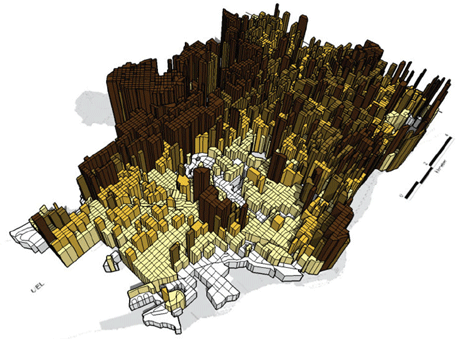
Ratio of Vancouver's dwellings per acre by the city block, based on latest census. Click here for a larger version with statistical key. Graphic by E. Villagomez.

As one of Mayor Sullivan's many pet projects, EcoDensity has received its fair share of publicity and attention. For those of you "not-in-the-know," the EcoDensity initiative focuses on the idea that population/housing density is intricately related to environmental sustainability, housing affordability, and livability.

As the argument goes, housing people closer together reduces urban sprawl and our ecological footprint by making better use of smaller parcels of land. Similarly, with more people within a designated area, higher density allows communities to support local commerce, amenities, and transit. This, in turn, allows for the potential creation of walkable and transit-friendly communities.

With regards to housing affordability, the connection to density is related to housing type. In contrast to the typical homogenous single-family neighbourhoods, the belief holds that more diverse, dense house types create more diverse and affordable housing options (due to lowered construction costs, decreased development fees, and fees saved from using existing infrastructure) for a variety of households. Furthermore, this increased density would make new, more expensive energy technologies (i.e. district heating, etc.) more viable.

Lastly, and most importantly, the EcoDensity initiative preaches the idea this density must be "strategically" located. And although there are several questions, concerns, half-truths and inaccuracies regarding all aspects of the EcoDensity argument, one of the most deceitful revolves around the seemingly harmless issue of "well-located" density.

What's been densified in recent years

As most locals know very well, Vancouver has been growing and densifying at an astonishing rate over the past three decades. Buildings have been demolished and neighbourhoods transformed seemingly all over the city. In reality, however, this uniformity of growth, densification, and development is an illusion.

In general, Vancouver's growth has largely taken place in either derelict areas or neighbourhoods with minimal political representation -- namely East Vancouver. The formation of the great east-west divide goes back many years and is nothing new to any local resident. But how this has shaped the city itself is a very telling and a relevant story to what EcoDensity really means for the future of Vancouver -- an issue constantly evaded by the City of Vancouver and other avid EcoDensity supporters.

The creation of rules and regulations pertaining to building and development often take place behind closed doors. Aside from those brave homeowners who have delved into the murky waters of municipal affairs when applying for building permits, few of us are ever exposed to the effects that municipal policies have on the creation of a city. Jargon-based, poorly written, and overly confusing, reading municipal documents -- such as zoning bylaws -- is akin to some kindof water torture . . . slow and annoyingly painful.

City Hall's double standard

There is much lost, however, through the public's ignorance of these highly influential documents. For it ensures that citizens don't understand how values, biases and prejudices are institutionalized and fossilized into the way we build our cities. Even worse, it allows those familiar with the terminology and processes (an elite minority of community members, politicians and municipal officers) to publicly speak one message while silently communicating another.

This issue becomes exceedingly important when discussing a city-wide densification initiative such as EcoDensity. For, although it is touted as pertaining to Vancouver as a whole -- and although there may, in fact, be good intentions behind it -- the reality of it will necessarily be skewed in the direction of wealthy, politically savvy communities and individuals that this city has historically always favoured.

Through the 1980s and '90s, a number of important new zoning bylaws -- setting out the rules and regulations to which builder and designers must abide -- were introduced. Several of these bylaws such as RS-7 and RS-5 -- often aggressively pushed by wealthy community associations -- had the calculated effect of deflecting denser developments to East Vancouver. Under the guise of "maintaining the streetscape and local character" and through carefully developed incentives, these policies have served to preserve social homogeneity and the high land values of well-to-do communities through excluding intensification.

With limited land to develop and a growing immigrant population, these municipal practices served to direct densification beyond the concerned gaze of its wealthy inhabitants to East Vancouver. This took the form of rampant demolition and replacement of older housing stock that was, more often than not, replaced by poorly designed and built speculative housing or subdivided (legally and otherwise) into several substandard dwelling units.

Mapping the lopsided reality

At the scale of the city, this lopsided bias is blatantly expressed in the three-dimensional density map above showing population densities -- in dwelling units per acres (du/ac) -- by the block. Drawn in accordance with most recent census statistics, one can see the vast difference in population as one travels from west to east.

Given how difficult these bylaws are to change after implemented -- and despite the "intention" to re-visit the RS-5 zoning -- it is fair to say that EcoDensity will serve to exacerbate this biased condition and maintain the status quo. NPA Coun. Suzanne Anton's recent citing of Fraser & 48th and Victoria & 49th as specific areas that could "benefit" from EcoDensity serves to prove the point.

Similarly, it is clearly stated throughout the EcoDensity website that the initiative is not intended to overwrite the city plans and community vision documents created by different neighbourhoods. These visions serve to express (and, effectively solidify) the values residents have regarding their neighbourhoods. Thus, for example, it is no surprise that 86 per cent of residents within the Arbutus Ridge/Kerrisdale/Shaughnessy neighbourhoods support maintaining "most single-family areas" within their jurisdiction. Without an ability to address these biases, densification promises to be lopsided.

Eastside is doing its share

This is no small deal, since most of the East Vancouver neighbourhoods are already within, or close to, the density range that research has shown to be "sustainable" -- that is, densities between 15-20 dwelling units per acre that are enough to support walkable communities with local commerce, economically viable transit and a variety of house types that accommodate a diversity of households. Commercial Drive, Hastings-Sunrise, Main Street and Victoria Drive between 33rd and 54th are excellent examples. Thus, one can reasonably argue that East Vancouver is already "EcoDense" or, at the very least, much closer to "EcoDensity" than its Westside equivalents.

Looking at the densities of several of these Westside neighbourhoods -- some of which are the lowest in Metro Vancouver -- it would seem reasonable to asked our heroic leaders at the City of Vancouver to do something truly forward-thing, progressive, and "green." That is, focus its energy on reversing the institutionalized prejudices of the past three decades and stop subsidizing our wealthy patrons' insatiable appetite for "unsustainable" land-use practices.

Growing EcoDensity concerns among Eastside neighbourhoods is not a misunderstanding of the intentions of the initiative, as many advocates currently hold. To the contrary, it seems to me that it is simply a manifestation of the fact that these often under-represented citizens will not stand to have green smoke blown in their faces to justify yet another Westside swindle.

Related Tyee stories:

 [Tyee]

20  Comments:

Login or register to post comments

  • allertonm

    5 years ago

    Clipping?

    I like the chart, but can't help thinking that some information is being accidentally lost, if not deliberately obscured. For example, it shows the Wall Street area of East Van and the downtown peninsula as the same colour and height - i.e "densest" - but I think it is pretty safe to say that one is much denser than the other. What is the densest block in Vancouver? How dense is it?

    Without that information, for all we know there could be as much variation within the "dark brown" category as the rest of the chart put together, which would make the basis of your article fairly questionable.

  • zalm

    5 years ago

    It's about time...

    ...that West side residents realized that their schools are closing because they don't have enough kids living there...and the best way to get more kids there would be to densify.

    I know, I know,...Barbie says "Math is hard", especially if you marry into money or inherit Daddy's business.

  • attaboy

    5 years ago

    This just in...

    ...Rich people have bigger homes, more land. Full story at 11.

  • Fiat lux

    5 years ago

    The concept of eco density

    The concept of eco density is nonsense. The bigger the city the bigger the damage it causes to the environment on a per capita basis.

    Most of this damage is caused by huge consumption of water, oil etc. and the resulting depletion and pollution to supply the inhabitants and the infrastructure with everything.

    I just took the enclosed chart of water use off the Net, which is typical for every major city, at least in North America.

    No wonder that with the forced depopulation of rural areas and the jamming of people into mega cities, we're facing a water crisis.

    Of course, waste raises the GDP, so everything is A-OK. Or is it?

    Ed Deak.

    Daily Water Consumption by Selected Texas Cities

    Measured in Gallons Per Capita Daily

    Dallas uses 244 gallons per capita daily.
    Brownsville uses 224 gallons per capita daily.
    Odessa uses 210 gallons per capita daily.
    Fort Hood uses 189 gallons per capita daily.
    Lubbock uses 171 gallons per capita daily.
    Laredo uses 182 gallons per capita daily.
    Austin uses 172 gallons per capita daily.
    El Paso uses 166 gallons per capita daily.
    Houston uses 166 gallons per capita daily.
    Denton uses 152 gallons per capita daily.
    San Antonio uses 142 gallons per capita daily.

  • alive

    5 years ago

    why not

    creme de la creme?

  • Bossfan

    5 years ago

    Where is

    Ah yes, where is Jennifer Clarke (The Queen of Creme) when we need her most?

  • vangruvie

    5 years ago

    Sam's pet project?

    I'm in favour of density...but when did this become Sam Sullivan's pet project. How about placing credit where it is due?...Vancouver city planners deserve credit for a livable dense city...not our self serving mayor.

    As for densification...it needs to follow a logical path. If the eastside makes more sense at present then that is where efforts should be focussed...then move on to other areas. Increasing density in the westside simply to achieve parity with the eastside is poor planning.

  • grapeman

    5 years ago

    What kind of density?

    As usual with Vancouver's discussion of greater density, what kind of density are we talking about? Are we looking for more one and two bedroom condos? Do we need more soulless, mono-cultured condo neighbourhoods like Yaletown? Or, will Vancouver face its own culpability regarding urban sprawl and look to affordable urban housing for working class and middle class families?

  • freebear

    5 years ago

    Eco Socially Just?

    A component of sustainability is social justice.

    Seems lacking with Vancouver's planning. All places atually!

    Also a result of private property and developer influence/funding.

  • chaosmaker

    5 years ago

    Re: This just in....

    [...Rich people have bigger homes, more land. Full story at 11.]

    But isn't the point that having single-family zoning laws amounts to a subsidy of rich people? Areas -- including Vancouver's Westside -- that are zoned denser will become denser because a developer will outbid most individual homeowners. Zoning prevents this and allows for single-family dwellings that are much cheaper than they otherwise would be.

    This is a good article that makes an important point.

  • Andrea from Bec...

    5 years ago

    Part of the reason that the

    Part of the reason that the West Side hasn't become very densified is basement suites. The housing prices there are extra-elevated by the prices people can get for basement suites, because of the supply of "good" tenants, like UBC grad students. Buying a duplex or townhome on the West Side doesn't make sense, because you can't rent out the basement. But, if you buy a house, you can live on the main floor and rent out the basement. Even if you make $150k a year and have $300k in equity, it's a big stretch to afford a West Side townhome and strata fees. But, if you can get approved for a $1M house, you can rent out the basement and actually breathe a *little* easier.

    Andrea
    http://www.consultantjournal.com

  • Grumpy

    5 years ago

    The density farce - or the grand con job!

    Densify, densify, densify, is the great clarion call of politicians and academics, yet no has stated what is an ideal density for the city. Is it 2,000 per sq. km.; 4,000 per sq, km,; 8,000 per sq. km.? what densities are we aiming for. We need higher density for transit cries Falcon & Harcourt, yet the West end which has Hong Kong style of density has very poor transit service. Not one of Vancouver's three metro lines service the West End!

    Eco-density (TM) is nothing more than Sam 'the unwise' Sullivan's sop to his moneyed pals, for when one increases allowable density, property values rise!

    As one planner from the states told me recently that, "Vancouver has lost its way on the world scene. Once a leader in innovative planning, Vancouver is now looked upon as the 'little city that couldn't. It has become a Frankencity, with all the ills of modern city, but those in power wearing rose coloured glasses, ignoring the growing unlivability of the city."

  • James Daniels

    5 years ago

    the map sure makes its point

    look, i'm not defending the enclave of the west-side, but the map would also have low density in the foreground looking from the east back towards downtown.
    There are areas of single family dwellings ringing all around downtown.
    they should have a special macro on shaughnessy.

  • City Person

    5 years ago

    Density

    There are now appoximately seven billion people in the world. A portion of them are going to end up in Vancouver. That is a simple fact. How we deal with it will have a profound impact on the future of our city. The "I'm here now so close the gate" mentality has gone on for far too long. This issue is nothing new. The poor decisions made in the the late 1970s and early '80s that bascically swept the issue under the rug has produced the problems we have in Vancouver now.

    Solutions? Well, in most countries, you cannot but land unless you are a citizen of said country.

  • alive

    5 years ago

    blame speculators

    City Person:

    Quote:
    in most countries, you cannot but land unless you are a citizen of said country.

    Buy land I assume?

    Even better would be to not allow anyone buying land for speculation, because it often means that said land lies fallow for ages waiting till the investor deems enough profit is possible!

    Maybe noone should own more land than what is needed for a residence unless actively farming!

    Maybe land as such should not be allowed to increase in value? there is a limited supply, so why are we hoarding it all up leaving nothing for future generations?

    We have enough profiteers buying "futures" on items of limited supply, Land should be excluded from speculation!

  • RossK

    5 years ago

    Densification And The Lack Of Political Representation

    "In general, Vancouver's growth has largely taken place in either derelict areas or neighbourhoods with minimal political representation -- namely East Vancouver."

    So.

    Just when is Mr. Sam Sullivan going to provide disenfranchised East Vancouverites with that long ago promised list of moneymen that bankrolled his successful 'Know Wards' (a.k.a. anti-political representation) campaign?

    .

  • smaller one

    5 years ago

    density and related BS

    If any of us (Sam Sullivan included) are truly interested in making the Lower Mainland a more "livable region" we must take into account a few facts.
    #1- every human is a consumer
    #2- because every human is a consumer that
    makes every human a polluter
    #3- densifing human population increases the density of pollution (stress on all of our infrastructures- water supply, roads, sewer and waste water treatment, etc.)
    #4- densifing human population simply to support the money being made by the companies creating new housing and public transit in order to service an increasing population density is complete nonsense. This is a never ending, self engulfing, huge mistake. Yes, the developers are profiting. Are the rest of us? Can you afford to buy in Vancouver?
    #5- This is , of course, a global problem, but, who says that we must buy into this problem? Is there a "law" that states that we must over develope and therefore overpopulate our home?
    # I don't buy it, do you?

  • Jay Currie

    5 years ago

    The End of Single Family?

    A very interesting article.

    Cities tend to evolve and what was once single family housing becomes multiple. The West end of Vancouver being a case in point where, thirty years ago there were still several stands of old single family houses. Same with Kits and the Fairview slopes.

    The gradual replacement of single family houses with apartments and condos is a process that a growing city can slow but not halt. Claiming that this is eco-density is a nice bit of spin but the underlying reality is the old economic rule of the marketplace.

    That said, there are miles of land near downtown which are undeveloped. Take a look at the Great Northern Yards behind the old train station on Main. And, at the same time, consider that the tallest buildings in Vancouver are what 40 stories? Building to 60-80 stories would make a great deal more sense. (Let's face it, the views are gone and the shadows pretty much overwhelm the sun downtown.)

    Vancouver has become unaffordable and, frankly, unlivable in many respects. A great place to do business but why bother living there?

  • zalm

    5 years ago

    Density at the expense of livability

    James Daniel says:
    "look, i'm not defending the enclave of the west-side, but the map would also have low density in the foreground looking from the east back towards downtown.
    There are areas of single family dwellings ringing all around downtown. "

    True in a few of the areas you mention, but most of those houses are on land zoned industrial, or next to industrial land. Most of the low-density spaces you see surrounding downtown are actual industrial land. If we are to be a livable city, there have to be spaces for businesses to operate, and not just ones that provide services to the city, but ones that generate or transfer wealth from the rest of the region and the province. Unfortunately, as the old industrial business left town, like the freight forwarders, CN/CP Rail, warehousing and industrial shops, the landlords of those properties pressed City Hall to allow rezoning for residential/commercial.

    Regretfully, City Hall did so, but at least made the landlords go through a process of Cityplanning first, at least in a few areas. Unfortunately, City Hall led that charge too, when they tried to set up zoning favourable to high-tech (I-2), but found it was a chimera.

    Now that land is being rezoned again - not back to M-1 or M-2 manufacturing/industrial, but to Commercial C-1 and Residential/Commercial MU-1. This effectively prevents small business from setting up in Vancouver, and seeing as big business has already fled the city to cheaper land in the suburbs, this city now has no economic base to create the livable city.

    That's why planners are now looking at moratoria on conversion of industrial lands. Unfortunately, its too late for about 1500 acres of industrial land in the city.

    Private property rights are not absolute. Unless you're a big developer.

  • netscaper2

    5 years ago

    Turn your garage . . . .

    . . . into a residence. So say's Sam. Of course you would then park you car or car's on the street.
    Then Super Sam would place parking meters on that street !
    But of course by 2012, with Gordo's gas tax, we won't be able to afford to drive. So, then you put a second floor on that ex-garage and sell that for gas money, then .........
    I'm so happy with our leaders I could cry !

    • The discussion for this story is closed. No more comments can be added.