It's the Tar Sands, Stupid
Canada home to global warming's new ground zero.
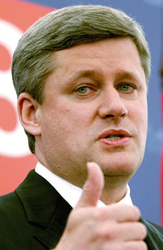
PM Harper: Bali ballyhoo.
You can't practice abstinence while running a brothel. Yet politicians of almost all stripes talk simultaneously about developing the Alberta oil sands while getting serous about reducing carbon emissions. Sound like a crock? It is.
Beyond arcane terms like "emissions trading" and "carbon credits," climate change is actually very simple: Every time we extract ancient carbon out of the ground and burn it we are making climate change worse. The more you burn, the worse it gets.
Bearing in mind that simple truth, how much extractable oil is in the Alberta oil sands? That is one area where industry and environmentalists agree. It's a lot -- about 175 billion barrels. That is second only to the oil reserves of Saudi Arabia.
Beyond this massive storehouse of ancient carbon, the additional problem with the oil sands is that is takes a colossal amount of energy to extract and refine the extremely low-grade tar deposits that cover more than 20 per cent of the Alberta landmass.
The oil sands are mostly rock and sand -- only 12 per cent is bitumen. This tar must then be upgraded at enormous energy cost to synthetic crude. That process consumes about 700 million cubic feet of natural gas each day -- enough to heat over 3.7 million Canadian homes. That massive waste of finite and comparatively clean natural gas is expected to triple in the next eight years.
Of course there is no point in creating synthetic crude oil unless you are eventually going to burn it -- that is what the oil business is all about. These "downstream" emissions are four times as great as the carbon released during oil sands production.
How Alberta will cook us
Doing the math a rather stark picture emerges. The average production and downstream emissions of Alberta synthetic crude add up to around 638 kg of carbon per barrel. Multiply that by the total extractable oil reserves and you get a rather large number.
When all the Alberta oil sands have been extracted, upgraded and burned, they will result in the release into the Earth's atmosphere of around 112 billion tonnes of carbon dioxide. That is equivalent to all fossil fuel and industrial emissions worldwide combined over a period of more than four years.
The planet's atmosphere is a finite system. It currently contains about 3000 billion tonnes of carbon dioxide -- about 35 per cent above pre-industrial levels. If all the carbon from the development of the oil sands were released at once it would single handedly increase atmospheric carbon dioxide concentration from the current level of 384 ppm to 400 ppm.
Some scientists believe that there is a one in five chance that a carbon level of 400 ppm this century would lead to catastrophic changes. In fact we are on track to reach that milestone by 2015. The oil sands alone would put us beyond that potential tipping point.
Of course, none of this cuts much ice with either politicians or the public. There is an oil boom going on in Alberta -- end of story. Even here in Canada, there seems to be almost no discussion about the eventual need to leave this dangerous substance in the ground.
Runaway mega-project
Consider this thought experiment: imagine the political likelihood of any government in Ottawa attempting to shut down of the oil sands. Recall what happened when Trudeau brought in the comparatively mild National Energy Program in the 1980s. Thirty-seven years later, Albertans have neither forgotten nor forgiven that perceived transgression into their sacrosanct industry.
Nor would the U.S. be indifferent if Canada presumed to leave our own oil reserves in the ground. In fact, George Bush committed in his 2006 state of the union address to end his country's addiction to Mideast oil. What he did not intimate to his country or ours was that the shortfall was to be made up by Canadian oil from the oil sands -- now deemed to be a national security objective of the U.S. government.
That same week in January 2006, Stephen Harper helpfully committed Canada to a five-fold increase in oil sands production during secret meetings held in Houston, Texas, between U.S., Canadian and industry representatives immediately after he took office.
Then there is a small matter of money. While oil companies love to whine about their onerous taxes, the fact is that they are now making astronomical profits. The break-even production costs of the oil sands are about $28 a barrel. World oil prices are now close to $100 a barrel. Royalties to the government are as low as 1 per cent and a new regime will not come in until 2009. Not a bad gig.
Assuming the oil remains at only $100 a barrel for the next few decades (highly unlikely), oil companies can expect to reap more than $12 trillion in profits over the lifespan of the oil sands. The oil industry is already the largest industrial sector the world has ever seen -- worth more than $8 trillion in sales annually. That is almost five times larger than the next biggest industry: cars.
Bogging down Bali
Keep all that in mind when Stephen Harper trots out his bizarre position during the UN climate negotiations this week in Bali. He is almost alone among world leaders in insisting that there be no binding emission targets until every country in the world signs on. One exasperated diplomat at the Commonwealth conference last month described Mr. Harper's position as "a perfect recipe for making sure nothing happens."
All this is a good example of how far political and public discourse has to go to deal meaningfully with this planetary emergency. Try to imagine some future reality where we collectively commit standing armies to known oil reserves -- not to facilitate their extraction -- but to ensure that it never is. That is what it might eventually take to prevent global catastrophe.
Given the pell mell development of the Alberta oil sands, we instead have a very good idea of how much and how fast the world's fossil fuel deposits will be extracted and burned -- all of it, and as fast as possible.
The chemistry of the atmosphere doesn't care what disingenuous political posturing happens this week in Bali. Climate change is very simple. The more you burn, the worse it gets. We ignore that simple truth at our peril.
Related Tyee stories:
- Will Voters Turn Politicians Green?
Global warming tops polls, but how much heat do officials really feel? - President Stephen Harper
Is he governing for Canada, or just Alberta? - Green Spin Out of Control
Forests and seas healing! Oil aplenty! And more eco-baloney.


ThisCanadian
03-12-2007
When Canada can wrap its collective head
around the idea that there is a *future* for Alberta & BC that doesn't include petroleum or Old Growth lumber...
& embrace the massive future that can be had in renewable, alternative industries...
...we'll get somewhere.
Until then... I'll keep flashing back to my childhood in NS where everyone kept assuring us that the Fisheries would return...
No, I'm not saying biodiesel.
But its tragic to me that American transnationals with their Toronto & Montréal investors have convinced Canadians that we're helpless without them.
Yeah, the GREEN movement is really about starving families & undermining culture.
& people *believe* that?? amazing how easily people get scared into believing the things that keep their World small... & smaller, every day.
Meanwhile SPAIN is leading the World in this technology. Australia's Global Warming crisis has actually reached a tipping point...
& Canadians are happy with the idea that Harper is seeking a massive 'Carbon Trapping/Reclamation' engineering project... that of course, will be sought by... more of the same folks that brought us the Tar Sands.
...& *how easily* could Canadians install solar roofs & make a massive dent in our consumption?
*snap*
just like that: a distributed, independent & renewable solution.
but there's no money in that for Corporate Croney-ism, is there?
the problem with these massive initiatives? we *have* a trade surplus... because we allow the rape of our resources.
that won't last forever. & these massive initiatives do *nothing* to create a renewable & sustainable economy. But we'll pay out massive fees to services that purport to *someday* sweep up behind our dirty feet.
===
Spread Love...
BlueBerry Pick'n
can be found @
ThisCanadian
~~~
"We, two, form a Multitude" ~ Ovid.
~~~
"Silent Freedom is Freedom Silenced"
joanie
03-12-2007
Tar Sands
Canada cannot rely on the Tar Sands for long-range security, we cannot afford to create environmental havoc with this. We do not have the luxury of time to figure out that further development of the Tar Sands has to stop now, or we are in serious trouble, even as soon as 20 years.
In 2011, the first wave of baby boomers reaches 65, now a lot will retire, and they all will be able to start collecting CPP. Health care will start to become strained, even more than now, water, air, sustainable living will be even more expensive to maintain, as the money goiung into the system will start dwindling and the next generations paying into the system will be far less.
So who is going to be able to afford to buy skyrocketing gas prices?
ONLY THE RICH.
Do you think the rich will stay rich if no one is spending as they have been?
I think not.
So, you see the snowball effect will be HUGE, and we will all have to bite it.
This is just the tip of the iceberg, we have to get smarter, and think in terms of 20 years not 4..
fabian
04-12-2007
Kyoto isn't achievable but who will admit it?
I agree with the article that the Tar Sands industry in Alberta consumes a volumnious amount of oil but I feel this article lays too much blame on Alberta's main export for Canada's failure to meet its environmental/Kyoto goals. When Kyoto was negotiated in 1997, the Federal Liberals decided that Canada would cut its greenhouse gas emissions to 6% below its 1990 levels. But then they failed to do anything to meet this goal--perhaps because they knew this would hurt the manufacturing sectors of Ontario and Quebec--where most Canadians live. In contrast, the Australians were wiser: they signed in on a deal that permitted them to maintain their emissions levels at 108% of their 1990 levels. That is one reason why its PM Kevin Rudd just signed the Kyoto accord into law today in Australia. Kyoto is more achievable for the Aussies.
The Federal Conservatives were always agnostic on Kyoto amd it doesn't help that their main political support comes from Alberta where the oil industry is based. Today, Canada's overall emission output is 33% above its 1990 Kyoto levels under both Liberal and Conseravtive administrations. If we try to meet out Kyoto commitments and reduce our emissions to 94% below its Kyoto levesl, this will surely wreck our manufacturing and resource economies especially when our main neighbour and competitor--the US--and the 4 major BRIC nations are studiously avoiding anything which will tie their hands economically. For instance, China is opening a new coal plant every week--and the Chinese get off scott free here under Kyoto.
It seems to me, rightly or wrongly, that PM Harper is right to want a global commitment to curb greenhouse gases especially when Canada forms only 2% of the world's economy. But our Federal politicians--excepting the Conservatives--don't want to admit that Kyoto is dead on arrival in Canada today. If Canada had signed a deal at Kyoto which stated that Canada would limit its greenhouse gas output to 110 or 115% of its 1990 levels, there would be considerably more pressure on Harper to really implement Kyoto and get tough with the oil industry in Alberta and manufacturers in Central Canada since Canada could actually meet this goal.
Cycling Commuter
04-12-2007
Solar Water Heater Energy Payback Period
*how easily* could Canadians install solar roofs & make a massive dent in our consumption?
Yes, solar can be an important part of the solution. Evacuated tube solar collectors are up to 85% efficient and they can produce hot water on a sunny day even when it's 40 degrees below zero (C or F) outside. 40 below C is the same as 40 below F because the two temperature scales just happen to converge at that point.
Financial payback period for solar hot water heaters currently runs from 5 to 15 years depending on interest rates, hydrocarbon prices etc. When Canadian natural gas starts to run out in 8 years, we'll have to import the stuff, the cost will skyrocket and the solar payback period will get much shorter. Even a worst case 15 year payback period is a lot shorter than the 25-40 year payback period for building new hydro dams.
Some people who are making huge profits or wages off hydrocarbons try to disparage alternate energy by claiming that the energy required to manufacture solar collectors is more than the collectors will produce. But according to a breakdown at
http://www.trendsetterindustries.com/apricus/FTD-801-2-EmbeddedCarbonEmissions.pdf it only takes 62 days for an evacuated tube solar hot water heater to produce an amount of energy equal to the energy consumed to manufacture the collector. And that's assuming a collector efficiency of only 65%. The payback calculation even includes the energy required to produce the cardboard packaging the solar water heater is shipped in. The chart shows 114.5 kWh is required to produce the cardboard packaging vs 91.8 kWh required to produce the copper in the solar water heater.
Solar water heaters are generally expected to last 25 - 40 years, perhaps more. It mostly depends on corrosivity of the water they're exposed to and thickness of the copper tubing. I paid $60 each for two solid brass 22 gallon hot water tanks from 80-year-old houses that were being demolished in Point Grey. The tanks show no signs of corrosion after 80 years of service exposed to city water.
Collector lifespan can be extended by using a hot water tank with a coil of copper tubing in the bottom to transfer solar heat to the tank then recirculating super-pure, deoxygenated water between the solar collectors and the copper coils instead of letting ordinary tap water run through the collectors. Even when the copper tubes in the collectors corrode to the point of requiring replacement, the energy/environmental cost of melting down the old copper tubes and making new copper tubes out of them will be much lower than the energy/environmental cost of mining new copper. So the energy payback for rebuilding these solar collectors 40 or 80 years from now will likely be less than 62 days. If the remanufacturing is done locally, the 114.5 kWh cardboard shipping box may not be needed.
rangergord
04-12-2007
Tar sands
It's too bad we do not have a national energy program, that establishes energy security and sovereignty for Canada first and foremost. After that we could decide to cancel NAFTA, and have a choice over how much we export. Other than the enormous quantities of natural gas and water consumed to refine tar sands, I don't think it matters much wether we export oil or not. If we do not sell the US oil, someone else will, although maybe at even higher cost. So globally emmisions will not go down. Emissions trading and carbon credits will allow the big picture to be obscured. Global warming is an awfully fuzzy science anyways. It all adds up to a massive cash grab on the part of both the oil companies and the enviro-fascists. Meanwhile the new energy technologies that can solve the problem continue to be ignored. Check out
www.freeenergynews.com
Budd Campbell
04-12-2007
A QUESTION FOR MITCH ANDERSON
Mitch, ... since you're an expert on the science and the politics of climate change I have question for you in terms of the implementation of the Kyoto accord.
For oil and gas produced in Alberta, or in BC's Northeast, but consumed in the United States, and for coal produced in BC but consumed in Asia, where do the GHGs produced when these fuels are consumed count in terms of Kyoto limits? Do they count against the limits of the producing areas (BC and Alberta), or against the limits of the consuming areas (US and Asia), or against both?
Mitch, I await your answer!
alda
04-12-2007
nice coincidence
It's a nice coincidence that this important and relevant article shows up in the same issue of The Tyee as Murray Dobbin's spot-on article about the CBC. The two are not unrelated issues by any means.
While most of the discussion above is intelligent and fascinating, it is, in the final analysis, mere talk. The real problem is how to get the masses to wake up, vote in their best long-term interests, something they clearly don't know how to do.
In my opinion, the left wing in this country has GOT to unite in some new way that has not been explored before. Or do we require complete and painful collapse in order for the suffering citizens to arouse from their slumber? All talk and no real action is akin to the road to hell being paved with good intentions. Everyone is waiting for leadership, but what I think is more important is that we need UNITY and humble, genuine cooperation by the entire humanistic segment in this country.
freebear
04-12-2007
Energy Superpower!
Remember PM Harper announced that he expects Canada to turn into an energy superpower!
Of course this will also mean we may become more of a terrorist target, especially supplying the U.S. with oil (to fuel their fight for more oil!)
Of course NAFTA means that we can not reduce the current export volumes of oil, whether we want to leave it in the ground or not!
The planet is &^%(&$%# because we think its too hard to change for the better.
Good Luck Earth and its inhabitants!!!!
macsasquatch
04-12-2007
Learning from Kyoto targets...
Lessee what I can learn here,...
The Libs did not do enough, so now we can't meet the targets, so we don't do anything to meet the targets...
Okay, so with the kids'sports team I coach, our target is the championship at the end of the season.
But the previous coach did not rebuild, consequently, all my kids are rookies, so there is now way we can meet the target of winning the championship.
So, we quit,...we don't play...
Working Man
04-12-2007
Excellent Observation
This is truly an excellent observation, one that I have been making for years. The left also has to come up with some concete way of implementing its policies in a way that are attractive to voters.
Fossil fuel use is with us for immediate future at least. Our challenge is use these rescources wisely and reduce them. This can be very easily done, for example taxing cars on CO2 output and using nuclear energy to extract the oil from the tar sands.
rangergord
05-12-2007
Ed an Enviro-fascist?
I am shocked, I never would have guessed. Forget about getting any of the money, it won't trickle down to the little guys. By envirofascist's I mean the government and corporate fakers that push the global warming crisis. A crisis that means we should suspend rational thought and just pay the carbon taxes and enviro-fees already. These guys had no real interest in environmental issues until they realized that they could dupe the masses into paying penance for environmental sins and reap enormous profits and revenues. Now I consider myself an environmentalist, although of a different stripe obviously. We have many choices about what to do to about environmental problems. With the high cost of energy, and air pollution problems worldwide we should all conserve energy and seek to reduce our emmissions even if global warming science is suspect. Technological solutions such as contained in the link I posted above should be pursued without delay.
Frank
05-12-2007
Why?
But if there is no such thing as climate change why would we conserve energy and reduce emissions?
Pollution? Does the right-wing of the spectrum even concede that industry and cars cause pollution? And that it causes deaths every year? Do they think that there are limits to our available energy?
Apparently not. They instead believe that what problems there are will be fixed by the stock market directing money into the hands of clever people who will save us via technology.
So if that's all true, I say buy a car with an 8.1 litre V8 and throw all that trendy stuff like windmills and solar panels onto a really big tire fire because its waste of money that would be better spent on corporate tax breaks for the oil industry.
Working Man
06-12-2007
Really?
I would like you to show me where. What I have said, repeatedly and to your deaf dogmatic ears, is that the left needs to come up with policies that actually make it attractive to voters. Try these:
1) Auto taxes based on CO2 emissions. While you are at it, double gasoline and diesel prices. You'd see cars like the Opel Corsa 1.3 litre common rail multijet next week and the end of Chevrolet Avalanches.
2) All new homes shall have rain water collectors, sewage digestors, instant on hot water systems and the most efficient heating systems for the are. It is incredibly inefficient to have 200 litres of water sitting in a tank all day doing nothing. North America is the only place I have ever seen a "hot water tank."
3)Tax breaks to encourage retrofit of such energy saving devices.
4) Limits on the amount of living space that each person needs. For example, any dwelling with more than 50 square metres per person would face much higher property taxes.
5) A comprehensive public transit system funded by those CO2 taxes on autos.
6) Instead of insisting on two parking spots per housing unit, legislate one parking spot for two units.
7) Actually accepting the fact that the population of the world is increasing and that will spill over even to Dear Olde Vancouver. Tax the living cr*p out of the monster houses between Abutus and Dunbar and build subsadised sutainable medium-density housing so working people can actually live and work in Vancouver.
These are only a few things the Left could embrace to get elected. But tjhey don't. They spew the same dogma they did 50 years ago. These policies are being advocated by the Green Party which is taking votes away from the NDP like crazy. Are these ideas "right wing?" I don't know but I don't exactly see Comrade Carole embracing them.
Would the NDP implement these policies? No way they would because they would be afraid of alienation of the unions that represent the dying "domestic (really a usless term in Canada)" auto industry and the construction unions.
The Green Party, on the other hand, is advocating economically and environmentally sustainable policies and will continue to get my vote.
freebear
06-12-2007
Good ideas Working Man!
I like your suggested new 'rules', I have 'pitched' ditching property tax and switching to sustainability tax, which would use measure similar to soem of your suggested rules (e.g. taxing excessive living space and space for cars!).
It does not however make me want to vote Green.
Do the Green's still believe in a growing economy, or do they recognize there is a limit, which would then influence 'rule-making' and really bring about positive social, economic and ecological sustainability?
Too few voters seem to want that!
Most unfortunately!
I have a sustainable vision for Canada, but too many think too little about it.
I suppose that is why I may never be elected Prime Minister!
Working Man
06-12-2007
Karma vs. Dogma
Do the Green's still believe in a growing economy, or do they recognize there is a limit, which would then influence 'rule-making' and really bring about positive social, economic and ecological sustainability?
Implementing the policies that I have mentioned above will definately cause economic growth. To provide the basic needs of life for an expanding population in a democracy also requires growth because you can't simply expropriate property because history has shown this to be not terribly effective in the long run.
Also, freebear, most voters and middle class people with families (such as myself). They are going to vote for stability and what is best for them. Since we live in a democracy, this is what the political parties present to voters.
However, in my age demographic, presenting both economically and environmentally sustainable policies is very attractive and that is being reflected by the increased share of the Green Party in BC and the rest of Canada.
The Green Party has also been instrumental in getting progressive legislation passed in Europe such as auto taxation based on CO2 output
Growth is not necessarily a bad thing. Building Skytrain down to UBC will cause growth but it will also vastly reduce the number of cars and on Broadway.
Like it or not, people are not moving back to caves. They are not moving back to the 1950s. Arlo Guthrie is but a memory. Canadians are some of the highest CO2 emitters in the world and that amount could be vastly reduced if the political will existed.
G West
06-12-2007
working man
I'm inclined to agree with Frank about your previous submissions relative to the 'left'.
Let's say, as a kind of introduction that - despite what may have been your intention, you have never come across in your posts here as a 'progressive' individual: Quite the contrary, in fact.
There's a hint of that same disingenuous attitude in your magnum opus just above too – please don’t take it as unkind that you really have sounded like a typical entrepreneurial union-basher a great deal of the time.
You also made a series of erroneous posts about taxes as well about which I'm not going to argue at this point since I’ve already addressed both that and your mistaken statistics about education and the costs thereof.
There's a good deal of positive thought in what you've written today - although I think you fail to appreciate that the kind of program you're suggesting would never sell in an election campaign. For exactly the same reason that any mention of removing the home owner grant and increasing the rate of tax on homes above a certain assessed value (something, you'll remember, that the NDP tried to do when it WAS in power) causes apoplexy not only in the electorate but, more importantly, in the media conglomerates and businesses who sustain, finance and defend the current system. Without a change in the rules about how elections are run, political parties are financed and managed and lobbyists are allowed to infiltrate the upper echelons of power there is no possible way that your program would fly except at the point of a lot of guns if a party, once elected, chose to implement your ideas.
You also ignore the fundamental problem of a democracy: That it is necessary to obtain the 'consent' of the governed and that, were the measures you've outlined to be implemented tomorrow your version of a green utopia would be run out of town on a rail.
Which is why, sadly, I’ve come to the conclusion that the only likely way for radical improvements to be adopted and sustained in this province is after the cathartic effects of a complete – or near complete – economic or natural collapse.
The other thing I notice from your set of proposals is a striking reliance upon the construction and development industry as the savior of the piece. I can’t help but say that, in fairness, I think there's a good deal of self-interest in your proposals too.
realisticman
06-12-2007
Yeah, tax breaks
Working Man
I like this one:
The oil sands will be delivering 4 million b/d by 2020 and still producing in the 22nd century. By that time the world will probably be cooling again.
margot
07-12-2007
sewage
Back to the tar sands, Ok?
Some of our energy needs could well be provided by what we make such a ridiculous fuss about getting rid of. Sewage.
Millions of homes in rural China have a simple little dome in the ground that turns the urine and faeces from four people and two pigs being raised for market to lighting, cooking gas, and in some cases, hot water.
Sweden has apartment complexes built around a central sewage to heat and hot water methane/natural gas system.
Talk about renewable.
Toronto sends landfill gas to many homes in the area.
Where I walk my dog and fling her shit into the bushes, blackberries by Lulu, we send hundreds of pounds of dogshit in little green "eco" bags to Cache Creek every week. It's absurd. We could have a tube or two, with lots of baffles, to a methane digestion system to provide, if nothing else, heating and hot water and cooking gas for the sports facility building.
Oh by the way, when I do the Cowichan fling, I use a little green reusable "eco" bag on my hand. And put it back in my pocket. And people shudder.
How do we get over this?
politico
07-12-2007
Quote:In my opinion, the
This is truly an excellent observation, one that I have been making for years. The left also has to come up with some concete way of implementing its policies in a way that are attractive to voters.
The commentary avoids the nuclear elephant in the room. As noted, Harper intends on achieving Energy Superpower status. This should not be ignored. Nuclear power will drive the quadrupled extraction of the tar sands and after the privatization of the billions of public dollars invested in the AECL, look for the Corporateers to drive a nuclear agenda unparalleled in history.
Gary Lunn has got the ball rolling and announced last week, without public input or parliamentary debate, that we are now partners in the Global Nuclear Enery Partnership (GNEP). If anyone believes that Canadian citizens have any capacity to shape our destiny in this regard they are sorely mistaken. This Government has no intention of following the citizens lead and is utilizing every known tactic to usurp the rule of law in implementing its agenda through partnership agreements such as the GNEP, the SPP and TILMA.
We can do one thing. Vote them out and we can start right here by paying particular attention to our Natural Resource Minister's riding of Saanich- Gulf Islands.
Visit http://members.shaw.ca/shunlunn/ and see how you can make a difference.