Opinion

Corny Energy 'Solution'

Last stage of denial: ethanol will save us!

By Murray Dobbin, 4 Apr 2007, TheTyee.ca

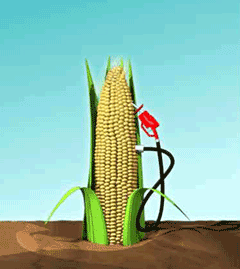
Corn cob with gas pump

Recipe for hunger: food into fuel

Citizens in industrialized societies, including Canada, will cling to their extravagant lifestyles and massive over-consumption for a while yet, it seems. Global climate change is still seen by most people -- even those who have no doubt of its human origins -- as something that can be fixed by legislation, tougher rules and punitive penalties on big polluters -- and that allegedly clean and green quick fix, ethanol.

Yes, we can all keep our individual chunks of steel, rubber and glass, those symbols of 20th century excess and irrationality, so long as we shift to burning alcohol.

This particular mass delusion was madness enough to inspire the still-ailing Fidel Castro out of his bed to write the first editorial he has written for the country's principal newspaper, Granma, since last falling ill last July. It's not as if there is a lack of issues for the grand old commander-in-chief to comment on. But this one he deemed the most important. Why?

To quote Castro himself: "More than three billion people in the world are being condemned to a premature death from hunger and thirst.... The sinister idea of turning foodstuffs into fuel was definitely established as the economic strategy of the U.S. foreign policy on Monday, March 26th last."

That was the day that President George Bush met with the Big Three auto CEOs and declared ethanol to be the next strategic fuel for the empire -- and a partial answer to its failed Middle East policies.

20 per cent solution?

Castro was talking about corn but this is not the only grain that the ethanol pushers are talking about -- wheat, sunflower seeds, canola and other foodstuffs are already being used and targeted by, amongst others, the big oil companies. The demand for ethanol will be so enormous that only the largest and best capitalized corporations in the U.S. will be able to take advantage -- driving smaller producers out by driving up the price of corn.

Bush proclaimed coming out the meeting with the Big Three that he is aiming at reducing gasoline consumption by 20 per cent in 10 years -- a staggering number if it is to be taken seriously, requiring 35 billion gallons of ethanol. Of course Bush and his corporate allies talked about using wood chips and switchgrass, too, but corn is the key. To produce that much ethanol would take 320 million tons of corn. The UN's Food and Agriculture Organizations (FAO) says that U.S. corn production in 2005 reached 280 million tons and the U.S. produces 40 per cent of the world's corn, controlling the market price. It doesn't take complicated math to see that just to meet U.S. ethanol demands within 10 years will take up 46 per cent of the world's corn supply.

This is an obscenity. Because most of these billions of tons of corn are now eaten by the world's people -- most of them poor -- or fed to their livestock. Ultimately, it means that the world will have to produce more and more grain just to stand still and at the same time that the demand for ethanol increases the price of corn. The FAO says the competition between grain for fuel and grain for food is already happening and was the principal explanation for the decline in world grain stocks during the first half of 2006.

As Castro pointed out in his Granma article, not only will corn be priced out of reach for millions, "What is worse, let the poor countries receive some financing to produce ethanol from corn or any other foodstuff and very soon not a single tree will be left standing to protect humanity from climate change." He also pointed out, demonstrating that his grasp of world events is as acute as ever, that the increased demand for grain for energy will also greatly exacerbate the already critical water shortage facing two thirds of humanity.

Discouraging numbers

Despite this catastrophic scenario there are still those who will argue that the trade-off has to be considered, that global climate change due to carbon emissions must be tackled. But recently two Canadian studies raised serious doubts about what we actually get in this morally questionable trade. The U.S. may well get a strategic replacement for oil but there are serious doubts the world's climate will benefit. One study was done by the Library of Parliament's Frédéric Forge working in its science and technology division. Forge says the benefit of the massive effort required to use 10 per cent ethanol in all vehicles will be minor: "In fact, if 10 per cent of the fuel used were corn-based ethanol [in other words, if it were used in all vehicles], Canada's greenhouse gas emissions would drop by approximately one per cent."

But an unpublished study by Environment Canada says even this estimate is questionable. A recent CBC report -- it came and went with no one else touching it and was not repeated -- revealed that scientists at Environment Canada studied four vehicles of recent makes, comparing normal emissions with a 10 percent ethanol blend and using a range of driving conditions. The study revealed that there was virtually no statistically significant difference in greenhouse gas tail pipe emissions. Some of the hydrocarbon gas emissions actually increased under some conditions.

The delusional thinking that tells us we can maintain our current lifestyles and save the planet will, sooner or later, be relegated to history's dustbin. The sooner we dispose of that part of the delusion embodied by "salvation by ethanol" the better. Then we can start on hybrid vehicles. And since you asked, I don't own a car. I am member of the Co-operative Auto Network.

Related Tyee stories:

 [Tyee]

38  Comments:

Login or register to post comments

  • Frank

    6 years ago

    Monbiot

    Read George Monbiot in the Guardian for more info on this topic.

    http://www.monbiot.com/archives/2007/03/27/a-lethal-solution/#more-1051

    The fact is, nothing short of a miracle will get humanity out of its predicament.

    To believe that we can halt or reduce emissions when the population is growing is lying to yourself or you have an incredible faith in capitalism's ability to invent a new technology.

    The world needs to reduce its population drastically while halting the growth of per-capita emissions through either conservation or technology.

    Even if that were to happen it may already be too late according to some.

    Growing corn for ethanol is at best a misguided attempt to help the planet, and at worst you have to wonder what the real motivation is.

  • maestro

    6 years ago

    The evidence suggests:...

    The Ethanol from CORN option is a very BAD idea.

    The Details have many Devils in them, few if any " Saints and global salvation" .

    PS: Good article.

  • Fiat lux

    6 years ago

    The only solution is the

    The only solution is the breaking down of top down gloablization, the breaking up of huge multinational conglomerates with the already existing anti cartel and anti trust laws, the reregulating of banks by removing their free money creation powers, the rebuilding of bottom up, labour intensive , local production systems, cutting back and dismantling the armed forces, and airlines.

    In short, a physical laws based economic system.

    Money is now a licence to control energy, issued by a special interest sector for its own benefit, licencing human and environmental destruction.

    Until this is realized and stopped, there's no hope.

    Ed Deak.

  • Fiat lux

    6 years ago

    April 4, 2007 How Biofuels

    April 4, 2007

    How Biofuels Could Starve the Poor

    By C. Ford Runge and Benjamin Senauer, University of Minnesota

    Filling your tank with ethanol may mean emptying other people's wallets and stomachs.

    http://www.foreignaffairs.org/20070501faessay86305/c-ford-runge-benjamin-senauer/how-biofuels-could-starve-the-poor.html

  • G West

    6 years ago

    Yep!

    The world's population is increasing by about 70 million net with each passing year; at the same time the carrying capacity of agricultural production is falling behind in the race to feed the folks already here and we're drawing down stored reserves already.

    Just look at grain and corn futures (there's another tip for you cappy). In addition, we're going to start converting more food into alcohol to run our cars so we can avoid making the real needed changes in our lifestyle to save the environment. Funny how Fidel Castro sees these things so much more clearly than George Bush. Sad.

    Well, get ready to watch a lot more of those ads on TV about starving people folks.

  • Grumpy

    6 years ago

    This is the end......

    I am very pessimistic about the future and nothing short of a thermonuclear war will fix it.

    Our current business mantra, based on trillions of 'paper money', driving so called stock markets, is obscene. This is not 'free' or 'private' enterprise, but something horribly evil.

    Corporations care nothing about the poor, rather it is the bottom line. The recent dog food poision recall is a good example; one manufacturer supplies many corporations, with everyone taking their cut, driving up the price.

    We live in an era where consumption is the great god! Just banning 'Fast-food' plastic toys would save much precious oil, but no, we allow the waste of useless toys as teaser to compel children to drag their parents into their 'greasy spoon'.

    It will come to a grinding halt, as we cannot sustain our way of life, what then? A mass extinction of the human race, there is no alternative.

  • Gary

    6 years ago

    Personally...

    I think Bush and the rich boys are trying to starve out the poor this way. I would advocate Hemp Fuel. You wouldn't have to eliminate the corn fields. It would grow anywhere. Especially in the timber clearcut areas.Why just using those areas here in BC would probably fuel most of the vehicles in North America. And using the stalks would reduce our dependancy on wood for making paper. But of course this non harmful product is illegal. Why? Well big business doesn't like it so they lobby the government to keep it illegal. Have a look at http://www.hemp4fuel.com

  • Cycling Commuter

    6 years ago

    Soil erosion is a big problem too! Electric cars are better.

    Quote:
    Fidel Castro wrote:
    sinister idea of turning foodstuffs into fuel

    Alcohol fuel is OK if it's made out of waste material such as rotten wood, potato peelings, fallen leaves etc. Making it out of food is truly evil. It's even worse when you consider that using current open-field production methods, one kilo of topsoil is lost for every kilo of corn produced. And of course all kinds of petrochemical-based fertilizers, pesticides and herbicides are used too.

    Quote:
    increased demand for grain for energy will also greatly exacerbate the already critical water shortage

    Yes, that's also a big issue.

    Here's an idea for a politicial cartoon. Frame 1 shows someone standing beside their huge SUV, fueling it up. Frame 2 zooms in close to the gas nozzle, showing a bunch of little American, British and Iraqi flag-covered caskets pouring out of the nozzle into the gas tank with a caption underneath saying "Iraqi Oil." Frame 3 is about the same except the caption says Iraqi/Iranian oil blend, and now there are a lot more caskets flowing, some with Iranian flags on them. Frame 4 is white text on black background which says, "Lets's try something different." Frame 5 shows a thin African child eating corn from a wooden bowl. Frames 6 and 7 show a well-fed American in gaudy tourist garb saying "Gimme that!," grabbing the bowl of food from the child and pouring it into the gas tank of his huge SUV. Frame 8 is text again, saying, "No, I don't think so." Frame 9 shows people walking, biking and driving ultralight solar-charged electric cars similar to the one at http://www.youtube.com/watch?v=M0JNohHaqM4 This vehicle cost only $2,000 to build, by the way.

  • bc4me

    6 years ago

    Lessons from the Dark Side

    When I want some insights into the Dark Side, a glimpse into the word of those who live without any sense of ethical purpose, I tune in to a certain Vancouver radio station (run by a media conglomerate totally without ethical purpose) on Saturday mornings to listen to a show hosted by a certain provincial premier's brother called 'M*ney Talks'. It's extremely disturbing and educational listening to the extraordinary exchange between C*mpbell and guests, who, evidently will hype and invest in any shameless enterprise, all in the name of 'Captain Capitalism!'.

    The last episode I listened to, a month or so ago, was C*mpbell and a guest extolling the virtues of investing in corn futures. In fact the guest was taking time away from a large conference he was attending where he was hearing from top US government officials who were all gushing over a "modern-day golden corn rush" (a phrase I heard on the show). Evidently, corn futures were promising but so was anything in the supply industry, too, from tractors to fertilizer.

    The previous show I tuned into a few months back was promoting uranium investing, with similar hype.

    God help us is right.

  • skeptikool

    6 years ago

    Some duped, but many in on the "fraud"

    While there will be those politicians duped into supporting the ethanol-from-food drive, I believe referrence to the "ethanol fraud" fits well.

    The addition of a little ethanol may tend to ease the conscience of the driver of the gas-guzzler but at unacceptable cost, as it extends our acceptance of the internal combustion engine and slows the introduction of alternatives such as plug-in EVs.

    This, I believe is a major motivation behind the promotion of ethanol. You may search long for such an admission in your auto supplement.

  • freebear

    6 years ago

    Preaching to the converted!

    This is not news to me, but nice to see the article.

    Ethanol - Anything to postpone reality! Similar to those tat are saying climate change will be good for us (Canada!) Fossil Fools!

    We must make do with less, consume less (and smarter), live in smaller homes, walk, bike and bus/train/tolley/streetcar, grow food locally, dump the Growth is God, and growth is unlimited, and technology will fix everything paradigm.

    Whay can't a computer be 'up to speed' for 10 years (since we are all using one to view this!)?

    Oh right, not enough profit and sales growth!

  • alive

    6 years ago

    too many people

    The world's population is increasing by about 70 million net with each passing year;
    Maybe this is the real problem?
    Let us spend those millions on free condoms and save the world that way!

  • Cycling Commuter

    6 years ago

    Cooperatively-owned vehicles make clean tech more affordable.

    Quote:
    Murray Dobbin wrote:
    Yes, we can all keep our individual chunks of steel, rubber and glass, those symbols of 20th century excess and irrationality, so long as we shift to burning alcohol.

    and

    I am member of the Co-operative Auto Network.

    Both individual vehicle ownership and cooperative ownership have advantages and disadvantages.

    I'd like to see individual ownership of small, light, low-cost, low-speed neighborhood solar/electric cars such as the one at http://www.youtube.com/watch?v=M0JNohHaqM4 with pedals added for exercise and extra propulsion-power/range similar to the Twike (see http://www.twike.ca ). With hinges and some ingenuity, a small vehicle like the solar-recharged one could be made to fold flat when not in use so that it occupies hardly any parking space. I bought a fold-up trailer that works like this. Cost was about C $450. See http://www.redtrailers.com/images/TrailerFolded.jpg and http://www.redtrailers.com/images/TongueRedTrailers.jpg

    Cooperative ownership would be more affordable for larger, more expensive vehicles such as Prius or Camry hybrids with plug-in conversions, plug-in hybrid vans with lots of photovoltaic panels on the roof, and small, single-occupant, high-speed electric cars such as the Tango (http://commutercars.com/images/gallery/customerCars/index/indexfiles/IMG_0496.JPG.jpg). Tiny, low-cost, individually-owned vehicles are ideal for short, low-speed neighborhood trips to pick up groceries etc. The Prius would be better for higher speed carpooling on freeways during peak traffic hours plus off-peak long-distance/high-speed multi-occupant social trips. The van could be used for larger carpools during peak traffic hours, hauling building materials during off-peak hours, and occasionally for camping on weekends. The Tango could be used for single-occupant, moderate-distance/high-speed, off-peak trips, and some local trips when there's too much snow on the ground for a tiny, light vehicle to handle.

    Taxicabs are usually not cooperatively owned, but they are cooperatively used. According to a March 28 Globe and Mail article, a Prius cab in Vancouver saved about $22,000 in gas in 2 years. Of 477 licensed cabs in Vancouver, about 50 are hybrids. Vancouver's licensing department may recommend issuance of 100 new cab licences requiring extremely high fuel-efficiency standards that are in line with what hybrids deliver. See http://www.theglobeandmail.com/servlet/story/LAC.20070328.BCGREENTAXI28/TPStory/Environment

    Former federal Green Party leader Jim Harris is heavily involved in arranging financing for hybrid cabs through the Cleantech Innovation Institute. Between that financing, federal and provincial rebates, and the availability of the Toyota Camry hybrid which is a bit bigger than the Prius, there's no reason why most cabs shouldn't quickly switch over to hybrids.

  • dolphin

    6 years ago

    Ethanol needs lots of diesel

    Growing corn requires a huge amount of petrochemicals--huge diesel tractors to plow, seed, fertilize, harvest, and transport to the plant. Fertilizers themselves are made from petrochemicals. Let's not even talk about pesticides, herbicides, and huge amounts of irrigation water.
    Cornstalks, wood waste, yard waste, yes, but taking food that humans or livestock could eat to make fuel is just wrong.
    Check out the air car at www.theaircar.com

  • Yammer

    6 years ago

    As CASTRO says...

    Oh, the grand old commander-in-chief has spoken!

    Yeah. Well...yeah. He did.

    Anyway, cars can't run on straight ethanol. Any measure that helps reduce the importation of Saudi crude, and therefore the power of the crude Saudis, is probably a good thing.

    As a solution, it's not going to help the starving masses (as Castro says -- I mean, I need to see that phrase at least 10x per article), but as a transitional bandaid between now and Ed Deak's plan (which will be implemented very easily and quickly, I'm sure), it's better than the status quo.

    Does anyone want to rip on biodiesel? I'm using it now, and just want to know from Castro or his mouthpiece just how badly I ought to feel about using processed french fry grease.

  • Frank

    6 years ago

    Castro's mouthpiece

    Ron, did you check out the Monbiot article on ethanol? Many would say ethanol is actually making things worse, that its not even a baby-step in the right direction.

    1. starving masses
    2. starving masses
    3. starving masses
    4. starving masses
    5. starving masses
    6. starving masses
    7. starving masses
    8. starving masses
    9. starving masses
    10. starving masses

    :-)

  • Yammer

    6 years ago

    Frank, LOL

    Man, you are a breath of fresh air here. Must be the ethanol.

    I meant, the phrase "as Castro says." What cult of personality?

    No, haven't read it yet.

    I agree with the general sentiment that plug in electric (perhaps hybrid with biodiesel in larger/longer distance vehicles) is the way to go over the current, century-old paradigm.

    Of course, where's that gonna come from? Nuclear! (As a transitional measure to beam-down microwave, or geothermic ocean generation -- which, you just know, are also going to be terrible in ways we don't understand yet -- a hole in the fourth dimension or something.)

  • clubofrome

    6 years ago

    Cling??

    I'd say clinging to their extravagent lifestyles is somewhat understated. Try white knuckled, feet dragging and screaming all the way as finger nails dig deep into the leather interior of their Lexus as we try and drag them out of this lifestle. I say leave the frog in the boiling pot of water as we may be hungry after the revolution...

  • Cycling Commuter

    6 years ago

    Gas-guzzling tanks as collision protection?

    A lot of people seem to drive huge, gas-guzzling tanks for collision protection reasons rather than carrying capacity. The recent move toward much higher insurance premiums for dangerous drivers could backfire if these are flat annual rates. After paying $10,000 for a year's insurance, many lousy drivers will drive as much as possible in order to "get their money's worth." That's the last thing we want them to do. The same drivers given an option to buy pay-as-you-drive insurance with per-km costs commensurate with their personal driving record, and that outright prohibits late-night driving (when many horrific crashes occur), will likely drive as little as possible during the day and let a safer driver take the wheel late at night at pub closing time. Getting these dangerous drivers off the road will help to remove the battletank excuse.

    Motor vehicle deaths per capita are about 40% lower in Sweden than in Canada largely because they get dangerous drivers off the road instead of mollycoddling them. See http://www.nationmaster.com/graph/hea_mot_veh_dea-health-motor-vehicle-deaths. The Soviets used to put drunk drivers who caused death in front of a firing squad. That's a bit harsh. But Canada is too extreme in the other direction, way too lax.

    A pay-as-you-drive auto insurance option also encourages people to obtain access to various sizes of vehicles and drive one that's appropriately-sized for the job at hand instead of getting a single huge vehicle that's big enough for all jobs then driving it exclusively. And pay-as-you-drive encourages people to walk or bike more often.

    The ultralight solar-electric vehicle shown at http://www.youtube.com/watch?v=M0JNohHaqM4 doesn't require any insurance at all in some jurisdictions.

  • JRG

    6 years ago

    Critically important topics

    Great stuff. Here is another article on the topic:
    Ethanol boom could worsen world hunger: study http://news.yahoo.com/s/afp/20070403/ - sc_afp/usenergyfoodeconomy_070403185953

    April 2 was a calendar marking day for Vancouverites IMHO. Please correct me since I actively avoid much of Vancouver's MSM I think the day was the first the print rags or TeeVee mentioned "Peak Oil," by the article's own admission not until after new reality us upon us (I have seen PO in the Sun's web articles before, but not its print)
    "Now that we are at peak oil, the next 50 years in food production are going to look very different"
    http://www.canada.com/vancouversun/news/ - story.html?id=ab7a0613-7ca4-4104-896e- 5f31a2eda914&k=91721

  • clubofrome

    6 years ago

    Deep Impact

    The activities of so many people, have been at the core of so many diverse problems. Isn't it funny when you hear someone say that the book "The Limits to Growth" was wrong, and that Erlich didn't have a clue. The impact of these activities predicted, are likely all true and then some! When the human population is a few hundred million scattered souls, I don't see anyone arguing that Erlich was wrong anymore. Another tidbit from GNN...

    Quote:
    Not only does the impact of agricultural practices of soil and water conservation and irrigation impact the climate directly by increasing the specific heat capacity of the continents and increased terrestrial evapotranspiration, but we are at the same time by withholding runoff from the sea inhibiting the natural process of CO2 sequestration and providing the nutrients upon which all sea life, including tropical coral reefs depend.

    It is for these and many more reasons that CO2 in the atmosphere is increasing, not simply because mankind is using fossil fuels.

    In the absence of the damming of the great river systems around the globe and the flood control it provides that in turn starves the seas of nutrients and inhibits the long term deposition of biological material in river deltas around the globe, it is unlikely we would have seen such a dramatic rise in atmospheric CO2 levels if a rise at all. Up until the past several decades deforestation had a greater impact upon anthropogenic increases in atmospheric CO2 levels than has the burning of fossil fuels.

    The slight increase of global average temperature we’ve experienced is due primarily to the anthropogenic increases in water vapor attributable to flood control, agricultural water and soil conservation practices and of course agricultural irrigation.

  • Cycling Commuter

    6 years ago

    Heavy manual labour is not efficient and not necessary.

    Quote:
    Fiat lux wrote:
    rebuilding of bottom up, labour intensive , local production systems

    Local food production offers the advantage of fresher, more nutritious produce as well as lowering energy consumption. But local production doesn't have to be labour intensive. An extremely fit person can produce short bursts of up to 250 watts of muscle power - about 1/3 horsepower. A photovoltaic panel with a 25-year warranty and rechargeable battery storage can power a 1/3 horsepower electric motor 8 hours a day, year after year at a cost of less than 20 cents per hour, assuming the system purchase cost is amortized over 25 years at 6% per annum interest.

    Why would anyone want to work themselves to death to avoid paying 20 cents an hour for 100% clean and reliable solar electricity? Even assuming a human could work that hard 8 hours a day without collapsing and dying, the cost of providing them with enough food calories to do a continuous 1/3 horsepower of work is going to be a lot more than 20 cents an hour. The ecological footprint of an adequately sized photovoltaic panel (about 4 square meters for a 12% efficient single-layer panel or 1.6 square meters for a 30% efficient 3-layer panel) is going to be 100 times smaller than the area required to grow the food necessary to produce the same amount of muscle power, even using the most efficient farming methods. And the land used for the solar panel can be entirely unsuitable for agriculture - a desert, the side of a steep cliff, salty soil, bare rocks, etc.

    Some physical exercise is needed for health reasons. But numerous studies have shown that about 40 minutes a day of enough exertion to bring a slight sweat to the brow is adequate. Doubling or tripling the amount of physical exertion beyond that doesn't improve health outcomes. Increasing the amount of physical exertion far beyond the optimum amount actually reduces physical health in various ways by wearing out joints, inflaming tendons, lowering immune system strength etc. The ideal amount of daily exercise can be obtained by briskly walking for 20 minutes to work or school in the morning then another 20 minutes on the way home.

    Former Olympics athlete Silken Laumann says children today are enrolled in twice as many structured sports activities as they were 20 years ago and yet they are half as active. She suggests creating neighborhoods that are safe for walking and playing and setting up "walking school buses" to get kids to school instead of driving them in cars or buses. See http://www.silkensactivekids.ca

    All the billions being pissed-away on the Olympics could have built one hell of a lot of sidewalks and pedestrian overpasses instead of pampering a few bloated egos while everyone else sits on their asses watching the elite.

  • jwstewart

    6 years ago

    CC's Energy Sink

    Cyclingcommuter;

    A 4 square meter solar panel would cost thousands of dollars, over 20 years there would be at least a dozen battery replacements each producing significant amounts of chemical and lead polution, and the energy to even produce such a power system would quadruple the cost.

    Of course, you are welcome to install such a system on your bike and tell us how it works.

  • Burgess

    6 years ago

    Seers not listened to.

    Years ago had a school principal in 1948/50 who predicted a) oil would run out, b) the US would control our water, c) the Fraser would be dammed for power and d) we should all become backyard gardners. He was right on all counts. Global economic collapse means an end to the standard of living we now have (enjoy?) The economies of the world can never ever recover from a global disaster as the "easiest' resources have already been used up (or plundered.) (One needs the 'easy resources' to get the 'difficult ones,' Given the present rate of exploitation no wonder the thieves are now starting to rip off copper, aluminum, brass, etc. There is a world shortage of resources and there are folks willing to buy even the brass plaques from war monuments and graves. When that runs out they will be into homes to strip the wires, pipes and whatever. A black view of things? Yes, but it is already happening in our new housing projects and will be coming to a home near you while your neighbour is away on holidays.
    PS When all the Fraser's tributaries are dammed for power and the salmon gone the Fraser will be dammed and the public will see none of the benefit as it will be the "private partners' that will walk with the money.

  • Umslopogaas

    6 years ago

    Population

    Not one of the eco gurus from Suzuki to Al Gore dares mention the idea of mandatory population control. That is the only solution but it is probably too late anyway. All this effort to conserve, while we breed more and more people is a farce.

    One way or another, nature will cause a large drop in our population very soon.

  • puppyg

    6 years ago

    corn into ethanol

    Such a bad idea. If corn works in the gas tank, then why not rice, trees or some of those animals you see running around unharvested on Wild Kingdom?

    Corporate solutions to global crisis... GAD! Say hello to the abyss.

    I have just read that the destruction of Indonesian and Malaysian rain forests has gone into overdrive, this to allow expansion of oil palm production for (wait for it...) BIOFUEL. Now, there's the answer!

    Does it really matter that the palms aren't being planted and that the companies only ever wanted the lumber? In the end, probably not.

    (I saw this lunacy in action a few years ago in Borneo where upstream travel was restricted to keep journalists from reporting on why all the rivers had turned muddy red.)

    Well, as a solution to global warming, George Bush had his team exploring the possibilities of swathing the Sahara in white plastic to deflect all the heat (no kidding - I did read this). Yup, another petro-solution. Go, George, save that planet!

    About corn, I have read of the enormous chemical inputs necessary to grow it and of the terrible toll it takes on the soil.

    Corn is cheap to grow on highly mechanized farms as long oil prices remain artificially low (i.e. subsidized by government). As such, food companies are always looking for ways to sneak more corn products into processed food. Their profits rise when corn-derived sugars and starches can replace costlier ingredients.

    Check out the ingredients in raisin bran or canned spaghetti sauce: glucose, dextrose, sucrose, fructose, modified corn starch etc., all listed separately. Is there any wonder why obesity and diabetes are taking control of our lives? Now that people are catching on, all that corporate corn will have to go somewhere, I am thinking, and our gas tanks will surely trump the world's poor.

    No blood for oil! No corn for ethanol!

  • clubofrome

    6 years ago

    Wild Doc's

    Good CBC show last night on El Nino and the history of research on climate over the last 100 years. How the history of this major weather system has shaped the world. Sending entire societies into extinction!! I find it amusing that humans today think they are insulated from nature, thinking nothing like that could ever happen to us. Humans have survived many collapses in the past and no doubt will survive this next one. But it's gonna be a big one! Lots of people depend on the global economy, or global crime wave is more accurate. The bigger they are the harder they fall. As noted in this thread and others before, the recovery is not as simple when the low fruit is gone. I've said this before, to howls of laughter, we're not far removed from going back to cave dwelling. Remember George C Scott in Dr Strangelove? "We must not allow a mine shaft gap!" Too far ahead of it's time. I love that movie!

  • skeptikool

    6 years ago

    Castro again hits U.S. energy policy

    There's little doubt that Fidel Castro has done much to spur a growing backlash against the ethanol fraud. In his second column, he warns that the U.S.'s energy policies could spark a global "holocaust".

    It is hoped that a reversal will not fuel support for moves against the moratorium on offshore oil and gas development.

    Government to be fuelled by Exxon?

    http://vancouver.24hrs.ca/TopStory/home.html

  • cpbl

    6 years ago

    misleading paragraph

    Quote:
    The study revealed that there was virtually no statistically significant difference in greenhouse gas tail pipe emissions.

    What would you expect? I don't know who made the error in interpretation, but this sounds misleading to me. There's not going to be a difference in tail pipe emissions. What matters is the life cycle. Did the emitted carbon come from fossil fuels or from last year's atmospheric CO2, fixed together with sunlight. That's what biofuels are about -- a shorter time scale between taking from the atmosphere and returning to it.

  • reality_check

    6 years ago

    biodegradable battery made out of sugar

    Excerpt:

    Researchers find sweet battery solution 11:47AM, Tuesday 27th March 2007

    Researchers have developed a battery cell that can run on sugar, lasts up to four times longer on a single charge than a conventional lithium-ion cell, and is biodegradable.
    The researchers, at Saint Louis University in Missouri, presented their findings at the 233rd national meeting of the American Chemical Society. They claim the new fuel cell can operate using almost any sugar source.

    'This study shows that renewable fuels can be directly employed in batteries at room temperature to lead to more energy-efficient battery technology than metal-based approaches,' said study leader Shelley Minteer, Ph.D., an electrochemist at Saint Louis University. 'It demonstrates that by bridging biology and chemistry, we can build a better battery that's also cleaner for the environment.'

    Minteer's battery cell contains enzymes which convert sugars into electricity, leaving behind a harmless by-product: water. Successful tests were carried out using a range of fuel sources, including glucose, flat fizzy drinks, sweetened drink mixes and tree and cacti sap. Carbonated drinks appeared to be too inefficient for use. Table sugar itself was found to be the best fuel source

    Full story

    http://www. pcpro.co.uk/news/108869/researchers-find-sweet-battery-solution.html

    (long URL are not rendered properly, so I had to put a space after the www. Remore space after the www. when cut and pasting.)

  • G West

    6 years ago

    interesting

    But, important to remember the article also includes the following:

    Quote:
    Commercial production of sugar batteries based on Minteer's prototype could occur in the next three to five years claims the team, depending on the success of further tests.

    The US Department of Defense is funding further work on developing versions that can withstand extremes of temperature. The team will also work on extending the lifespan of the enzymes used and increasing overall performance of the cell.

    It is interested in using the fuel cell in military hardware because of the ready availability of fuel sources. This means that equipment will still function even in areas where there is scant availability of electricity.

    For consumers, the most likely home for the cells will be in mobile devices such as phones and music players. It will particularly benefit the environment in helping to reduce the toxic waste of these products, which are often replaced with new models annually.

    However, the technology may well also find a place in computers, sensors and other technology.

  • doggone

    6 years ago

    Same page

    Could be the desperation expressed above is premature: that is: weather and such (probably not ongoing species extinctions) continue at our "acceptable" levels.
    Humans are so accepting and "adaptable".

    The fan got the hit some time ago. This ain't something we should be checking our email or RSS feed for frequently - just the way it is.

    Circle the wagons!
    Ethanol added to gasoline is a problem for another reason:
    It will mix with water (more or less like your favorite fuel additive, methanol) Just don't let it sit in the fuel tank for too long - the water tends to separate out.

  • mopled

    6 years ago

    GW/CC

    First corn is ruined for consumption by genetically engineering it, then the price is driven up by its use as a 'bio-fuel'.

    I absolutely agree that bio-fuels are a snare and a delusion, but so are the reasons we're being told we need them, the principle one being global warming /climate change.Tthe concept of peak oil may also not be a real problem. Since we know that carburator design could double or triple milage on cars, why are present models getting milage not much better than 20 years ago?
    Add a solar panel to more efficient carburators on hybrids and the problem disappears.

    We're being subjected to a propaganda blitz on GW/CC. The process the IPCC is using is backwards, first we get the policy and then the fourth step, is to present the data. The public will not have access to the science until June, long after the hoopla has died down. Steve McIntyre http://www.climateaudit.org/
    has complained that the reviewers were not given access to the raw data on some very questionable papers.
    The whole thing stinks of fraud.

  • bob the cat

    6 years ago

    war on Climate Change

    " When the rich decide on war..its the poor who die"
    J.P.Sartre

    And isn`t that how it will be...Al Gore and Gordo and David Suzuki driving their "priapusses"or is it Prius..on the backs of the poor.

  • snert

    6 years ago

    A valid point

    cpbl

    Quote:
    What would you expect? I don't know who made the error in interpretation, but this sounds misleading to me. There's not going to be a difference in tail pipe emissions. What matters is the life cycle. Did the emitted carbon come from fossil fuels or from last year's atmospheric CO2, fixed together with sunlight. That's what biofuels are about -- a shorter time scale between taking from the atmosphere and returning to it.

    The rewards would even greater if any energy needed for processing could come from renewable or non CO2 producing sources.

  • wiley

    6 years ago

    cannibalism

    One could pedal quite a few kilometers on a bit of cornbread, or at least have a good time with some bourbon ethanol, but to turn the staff of life into mere fuel for pigmobiles...wtf?

    Castro has a good grasp of social ecology. I guess if Lyndon Larouche had won his bid for President of the US the world would be on a whole different track. At least the guy has an intellect, which is more than I'd dare say about the Little Chimp.
    In his rambling essay "The Dance of the Bio-Fools" which you can try to read at

    http://www.larouchepub.com/lar/2007/3405_dance_of_bio-fools.html

    Lyndon reaches this sober conclusion:

    "On this account, the attempt to use an element of the Biosphere, foodstuffs, for abiotic power, would not be that far distant in annals of either science or morality, from raising and eating one's children as a practical matter of producing food."

    Some solution!

  • reality_check

    6 years ago

    About the sugar battery above,...

    About the sugar battery above,...

    I do not know much about electricity, but the reason I put this up (if it is not obvious) is that solar energy is cheap and clean, but the battery is its Achille's heel.

    Now, I understand that these batteries (if they work) will take 3 to 5 years to market and that they seem to be targeted for smaller products. Does this prevent them for being used for working in a solar powered car (in any configuration, size,...)? Lithium batteries have the same limitations I suppose?

  • Bytesmiths

    6 years ago

    "Reduce" is the first "R"

    There is not going to be "life as we know it."

    Anyone who tells you "doing 'x' is going to save us" is either willfully ignorant, or lying.

    Ethanol is an abomination. Biodiesel is somewhat "less bad," but it should be used for food production in the existing farm fleet. Even better: convert farm machinery to use straight vegetable oil (SVO) or waste vegetable oil (WVO).

    Some back-of-envelope calculations show that an acre in rapeseed can supply enough farm energy to use mechanized organic agriculture on about 15 other acres.

    I work at home, and what little driving I do, is on biodiesel made from waste oil. I think biodiesel from virgin, food-quality oil is as much an abomination as ethanol.

    In the future, many of us will be working at home. Want to minimize the impact of the coming energy crunch? Prepare for such a life, with minimal driving, and you'll be way better off than those commuters who will be trapped in the inflationary spiral of transportation (and everything else) out-pacing wage increases.

    Veggie Van Gogh

    • No best comments selected by an editor for this story yet. To see all comments, click the All Comments tab, above.
    • The discussion for this story is closed. No more comments can be added.