
The Angriest Riding in BC
In Tsawwassen, massive power lines have sparked voter rage.
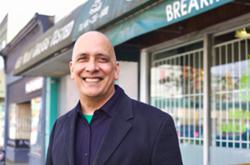
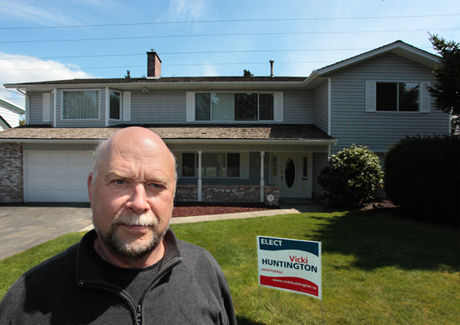
Cecil Dunn and the house he felt forced to abandon.
Gallery: Angriest Riding in BC »
Cecil Dunn fought the provincial government and lost. For four years, he battled a proposal to build steel power poles in the backyards of Tsawwassen homes. The struggle wasn't just about sparing residents the anxiety of ever-present radiation or saving its tree-lined skyline from 30-metre eyesores. Dunn's own house of 26 years lay on the proposed route. The fight was personal.
The retired Telus executive describes the last four years like a rollercoaster ride, full of euphoric highs and cynical lows. But the defeats built up one by one. The opposition he spearheaded lost in B.C.'s highest court. The power poles went up last summer. And this year, faced with a tough choice between life under the lines or a government buyout, he opted to sell the home he'd planned to grow old in.
Dunn feels betrayed by the political system, but not enough to abstain from the May 12 vote. He's throwing his support behind heavyweight independent Vicki Huntington, a five-term local councillor who's promised to defend Delta South against the whims of big government. Her main challenger, BC Liberal Wally Oppal, is drawing from the same sense of helplessness, albeit with a twist. As attorney-general, he's promised voters the ear of the premier and a key voice in cabinet.
Whether voters reject the current government or bid for a stronger place inside it is anyone's guess. But perhaps nowhere else in the province is the choice so visceral.
From a 'back lane to a superhighway'
I meet Dunn in a Tim Horton's on Tsawwassen's main strip. He buys me a coffee and we stake out a table near the back, away from the crowds of seniors gathered for their morning social. I tell him this is my first time in town. Normally I'm just passing to the nearby ferry terminal. He nods his head in assent. "Just like most people," he says.
Dunn begins our talk with a crash course in local power line history. In the mid 1950s, the British Columbia Electric Company bought land rights for a transmission corridor through "a couple of potato farms and forest." Tsawwassen grew into a thriving coastal community over the coming decades, cut in half by 17-metre wood power poles on a 3.7 kilometre right of way. Many homeowners assumed the lines would be dismantled once their life cycle came to end.
In late 2004, they were shocked by the province's proposal. The old lines were coming down. And in their place, 20 steel poles the size of a high-rise, capable of transmitting 60 per cent more power and connected to a 23.5 km submarine cable under the Strait of Georgia. Residents were told the project was essential to meet Vancouver Island's growing energy needs.
"The analogy I like to use is they wanted to turn a back lane into a superhighway," Dunn says.
Retracted promises
The Tsawwassen Residents Against Higher Voltage Overhead Lines (TRAHVOL) sprung up to fight the proposal. Dunn spent hours researching the link between electro-magnetic fields (EMF) and cancer rates. He shook hands with senior government executives, urging them to reconsider. TRAHVOL's efforts soon paid off -- or so residents thought.
Just weeks before the 2005 provincial election, Dunn received a letter from Energy Minister Richard Neufeld. The B.C. Transmission Corporation (BCTC) had abandoned plans to build overhead lines in favour of yet-to-be-determined alternatives, it read.
"People were excited," Dunn says between sips of coffee. "They thought, 'Hey, these guys are actually listening to us.'" When election day came, BC Liberal Val Roddick defeated the independent Huntington by 1,100 ballots. Dunn's vote helped her win.
"We were all a bit politically naïve," he admits. "I have quite a different view of politics than I did then."
After the election, BCTC announced plans to bury high voltage lines in a shallow trench along the Tsawwassen right of way. Residents weren't impressed. They argued the plan would tear up backyards and emit even more radiation than the steel pole system. Even worse was a carefully worded July letter from Neufeld that appeared to play down the province's commitment to oppose overhead lines.
TRAHVOL proposed alternate routes, organized rallies and pleaded with government officials, to no avail. In the absence of broad public support, the province's utilities commission disregarded the trench alternative and forged ahead with the original proposal. A legal battle followed, but B.C.'s court of appeal refused to reverse the decision. Construction on the towers wrapped up last summer and BC Hydro energized the lines in December.
'They look disgusting'
South Delta Secondary School sits in the middle of Tsawwassen, a low building fringed by open sports fields and leafy residential streets. When I visit, wind tousles the hair of teenagers enjoying their spares in the sun. The setting would be unexceptional, were it not for the gigantic steel towers cascading down a nearby hill -- or the 30-metre power pole that juts out from the parking lot, towering over surrounding cars. During the fight to reroute the overhead lines, Delta Secondary became a key battleground. The Mothers Against Power Poles formed out of fears the school's 1300 students would be made test subjects for prolonged EMF exposure. After the lines went in, some parents withdrew their children, and local anger hasn't subsided.
The BCTC maintains exposure levels are well within the World Health Organization's guidelines. It notes 30 years of scientific studies haven't revealed any definite link between EMF and cancer. Still, as the Canadian Cancer Society points out, incidents of childhood leukemia appear to be greater when radiation levels are high.
Crossing the school's soccer field, I approach a group of Grade 12 girls reclined on a blanket. The appropriately named Natalie Watts seems a bit aloof as I motion towards one of poles. With graduation so near, she's not too concerned about radiation. But aesthetics are a different story. "I hate them. They look disgusting," Watts says. "It's our small town and there's these huge urban power lines going through."
'People here are exhausted'
When I enter Ladner's ABC Restaurant later that day, Vicki Huntington appears tired. We take a booth near the back and I glance at the flower paintings on the walls. "It's so loud here," she remarks, cringing at the background muzak.
Huntington tells me she was courted by Gordon Campbell and Carole James before her campaign began. Both knew her local popularity and five terms in civic politics make her a potent candidate, she says. But neither offer was enough to sway her.
"I'm firmly of the opinion that MLAs in British Columbia represent parties, not the people," she says.
That's been a frequent theme in Huntington's campaign as she tries to position herself as a staunch defender of local interests, unbeholden to a government that treats Delta South like its personal "doormat."
When she lists off local grievances, they sound like personal affronts. The healthcare cuts that gutted Delta hospital. The proposed Deltaport container expansion and $1 billion South Fraser Perimeter Road -- both poised to destroy critical wildlife habitats, she claims.
And of course, the Tsawwassen power lines. I ask her whether an independent MLA could have made any difference in an entrenched party system. She brings up the late Chuck Cadman in response -- everyone knows if single voices can't make a difference, democracy has failed, she says.
"People here are exhausted. They've been fighting their own government for almost eight years."
(Delta South isn't the only area to rally against outside encroachment. See sidebar for examples across the province.)
Anger Hotspots in BC
The Tsawwassen power lines upgrade isn't the only infrastructure project to raise the ire of B.C. residents. Here are four current examples of concerned citizens taking on powerful interests.
Texada Island
In 2007, WestPac LNG Corp. proposed a $2 billion mega-project to build a liquefied natural gas terminal and electricity facility on this island in the Strait of Georgia. Texada Action Now formed to fight proposal, claiming the project would be a major eyesore and anathema to the province's carbon targets. Project still in early stages.
West Vancouver
A $130 million road connector formed a key part of the Sea-to-Sky highway upgrade. The Eagleridge Bluffs Coalition feared the project would harm critical wetlands and held vocal protests that resulted in arrests. The province turned down a costly tunnel proposal and the four-lane highway opened last month.
MacMillan Provincial Park
A provincial proposal to build a new parking lot in the old-growth forest at Cathedral Grove pitted loggers against camped-out protestors in early 2004. Cabinet minister Bill Barisoff vowed to have the lot built before the summer tourist season but years of protests followed. The lot was scrapped in 2006.
Klappen Valley
Shell Canada received land tenure five years ago to explore for coalbed methane near the Sacred Headwaters in northwest B.C. The Tahltan First Nations blockaded roads in 2007, citing concerns about salmon habitat destruction. Arrests followed and both sides threatened legal battles. The province set a moratorium on the project last fall. -- G.D.
Oppal's strategy
After meeting with Huntington, I contact Oppal's headquarters. I was supposed to sit down with the attorney-general at noon, but his campaign manager called in the morning to cancel. I'd visited his Tsawwassen office twice today but was told both times he was too busy to talk. Phone in hand, I try my luck again.
Election staffer Matthew Naylor tells me Oppal definitely can't meet today. "Would he be able to phone sometime this week?" I ask. "I wouldn't be too optimistic," Naylor replies.
This is Oppal's first run for Delta South, though he's called Tsawwassen home for 10 years. If 2005 results are any indication, the vote here could be tight. Most analysts predict a dead heat between the well known attorney-general and the former councillor, with the New Democratic Party's Dileep Athaide trailing in third.
Though Huntington draws on popular anger to buoy her candidacy, Oppal's personal charm and claim to be a powerful voice in government could carry him to victory. "The premier listens to me. Other members of my cabinet listen to me," he told a packed room of Huntington supporters at an April 16 debate.
His challenger likes to point to Oppal's record of silence on critical Delta South issues, including his intervention against TRAHVOL's power line challenge in the court of appeal. But the attorney-general can hit hard too. The governing party makes the rules, he argued at the debate earlier this month. "There's no possible way that any independent could have any influence on that."
Strange homecoming
Back in Tsawwassen and fresh off our Tim Horton's chat, Dunn takes me for drive in his green pick-up. We follow the steel poles -- from the hulking power station near Fred Gingell park to the tree-lined street he used to live on. After electricity started flowing, the provincial government made tempting offers on 119 homes. Only 15 households could resist. Dunn moved to Ladner on April 1, and as we stand in front of his old house, he tells me government workers just came by to change the locks. For the time being, it sits empty.
We're soon being greeted enthusiastically by Dunn's old neighbour, Rick Grant. He took the government buyout too, but won't be leaving until the end of summer. The former neighbours chat like old friends. "You know, there were some people by last week to cut your lawn," Grant says. He leads us to a compact backyard, bursting with spring colours. Overhead, power lines grid the sky. The poles are impossible to miss.
"Your tulip tree looks great," Dunn says, pointing to the white petals littering the grass.
"It's the energy from the lines," Grant jokes.
When Dunn and I get back into the car, I notice a Huntington sign on his old front lawn. He says Grant put it there. We start to drive and he tells me the decision to leave Tsawwassen was one of the hardest he's ever made.
"You've always got that apprehension in the back of your mind -- do you live with these lines forever or start a new life?" He takes a right turn down a quiet street. "What we chose is not what we wanted to choose."
Related Tyee stories:
- Map Scopes Region's Power Future
Plans for BC, Alberta and eleven states to produce and export renewable energy. - Gordon Campbell, House Flipper
Offer to buy power line homes is cynical, bad business, says Rafe Mair. - Unstable Mix: Politics and Liquefied Natural Gas
Citing 'safety concerns,' feds fight LNG project back east -- but not along BC's coast.


14
Login or register to post comments
Jeffrey J.
2 years ago
Ooops
That should be, "all in all, BC would be better off WITHOUT these guys". Sorry for the typo.
Grumpy
2 years ago
Damn right we are mad, mad as hell.
The Liberal lick-spittles who prostrate themselves to Gordo have reigned for far too long. Val Roddick was a corpse walking and never said boo to Campbell and his incestuous lot.
Now Val is out (that pension looks good) and Wally Awful is parachuted in.
Everyday it becomes clearer why the Fraserview riding association wanted to be rid of Awful, he is just mediocre, a nobody, a hapless ass kisser EDITED -- TYEE MODERATOR.
Now Wally the Awful is not doing so good. so as a sweetener, premier Campbell ordered TransLink to operate a direct nus (the 609) from Tsawwassen to Tsawwassen First Nations. The damn bus is carrying less than 10 people a day! But guess what, the bus passes Tsatsu Shores, where the hapless Awful lives.
Not being picky, but wally Awful does not live in Delta but on Tsawwassen First Nations land - so much for him claiming to be a long time South Delta resident. Sorry Awful your geography is wrong.
But the polls are looking bad, so enter the premier again to offer a $17 million bribe to the residents, in the form of giving the Whitecaps more money to take over scarce Delta sporting fields!
And what about the BritLion rugby club who invested $1 million in J.O. Park? Oh yes the Liberal lick-spittles on Delta Council gave them the toss for the more electorally photogenic Whitecaps!
I will boycott the Whitecaps and all who support them.
It makes me sick and damn right I am mad as hell, Gordo, his inept AG and councilor (I wonder what they have been promised)lick-spirals will destroy the riding, EDITED - TYEE MODERATOR
southdeltawalker
2 years ago
It's not only the power poles...
...that have folks angry here.
There is:
-The Port Expansion-destruction of important marine habitat and deadly emissions form all those trucks and ships. Valuable farmland to be used for storage of containers
-South Fraser Perimeter Road-a four lane highway through farmland and neighbourhoods
-The greenhouses-emissions and destroying habitat
-Gateway-why?
Now the latest is that more farmland is to be taken for a soccer facility-big announcement by Campbell here on Sat.
But Delta only gets the field if he is elected!
Delta Mayor Lois Jackson and three councillors were almost falling over each other in their hurry to endorse Campbell this week.
What's going happen?
The sparks flying election night here might not be from those power poles.
Stay tuned.
politico
2 years ago
The list is too long, the pain is to great
It has been proven that people block out the painful experiences in their lives and in some cases this leads to split personalities.
This helps explain BC Politics.
Kudos to the folks here at The Tyee for bringing back to the public consciousness a few of these issues we forced back to the dark recesses of our collective unconscious.
Maybe, just maybe, now that pieces like the one in today's globe where Husband and Morton sign on with scientists to warn people of the destructive regime and what it means if and when they are re-elected, are out there people will shake their collective head and vote these bastards out.
Every riding is angry in this election and anyone on the ground, in the streets and living the struggle imposed upon us by these corporateers knows it.
If BC is able to awaken from the asper inspired trance and look at the mess made of this place by these crooks they will be gone and we begin the clean up.
Grumpy
2 years ago
Liberal lick-spittles
Sadly, Delta is full of Liberal lick-spittles, why? Simple, Gordo rewards all with government lolly for their support.
Track who's farm lands are being expropriated for the new Gateway highway and what generous compensation they are getting. Susan Heyes, watch this one, because friends of the government get well paid.
Track what developers are getting ALR land for housing, you pay into the Liberal Party of BC and you are rewarded. Just ask CN Rail.
Want a new park for photogenic soccer players? No problem, elect Wally Awful and we will give you $17 million and take land out of the ALR (it's useless as farmland now because they are building a new highway) for playing fields. Play rugby, well that's a different story, Liberal lick spittles don't play rugby (to rough for them), so kick the rugby players off - Oh, you spent $1 million for new fields - too bad, so sad.
Liberal lick-spittles on Delta council are falling over themselves to support Gordo's old-boy/girl network, so I wonder what the lick-spittles been promised?
We would soon find out, or not if the Asper press doesn't want us to know.
Van Isle
2 years ago
Maybe South Delta is more
Maybe South Delta is more visible with the anger because of how they have been treated by the Government, but I think there is a very controlled seething through out the population in general. Its a wonder, that here in Canada, we haven't had hardly any protests/demonstrations, but boy oh boy, people are generally pissed-off with our governments/institutions.
The Blackbird
2 years ago
Perhaps if gangster bullets
Perhaps if gangster bullets start flying in Delta like they have just a little to the north, the race wouldn't be so tight. Oppal has proven impotent in dealing with gang violence and doesn't appear to have much of a plan to deal with it. So what if he's got the Premier's ear if all he has to whisper into it is gibberish.
David Lewis
2 years ago
we're alright Jack, let the world go to hell
This anger based politics in Tsawwassen is an example of the not in my backyard bull@*&t that is killing the planet.
We need to replace 80% of the energy presently powering civilization with carbon emission free sources and difficult decisions have to be made.
All I hear from these people is how angry they are that the entire world isn't catering to their immediate needs. Have they considered what they might be able to contribute?
Van Isle
2 years ago
It's obvious David Lewis
It's obvious David Lewis didn't read the article. People did try and work with the system to try and get the transmission lines changed. After awhile they realized they they were just being strung along and the government had no intention of doing anything different. Another thing David, where was their MLA?
Van Isle
2 years ago
With comments like David's,
With comments like David's, it's obvious that he hasn't been paying attention for the last 8 years.
f00bar
2 years ago
NIMBYs
The fact is, the powerlines were there before the people. They took a conscious decision to move in, despite the powerlines. They paid less for their homes because of the proximity to the lines. If the lines had come down, they would have had windfall profits on their homes.
How many of the people who protested would have been willing to donate the difference between the value of their homes with the lines, and without, to the province? As we've seen from the sweet buyouts they all accepted, no-one.
Not just NIMBYs, greedy NIMBYs.
runner
2 years ago
backyards
hey f00bar, best not to judge so harshly until you have had a beer with one of the homeowners in their backyard.
They would probably tell you they bought and moved in knowing the lines were there, but that they got pretty upset when the NEW lines with 60% more capacity and associated increase in EMR were forced upon them, their input ignored and huge steel towers erected instead of the old wooden poles. The power lines were changed AFTER they already lived there, they did not buy into that willingly. You can also bet that not one owner ever thought that they would stand to make a buck by having the lines removed - that would bring new meaning to "real estate speculation".
It was the government that came later and offered the buyout, so don't blame the homeowner for accepting a decent price to get themselves and their families out from under a potentially more dangerous power line that wasn't there when they moved in. Was the buyout deal that sweet? What were the numbers? What cost factor has been included for personal time spent trying to work with Hydro/Gov't for another solution, plus the stress incurred when their input was squashed and when they moved from their neighbours and home environment? Bet it doesn't look so sweet when you count those in, nor would there be anything left over to donate back to the province.
However, after the visit and conversation, freely call the homeowner greedy if he/she tried to charge you for that beer you had...
jericho beach
2 years ago
NIMBY
Unfortunately when most people use the term NIMBY they place a pejorative meaning to the word. And those who use the term the most are proponents of projects or developments.
It is believed that the nuclear power industry in the US first used and perhaps coined the term NIMBY to describe their opponents. As if those who lived in an area should not have a say about developments that would impact their lives.
If we could separate the development community's pejorative use of the term we could then try and understand the nature of involvement.
Residents have the right to be consulted and the right to oppose locally undesirable land uses.
There are two points about any development that must be understood, they are:
(1) that development projects are generators of impacts that must be assessed before development decisions are made, and
(2) that citizen participation is an essential component of such reviews.
Unfortunately, the residents of Tsawwassen were taken for a ride and because of their believes in a particular political ideology they were more than willing to believe in government and agency promises. As Dunn admits, they were niave.
Folks should hasten to use the word NIMBY. After all, I wonder how anyone would feel if they were subjected to a similar scale of electrical transmission line upgrading that the residents of Tsawwassen have had to endure.
I used to live in Tsawwassen in the early 90's and am well aware of the former transmission lines that went through the back of folks properties. One really has to go and look at the scale of the project and the placement of the wires to see what residents are talking about. Despite having a right of way in their backyards, what was being proposed and what was built is nothing like what it used to be. Anyone would be alarmed by the scale of this project and the impacts on local community.
There were alternatives and unfortunately when you have a privateer running your power company, Accenture, you can kiss democracy and policy by citizens goodbye.
I don't know who told them that underground cables were more dangerous than above ground. Depending on the shielding most studies show that EMF emissions from underground shielded electric cables are non-existent if they are buried more than 3 meters below ground and even underneath seabeds. Buried lines by far was the best alternative but perhaps the best alternative was a different route that directed the lines through industrially zoned lands and not residential lands.
Another development event that has made residents of South Delta angry and not mentioned in the article was the introduction of massive greenhouses that are artificially lighted at night to grow whatever is inside.
Grumpy
2 years ago
Seething in Delta South
There is an undercurrent of seething in Delta South and if 'Where's Wally' gets elected, his term will be one of controversy.
The recent mass disappearance of Huntington election signs along Delta roads has been noticeable, especially where a Huntington sign sat, now sprouts a Wally sign.
I also notice lots of Opal signs in the garbage when they have been put on peoples lawns, without first asking the owner.
This smacks of desperation, by a desperate politcal party.
No money to put wires underground, but a $17 million electoral bribe to invest in John Oliver park for soccer, only if 'Where's Wally' is elected.
The Liberal Lick-Spittles are out in full force, like zombies awaiting their masters orders.
We are not fools in Delta South and after 8 years of an absentee MLA, another 4 years of Where's Wally, will be a joke.