

 SHARE:
For 20 years or so I sold my images of the Tibetan and Indian cultures to raise funds for a non-governmental organization that restores eyesight to the blind. Commentators frequently observed that there was a poetic beauty in the fact that photography and a camera played such a significant role in the return of eyesight and the removal of a defective lens (cataract).
Now I am working with FarmFolk/CityFolk, a Vancouver-based, provincial not-for-profit society that addresses the issue of local, sustainable and ecologically safe food production. In other words, the vision of FF/CF is to eat local food that is grown by sustainable methods, wherever possible. One of their inspiring qualities is a focus on attainable solutions. Another is their collaborative approach to developing sustainable models. The aim of the FF/CF is to develop ways to restore balance to the production of food. Their methods -- inspiration, collaboration, and hope -- fit well with my own perspective.
When I was photographing blindness, I chose not to portray the misfortune of being blind. Instead, I focused my camera on the transcendent beauty of the spiritual traditions that I found within the cultures of those who were having their sight restored. Now with FarmFolk/CityFolk, I direct my camera toward the people who farm sustainably and to the land that remains "naturally" bountiful, year after year. As I discovered last year, on visits to five community co-op farms across B.C., beauty does indeed abound.
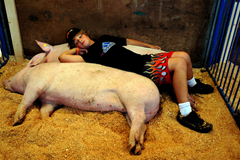
In my first season of photography down on the farm, I came across and photographed a teenage boy lounging on top of two prized pigs. Bright yellow and red flames shoot up the leg of his shorts, acting as a counterpoint to his bored gaze, the lazy hogs prone beneath him. On that visit, I also made a picture that became the cover of FarmFolk/CityFolk's inaugural 2009 wall calendar (see box with contest note). The young woman moves through rows of chest-high purple and green kale, filling her arms to overflowing while simultaneously sampling, indeed stuffing her mouth, with her organically-grown harvest.
Savouring simplicity
In Michael Pollan's double punch publication of The Omnivore's Dilemma and In Defense of Food, he lays out (in the first) the devastatingly destructive consequences of the corporate industrial food empire and (in the second) his conclusion: "Eat Food. Not too much. Mostly plants." Two thousand years ago, the Buddha advised his monks to stop eating two thirds of the way toward feeling full, to avoid meat and "to eat only what is given or placed before you." In other words, cultivate restraint and find satisfaction in simplicity. It was not an easy task then -- and it is that much harder today for a whole new set of conditions that Pollan's two books masterfully explicate.
Even so, you and I and our society will not achieve any significant move toward a sustainable way of living until we are able to be happy without our current dependence on the continual and ever-expanding consumption of stuff. Cultivate contentment.
Related Tyee stories
- The Dirt on Organic Wines
Are they vegetarian or vegan? And more fine distinctions. - Deconstructing Dinner
Find and listen to Jon Steinman's podcast series here on The Tyee. - My Back to the Land Fantasy
And why it feels more real every day.
![[Tyee]](/design-article.thetyee.ca/ui/img/yellowblob.png)
Read more: Food, Photo Essays, Environment





Tyee Commenting Guidelines
Comments that violate guidelines risk being deleted, and violations may result in a temporary or permanent user ban. Maintain the spirit of good conversation to stay in the discussion.
*Please note The Tyee is not a forum for spreading misinformation about COVID-19, denying its existence or minimizing its risk to public health.
Do:
Do not: