
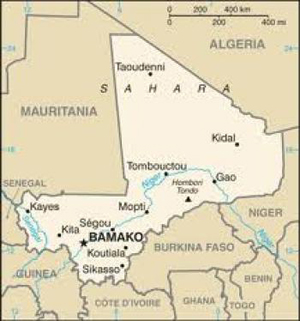
If the call comes, it will be a mission tailor-made for our nation and military.
Mali in need: When Canada acts on behalf of the international community, it bolsters its reputation, generating 'soft power.'
"We need action not only to end the fighting but to make the peace." -- Lester B. Pearson
Spoken by Lester B. Pearson in 1956, these words grace the side of the peacekeeping monument in Ottawa. They also provide insight into a difficult but worthwhile task that Canada may well be asked to fulfill in the West African country of Mali.
Pearson knew a great deal about war, having served in both the army and air force during the First World War and as a diplomat in London and Washington during the Second World War. When Pearson spoke about making the peace, he was drawing a distinction from two other types of missions: the defence of one's country from outside attack, and forward-leaning interventions aimed at defeating opponents overseas.
Defending the country from outside attack is the fundamental role of the Canadian Forces. Some overseas missions will also be necessary: during the Cold War, the principal duty of Canadian soldiers was not to make the peace, but to guard against the Soviet threat. From sailors in the North Atlantic, to pilots on patrol over West Germany, they protected both Canada and our NATO allies.
Other overseas missions will take place in circumstances where there is no real military threat to Canada. The "counterinsurgency" mission in Afghanistan was optional, from a security perspective, since Al-Qaeda had relocated elsewhere by 2005 and the Taliban posed no significant threat to Canadians in Canada.
Peacekeeping is also optional, insofar as it does not address direct threats to this country. It is something that Canada traditionally did to promote our long-term interests. Between 1956 and 1992, Canada was often the single largest contributor of U.N. peacekeepers.
Today, Canada occupies 55th place with only 11 military personnel and 119 police officers participating in U.N. peacekeeping missions. Logistical and personnel constraints in Kandahar were only partly responsible for the downward trend, which began before 2005.
The retreat from peacekeeping has been a political decision, as was demonstrated in 2010 when the U.N. wanted to place Canadian General Andrew Leslie in command of its 20,500-soldier force in the Congo. It was initially reported that the Canadian Forces were "angling to take command of the U.N.'s largest peacekeeping mission," and the required deployment of just one general and a couple of dozen Canadian troops "would be small enough not to make any impact on resources." But then the politicians stepped in, with the Department of Foreign Affairs explaining: "We're fully engaged in Afghanistan until 2011, and that's what we're concentrating on for now."
Peacekeeping works
For more than a decade, commentators with close links to the Canadian military have argued that peacekeeping is passé, and counter-insurgencies are the new reality. They point to the failed U.N. missions in Bosnia, Somalia, and Rwanda, where peacekeepers were forced to stand by -- due to inadequate mandates, equipment, or numbers of personnel -- while thousands of civilians were killed. They often overlook the core reason for those failures of the early-1990s, namely, a lack of political will, not on the part of the U.N. as an organization, but on the part of its member states.
A learning process was also underway, as the end of the Cold War enabled the U.N. to take on more robust and complex operations. As a result of that process, peacekeeping has evolved significantly since the early-1990s, as evidenced by changes made to the operation in Lebanon.
The U.N. Interim Force in Lebanon (UNIFL) was formed in 1978. In the summer of 2006, after two months of fighting between Israel and Hezbollah, the Security Council increased the number of troops from around 2000 to 15,000. It also provided a much more robust mandate that authorized UNIFL to take "all necessary action" to protect civilians under imminent threat. Consistent with this mandate, UNIFL was equipped with tanks, artillery and surface-to-air missiles. It has, since 2006, successfully prevented a return to all-out hostilities between Israel and Hezbollah.
There have been many other successful missions. From 1992-1993, the U.N. Transitional Authority in Cambodia stabilized and administered an entire country, ran an election, and managed a transition to a power-sharing government with strong public support, while sidelining the notorious Khmer Rouge. The U.N. Peacekeeping Operation in Mozambique from 1992 to 1994, and the U.N. Transitional Administration in East Timor from 1999 to 2002, had similar mandates and successful outcomes. The U.N. Mission in El Salvador from 1991 to 1995 successfully demobilized the FMLN guerrilla organization, as well as military and police units implicated in serious human rights abuses, and also trained a new national police force. The U.N. Mission in Sudan from 2005 to 2011 led to the end of the civil war, a referendum, and the relatively peaceful secession of South Sudan.
Independent analyses confirm that modern peacekeeping works. From 2003 to 2005, the RAND Corporation compared eight state-rebuilding missions conducted by the United States, and eight by the U.N. in terms of inputs, such as personnel, funding, and time, and the achievement of the goals of peace, economic growth, and democratization. The study showed that seven of the U.N. missions succeeded, whereas only four of the U.S. missions did. It concluded:
"Assuming adequate consensus among Security Council members on the purpose for any intervention, the United Nations provides the most suitable institutional framework for most nation-building missions, one with a comparatively low cost structure, a comparatively high success rate, and the greatest degree of international legitimacy."
The point about costs bears emphasis: U.N. peacekeeping accounts for less than one percent of global military spending. In 2012-2013, the U.N. will spend a total of $7 billion on its 15 missions involving more than 80,000 soldiers. In 2010-2011, Canada alone spent an equivalent amount on its Afghanistan mission, with only 2500 soldiers involved.
In 2008, Virginia Page Fortna of Columbia University conducted a book-length investigation into whether U.N. peacekeeping works. She determined that "peacekeepers make an enormous difference to the prospects for peace, not only while they are present, but even after they depart."
Some critics of peacekeeping argue that most conflicts in the post-Cold War era are civil wars requiring more robust forms of intervention than the U.N. can provide, and that this explains the move to NATO in Bosnia, Kosovo, and Afghanistan. However, the Human Security Report reveals a decrease of more than 70 per cent in "high-intensity" civil conflicts since the end of the Cold War. It examines the various possible reasons for this decline, and concludes:
"[T]he key factor was the liberation of the U.N. from the paralyzing rivalries of Cold War politics. This change permitted the organization to spearhead an upsurge of international efforts to end wars via mediated settlements and seek to prevent those that had ended from restarting again. As international initiatives soared -- often fivefold or more -- conflict numbers shrank."
The member states of the U.N. are aware of the many successes, for they continue to establish and fund more missions. In the last three years, the U.N. has deployed more peacekeepers than at any time in the organization's history, with more troops in conflict zones than any actor in the world apart from the U.S. Department of Defense. But unlike the interventions in Iraq and Afghanistan, most Canadians have not heard of these missions -- in part because they are successful, and therefore considered less newsworthy.
Lessons from Afghanistan
Canada joined the U.S.-led counter-insurgency in southern Afghanistan in 2005. Put forward by opponents of peacekeeping as a better fit for the Canadian Forces, the mission was hardly successful. Indeed, the security situation in Afghanistan is significantly worse today than it was in 2005.
As U.S. commander General Stanley McChrystal stated in 2009: "Although considerable effort and sacrifice have resulted in some progress, many indicators suggest the overall situation is deteriorating." According to the United Nations, 2010 was the bloodiest year since 2001 for Afghan civilians, while 2011 was nearly as bad. The number of NATO casualties has also remained high, with 402 soldiers killed in 2012 alone.
As an exit strategy, Canada and the U.S. are expanding and training the Afghan army and police. But the attrition rate of the Afghan army is 24 per cent; in other words, nearly one-quarter of Afghan soldiers leave the army each year. Eighty-six percent of the soldiers are illiterate, making them difficult to train. Adding to the challenge, the Taliban are systematically infiltrating the ranks of the recruits and then turning their guns on the instructors. In 2012, NATO significantly reduced the number of joint operations between Afghan and Western forces because of the frequency of these "green-on-blue" attacks.
It is time to accept that the counter-insurgency mission in southern Afghanistan has failed, and with it, Canada's move away from U.N. peacekeeping.
Canada's niche
Most peacekeeping missions today have more robust mandates, more soldiers, and better equipment than the missions of the early-1990s. What they tend to lack are well-trained soldiers from the developed world. A relatively small number of Canadian soldiers could act as force-multipliers in U.N. missions, by providing leadership and mentoring, and by serving as role models for less-well-trained developing country troops. Contrary to the line of argumentation that took us to southern Afghanistan, if Canada wants to "punch above its weight" militarily, U.N. peacekeeping missions are a good place to start.
Moreover, when Canada acts on behalf of the international community, it bolsters its reputation, thus generating what Joseph Nye of Harvard University calls "soft power" -- the ability to persuade rather than to coerce. Soft power is the principal currency of diplomacy for middle-power states.
Sadly, Canada's soft power has declined considerably in the past decade. In Sept. 2010, for the first time in its history, Canada lost one of its regular bids for a non-permanent seat on the U.N. Security Council. According to international observers, our abandonment of U.N. peacekeeping was a contributing factor in the defeat.
Within the next few weeks, the U.N. Security Council may well authorize an U.N.-led peacekeeping mission to stabilize Mali after the French-led combat mission ends. The success of the peacekeeping mission will turn, in large part, on whether well-trained soldiers from the developed world are involved.
It's a mission tailor-made for Canada; one that Pearson would undoubtedly have embraced. ![[Tyee]](http://thetyee.cachefly.net/ui/img/ico_fishie.png)
Michael Byers holds the Canada Research Chair in Global Politics and International Law at the University of British Columbia. This article draws on a longer piece in the Canadian Military Journal, a peer-reviewed publication of the Department of National Defence: http://www.journal.dnd.ca/
41
Login or register to post comments
Otto Rant
19 weeks ago
Peacekeeping and Responsibility to Protect Libyans
A few months ago the same writer had a piece here celebrating the bombing of Libya as ushering a new age of humanitarianism under the banner of protection of civilians.
The bombing, headed by a Canadian, and subsequent downward spiral of murderous violence in Libya, don't seem to add up to a successful protection of Libyan civilians - quite the opposite. It also appears that personnel and weapons used by rebels in Libya are now being used in Syria and Mali.
Before progressing to another idea, it would be interesting to see the writer's thoughts on the actions supposedly meant to protect Libyan civilians.
Also, the writers current piece, when searching for reasons for the decline of Canadian international influence, seems to gloss over Harper's subservience to the U.S. and Israel. Harper allowed Israel to deliberately shell for several hours a Canadian observation post and nearby village, to the point that Canadian peacekeepers were killed, and raised nary a peep. This certainly must raise questions about Canada's commitment to honest peacekeeping.
peasant43
19 weeks ago
peacewashing?
Here we go again. Western countries are in Mali at the behest of Capital. There is some valuable commodity, probably to be mined, Capital needs. Bet you the Chinese are hanging around too, but with money not might.
"Mali in need: When Canada acts on behalf of the international community, it bolsters its reputation, generating 'soft power."
Riiiight. Helping Mali. The rare elements in my cell phone tell me otherwise.
Hakuin
19 weeks ago
Here's a tailor made job
http://www.cbc.ca/news/canada/story/2012/09/23/harper-veterans-military-pensions.html
Hakuin
19 weeks ago
Funny you should mention that, fellow peasant
http://www.huffingtonpost.com/barry-lando/china-business-africa_b_2468659.html
Fiat lux
19 weeks ago
Lester Pearson didn't know,
Lester Pearson didn't know, of could even imagine, the destruction caused by the "free trade" and "free movement" rackets, that have replaced armed invasions and the occupations of countries.
The presently ongoing demands for negotiations with the Taliban in Afghanistan are the most ridiculous waste of more lives.
When the foreign troops pull out, Afghanistan will be taken over by the Taliban in a few weeks, and all the lives that have been and will be lost have been and will be for nothing.
As in the case of most wars in history. Something humanity has yet to figure out, while glorifying wars as some kind of "heroism" (I'm a WW2 vet, wounded in action)
At the same time, the Muslim Brotherhood also have a planned timetable for the takeover of the world, including Europe and the Americas. Basically the same idea as the Taliban's.
So, now we have the monetary priesthood of so called "economists" on one side and the disciples of the Prophet on the other, both with the same world ruling plans in service of and submission to special interest classes.
How can humanity stop either, or both sides from the execution of their criminal plans for the total enslavement of humanity, either with the religion and rule by imaginary monetary figures, or the Words of the Prophet, dreaming of 4 billion illiterate women walking under tents ?
Ed Deak.
paisley
19 weeks ago
Rally the troops the
Rally the troops the carpetbaggers need to leverage their position.
bcwoodcarver
19 weeks ago
uranium miners
France and Canada are in Mali to protect french uranium corporations.
RickW
19 weeks ago
Harper Government Interested In PeaceKeeping?
I think not.
alive
19 weeks ago
Here's why:
The war machine creates job, and profit for the 1% scum
NickS
19 weeks ago
US drone base on Mali border with Niger
"What is really happening is the US now has a drone base with which to supervise Chinese expansion in Northwest Africa, and a drone fleet to use defensively and offensively as it sees fit."
http://www.zerohedge.com/news/2013-01-28/here-come-drones-or-true-reason-mali-incursion
pwlg
19 weeks ago
Something smells in the state of Mali - Part 1
Byers wrote:
"They point to the failed U.N. missions in Bosnia, Somalia, and Rwanda, where peacekeepers were forced to stand by -- due to inadequate mandates, equipment, or numbers of personnel -- while thousands of civilians were killed."
Not sure who does the fact checking for Byers but there were more than "thousands of civilians" killed, even more than 10's of thousands and even more than a million. The figure touted as accurate civilian deaths in Rwanda alone is 1.5 million. Indirect deaths from starvation (Somalia), inadequate medical care also adds hundreds of thousands if not millions to the score card of war on innocent civilians. But who's counting in these days of cleansed or more apt mainly uncovered war stories from the media. Not sure what Byers reasoning was for belittling the millions of deaths of innocent civilians in UN peacekeeping missions he has listed.
I totally agree with peasant43 this is an intervention by capital in Mali. Both France and Canada, as well as other European states have vast mining interests in Mali. The so called "Islamic rebels" may not be much different from those governing Mali today.
Human Rights Watch noted that there were more than 20,000 children working the gold mines of Mali despite the government (run by Mali's military) instituting a "National Action Plan for the Elimination of Child Labour" in June 2011. The children handle mercury with their bare hands, they have little or no health care and no schooling despite Mali having a law against child labour and compulsory and free education however like their environmental laws they do not fully enforce them.
These children and other workers in Mali who mine small foreign claims have dug out more than $200 million worth of gold. This is another great failed example of Reagan/Thatcher/Greenspan/Fraser Institute trickle down ideology.
The people of Mali need peace and real aid not tied to them giving up their resources and human potential. The military must move aside and allow Mali to create their own form of governance. The military interventions do little to bring about distribution of the wealth being dug from Mali's soil, in fact, even a UN mission may be more about keeping the status quo and delaying real change for the Mali people.
pwlg
19 weeks ago
something smells in Mali - Part 2
The only way peacekeeping works is when both sides decide to stop fighting each other and the use of a third parties to ensure the peace until agreements can be made. It is obvious to me that when there are these types of revolutions in a country there are deep seated inequalities and injustices taking place and its not one-sided.
At least France is being honest about its intervention in Mali and bordering states. Reuters reported on January 24, 2013 that France was sending in their special forces to Niger to protect their uranium interests. (France relies heavily on nuclear power for its energy needs).
The Brits, with grandstanding PM David Cameron at the helm is also mum on his country's corporations involved in Mali mining.
The military in Mali is the de facto government propped up by Western governments, and now their militaries, hungry for resources.
There is more to this story and even The Tyee has failed us wanting to learn more about the reasons for the lengthy internal conflicts which are not wholly based on fanatical religious groups.
Something stinks and it ain't Denmark!
Hakuin
19 weeks ago
Well come on now pwlg
We all have the whole web at our fingertips and this forum here, delve and post man, delve and post!
Van Isle
19 weeks ago
And as I understand it,
And as I understand it, Canada has no less than 10 gold mines operating in Mali. If Mali is so rich in minerals how come the average citizen makes only $1.25 a day?
RickW
19 weeks ago
More of the Same
Western "democracies" find it very difficult (if not outright loathsome) to support emerging democracies.
ireckon
19 weeks ago
Lame Article
Great comments!
Anybody got favourite journalism sites they want to share?
I have been using Global Research quite a bit
http://www.globalresearch.ca/?context=home
Bob Watts
19 weeks ago
Beware of Christians....
For Harper this is about religion, his religion, his god money, and how to kill Radical Muslims for fun and profit!
Harper's Government has already stated that they know of 50 terrorists that are Canadian Citizens, could you please, please cancel their passports, without paying them millions because they are now stressed out!
Could we at least, kick them out of Canada including thier families, come on the wifes know their men are Jehadists!
margot
19 weeks ago
current debate link
Best not to watch this while eating:
http://parlvu.parl.gc.ca/Parlvu/TimeBandit/PowerBrowserLive_SilverLight.aspx?ContentEntityId=9974&EssenceFormatID=424&date=20130205&lang=en
Bob Watts
19 weeks ago
Margot, what do you want us to watch?
Thanks.
pwarkentin2pc
19 weeks ago
Stephen Harper - peacekeeping: way off base
To suggest that Harper is in any way interested in peacekeeping is absurd. His focus is on plunder and destruction for profit of Canadian and world resources. Further he is certainly not interested in "soft power" and has no acumen whatsoever for diplomacy or negotiation.
It is an obscene insult to compare his attempts to get involved in the Mali conflict with peacekeeping missions and the Nobel Peace Prize winning initiatives of Lester Pearson (1957). Peacekeeping is done under the auspices of the UN which Stephen Harper clearly holds in contempt.
ireckon
19 weeks ago
Harper
I will not forget how hard he tried to get us into the war on Iraqu. That being said all of the other parties backed him on attacking Libya and are all backing him again in Mali. Nobody has brought him to task for prisoner torture in Afghanistan or his shutting down of parliament to avoid that discussion. We have a large problem.
Babar
19 weeks ago
Mail
Yup, let's resurrect the airborne regiment, so that our boys can hogtie a Mali teenager and roast him over an open fire, just as they did to a Somali kid.
Fiat lux
19 weeks ago
Peace is not competitive,
Peace is not competitive, therefore every good "conservative" must avoid it.
At the same time , would Mali, or any country be better off under the jihadists?
Ed Deak.
freewilly
19 weeks ago
I dont think
I dont think peace keeping is going to work in this case. Gadafi's arsonal is now in the hands of Al Quaeda. (I remember someone saying this would happen...) and they are close to taking control of Mali. Its turned into a rats nets of militant fundamentalists that make the Tuareg look like Unitarians
If there was ever a good reason for the international community (the UN) to support a war maybe its this one. These thugs in Mali are already burning burning books and treasures that belong to all of humanity. The sufis, the indigenous people and thinkers are all going to suffer. no doubt these characters (Ansar Dine) are trying to draw the west into a war.
My good friend's sister is a missionary in the midst of this mess, there are other humanitarian groups over there, not sure if they have all left or not.
Yeh the west are hypocrites and created this situation? I still dont have a clear opinion or enough knwoledge to really have a strong opinion, but any group of people burning shrines, books and destroying antiquities, chopping off limbs for not thinking the right way really need to be reigned in or worse.
ireckon
19 weeks ago
Good question Ed
Lets have a look at Libya, we installed Al-Quaida rule there, what does it look like today?
The second question is; are the Tuaregs Jihadists or are they just fed up with being abused by a dictatorship? Canada's role in this is confusing indeed. We supported the previous "democratic" government with arms and training and now we support the people who removed that government by way of military coup.
http://www.globalresearch.ca/the-crisis-in-mali-a-historical-perspective-on-the-tuareg-people/5321407
Hakuin
19 weeks ago
When did a Canadian prime minister last
Put on a uniform and see actual combat?
Fiat lux
18 weeks ago
Must have been Lester
Must have been Lester Pearson, long before he became a politician, but at least he knew what he was talking about when he proposed peacekeeping.
Ed Deak.
Hakuin
18 weeks ago
Thought he was a stretcher-bearer
Shot at but never stained with the blood of another.
Anyway:
http://www.cbc.ca/news/politics/story/2013/02/06/pol-kenney-citizenship-terrorism.html
Der Harpenfuhrer will use immigrant cannon fodder to silence opposition. He also will alter the definition of "terrorism" to include any objection to his absolute rule - after all, Canada is now a torture state so it will be easy to bring back capital punishment if you start on " non-citizens".
Fiat lux
18 weeks ago
Soldiers are killing each
Soldiers are killing each other in wars, because they wear different uniforms. That`s all the reason.
At least stretcher bearers are doing something useful.
Where I was, we used to carry a handgrenade in our belts to blow ourselves up with if we got wounded, because there were no stretcher bearers on either side.
Ed Deak.
Hakuin
18 weeks ago
So,
You cheated. :)
pwlg
18 weeks ago
Here you go Hakuin
State of Wisconsin enters status as "developing nation" as it lowers environmental standards in a race to the bottom.
http://wcmcoop.com/2013/02/01/mining-industry-targets-prove-it-first-law/
In terms of Mali, laws were made, never enforced and Canadian and other developed nation mining interests take advantage.
In terms of knowing what's going on militarily by France, Canada and other nations in Mali as well as the Mali military who orchestrated a recent coup in their country we trust embedded journalists riding in French military vehicles.
It's deja vu all over again. Remember Iraq? Who orchestrated the removal of the Hussein statue in Baghdad? How many instances of false stories from Kuwait including how the Iraqi forces were killing babies in Kuwait hospitals (later proven deliberately false).
Be very suspicious.
Hakuin
18 weeks ago
thanks pwlg
good article, will study that one
ireckon
18 weeks ago
Govt sponsored terrorism
Ya know Hak my agreeing with you is going to blow your credibility all to hell. But you have linked to the master plan, and at Canada's leading conspiracy news source to boot!
Currently we can be indefinitly detained without trial or legal counsel if someone (unspecified) has reason to believe that we might be affiliated with terrorist organizations. The Liberals did that for us, Harper wants to up the ante. So if you give aid to a hospital in Palestine you are dealing with a terrorist organization because Hamas is the government of Palestine. Furthermore if any of you geisers out there piss the government off they will throw you in jail and take away your pension.
Kinda hard on gramma.
I would like these laws all to bits if we could apply them to the real terrorists.
RickW
18 weeks ago
ireckon
Thing is, they ARE being applied to "real terrorists". That is what Canuck governments think of the citizens - always have, and alawys will.
Hakuin
18 weeks ago
If only they had listened to Harper
This could all have been ours!:
http://www.fas.org/sgp/crs/natsec/RS22452.pdf
Hakuin
18 weeks ago
der Harpenfuhrer has extended the holy war
to kill all the gays with YOUR tax money! Truly blessed is savage Africa!! We will also no doubt be providing pink triangle armbands with little maple leafs. Be proud, Canada!
http://www.huffingtonpost.ca/2013/02/10/crossroads-christian-communications_n_2658076.html?utm_hp_ref=canada
Hakuin
18 weeks ago
weasels caught:
http://www.cbc.ca/news/politics/story/2013/02/10/pol-cp-anti-gay-religious-group-gets-funding-from-ottawa-to-work-in-africa.html
anne cameron
18 weeks ago
seems to me
Mali is the worlds third largest producer of gold...canadian mining companies must be salivating, even slavering and slobbering...
this article is really upsetting. Rah rah rah, glory, peace, and our place in the world... blech!
The dead will be dead, the maimed will be maimed, the children will perish and the price of gold will rise...
and some dweeb thinks our "return to peacekeeping" is a good thing? We'll still send our troops off to march with their noses firmly planted up the crack of the ass of the corporations.
Laughing At You
17 weeks ago
the Author has His Head Up His Ass
This statement is patently false and
misleading
"Today, Canada occupies 55th place with only 11 military personnel and 119 police officers participating in U.N. peacekeeping missions."
There are Canadian military men and women serving as peace keepers in - Israel, Syria, Lebanon, Somalia, Chad, Kenya, Congo and many more as I write.
I just returned from a peace keeping mission in the middle east with more
Canadian soldiers than the author suggests
are serving in the entire world - proving he is an idiot.
Canadian citizen idiots forget that to be a peace keeper you must go in and kill those who do not want peace and are not willing to negotiate - so it is not the nice friendly job that left leaning idiots like to think it is.
Pearson's world is no longer - time all Canadian left leaning idiots got that clear in their minds and out of their heads.
Peace keeping is nasty and dirty and means doing very bad things to keep that peace.
The author and anyone else who believes his
written bull crap need to visit the real
world and get out of their pink panty wearing princess of entitlement living in Canada world
Laughing At You
17 weeks ago
the Author has His Head Up His Ass
This statement is patently false and
misleading
"Today, Canada occupies 55th place with only 11 military personnel and 119 police officers participating in U.N. peacekeeping missions."
There are Canadian military men and women serving as peace keepers in - Israel, Syria, Lebanon, Somalia, Chad, Kenya, Congo and many more as I write.
I just returned from a peace keeping mission in the middle east with more
Canadian soldiers than the author suggests
are serving in the entire world - proving he is an idiot.
Canadian citizen idiots forget that to be a peace keeper you must go in and kill those who do not want peace and are not willing to negotiate - so it is not the nice friendly job that left leaning idiots like to think it is.
Pearson's world is no longer - time all Canadian left leaning idiots got that clear in their minds and out of their heads.
Peace keeping is nasty and dirty and means doing very bad things to keep that peace.
The author and anyone else who believes his
written bull crap need to visit the real
world and get out of their pink panty wearing princess of entitlement living in Canada world
Hakuin
17 weeks ago
Yes, You
I do believe you are a prime example of who is wearing our flag and carrying a gun overseas to represent the Conzi agenda. Lemme guess; Airbourne?