Opinion

The Rising Tide of Environmental Refugees

No longer a 'hidden crisis,' millions are on the move due to ecological collapse.

By Andrew Lam, 20 Aug 2012, New America Media

Enviornmental-Refugees.jpg

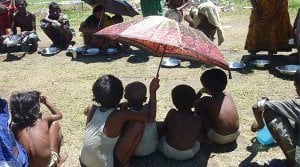
A one meter rise in sea level may wipe out 17 per cent of Bangladesh's land mass. Photo by Sandip Roy.

Related

DESTINATION CANADA?

A background paper titled Climate Change and Forced Migration: Canada's Role was prepared for Canada's Parliament in 2010 by its Industry, Infrastructure and Resources Division. Excerpts:

"It is impossible to predict with any degree of certainty how many additional people each year will need resettlement due to the effects of climate change. However, it seems certain that climate change will be the source of additional pressures on Canada's humanitarian immigration program to expand, perhaps substantially, in the coming decades.

"To the extent that refugees are able to integrate into the Canadian labour market and society, Canada may stand to gain from a new influx of migrants. But, there are costs associated with helping newcomers to integrate into Canadian society, especially in cases where skills are not relevant or recognized in the Canadian job market, and where newcomers speak neither English nor French....

"Best estimates suggest that hundreds of millions of people could be on the move in the coming decades due to the impacts of climate change. Canada has an opportunity now to plan an orderly and effective response to the coming crisis."

Find the entire report here.

The modern world has long thought of refugees in strictly political terms, victims in a world riven by competing ideologies. But as climate change continues unabated, there is a growing population of displaced men, women and children whose homes have been rendered unlivable thanks to a wide spectrum of environmental disasters.

Despite their numbers, and their needs, most nations refuse to recognize their status.

The 1951 U.N. Convention relating to the Status of Refugees defines a refugee as a person with a genuine fear of being persecuted for membership in a particular social group or class. The environmental refugee -- not necessarily persecuted, yet necessarily forced to flee -- falls outside this definition.

Not recognized, not counted

Where the forest used to be, torrential rains bring barren hills of mud down on villages. Crops wither in the parched earth. Animals die. Melting glaciers and a rising sea swallow islands and low-lying nations, flooding rice fields with salt water. Factories spew toxic chemicals into rivers and oceans, killing fish and the livelihood of generations.

So people flee. Many become internally displaced, others cross any and all borders in order to survive.

Experts at last year's American Association for the Advancement of Science (AAAS) estimated their numbers would reach 50 million by 2020, due to factors such as agricultural disruption, deforestation, coastal flooding, shoreline erosion, industrial accidents and pollution.

Others say the figure will triple to 150 million by 2050.

Today, it is believed that the population of environmentally displaced has already far outstripped the number of political refugees worldwide, which according to the United Nations High Commissioner on Refugees (UNHCR) is currently at around 10.2 million.

In 1999 the International Red Cross reported some 25 million people displaced by environmental disasters. In 2009 the UNHCR estimated that number to be 36 million, 20 million of whom were listed as victims of climate change-related issues.

More accurate statistics, however, are hard to come by.

Because the term "environmental refugee" has not been officially recognized, many countries have not bothered to count them, especially if the population is internally displaced. Other countries consider them migrants, and often undocumented immigrants, and therefore beyond the protection granted refugees.

Another factor obscuring the true scope of the population is the fact that their numbers can rise quite suddenly -- such as after the Fukushima nuclear disaster last year, or Haiti's 2010 earthquake, which in a matter of hours displaced more than 3 million people.

A 'hidden crisis' no more

Two decades ago, noted ecologist Norman Myers predicted that humanity was slowly heading toward a "hidden crisis" in which ecosystems would fail to sustain their inhabitants, forcing people off the land to seek shelter elsewhere. With hurricanes Katrina and Rita, that crisis became painfully obvious.

Along with images of hundreds of thousands of displaced Americans scurrying across the richest nation on Earth searching for new homes came an awareness that no matter how wealthy or powerful, no country is impervious to the threat of climate related catastrophe.

Indeed, being displaced by natural disasters may very well become the central epic of the 21st century. Kiribati, the Maldives and Tuvalu are disappearing as we speak, as the sea level continues to rise. The World Bank estimates that with a one meter rise in sea level Bangladesh -- with a population of 140 million -- would lose 17.5 per cent of its land mass and along with it river bank erosion, salinity intrusion, flood, damage to infrastructures, crop failure, destruction of fisheries and loss of biodiversity.

Those who have already fled the country to neighbouring India -- largely because of flooding -- face lives of immense misery and discrimination.

China, in particular, is a hot spot of environmental disasters as it buckles under unsustainable development, giving rise to rapid air pollution and toxic rivers. Alongside desertification, these man-made catastrophes have already left millions displaced.

John Liu, director of the Environmental Education Media Project, spent 25 years in China and witnessed the disasters there. He offered the world this unapologetic, four-alarm warning some years ago:

"Every ecosystem on the planet is under threat of catastrophic collapse, and if we don't begin to acknowledge and solve them, then we will go down."

Growing numbers, fewer alternatives

When President Obama granted temporary protected status (TPS) to undocumented Haitians living in the United States in the aftermath of the earthquake in Haiti, it was a step in the right direction.

After all, repatriating them back to an impoverished nation devastated by one of the worst-ever recorded disasters would be immoral at best, and at worst, a crime against humanity.

Sadly, such actions are rare and when they do come, they manage to address barely a fraction of the pressing legal and humanitarian needs of the growing population. What solutions do exist, experts agree, must recognize that the needs of environmental refugees are one and the same as those of our planet.

Policies toward climate refugees should therefore include issues of reforestation, re-habilitating degraded land and soils, and desalination of low coastal areas. And the International Court of Justice should also step up its efforts to prosecute those responsible for man-made environmental disasters such as illegal mining, deforestation and dumping of toxic waste.

"One of the marks of a global civilization is the extent to which we begin to conceive of whole-system problems and whole-system responses to those problems," noted political scientist Walt Anderson in his book All Connected Now. "Events occurring in one part of the world," he argued, "are viewed as a matter of concern for the whole world in general and lead to an attempt at collective solutions."

Whether humanity can move toward that vision depends largely on how it responds to the central issue of our time.

"A rising tide lifts all boats." But in the age of melting glaciers, that tide is an ominous threat driving more refugees to flee and, if ignored, swallowing humanity itself.  [Tyee]

10  Comments:

Login or register to post comments

  • Hakuin

    39 weeks ago

    China is just the other side of the puddle from us

    Their economic wheels are coming off and there are going to be MILLIONS of desperate refuges crowding onto anything that floats and heading our way. Any ideas?

  • Chockalingam.S

    39 weeks ago

    Ethnic conflicts to be kept in mind

    Accepting refugees from neighbouring countries is a good step in humanitarian terms. But we should consider and keep a check on the ethnic conflicts that might arise due to such refugee immigrants.
    The latest conflict: Assam in India that is witnessing a ethnic conflict due to immigrants from neighbouring Bangladesh.

  • NickS

    39 weeks ago

    The Bengal plate is sinking

    so absorbing all those people is going to be tricky, but it can be done with planning, since it is gradual.

    I am more worried about war creating refugees, especially in Africa. Obama sent "advisers" and second hand equipment to Uganda last year.

    Isn't that the way Vietnam started\?

  • Birch

    39 weeks ago

    CAMP OF THE SAINTS

    Several decades ago a French author wrote an apocalyptic novel called CAMP OF THE SAINTS about ecologically caused social breakdown in the Third World. Its basic premise was that millions of people confronted with no chance at home would migrate en masse to Europe from Africa and India. The curious question was how the inhabitants of Europe would respond.

    This is interestingly being played out today (although not en masse quite yet) as North Africans continue to attempt to get into fortress Europe.

    Given Canada's huge quantity of relatively empty land, it's not hard to imagine Canada's looking pretty inviting to huge numbers of refugees from Asia and elsewhere. Again, how would Canadians respond? With careful planning or with fear and violence?

    In CAMP OF THE SAINTS there was an extremely tense scene on the border between China and the then Soviet Union. A huge migration of desperate Chinese was approaching the Soviet border, where several hundred thousand Russian troops were dug in to repel them. But the Soviet commander was experiencing great doubt about his own willingness to murder thousands of unarmed people.

    Are these harbingers of a reality to come?

  • NickS

    39 weeks ago

    Harbingers of reality?

    The Chinese aren't so poor any more.

    As for weather refugees, we should probably look closer to home. California is having their rainfall geo-engineered away and dumped in the Mid-West. Weather control is here and will be very profitable as weather derivatives come on to the market. Now you can place bets on the weather with the house holding all the aces.
    http://www.infowars.com/why-in-the-world-are-they-spraying-full-length-documentary-hd/

  • Hakuin

    39 weeks ago

    The Chinese aren't so poor anymore?

    I think you will find they have 1% owning 70% of the assets, maybe 300,000 to 400,000 "middle class " by their standards and damn near a billion "poor" by ours.

  • Fiat lux

    39 weeks ago

    Interesting, that neither

    Interesting, that neither this author, or any scientist, or politician dares to mention that much of this damage is being caused by deregulated money creation from the air, licencing and demanding ecological destruction, "development" and the dislocation of millions of people to maintain the imaginary value of that non existing money.

    Is everybody scared of repercussions from the criminal sector ruling, controlling, mismanaging the world's ecology, or of the monetary priesthood of so called "economists", in the fraudulent name of the "economy", otherwise known as "profits", with the perceived power of imaginary "capital" ?

    When people and politicians talk about the "economy", why are they always and first think and talk about money, while the real economy, the ecology and humanity, in other words, the physical realities, are sinking into destruction ?

    Ed Deak.

  • dorothy

    39 weeks ago

    Enough!

    I'm disgusted. Who did not know this would happen? When I was twelve years old, reading every word in Reader's digest told me clearly that Earth was already over-populated. Are you seriously telling me that the tycoons, the moguls, the nabobs and the politicos in all their glory and might could not conclude on the level of a twelve-year old kid?

    Seriously, we can only figure that the almighty dollar was more important. In the spirit of the oh-so-humble Enbridge, let them clean up their own mess! We built some islands in the Beaufort sea and in some river as well. Can we not do the same for these people who are losing the ground under their feet? All these billionaires with billions to burn and monumental benevolence in their rugged hearts must have it in their power, yes? The RCC must also have a stake in the enterprise. They STILL hold to the view that contraception is evil, and they have had their tentacles out all those places where people are now in a serious fix. It's their fault that people had to move into marginal habitats to feed all those offspring the Lord kept sending them.

    The only thing they cannot do is punish those of us who did not make the moolah or win a place in heaven, but just went about life in our own quiet way, never being asked about those grandiose visions of the World and how they could make something from nothing, with the help of God, Gold, and an aggresively enterprising spirit. Let them have the trouble and the moral dilemmas (as if).

    No, we cannot accomodate the numbers that will in reality arrive if we don't say no. What that will do is send the entire World out into chaos and ugliness. We must find solutions to making the uninhabitable places habitable again. We can rebuild it. We have the technology. But it will have to be non-profit. These people have the right to their own place, not being guests in a foreign culture. Nobody is indeed immmune to disaster, but there is disaster, and then there is humman arrogance and stupidity. It is written that as you sow, so shall you reap. NOT as you sow, so shall all sorts of other people reap.

  • OwlRol

    39 weeks ago

    All of us can, but not simply as self-interested nations

    Paul Ehrlich was ahead of his time with the Population Bomb (much as George Orwell was with 1984).

    Cornucopians and such critics pooh-poohed them, don't want to frighten people away from the profits of a nationalist consumer society. Better professional sports and glamour distractors.

    Nationalism prevents many from viewing the whole, rather it divides "us and them". "We" don't want "them" to place a burden on "our" resources. A nasty form of tribalism that includes racism and genocide.

    So the walls go up around Europe, North America, Australia and other artificial "nations".

    This need for mass belonging is nothing new, likely a survival mechanism that surely goes back to pre-Babylonian days.

    Climate change is only the latest challenge to limiting migration and national interests.

    Consider the best of all the geo-engineering schemes so far, to reduce insolation (incoming solar radiation) and surface reradiation (heating), the notion of up-spraying water particles to increase the white, reflective, upper surface of (marine stratocumulus) clouds. Great idea because if there are unforseen problems, this can be adjusted or completely turned off (unlike many other geo-engineering schemes).

    But the nationalist politics, ouch. If one nation or region uses such technology in their own territorial waters and it improves conditions for their own, but has negative effects for neibouring regions, what then, war?

    Kyoto is a good example of this problem, as was the deforestation of Hymalayan slopes, resulting in many siltation and flooding problems in Bangladesh, which was not in the least responsible.

    Solutions are possible, but not likely with the way our nations and politics are structured.

    And I don't really see any developed nation truly ready to address the situation beyond some emergency donations (notably our own Feds), rather than as a global partnership project. Too bad for "them", but "we" can't really help as "our" economic money-making recovery is more important than "their" survival, even if "our" industries and lifestyles are contributing to "their" demise.

    "We" will surely feel both natural and human blowback, not too far down the road. Even the Pentagon recognized that. Very dangerous with so many desperate people who the richest prefer to meaningfully overlook.

    Paul Ehrlich, too bad so many chose to ignore your warning, even though the timing was premature.

    Ah yes, and for the wealthiest, Olympic desert soccer, underwater hockey and waterproof cosmetics anyone?

  • Hakuin

    39 weeks ago

    How about instead of waiting for them to implode and export

    their troubles to us we instead preempt them and invade and fix their dysfunctional governments?

    • The discussion for this story is closed. No more comments can be added.