Reflections on helmets, lanes and the road ahead. First of three keying off the recent Velo-city bike planning conference.
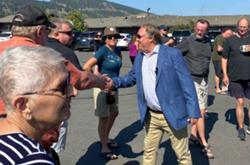
Reporter Luke Brocki takes cycling conference head on. Photo by Mellisa Mills.

-
TYEE LIST #18: Hint: Vancouver's not the most progressive bike city. Not even close.
-
Radio jock rants portray horde of angry car commuters, but even mayor's enemies are bike lovers.
-
Momentum Magazine's best biking stories for summer.
-
Find more urban planning reporting on The Tyee.
[Editor's note: Last month, Vancouver hosted Velo-city Global 2012, the world's largest cycling planning conference. The event made its North American debut June 26 to 29 at the Sheraton Wall Centre, just a block off the controversial Hornby street bike lanes. Debates over the hottest cycling issues of the day brought some of the world's brightest bike-lovers to Vancouver. They also depressed the hell out of reporter Luke Brocki. First in a series.]
The scene is a massive hotel in Vancouver, but it feels like Europe. The place is crawling with men in pointy shoes and shirts with the top few buttons undone. Women wear scarves, skinny belts and summer dresses you won't find at the local outlet store. They all speak a language reminiscent of English, yet coloured with odd bits of German, French, Spanish and Flemish dialects of Dutch. This bike love-in is a delightful and cosmopolitan affair. It's an upbeat, friendly beginning.
The trouble starts in an upstairs media room, where, morning plenary complete, I sit around a table with some of the world's brightest minds in cycling policy and realize I'm the only reporter present. Where the hell is everybody? This is a smorgasbord of cycling knowledge and I'm the only one feasting.
To my left sits the grinning, bearded and silver-haired German entrepreneur Manfred Neun, trained in psychology and economics. Since 2005 he's been president of the European Cyclists' Federation and a major player in the world of cycling advocacy. To my right is the stoic and peeved German political scientist Hans Michael Kloth, former political editor at Der Spiegel and now acting secretary-general of the International Transport Forum at the Paris-based Organisation for Economic Co-operation and Development.
Kloth is resentful he didn't get to speak at the morning's keynote address, thanks largely to a long and entertaining opening talk by another man at the table, Colombian-born Gil Penalosa. He's the executive director of Canadian non-profit 8-80 Cities, and his passionate talk about how the humble bicycle could cure many of the world's problems had hundreds of delegates laughing, cheering and jumping out of their seats in loud applause. He would also dominate this little press conference of ours.
"Gentlemen, welcome to the greatest cycling city in the Americas!" I proudly proclaim, thankful for how far Vancouver has come in recognizing cycling as a viable transportation option. They all laugh and it feels strangely patronizing.
Beyond helmets
"So let's talk helmets," I push. "I've been reporting on them for months and the idea of revisiting B.C.'s mandatory helmet law is finally getting some traction. Surely it's the most important issue of the day."
I get a bunch of blank stares. No one seems particularly interested in our city's bitter helmet debate. They're keen to speak about cycling infrastructure instead.
"But helmets... and ahmm... public bike share..." I grumble, confused.
Turns out they don't care much about public bike sharing schemes either, saying they're just gravy compared to the meat and potatoes of bike lanes and traffic calming.
"It's about infrastructure," someone starts again, but I cut them off and steer back toward helmets. Realizing they're stuck with me for another 40 minutes -- with no other reporters present to ask different questions -- they finally decide to humour my myopia:
"We as the cyclists' federation must intervene and say no," says Neun in a thick German accent, his face creased with concern. "This cannot be, that the vulnerable and weaker road users are then also becoming criminalized because they're not using a helmet. That doesn't work. We cannot accept that."
But local officials tell us we're all safer in helmets. Brain soft, ground hard, I say, parroting the rationale of Vancouver's non-cycling newspaper columnists.
"I don't think it should be mandatory," says Penalosa plainly. "They have done many studies, the most famous one in Australia called Safety Numbers, which shows when you have helmets mandatory, much fewer people are going to bike. And when you have fewer people cycling, cyclists are not as visible. And when cyclists are not as visible, then it becomes more dangerous. So it's better to have more people cycling even without helmets, than fewer people cycling with helmets."
I also learn we are one of just a handful of jurisdictions in the world with mandatory helmet laws for adults (the others being Australia, New Zealand and parts of the Maritimes), before my interviewees start ranting about how the helmet war threatens to exhaust local cycling advocates who should be fighting for cycling infrastructure instead. After all, they argue, all helmets can ever hope to do, assuming they work like they're supposed to work, is prevent the consequences of certain crashes. They do nothing to prevent the crashes themselves.
"The helmet becomes an excuse," says Penalosa. He feels the longer the discussion remains focused on helmets, the longer governments avoid building bike lanes.
"We come from a car culture, so we think about protecting cyclists in a car environment," pipes up Kloth, breaking the silence he's kept since getting passed over in the morning plenary. "What we really need to get to is a safe systems approach. Thinking not (about) wearing protectors and that kind of stuff, but thinking separated bike lanes."
Capacity stalled
"Wait just a minute, guys," I mutter. We've already got 12 kilometres of separated bike lanes here in Vancouver. Did you not ride in on the Hornby Street lane? I sure did! We're already at five per cent cycle mode share in Vancouver (five per cent of all trips already done by bicycle). And Mayor Gregor Robertson wants to get to seven per cent by 2020. Isn't that something?
Here come those patronizing smiles again, before Penalosa bursts:
"You have a mayor that was just re-elected. He's a cycling mayor. Now he has an overwhelming majority on council, so there's no excuse. If he doesn't do it, who's gonna do it?"
But... he is doing it, I venture.
"Two per cent in eight years in a city like Vancouver? It's ridiculous. It's nothing!" he says. "When he's talking about sustainability, he's benchmarking himself with the best cities in the world. But when he's talking about cycling, then he's benchmarking himself with Dallas, Mississauga and Atlanta. Vancouver doesn't have to do anything to be better than Atlanta. We need Vancouver to benchmark itself in cycling with the Copenhagens and the Berlins and the Amsterdams and the New Yorks and the Portlands of the world!"
Energized by their aggressive ringleader, the rest of the bike evangelists join the attack against Vancouver's best efforts to keep cyclists happy: the bike commuter paradise of Copenhagen, already at 37 per cent cycle mode share, is looking for 50 per cent of all commuter trips to be done by bicycle by 2015. Chicago is building 160 km of protected bikeways in a single four-year mayoral term, bitter winters be damned. The mayor of Paris spent two years building bikeways all over that city before unveiling Velib, the old continent's largest public bike share system. He even eliminated 7,000 parking spots to make room for the new bikes. In South Korea, the mayor of Changwon is looking to double that city's cycle mode share to 20 per cent by 2020.
When someone mentions Seville, the room falls into silent appreciation: Seville, a medium-sized Spanish city of some 700,000 people has recently become the poster child of political will in the cycling planning world after its administration built 140 km of protected bike lanes, even though the city's cycle mode share was an insignificant 0.2 per cent.
"They went from 0.2 to seven, now at nine per cent and the goal is to go to 15 per cent by 2015," says Penalosa. "What does Seville have that Vancouver doesn't? The key issue was to build infrastructure."
But even in the absence of demand? I venture. Most of the cyclists in Vancouver are potential cyclists. According to Translink's own numbers, 40 per cent of people responding to the company's market research surveys say they're interested in cycling, but also concerned. Economists call that latent demand. And politicians would rather forget all about it. Catering to would-be cyclists seems like political suicide.
"It's almost political suicide," smirks Penalosa. "But politicians have to decide if they're doing whatever they think is right, or just whatever they need to do to get re-elected."
My Vancouver patriotism is bruised and my spirits are down. Desperate, I go for a low blow: "But why is increasing cycle mode share even a good thing?"
Nobody laughs this time. Instead they grumble about health, transportation, recreation, economic development, social justice, democracy, sustainability and liveability before filing out of the room in disgust.
We're only hours into this weeklong conference and I'm in way over my head.
TOMORROW: Brocki rides deeper into Velo-city 2012, quarreling with security over bicycle parking and settling in for another big roundtable filled with transportation experts looking to sell him on the broader economic benefits of building cycling infrastructure. ![[Tyee]](http://thetyee.cachefly.net/ui/img/ico_fishie.png)
Luke Brocki is a Vancouver-based journalist. Follow him on Twitter @lukebrocki.
41
Login or register to post comments
Hakuin
44 weeks ago
choose:
you can have me on the inside pissing out, or the outside pissing in. Lose the phoney helmet law and gain allies.
thecyclinglawyer
44 weeks ago
Get some updated data
I think pointing to the Australian study is risky. The stats used were mostly 1980's figures with a few early 1990's figures.
With the explosive growth in cycling in Australian urban centres in the last 10 years, let alone the last 5 years, I doubt new data would bear out their conclusions.
The anti-helmet lobby is a vocal minority only, and my guess is that tourists on bike-share bikes are the greatest offenders, despite $5 helmets being available.
Julian_ferguson
44 weeks ago
It's about a little more than helmets
@thecyclinglawyer @hakuin I think you have both missed the point. This isn't really an article about helmets. It's an article about a journalist realising there's more to cycling than simply writing about the helmet debate. Kind of nice to see...
Hakuin
44 weeks ago
I thought I had made myself clear
to me, it IS about oppressive, unnecessary laws and basic freedoms. Everything else regarding this issues is secondary at most, to me.
Yes, it IS all about me.
peetey
44 weeks ago
protection
there needs to be a rethink on the design of the helmet. It's pretty old fashioned, occupying more space than nec. As an amateur specialist at crashing things, my bike impacts in which the helmet saved my head could have been done by a narrow band of high imnpact foam worn like a sweatband.
realisticman
44 weeks ago
Very Well Writen Last Phrase.
" ... I'm in way over my head."
Good pun too.
alive
44 weeks ago
This is new, there are things to learn!
Perhaps we need to remember that cycling was the only choice for most people in places like Copenhagen?
Not like here where everything is designed around vehicles, and everybody grows up using cars as their primary transportation and bikes are a novelty that at times can be fun.
No doubt the cities here can begin to adapt to this "new" mode of transportation, but not as long as it competes with skateboards as an option (in the publics mind).
So far bikes have got a bad name thanks to couriers who disregard any law or common sense.
Finally riders need to understand that they do not own the road, there are times when you need to apply the brakes and dismount, just like a car has to stop and wait for others.
unrealisticexpe...
44 weeks ago
why wouldn't you wear a helmet?
I just assumed that its kids who don't know any better that don't want to wear helmets.
Most adults hopefully realize that having their hair a bit messed up is better than severe brain injury. Hell I barely ride at all, but have had a few accidents over the course of my life which would have been much worse (one probably fatal) if I had not had a helmet on.
Hakuin
44 weeks ago
not worry Alive,
Darwin sorts out those who can't tell the difference between twenty pounds and four thousand.
[OFFENSIVE COMMENT REMOVED - MODERATOR]
thecitycyclist
44 weeks ago
That's the problem
@unrealistic
The problem is people who "barely ride" trying to put fear into those who actually do ride by believing a helmet saved them.
If you hardly ride and have had as many accidents, try looking at the way you ride.
@thecyclinglawyer
You mean the vast majority of the world where helmet laws don't exist is the small minority?
If you want to talk about old data, lets look at that famous "helmets reduce brain injuries by 85%". A study conducted nearly 3 decades ago and has been recycled.
Yes -- Australian urban centres ARE seeing an increase in people cycling...Just not with helmets on and still less then any Canadian city.
Why has Melbourne's bike share failed, or Vancouver failed to even get off the ground?
@alive. Should we assume taxi drivers give all motorists a bad name? People who look at couriers and believe all cyclists are evil are in turn -- dumb themselves.
Riders may have to know they don't 'own' the road, but motorists better start realizing bicycles are entitled to use it.
Hakuin
44 weeks ago
I think all those elderly types
whizzing about the public streets on their mobility scooters without any regard for public order or the emotional comfort of the horses should be forced to wear helmets AS WELL as complete suits of protective armour. Too long now has this tiny fringe of society been permitted to run roughshod over the rights of others with their whining and bleating about how such equipment is unnecessary. Bring these greying gangsters to heel and make our streets safe again! They are the best current argument for the return of the lash and pillory!
trylogic
44 weeks ago
it is about the oppressive helmet law...
I have been cycling for 67 years. It is my main mode of transportation and I do not wear a helmet. People who feel saver using a helmet when cycling obviously will wear it, mandatory or not. Bicycles are the most efficient and versatile land vehicles on earth. Because the driver powers the light weight vehicle, she or he has complete control and that makes it extremely safe. Anybody who only drives a car or motorbike is not competent to talk about bicycles, cycling or cyclists. I know from experience that to get through an accident with no- or minimal injuries you need agility, quick reaction and sometimes luck. If you wear a helmet and have a horrendous crash you might survive and be paralyzed for the rest of your life. If you don't wear a helmet in the same situation you might be dead. Which outcome is preferable for you or society as a whole? If you fall into a ditch a stick might pierce your brain through a ventilation slot of your helmet. Without a helmet the stick might have missed your head. It is all conjuncture. For every argument you present for wearing a helmet I can present an equally valid one against. Do you wear a helmet walking up- or downstairs in your home? It is more dangerous than cycling. Little kids are playing in the sandbox and at the beach wearing bicycle helmets. Absurdity redefined. Laws forcing every cyclist to wear a helmet are scams, justified and promoted by evoking people's fears and insecurities. That is why you pay 50 dollars for a piece of injection moulded plastic foam which costs 25 cents to produce. Societies change and evolve. New insights take hold. Scientific studies now show that bicycle helmet laws are regressive and have a negative impact on the cycling community and society as a whole. British Columbia's 16 year old helmet law should be repealed. This would expand the cycling community by large numbers and free it from hassle, resulting in more programs and better infrastructure. That I would call progress and wisdom.
Snowrunner
44 weeks ago
Minority?
"The anti-helmet lobby is a vocal minority only, and my guess is that tourists on bike-share bikes are the greatest offenders, despite $5 helmets being available."
Riiight. All of Europe is against helmet laws but it's just a "vocal minority".
If helmets are the knees bees, why don't you provide the peer reviewed studies that show the benefit of mandatory helmet laws? Got none? How come? Shouldn't it be a slam dunk if they are a "no brainer"?
Hakuin
44 weeks ago
so long as a bad, irrational and unjust law
is hanging over my head, I will vote and campaign against every pro-cycling initiative that comes along. And why not? I would no receive no benefit for expanded cycling amenities if I am forbidden from using them. Better any money be spent on more parking for cars.
jpfeifer
44 weeks ago
Topography Overlooked in Vancouver
I'm in full support of cycling and all the infrastructure being built for it in Vancouver.
But in most conversations about the bicycle in Vancouver, ultimately a comparison is always drawn between Copenhagen or Amsterdam. While of course being good benchmarks for Vancouver to have in terms of number of cyclists and amount of infrastructure, I'd like to temper this with something I never seen in this discussion.
Vancouver is not flat.
Copenhagen and especially Amsterdam are very flat. Putting cycling infrastructure anywhere in those cities by default allows a Grandma and her Grandchild to cycle around with ease.
One in Vancouver only needs to see the profile of a cycling trip from Edgemont Village to the downtown core, or from the downtown core to UBC, to see that a degree of athleticism and fitness is required to make those trips.
So yes, let's keep building the infrastructure. But let's be realistic - you are not likely to see someone leisurely peddling their way from North Van to downtown already dressed in a business suit (as you do in Amsterdam or Copenhagen).
Just building the same amount of infrastructure here will not automatically bring the same number of cycling trips in Amsterdam or Copenhagen. This does not mean it's not worthwhile, but it is worth pointing out.
Hakuin
44 weeks ago
yep, not flat, and it rains thirteen months of the the year
That never stopped me from riding before. You learn the gravitational gradients and adjust your route accordingly and you carry rain gear, no biggie.
In any case, the true human rights issue here is freedom of conscience and belief. My faith requires me to wear the Invisible Colander of Rational Thought and it is a direct affront to my Pastafarian principles to defile it with any other head covering during worship. This includes the traditional obeisance to the FSM as one cycles with the wind tousling one's locks just as the Noodly Appendages of the Supreme Being are gracefully draped by the Breath of Quantum Ineffableness.
I offer fair warning: any more persecution of my religion will be met with all necessary self-defensive force. If Canada values her diplomatic relations with Austria she had best turn aside from this irresponsible course of aggression.
http://www.huffingtonpost.com/2011/07/13/niko-alm-pastafarian-colander_n_897700.html#s308409&title=Pastafarian_Niko_Alm
jilenium00
44 weeks ago
Helmet laws are not a priority
"Turns out they don't care much about public bike sharing schemes either, saying they're just gravy compared to the meat and potatoes of bike lanes and traffic calming."
BINGO. I run one of the largest cycling organizations in the province 'beyond Hope', and I don't give two bits about the helmet debate. Until we start focusing on infrastructure, and the desperate lack thereof outside of Victoria and Vancouver, the rest is just a waste of my time.
BradT123
44 weeks ago
helmet stats
ICBC keeps helmet stats. They say that, in a bicycle accident, a helmet will reduce the incidence of serious head injury by 30%. Pretty clear, open and shut case for helmet use.
I do not want to pay vast summs of money to keep my fellow cyclists on life support because they were worried about their hairstyle and failed to use basic safety equipment - just like any other sport.
The Australian data (and other data) that purports to show helmets decrease cycling is just so weak and invalid it is embarrasing. The cyclist advocates that bring up these "studies" are just telling the rest of us that they don't have a clue what good data is. They lose all credibility with city planners and politicians, and come across as goofy.
Hakuin
44 weeks ago
Brad
your "case" is embarrassing.
Snowrunner
44 weeks ago
@jilenium00
The problem is that helmets are used by politicians to wash their hands of the need to build an infrastructure. So as much as it is a distraction, it is a very powerful weapon in the arsenal of public opinion as most people are afraid of cycling and the helmet just confirms their fears. Separate infrastructure or not, most people will still be weary about riding.
Snowrunner
44 weeks ago
@Brad
"I do not want to pay vast summs of money to keep my fellow cyclists on life support because they were worried about their hairstyle and failed to use basic safety equipment - just like any other sport."
You do know that with the introduction of helmets in American Football and Hockey (and all the other safety gear) serious injury rates have actually increased, right? You know why? Because nobody playing rugby would have the idea to run headfirst into someone elses head. They all know how that would end. But put a helmet and body armour on the same group of people and suddenly they will play much harder, resulting in way more serious injuries than before.
schlossb
44 weeks ago
A Great Quote from a Copenhagen Traffic Engineer
During Velo City, I was in the middle of taking 14 University of Oregon students to Copenhagen, Amsterdam, and Utrecht to study their bicycle transportation systems with an eye of bringing lessons back to North America and understanding how much higher the bar can be.
One of the Copenhagen traffic engineers told the group "If you build more roads, you get more cars. if you build more cycle tracks, you get more bikes."
That about sums it up to me - what the infrastructure needs to be to get more regular people using a bike more of the time and what the policy decisions need to do to get there.
Jeremy J.
44 weeks ago
well...
In reality, Vancouver is a total joke on most environmental issues. We like to pretend we're oh so progressive and ground-breaking, but in reality we are NOTHING. Reason? We don't have to be.
With a wealth of resources and small pop we don't NEED to be, so we aren't
freebear
44 weeks ago
A slap in the face of Vancouver's Green Facade and Ego!
Mind you those European cities were designed and built before cars were around.
Nothing new needs inventing; everything needs to be re-discovered!
schlossb
44 weeks ago
Why policy matters
There is a difference between cities developed with walking as the transportation technology of the time versus cars as the technology. Flat topography is helpful as well. And so is policy and political decision making. In Amsterdam, a city council vote in the early 1970s on whether to pave some more canals to provide better car access was defeated on a vote of 23-22. (A large city council.) That political vote mattered and the policy decisions since to accommodate the bike everywhere - not just the dense historical city center, but on every arterial road, suburban development, and rural road - was important.
In Denmark, when gas prices peaked in the early 1970s during the oil embargo, political leaders decided to try to be less dependent on oil price fluctuations, so they decided to hold the peak gas price as the new floor price. As oil decreased in price, but gas prices remained high, the government invested the excess into creating the bicycle infrastructure it has today.
So there are definite historical advantages to Denmark and the Netherlands, and perhaps their culture/political system is better able to make decisions for the common good, but politics and policy leadership have also been critical in their efforts.
snert
44 weeks ago
Ahhhh, bycycles.
Just one more obstacle to get in the way of public transit. Cyclists and buses don't mix.
Vancouver can then hold the world record for the longest public transit commutes.
pwlg
44 weeks ago
Enough excuses already
It's not about helmet laws that prevent people from cycling, its about me and you doing something about the way me move ourselves around in the city.
For the most part I don't need to be separated by traffic in Vancouver, I use the little used side streets some that are bike routes but many that are not. I wonder why anyone would want to travel along streets that are heavily used by vehicles. Tailpipe emissions and road dusts containing tire and diesel particulate are something I like to avoid.
I traveled from Steveston to Trout Lake the other day by bike and used the new Canada Line bridge across the North Arm of the Fraser River. Except for the approaches to the bridge in the industrial sections I felt completely safe.
I was surprised when a cement truck stopped to let me across Kent Avenue where there was no stop sign or crosswalk. Kudos to the driver.
It would be nice to read something about walking and the rate it is increasing in the region.
PS I choose to wear a helmet.
oeanda
44 weeks ago
Tyee Readers, Proving Mr. Brocki's Point
If we can't get past this minor helmet issue, we'll always be second-class citizens.
How embarrassing.
ptudge
44 weeks ago
and so they should have laughed.
Vancouver, is not really the all green city, it is actually quite conservative, hence the helmet debate dominates safe infrastructure. recently I moved from Van to Montreal, where parents double there kids to school on bikes, with no helmets- I initially was shocked but really the bikes lanes here are full of people all ages, the traffic bike lights are great and I feel safe zipping through this busy city, with my 8 year old-compared to Van. So listen to those Euro cities with 50%, not 5%, we would all do better.
thecitycyclist
44 weeks ago
Moving on is easy
@oeanda
It is quite easy to move on from this issue. Get rid of the law forcing people to wear a helmet.
For whatever reason *some* believe that dumping the helmet law means putting in a "No Helmet Law" where you can't choose to wear one anymore.
ptudge said it best with Montreal!
Snowrunner
44 weeks ago
Ideology
"For whatever reason *some* believe that dumping the helmet law means putting in a "No Helmet Law" where you can't choose to wear one anymore."
Because these kinds of people believe deep down that all other humans are stupid and need to be forced to behave well.
In general North American parlance it is thought of as a "liberal" attitude but in reality it seems to be mostly religious / right wing people who think nobody would behave rational if there wouldn't be a severe threat of punishment associated with the action. Hence why we get helmet laws, sin taxes and tough on crime bills.
snert
44 weeks ago
pwlg
Wrong, wrong, wrong. One of the reasons to ride a bike is not for exercise or transportation but recreation. If the helmet interferes with enjoying that experience people will not ride. It's got nothing to do with hat hair but simply comfort.
More safety, less participation.
Here's an olde adage that might also help with safety. 'Learn from the mistakes of others. You won't live long enough to make all of them yourself.'
When was the last time not wearing a helmet caused an accident.
ilumin8
44 weeks ago
European Motorists Respect Cyclists
The helmet debate is badly muddled by a failure to distinguish between the two versions of it. One version is whether cyclists should voluntarily wear helmets, and the other is whether cyclists should be forced to wear helmets.
I'm amazed and disappointed that the comparisons with Europe failed to consider an aspect that is at least as important as dedicated infrastructure for cyclists. Europe does not tolerate motorists being careless and aggressive toward cyclists. Most motorist/cyclist accidents are deemed the fault of the motorist almost irrespective of the circumstances. This balances the difference in amount of weight being thrown around and the resulting potential for damage and injuries.
The effect is that people feel safe to ride bicycles, whereas in North America there is a deep, partially-justified underlying perception that cycling is too dangerous.
Anyone who has been cycling enough decades to have had a few incidents with motorists will know that the police have historically sided with the motorists. This is only recently starting to change.
Helmet laws unfortunately reinforce the belief that cycling is inherently dangerous. So if you're going to encourage cycling, cracking down on motorists who endanger cyclists is just as important as bike lanes, and must be paired with helmet laws. And this means the police have to get serious about cyclists' rights. Their annual "crackdowns on cyclists" are an insult that accomplish nothing.
Hakuin
44 weeks ago
not to worry
when gas hits ten bucks a litre you will see more bikes than cars on the road
Snowrunner
44 weeks ago
Car enforcement
"Helmet laws unfortunately reinforce the belief that cycling is inherently dangerous. So if you're going to encourage cycling, cracking down on motorists who endanger cyclists is just as important as bike lanes, and must be paired with helmet laws."
Good one. Two years ago during one of their "Helmet blitzes" I watched a cop give a cyclist a ticket for not wearing on (I was on foot). Right next to the two was a stop sign. Cars just ignored it in order to get across the street with the "pedestrian green".
I asked the cop why he wasn't ticketing any of the cars who ran the stop signs. The answer I was given (Paraphrased) was: "We are here to educate people about bike helmets. It's all about keeping them safe." When I asked what risk a car running a stop sign poses vs. the cyclist not wearing a helmet it was made clear to me that he had no interest in discussing this any further.
There's a serious problem with priorities at the VPD.
Hakuin
44 weeks ago
it just the usual gangster priorities Snow
they want us to FEAR and OBEY.
ilumin8
44 weeks ago
New Laws Requiring Bicycle Clearance
This morning on CBC radio there was a story that a few jurisdictions in North America are just starting to pass laws requiring motorists to stay 3' or 1m from cyclists. This would be a start along the lines of forcing motorists to stay away from cyclists.
The CBC commentators, to their discredit, were somewhat dismissive of this measure. They said Vancouver's streets are too narrow for this to work. Well, streets in Europe are a lot narrower, and they don't have problems with such policies. That's because they respect the rights of cyclists to be on the roads.
I drive in Vancouver, and because I respect cyclists, I don't have any problem staying at least that far from them.
Hakuin
44 weeks ago
one meter?
the law already requires you to not run over cyclists, it's called "due care and attention.
An interesting point: the "Liberal" filth that presently chokes B.C. is the direct descendant of the old, foul Socred evil that blighted us for so long. Many of those venomous dinosaurs were car dealers. Is it any wonder that any competition with gas guzzling cars was strangled at birth?
rayne_koest
44 weeks ago
Small-minded context kills globalization of good ideas
The continental mindset that hampers many senior officials, and even experts is mindboggling.
The excuse of "different context" is getting old and out of date as our population becomes more and more globally aware and connected. Just becuase boomer-aged consultants didn't study other continents 30 years ago doesn't mean they don't exist and aren't worth learning from - even developing countries. We have a globalised economy- why not globalised ideas?
Are the "leader cities" in North America scared of falling to the bottom of the global pit? It's much less sexy or PR friendly than being able to say "we're #1" - are we brave enough to do it?
MonicaC
43 weeks ago
Isolated from the world
I am quite stunned with the comments under this article, frankly. You read an article in which European leaders in the cycling debate tried to explain to Luke Brocki that helmets are a secondary issue, not worth the enegry we are spending on them in Van. And then, you went straight into a huge comment discussion about helmets precisely!!! Just like Luke Brocki did in his interviews.
Vancouver is a geographically isolated, not that big, and a very very young city. But for whatever reason, I am getting an impression that people here like to think that the city is extremely progressive in terms of infrastructure, architecture, and transportation. And when you have very knowledgeable and experienced people coming to town to help you learn about cycling solutions that have worked elsewhere, Luke Brocki uses their time to have them repeatedly explain to him why Vancouver's secondary cycling debates are not going to help cyclists in town. And then, over half of the comments are about helmets too.
I have lived in Europe and in Montreal and it is a no brainer to me that Vancouver is not a cycling city (not to mention a leader in cycling solutions). Some people made valuable comments about geography and weather being an issue - and they really are. The oppressive car culture is an issue too. Cars are the holy cows of the city. They are expected to have easy access everywhere and the whole city is designed such that they do. Large roads divide our neighbourhoods like rivers. As a cyclist, I am expected to feel out of my league if I enter the holy space of car roads and take a tiny bit of their space while inhaling their fumes and listening to their roaring noise. This is a problem to me.
jokingsley
29 weeks ago
vancouver fitness>
Hello luke my friend,I am quite impressed about your blog.Actually the issue you have been raised is extremely important for the people of vancouver because they all admire that wearing helmets during cycling was tough job and i think helmets is very important as our safety is concerned.I am willing to know more on this issue.