Government's claim it's responding to pro-First Nation court decision rings hollow.
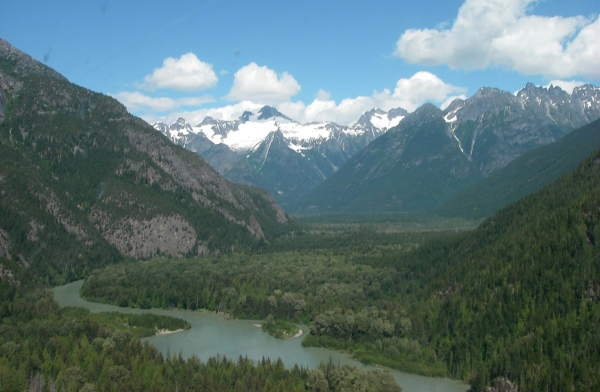
The Klinaklini River on north end of Sunshine Coast: Proposed site of one of largest private river power projects ever.

-
Turning natural gas into liquid sucks electricity. Ratepayers, guard your wallets.
-
Premier's team deftly obscures the real fix, and what drove up costs: BC Lib decisions.
-
Memo to media: time to expose Campbell's fallacy.
- Read more: Aboriginal Affairs, Energy, Politics,
Amid the flood of bills the BC Liberals recently pushed through the legislature in the closing days of the spring session was a quiet amendment to the boundaries of the Great Bear Rainforest -- labelled Bill 49. The legislation cleared the way for one of the largest proposed private river power projects in Canadian history on the Klinaklini River.
Bill 49 reversed then-Liberal environment minister Barry Penner's 2010 decision to reject the redrawing of the conservancy boundary. The recent flip-flop is related to a lawsuit launched in 2010 by project proponent Kleana Power Corporation and its partner, the Da'Naxda'xw First Nation, whose village lies 30 kilometres east of Alert Bay, after their project was waylaid.
But did the Liberal government need to go so far as accommodating the project by changing its own law?
The Klinaklini River, which flows west from the Chilcotin plateau into Knight Inlet on the north end of the Sunshine Coast, is the proposed site of a private river power project of unprecedented proportions. With estimates ranging from 550 to 800 megawatts (MW) of peak energy production, it would see the mighty river diverted for 17 km through a 10-metre wide tunnel and involve a 10 to 30 metre high dam (euphemistically referred to as a "weir" and "head pond" by the project's proponents). The dam would flood part of the conservancy; transmission lines and other components of the project would also encroach on the protected lands.
Only Alterra Power's proposed 17-river Bute Inlet project would cumulatively surpass Kleana Power's $2.5 billion project in scale. The Kilanklini project even approaches the scale of Site C -- a conventional dam proposed for the Peace River -- with its 1,100 MW capacity.
NDP charges 'broken promise'
The official Opposition came out swinging last week against the BC Liberals' "broken promise" to protect the Klinaklini: "Two years ago we were delighted when the environment minister effectively killed this project by refusing to change the conservancy boundaries," said North Island MLA Claire Trevena. "So it was extremely disappointing to see the new Liberal environment minister reverse that decision."
As NDP Deputy Environment Critic Michael Sather asserted to Liberal Environment Minister Terry Lake during the mere 30 minutes of debate allotted by the government for Bill 49, the government has clearly gone well beyond Madam Justice Barbara Fisher's ruling, which stated it was "not appropriate" for the court to force the government to actually change the conservancy boundary.
Said Sather: "The First Nation asked for the 2010 order that Barry Penner made to be quashed. They got that. They asked for the minister to be directed to recommend to cabinet that the boundaries of the conservancy be changed. They did not get that... Yet Bill 49 changes the boundaries of the conservancy, something the court didn't grant. Why is the government abandoning its previous attempt to protect the Klinaklini River and going beyond what the judge ordered?"
Sather is correct here -- and the reason the court did not order this change to the Great Bear Rainforest boundaries is because courts do not have the power to mandate legislation, only to strike down that which is unconstitutional.
The minister defended the government's decision, saying, "The court ordered that the Minister of Environment has a legal duty to consult with the First Nation, a proponent in this case, about their request for an amendment -- and this is the important part -- with a view to considering a reasonable accommodation."
But, as Sather noted, while the judge clearly directed the government properly consult and accommodate the First Nation, she did not go as far as to order it to change the law on the plaintiff's behalf: "It is rare, however, for the court to become involved in directing a particular form of accommodation... I do not consider this an appropriate case to direct the minister to make the recommendation sought."
The rekindling of the project is sure to be controversial, as it comes at a highly-charged moment for both private power projects and the Great Bear Rainforest, which has become a focal point for citizens, First Nations and environmental groups battling the proposed Enbridge Northern Gateway pipeline.
Private power controversies
Private power projects have been the subject of intense criticism of late, both for revelations of widespread fish kills and weak environmental monitoring and enforcement -- slammed by BC's Auditor General -- and for the economics of these deals, discredited by independent economists such as Dr. Marven Shaffer and Erik Andersen.
Page 10 of BC Hydro's new Draft Integrated Resources Plan states the Crown corporation is still intent on purchasing another 2,000 gigawatt hours (GWhrs) a year of private power, despite losing hundreds of millions of dollars this year on the deals it already has in place. Yet the proposed Kilnaklini project would likely considerably exceed that 2,000 GWhr total.
That means Hydro's plan would need to be revised upward to accommodate the project and would leave no room to purchase any other private power contracts -- such as the even larger Bute Inlet project proposed by Alterra Power (unless it, say, quadrupled its next "Clean Power Call"). The equally controversial Bute project was also put back on the table last week as the proponent announced a deal with the local Sliammon First Nation to build transmission lines through its territory.
What Da'Naxda'xw First Nation and Kleana Power argued
Writing for the Vancouver Sun and its newspaper chain, Scott Simpson summarized Kleana Power and the Da'Naxda'xw First Nation's case in May 2010, a month after Penner rejected the project.
"Da'Naxda'xw First Nation and Kleana Power Corporation allege in a writ of summons filed this week in B.C. Supreme Court that the government failed to honor a 2007 commitment to exclude the project area from the bounds of the Upper Klinaklini conservancy, prior to the settling of the conservancy's boundaries.
"When the conservancy was announced in 2008, the project area was included within its boundaries -- contrary to the expectations of the Da'Naxda'xw and Kleana.
"The project includes a 10-metre-high weir that would cause water to back up about 5.5 kilometres into the conservancy.
"Environment Minister Barry Penner has stated in the legislature that the government will not consider moving park and other protected area boundaries to accommodate electricity projects.
"The plaintiffs are seeking a court declaration that would overturn the boundaries of the Upper Klinaklini conservancy, and order the B.C. environment minister to recommend to cabinet an amendment to the conservancy boundary in order to exclude the land and stream bed required to sustain the power project."
In the end, while Madam Justice Fisher's decision, reached in May of last year, concluded that the nation had not been properly consulted, she stopped far short of telling the government to change the boundary.
The judge's decision included another interesting conclusion.
Noting that one of the First Nation's councillors, Fred Glendale, is also a director of Kleana Power Corp., the judge stressed that while the First Nation is entitled to be consulted and accommodated on the conservancy, the company is not: "While it may be obvious, it is important to emphasize that the Crown's constitutional duty to consult is owed only to a First Nation. In this case, Mr. Glendale is both a councillor of the Da'naxda'xw and a director of Kleana. I have considered his evidence with this in mind, as it is not proper for a corporate entity with First Nation directors (or shareholders) to be the recipient of this constitutional duty."
Wildlife risks
The Da'Naxda'xw First Nation fired back at the NDP this week for its criticism of the project. Spokesperson Dallas Smith told the Campbell River Courier-Islander, "If built, the Kleana project would be one of the most sustainable sources of clean energy in North America."
By contrast, in a media advisory issued on June 7, Deputy Environment Critic Michael Sather had stated, "The environmental devastation from this project is unthinkable. Five species of wild salmon make the Klinaklini their home. This project would affect them, plus red and blue-listed species and a grizzly bear and moose corridor."
Smith countered, "There will be no net negative impact to eulachon, salmon or grizzly bear by the project... In fact, the project has the potential to deliver a net benefit to fish populations," though he neglected to elaborate on this surprising contention.
According to the Globe and Mail's Justine Hunter, reporting in 2010, even the BC Liberal minister acknowledged the project's likely environmental impacts: "Kleana's president said the project could be built with a fraction of the ecological footprint of Site C, but Mr. Penner said it threatened protected wetlands, fish-bearing streams, old-growth forest and grizzly-bear habitat."
The Da'Naxda'xw may hold title to the territory affected by the project, but they and councillor/Kleana Power corporate director Glendale are asking the people of B.C. to purchase private power which has been roundly criticized as driving up hydroelectric bills and contributing to the bankrupting of B.C.'s most prized Crown corporation.
The BC Liberal government can't honestly contend Madam Justice Fisher forced their hand. They're only too eager to ignore Aboriginal title and rights when First Nations oppose a favoured industrial project -- i.e., Enbridge, Fish Lake -- but if a nation supports a private power project, they apparently bend over backwards to accommodate it.
Whatever the case, the project's revival would seem to be short-lived, as the NDP have made their position clear. If the BC Liberals and the project's proponents can't ram through environmental approval and a multi-billion dollar purchase contract for the power from the project by May 2013, future premier Adrian Dix may well kill it once and for all. ![[Tyee]](http://thetyee.cachefly.net/ui/img/ico_fishie.png)
Damien Gillis is a Vancouver-based documentary filmmaker with a focus on environmental and social justice issues, especially relating to water, energy, and saving Canada's wild salmon. He is co-founder of the online publication The Common Sense Canadian, where a version of this article first appeared.
34
Login or register to post comments
pwlg
48 weeks ago
I am relieved, "no net negative impacts" , not!
"There will be no net negative impact to eulachon, salmon or grizzly bear by the project... In fact, the project has the potential to deliver a net benefit to fish populations"
First off, where is the evidence proving this to be the case. I guess we will have to wait for the environmental assessment which is now a matter for cabinet and not science. Environmental assessment in terms of Private Power Production in BC has become known as environmental acceptance.
Second, no "net" negative impact means in fisheries policy, no net loss. In 1986 DFO created the "no net loss" policy:
"the government established a habitat management plan that stipulates that when fish habitat is damaged by development, then an equal or greater amount of habitat should be created or restored nearby, as compensation."
However, in April 2011 three experts from DFO testified at the Cohen Commission of Inquiry into the missing Sockeye Salmon in BC on the no net loss policy:
"...the policy intended to ensure there is "no net loss" of fish habitat in Canada is failing to achieve its goal."
Patrice LeBlanc the head of DFO's Habitat Policies and Practices had this to say to the Cohen Inquiry when asked about the extent of salmon habitat loss in BC since the policy took effect in 1986:
""We do lose some habitat," he said, "I'm not sure if it's 10 per cent or 50 per cent - we have no true way to measure."
Documents presented to the Cohen Inquiry from the Auditor General, the Commissioner of the Environment and Sustainable Development, and internal DFO audits concluded that the no net loss policy "does not seem to be working".
Even the DFO internal audit documents showed that 2/3 of the "no net loss" projects failed at compensating for habitat loss.
I am pretty sure Christy Clark and her underling Terry Lake are well aware of some of the damaging testimony and evidence presented to the Cohen Commission of Inquiry regarding the failures of DFO to protect salmon and their habitat in BC.
Despite this knowledge Clark and her Dim and Ignorant quickly ushered in legislation to further destroy salmon habitat before Justice Cohen presents his findings no later than June 30th of this year.
What is planned to augment the losses of habitat and fish from the Klinaklini River is a hatchery. Hatcheries are at the bottom of the list for measures to protect salmon populations. They should only be used on waterways permanently damaged by human development or natural hazard events. There are fish management problems with hatcheries when a commercial fishery is part of the management "plan".
What happens is most of the wild stock gets fished out over time and the genetic diversity all but disappears from the river system. Genetic diversity in all life on this planet is a great survival strategy. Without human genetic diversity our own survival would be in question.
Gary
48 weeks ago
And now I think we know...
...just why Penner resigned.
cyberclark
48 weeks ago
BC looking forward to Private Power, Alberta Style - Again.
Alberta was mostly developed when the Cons decided to privatize it through a very complex set up.
To get control of all the power lines,Ralph Klein took them over from communities with the reason of distributing money for computer labs in schools. As it was, towns that collected revenue from power lines had more revenue to work with than those who did not.
Once they had control, they passed a bill separating the power generators from the Power Line owners. Individuals owning the power lines could select to buy power from the generators. This little move towards privatization cost Alberta Taxpayers some 7 billion dollars at the time.
The power generation was registered with the Provincial Government who in turn sold Power Purchase Options (PPAs) to individuals.
At the time natural gas was horribly expensive so power sales from natural gas generation were low. Not sold they were picked up by LIFco.,and insurance company, and the parent company of General Life who Mazankowsky was president of.
Now, with gas low and more gas generation coming on board, these same options would be worth a great deal of money all ripped directly from the Taxpayers of this province.
Another example was the owners of Alberta News Print company buying PPAs from the generator who supplied their plant with electricity.
This creates a situation where high priced electricity puts coin in the owners pockets while the plant takes a hit. Curious eh?
Other power was sold to Edmonton and Calgary known as EPCOR and ENMAX. The so called market created allows these to cities (arms length from the boards of course)to charge pretty much what ever they want for the electricity. It is called Indirect Taxation.
The Federal Liberals were hounded to make a National Energy Policy encompassing control of Electricity.
Keep in mind, the trust is for getting more money for exported power and opening more export markets.
The thing to consider, do you want this in the hands of private industry which may or may not have an office in BC? Or, would you rather have it stay in the ownership of the province and collect the profits and expenses directly into provincial coffers?
In Alberta, Klein put in the rule all power lines would be paid equally by all citizens in the province. (Remember funding schools)
Now, it has progressed so the business base in Alberta and the citizens in the province pay for power lines built into the Tar Sands for the purpose of Exporting power to California via Montana.
Certainly BC has to Consider their next election.
hg
48 weeks ago
Graft
It is just a case of the liberals shoveling more money into the pockets of their friends, while they still can. Those IPPs are nothing but a fraud. There are no merits for IPPs.
Luck
48 weeks ago
LIB FLIP FLOP
INTERESTING ARTICLE,
PEOPLE SHOULD BE UP IN ARMS,
MORE DESTRUCTION,
DO OUR GOVS REALLY THINK AND BELIEVE THEY KNOW WHAT THEY ARE DOIN,
CAN'T PREDICT THE COLLATERAL DAMAGE UNTIL IT IS DONE,
MIGHT AS WELL HAVE CHILDREN RUN THE GOVERNMENT,
AT LEAST CHILDREN HAVE REASONED,
AND WILL TELL YOU THAT THERE WILL BE COLLATERAL DAMAGE AND EXTINCTION,
WHEN YOU MESS WITH NATURE,
AND CONTINUALLY ASK ADULTS TO STOP HURTING OUR ECO SYSTEMS AND OUR WORLD,
BUT IT IS FALLING ON DEAF EARS THAT REALLY SHOULD BE LISTENING,
CAUSE NOT ONLY ARE YOU KILLING LIFE ON EARTH BUT ALSO KILLING YOURSELVES,
SOMETHING TO PONDER EH
SteveA
48 weeks ago
Is this right?
Apparently the Glendale name is common within this "nation". How the hell did we get to this situation where a tiny group of people can lay claim and imply some kind of ownership to vast areas of BC? Then be used as the back door to environmental destruction by private corporations for huge profits? This is so wrong on so many fronts. Time to call the bluff.
RickW
48 weeks ago
Wouldn't it be a "hoot"......
.....if Dix and the NDP declared now that, if elected, the NDP would immediately rescind all considerations offered IPPs, and would refuse to acknowledge any lawsuits arising over this...
Cool Hand
48 weeks ago
Rick W
Def would be a hoot!! I love it! The NDP was also responsible for a good chunk of IPP contracts during the 1990's.
The media would jump all over it. Capital markets would declare BC a "no investment zone". First Nations IPP participants would scream bloody murder. $Tens of billions$ in compensation would eventually be imposed by the courts against the BC taxpayer in compensation as a result. BRILLIANT!!!
All of those "soft" anti-Liberal votes, currently parking their votes with the NDP, would jump ship en masse. The NDP vote would collapse akin to the 1990's. Can you say Hallelujah?
Gotta give the looney left credit - they def earned the moniker "looney".
Now let's throw something else into the ring. The BC NDP apparently supports the lng industry on the west coast. The gold rush in that vein has just started. Read my previous posts. Potentially 10'000s of jobs turning Kitimat and Prince Rupert into mini Fort McMurrays.
And that source lng would be derived from "fraccing" ng in NE BC. Ergo, the BC NDP now supports fraccing. Sheesh.
And the lng terminals require HUGE, and I mean HUGE, amounts of electricity. BC Hydro's Site C dam multiplied by 3, 4 or 5.
So the BC NDP obviously now supports the environmentally destructive Site C dam to service the lng terminals.
But these lng terminals will require more than that. Site C, a few more Site C's, plus considerably more IPP power.
How do we square that circle?
And why do I always hear crickets when I bring this matter up? It will eventually be brought up by the media.
Green Party anyone?! :P
Colin65
48 weeks ago
So, if this project is
So, if this project is approved, we (BC Hydro's consumers) will be buying even more fixed price (overpriced) power from Kleana while releasing water from BC Hydro's 'heritage' dams. Dams that can produce power cheaper than by any other method and all while the spot market price remains very low. We better have a drought soon so that these IPP's become viable for anyone other than the owners.
RickW
48 weeks ago
Cool Hand
Ah yes - you are talking about the "stuff" put into place largely under the influence of the fifth columnist Glen Clark.
However, I will concede that your "suggestion" of the Green Party as an alternative is a consideration should the present incarnation of the NDP be (as rightistas continually wish) a rehash of what has come before.
pwlg
48 weeks ago
the only way to win
WAC Bennett nationalized BC Electric.
We are going to be paying big time to private interests elsewhere if we don't nationalize all private power producer deals now. What have we got to lose, except our own provincial energy autonomy.
Read Erik Andersen's recent essay, The Profligate of BC Hydro:
http://pacificfreepress.com/news/1/11875-bubble-logic-and-how-bc-hydros-profligacy-will-ruin-the-province.html
Profligate: given over to dissipation
pwlg
48 weeks ago
Cool Hand
You wrote:
"And the lng terminals require HUGE, and I mean HUGE, amounts of electricity. BC Hydro's Site C dam multiplied by 3, 4 or 5."
I am not sure where you are getting this information from but I would assume any LNG Liquefication Plant would produce its own energy from the natural gas delivered there and from a heat recovery unit. It is assumed that a LNP export facility would use up to 10% of the NG delivered for operations. I am not sure if this includes electrical generation.
There is also any additional electrical energy capacity from Rio Tinto Alcan's Kemano Dam since both Methanex and Eurocan are no longer in operation.
Noah_Scape
48 weeks ago
Smells fishy [n p i]
"the project has the potential to deliver a net benefit to fish populations" - so says Da'Naxda'xw First Nation Spokesperson Dallas Smith... but why would we trust him?
After all, one of the First Nation's councillors, Fred Glendale, is a director of Kleana Power Corp., so maybe Dalls Smith also has a vested interest...
and it just smells so fishy [n p i] to say something so absolutely IMPOSSIBLE about a project with a $2.5 billion price tag and years of returns.
Noah_Scape
48 weeks ago
Organisational chart
http://www.nanwakolas.com/sites/default/files/Org%20Chart%20%28June%202010%29.jpg
- that link to the "organisational chart" for the Nanwakolas Council, of which Dallas Smith is President, and which the Da'Naxda'xw First Nation is a member of [and Dallas Smith is spokeman for them]
Nanwakolas Council home page> http://www.nanwakolas.com/
Cool Hand
48 weeks ago
pwlg
Alcan's surplus power is already counted as part of BC Hydro's electrical generation capacity as Alcan has an IPP contract with BC Hydro (signed by the NDP guvmint IIRC).
Firstly, the cooling of ng at terminal requires massive amounts of electricity.
Secondly, an lng plant is separate from any ng electicity generating plant, which would also costs a few $billion$. BC Hydro's Burrard Inlet ng generating station is an example (albeit utilizing older scrubbing technology, etc. as it was constructed during the late 1950's).
BC Hydro itself relased its forward looking plan a few weeks ago:
And that projection was based upon just 2 lng plants (Encana/Apache/EOG) and a puny offshore collective lng plant for juniors.
Right there we are talking about another demand requirement for ~33,000 gigawatt hours/year from BC Hydro's overall current 56,838 gigawatt hours a year demand in 2012.
http://www.vancouversun.com/business/Electricity+demand+rise+cent+2032+Hydro/6724913/story.html#ixzz1y7CPCVEk
7 additional Site C dams?
And that Apache/Encana/EOG terminal might just be doubled in size based up Apache's massive new find in the Liard Basin of NE BC, released on Friday:
http://www.vancouversun.com/business/Liard+Basin+find+best+reservoir+continent+stakeholder+says/6787305/story.html
But those 2 lng plants energy requirements, forecast by BC Hydro, are just small potatoes compared to what is still coming down the proverbial BC lng pipeline (not in BC Hydro's forecasts):
1. Royal Dutch Shell's $12 Billion lng facility;
2. Petronas/Progress Energy's lng proposal;
3. British Gas' lng proposal;
4. Inpex/Nexen lng proposal;
5. Mitsubishi/Penn West lng proposal;
6. Itochu, a 150-year-old Japanese conglomerate, lng proposal;
7. ExxonMobil/Imperial oil lng proposal;
Most, if not all, of the foregoing lng proposals are currently undergoing quiet feasibility studies and have not yet been included in BC Hydro's future electrical demand forecasts.
Cool Hand
48 weeks ago
pwlg - Epilogue
Monetization of the ng assets in NE BC will either be lng to Asia, contracts tied to oil prices, or gas to liquids facilities. IOW, converting ng to diesel (which is more environmentally friendly than oil-based diesel).
SASOL already is looking at a $10 billion gas to liquids facility in NE BC. So is ExxonMobil from what I here. And those facilities will also require HUGE electrical requirements from BC Hydro.
HUGE capital investments and the break-even point is MUCH lower than current $80/barrel for AB oil sands, which is currently trading at ~30% discount from one year ago and below new production costs.
As you can see, the electricity requirements are phenomenal, just based upon the only 2 lng proposals in BC Hydro's future forecast demand.
How those lng electrical requirements will be met is another matter. Site C dam, IPP RoR, ng electrical generation, etc. BTW, NW BC is also considered to be the "Saudi Arabia" of potential Run-of-River power generation. Look to that angle as part of the answer as well.
SteveA
48 weeks ago
Cool Hand..
Calm down Mr.Cool..
The notion that the NDP was responsible for a "good chunk" of IPP contracts during the 90's can be attributed to Liberal spin and propoganda that fools repeat.
REcall similar warnings of economic disaster when ICBC was formed from business interests. After more than a few different changes in Gov. ICBC is still there. These contracts that have been signed are not in the best interests of British Columbians. When an elected Gov. acts contrary to the best interests of the electorate they should be held accountable and dealings that have been done- need be undone. Just because billions of $$ worth of "deals" have been signed doesn't mean there is no way out of them should they be declared illegal. Paying the IPP's market rate for power produced need not be the end of our World.
Damien Gillis
48 weeks ago
Electricity for LNG is an important topic indeed - Pt.1
Cool Hand makes some pertinent points on the subject of the massive new electricity required to power even a couple of the half dozen or more serious LNG proposals now on the table in BC.
It is becoming increasingly clear that the NDP, while rightly tough on IPPs and the proposed Enbridge bitumen pipeline, will likely take the baton from the Liberals on fracking and LNG and run with it. Energy Critic John Horgan's comments last week remove little doubt as to their intentions on this file: http://www.vancouversun.com/technology/Horgan+deems+greener+future/6780093/story.html
LNG must be understood not in isolation but in the context of the system to which it would be connected - i.e., Site C dam, more ruinous IPPs, and a series of additional major energy projects to power LNG plants. Moreover, there's the matter of how the gas is increasingly being derived - i.e., by fracking and other unconventional techniques which carry a range of environmental impacts and require massive inputs of water.
The supreme irony here is that Talisman and Cambrian Energy received a 20 year license last year to suck 10 million litres a day out of WAC Bennett dam to use in their nearby fracking operations - in other words, taking water (read: power) out of an existing hydroelectric dam for fracking, then building a $10 Billion new hydroelectric dam (Site C) to provide the energy to turn that fracked gas into liquid. We truly are robbing Peter to pay Paul. http://thecanadian.org/item/1143-energy-minister-lied-consult-public-frack-water-pipeline-coleman-talisman-damien-gillis
Compounding the folly of this situation is the fact that all of this power provided to industry is heavily subsidized by ratepayers and taxpayers. We're buying IPP power for up to three times the price we sell it for to mines, mills and other large industrial operations like future LNG plants. We're being asked to pay for the construction of a new $10 Billion dam (before financing costs), of which, according to our premier, 100% of the power would go to the Shell LNG Plant alone! So the big question here for BC taxpayers and ratepayers is do we support the subsidization of fracking and LNG through new dams, heavy discounts on existing power, and massive amounts of water - including that coming from our own hydroelectric dams?
Damien Gillis
48 weeks ago
Electricity for LNG is an important topic indeed - Pt.2
Today, it emerged that Canada is intent on blocking the push from many nations attending the Rio Summit to end government subsidies of hydrocarbons: http://www.canada.com/business/Canada+wants+hold+fossil+fuel+subsidies+leaked+document+reveals/6798761/story.html
The commitment from both the BC Liberals and NDP to continuing down this path towards more fracking and new LNG plants only serves to dramatically increase public subsidies for hydrocarbons.
The NDP are likely married to this plan for 3 or 4 key reasons: 1. They recognize how much BC's coffers have come to depend on revenues from natural gas (despite prices being near an all-time low); 2. They don't want to be perceived as being against all development - they've come out against IPPs and Enbridge, so they feel the need to support natural gas - even going to far as to call it green energy; 3. They see some First Nations like the Haisla in Kitimat who are dead set against Enbridge are supporting (even partnering in) LNG projects and don't want to stir up controversy in those communities by coming out against LNG; 4. Opposition from First Nations to fracking and Site C in northeast BC has been growing but is still relatively measured compared to the Enbridge pipeline - many communities are conflicted as they're naturally opposed to seeing another dam on the Peace, but they derive their income from the gas patch.
In any event, this is a massive issue which threatens to reshape the future of our province at least as much as new bitumen pipelines from Alberta do - and yet, it's receiving a mere fraction of the media coverage and public discussion.
In the end, the whole LNG scheme threatens to become a multi-billion dollar boondoggle. These political parties and the industry are banking on achieving a higher price for their gas in Asian markets - particularly China and Japan. But China has its own shale gas potential and is only just beginning to develop it. Moreover, other competitors, particularly Australia, are rushing to access this opportunity and are much further along than we are, Australia having already obtained contracts to supply China with LNG. Then there's the question of the future of the Asian economy. China's economy is already showing real signs of slowing down. It will take us close to ten years to build these LNG plants and the additional energy assets to power them. Will China still be paying premium prices for LNG 10 years from now, given the volatility of the various factors which enable that pricing today?
Site C, LNG and fracking, taken together - as they should be - constitute a massive gamble for the citizens of Birtish Columbia, both environmentally and economically. As such it's time we have a frank conversation about the issue before rushing headlong into a potential boondoggle of unprecedented proportions for our province.
Frank
48 weeks ago
Luke
Its almost sad watching you keep hoping for an NDP mishap that will result in them falling 30% in the polls and the Libs rising the same.
I hate to tell you this but even if the NDP declared they were going to pass a law that abolished summer, half the province would still think they would be better than your Clark-led Liberals.
If you understood politics you would know that governments defeat themselves and the Libs have done an admirable job of that.
But I admit that the entertainment value of watching you pull your hair out every week is pretty darn high.
Frank
48 weeks ago
Luke's security blanket
The quote below is the thread Luke is hanging on to.
"The media would jump all over it. Capital markets would declare BC a "no investment zone". First Nations IPP participants would scream bloody murder. $Tens of billions$ in compensation would eventually be imposed by the courts against the BC taxpayer in compensation as a result. BRILLIANT!!!
All of those "soft" anti-Liberal votes, currently parking their votes with the NDP, would jump ship en masse. The NDP vote would collapse akin to the 1990's. Can you say Hallelujah? "
There are no "soft" anti-Liberal votes. Everyone who is anti-Liberal is really really sure about it.
And no, the doomsday scenario you suggest if the NDP reversed policy on the IPPs would not happen. The media wouldn't even care for one thing. And the few left (100,000?) who even follow Fazil Mihlar's and Mikey Campbell's constant declarations of eceonomic catastrophe if the NDP are elected are part of the 20% who still believe in Christy anyway.
The only people that would lose if the IPPs were reversed would be all the ex-Liberals and their friends that took advantage of their government's policies and screwed the people of this province ten times over.
Everytime people see their hydro bill go up they should remember to thank Luke's political allies and vote accordingly. Apparently roughly 50% do in fact do that.
Frank
48 weeks ago
By the way
John Horgan already did what Luke claims would destroy the NDP. Over a year ago John said the NDP moratorium on future IPP's was still in place and that all existing IPPs would have the lights shone on them in a thorough review and if they couldn't stand up to scruting as being in the public interest then action would be taken to rectify that.
Strangely, since saying that the Liberals have dropped in the polls and the NDP has risen.
So much for another of your predictions eh Luke?
jimmy_laroux
48 weeks ago
@ Cool Hand
If by "good chunk" you mean small fraction, then yes.
What about Liberal support of the "environmentally destructive Site C dam"? (I'm guessing you call it "environmentally destructive" only when the NDP are mentioned in connection with it.) According to Christy Clark, "Site C is essential for liquefied natural gas (LNG) development and Site C and B.C.’s proposed LNG development go hand in hand." Well, at least she's honest about why Site C is being built.
Or these terminals could generate their own electricity from the natural gas they are liquefying, like facilities eveywhere else in the world do. The idea that BC Hydro should subsidize these terminals is utterly insane.
jimmy_laroux
48 weeks ago
@ Cool Hand
Do you mean the one signed in 2007? After the original agreement signed in 2006 was rejected by the BCUC because "it was not in the public's interest"? Which "commits Hydro customers to pay premium rates for electricity from a 50-year-old Alcan installation that produces the cheapest power in the province"? But wait, the NDP wasn't in power in 2006! No, it was Gordon Campbell and the BC Liberals that
screwed the BC ratepayersigned the deal with Alcan. Now you know. It might also interest you to know that BC Hydro has been buying electricity from Alcan since the sixties.jimmy_laroux
48 weeks ago
@ SteveA
You nailed it!
Cool Hand
48 weeks ago
Frank
Your comments come across as going a bit off the deep end. But I digress.
Looks like later this fall and early next spring a further $50 billion$+ in capital intensive projects in both lng as well as gas to liquids will be announced for BC and BC Hydro will be working with same for their electricity requirements.
The future potential for the provincial treasury will be in the additional $billions$ annualy as well as tens of thousands required in construction and permanent employment.
To wit, SASOLS' gtl facility is undergoing front-end engineering as I type. That's a $10 billion+ project that will convert its shale gas reserves in the BC NE Montney Basin into diesel and naphtha.
From PE Unconventional Global Intelligence of June 7, 2012:
http://www.petroleum-economist.com/Article/3042692/Unconventional/Sasol-moves-forward-with-Canadian-GTL.html
Again, perhaps 1,000+ in the construction phase and ~500 in the permanent employment phase plus taxation revenue for this single project. Now, BC Hydro will need to supply the SASOL facility with its enormous electrical requirements.
Since fracced shale ng from the NE BC Montney Basin, currently produced, flows eastward into Alberta, SASOL could easily set up their facility in the Grand Prairie, Alberta region instead if you do not want BC Hydro or IPP power to supply its needs.
Again, the west coast lng facilites, with their huge electrical requirements will also need to be serviced by BC Hydro and IPPs.
That's why WAC Bennett created BC Hydro and the Columbia/Peace dams in the first place - to provide electrical power for future industrial development.
Site C dam, IPP's, fraccing, lng development, gas to liquids development, BC Hydro's supply of electrical generation thereto...
... Will definately be a wedge issue for the Liberals, the NDP, and the Greens next spring. Because that's when the discussion will begin to take off and the media will be searching for answers from all political parties. ;)
Frank
48 weeks ago
Luke
And your comments often come off as hysterical, but I too digress.
Most of your comment has nothing to do with me, I assume you meant to point it at jimmy laroux?
As for the last paragraph, the Liberals may not even be involved in any "wedge issues".
They could be the 4th place party when the election is called if they don't stop the bleeding. I know you think they will and I admit its possible, but at this point it doesn't look very likely unless you're a "true believer".
jimmy_laroux
48 weeks ago
@ Cool Hand
Pure horsesh*t. There is absolutely no reason whatsoever that these facilities, if they are ever built, need to be "serviced" by BC Hydro. They can generate their own power with a portion of the natural gas they are meant to liquefy.
The BC Liberal plan involving "self-sufficiency" from IPPs has already precipitated skyrocketing hydro rates. Or as a former (Liberal appointed) BC Hydro CEO memorably put it: "If [self-sufficiency] doesn't change, it would be hundreds of millions of dollars per year that we would be spending of our ratepayers' money with no value in return".
1. As pointed out above, these sites can generate their own electricity, and do so far more cost-effectively than BC Hydro can with high-priced IPP electricity.
2. There is only so much of the province that can be dammed and diverted. The best sites (e.g. the Bennett Dam) have already been developed, and newer sites are less cost effective (or indeed are, as in the case of run-of-river, intermitten nonfirm sources and thus pretty much useless).
Damien Gillis
48 weeks ago
Hydro for LNG...or co-gen?
The matter of these LNG plants supplying their own energy through co-gen gas power has been raised here and it's an important point. If Hydro (and their government puppet masters, whether Liberal or NDP) insist on supplying these plants with non-subsidized electricity and to cover the costs from new transmission lines, etc. (meaning $100+/MWh instead of $40), then I suspect these operators would choose to supply their own power. I understand that would currently cost in the region of $50/MWh, less than half the alternative. Naturally, there are concerns about the carbon emissions and other impacts from gas-fired electricity which need to be taken into account. Some would argue that not subsidizing the oil and gas industry in cases like this will drive away investment. Even at $100/MWh, that's incredibly subsidized electricity compared with the rest of the world and most of Canada. Plus, we have the gas. If these projects don't make sense at $100/MWh electricity, then then don't make sense, period.
jimmy_laroux
48 weeks ago
@ Damien Gillis
I entirely agree with your comments.
I've heard the "carbon emissions" argument made in supprt of Site C. It's like some people forget what these plants are processing. It's natural gas. It's a fuel. It all gets burned eventually, and it doesn't much matter, from an environmental perspective, where it gets burned. Anyone concerned about the carbon emissions from liquefying the natural gas ought to be far more concerned about exporting natural gas in the first place.
Cool Hand
48 weeks ago
Kitimat LNG - Power Supply
So far, 2 lng terminals in Kitimat have received certificates from the BC EAO. Each of these facilities will utilize power from BC Hydro.
1. Douglas Channel Energy Partnership (the smallest proposal of 'em all)
It's website says:
"Access to hydropower – The location allows the Project to run entirely on shore-based power from BC Hydro."
2. The $5 billion Encana/Apache/EOG terminal:
It's website says:
"Use of hydroelectric power to reduce overall emissions."
These 2 projects will utilize BC Hydro (hydro power) and that future use has been determined in BC Hydro's long-term plan.
Neither of these 2 projects have a BC EAO certificate to develop a separate natural-gas generation plant. In any event, it's not part of their business model.
That doesn't preclude IPP's such as Alta Gas from developing their own natural gas generating stations in the region for other larger proposals (with the lng proponents guaranteeing a low ng feedstock contractual price.
And since NW BC is likely the wettest region of BC on an annual basis, it has been described as the "Saudi Arabia" of potential RoR hydro power. Again, look to that future source for IPP power generation as well.
jimmy_laroux
48 weeks ago
@ Cool Hand
Really?
By a tiny fraction as compared to the total emmisions when the gas is eventually used as fuel. As Damien Gillis points out above, they wouldn't use elcticity from Hydro if they had to incur the cost of new development. Lucky for them the ratepayers of BC are so generous, and can't wait to subsidize the operations of a few giant oil & gas corporations, even if it means bankrupting BC Hydro, whose $11.5-billion debt... has nearly doubled since 2007.
Ah, we'd best be sure to subsidize the private development of it then! Force BC Hydro to buy IPP power at exorbitant prices, then sell it at a fraction of the price paid to giant gas conglomerates. Brilliant!
Cool Hand
47 weeks ago
Yo jimmy
You clearly do not understand the natural gas industry or the contemplated capital investments to monetize those assets.
A Vancouver Sun article, from 3 months ago, describing SASOL's field development of its shale gas play in the Montney basin reflects current ng pricing of ~$2 MMBtu when break-even is roughly in the $4 MMBtu range.
No wonder SASOL is not contemplating much development of it's current acreage. That's not the reason that they purchased a 50% interest in those fields in the first place.
The key quote in that dated article is:
And that $10 billion gtl facility was further corroborated by the article in last weeks Petroleum Economist:
http://www.petroleum-economist.com/Article/3042692/Unconventional/Sasol-moves-forward-with-Canadian-GTL.html
jimmy_laroux
47 weeks ago
@ Cool Hand
Oh, well I certainly don't pretend to understand the natural gas industry as well as you pretend to understand it.
There's many a slip twixt cup and lip, and it seems like some of these companies are starting to reevaluate their projects in light of current natual gas prices.