Opinion

Managers vs. the Managed: Another Way to Look at #OWS

It's not about resenting wealth. It's about stopping the war on productive work.

By John MacLachlan Gray, 15 Nov 2011, TheTyee.ca

Manager and the managed

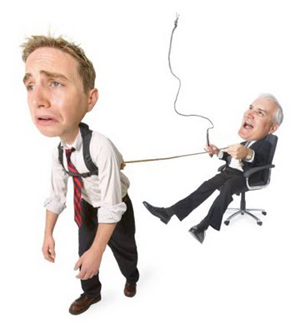
Whipped: Did you make the strategic mistake of knowing what you are doing?

Related

"Something is happening and you don't know what it is, do you, Mr. Jones?"

That Dylan song has drifted through my mind more than once over the past year, in a number of contexts.

The Occupy movement, for example. "We are the 99 per cent" goes their slogan (one of them at least), referring to the disproportionate share of the economy occupied by the rich.

To which conservative mass media (are there any other?) respond with the spectre of "class warfare," evoking Bolshevik execution squads -- blindfolded men and women in Patik Philippes and Manolo Blahniks put up against the Wall Street wall and mown down.

An attractive image perhaps, but I don't think it's about the rich. For one thing, as most people know, there are good rich and bad rich. Is anyone going to pretend Bill Gates hasn't done at least some good? And whether or not George Soros funds it, who in the Occupy movement wants him to disappear?

There's a class war brewing all right, but it's not between the Rich and the Poor: it's between the Managers and the Managed.

Put simply, North America suffers from a cancer of the management class.

Not to be offensive, but these people are breeding like rats.

You've been 'rationalized'

Does an institution exist in North America, public or private, that has not increased its complement of managers, while decreasing the number of people who actually do the job?

Sure, the product is being produced -- by being "outsourced," meaning that the jobs are subcontracted to countries and constituencies where labour is cheap and benefits need not apply; and "rationalized" -- in which fewer and fewer people produce more for less, overseen by a tier of management and sub-management for each stage in the process.

The trend has been going for a century, but of late it seems to have entered a pure, lethal phase, purging the economy of real products and services and replacing them with speculative mathematicians.

The flow chart. The balance sheet. The algorithm. It's what managers are trained to know and, more and more in recent years, it's all they know. In the absence of physical workers in the building to watch over and whip into shape, managers stare at computer screens and crunch numbers, creating for themselves a meta-industry in which people just don't factor in at all, other than as consumers.

I first became aware of this invasive pathology several years ago, when I learned that the previous position occupied by the CEO of CTV, one John Cassaday, was as vice president of Campbell's Soup.

What does TV production have in common with soup production, you ask? Well I'm sure you could find commonalities and synergies, but should you be surprised if an evening's TV schedule comes out looking a lot like different flavours of the same soup?

I know I have reached an unbelievably old age, because I remember a time when the management of a company consisted of people who had acquired some experience with the specific product. People who had "moved up the ranks," who could not only could oversee the job but knew what it was like to be actually doing it.

Evidently I was in a fool's paradise.

In 1908, Harvard opened its business school, which introduced the concept of management as a skill in and of itself, regardless of the product; and in doing so, it gave birth to a cult. Like Scientologists, contemporary managers believe they have a scientific formula that transcends all the messy particulars of life here on earth. In other words, they have The Answer. In that sense, managers are the new Bolsheviks.

John Cassaday graduated from the Rotman School of Business, one of hundreds of institutions that imitate Harvard in promulgating the idea that you can run a business as an abstraction, the way a hired assassin can kill anyone he or she is hired to kill -- and just look at the tuition fees! A Queens MBA will take 16 months and cost you 75 grand -- and worth every penny, because you come out of it with the sacred knowledge, the mystique. (The relationship between management and witchcraft is something I won't get into; it would be a disservice to Wicca.)

In an era of decreasing government support for higher education, what university is going to pass up on that? As a result, MBA programs have multiplied like those other supposed springboards to Success -- cosmetic surgery clinics, weight-loss programs and personal coaches. I counted 38 MBA's in Canada, including the universities of Athabasca and Cape Breton.

But can you bake a pie chart?

Like any toxic phenomenon, Management is most lethal in its purest form.

The mathematical thrust of the discipline really zoned in with the advent of the computer and the Internet, so that by the mid-1990s, more and more MBA graduates had gravitated to the financial services industry -- and small wonder, for the profession allowed them to use their training in an industry undiluted by the exigencies of soup or television production or anything else you touch or use or see or hear.

Is it any wonder that the mathematical logic of management took people to logical conclusions -- credit default swaps for example -- that nobody outside a computer chip could really understand? And just look what happened.

Even so, let's not fool ourselves into thinking that the colossal failure of the financial services industry will diminish the mystique of management itself -- in which a single CEO is deemed to be worth a sum equal to the gross national product of a third world nation.

Meanwhile, when everything can be expressed in flow charts and pie charts and sales charts, do we wonder that North American culture has become more and more standardized, rationalized, homogenized? Should we wonder why it all comes down to one talk show format, one TV news format, one action movie, one song length?

As often happens, when it comes to trends in the culture, the canary in the mineshaft has been the music industry, in which the abstract, technological bent of management is brought to bear on an already abstract field of endeavour.

Take the process of "sampling," for example, in which music isn't played so much as managed -- surgically removed from its original context and pasted into a form that fits the airplay demands of program managers, themselves beholden to the managers who run the company -- without any of them having to play a note.

Meanwhile, musicians find themselves playing their instruments, literally, for nothing.

So it goes with teachers, nurses, ferry workers, public servants, longshoremen, waitresses, actors and salespeople find their salaries and their "lifestyles" eroding like sandstone, while their managers' "compensation" shoots up and up -- plus, of course, "performance bonuses" for showing up at the office.

Pink slips for management

As part of the cancer we must not neglect the world's political leadership -- a major branch, or tentacle, of Management. Note how, in Europe, management has metastasized to dominate the nation state, with currency unions and trade deals, creating a reigning corporatocracy under the leadership of unelected bodies such as the IMF -- for whom a referendum in Greece would be like handing the asylum over to the inmates. Similarly, under NAFTA, Canada may nor may be forced to sell its own resources, whether its citizens want to or not.

However, the inmates in the asylum are not pleased.

Never in my lifetime have the world's citizens been so uniformly disgusted with their politicians: in the U.S.A., France, Egypt, Syria, Iran, Japan and China, to name just a few. (Russia is, for the moment, an exception; Russians have a high tolerance for arbitrary despotism.)

The Occupy movement. The Tea Party. The Arab Spring. However diverse and inchoate they might seem on the traditional left-right spectrum, they all seem to want the same thing -- to fire the Management and start over.

The Managers versus the Managed: a class war has started, a revolution is coming, and it's only a matter of time.

One way or another, the infestation must stop.  [Tyee]

24  Comments:

Login or register to post comments

  • hg

    27 weeks ago

    Managers

    This is precisely my gripe as a lifelong worker, which I could never express so succinctly.
    This started in the Trudeau years, when he put "managers" in charge of the fisheries, and look what happened.
    I worked in three different categories of industry and noticed the dehumanizing of the workplace and/or the attitude to customers. All in the name of "policy".

  • snert

    27 weeks ago

    The best way to screw a company

    is to just let the managers manage. This works really well when managers are hired off the street as opposed to promoting from within if the talent is there.

  • Fiat lux

    27 weeks ago

    What the bloody fools,

    What the bloody fools, including the professors who teach this crap, don't realize, or even promote, that more office jobs and "outsourcing" may increase temporary profits, but they're not cutting, but increasing real costs in the forms of incompetence and myriads of illnesses we've never heard before.

    People are born with certain talents and when these productive talents are suppressed to fill the fraudulent demand for "jobs", the inevitable consequences are destruction.

    As we can see it all around us, albeit not noticed by universities and bought politicians.

    When I was in the custom furniture business in Vancouver from 1957 to 79, the largest professional group of my customers were doctors and I had the opportunity to have some long chats with good many, including psychiatrists, who were also interested to find out what makes me.

    Even 30-40 years ago, when the health problems were nowhere near the present disaster area, many of the doctors I talked to considered that 70% of all illnesses had psychosomatic causes.

    People were unhappy and their minds forced their bodies to break down with all kinds of sicknesses. That simple.

    Today, this has become an epidemic, while our so called "economists" and politicians report "growth" and "wealth creating globalization" and the hospitals are full of the sick and bald headed little kids with cancers that didn't exist before.

    Will humanity ever wake up to this racket?

    Ed Deak.

  • OhCanada

    27 weeks ago

    Managers - excatly - multiply like rats

    "As we can see it all around us, albeit not noticed by universities and bought politicians."

    Of course universities can't see it! They are turning their staff into managers. It is happening in BC's universities - there are more managers than actual staff who does the work. Just look at their job ads - managers, managers, managers. While those working within are disgusted and looking for moving on. They don't promote their own.

    Do you wonder then why universities are becoming so expensive? Most of the universities I have seen are just a money pit with ugly inequalities - and growing. Someone needs to pay for all those. And yes, they are the students and tax payers.

    And the managers? Thank you very much they are doing just fine.

    Unbelievable!

  • Fiat lux

    27 weeks ago

    Yes, and management of all

    Yes, and management of all forms of life is what our "conservatives" are selling as "individualism".

    The whole world is being enslaved and exploited by a corporate mafia in the name of "individualism".

    Ed Deak.

  • alive

    27 weeks ago

    Not my job, Man!

    Thank you for expressing my feelings so well!

    Certainly there has always been some "featherbedding" amongst workers in larger plants, and managements answer was time and method studies, (the man with the stopwatch watching your every move).

    The next step was "job-planners" who tried to tell a skilled worker how to do his job, (again a guise to make the workforce work harder and take fewer breaks).

    And finally the increase in middle management, which happened because they could get away with easing the work of the existing managers by hiring even more managers.

    Along the way, it seems that nobody above the rank and file have any idea about how to actually perform the tasks, or any interest in learning about it.

    We have not yet reached the Japanese devotion to the firm, where employees must attend the sing-song every morning, and salute the top brass --- but it may still happen.

    What all this has done is to make the average Joe totally disregard the job at hand, because nobody else in the organization worries about the actual product any more, it is all about passing memo's around and looking important!

  • kootenay

    27 weeks ago

    Alive Nailed it

    I felt like I was reading about my own workplace. If managers were to shift their focus to their employees and listen to their contributions, not only would they need less managers, they would increase production as well.

    Any 'manager' knows you can't trust your employees, they'll screw you at every turn. Also, they are less educated than a manager and therefore have nothing useful to contribute, hire consultants.

    I think back to all of the "programs" that have been introduced into my workplace over my career, it's been several, they all costed millions to implement and everyone of them fell flat on their face.

    Simple fact that managers will never understand, your workforce will never change until you lead and demonstrate the change. No matter how great your 'program' is, if the management doesn't change their attitude, nothing will change.

  • Christophe

    27 weeks ago

    All this wailing about managers is galling to me

    If you aren't happy working in a large organisation, set up your own business. Work for yourself. You will find that you are the hardest slave-master you could possibly have. If you aren't, your clients will be.

    British Columbians remind me of the British from back in the 1970's. The motto was "I'm all right, Jack, bugger you".

    That is the refrain I keep hearing from disaffected workers. Work, any kind of work, is a hard task-master, so get used to it.

  • Fiat lux

    27 weeks ago

    Managers would achieve better

    Managers would achieve better results if they'd tell the workers what to do and then get the hell out of their way.

    I learned this from experience and applied it with the best results. My guys always knew what and how things had to be done and felt being part of the business.

    Never made major decisions without meetings.

    I suggested this to other managers and they were horrified: "We were hired to manage"

    Most workplaces don't even have the old "suggestion boxes" any more and people are used like herded animals.

    In the name of "conservative individualism" of course. We can see the results.

    Ed Deak.

  • Langley

    27 weeks ago

    Wow, you nailed it kootenay

    I've just been laid off from a company where the middle management did the exact opposite of the golden rule "lead by example".
    Double the break times, numerous smoke breaks while all the peasants worked away. They were so self important and eltist you'd think they were training to be politicians.
    Worse still, the senior management thought they were doing a great job and kept promoting them up the ladder. It was truly a shocking workplace. I was happy to be laid off and I figure now that I've seen the worst it can only get better for me.

  • Jerry Munro

    27 weeks ago

    Poppycock....

    Poppycock. It IS about resenting obscene wealth, the economic power imbalance and the democratic deficit. And unapologetically, rightfully so. Sheer bourgeois liberal poppycock!

  • igbymac

    27 weeks ago

    Entertaining screed

    ... but from my perspective, it's essence is misplaced frustration. Management is just systemic fall-out from Taylorism, like all jobs that have been drawn and quartered by corporate overlords seeking profit.

    There is a superb documentary released a year ago called Human Resources which looks at 'Social Engineering in the 20th Century [and] explores the rise of mechanistic philosphy and the exploitation of human beings under modern hierarchical systems". I believe it will open some minds about how we have got to this point in our development.

    Human Resources Free On-line Viewing LINK

  • frank2

    27 weeks ago

    Ouch. My comment didn't seem to print. Here's a summary.

    The problem isn't the managers, it is those who engage them to do what they do. In a nutshell, that's the owners of firms, highly concentrated in the financial sector, but also including stewards of pension funds. So long as we allow -- indeed, insist -- that firms seek short term profits for owners (and top managers) with minimal constraints regarding protection of consumers, workers, or the environment, we can expect things to get worse. Our present system is so perverse that we --taxpayers--pay to bail out the biggest outfits of all, so they can continue their depredations.

  • OwlRol

    27 weeks ago

    Not new news, but well presented

    I suppose its been going on even before Robin Hood. The Sherrif of Nottingham was a middle manager doing the bidding of Prince John, able to extract tribute from the serfs, mostly through force, without ever being able to grow a single bite of food.

    Likewise many military captains and majors, supervisors, department heads, etc.

    Some are needed and should be carefully selected as they move up through an organization (real accomplishments, not based on who you know), rather than being parachuted into top positions with nearly no significant knowledge of the real operations.

    That's also why top government patronage appointments and the revolving door mostly don't work well for the common good.

    Gerry, you are correct about the "economic power imbalance and democratic deficit" frustration.

    But there is also the resentment towards people that don't pull their weight in an organization. It was a huge problem in the so called communist system.

    I'll never forget the anger from staff when a vice principal and counsellor went for a 2 P.M. jog out back while understaffed teachers and other admin. had to manage provincial exams in a large school. This and much worse goes on in many organizations, both public and private.

    Those people have intentionally ignored the work ethic they get paid for, betrayed their colleagues and undermined their organizations. Nothing new here, except that it has become systemic.

  • OwlRol

    27 weeks ago

    cont. - Reasons and Change

    Here are six likely interrelated reasons.

    1. The sense of entitlement, rampant from top corporate jobs to child and teen self esteem promotion.

    You really are not special until you've actually accomplished something beneficial, not just for you and your family or buddies. Media recognition ought not to be a factor.

    2. The "you don't need hard work, just smart work" ethic has a grain of truth to it, but it usually implies that someone else has to do the hard work. 10% inspiration, 90% perspiration. Few people can think "outside the box", especially when stressed out and sleep deprived.

    3. It's O.K. to break rules so long as you don't get caught. As long as its legal, never mind ethical (like oil :-) ), you are sooo good. That only promotes the worst qualities of the “rugged individualism” that Ed speaks of.

    4. Corporate loyalty to employees has fizzled to nothing in most quarters. Why put in any more than required if there is no true recognition forthcoming and layoff slips are just over the horizon anyway. The "just in time" model of commodifying workers is very counter-productive.

    Good luck finding a job with an organization that really treats its employees well, there's so little turnover. On the other hand, McJobs...

    5. The government-corporate cabal won't support even the best of our post secondary students (scholarships help but rarely cover much of the bills) to fill those needed posts, and who would really want to come here simply as a "guest worker" (ugh), only to be expelled later. Again, loyalty and that "just in time" mentality.

    6. Lower taxes is much less the reason than free universal health care and other such perks for many companies to locate here. But the mantra...

    These are just some changes needed to make this system work, or, to introduce a new, sustainable and fair one.

  • Mal

    27 weeks ago

    Social accounting

    Say what you will about the discarded Material Product System's inability to measure both productive services and unproductive expenditures like military spending, but at least unlike GDP it tried to measure productive work.

  • Bailey

    27 weeks ago

    Not just managers, middle managers

    I have a theory.

    Military tactics always lag behind the advancing technologies, so the boots on the ground are always fighting the last war so to speak.

    So during WW1 huge numbers of the best young men in all the western cultures were mown down when they were ordered to pop out of holes in the ground as if they were facing swords. when they were in fact facing the crossed fire of machine guns and pinpoint mobile small artillery.

    To qualify to be allowed to lead these slaughters one had to be:

    Brave, generous imaginative, honourable, loyal and willing to do one's duty regardless.

    In short; a natural leader. One of those people who would in the course of things assume positions of leadership in societies. Who would determine all sorts of qualities those societies might need.

    Each and all of them wiped out, leaving nobody growing into leadership at all.

    But, don't worry, the old guard aren't lost. We can keep the last generation at their posts a while yet. So that's what we do, and start breeding a new crop. The young growing up well, until 20 years later we do exactly the same stupid thing again.

    This time the last generation is really old, and pass away as we all must, leaving us firmly in the grip of middle managers.

    Able to count every bean, and squeeze money out of the world, but no idea whatever how to use that money to build a world. Or even to know that they should.

  • packrat2

    27 weeks ago

    managers mange

    ignore repress develop.

    prevention, problem solving, supervision

    pragmatic environmental realization

    technocratic realities (all six)

    like other control freaks, they run out of steam when they run out of things to steal.

    packrat2

  • aicra

    27 weeks ago

    Old methodology

    The manager/employee model is old, stale and needs improvement.

    I have always found this model ineffective. My first experience with bad management came when working at my father's wire manufacturing company.

    Owners tend to like managers because they can just reap profits and let someone else do the work - sometimes the dirty work.

    When I worked at Kinkos, the graveyard manager was running his "own" print shop on Kinko's dime and the employees went along with it. He took orders, ran jobs on the company machines but they all split the cash.

    Today, with remote situations such as oDesk, Freelancer, Guru, etc. individuals can do the work and manage themselves. They know they are not getting paid if they don't produce. In full time corporate jobs, someone can "show up" and do nothing or the minimum to keep the job but still get a paycheck.

    I don't know what the solution is to eliminate or improve the manager/employee model but it does seem so industrial age and we need to move forward to the information age.

    Profit sharing could be one option. If employees feel they are working together to make a profit, that could be enough initiative to move work forward. However, who do they report to? Perhaps, it could rotate, perhaps each other.

    Unfortunately, this model is so set into place, I don't know if we will see any real change anytime soon.

  • Jerry Munro

    27 weeks ago

    Hierarchical and Self Management: Direct Democracy

    "But there is also the resentment toward people that don't pull their weight in an organization. It was a huge problem in the so called communist system." Owlrol.

    First, I have to acknowledge how much I enjoyed Bailey's piece. Who always cuts close to the bone, and not without a sense of humour. :-)

    But Owlrol, also from a generally good piece.

    Which is why such as I say, along with yourself, "so-called Communism". Because we now know, looking back, post the full blown emergence of "western style" capitalism from out of the end result of that Bolshevik revolution, that a class of elites had been growing up within it all the time (in and around The Party.) At least from the time of the death of Lenin. And that what really more evolved in the old USSR, and still, though now more openly in China, was a kind of State Capitalism, grown down from the top rather than as did conventional capitalism in the west, more organically out of an evolving merchant class over the long history of slavery and feudalism. (Which emerged through the extruded result of their Cromwellian "roundhead" victory over the landed nobility around Charles in England. Later France, Garibaldi in Italy etc.) For which reason, under Stalin and Mao, in my view (too complex to present here)it evolved with an even less democratic result than "traditional" western capitalism. (Which was the real "lack of enthusiasm" source for that deep "shirking tendency" in the USSR.)

    Which is the long way around of attempting to demonstrate that what is really needed to evolve here, likely through one or another kind of revolution, is a co-operative system of economic enterprises "democratically self-managed" by the working class itself (in the broad, all the various working class 99% strata inclusive sense). For while there is unlikely ever to be a "perfect" way of dealing with shirkers, like greedy and power hungry persons, an all inclusive and profoundly democratic "self-management system" will be the best way. Nobody hates shirkers or grasping greedy persons more than the collective working class. They pay the highest price in all regards for these assholes. And if the "co-operative" fails to deal with them, they will be the ones who directly pay the consequence in any case.

    But the fuller status quo reality is, in the current hierarchy model, that the higher up the greed and power chain you go, the less real productive, real creation value work goes on, with more real high priced shirkers. Flattening the managerial/power structure, which such democratization would achieve, will take care of these "high priced" folks too.

    In short, it is time to take capitalism and all its assumptions of right on... including its managerial and parliamentary State and Party ones. Having about as much to do with real democracy as a beauty contest... a rather nasty, highly exploitive one.

  • alive

    27 weeks ago

    Yes Virginia, there are other methods!

    Christophe that was an interesting post, I hope you realize that not everyone is able to start his own business?--- I did and agree that working for yourself is harder, but also much more rewarding --- but this is not a solution to the problem discussed.
    As others question what could be done, may I point out that my experience working in Denmark, showed me a totally different attitude from the owners.
    I got a job in a new plant where for one thing everything was colour-co-ordinated to soothe the eye ( as opposed to the tinshack I had worked in, in Nanaimo).
    Every employee was treated like a hockey superstar, with shiny lockerrooms, sauna style showers etc etc.
    The machinery was the latest design and the tools provided (yes: provided) were first class!
    The un-official goal was to have 50 minutes productivity from every paid hour of work ( and no free overtime either).
    So, Panorama windows, a great cafeteria and respect (respect is an oxymoron here)worked just fine there--- is there any reason why it could not work here?
    My guees would be that we suffer from too many fly-by-night owners, who set up shop on a poor budget and only care for a quick profit?
    Oh yes there are unions in every shop in Denmark--- could that make the difference?

  • freewilly

    27 weeks ago

    we are all managers

    I saw a program on the history channel last night about how the British under Churchill destroyed a number of french battle ships. Never knew that before. Wether it was right or wrong the British felt that if the french fleet fell into German hands they would certainly lose the war.
    A hard decision that was management. Managers are supposed to make these difficult choices. In fact all of us at some point in life have to make hard choices just like managers.
    Ive worked for good companies and badly managed ones. The worst are the ones who's managers are faceless. Decisions are handed down by some suit and knowone whos he is.

    I worked for a family retail business for 4 years and I did not envy my bosses position. He had to answer to the customers. If the customers werent complaining about one thing or another and trying to get something for next to nothing. Other customers would be shoplifting while Dave wasnt looking.

  • dorothy

    27 weeks ago

    There it is, again...

    "..my experience working in Denmark, showed me a totally different attitude from the owners."

    I read an article in National Geographic Magazine years ago, about Denmark. The author was marveling at how "the lowliest clerk in a bakery would send you a level gaze across the counter". Now the problem here is the notion that anyone doing an honest job could ever be considered 'lowly'. I feel so frustrated when someone suggests that we here in Canada should
    do it more like the Danes do, for you are talking about a different mindset and culture altogether, one that takes generations upon generations to build. You can go back before year 1000 and find self-serving attitudes and pettiness outlawed in Denmark. There was a set of laws for the guards of the king's council, which stated that you could ultimately be shown the door for such transgressions as taking your own horse and that of a fellow guardsman to water and riding your comrade's horse both ways. Does anyone recognize the habits of a not-so-loved colleague here? He or she who takes credit for doing the job, when in fact they left some mopping up for you, which no one will ever give YOU credit for? So, in Canada where self-serving, snooty attitudes are de rigeur among the successful, and people are indeed considered 'lowly' if they do manual work (I just have to think about how some of my 'professional' colleagues deal with members of the cleaning staff when no one they care about is present), we have a long, long way to go.

    That is not to say that we'll never get there, we just should not underestimate the magnitude of the task...It is a certainty that unions can help, but it would help even more, if they were populated with leaders and reps, who understood that when they deal with management in a representative capacity, those managers are their equals and not their superiors. Yes, in theory most people 'know' that, but the task is to internalize it and act it.

  • ratemmer

    27 weeks ago

    Priests in the Temple

    I'm glad you avoided making a comparison between "witchcraft" and management. You would get much further if you considered it a sort of priesthood. Where specialists are trained to use magic words in a hierarchy, they mystique and insulated comfort of the temple don't actually contribute anything to the "real world".
    I had a manager once who had an incredible talent for standing in front of a room full of people and spewing forth so much garbage management speak. People would avoid asking questions because we had no idea what he was saying (if anything).