


 SHARE:
It is spun in government press releases as a "first" for any jurisdiction in North America, an achievement that places British Columbia "on the leading edge" of efforts to combat climate change.
But scratch the surface just a little, and questions arise about the legitimacy of Environment Minister Terry Lake's recent claim that "from this point forward, every government building in our province will be carbon neutral."
Since it is almost impossible for government buildings -- cash-strapped schools and hospitals among them -- to not be net consumers of energy and therefore net greenhouse gas emitters, purchasing carbon credits to allegedly counteract those emissions is essential to the province's claim to carbon neutrality and its self-anointed status as continental environmental leader.
By law, the provincial government requires institutions to buy those credits from just one entity -- the Pacific Carbon Trust or PCT, a Crown corporation set up for specifically that purpose. This gives the PCT a monopoly position for a segment of the carbon market, which at present is largely a voluntary market dominated by private sector carbon sellers and buyers.
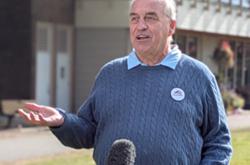
Bob Simpson, Independent MLA for Cariboo North, says not only is the PCT's monopoly position hurting cash-strapped school districts and health authorities that are forced to pay the PCT as much as four times more money than they would otherwise pay for the same credits from a private credit marketer, but the legitimacy of a good number of the credits that the PCT has bought and sold may be of questionable merit as well.
'Money from kids and patients': MLA Simpson
An examination of the PCT's "2010 Carbon Neutral Government Portfolio" published in June of this year reveals that fully 55 per cent of the 729,782 tonnes worth of carbon offsets that it has purchased and marketed to meet the provincial government's "carbon neutral" goal for 2010, came from just one project known as Darkwoods, a chunk of privately owned forest land purchased three years ago by the Nature Conservancy of Canada when, Simpson says, the PCT "was nothing more than a just fledgling organization."
Simpson also says that the project does not appear to meet the PCT's own standards for qualifying carbon offset projects. That standard is known as additionality. Part of the additionality test is that any project supported by the PCT must face "economic, investment or technological barriers to implementation that are overcome or partially overcome by the money from the sale of offsets."
"The trust must prove that without its money this purchase would not have happened and therefore the credits would not have been generated. I don't buy that in this case," Simpson says. "And we're talking money from kids and patients to make this happen?"
Mark-up is not transparent
As a matter of policy, PCT does not disclose what it pays for its carbon credit purchases, says its managing director of business development, David Moffat. However, enough facts are known about the Darkwoods project to give a good idea. The sale of the credits was announced June 8 in a jointly issued press release that included the NCC and PCT.
The press release notes that the NCC as "Canada's leading private land conservation organization", had just completed the largest ever forest carbon project to date in North America, with the successful marketing of 700,000 tonnes of carbon credits. The sale of the credits not only raised the bar for conservation in Canada, the press release claims, but it "contributes in excess of $4 million for NCC's conservation work."
Based on the number of credits sold and the selling price, the sale worked out to roughly $5.70 a tonne. While PCT will not disclose what it paid for the 403,112 tonnes of credits it purchased from the NCC, the price that PCT's captive public sector "clients" are required to pay is known. That price is $25 a tonne, or more than four times the average price generated from the Darkwoods carbon credit sale, meaning that public sector entities including school districts and health authorities will fork out $10.07 million to help meet the government's carbon neutrality goals.
And that's just the beginning of where things get murky from a public policy perspective.
Darkwoods billed as 'immense carbon sink'
Just how much additional carbon has actually been stored at Darkwoods since the NCC stepped in to purchase them in 2008? Well, it turns out the answer to that question is, at best, hypothetical. Here's why.
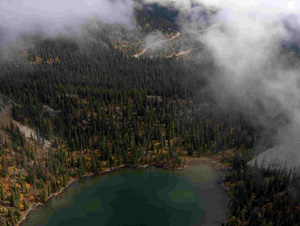
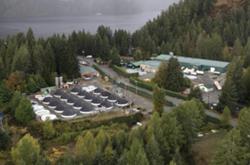
Darkwoods encompasses 55,000 hectares of land between the communities of Creston, Salmo and Nelson in B.C.'s Kootenay region. The lands also border a lengthy strip of Kootenay Lake's shoreline, and cut deep into mountainous terrain. For decades prior to the NCC purchase, the lands were logged under the ownership of a German aristocrat, Duke Carl Herzog von Wurtemberg.
In July 2008, the NCC announced that it had purchased the extensive parcel of private forestland -- a rarity in B.C. where 94 per cent of land is publicly owned -- for $125 million (a price that included projected future management and carrying costs of $385,000 per year, of which $150,000 was property taxes.)
On its website, the NCC hailed the purchase as "the largest single private land" conservation acquisition in Canadian history. The group benefited enormously from a $25 million contribution toward the purchase from the federal government.
In announcing the purchase, the NCC highlighted the climatic benefits of a conserved Darkwoods estate, saying its forests represented "an immense carbon sink" of some two million tonnes -- an amount "equal to the annual carbon footprint of nearly half a million Canadians." It also clearly stated that its vision for the property was one that could fairly be characterized as "business as usual" for an organization dedicated to protecting biological diversity. (This is important because according to PCT standards a successful offset project must demonstrate an "incremental benefit" in terms of carbon storage and cannot be "the outcome of business as usual.")
"Darkwoods," NCC president and CEO John Louds said at the time, is "part of a greater vision that will set new standards for conservation success."
What the NCC didn't say then was that it wished to turn that green asset into greenbacks, and plenty of them. By monetizing the carbon storage capacity of Darkwoods, the NCC could in effect have its very own green ATM generating cash to help it pay for Darkwoods and other conservation acquisitions.
Worth of offsets based on hypotheticals
And here's where things get murkier, because while Darkwoods' trees had pulled a great deal of carbon out of the atmosphere and stored it in their trunks, branches and needles, the incremental or additional carbon stored would be relatively small based on a "business as usual" conservation approach.
"Harnessing the power of the carbon market," became NCC's goal and that of its advisors Ecosystem Restoration Associates or ERA, a Vancouver-based company described as a "pioneer" in the development of forest-based carbon offsets, and 3GreenTree Ecosystem Services, a Vancouver company billed as a "full service forest ecosystem asset development, acquisition and management company."
To boost the future market worth of Darkwoods, a strategy was hatched that cast into the future and honed in on a hypothetical situation in which an entity other than NCC succeeded in buying Darkwoods. This hypothetical buyer then embarked on a massive, unsustainable logging operation as well as subdividing tracts of land for resale to wealthy individuals wanting their own little slice of lakeside paradise; in general a company intent on making off like bandits to the delight of its short-sighted, profit-driven shareholders. The scenario is outlined in a voluminous "project description" posted on the Verified Carbon Standard website. VCS self describes itself as founded in 2005 "by business and environmental leaders." Its stated mission is to "ensure that carbon credits bought by businesses and consumers can be trusted and have real environmental benefits."
This hypothetical situation then became the "baseline" against which NCC's light-handed approach would be judged. A hypothetical logging rate was assigned the phantom company and set at 300,000 cubic metres per year -- a cubic metre equalling one telephone pole's worth of wood. By comparison, the NCC said it would engage in only low levels of logging to a maximum of 10,000 cubic metres per year for "conservation and management" purposes.
The difference between the hypothetical baseline rate and the NCC's proposed rate then served as the basis for calculating additional carbon storage. This scenario was ultimately given a green thumbs up by, among others, Scientific Certification Systems, a third-party "validator" of the Darkwoods carbon project.
The company's senior vice-president, Robert Hrubes, hailed the "unique methodology" developed by the carbon project team and said he believed it "will benefit the entire carbon industry."
How credible are the calculations?
The hypothetical rate, however, represented an astonishing increase over what had actually occurred on the same lands over decades. Searches of a provincial government database on logging rates reveal that the company managing Darkwoods -- Pluto Darkwoods Corp. -- logged nearly 396,500 cubic metres of timber between 2001 and 2007, the last full year of operations before NCC took over. That worked out to an average of just 56,631 cubic metres per year, less than one-fifth of the hypothetical rate used to generate those $4 million worth of carbon credits.
Tom Swann, the NCC's associate regional vice president for British Columbia, maintains that Pluto's logging record was not indicative of most private forest land owners and that the company's logging rates were "well below what they could have been doing if they were a commercial logging company." That was because the aristocratic German owner placed a higher premium on conserving forests, and therefore chose to log less than others might.
Be that as it may, Simpson remains concerned that a conservation organization buying lands with the express purpose of conserving them should on the basis of a hypothetical scenario involving liquidation logging by someone else then be able to lay claim to millions of dollars worth of credits, many of which are paid for by tax dollars directed to public institutions, which are then clawed back.
And he is not alone in worrying about the precedents this sets. NDP environment critic Rob Fleming, says the government's carbon neutral claim has achieved very little in terms of actual greenhouse gas emissions reductions, which are "a tiny part of the overall total."
Furthermore, Fleming says, the requirement to buy credits from the PCT applies only to government buildings, which represent less than one per cent of the total greenhouse gas emissions sources in the province, leaving unaddressed the emissions from big industrial emitters.
Meanwhile, the same document outlining the hypothetical industrial logging rate that generated all of the carbon credits generated at Darkwoods and subsequently purchased by the PCT notes that for decades running the NCC hopes to market large numbers of additional credits -- 400,704 credits, on average, per year over just the next 10 years alone, which based on the NCC's most recent carbon credit sale would be worth another $2.28 million per year.
Whether the PCT will buy more such credits in future years to meet the government's future "carbon neutral" goals remains to be seen. ![[Tyee]](/design-article.thetyee.ca/ui/img/yellowblob.png)
Read more: Energy, Environment






Tyee Commenting Guidelines
Comments that violate guidelines risk being deleted, and violations may result in a temporary or permanent user ban. Maintain the spirit of good conversation to stay in the discussion.
*Please note The Tyee is not a forum for spreading misinformation about COVID-19, denying its existence or minimizing its risk to public health.
Do:
Do not: