
ENERGY & EQUITY: Studies sweep away clean image of the blue flame.
If this has been fracked, it's dirtier than you might think.

-
Short on fuels, their LNG tankers are ready to fetch BC gas. Will they spark a latent NWT gas boom, too?
-
Christy Clark picked the EnCana empire builder to guide her into power, and that says volumes about who's shaping BC's future. Part one of two.
-
Industry has 'overblown' the benefits of shale gas, according to a new report.
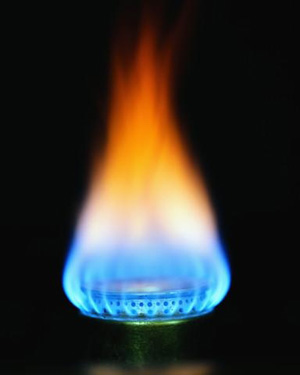
For years now, everyone thought that natural gas was cleaner than coal and more benevolent than oil. The blue flame just burned purely and wasn't nearly as complicated or carboniferous as a lump of, well, bituminous coal.
And so groups like the Natural Gas Supply Association advertised the blue flame as "the cleanest of all fossil fuels" and a brave climate change fighter to boot. Burning gas produced 50 per cent fewer carbon emissions and just decreased "harmful pollution levels" all around.
But shale gas, methane trapped in hellishly deep rock formations, has challenged this dated perception. In fact, the very stuff that energy experts champion as North America's new energy wunderkind may be dirtier than coal, if not as extreme as Alberta's dirty bitumen.
In other words, the so-called "bridge fuel" to renewable energy sources may be one troubled bridge, or perhaps another energy destination as perversely questionable as industrial wind farms.
Shale we or not?
The whole unbelievable shale story emerged piece meal from a series of often startling reports, all populated with unconventional facts. (Dirty energy is all about dirty numbers.)
A brief advisory: shale gas depends on a highly energy intensive technique known as hydraulic fracking to release methane trapped in rock. Fracking blasts open the pores of dense shale formations with millions of gallons of water, sand and chemicals at high pressure. (Just imagine an underground fireworks display.)
This brute force tool, never a precise science, can contaminate groundwater with methane and chemicals, and even cause local earthquakes. As a consequence, France and New Jersey have banned shale gas in their watersheds, while Quebec declared a moratorium to protect its farmland. The European Union is thinking about restricting the difficult resource with "an energy quality directive."
Meanwhile, petro states highly dependent on shale gas revenue such as Texas, Wyoming and British Columbia keep on drilling with nary a word of debate or a sober second thought. (To be fair, two independent MLAs in B.C. have demanded a study on the resource that every citizen should support.)
Individual scientists and researchers have also started to ask some tough questions. Al Armendariz at Southern Methodist University in Dallas, Texas and now a regional manager for the U.S. Environmental Protection Agency, got things off to a roaring start in 2009. That's when he calculated that the compressors and equipment required to drill the Barnett Shale (a 5000 square mile region in north Texas) released more smog-forming pollutants than all the cars, trucks and airplanes in the Dallas-Fort Worth area. The engineer also recorded that 7,700 wells in the Barnett Shale sent more CO2 and methane into the air than two 750 MW coal-fired power plants.
Bad numbers in BC
Next came an eye popper from British Columbia. The province claims vast reserves of shale gas, but many sources such as the Horn River Basin contain up to 12 per cent CO2. (That's about six times dirtier than conventional gas.) Venting the climate warmer to the atmosphere, the industry's traditional form of garbage disposal, will acidify the ocean, unsettle the climate (and we're well on our way) and kill the province's climate change strategy.
A 2010 study by Mark Jaccard and Brad Griffin for the Pacific Institute for Climate Solutions concluded that adding 4 million tonnes (MT) a year to the province's GHG inventory, at time when the province needs to subtract millions of tonnes, means "that the B.C. government will sustain a 20-year Canadian climate policy tradition -- failure to meet its GHG emission targets."
The report told the government that it had several options: shut down shale gas development, abandon its climate change targets, restrict shale gas to low carbon plays or mandate all projects to "to include CO2 capture and storage," a largely unproven technology. It also recommended a comprehensive analysis on shale gas and its big tar-sands like carbon footprint.
Then came a real myth buster from Cornell University. The ecologist Robert Howarth crunched some numbers and concluded that methane leaks and venting from shale gas wells (3.6 per cent to 7.9 per cent of production or twice as much as conventional gas) made the resource's carbon footprint 20 per cent to 100 per cent greater than coal over a 20-year period. (Methane has a 72 to 105 times greater impact than CO2 over a 20-year timeframe, but only a 25 to 33 times greater impact over a 100 year timeframe.)
Howarth concluded that a lot the methane burped into the atmosphere during flow-back from fracking fluids and well completion. Substituting shale gas for coal or oil, he concluded, "may not have the desired effect of mitigating climate warming."
Green promises turn brown
Around the same time, a U.S. energy think tank (Resources for the Future) looked at the abundance of shale gas and concluded that a free market policy wouldn't generate many green benefits for a bunch of reasons.
"We find that abundant natural gas supplies increase use in most sectors of the economy, but do nothing by themselves to create a bridge to a low-carbon future. Without a carbon policy in place, abundant and inexpensive natural gas fosters greater energy consumption and displaces the use of nuclear and renewable resources to generate electric power. Even though coal and oil use fall, the result is higher CO2 emissions."
But the Howarth study really took the starch out of the industry. Shale gas promoters have now overhyped, overdrilled and overproduced a fundamentally dirty but abundant resource that has now created a veritable natural gas glut. The surplus could be as troublesome as the great oil glut of the 1930s that paralyzed the Texas oil patch. That price free-fall, caused by rampant over drilling and greed, forced prorationing or an OPEC-like quota system.
Now the last chapter in this unconventional story, for the time being, hails from Canada's David Hughes, a former NRCAN scientist who has studied natural gas and coal most of his life. In a July paper for the Post Carbon Institute, Hughes contrasted Howarth's peer reviewed science with a recent PowerPoint constructed by the National Energy Technology Lab (NETL). The NETL, where standards must be falling, contested Howarth's findings but didn't provide a lot of source data.
When Hughes checked out the NETL findings, he found that the agency had low balled estimates for methane leaks and overstated production from shale gas reserves. Once these corrections had been made both the NETL and Howarth studies arrived at the same bloody conclusion: "shale gas has higher emissions than coal on a 20 year basis, and equal or lower emissions on a 100 year basis."
Expect a game-changing announcement any day now from the American Coal Council or the Coal Association of Canada: "Coal is cleaner than shale gas." ![[Tyee]](http://thetyee.cachefly.net/ui/img/ico_fishie.png)
This is the latest of Andrew Nikiforuk's weekly Energy and Equity column for The Tyee. Nikiforuk is an award-winning author and journalist, and a contributing editor to The Tyee. Read his previous Tyee stories here.
16
Login or register to post comments
Talon
1 year ago
Thank You
Thank you Mr. Nikiforuk for another well written revealing story. You are one of the reasons I am such a fan of The Tyee. Please keep up the good work on behalf of us all.
Bruno96
1 year ago
Shale Gas Emissions
For a number of years now, there have been a small number of manufacturers that have developed waste oil/multi fuel burners, furnaces, boilers(some even Energy Star rated) that burn as clean as straight natural gas burners. There are even boiler systems for restaurants that run on fryer fats & oils, and if that supply runs out, will automatically switch to a natural gas feed. (savings by elimination of disposal costs-$250-450 per month)
The Government & Energy Big Business, however, have spent large amounts of tax dollars on false advertizing, scaring the general public into believing that these alternative forms of heating are major polluters.
There is currently a ban in the bureaucratic "hell" called Ontario, that prohibits the use of waste oil burners from the U.S./ Canadian border to North Bay, Ontario.
Sound impressive? It should, because bureaucrats evidently believe they can now start defying the laws of physics.
Large amounts of waste oil, unusable in Ontario, are shipped to northern U.S. states
(New York, Michigan, Illinois, etc.)where it is used as...HEATING FUEL.
Here comes defying the laws of physics, because the powers that be in Ontario initiated the burning ban, emissions from oil burning in the U.S. WILL NOT cross a geographical International border into the North.
SUCH OMNIPOTENCE!
And don't get me started on companies that recycle oil.(and they're right in bed with their respective Government cronies as well)
You can't use recycled oil on cars with an existing manufacturer's warranty- IT WILL BE VOIDED.
Cheer up, though. The energy companies have always and apparently WILL always: LIE, Pollute and GOUGE us ALL - ALWAYS.
OwlRol
1 year ago
Thank you too
Great investigative and informative articles. Keep em coming.
Now the bigger problem. How do we get off at least 90% of fossil fuels (no fast flight available at this time without them)?
Bigger problem yet. How do we get the "Energy Superpower" governments and their expanding fossil fuel corporate backers to slow down, let alone stop at current levels of extraction, or better yet, reduce product emissions to 1990s levels.
Mr. Nikiforuk's articles educate us, but we must act and convince our governments to do likewise, not just use mirrors and smokescreens to pretend that we and they are making a difference.
How do we retract at this point? The first of the 3Rs is REDUCE. How many are willing to go there?
RickW
1 year ago
Read Discover Magazine article
http://blogs.discovermagazine.com/intersection/2011/02/27/everything-you-ever-wanted-to-know-about-fracking/
A trio of highlights:
- Cornell University researchers factored in the carbon emissions over the course of nastural gas's life cycle........and concluded that natural gas is dirtier than coal;
- There have been reports of small earthquakes near some injection sites for fracking waste in Texas, a state not known for seismic activity;
- a swarm of 500 mini-quakes rocked rocked central Arkansas, near the Lafayetteville Shale, and a 4.7-magnitude earthquake in February [2011] prompted the Arkansas Oil and Gas Commission to order two drilling companies to temporarily suspend operations.
edoherty
1 year ago
Coal in your gas tank
So since much of the fracking activity is driven by the insatiable demand for natural gas for tar sands processing, it is like burning coal to create the diesel, gas and aviation fuel we burn here in BC.
So when you see a new freeway or road being built, imagine it filling up with cars and trucks all burning coal. Things need to change quickly.
reallife
1 year ago
Where do I start?
Nikoforuk: "Coal is cleaner than shale gas."
- I think I will continue to use natural gas in my home.
Bruno96: "scaring the general public into believing that these alternative forms of heating are major polluters."
- I must not be one of the general public but I am not very scared.
Owlrol: "How many are willing to go there?"
- You first!
RickW: "concluded that natural gas is dirtier than coal"
- At least natural gas does not make my hands black. Seriously, RickW do you believe the comment you wrote?
Edoherty: "insatiable demand for natural gas for tar sands processing, it is like burning coal to create the diesel, gas and aviation fuel we burn here in BC."
- Um, no BC gas goes to fuel oil sands development and no synthetic crude is processed in BC.
mopled
1 year ago
Such emissions!
CARBON EMISSIONS (Plant Food)
The Top Ten Plant Growth Promoting Countries
Producing Millions of tonnes of lovely CO2 pa
1 China emits 6,533 (21.6% of world emissions)
2 USA emits 5,832 (19.2% of world emissions)
3 Russia emits 1,729 (5.7% of world emissions)
4 India emits 1,495 (4.9% of world emissions)
5 Japan emits 1,214 (4% of world emissions)
6 Germany emits 828 (2.7% of world emissions)
7 Canada 573 (1.9% of world emissions)
8 UK emits 571 (1.9% of world emissions)
9 South Korea emits 542 (1.8% of world emissions)
10 Iran emits 511 (1.7% of world emissions)
-------------------------------------------------------------------
World Emissions are 30,134 million tonnes pa (UP (9% on the 2005 figure and 1.7% on last year)
source: EIA International Data
Canada...you have a long way to go to help Mother Nature...stop being such a slacker!
Your tiny 1.7% addition to the plant food is pathetic. Get it up!
G West
1 year ago
@reallife
Great idea to continue to use Natural Gas in your home - however, I'd suggest you might want to read Nikiforuk's piece again.
He's talking about 'shale' gas - not conventional natural gas.
There IS a difference.
mopled
1 year ago
We may need every calorie we can get
http://www.infiniteunknown.net/2010/02/14/leading-scientist-warns-of-ice-age-most-of-europe-will-be-under-ice/
“They keep warning people about global warming, but half of America no longer believes it as they keep freezing,” he said.
And he added: “The reality is that mankind needs to start preparing for the ice age. We are at the end of the global warming period. The ice age is to follow. The global warming period should have ended a few thousands of years ago, we should have already been in the ice age. Therefore we do not know precisely when it could start – but soon.”
RickW
1 year ago
@reallife
Diss the Cornell University researchers. And then maybe pickup a copy of Discover Magazine and educate yourself....
mopled
1 year ago
Git out your woolies, guys....
"Third, scientists at the Met Office and elsewhere are beginning to understand the effect of the 11-year solar cycle on climate. When sunspots and other solar activity are at a minimum, the effect is similar to that of El Niño: more easterly winds and cold winter weather for Britain.
“We now believe that [the solar cycle] accounts for 50 per cent of the variability from year to year,” says Scaife. With solar physicists predicting a long-term reduction in the intensity of the solar cycle – and possibly its complete disappearance for a few decades, as happened during the so-called Maunder Minimum from 1645 to 1715 – this could be an ominous signal for icy winters ahead, despite global warming."
I just wonder how long the carry on about fracking and "emissions" will last as the ice sheet advances?
RickW
1 year ago
mopled
Ain't no ice sheet gonna advance without first a whole lot of snow - which means a whole lot of moisture in the air. Now you tell me how that moisture gets there.
mopled
1 year ago
Haven't you heard?
It keeps snowing out of season all over the place and it hasn't warmed since 1998...in spite of the continual rise in CO2. Now, you explain that one....How can CO2 be a cause of
warming when it keeps going up.....and temperature keeps going down?
Just go to Ice Age Now and see the reports of out of season and out of place snow. The spam filter is giving me problems again, or I'd provide the links
G West
1 year ago
Guess you missed this
http://www.nytimes.com/2011/07/12/us/12drought.html?hp
mopled
1 year ago
And the flooding in BC?
cbc.ca/news/canada/british-columbia/story/2011/07/08/bc-peace-river-evacuation-alert.html
or the Missouri and Mississippi River Valley
floods this year?
While there may be drought in the SE US, it is NOT generalized over the continent....is it?
mjb4861
1 year ago
Mopled: "It keeps snowing
Mopled: "It keeps snowing out of season all over the place and it hasn't warmed since 1998..."
I'll call bulls#@t on that one: both the NOAA (a branch of the US Department of Commerce) and NASA - you've heard of them, right? - state firmly that the last decade 2000-09 was the warmest on record. Look it up if you like...and for the record, the arctic ice sheet, like the majority of world-wide glaciers, isn't advancing, it's shrinking. That's why so many countries have a renewed interest in Arctic sovereignty, what with easier access to untapped oil reserves and year-round shipping lanes.
And by the way, one of the by-products of global warming is more moisture in the atmosphere (you see, when water warms up, it has the odd habit of evaporating). This gives rise to more rain and yes, more snow. Keep in mind that climate change is the result of global warming, creating extreme drought in some parts (e.g., eastern Africa), increased flooding in other places (such as the mid-west of North America) and eddy currents of cooler weather due to changes in global atmospheric and ocean currents.
Sorry, but your Earth-cooling ideas are a tough sell...