
Opinion

How We Helped Pave Haiti's Road to Cholera Hell

Canada and the UN have committed public health malpractice on a very large scale.

By Crawford Kilian, 7 Jul 2011, TheTyee.ca

Cholera aid workers in Haiti

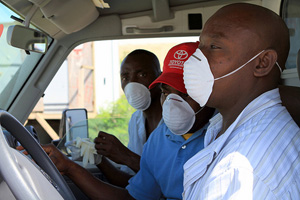
Ambulance drivers take critically ill patients, referred by the Red Cross, to a cholera treatment centre. Credit: Amanda George/British Red Cross/Creative Commons.

Related

On Oct. 18, 2010, Cuban medical personnel in rural Haiti reported they had treated 61 cases of acute watery diarrhea in the previous week. On that same day they had another 28 cases and two deaths.

That was the start of a public health catastrophe that has so far infected over 370,000 Haitians with cholera and killed over 5,500 of them. A proportionate epidemic in Canada would have sickened 1.2 million of us, and killed over 18,000.

It was a totally avoidable epidemic; worse yet, it was brought to Haiti by the UN peacekeepers who were supposed to be protecting the Haitians. Since Canada is involved with MINUSTAH, the UN agency that effectively runs Haiti, we share some of the responsibility for inflicting needless suffering on an already traumatized country.

First cholera in Haiti in 100 years

Ever since 2004, when the U.S. and Canada encouraged the ouster of President Jean-Bertrand Aristide, the nominal government of Haiti has been ineffective, especially the Ministry of Public Health and Population (MSPP). Haiti has been run by MINUSTAH and thousands of non-governmental organizations. They range from the Pan American Health Organization (PAHO) and Medecins Sans Frontieres to religious groups.

When cholera arrived last October, Haiti had not seen it in a century, if ever. It had started along the Meille River in a rural area, downstream from a MINUSTAH peacekeepers' camp that had just received a contingent of Nepali soldiers, and suspicion fell on them at once.

After all, they had left Nepal in late September during a cholera outbreak. While they had all had medical exams (including stool tests), they had then been granted ten days' home leave before reassembling in Kathmandu.

Deny, deny, deny

The Nepalese army denied that its troops were to blame. MINUSTAH also denied the accusations, claiming the Nepalis had tested negative for cholera.

Under pressure, the UN finally arranged for an investigation into the origin of the outbreak. That report was published on May 4, after cholera had been raging for over six months. Indirectly it admitted the Nepalis had brought the disease, but it didn't mention them explicitly; it spent more time blaming the Haitians for their lack of clean water and a sewage system.

Meanwhile, a team led by Renaud Piarroux of the Université de la Méditerranée had done its own survey in November 2010. It found the Nepalis the likely source, but needed more evidence. After further work, Piarroux has just published a more detailed report in Emerging Infectious Diseases, a journal of the US Centers for Disease Control.

Appearing in a peer-reviewed journal with the implicit support of the CDC, Piarroux's report is even more devastating than his original survey. It tracks the outbreak using evidence that "strongly suggests" the epidemic emerged from the Nepalis' camp.

Where was the source?

Worse yet, Piarroux argues that it could not have come from a recovering cholera patient, or from an asymptomatic carrier. To infect users of water from the Meille and Artibonite rivers, the quantity of Vibrio cholerae would have to come from at least one seriously sick cholera victim.

This directly refutes the assertion of Secretary General Ban Ki-moon's spokesperson in Haiti, who had claimed "negative" test results on the Nepalis. Cholera is a spectacularly messy and smelly illness causing both diarrhea and vomiting, so everyone in the base would have known about it. Suppressing information about such an outbreak would have required the collusion of senior Nepali officers, MINUSTAH officials, and at least some healthcare professionals in PAHO and the MSPP.

The UN had originally said the source of the epidemic was unimportant compared to the need to fight it. Piarroux's report pointed out that knowing the source was critical to an effective response to cholera.

Ignoring this obvious point, MINUSTAH issued a press release saying the study had been followed "by many others... each with different possible scenarios." To my knowledge, no such alternate studies exist, and MINUSTAH didn't cite any. We have only the UN report and that of Piarroux.

So the Piarroux report is an indictment of the United Nations and its agents in Haiti, including PAHO, which is the western-hemisphere branch of the World Health Organization. The denials and press releases only aggravate the problem.

Who will believe WHO?

This means that even WHO's integrity is compromised. It was ridiculed for calling swine flu a pandemic in 2009, and criticized for allowing Indonesia to withhold virus samples of bird flu. Now WHO has exposed itself to a far more serious charge of suppressing vital information about the epidemic while it spread explosively through the whole island of Hispaniola, including the Dominican Republic.

When the next serious outbreak arrives, therefore, WHO's ethics and credibility will be in question. Governments, health professionals and individuals will all be justified in wondering what the real story is, and whether the scare is really a scam or a coverup. Such skepticism could cost lives. (The Tyee sent a draft of this article to WHO, but did not receive a reply.)

This is not a problem just for faceless bureaucrats in Geneva or some third-world country. Canada has been deeply involved in Haiti since the 2004 coup against Aristide. We have sent some of our best cops to train the Haitian police; two of them died in the quake. Canadian Forces went into Haiti after the earthquake in Operation HESTIA to deliver humanitarian aid. The Canadian government has promised almost a billion dollars in aid since the 2004 coup.

A Canadian, Nigel Fisher, is the UN's Haiti Humanitarian Coordinator, supervising UN projects and coordinating with the NGOs.

What's more, our last Governor General, the much-beloved Haitian-born Michaëlle Jean, is now the UNESCO special representative to Haiti. If the UN's peacekeepers, health experts and humanitarian coordinators are compromised by a cover-up, so is she.

So over 80,000 Haitian-Canadians must now wonder if their new homeland really cares about Haiti as much as it says it does. The rest of us have grounds for feeling the same way.

Old-fashioned incompetence

The UN didn't set out to make matters worse in Haiti. Importing cholera looks like old-fashioned incompetence, frosted with some misplaced political appeasement.

Someone allowed the Nepali peacekeepers to spend ten days at home while a cholera outbreak was going on. No one demanded that the soldiers be re-tested before leaving for Haiti. Someone allowed the sewage tank at the Meilles base to leak right into the river, and no one did anything about it before the new troops settled in.

If Piarroux is correct, one or more Nepalis had active, symptomatic cholera. Someone should know who they were, and who said what to whom about such cases. And someone must have known that the truth would come out, but chose to deny both Piarroux's initial report and this more detailed one.

The denial may have been in part to spare both the UN and the Nepalese government from embarrassment. Nepal has been exporting soldiers since the days of the British Raj, and in September 2010 it was supplying 5,044 troops on peacekeeping missions. The UN was reimbursing Nepal to the tune of US$1,028 per soldier per month.

Demand for infectious peacekeepers being zero, Nepal would therefore stand to lose over $5 million a month, and the UN might have trouble finding replacements.

The Piarroux report has certainly embarrassed all concerned, including the Canadians in Haiti who didn't protest MINUSTAH's denials. But it may well be swept under the rug anyway. The mere mention of Haiti induces instant donor fatigue. That's why most of the money promised for both earthquake relief and for cholera has dried up.

The current second wave of cholera cases has gone largely unnoticed in the North American media. This is convenient, because the resurgence shows how little the UN has done to eliminate the squalor that cholera thrives on.

Dr. Rupert Virchow, the 19th-century doctor and politician, famously said that "Medicine is a social science and politics is nothing else but medicine on a large scale." In the case of Haiti's cholera, Canada and the UN have committed malpractice on a very, very large scale.  [Tyee]

16  Comments:

Login or register to post comments

  • southdeltawalker

    1 year ago

    Blessed are the peacekeepers?

    As shocking as this is, it is a part of long unhappy history of Haiti-the poorest country in the "West".

    Canada has had and continues to have a major role in undermining the Haitian people.

    Looking for a summertime read?
    How about "Canada In Haiti: Waging War On The Poor Majority" by Canadian author Yves Engler.
    It won't be the sun that will heat you up reading this.
    This book belongs in every public library, make sure your library has several copies.

  • Jerry Munro

    1 year ago

    Later Bloomer Imperial Dreams?

    Poor Haiti is but again, another example of the UN and this country being but handmaidens to largely US imperialism, which has many times crushed by force of arms and or manipulation and outright interference, the efforts of the Haitian people to come to grips with the corruptions of capitalism there. The only hope here is in the impending collapse of the US Empire... and its diminished ability to control even the southern hemisphere of its former Empire.

    Though this country, under both Liberals and Harper are showing some signs of a desire on the part of our national ruling class, to slide into assuming the role of the US Empire, as it is forced by its new and diminished realities to retreat... in this part of the world especially. There seems to be a "wannabe desire" emerging amongst our own con/fascists, with their own arms buildup dreams and encouragements of economic incursions in the southern hemisphere, to test the waters of an imperialist ambition of their own. We shall see how far this goes, if I am reading the early evidence correctly, as capitalism world wide shows increasing signs of setting itself up to implode terminally. I suspect it is too late for this Canadian national bourgeois fantasy, of a class which was too long contented itself with being but a bootlick to the Empires of others, to now at this late stage to begin to develop global hegemonic dreams of its own. Indeed, it is rather comic... these pathetic johnny come lately strutters.

  • cboo44

    1 year ago

    That's IT !!

    No point in doing "Humanitarian Missions" any more, they only cause further problems at a HUGE cost to the Canadian Taxpayer. Enough. Forget the emergency airlifts, food drops, fully staffed field hospitals, multi-million dollar transportable drinking water systems, rescue specialists, troops, NGO aid agencies.
    Let's just do nothing, that way, if something happens, " Sorry, we're not involved."

  • jwstewart

    1 year ago

    Um, where's the connection.

    In this article I see no direct connection between the introduction of Cholera to Haiti and any Canadian person.

    So far it's just guilt by association, the article doesn't completely justify that guilt trip. Germs come from Asia to Haiti and it's Canada's fault?

  • Jerry Munro

    1 year ago

    Send money. Stay home.

    Actually, the poverty, economic and political chaos at the root of Haiti's problems, indeed the entire southern hemisphere, are in turn directly relatable to the long history of imperialism in the region... which in modern times includes Amerika and ourselves... us typically holding the latter's coat along with the UN, and otherwise enabling them.

    Now, the US especially, owes them a huge debt unlikely to ever be paid... without further interferences in their internal affairs in any case.

    Yes, they would be better off simply being left to deal with their own problems. Send cash and material assistance... and stay home, out of their affairs. (And yes, they may have to fight it out, as all people's tend to do from time to time over their history.)

  • Phay

    1 year ago

    We Care

    "So over 80,000 Haitian-Canadians must now wonder if their new homeland really cares about Haiti as much as it says it does. The rest of us have grounds for feeling the same way."

    Of course, we care... we are mining their rich mountainous wealth are we not?

    Are the RCMP training Haiti for their own good, or are they protecting the mining companies, such as the US does the oil companies?

    As far as WHO is concerned, I place them in the same category as the World Bank, NATO and the IMF... as someone put it, handmaidens of the Imperialistic US.

  • Jerry Munro

    1 year ago

    We care.... in a pig's eye.

    Ooooo, good comments Phay.

  • Skywalker

    1 year ago

    Sounds to me like Crawford is saying...

    ..that when we go in to help we should make very sure that we are not carrying more grief with us. This time it was the Nepalese and they should have been told it was too risky given they had an outbreak or realized tit themselves.

    I don't see anything in the article that says we should not help. As to the rest of the comments on western colonialism when it comes to Haiti, that is fair comment.

  • perplexis

    1 year ago

    Its Worse

    Western do-gooders also forced starvation on Haiti. The Bush government forced Haitian Rice producers to compete with large Texas agribusiness, and wiped out local production. The country is an ideal producer of that staple. Let's help solve food problems first before putting fledgling local industries into fatal market competition.

  • Jerry Munro

    1 year ago

    Perplexis Is Correct...

    "Let's help solve food problems first before putting fledgling local industries into fatal market competition." perplexis

    Good observation, Perplexis. Give people the infrastructure and tool resources help they need, as one is able, then get the hell out of the way and let them solve it. (Using their own, rather than our labour. Which begins creating jobs for the locals.) The old "Whiteman's Burden" notion still much evident here, including in Haiti, is but a too frequent mask for imperialist interference, self-interest and creation of states of dependency in vulnerable countries.

    Besides, as a not small aside, your observation I've quoted could be as much applied to this country as anywhere. We need to first, if we are going to avoid becoming another Greece ourselves, as this crisis of capitalism deepens, protect and expand our own food, as well as other "self-sufficiency" production. All of which has declined precipitously over this entire conservative/fascist period of "capitalist globalization", which has seen us return to the pre-war II condition of growing "resource extraction and export" dependency... Which is a recipe for placing the country and our economy, no less than Haiti's, at the total mercy of the world wide industrial collapse of others... the US, Japan, etc, even possibly China (China currently going through its own exaggerated real estate bubble, setting up to burst.).

    There is the screaming need in this country for finally recognizing our need for a maximized, rounded out and balanced economic self-sufficiency policy and practise model, as the best insurance against vulnerability to global "casino capitalism's", so called "free market" shocks and excesses.

    As the collapse of the postwar social democratic state, and movement to the new "de-regulated" free market model of capitalism has been a distinct failure, so has economic globalization with its attendant loss of national sovereignty for virtually all states... even the US to China, rather oddly. Which is what really lies behind the Greek crisis, and that emerging in other European states, as well as our own, AND Haiti's. (We are all at the mercy of this global network of bankers, financiers and international industrialists, who pull the strings from outside every country.)

  • pwlg

    1 year ago

    Clinton

    Bill Clinton is not without blame in making Haiti the world's poorest nation. He even admits how his neo-liberal policies contributed to the suffering of Haitians while he was President of the US.

    With a lack of central government organization, chaos amongst the hundreds of NGO's and an arrogant and class driven UN, Haiti has become the world's best example of how outside help can be a significant detriment.

    When I first heard Canadian and UN rep Nigel Fisher's arrogant comments at the beginning of the cholera outbreak I thought he should be fired.

    From a November 10, 2010 UN media release:

    "Some Haitians have grown suspicious of UN facilities in the area after a rumour began that a peacekeepers’ camp was the source of the original outbreak. Mr. Fisher responded to questions on the subject saying that no link had been found between the camp and the outbreak. He said the United States Centers for Disease Control (CDC) had analyzed the strain of cholera but had been unable to place a definite source on the outbreak.

    “The conclusion was that it would be impossible to ascertain where and how it came in,” he said."

    One can see how Fisher was already taking a defensive position and how he had absolved the UN military contingent from Nepal using the CDC as his backup. I wonder how he can now criticize the CDC's backing of Piarroux's findings which does implicate the UN-Nepalese camp for the source of the outbreak.

    The UN using developing country "peacekeepers" has become a cheap way to put boots on the ground, and the donor countries appreciate the revenue as Killian has pointed out.

    Perhaps all UN military and medical personnel coming into Haiti should be tested for infectious diseases in an isolation area upon arriving in Haiti and not allowed to depart until all tests indicate negative.

    As well, the UN should provide compensation to the those people who have lost family members due to the cholera outbreak. If Haiti actually had a functioning justice system its citizens could use the courts to take civil action against the UN and those who have been part of this cover-up.

    But alas, since Canada has been responsible since the coup in 2004 for training police and improving the justice system in Haiti can we realistically count on justice being served in Haiti?

    Our main contribution in Haiti's reconstruction has been building a prison and ensuring that our diplomatic service in Haiti has the best housing and offices in the country. We spent $21 million from citizen's aid money for the land alone to house our diplomatic corp in Haiti.

  • Jerry Munro

    1 year ago

    pwlg...

    "Our main contribution in Haiti's reconstruction has been building a prison..." pwlg

    That... building prisons... and growing our military and "riot control" capacity, seem to be the preoccupation speciality of the Harper Cons.

    Interesting details pwlg, and along with the article by Kilian, an appreciated jog to my memory re some of the development details of this cholera breakout in Haiti.

    All suspicions of the too much presumed "non-aligned" UN, like the criminal court in the Hague, and who it chooses to charge and not, are entirely justified, by Haitians and ourselves.

  • snert

    1 year ago

    Haiti won't change

    until the Haitians decide to get their act together and change it themselves. Nobody else can do it for them.

    That should be as obvious as the nose on one's face because anybody who tries to help Haiti just gets blamed for all their woes. Why bother?

  • toquer

    1 year ago

    Kilian the Spurious strikes again

    So....Canada, officially (and peripherally) a part of what is typically a large, unwieldy, bureaucratic and multi-national UN offshoot has 'paved the road to cholera hell' because it shares letterhead with a group that includes some infected Nepalese, once trained Haitian police, and once had a Haitian GG. The disconnect between the headlines and the article is stark: put simply, the article utterly fails to support the sensational title. Doesn't anyone at the Tyee vet this stuff? Sloppy, sloppy dreck which utterly undermines an important story. Higher journalistic standards, please: as it stands, getting a strong whiff of HuffPo push button say-whatever reportage. Clearly, the UN is the problem here: stick to that. What honest reader of your references could conclude that Canada and the UN shared equal culpability, as per your sentence "..Canada and the UN have committed malpractice...". Why did you leave out every other country? Why not say "Nepal and the UN?".

    Fail.

  • RickW

    1 year ago

    cboo44

    Quote:
    No point in doing "Humanitarian Missions" any more

    We have ceased doing "humanitarian missions" quite some time ago. Wherever we go, it's in our own best interests, and the "humanitarian" aspect is either a smokescreen or incidental fallout from our real intersts.

    We have long ceased to provide anything approaching altruism.

  • rogerannis

    1 year ago

    Canadians should be concerned about cholera in Haiti

    Vancouver BC

    Thank you to Crawford Kilian for an important and informative article. There are at least three reasons why Canadians should be concerned about cholera in Haiti:
    1. Canada is a central participant in the police/military force (MINUSTAH) whose soldiers introduced cholera to Haiti (and hence to neighbouring Dominican Republic).
    2. It is clear that officials of that force took few precautions concerning the known dangers of disease transmission when military forces move from one part of the world to another. This point has been made forcefully in medical and scientific journals, including in the weekly New Scientist.
    3. The victims of this reckless introduction of cholera are owed compensation and the rest of the world is owed an explanation of what happened and how this will be strictly prevented in future. As Crawford notes, the UN players in Haiti have been less than forthcoming.

    There is a wealth of information on the cholera crisis in Haiti compiled on the website of the Canada Haiti Action Network, www.canadahaitiaction.ca. I recently traveled to Haiti and will report our delegation's findings, including on the state of health care in Haiti, at forthcoming public events, including at the monthly education session of the Vancouver and District Labour Council, Tuesday July 19, 6 pm to 7 pm, 1880 Triumph St.

    Roger Annis
    rogerannis (at) hotmail.com

    • The discussion for this story is closed. No more comments can be added.