
That question asks: Who truly cares about the suffering island? And how democratic, really, is the web?
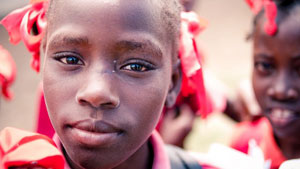
Children in Haiti. Photo via Creative Commons/Flickr user danboarder.
When cholera hit Haiti late in October, it was just a "mystery outbreak." I pick up such reports once or twice a month on my blog H5N1, which covers infectious diseases and the politics of public health. Usually no follow-up story explains the mystery.
But within a couple of days this outbreak was confirmed as cholera. Again, this was not unusual. Cholera stories pop up all the time, especially in West Africa and South Asia. Apart from a handful of odd bloggers like me, no one pays attention. Cholera belongs in the 19th century, so it's embarrassing to see it thrive in the 21st.
Cholera in Haiti did get attention. In tracking it over the last couple of weeks, I've also learned more about Haiti's friends than about Haiti itself.
After the Jan. 12 earthquake that killed an estimated 300,000, I knew that infectious diseases would surely spread in the tent cities of Port-au-Prince. But I could find few links to websites in Haiti.
FOREIGN GROUPS COVERING CHOLERA IN HAITI
Least of all to the government. Google "government of Haiti" and your first hit is the Haitian embassy in Washington. Exploring it won't take long, or get you anywhere. The next couple of dozen hits are to governments or NGOs that deal with Haiti. Google "Haiti government" plus "ministry of public health and population," and your first two hits are a) a PDF from 2004 and b) one of my own posts from Oct. 28.
A cobwebsite from 2003
Try being more specific: Google Ministere de la Santé Publique et de la Population and you land on a page last updated on July 5, 2003.
How about Haitian media online?: A few online papers are functioning, like Le Nouvelliste and The Haitian Times, but they tend to update slowly.
The best of them is Haiti Libre, which does post frequently and has covered the cholera outbreak in detail.
To get a sense of what's really going on, you need to go to the websites of the Pan American Health Organization (a branch of WHO), a handful of NGOs, and one or two freelancers operating in Haiti.
'Going where the silence is'
The most notable journalist is Ansel Herz, also known as Mediahacker. He's a 22-year-old freelancer from Texas who's been in Haiti since late 2009, "going where the silence is." Herz's coverage is so good I wish he'd write more; as it is, I have to content myself with the tweets he posts between reports.
Another important observer is Dr. James M. Wilson, CEO of Praecipio International and blogger at Haiti: Operational Biosurveillance. Wilson clearly knows medicine and knows Haiti. If he's worried about the spread of cholera into the tent camps of Port-au-Prince and Cité Soleil, we should worry too.
Dr. John Carroll works in a Cité Soleil clinic and blogs about his experience at Dying in Haiti. He writes clearly and powerfully, and his photographs are both beautiful and heartbreaking.
Grateful though I am for the news that such outsiders provide, I keep wishing I could hear from more Haitians. The NGOs supply fascinating stories about their efforts to bring clean water to remote villages, plus frequent appeals for donations. (The missionary NGOs also want prayers.) Agencies like PAHO itemize their efforts to fight cholera, presenting themselves as compassionate and competent bureaucrats.
Where are the Haitians?
An echoing silence fills the void where Haiti ought to be. Apart from Haiti Libre and a few other media, the whole country is like a patient in intensive care. We can anxiously peer through the window, and the ICU staff will sometimes come out to tell us how the patient is doing. We just can't hear directly from the patient.
Bad as it is, online coverage of Haiti's cholera is superb compared to cholera elsewhere in the world. The disease is endemic in Nepal (and Haitians suspect a newly arrived unit of Nepali peacekeepers brought the disease to them after half a century without a recorded case).
Cholera has killed almost a hundred Pakistanis in the aftermath of the summer floods, and sickened thousands more. Close to 1,500 Nigerians have died of it recently, and hundreds more in other West African nations like Benin.
But those countries have no resonance with North America, and precious little even with their former colonial masters. So their epidemics spread with little notice in the mainstream media or online.
Haiti, however, is our problem child, our personal guilt-trip. With every disaster we promise more help, though we're often slow to deliver it. Of course the U.S., Canada and other countries are promising still more dollars to fight cholera. For us, the Haitians are the problem and we're the solution, the heroes riding to the rescue.
But you would think that at least one of these donor countries could find the spare change it would cost to create a respectable government website, and to train Haitians in how to run it. Then they could at least speak for themselves, as the heroes of their own story. ![[Tyee]](http://thetyee.cachefly.net/ui/img/ico_fishie.png)
Crawford Kilian is a contributing editor of The Tyee.
9
Login or register to post comments
jwstewart
2 years ago
The assertion seems to be
The assertion seems to be that Cholera affects backward countries that lack resources to provide clean water, food and medicine to thier populaces.
I would hazard a guess that those same countries would also lack resources to create web sites to inform the world of thier plight.
Nokekula
2 years ago
Haiti Cholera Outbreak
It is heartbreaking what the Haitians are going through. During times of crises we realy need to know how to survive. Help never seems to be quick enough. When you are in a situation such as this and in need of medicine, shelter, food, it would seem you have to wait your turn. Knowing how to survive from I am sure many people in Haiti already know about coconuts. However, some do not and some have forgotten. For those suffering dehydration, drinking coconut water could have helped until other medicine and fresh water was avialable. This is disscussed in "Haiti's Plight:Can We Learn From It?" http://www.suite101.com/contents/haitis-plight-can-we-learn-from-it-a302074. It is so important for us to realize the resources we have around us, and how to use them.
realisticman
2 years ago
You should go
Crawford. Hop on down there. Help 'em out.
It will take many years before buildings can be constructed to house all the people. That's just a fact considering the magnitude of the situation, the logistics of even setting up a cement plant, a water treatment plant or whatever. People are dying, the country barely functions, communication infrastructure is ruined a chatty web site is far off while blood is still oozing from humans. Tiny Haiti is already the second highest recipient of Canadian aid.
"the Canadian government has already committed more than $1 billion over the 2006-12 period to Haiti. The Canadian International Development Agency website says $770 million has been pledged since the earthquake in January, which killed nearly 300,000 people."
Read more: http://www.vancouversun.com/news/Haiti+gets+Canadian+help+after+cholera+outbreak/3718917/story.html#ixzz145REb8z2
Please tell us why this post-French colony is as you say, " ... our personal guilt-trip".
Est que je manque quel que chose?
Crawford
2 years ago
Realisticman
A 69-year-old guy who doesn't speak Kreyol would be more encumbrance than help. Haiti is our guilt trip because both Canada and the US have been involved in the country for many years (the US occupied the country for decades, when it wasn't run by American stooges like the Duvaliers). And look at the result.
As for "committing" and "pledging" support, let's see the money. The Vancouver Sun article you cite is another demonstration that talk, whether in English or French, is cheap.
Check my H5N1 blog for a recent story by Ansel Herz, a young American correspondent on the ground, pointing out how little money from the Clinton-Bush fund has actually reached the country.
realisticman
2 years ago
Canada is involved
The cholera outbreak is not unreported, if one takes the trouble to look around.
http://www.phac-aspc.gc.ca/tmp-pmv/thn-csv/quake-tremble-haiti-eng.php
I presume you are aware of these stats:
http://www.international.gc.ca/humanitarian-humanitaire/earthquake_seisme_haiti_efforts.aspx?lang=eng#humanitarian_aid
Which includes over 2,000 Canadian Forces personnel involved with the relief effort:
http://www.comfec-cefcom.forces.gc.ca/pa-ap/ops/hestia/index-eng.asp
"Canada’s deep engagement in Haiti falls within Canada’s priorities for the Americas and focuses on Prosperity, Security, and Democratic Governance. Haiti is the highest beneficiary of Canadian development assistance in the Americas."
I can appreciate that as someone from Santa Monica you may have some interest as to the assistance provided by the USA but Canada has been providing aid in many forms to Haiti for many years and guilt is not a word that I believe is appropriate with respect to Canada.
further:
http://www.canadainternational.gc.ca/haiti/highlights-faits_saillants.aspx?lang=eng
Speak to anyone, as I have, that's actually been to Haiti - before the 'quake and they will tell you that the problems there are huge. Now they are much worse. Canada has not ignored Haiti before and is not now. I cannot speak for the US.
G West
2 years ago
Canada has not ignored Haiti - But
It may have been better if it had.
Canada has been the handmaiden of US policy toward Haiti for years - to the point of holding the door while the US deposed the country's duly elected leader.
In February, 2004 U.S. Marines kidnapped and deposed democratically elected President Jean-Bertrand Aristide - supported by Canada and France, they forced him into exile, forbade him from even returning to the hemisphere, and reestablished a despotic puppet government backed and enforced by so-called UN peacekeepers and the brutal Haitian National Police.
Whatever aid we pump into the country now will never be enough to wash away the shame we ought to feel for those actions.
GUILT is precisely the CORRECT emotion.
realisticman
2 years ago
Here's a site Crawford
with regular posts.
Agence Haitïenne de Presse
http://www.ahphaiti.org/eng.html
realisticman
2 years ago
Photo Essay
http://www.boston.com/bigpicture/2010/11/haiti_ten_months_later.html
vera gottlieb
2 years ago
Who's reporting on Haiti's cholera?
I've been asking this question wherever I can...where is all the money that was pledged right after the earthquake??? Just a cruel hoax?