
- Ms Kaye is a Tyee Builder. You can be, too.
- Mary Carlisle is a Tyee Builder. You can be, too.
- Prem Gill is a Tyee Builder. You can be, too.
- Nancy Flight is a Tyee Builder. You can be, too.
- Justin Everett is a Tyee Builder. You can be, too.
- John Westover is a Tyee Builder. You can be, too.
- Nora Etches is a Tyee Builder. You can be, too.
- Edward Henderson is a Tyee Builder. You can be, too.
- Bharadwaj Chandramouli is a Tyee Builder. You can be, too.
- Dean Chatterson is a Tyee Builder. You can be, too.
- Marius Scurtescu is a Tyee Builder. You can be, too.
- Robert Parkes is a Tyee Builder. You can be, too.
- James Murton is a Tyee Builder. You can be, too.
- Susan Doyle is a Tyee Builder. You can be, too.
- Vincent Strgar is a Tyee Builder. You can be, too.
- Helen Spiegelman is a Tyee Builder. You can be, too.
- Subir Guin is a Tyee Builder. You can be, too.
- Kimball Finigan is a Tyee Builder. You can be, too.
- Joanne Manley is a Tyee Builder. You can be, too.
- David Leach is a Tyee Builder. You can be, too.
'Sowing the Oil'
Canada, heed the nation-building dream of Venezuelan Arturo Uslar Pietri. Latest in Andrew Nikiforuk's ENERGY & EQUITY series.
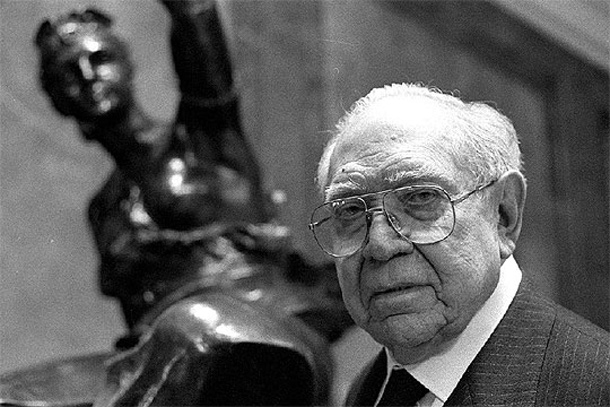
Arturo Uslar Pietri: He would tell us we could do so much more.
One day the indomitable Arturo Uslar Pietri (and his statue should tower over Fort McMurray), awoke from a feverish dream in Caracas and grabbed pen and paper. The young writer called his dream "To Sow The Oil" (Sembrar El Petroleo).
The year was but 1936 and Venezuela was already the world's second largest oil supplier after the United States. US companies exported the Venezuelan crude so that every Sunday millions of gringos could go joyriding in their flivvers and jalopies.
Pietri's bold dream (and the man was but 30 years old) went like this: for most of its history Venezuela was an agrarian country. But now its true physiology became clear: it was a backward place that lacked schools, hospitals, aqueducts, roads, sewers and parks or everything except malaria.
Moreover the cattle, coffee and coca business were shrinking. In fact, the only economic activity that shined in Venezuela "originated from destructive and non-reproductive ideas such as mining and oil" or the felling of hardwood trees.
So Pietri dreamed of using the transient wealth of oil to develop a productive and renewable economy based on agriculture and national industries. He dreamt of what oil could permanently create instead of what oil could temporarily buy.
To Pietri it seemed a simple call to reason. Oil was not the product of hard work but a one-time gift of Nature. "Take the dark and foul-smelling substance that sprouts from drilling towers and that flows heavily and viscously through the oil pipelines" and convert its magical dollars into "irrigated and sowed hectares, into fat herds, into chimneys of factories." Pietri, was, well, a writer.
Somewhat in disbelief the novelist watched his words take on a magical life. The phrase "To Sow the Oil" soon appeared in newspapers and universities. Why, even the Venezuelan Development Corporation adopted the slogan in 1946.
'Ravenous and threatening'
Time flowed by and more oil was pumped. During World War II, new laws won a fair share of oil profits for Venezuela or "the largest that any country has ever derived from a single activity." But a dictator used the money to concentrate his power and champion what he called "the conquest of the physical environment." Pietri fled the country. Everyone still talked about sowing, but the powerful only wanted to spend.
In 1961 Pietri revisited his youthful dream and revised his thoughts. To his dismay he found that little oil wealth had been planted. It all went to "ornate public works, sumptuous or unjustified investments and to the excessive growth of the bureaucracy." The avalanche of petrodollars did not take the grime off the poor's face or polish Venezuela's economy. Or build resilience. Oil only sowed more interest in oil.
Pietri repeated his call: take the returns of oil and mining and employ them for "the maximum benefit for the country." Sowing the oil, he noted with much displeasure, "continues to be the fundamental slogan for Venezuelan progress." He ran for president in 1963 but became, as The Guardian noted, "the best president Venezuela never had."
In 1972 Pietri, now one of Venezuela's foremost intellectuals (which means the elites just ignored him) warned that oil had become Venezuela's destiny and that the country looked more like Saudi Arabia than, say, Colombia. "It is like the minotaur of ancient myths, in the depths of his labyrinth, ravenous and threatening."
He went on: "The vital historical theme for today's Venezuela can be no other than the productive combat with the minotaur of the petroleum. Everything else loses significance. Whether the Republic is centralist or federalist. Whether voters vote white or any other color. Whether they build aqueducts or not... Whether the workers earned five bolivares or 15 bolivares... All these issues lack meaning. Everything is conditioned, determined, created by petroleum."
'The resource curse'
More time passed and a series of democratically elected Venezuelan presidents repeated the slogan but squandered the money. Events, booms and easy living defeated them while academics mumbled about "the resource curse." Meanwhile Pietri went on to host a television show on Venezuela's history and literature. The old man sat behind a desk and greeted viewers with the line "Welcome, my invisible friends."
In 1995 a journalist from the petro state of Oklahoma visited Pietri in his neighborhood of La Florida in the sprawling chaos of Caracas. For the gringo, Pietri summarized the country's history in three simple sentences: Columbus discovered it, Bolivar liberated it and "oil riches sank us."
During 75 years of oil production more than $175 billion dollars had poured into the country. But all that Venezuela had to show for it was a modern airport, a highway system, a clean subway and many people with degrees. But four in 10 Venezuelans lived in poverty and corruption was rampant. Moreover everyone expected a government handout. The wealth of oil had taught Venezuelans a crude lesson: it was better to be lazy and cunning than hardworking and honest.
Venezuela, Pietri explained, was once like the poor farming kingdoms of Texas and Louisiana. "The country was poor, small and not very developed, with limited possibilities. Then suddenly without effort, without work, it became immensely wealthy. That is the short history of Venezuela." (It is also the short history of almost every petro state in the world with the notable exceptions of Canada, Norway and Britain.)
'Country without a brain'
Before the dreamer died, the poet Rafael Arraiz Lucca paid him a visit in 2001. Pietri was then 94 years of age and battling cancer. He told Lucca that Venezuelans "are a very immature and superficial people. A mountain of resources fell on this country and we were not capable of using them wisely."
The old man continued: "The day when we write about Venezuelan history after the discovery of oil is going to be very frightening... No other country was rained upon so suddenly by massive riches, the equivalent of six or seven Marshall Plans. This is an immature country without a brain and without a managerial class."
The poet then asked Pietri about Hugo Chavez, the colonel and populist who came to power in 1998 and promised, of course, to sow the oil. Pietri called him a selfish sloganeer.
"He is delirious, extremely arrogant and he says anything that comes to mind. What a disgrace." Events have only strengthened Pietri's assessment: the authoritarian Chavez has played the old game of either spending petrodollars to concentrate the power of the state or waste it on grandiose schemes of little real consequence. The poor of Venezuela today remain as poor as they were 40 years ago.
But Pietri had more to say. "I tell you, I am in a very bad state of mind, I have no hopes, I exist as though I'm in Dante's Inferno. We have nothing to hold on to here. It's sad to see a country without a managerial class. An improvised and improvisational country. To think what this country might have been like with its mountain of resources, if only the government had had a bit of common sense."
Shortly after that final interview, the dreamer that encouraged oil exporters to use their temporary and finite oil wealth to build permanent and renewable economies, died. Chavez, of course, did not attend the funeral.
Sow what?
Canada now exports more oil to the United States than Venezuela. Just as Pietri's country once pompously called itself "Grand," Canada now arrogantly calls itself a "Clean Energy Superpower." But everyone agrees Canada is just improvising: we are neither clean nor super.
And what would Pietri make of the Canada's petro state, where the corrosive reality of oil is rarely discussed in polite company?
With bitumen now accounting for five per cent of our GDP and more than 25 per cent of our exports, the minotaur of petroleum has seized our destiny. But wait. To date not one major Canadian public intellectual (with the exception of Peter Lougheed) or one major newspaper has talked about sowing the oil. Or asked what are we doing with the money. Or dreamt of making the transition from a destructive economy to a renewable one. Or even cautioned about the ethical perils of easy money.
It's as though we've become another oil-based improvisation with no time for dreams. ![]()


12
Login or register to post comments
adixon
48 weeks ago
Great story
Understanding how Canada as a whole is destroying itself in so many ways with its resource extraction industries is important, and the article does a great job of providing a perspective to see that.
A really important piece that is missing in the picture is the experience of the people who occupy or occupied the land that is being wasted - usually indigenous people.
It's enough of a tragedy that we're destroying ourselves and our future with these choices, but don't stop with self-pity - we've destroyed other cultures and peoples along the way and we're still doing it, and that's just plain evil.
jwstewart
48 weeks ago
Easy money
is just that, easy money. It's value is less since it is gotten for less effort.
Since it's less valuable, it would sustain a life of lower value.
Had it fallen into the hands of the masses, it would have been squandered no less, or no more.
Confucious said: it is not the way that is dificult, it is the dificult that is the way.
morechatter
48 weeks ago
rained upon
Canadians are getting rained upon because of all the chemicals used to turn mud into oil. And don't forget the subsidies and the war in Libya is also all tied into the price of oil. Men who pave the road with glitter and gold find a fool at every turn. Is investing in the high price of oil a sure thing or are there pot holes along the way?
Van Isle
48 weeks ago
I think Mel Hertig is
I think Mel Hertig is another one who has questioned our idiotic elite. Norway is an example of where their natural resources (oil) is doing good for their society.
OwlRol
48 weeks ago
Yup, tar and frackin' gas
Lets get it out of the ground and shipped off as quickly as possible, consequences be dammed.
A few jobs, minimal royalties and a handful of growing shareholder's wealth. U.S. corporations, their Canadian subsidiaries and bought off politicians would never let us follow the Norwegian lead. Too equitably socialist. After all this is still the wild west, black gold rush.
Sask Resident
48 weeks ago
The same but different
The difference between Canada and Venezuela is that the money in Canada has been given to the developers of the resource and the workers in the industry. Canadians in the oil industry spread their knowledge around the world. Canada almost fell into the "Sow the Oil" fantasy with the National Energy Plan. Alberta has many hard working people who believe they can succeed, leading universities and medical facilities, philanthropists (one died this week) and desires for their children to have better lives. Giving the money to government would have just allowed them to squander it like Venezuela and something like equalization in Canada does now to reward those who over spend.
G West
48 weeks ago
@Sask Resident
I think you might be well advised to do a little research about what kind of a society Venezuela is creating relative to Canada.
Jeffrey J.
48 weeks ago
Lovely Prose
Nikiforuk's prose continues to develop. Who would expect almost lyrical langauage about oil!
We are privileged to read about Arturo Uslar Pietri and his Sowing the Oil initiative. Simply lovely.
And there is a symmetry which is not accidental: the opposite of evil is good; the opposite of deciet is truth.
Nikiforuk, like Pietri and others trying to defend our earth from liquidation and destruction, comes to us with clean hands, the opposite of the oil cartel. He comes with a desire for purity. The opposite of the petrostate. He exudes generosity, the opposite of greed and self-interest.
This was presaged by Aristotle who understood the only way to persuade a non-rational person to become rational was through virtue and love. If a non-rational person is inspired by the rational (virtuous) person, they will in short order begin copying their behaviour. In no time, the non-virtuous will begin to embrace virtue. Rationality is not far behind.
Ultimately, it can only be through great writing, driven by purity and virtue, that we might be inspired to turn away from the black hole of deceit and greed currently dominating our society.
Nikiforuk is at the forefront. May there be more to follow.
Okanagan Orchardist
48 weeks ago
"Lovely Prose" by Jeffrey J. ...
who said:
"If a non-rational person is inspired by the rational (virtuous) person, they will in short order begin copying their behaviour. In no time, the non-virtuous will begin to embrace virtue. Rationality is not far behind."
I couldn't agree with you more...provided, however, that the non-rational person in question is willing to learn and heed the advice of a learned individual. I would present you with one of the most un-rational persons in public life...Stephen Harper. There are lots of rational and virtuous people in the world that should have inspired him by now, but there is no way in the world that Stevie would ever consider embracing their ideas. The conclusion then is that he will never become a rational person.
North of Hope
48 weeks ago
energy plan
BC and Canada should be self sufficient and sustainable in energy. We have to look at how we are going to get our energy. We must do a complete and thorough study of all ways we can generate energy, whether it be hydro, coal, solar, geothermal, wind, nuclear, wood, biofuels, gas or any other source of energy. All methods must be examined in public and these results must be made public. These studies are not to be done in private behind closed doors. The BCUC was too public for Campbell, so he ended its service. It told him that some power plans he had were not in the public interest. Only after such a study can we use an energy source. We must do this so our energy sources are sustainable and not harmful to the environment.
For example, with the Site C Dam project, we would look at the need, if any, the costs to the environment, people displaced, farmland lost, loss of a carbon sink, water use downstream and the generation of energy without producing GHG’s.
No undertaking such as mining, housing developments, highways, etc. can be done without an open environmental and sustainability analysis. We must be careful not to remove too many plants or trees, as we need them to absorb CO2 from the atmosphere. Other wastes must be recycled rather than thrown into landfills or oceans. Recycling must become a major activity in our sustainable culture.
We must develop a national and provincial energy plan so we can look forward and know we can have a healthy life for future generations.
John R Bell
47 weeks ago
Nikiforuk and Pietri
What a disappointment. Pietri may have known something about the nature of the problem but neither Pietri nor Nikiforuk have a clue as to what should have been done in Venezuela or anywhere else. The development of a managerial class is perfectly compatible with the profligate consumption and squandering of a finite and irreplaceable resource. I must tremind myself never to read Nikiforuk again.
alda
47 weeks ago
Sask resident, you
Sask resident, you wrote:
"Alberta has many hard working people who believe they can succeed, leading universities and medical facilities, philanthropists (one died this week) and desires for their children to have better lives."
In case you haven't been paying attention, our university departments are being slowly bought out and subsequently dictated to by corporate interests; so much for universities and institutions of learning as traditional, liberal bastions of free and higher thought. Furthermore, many "philanthropists" in Alberta are resource robber barons who owe far more to ordinary Albertans than the paltry sums they so "generously" bequeath our institutions, which for, by they way, they receive very nice tax breaks and excessive public recognition for their donations (i.e. their names in obscenely huge letters on the sides of buildings). I'm not convinced these donations stem from a purity of heart -- otherwise, they'd no doubt be anonymous.
As for the desire for Albertans' children to have "better lives," desiring a "better life" for one's own family is pretty damned self-serving when a more socialistic, equitable system that gives hope and better lives to ALL children is what is needed.