
Opinion

Debunking the 'Shale Gale'

Industry has 'overblown' the benefits of shale gas, according to a new report.

By Andrew Nikiforuk, 16 May 2011, TheTyee.ca

Shale gas report by J. David Hughes

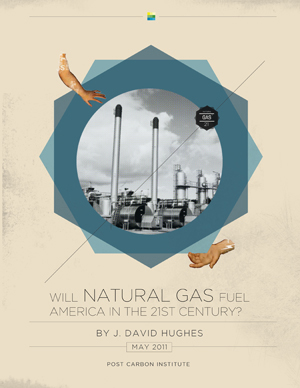
Report by J. David Hughes takes on three major assumptions of the shale gas industry. Source: Post Carbon Institute.

Related

For several years now, the natural gas industry has been exclaiming Hallelujahs about the marvels of shale gas with the passion of a church choir belting out Handel's "Messiah."

The hallelujahs, which spring from the U.S. Energy Information Administration (EIA) or the likes of Chesapeake Energy ("American's Champion of Natural Gas"), come in three happy choruses.

The first says that the shale gas revolution will miraculously create 100 years worth of methane; the second chorus maintains that the price of natural gas, a volatile commodity, will stay low for decades; and the last chorus says that natural gas will green the economy and arrest climate change. Hallelujah.

But a new report by J. David Hughes, one of North America's foremost coal and gas experts, challenges every single one of these faith-based assumptions with hard science and clear-eyed math. In the stunningly lucid 64-page report for the Post Carbon Institute, Hughes squarely concludes that all three assumptions are highly questionable, if not total "impossibilities."

Hughes is no wide-eyed greenie or industry basher. He happens to be one of Canada's most credible energy scientists. The geologist worked for Natural Resources Canada for 32 years and mapped Canada's coal and coal bed methane fields. He has also served on Canada's Natural Gas Potential Committee and is regarded as one of the continent's top global energy analysts. (B.C. politicians take note: Hughes lives on Cortes Island on the West Coast.)

"Natural gas is a truly important resource. But industry has overblown what shale gas can do for us," says Hughes. "Shale gas is an exercise in creating greater complexity with lower and lower returns."

Shale industry 'hubris'

Until shale gas appeared on the scene, analysts predicted a high noon for natural gas. Gas production in the U.S. peaked in 1973, and has been on a bumpy production plateau ever since. But then companies started to use horizontal drilling, combined with hydraulic fracturing, to open deep rock formations once considered as inaccessible as bowhead whales in the Arctic.

Hydraulic fracking, a high-energy technology that uses millions of gallons of water, sand and toxic chemicals to blast open methane trapped in dense rock, created a shale boom from Pennsylvania to northern B.C. and beyond.

The fracking energy binge, which industrializes rural landscapes, sparked moratoriums in Quebec and New York due to widespread concerns about surface and groundwater contamination, and earthquakes from reinjected fracking fluids. U.S. Energy Minister Steven Chu just ordered a high level investigation on fracking issues. Even France has banned the practice to protect its water-dependent cheese makers and grape growers.

Although T. Boone Pickens, the natural gas lobby and some environmental groups now champion shale gas as a "transition fuel" that could possibly retire coal plants and even power vehicles, Hughes says the real production numbers don't add up without unprecedented levels of drilling.

For starters, industry hubris simply defies the law of thermodynamics. From 1990 levels, U.S. gas drilling tripled to 33,000 wells per year between 2006 and 2008 before collapsing back to 20,000 wells. In order to build a modest 21 per cent increase in natural gas production, the gas industry constructed a complex infrastructure nearly 100 per cent larger than what previously existed in 1990.

"What matters are flow rates and how fast the gas can be produced," explains Hughes. "There may be 100 years worth of methane in the ground, but it may take 800 years to produce it." Meanwhile, conventional gas production in both Canada and the U.S. is declining rapidly. In other words, shale gas might temporarily replace some of the air leaving the conventional gas tire -- but not for long.

Extreme, expensive, emissive

Next come the resource's extreme economics. A shale gas well with multiple fracks costs between $2 million and $10 million to drill. But unlike a conventional well, which declines between 25 and 40 per cent in its first year of production, a shale gas well drops like lead from 63 to 85 per cent. So, an initial whale of a return bought by fracturing an industrial scale land base (and watershed) abruptly becomes a sardine in short order.

Due to the high amount of capital, energy and water needed to frack a formation at high pressure, shale gas is expensive and is only economic in the best portions of today's shale plays. But due to over-drilling and the recession reducing demand, the actual market price has sunk to below the cost of production in many areas.
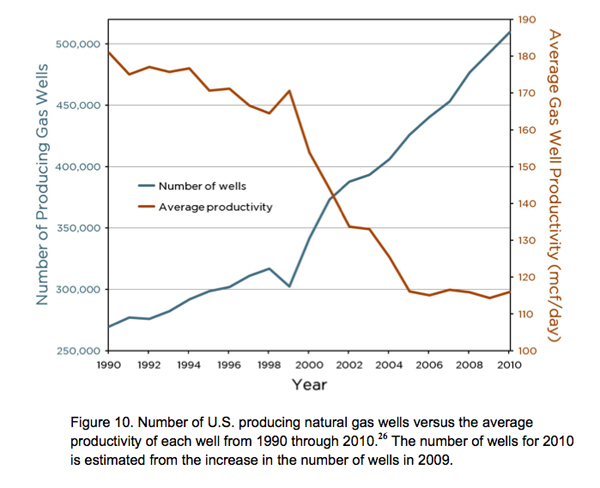
U.S. natural gas production versus productivity

Source: Post Carbon Institute.

This explains why many producers have shifted their activity to shale oil exploration or sold a portion of their assets to foreign companies. (The British Columbian government has unwisely subsidized shale gas drilling with roads and low royalties and other billion dollar giveaways.)

"One thing is certain," adds Hughes. "Shale gas is expensive gas, much of which is marginally economic to non-economic at today's gas prices. The resource will require unprecedented rates of drilling to grow production, and we will need higher prices to justify that. We'll have to carpet bomb landscapes in Pennsylvania and New York with rigs and gas production infrastructure -- those folks haven't seen anything yet."

Last but not least, Hughes demolishes the claim that shale gas is green. For years, scientists generally assumed that the burning of natural gas produces 44 per cent fewer greenhouse gas pollutants than coal. But that's no longer true.

A recent study based on U.S. Environmental Protection Agency data, for example, found that the cleaner-than-coal claim fell to 25 per cent or less when scientists included methane leaks or "fugitive emissions" from wells and pipelines.

Two Cornell University studies went even further. After accounting for methane vents and leaks over the lifetime of a gas well, (and methane is a much more powerful climate changer than CO2 over the first few decades), these studies found that shale gas has few or no climate change benefits.

According to Hughes' analysis, shale gas repeatedly comes out a loser compared to dirty old coal for power generation over the next half century.

He concludes: "Best technology coal compared to best technology gas produces less emissions over a 50 to 60 year time frame... Thus, the concept of natural gas as a low-carbon bridge fuel to a future powered largely by renewable energy is cast in considerable doubt as a strategy to reduce global warming. Employing the best available methane capture technologies could reduce this impact, but shale gas would still be worse than coal over a 20-30 year timeframe because of the near-term global warming potency of methane."

'A small but important flame'

Asked if his U.S. report applies to Canada, Hughes replied "mostly yes." Since 2001, Canada's marketable gas production has declined by 18 per cent. Alberta's gas production (74 per cent of Canadian production) will drop by 44 per cent from 2006 levels by 2019, according to the Alberta Energy Resources Conservation Board. Given a National Energy Board prediction that shale gas will account for only 3.5 per cent of supply by the end of 2012, Hughes doesn't think that shale gas will begin to make up for conventional gas production declines.

"Why are all these companies planning on building a gas pipeline to Kitimat with an LNG terminal to export Canadian gas? It really leaves me scratching my head, except for the shale gas growth hype and the fact that global LNG prices are much higher than North American gas prices currently."

The implications of the Hughes report are disturbing. Without dramatic reductions in consumption of fossil fuels from outright conservation to energy efficiency (he strongly recommends more co-generation and targeting fuels to their highest-value applications), the rapid exploitation of shale gas will only confirm Eric Sevareid's law: "the chief cause of problems are solutions."

Moreover, "the growth mindset that has served us so well for the past few centuries no longer suits the situation we find ourselves in. Fossil fuels are a finite, one-time resource. Neither natural gas, nor oil, nor coal can fuel the 21st century to its end in the manner which we have become accustomed."

But that's not what industry or captured regulators are telling the public. "The people who own centre stage right now are the natural gas lobby," says Hughes. "The big picture analysis of where this is taking us and future generations really doesn't have much of a voice."

So the truth on shale gas burns down to this: It's a small but important flame. Due to extreme depletion rates and costly economics, it won't fuel the future or replace coal or imported oil. Like Alberta's dirty bitumen, the resource requires such high water, energy and environmental costs, that regulation must demand greater accountability. Incredibly, the resource may produce more global warming gases than coal.

What industry once pronounced as a "game changer," looks and sounds more like an Elmer Gantry sermon than Handel's "Messiah."  [Tyee]

11  Comments:

Login or register to post comments

  • Cycling Commuter

    2 years ago

    Targeting fuels to their highest-value applications

    J. David Hughes suggests targeting fuels to their highest-value applications. Good plan. Some of the highest value applications involve using remaining energy sources to manufacture and install the following items:

    1) Building insulation.

    2) Drainwater heat recovery systems such as the Canadian-manufactured one shown at http://www.renewability.com/video.html
    A nice benefit of the system is that in addition to saving lots of energy and money it substantially improves convenience by increasing the amount of hot water available from an existing tank without the need to increase the physical size of the tank. This is a useful benefit when several members of a household want to shower in quick succession. This particular unit is guaranteed for 10 years, but it should last at least 30 or 40 years in most cases.

    3) Cellphone with voice-to-text and text to voice capability to be used for dispatch purposes in conjunction with issuance of an unlimited number of part time cab licenses for drivers with zero-pollution vehicles, perfect driving records and no criminal records. This can substantially cut the number of single occupant vehicles on the road. Part-time cabbies can use carshare vehicles to pick-up paying passengers on the way to work and on the way home in a flexible way that doesn't interfere with the ability of driver or passenger to work overtime, go shopping on the way home, etc.

    Text to voice and voice to text may seem pointless, but it's much safer than a live voice conversation because people don't expect an instant answer when they send a text message. Converting an incoming text dispatch message to voice for a driver means the driver can wait to listen to the text message when it's safe to do so without taking eyes off the road. The driver can then wait to reply to the text message with a simple yes or no voice command to accept or reject a proposed fare when it is 100% safe to do so and without the distraction of pushing keyboard buttons. The threat of immediate loss of part-time cab license should prevent drivers from using their cellphone-based ride dispatch system in an unsafe manner.

    4) Occupancy sensors under parking spaces tied to smartphones to show where parking is available, and dynamic pricing to rationalize parking spot utilization. This reduces the 15-40% of local traffic in congested areas that consists of drivers circling round and round the block looking for a parking spot. It also encourages carsharing and carpooling. SFPark has built and is testing such a system. See: http://vimeo.com/22610428

    5) Some existing energy sources should be converted to electricity and applied to the rear ends of Bill Vanderzalm and other politicians who think it's a great idea to use property-transfer taxes to severely punish people who do the right thing by selling their old home that's a long way away from their job and buying a new home within walking or cycling distance of their job.

  • RickW

    2 years ago

    An Inconvenient Talk - David J. Hughes

    http://www.walrusmagazine.com/articles/2009.06-energy-an-inconvenient-talk/

    Quote:
    A barrel of oil, he tells you, contains about six gigajoules of energy. That’s six billion joules. Put your average healthy Albertan on a treadmill and wire it to a generator, and in an hour the guy could produce about 100 watts of energy. That’s 360,000 joules. Pay the guy the provincial minimum wage, give him breaks and weekends and statutory holidays off, and it would take 8.6 years for him to produce one barrel of oil equivalent (boe, the standard unit of measure in hydrocarbon circles). And you’d owe him $138,363 in wages. That, Dave tells you, is what a barrel of oil is worth
  • Cool Hand

    2 years ago

    Another Perspective

    Quote:
    But unlike a conventional well, which declines between 25 and 40 per cent in its first year of production, a shale gas well drops like lead from 63 to 85 per cent.

    Those depletion rates are common in the southern U.S. shale basins but, AFAIK, depletion rates in the Montney and Horn River basins are more in line with conventional ng wells based upon prolonged well testing.

    Quote:
    the actual market price has sunk to below the cost of production in many areas.

    Firstly, much of the shale gas plays in NE BC are rich in natural gas fluids (used in plastics and petrochemicals), which are nominally priced at a barrel of oil. Some ng fields are so rich in these ng fluids, that you can give the ng away for free and still
    recoup one's investment/plus a return on a drilled well.

    Secondly, while costs for a shale gas well has almost reached break-even just for natural gas alone, currently priced at ~$3/MMBtu in the North American market, it appears that most of the NE BC production will be destined for the Asian market with new lng plants slated to come on-stream for NW BC's coast.

    The price of ng in Asia is tied to oil and is about $12 - $14 MMBtu (4 times the NA price). It's no wonder that Nexen's prez has categorized NE BC's shale gas plays as lucrative "oil plays".

    Quote:
    the resource requires such high water costs

    And much of the water (as much as 80%) in NE BC is extracted from deep, sub-surface, non-potable aquifers containing saline, sour (containing hydrogen sulfide) water, which is treated at surface level into potable water.

    The Debolt Water Treatment Plant in BC's Horn River basin is such an example purposefully constructed for the shale gas plays.

    http://www.encana.com/responsibility/environment/water/snapshot/debolt-plant.htm

    Quote:
    Given a National Energy Board prediction that shale gas will account for only 3.5 per cent of supply by the end of 2012

    Makes sense. The Horn River/Montney basins in NE BC are still in their infancy in terms of exploration and infrastructure development and production won't ramp up until 2015 at the earliest.

    Another interesting side-note. South African SASOL, a world leader in coal/ng to gasoline conversion technology, has recently taken a $2 billion stake in one of the fields in the Montney basin.

    SASOL is also contemplating constructing a future plant to convert ng to diesel and other liquid fuels esp. considering the current historic price spread between oil and ng compared to the energy equivalent ratio.

    SASOL's proposed facility would convert ng into 96,000 barrels/day of diesel. Probably a $3 - $5 billion capital investment alone.

    BC's NE shale gas plays will not only make BC Canada's largest ng producer by the end of this decade (surpassing Alberta) but it will also immensely enrich gov't coffers.

  • RickW

    2 years ago

    SASOL

    Quote:
    has recently taken a $2 billion stake in one of the fields in the Montney basin

    Well so much for any profits to be derived for BC/Canada..........

  • dave49

    2 years ago

    The future?

    We're not going to leave much for our grandchildren, are we??

    I saw a Brit named Jonathan Porritt talk back in 2006 or 2007 and his talk was a resource parallel to Al Gore's 'An Inconvenient Truth'. He said we will come to look at 1950 to 2000 as Humanity's golden age.

    Sorry we couldn't turn around this ship headed for the rocks, Christopher.

  • Frank

    2 years ago

    Shale gas

    Over time all but the true believers will come to realize that the only way a shale gas future works is if government pays for the costs and guarantees the profits for decades.

    Kind of like BC's run-of-river contracts.

  • the real ODB

    2 years ago

    Cool Hand

    You're always big on the figures, too bad the facts never enter your drawn out exercises. Like how "externalities" are NEVER calculated into the price. You know, the "REAL" cost. Not to mention endless govt. subsidies. And lets not forget that little thing called "global warming."
    Again, the status quo is easy when you lack progressive, intelligent ideas.

  • Frank

    2 years ago

    Stockwell Day agrees with Luke

    I just wanted to say that.

  • G West

    2 years ago

    I don't suppose Coleman knows any of this stuff...

    The marginal cost of shale gas production comes in well above current gas prices, and above future price assumptions for most of the next quarter century.

    In order to meet shale gas production forecast it is going to require record levels of drilling and this will produce increased environmental impacts.

    In fact, Hughes shows that full-cycle greenhouse gas emissions from shale gas may be worse than previously thought, maybe even worse than coal.

    This stuff is just more tar baby technology - prettied up and decorated with a faux green ribbon.

  • KD Brown

    2 years ago

    Oil Gas and Coal

    Any industry promoting their business will state the rosy view. Much money will be made, much will be lost, and as the movie says, There Will Be Blood.

    Thanks for the insight, Cool Hand. Good to have some information from BC.

    But while the carbon industry works to sell the other half, past peak oil, gas and coal, the facts remain:

    - We are running out.
    - As the comparison of dude on bike and barrel of oil attests, we don't have anything to replace the really, really cheap energy that carbon fuels provide, unless we change our expectations.
    - The focus of our governments, BC, AB, SK and national especially, on the oil and gas industry, and the relative lack of attention to alternatives, means that our societies and economies are ever more dependent on these rapidly diminishing resources.
    - Conservation is being dealt with by business, but is being largely ignored by these governments at the scale that is required to reduce our dependence on these fuels.
    - Excitement over the money to be made in fossil fuels is clouding our attention to the world that we will have to live in within 50 years.
    - Even if we can prove that we are not past peak oil, gas and coal, the atmosphere is in no way prepared to be the continuous dumping ground for the polluting gases that will be the result of burning of all the rest.

    This is all a perfect storm of politics, economics and resources. It might be fashionable to pooh-pooh Al Gore and anyone else who is trying to alert us to the dangers, but they are there.

  • realisticman

    2 years ago

    We can buy gas from the Ozzies

    Use Kitimat to import.

    'Australia has around $200-billion (Australian) worth of LNG projects on the drawing board. ...'

    http://www.theglobeandmail.com/report-on-business/international-news/shell-plans-worlds-first-floating-lng-terminal/article2029705/

    • The discussion for this story is closed. No more comments can be added.