Opinion

Why Can't Politicians Talk about What's Real?

Looking at a federal election, and its parallel universe of life and death unmentionables.

By Murray Dobbin, 14 Mar 2011, TheTyee.ca

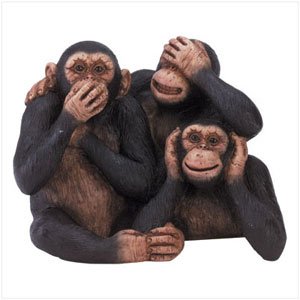
Monkeys

Stuck in a cage that prevents urgent discussion.

Related

In trying to anticipate what a federal election campaign will look like -- and it seems increasingly likely that we will be unable to avoid one – it is striking that the biggest issues facing humankind are not even on the radar, yet alone being framed as planks in any party's campaign platform.

This amounts to whistling past the graveyard with potentially fatal consequences. In our conventional political universe we are talking about jet fighters, corporate tax cuts, growing the economy and abolishing the Senate -- and if we are lucky some mention of climate change, poverty and the dire financial straits of seniors.

But the other universe is virtually invisible despite the fact that it is very real and well known. That parallel road that no one in authority wants to acknowledge is one which is taking us over a cliff. That universe tells us that we are rapidly reaching the planet's limits to growth, that we are well past the start of a global fresh water crisis, that we have already reached peak oil, that climate change will have ever-increasing planet-changing impacts and that rapidly rising food prices will lead to mass starvation in the developing world.

Why can't we talk about what really matters?

We are not good at incorporating totally new paradigms into our highly structured political discourse. It is as if we need a whole new set of institutions from civil society to the formal political level in order to even sensibly begin the conversation. The ones we have simply cannot cope with the looming human catastrophe because, in its totality, it tells us that everything we are doing now and are planning to do, and how we now think and talk about the present and the future are simply irrelevant.

Our institutions are failing us in anticipating the consequences of the various catastrophes we actually know are coming. At some level it is simply a failure of imagination. Our institutions have not been designed to create a response to something the world has never seen before.

How does a political party "frame" the fact that our conventional preoccupation with economic growth is going to kill us?

What political party is going to try to convince people that buying more and more stuff won't bring them happiness and is slowly strangling the planet?

Which civil society organizations are going to form that will begin to change the culture to one based on voluntary simplicity and a post-growth or slow-growth economy? Where would it start?

Governed by corporate values

Our political system now operates like a corporation -- within cascading three month intervals and an obsession with the political share price (read: most recent polling data). And it's not as if the issue of infinite growth versus finite resources just popped up yesterday. Scientists have been writing about this since the 1970s and even before. But 40 years on our liberal capitalist system is actually less capable of addressing the looming catastrophe today than it was then.

The cancer stage of capitalism, according to philosopher John McMurtry, is that stage in which the system's social immune system comes under attack and is systematically weakened by the newly dominant financial sector of the economy. The social immune system (Medicare, labour legislation, public education, environmental protection, etc.) protects citizens from the pathologies inherent in the competitive and unequal system of capital accumulation. As they erode, more and more of a nation's capital is diverted to the financial industry,which makes money from money rather than from productive activity.

McMurtry writes: "Indicative of the classic pattern of cancer mutation is... systemic intolerance of bearing the costs of maintaining social and environmental carrying and defense capacities, and its rapidly escalating, autonomous self-multiplication that is no longer subordinated to any requirement of life-organization."

What McMurtry implies is that the players in the global capitalist order, transnational corporations and the global financial institutions, have managed to separate themselves from the rest of society, radically decreasing their responsibilities. The ideology supporting this de-coupling from society was developed in parallel and effectively places the abstract "economy" on a pedestal above any other social institution -- whether government, community, family or individual.

The right seized the frame

This represents one of the right's propaganda coups of the past 20 years, beginning with so-called free-trade with the U.S. Through control of the media and the establishment of think tanks, the right has been able to turn the role of the economy on its head. In the so-called golden age of capitalism (with that healthy immune system) of the '60s and most of the '70s, the political question was always how could the economy serve the country/nation/society/families. In short, the economy was secondary to these institutions and integrated with them into a nation. It wasn't abstract and it wasn't decoupled from society.

Every politician talked about "full employment" even if they didn't believe in it because that was a societal objective that no politician could ignore. But I cannot recall hearing or seeing that phrase in print even once in the past 10 years, maybe more.

We are now almost 20 years into an era where the question "Is it good for the economy?" is on the lips of virtually every politician. Canadian bureaucrats at international meetings no longer refer to Canada and other nations as countries. They refer to them as "economies." It is a fundamental change in language that has infected our governing institutions and helped justify the now constricted economic role of governments: they just need to get out of the way of business through deregulation, privatization and tax cuts.

Sacrifice all for 'the economy'

The abstract economy is now the dominant institution and everything else has to be sacrificed for it. Of course, when you deconstruct what the economy means in this cultural context, it is nothing more or less than the largest corporations, with the financial sector being dominant. While the government has abandoned full employment (and workers' interests) as a goal, it has replaced it with an obsession with any level of inflation over two per cent. Why? Because the rich will fight to the death against anything that reduces their wealth and that is what inflation does.

Until we reverse this heightened status of the economy as a separate entity, which can act with impunity against the interests of every other institution, including democracy, that parallel universe of the really critical issues we face will be almost impossible to engage. Climate change, environmental degradation, unfettered and unregulated growth, the obscene gap between rich and poor -- these are all now the purview of "the economy."

Until we take control of it, these issues will remain beyond our grasp to change.  [Tyee]

21  Comments:

Login or register to post comments

  • Skywalker

    1 year ago

    What really matters is..

    ..what the establishment does not want the public to debate. If the consciousness level increases they might be spurred into action or at least boot some of the bastards out. They want us to focus on circuses which the sheeple readily do.

  • Van Isle

    1 year ago

    My question is; Why do

    My question is; Why do politians lie?

  • elbillug

    1 year ago

    Re: My question is: Why do politicians lie?

    Because we (as a society) reward them with office when they do.

  • cityzen

    1 year ago

    The first part of your article is timely and relevant...

    I'm not sure, however, that your diatribe on the economy is helpful. You don't take into account the importance of the economy to the average Joe - the reason that politicians focus on the economy in the first place.
    Politicians survive on votes, and appealing to their constituents' basic needs is a survival tactic. Many Canadians know what it's like to lose a job (or a town!) as a factory closes, or to have difficulty finding a decent job to begin with. The economy is very relevant to people's everyday lives. Any small change in economic stability means a corresponding and measurable impact on day-to-day existence, as businesses close or expand. And as people's margin of financial stability grows increasingly smaller year-by-year, the worry over having a stable personal income increases. A "strong economy" represents future prospects: healthy children, a good home, food on the table, and the other basic things that make life worth living.
    Of course, corporations are partly responsible for the poor job outlook. Raping and pillaging natural resources of the past left less for future generations (us), while simultaneous increases in "efficiency" to maximize profits eliminated more and more jobs as the years went by. Our Information age, previously seen as a new source for employment of the educated at least, is quickly losing appeal as new computer programs replace workers. Where then are people supposed to get the income to survive?
    You can understand the economic focus more as another crisis in the long list, and the only one of which we have knowledge to affect one way or the other, it seems. Too bad people don't also focus on the environment, as the economic and environmental issues are intimately connected.
    The time for political specialists is over. We need generalist leaders who examine the complete picture. Instead of Ministers of this or that we need Webmasters: leaders responsible for information nodes who help the various parts of a web of knowledge work together. No one part of the web is more important than the other; the whole survives or collapses together. The time of devisive political parties is over. With more information available, people's viewpoints are becoming more complex anyway, and no one party can represent a voter's perspective.
    Mr. Harper (and his "Harper Government") is a political fossil - no wonder he feels such affiliation with fossil fuels.
    The future of Canada - perhaps North America - is a collection of ecoregions and their concerned representatives, decisions being made with the health of the whole system as the priority. The selfish capitalist ideologies which hold sway now will give way to group-survival practices, either through willful adaptation or violent revolution. There's no other way - our current political system is useless to face our future challenges, and more and more people are realizing this...except for the politicians entrenched in the system themselves, it seems.

  • JohnArmstrong

    1 year ago

    great piece, Murray

    great piece, Murray

  • realisticman

    1 year ago

  • Dahlia

    1 year ago

    Excellent critique

    But we need to get on to solutions. A few of us have been thinking about this for a couple of years, and are led more and more to the conclusion that the answer lies in local groups in communities simply striking out on their own, expanding the groups - perhaps getting on councils, or just acting as pressure groups, being vocal, changing minds and views, and maybe others will follow. Sort of like throwing a pebble into the water, the ideas move out from the center.
    Communities live closer to the land, their economies are more real, and face to face democracy is the only real democracy.

    So, everyone, start small groups, and expand. Communicate on line - so far we can still do it. (But never forget, Communism fell through local activity, and the samizdat before any internet existed!). Time is of the essence!

  • Skywalker

    1 year ago

    R/man's response above proves the point.

    When you spend all your time watching Star Wars you don't need to be bothered with important issues. All those commercials in between give you all the insights you need.

  • lynn

    1 year ago

    melded together by what really matters

    "The abstract economy is now the dominant institution and everything else has to be sacrificed for it. Of course, when you deconstruct what the economy means in this cultural context, it is nothing more or less than the largest corporations, with the financial sector being dominant."

    Exactly. We heard this same superficial 'economic' refrain about the revolution in Egypt - how Egyptian tourism would suffer if the revolt in the streets continued....as if tourism had feelings and could suffer....as if tourism was of more significance than human rights....or human suffering.

    And we hear it now during these most tragic hours in Japan - worries over how uranium shares are plunging - how the nuclear industry is very nervous etc.

    Could there be a more cold-blooded response?

    When we refuse to deny reality any longer, when we refuse to allow ourselves to become distracted by 'measurement' and begin to answer 'what is real', and take on the complexities of what really matters, then that real desire for meaning in our lives will become our economic system, one inseparable from the other.

  • frank2

    1 year ago

    RIGHT ON, Murray. The right

    RIGHT ON, Murray.
    The right wing has been brilliant at framing the issue as "the economy" and then getting folks to think that their interests and that of the "economy" coincide.
    NDP and greens need to re-frame the issue so that voters have a visceral appreciation for the emptiness of the "economy" slogan, and start to understand that there IS an alternative. Not easy. But essential.
    Hope Murray and Tyee can provide some ideas.

  • Dahlia

    1 year ago

    Let's get this in perspective

    I have seen pie charts where there are 3 pies: society, economy, and environment. As if these were somehow equivalent.

    We need to get the correct image: visualize a house with a foundation. The foundation is the habitat, aka environment. The house standing on that foundation is the socioeconomic structure.

    Now imagine the next picture, where the foundation has collapsed. Right away the house falls down too. This is a much more correct representation of reality. We are just as dependent on our physical habitat today as our Stone age ancestors were. If we loose clean air, fresh clean water, and arable land -- How long will life as we know it continue?

    Recall the Cree saying that only when the last tree has been cut, the last fish is dead the last animal is gone, will the White man discover you cannot eat money.

    Another way of saying what I said with the house analogy. All my relations!

  • KWD

    1 year ago

    “Why can't we talk about what really matters?”

    We can’t talk about what really matters because we know we will sacrifice that which we want to believe is true: The simplest route to ‘happiness and prosperity’ is that which leads us along the path of least resistance to the accumulation of wealth; real or imagined.

    Despite the cliché ridden arguments about the economy and the environment being intimately connected, and communities living closer to the land, few will willingly yield to an ideology that asks for immediate, no-turning-back personal sacrifice; one that takes us along a path of greater resistance.

    All life on this planet exists because it has evolved biologically and culturally efficient mechanisms that seek pleasure and avoid pain.

    The political animal knows this is true, and it also knows that telling us “what really matters” means a failure at the polls. The fact voters also understand this pain/pleasure relatonship is proven time and time again at the polls: election outcomes in capitalist societies offer absolute proof.

    The peak-oil/global-freshwater/climate- change crises are important issues but they are symptoms of a much deeper problem: our failure to question culturally instilled storylines that make it socially unacceptable to empathize with the world around us.

  • G West

    1 year ago

    Look

    The rhetoric of the two traditional parties in the Ottawa parliament is and has been for decades mostly a fraud - primarily focused on providing a daily media ration of the red meat of hurling insults back and forth at each other.

    To expect straight talk from people who get their marching orders from fundamentalists in both the ideological and the corporate world is dreaming in Technicolor.

    In the end, the politics and the 'democracy' are incidental - both crowded out by rage and irrationality which, in the hands of a mostly sold out media, have become the lingua franca of public discourse.

    These people (the ones who enable and enlist puppets like Harper and Ignatieff and Clark) - the ones in power and the ones with a decent chance to ascend the power pyramid - don't give a fuck about us.

    They could care less what happens to our society as long as the money keeps rolling in from one source or another.

    Politics is, today, about nothing else - it's about who gets what and that's something no one talks much about these days, usually because we're all to busy screaming at the TV and shouting at each other while the con men in Victoria and Ottawa conspire with Howe Street and Bay street to keep on robbing the fridge.

    No one is going to talk about what is real – and it’s not likely to change anytime soon because we’re too busy being the fat, stupid idiots who voted these morons into power – the same fat, stupid idiots who’ve sat around doing nothing while this decent country was turned into a bad joke.

    Such a bad joke that, in the past year or two, 80 – 85% of the homes sold in Vancouver’s west side were sold to people who don’t even LIVE here – at the same time that no young family can actually afford to even think of buying one….

  • shepsil

    1 year ago

    Truer words were never spoken

    The longer progressives wait to get involved politically, the harder it will be to take control.

    Quote:

    "Until we take control of it, these issues will remain beyond our grasp to change".

    Egypt has just stepped out into the sunlight of democracy, but it feels like we in North America are stepping out of the sunlight of democracy.

    Political involvement and more are now our only chance to save the planet and what is left of our so called democratic society.

  • realisticman

    1 year ago

    "These people

    (the ones who enable and enlist puppets like Harper and Ignatieff and Clark)"

    I thought that Clark was elected by the party membership scattered across the province and that the caucus and the pro-business group wanted one of the others to win.

    Are you suggesting otherwise?

  • dorothy

    1 year ago

    And that's the way it is!

    "What political party is going to try to convince people that buying more and more stuff won't bring them happiness and is slowly strangling the planet? "

    None. They're all living in the pockets of corporations, one way or another. But the good news is, we have the power to do this.

    Who are 'we'? Well, you and me and Joe and Clara around the corner. Mom and Dad and Uncle and Aunt and Mr. Christopherson upstairs. All of us together.

    We built this monstrous edifice together, all of us, by our compliance with the bull-crap we were served; by getting all the stuff and paying bloody sweaty money, real money, real work, for it. We did it out of fear of being 'not with it', left out in the cold, odd or looking poor. Now we need to grasp that this was all hogwash, none of that was as important as what we see here:

    http://www.spacequotations.com/earth.html#truly%20is

  • dorothy

    1 year ago

    And that's the way it is! 2nd part

    See, we were never poor. We own all of this wealth. Together. Or maybe it owns us. This is the difficult point in what we must do. Let go of our damnable tendency to see the communal plate and, as the first thing we do, scrape aside a little glob of the food and label it MINE. More than anything else we have done, this has screwed us up. Those who are best at it and do it at the grossest scale are the sickest. but the rest of us are guilty of being enablers of their sickness. Recently, on the 'Dragon's Den', I heard one of the dragons express absolute horror at the idea of being 'chained to' having to get up and at'em every day in order to make one's living. Guess what? This is what we were made to do. Stop running, and we wither. All kinds of crazy time-killing and 'fitness training' has been invented to make up for the illness that will result when we become couch (or boardroom) potatoes because we can. More gadgets and more garbage, not to mention completely unnecessary health care costs. We can safely say that we have been too smart for our own good here. Evolution has allowed us into a blind alley where we will die. Do we have it in us to get out and seek a living path? This is one of the most exciting questions we have faced in my lifetime and likely yours. We are in a grand adventure, and none of us alive today will see the outcome, but that is just the way life works.

    Don't buy stuff. First, take care of yourself wherever you can. Do you really need a dishwasher? NO, you don't. But you're afraid that friends and neighbors will judge you as 'not concerned enough with hygiene' if you hand-wash (ooh, that germ-filled dishcloth! Never mind that some pediatricians now believe some childhood cancers can be linked to over-use of disinfectants) . They might not let their children play with your 'dirtier' children, or visit your house. You may be ostracized, or so you think. And so on and so forth. In truth, do you REALLY need a lot of the other gadgets and conveniences for which you toss and turn and maybe dismiss your kids and their rightful needs of your attention? Do you REALLY need to buy a new ski jacket every year, so no one will catch you wearing last year's colors? NO, you don't. So don't buy them. Wherever you MUST buy, buy locally made quality to last, and it will reduce worry over break-down, and garbage. It will save you money in the long run. Only that way will we better our chances of making it through the damnable bottleneck. That and don't hand food money to anyone who haven't been taught contraception and is willing to use it.

    We don't have the luxury of waiting for a political party to fix it all for us or invent a new evangelium. Lets all do our part, and we will see progress, and maybe we'll make it. If we don't, we won't.

  • G West

    1 year ago

    Yes! it doesn't matter which dummy has centre stage.

    The key is the fellas pulling the strings...

    And one look at the guy who's running her transition team assures me I'm correct about that too.

    I'm not "suggesting" anything - I'm merely pointing out the latest iteration of the way things are done here in BRITISH Columbia: You should spend a little time reading the history of the province.

  • zalm

    1 year ago

    Murray

    "While the government has abandoned full employment (and workers' interests) as a goal, it has replaced it with an obsession with any level of inflation over two per cent. Why? Because the rich will fight to the death against anything that reduces their wealth and that is what inflation does."

    I'm not so sure that's quite true. I'm still not sure who low inflation benefits more, but managing inflation functions on a number of levels to restrain greed at all levels. It also provides a level playing field where ordinary people can participate in assuring their own security, however, modest, without worrrying it'll be eaten away from them from within.

    Like I said, I can't quite evaluate who benefits more, but I'm quite sure this wasn't done at the behest of the rich. They have too many ways of making more money regardless of how the economic policy works.

  • Rolf Auer

    1 year ago

    Good article, Murray, as usual

    I've been working on this, too.

    Rolf Auer
    www.clearpolitics.wordpress.com

  • OwlRol

    1 year ago

    Not new but increased awareness

    Right on Murray D. My thoughts for more than 30 years. The number of like thinkers has grown in proportion to the growth of corporate control.

    David Suzuki has long made the point that the environment comes first and the community second, and that these are not in place to serve the economy, but rather the other way around, notably that a healthy environment is essential for a healthy economy.

    But the blinkers are on for CEOs and ministers who doublespeak of a healthy business environment.

    Ask not what Exxon/Syncrude/Encana/Talisman/GM/Monsanto/etc. can do for you,

    Ask what you can do for all of them.

    • The discussion for this story is closed. No more comments can be added.