- Ms Kaye is a Tyee Builder. You can be, too.
- Mary Carlisle is a Tyee Builder. You can be, too.
- Prem Gill is a Tyee Builder. You can be, too.
- Nancy Flight is a Tyee Builder. You can be, too.
- Justin Everett is a Tyee Builder. You can be, too.
- John Westover is a Tyee Builder. You can be, too.
- Nora Etches is a Tyee Builder. You can be, too.
- Edward Henderson is a Tyee Builder. You can be, too.
- Bharadwaj Chandramouli is a Tyee Builder. You can be, too.
- Dean Chatterson is a Tyee Builder. You can be, too.
- Marius Scurtescu is a Tyee Builder. You can be, too.
- Robert Parkes is a Tyee Builder. You can be, too.
- James Murton is a Tyee Builder. You can be, too.
- Susan Doyle is a Tyee Builder. You can be, too.
- Vincent Strgar is a Tyee Builder. You can be, too.
- Helen Spiegelman is a Tyee Builder. You can be, too.
- Subir Guin is a Tyee Builder. You can be, too.
- Kimball Finigan is a Tyee Builder. You can be, too.
- Joanne Manley is a Tyee Builder. You can be, too.
- David Leach is a Tyee Builder. You can be, too.
A Year Later, Why Go Downtown?
Hern and Berelowitz continue their back and forth on post-Olympics Vancouver. Today: bike lanes, towers, and more.
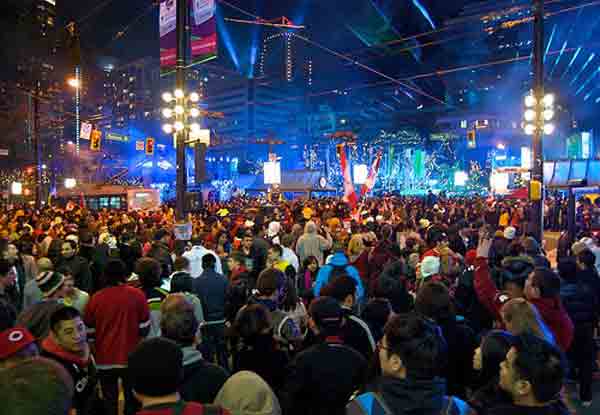
Robson Square at peak of Olympics fever last February. Photo compliments of nonstopdesign via The Tyee photo pool.
[Editor's note: This is the second of a three-part conversation between Lance Berelowitz and Matt Hern about the future of Vancouver. Berelowitz is an urban planner, critic and author of Dream City: Vancouver and the Global Imagination. Hern is a rabble-rouser and author of Common Ground in a Liquid City: Essays in Defense of an Urban Future. While they live on opposite sides of town, Berelowitz and Hern share a deep affection for their city and regularly meet halfway to compare notes and drink.]
Morning Lance,
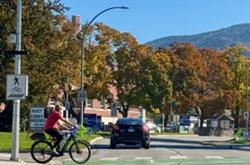
So returning to our theme of over-regulated urban space and nurturing a vibrant city, I want to talk for a moment about bike lanes. If you troll the letters or editorial sections of the Sun or Province, you quickly run into the argument that the new bike lanes along Dunsmuir and Hornby are a terrible idea because so few people in this city ride their bikes, and thus because most people drive we should be accommodating that.
Now obviously that's a bullshit argument in so many ways. Part of the reason so few people ride currently is that there is such a weak bike infrastructure here, and a hundred years of cynical urban planning has privileged car culture over all else. We should be thinking a better city and then building it, instead of defaulting to facile choice arguments. I want a politicized city where we can actively shape our future, not capitulate and let the market make decisions for us.
You know I am no cheerleader for this current city council to be sure, but they are exhibiting a little courage here, thankfully. A better city has to get people out of their freaking cars. And that's hardly a radical proposition. And not just for ecological reasons, but for the cultural repercussions. It is now urban orthodoxy that our future has to have vastly fewer cars, a lot more bikes and a way better public transit system. That's all good, and frankly we should be moving a hell of a lot faster on these fronts.
But I don't think any of that is enough. Really the key to urban transport issues -- especially in this city -- is density. We have to be getting people closer together. You said it perfectly once: "the whole city needs to be squeezed." Vancouver needs to be vastly more urban, not less. We need housing density (and I'm not talking faceless glass towers), commercial density, cultural density. This city needs to stop emulating a small town and embrace the urban. The result will be a much funkier city to be sure, but a much more ecological one as well. That said, density has to be done thoughtfully and politically. Just throwing up some condo towers in the Downtown Eastside is an ugly route to take, but that doesn't undermine the exigency of density.
As you know, I am a huge food gardener at home and have chickens and the whole deal. We keep bees at the Purple Thistle (alternative school Hern helped found) and have started a big ole community garden -- I have my share of hippie in me. But good lord, I have run out of patience with the tired old calls for more greenspace. We have far enough greenspace in this empty little city -- there is so much boulevard acreage, thousands of vast lawns, huge swaths of lonely parks, endless unused space. We need to squish this city, quit being so greedy in our endless gobbling of land and use the space we have more creatively. If we are really serious about reducing our ecological footprint, then living densely is the key. If we purport to love nature let's stop sprawling over so much of it, and that doesn't just mean the suburbs.
You have written about Vancouver's centrifugal character and that's a perfect visual. People tend to spin off to the edges here: wander along the seawall, head for the hills, get out on the ocean, drive off up the valley, go snowboarding -- which has a hollowing effect on the cultural life of the city. There's not enough going on here so people are attracted to that scenery, and because everyone's out hiking every weekend, there's not enough going on. People need reasons to get out of their houses, give up their bongs and endless video watching, their social networking and career obsessions, and get out of their cars. A vibrant city needs people participating in public life, contributing to the commonwealth, running into each other, having a good time and enlivening our communities. We have a responsibility to city life and a huge part of that is cutting down on how far we have to travel everyday.
Peace. Matt
**
Dear Matt,
There is no doubt in my mind (and many others, see David Owen's really spot-on recent book The Green Metropolis, for example) that increased density is the key metric for urban sustainability and reducing our carbon footprint. Propinquity -- that is, pushing people and the things they need to live, closer together – beats currently trendy "green design" hands down when it comes to real, measurable environmental impacts. But even more than that, it is higher urban densities, and the frisson that this creates between uses, people and events, that is the single biggest contribution towards a more vital, dynamic, creative urban life. Look at all the great cities of the world: Paris, New York, London, Hong Kong, Istanbul, you name it. They are flat out more fun and exciting and full of unpredictable possibilities. And a whole lot denser than Vancouver.
It is this lack of unpredictability that perhaps most drives me to distraction about Vancouver. Too many rules, too much proscription, rather than treating people like real adults and trusting ourselves to try different things, even make mistakes. We agree on this. The best cities are layers of divergent trajectories that feed off each other.
As far as densification goes, we've done a pretty good job densifying the downtown peninsula (regardless of what you think of the ubiquitous glass towers on podiums building form). This has been a real success. And we are starting to see intensification in Vancouver's suburbs such as Arbutus Walk in Kitsilano, Collingwood Village, and the development around Kingsway and Knight. But these are still relatively few and far between, and what we need is wholesale densification across the board, but done in ways that largely maintain the look and feel of the neighbourhoods that Vancouverites legitimately enjoy. There are many more incremental housing forms that could achieve this, which our regulations do not yet permit. The ecodensity initiative that the previous city council championed, and which the current council pretends to ignore but has also supported, such as through the laneway housing initiative, is a good start. For the first time, local politicians have explicitly linked densification to mitigating environmental impacts.
Berelowitz: 'The last thing we need is more greenspace.'
But it is not enough, and when you widen the lens further to include the surrounding municipalities, the picture grows even fuzzier. As a region, we have a long way to go and in fact, last time I checked the stats, the City of Vancouver is growing slower than other municipalities, which is worrisome if we consider ourselves a role model for the region and think of the even more serious consequences of exporting our population growth to the periphery, where sprawl threatens the Agricultural Land Reserve and we build into ever more marginal environments.
Which brings me back to bicycle lanes. Of course they are a good idea. But they will only really work as a viable alternative (i.e. get people out of cars in meaningful numbers) if we also offer the supporting elements of a much more integrated public transit system -- that addresses local, city-wide and regional transit needs -- as well as much higher densities and more mixed uses in closer proximity to each other, so that cycling becomes practical and comparable in convenience. Housing lots more people closer to where they work, shop, create and play is a huge step in this.
And yes, the last thing we need is yet more greenspace. But Vancouver does need more multi-use, urban public spaces, which in other cultures are called squares, places, piazzas, plazas, etc. Actually, I think the area around Commercial Drive is one of the few parts of the city that seems to have a really dynamic public life. It is perhaps the funkiest street in town. Why is this, I wonder? Maybe it's time I consider moving, although here's the rub: I confess to really enjoying being able to take a five-minute walk from my front door to the Kitsilano beachfront. It's a powerful draw on a sunny morning. But not particularly urban, I grant you. Maybe Vancouver will only really urbanize when the smog gets so thick that we can't see the mountainous backdrop or go jogging beside the sea…
Back to you,
Lance
**
Hey Lance.
I'm with you for lots of this, but I want to take issue with one particular point that illustrates a larger, central thread. I am not onboard when you call downtown a "real success." The recent renovation of the downtown peninsula is a genuine success in some ways sure (and especially if one were sitting in an office reading stats and staring at maps) but what you once called the new "forest of glassy towers" is butt-ugly, mostly vapid architecturally and totally unaffordable. The new (decade-and-a-half) densification of downtown has created a widening dialectic of unaffordability as the plague of condos spreads further afield and threatens huge swaths of the city, undermining existing thriving neighbourhoods like the West End, which to my mind has an energy, building diversity, decently-affordable rental stock and terrific density that is entirely missing in the new downtown. And for lots of obvious reasons the new forest of podium towers just won't age anything like as well as the WE has.
Hern: Density for the people, not towers for developers.
Increased density is absolutely essential, but if it is a density that privileges developers and profiteering above community vitality and affordability, then we're barking up the wrong tree. There are cities we know and love with awesome densities without a single tower: the hearts and most vital parts of Istanbul, Paris, the Lower East Side of Manhattan etc. are composed overwhelmingly of four to eight story walkups. Podium towers are most useful for capital accumulation.
What we need is a thoughtful, aggressive densification that adds to existing neighbourhoods instead of swamping them, creates affordability instead of undermining it, adds to the architectural diversity and flavour of the city instead of blandifying it, and builds a city of neighbours, not investors and speculators. I want a city full of people who love this place and want to inhabit it. Our current rendition of density is incubating a city full of people who love this city because it is adding to their net worth.
Talk soon. Peace. M.
**
Hi Matt,
That's a rather sweeping generalization of downtown. "Butt-ugly, mostly vapid architecturally and totally unaffordable"? Really? Tell that to the many hundreds (perhaps thousands) of families who have moved into apartments and co-op housing in Yaletown, Downtown South, Northeast False Creek and even Coal Harbour, because many of them come from places that are far more comfortable with high density, high rise living, like say Kiev or Sarajevo or Shanghai. Tell it to the most heterogeneous community in Vancouver who have colonized the West End (which you rightly admire). And tell it to those unfortunate indigents who still make the Downtown Eastside their home, however transitory it might be. That's all part of the downtown mix.
The problem with generalizations is that they tend to simplify what is a rather diverse reality. Yes, downtown densification has raised housing costs for some, but it has also created several thousand subsidized housing units, and increased the proportion of Vancouver residents living downtown from about 10 per cent to over 15 per cent, including some 7,000 children. And City policy requires that large developments typically allocate 20 per cent of their housing for non-market units, and 25 per cent of the total for family-oriented housing. These are good things.
Your dismissal of all things new in downtown also tends, by implication at least, to glorify your own 'hood as the only politically correct place. And let's be careful when referencing cities such as Paris as having no towers. Try tell that to the many million inhabitants of its surrounding high-rise banlieus, which by the way are every bit as bland and sterile as some of ours!
The real issue is how to get the private sector to invest in land development when land prices are so high that lower scale densification tends not to pencil out for them. Nor do the City's land use zoning regulations even permit this form of thoughtful densification in many areas. It comes back to too many restrictive regulations, and not enough freedom for market forces to find multiple, more organic ways to densify all over the city. Unless of course you don't believe the market has any place in the business of housing? Which I hope is not your position, although I will readily agree that government absolutely has a critical role to play in the provision of housing for the most needy end of the social spectrum, and Canada should be truly ashamed that it's the only G8 country without a national housing program.
Best,
Lance
Tomorrow, the discussion wraps up with sharp disagreement over whether it's time to treat the Lower Mainland as one big city. ![]()


29
Login or register to post comments
Road Lice
1 year ago
I could not agree more that
I could not agree more that Vancouver would be vastly improved by more bike lanes, better public transit and less of the facile nonsense from whinging motorists.
bicycleboy
1 year ago
where to park?
The downtown bike lanes will prove a huge waste of both dollars and political capital unless or until they are buttressed by abundant, secure, affordable and sheltered bike parking. Without a number of bike stations with the kind of parking that allows one to park the bike, accessories and all (and by that I mean you should be able to leave your keys and wallet in the panniers, let alone lights, pump, helmet, bottle), no one is going to use these lovely new lanes to actually go downtown. They might use them to pass through it, or maybe stop for a brief while; but as far as attracting a significant number of cyclists to switch modes of transport, the job is half-done at best.
pwlg
1 year ago
I am not sure where both of
I am not sure where both of these authors live in the city but since 1986 the focus on density has been for the most part downtown. Whenever you see someone writing about Vancouver and a photo is supplied you see the downtown area only.
For years residents taxes have been shifted to the downtown area to provide for infrastructure to accommodate the added population. Jobs are decreasing though which means more of those living in downtown must travel elsewhere for work.
In Europe, density did not decrease the use of the automobile nor did it in Los Angeles, which also has a dense population. Just have a view of the variety of webcams overlooking roadways within the core of several European cities and you will see cars dominating the public commons. One thing they do in Europe which would be good here is closing off streets for pedestrians. Oops, we did that but the city didn't encourage changes to the that street (Granville) rather spent their time making Concord Pacific's dream a reality.
You will not recapture the bleeding of young families leaving Vancouver even with higher density as you have allowed the wealthy developer and their facilitators to dictate planning and the future of the city.
In order to have a city that is there for its residents, the residents must be involved in the planning.
Two people, as qualified as they are, out of 600,000 does not make for good planning.
The future and planning is something everyone needs to be engaged in, not just two people. We create false idols and set our planners and architects on pedestals.
The downtown planning reminds me of the Wizard of Oz and the Emerald City (follow the yellow brick road). All smoke and mirrors with one 'wizard' pulling all the bells and whistles.
Oh to hear Jane Jacobs voice again!
snert
1 year ago
bicycleboy
This could all be managed quite nicely if the city imposed a license fee for both riders and bikes and enforced the registration and insuring of all bicycles in the city.
Oh,that's right, bike riders think they should get a free ride.
Chris Keam
1 year ago
free rides
Weird. I don't remember my car-using neighbours complaining about the increase in car insurance costs after they repaved and improved 12th Ave. What troopers!
Oh wait. That's right. Auto registration and insurance has no connection to highway infrastructure. It's used to pay for a small portion of the costs borne by the public purse due to traffic accidents.
snert
1 year ago
Chris Keam
So, you're suggesting that bicyclists pay a surcharge then? Good idea.
Chris Keam
1 year ago
Snert
No, I'm suggesting your idea is poorly thought-out, unfair, and pointless. It is in fact the typical muddle-minded pap that spews forth every time someone dares suggest moving people around by putting 200 pounds of meat in a 2000 pound tin isn't the pinnacle of human achievement and the only way to travel. I hope that clears it up for you.
cheers.
freebear
1 year ago
And the rest of the province's benefits are?
Sums it up; Olympics were only Vancouiver Whistler naval gazing and ferstive frolic for those who could afford, or brainwashed with feel good pseudo-patriotic warm fuzziness; or wealthy enough to attend the publically funded festive frolic in the snow and rain!
grapeman
1 year ago
Families?
So where are these new children coming from?
We'd love to move downtown with our children - or closer to Vancouver in general - but it's not clear how we could afford it on a middle class income. We have 2 older children, an adolescent male and female - and need 3 bedrooms. How has densification improved the housing stock for us, in terms of price or availability? To be honest, the discussion above seems to have little to do with our relationship with Vancouver - a city north of the Port Mann that's more elusive and abstract than ever.
snert
1 year ago
Chris Keam
At least when one rides around in the "2000 pound tin" one doesn't get wet when it rains.
Vancouver is a fair weather biking city and always will be. Trying to make it into something else is doomed to failure and a subsequent waste of money.
Joseph Jones
1 year ago
Not So Fast
Lance says: "And we are starting to see intensification in Vancouver's suburbs such as Arbutus Walk in Kitsilano, Collingwood Village, and the development around Kingsway and Knight." Really?
At Arbutus Walk, the neighbourhood had a real impact in the planning, and it shows in the result. Collingwood Village is developer droppings. Planners themselves have agreed with Norquay Working Group critics that King Edward Village is "a mistake." East is east and west is west!
Lance, spend half an hour hanging around KEV: Grok on a streetscape deadened by a mass of retail still unoccupied after 2-3 years, dance the line of pigeon poo under the archway, dodge back-alley traffic while strolling the interior public space, muse on how accumulated dirt under the public art animals provides context, meditate on the 12 symbolic dead trees (over half of them) in the middle of Kingsway. City of Vancouver tosses in some minimal public realm and then immediately neglects it.
Welcome to Vancouver's very first "neighbourhood centre," the only concrete evidence so far of its multimillion-dollar CityPlan exercise launched in 1995.
By the way, that "new library" at KEV was no developer gift to the community – only a simulacrum sweetheart payoff of fitting out and providing ten years of no-payment occupancy. Closed since Oct 25 due to flooding. I bet the term lease clock ticks along all the while.
Over to the bike theme. That attempt at median beautification on Kingsway just eats up road space that should go to a bike lane. Up the hill, Norquay wants a bike lane, NOT a median tart-up. Come out the Norquay open houses on Feb 19 and 21 and tell that to the "planners" – who just will not listen to us who live here.
daemar
1 year ago
What a concept!
Ahh yes BIKE LANES Had a rare opportunity to head north into Vancouver last August. I can't remember why but it must have been important otherwise I try to stay away especially during rush hour(s)
I kept a weather eye on the bike lane as I traveled over Burrard bridge at 5;00 PM Well there was the bike lane and as I neared the north end of the bridge i saw 2 bikes! Wow what an idea cost per bike per hour must make serious economic sense. Something like all the buses traveling south of the Fraser taking empty seats back and forth.
Common sense seems to be the missing commodity here. GET REAL!
Mikemah
1 year ago
don't include us
The vast majority of people who live outside of the city do so because they (we)don't want to be considered a part of the city . Try forcing it on people and, well, you know what happens.
Chatterbox
1 year ago
"Why Go Downtown?"
Wasn't this the title of the article? Where's the beef...er...tofu?
This was to be another article reflecting on the throngs of people downtown during the Olympics and asking where they all are now. Has not Vancouver finally broken out of its "no-fun-town" cultural straitjacket?
The problem is that Vancouver didn't add or improve any public spaces, including Granville Street, and didn't give anyone any more reason to visit, let alone stay. Where is our new green "Olympic Park" that every host city gets, our neighbourhood revitalization (Olympic Village? DTES?), our promised new affordable housing (Olympic Village again?), or new stadiums (not even a new roof!)? How about improvements in human rights?! Green jobs?
Why should people throng into downtown any more now than before? And one might also ask: is it in fact good for them to come? Matt Hern critically points out the importance of "cutting down on how far we have to travel everyday."
Do Lower Mainlanders not all live in complete communities within walking distance of vital cultural attractions, family, sports facilities, park space, community centres, churches, great restaurants, and lively pedestrian-friendly commercial areas?
If not, they should, because when Peak Oil hits they'll have no other choice.
We have to ask ourselves if it is somehow a social good for hundreds of thousands to commute to downtown Vancouver to flood the bars, mill around, scalp a ticket to a hockey game, keep downtown residents from sleeping, and leave a mess for our police and city workers to clean up at our expense?
Isn't this the real question being posed? Is the Olympic party something we want to see repeated every day or every weekend?
It was great fun for many and some businesses did benefit, but the hangover is just now settling in, with homeless numbers up, unaffordable and empty homes everywhere, crushing public debt, rising taxes, gang warfare on our streets, and transit service changes that might drive Delta out of Translink.
It was just like this after Expo, when Vancouver fell into a decade of real estate market malaise. We had to sell huge parts of the city to offshore developers, and gave up control of our most precious asset, our land.
Is there anything more in downtown to sell? And if so, and we build it, will they come? And for what? The views?
RickW
1 year ago
snert
Bicycleboy was saying that a SECURE place to park is required, to prevent thievery when the cyclist is working all day long.
Chris Keam
1 year ago
@daemar
Luckily, we don't have to guess. The measured volume of bike trips last August over the Burrard Bridge was 140,000. Poke around the Internet a bit and google for cycling infrastructure ROI and you will soon discover it's a fiscally responsible choice.
http://vancouver.ca/projects/burrard/statistics.htm
jcaputa
1 year ago
@chris
What was the number of bike trips in January?
snert
1 year ago
RickW
Looked like deluxe accommodations to me.
warbler
1 year ago
I`m encouraged
I'm encouraged that at least one of the two urban planners used the word 'dialectic' in the above exchange. I'm equally enthused by the usage of 'butt-ugly' by one of the two gentlemen.
daemar
1 year ago
@Chris
Using the statistics you provide the DIFFERENCE between bike lane usage and usage without the bike lane is only 40,000 trips. I assume that is both directions. Seems like a huge outlay of expense and bother to serve the needs of a small (but vocal) minority.
Chris Keam
1 year ago
@jacaputa
50,000
@daemar
Do you feel a minority should be subject to public spaces that are less safe than the majority enjoys?
bicycleboy
1 year ago
Sure, let's licence bikes, riders, etc.
Dearest Mr. Snert,
Re: licence and insurance for cyclists.
If anyone would stand to gain from the introduction of such measures it has to be me. As one of the most experienced and senior bicycle safety instructors around I would be in a good position to really cash in on such a move. I could probably finagle my way into some sort of government position in what would no doubt exist in a bureaucratic strata of either the provincial or municipal administration. If you wanna ride a bike you gotta go through me! Yay - big union wages, prestige, job security! I assume you can justify the tax-payer subsidies involved, same as the auto bureaucracies - or did you think your paltry fees actually pay for all that?
But what do we do in your scheme with, say, poor homeless people who ride bikes? Do the police pull them over, ask for licence and registration, and finding they don't have any, fine them, incarcerate them, impound their bikes? (hey, maybe we should also require licences and so forth for shopping carts!)
No? Seem a bit harsh to you too? Well, you keep working on that one Snert. In the meantime how be we do what the rest of the world has been doing for over a century and just allow people to choose a sustainable, clean, healthy form of transportation over the undeniably non-sustainable, unclean, unhealthy kind.
Chris Keam
1 year ago
bicycle licenses
Not to mention the bizarre situation where you'd have to explain to every sixteen year old with a bike that all of a sudden they would need a license for cycling, even if they'd been riding since they were toddlers, as well as every bike-renting visitor to town.
If the overall safety and good health of the populace is the point, then stepladder safety training would make more sense.
snert
1 year ago
Chris Keam
I grew up in Vancouver when you had to do that regardless of age. Had no problems with it either.
RickW
1 year ago
snert
Do you by any chance have an alarm on your car, or on your house? Do you lock your doors when you are not at home?
If you answer yes to any (or all) of the above, you too are enjoying what you call delux accommodations. The rest of us figure it's just prudence, what with crime being what it is.
Chris Keam
1 year ago
@Snert
I'm assuming you're talking about bicycle registration, not a bicycle license.
How is having to pay a fee to put a small sticker on my bicycle going to make me a better cyclist?
daemar
1 year ago
Chris
@daemar
Do you feel a minority should be subject to public spaces that are less safe than the majority enjoys?
Good point I ride a motorcycle, most riders killed on motorcycles are as a result of drivers turning left in front of them. Using bicycle brain logic we should ban left had turns.
Chris Keam
1 year ago
@daemar
Worth noting that that Burrard Bridge solution also separated pedestrians from cyclists, making the bridge safer for both types of users, and that the original shared pathway didn't meet suggested width requirements for a shared path. Not sure your motorcycle example is a similar situation.
zalm
1 year ago
Further to Joseph Jones
Lance should also consider that Vancouver's City Plan was amended in 2000 to provide for hi-tech parks in two places in the city where there was land owned by large development corporations that didn't want to put warehouses up.
So at great expense, the city modified its plan to allow for hi-tech...and everyone promptly lost their shirts. The western-most site (Schroeder properties) is still virtually vacant, having been subsequently re-amended, and yet once again to allow for hospitals, schools and commercial to be constructed on the former I-3 site. The other site (Eaton's Nootka site) sat half-rented for half a decade until it got properly renovated into commercial and is now slowly filling up.
So when the city sticks to is rules, Lance says it's an ossified dinosaur, but when it abandons is rules at the behest of corporate profit-junkies, and against the advice of ordinary planners, business people and activists, it makes multi-million-dollar mistakes that prove difficult and expensive to correct.
I think I know what I want my city doing, thank you very much. And innovation ain't it. Just stick to governance, please.