

 SHARE:
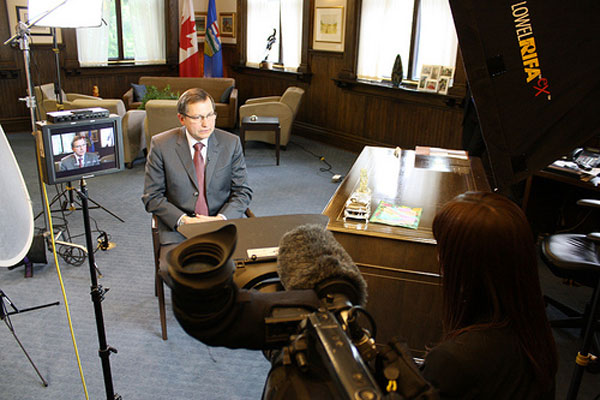
When Alberta Premier Ed Stelmach pragmatically announced his resignation this week, the unhappy petro politician told the world that his bitumen ship now rides an ocean of volatility.
In fact, a province once regarded as the most politically stable, if not authoritarian regime in Canada due its oil wealth, now looks like one unpredictable mess with rising political dissent from all quarters.
Stelmach's stunning departure, an incredible story about rank incompetence, is also a stark reminder of the power of oil price shocks as well as the growing shakiness of regimes dependent on hydrocarbon revenue.
With oil prices erratically bouncing from $150 a barrel to $30 and then back to $80 over the last two years, oil producing states as varied as Texas, Venezuela and the United Arab Emirates and, yes, Alberta, are now running big deficits.
But as Stelmach ably showed, political volatility invariably follows fiscal volatility due to the bad money sense and ineptitude of oil soaked regimes.
He had it made
From one perspective Stelmach's departure may look rather incongruous. Canada's highest paid premier won by a massive majority four years ago because only 40 per cent of the people bothered to vote (oil citizens are incredibly apathetic).
Stelmach, of course, commanded a kingly majority: 72 out of 83 seats (and now 67 of 93 due to defections and other changes).* His party, the Progressive Conservatives, has ruled the province with an oily fist for an alarming 40 years. And then the guy jumps ship.
"It was extradorinary," says Paul McLoughlin. "I was gobsmacked," adds the province's shrewdest political analyst and editor of the AlbertaScan, a political newsletter. "In 40 years there has never been this kind of volatility ever in Alberta."
But Stelmach jumped because of a brutal party squabble over how to deal with rising budgets and shrinking revenues in a petro state. Easy oil revenue, of course, tends to encourage oil exporters to spend too much and thereby become "over-extended, over centralized and captured by special interests." And Stelmach was one of several blind men at the party.
'It all blew up'
Faced with several years of multi-billion dollar deficits due to low bitumen royalties and disappearing natural gas income due to a shocking price collapse, Stelmach, a Red Tory, favoured soft cuts and a growing deficit. In contrast, Alberta's treasury minister, Ted Morton, an ideological Republican, demanded deep cuts in services. It all came down to either Morton's resignation or the premier's exit.
"It all blew up," says McLoughlin. "Stelmach couldn't get consensus on the budget. He knew he was going to lose seats in the next election and when you add up all the personal stuff, he said I've had enough and I'm gone and that's it."
It's a profound drama being played out all over the oil world. A 2009 report by the European Central Bank noted that oil exporters mostly spent their oil loot prior to the 2008 price collapse. As a consequence, most are not prepared for oil price shocks or leaner budgets let alone rainy days. (Texas, for example, is in deep trouble.)
However the bank praised noble Norway and little Botswana, which sit on one side of the petro state spectrum. These two oil exporters saved for the future by creating stabilization funds, pension funds and realistic tax regimes. Norway, for example, not only socked away $500-billion in a pension fund since 1996 but responsibly ran on taxes during the good years. (In contrast Alberta has saved but $14-billion and still runs on oil loot.)
But the bank recognized Botswana and Norway as rare exceptions. The majority of oil exporters such as Venezuela and Iran spent like crazy and saved nothing. As a result, they were now wobbling, well, like Alberta.
Buying into bust and boom
An important 2010 report by the C.D. Howe Institute clearly shows that Alberta lies much closer to the Venezuela bust and boom model than, say, does conservative Norway or far-sighted Botswana.
Now dependent on hydrocarbon revenue for 30 percent of its income, the Alberta government routinely boasts two to three times the budget volatility of other provinces. Moreover it recorded the lowest sales taxes and showed little interest in clear fiscal rules or a rigorous stabilization fund that would guarantee stable funding for government services.
A 2008 report that Stelmach quietly released before Christmas Eve spelled out another big fiscal iceberg. If the province didn't save $100-billion of its hydrocarbon inheritance by 2030, it could end up looking a ghost town by the end of the century.
Now Stelmach never showed much awareness about the perils of petro politics or oil price shocks for that matter. By failing to recognize the elephant in the room, let alone clean up its monstrous poop, he slowly became a source of ridicule throughout the province.
One recent cartoon by Vance Rodewalt even depicted the premier as a bumbling Sgt. Shultz from Hogan's Heroes. Shultz was the fat guy who famously repeated, "I hear nothing, I see nothing, I know nothing." (After a string of personal attacks the cartoon helped Stelmach's chief political advisor, wife Marie, to convince him to quit.)
His own worst enemy
But Stelmach, like most petro politicians, was his own worst enemy. By dedicating $2 billion to the dubiously uncertain technology (carbon capture and storage), he demonstrated a singular disregard for taxpayer's money and a stubborn faith in the sort of bad policy that Saudi Arabia is famous for. (It too supports carbon capture.)
By committing another $16 billion to the construction of electric transmission lines for which no public need has yet to be demonstrated, he also passed three pieces of legislation (Bills 19, 36, 50) that probably represent the most vile and concerted attack on property rights in the nation.
And by defending bitumen production more often than he talked about any other topic, he sorely demonstrated that petro politicians don't really represent taxpayers but increasingly extreme and difficult resources with dirty reputations.
Collapse and reform
Stelmach also didn't get the dynamics behind the growing opposition to the province's one-party rule.
Petro states typically boast long political reigns because of their access to hydrocarbon revenue. Yet whenever prices fall, their painful inability to handle money or balance budgets becomes obvious to all. And that's when political reform can happen.
Shortly after the price collapse of 2008, the Wildrose Alliance appeared on the scene under the capable leadership of Danielle Smith. She is everything that Stelmach isn't: articulate and charismatic. And her fledging right wing party has already captured half of Stelmach's constituency.
Meanwhile, one Liberal MLA has joined the ranks of the Alberta Party, a centrist item seeking more democracy and accountability. It could grow in popularity as quickly as the Wildrose Alliance.
As a consequence, Alberta's one party state is looking more and more like a Berlin Wall ready to topple. To most Albertans, Stelmach's departure is but a reminder that the ship is indeed sinking.
"Anything can probably happen in Alberta politics and probably will," now concludes McLouglin and he's probably right.
Oiled up girly-men
But one should never underestimate the determination of petro states to persist. As the political scientist Terry Karl observes, oil dollars "initially help regimes to consolidate; enable them to endure for unusually long periods; and even enable them to persist during periods of bust."
Incredibly none of the province's political leaders have yet identified any of the real solutions to the perils of petro politics: a pension fund, a stabilization fund, robust royalties and a government that responsibly runs on taxes. But that's typical of petro states, too.
The last word should probably go to wise old Arnold Schwarzenegger, the former governor of California, the world's ninth largest economy, which, too, is reeling from oil price volatility.
Speaking to a Calgary crowd on Tuesday shortly after Stelmach abandoned ship, Schwarzenegger called for more clean energy and comically pinpointed the political malaise of the day: "If you are afraid to fail, you are a girlie-man."
Alberta, a bona fide petro state that can't balance its budgets let alone run its hospitals, appears to be largely run by girlie-men who put the needs of the petro state above all else.
Now that's a formula for more volatility. And failure.
*Story updated at 12:08 p.m. on Jan. 27, 2011. ![[Tyee]](/design-article.thetyee.ca/ui/img/yellowblob.png)
Read more: Energy, Politics, Labour + Industry


Tyee Commenting Guidelines
Comments that violate guidelines risk being deleted, and violations may result in a temporary or permanent user ban. Maintain the spirit of good conversation to stay in the discussion.
*Please note The Tyee is not a forum for spreading misinformation about COVID-19, denying its existence or minimizing its risk to public health.
Do:
Do not: