
Andrew Nikiforuk is there as Hollywood's biggest director visits Extremistan.
Cameron as black swan: 'We're all connected.'

-
Better to describe Canada's oil sands crude as 'the devil's tears.'
-
Alberta is showing the way for nations with similar reserves. Brace for a global 'age of tough oil.'
-
Tories rewriting safety regs with no input from their own expert panel, says member.
James Cameron, one of the world's most famous story tellers, is the sort of Black Swan that multinational oil companies and Alberta politicians never imagined would land anywhere near their huge toxic tailing ponds in Canada's oil sands. Although imperfectly prepared for ducks and geese, neither big oil nor Canada's Saudi princes had any idea how to deter let alone welcome a big Hollywood bird.
Yet after three days of sponging up the energy-intensive nature of bitumen and the corrosive politics of oil sands development, Cameron, the Canadian-born son of an electrical engineer and a physics major, managed to say what no Canadian politician has had the courage to declare about the mega project: "It will be a curse if not managed properly or it could be a great gift if managed properly... Right now it's going in the wrong direction... I think the federal and provincial government need to play a stronger role."
Now Black Swans are simply small and unpredictable events that can create big ripples in a complex globalized economy.
Nicholas Nassim Taleb, the Levantine philosopher who coined the expression, argues that rare shocks and jumps pretty much shape every aspect of our social and political lives and that we all now live in Extremistan. The economic critic also thinks that ordinary folks behave like shipbuilders who don't believe in icebergs. He'd probably argue that Alberta politicians possess even less insight.
What a Black Swan can do
In recent months Black Swans have improbably shaken up the fossil fuel business. Although degreed experts confidently pronounce all petroleum activity as stable and secure in Extremistan, shit still seems to happen. The BP blow-out pretty much rearranged life in the Gulf of Mexico as well as all the regulations for deep water drilling.
On land, the rupture of two Enbridge pipelines ferrying bitumen across Michigan and Illinois also sent deep shockwaves through the petroleum industry. These modest Black Swans (two leaks) polluted a river, shut off more than 500,000 barrels of crude a day, upset the operations of five refineries in the Midwest, boosted the price of oil for millions of consumers, forced companies to barge gasoline up the Mississippi River and lowered the price of bitumen. The leaks also threatened the future of a 1,000 kilometre-long proposed pipeline from Alberta to the port of Kitimat, B.C. to put more cars on the road in China.
In other words, Black Swans tend to illustrate the brittleness of over-engineered systems the same way a child can effortlessly deflate a pompous adult.
And so when James Cameron, the eloquent director of Aliens, Terminator and Titantic, accepted an invitation from Canadian aboriginals to visit the world's largest energy project, Alberta's corporate czars held their breath. Many sweated like boiler room engineers on the Titantic.
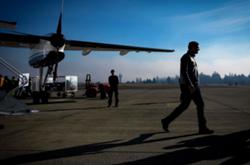
Premier Ed Stelmach, a bumbling bitumen servant who has yet to visit the embattled downstream community of Fort Chipewayan, even rearranged his schedule and commandeered a private jet to catch an audience with the icon.
Trying to shoot him out of the sky
Meanwhile spin doctors in the corridors of petro power questioned Cameron's motives the same way Saudis view foreign visitors. Some swore that the film director was a hypocrite to fly into the region, because as any Albertan knows you can't criticize fossil fuels and use them at the same time. Others hinted that only pinko Liberals and New Democrats watched Cameron's films anyway. Others dismissed the Canadian as a dangerous interloper.
(Note to readers: You have to live in Alberta to appreciate the subtle nuances of a dysfunctional state ruled by one political party for nearly 40 years. Even the U.S. Council On Foreign Relations describes this Texas-like petro kingdom as "skeptical of environmental management.")
Less oily folk speculated about the impact of Cameron's visit, too. Could a film director as famous for exposing human hubris as well as living it say something that might unravel a $200 billion project? Would the technical wizard behind the globe's most popular film, Avatar, compare the mined-out landscapes north of Fort McMurray to the blighted developments portrayed in the cinematic 3-D world of Pandora?
Cameron's science nerd tour
Petro states, of course, are much more sensitive to criticism than normal democracies. Being fragile objects subject to the extreme volatility of oil prices and the ire of oil patch lobbyists, petro politicians fear the pronouncements of Hollywood as much as they scorn the antics of Greenpeace.
When Cameron initially described the bitumen mining development as a "black eye" on Canada's environmental reputation several months ago, members of the Alberta government and the Edmonton Sun suffered the sort of paroxysms hapless space travellers do when incubating aliens get ready to pop from their chests. Even before Cameron frankly pronounced his views, Premier Stelmach, sounding more and more like a grumpy Venezuelan dictator, warned that shadowy "sinister forces" had a hidden agenda against Alberta and the oil sands.
Unlike Stelmach, Cameron did the right thing before opening his mouth. He donned a Syncrude hat and rubber boots and visited a small reclaimed mining site. After listening to their corporate story, he poked around a Suncor tailings pond whose waste had been transported to another pond to create good industry PR. Then he examined the primitive and energy-wasteful technology used to steam bitumen out of the ground. The man asked lots and lots of questions. Even the right-wing National Post commented that Cameron behaved more like a science nerd than a crusader.
In the community of Fort Chip, a place as big as Cameron's home town of Kapuskasing, the director patiently listened to the concerns of aboriginal fishermen, hunters and oil sand workers. (Many asked why the Alberta government didn't behave this way.) A 2009 Alberta Cancer Board study found a 30 per cent higher rate of cancer in the community than expected. Peer reviewed science has now documented cancer makers and heavy metals in waters downstream of the mining and refining project.
Next, Cameron sat down with Premier Ed Stelmach. They had a "gracious and polite" discussion as one farmer's son does with another farmer's son. But they didn't agree about much.
'The world is looking at what you do'
And then the Black Swan landed at one of the biggest press conferences witnessed in Edmonton in a long time. Accompanied by Shawn Atleo, National Chief of the Assembly of First Nations; Gerald Amos of Kitimat's Haisla First Nation, George Poitras, former chief of the Mikisew Cree First Nation and Chief Al Lameman of the Beaver Lake Cree, Cameron spoke with the kind of honesty and brilliance citizens pray they might someday find in their elected representatives.
The chiefs didn't mince words, either. Atleo called Cameron's visit "a historic moment where art imitates life," and demanded that Canadians respect treaty rights in the region. Amos said the proposed Enbridge pipeline to transport bitumen from Alberta to Kitimat would threaten the sustainability of B.C. coastal life. "The issue for First Nations is the pace and scale and type of development that is allowed to happen on our territory."
Cameron didn't miss a beat or utter a cliche. Without notes or script he simply spoke as a citizen of the world who brought a pair of fresh eyes on the project which proved to be as "bad or worse as I thought it was." Yet he called bitumen "an incredible resource and I understand why everyone has stampeded toward it." But he defined it as a transitional source of power. He deplored the influence of the oil patch on U.S. energy policy, which was moving from "being brain dead to slowly coming out of a coma."
Cameron also strongly advised both Alberta and the federal government, who have yet to do a cumulative impact study on the project, to get a handle on the full environmental and economic costs and to "future proof" the monster development.
Cameron, a man who understands complexity, didn't call for an end of the oil sands but for significant reforms. Given the difficulty and cost of reclamation (industry has spent 10 times the amount of money on PR plots than it has budgeted for all the disturbed areas), he recommended a moratorium on any more tailing ponds. He also called for better monitoring on the Athabasca River. He said that industry-funded science made a "good prop" but nothing more. He demanded more independent peer-reviewed science, something neither the Alberta government nor its industry funded monitoring group has ever produced. The techno-geek and inventor also accused industry of using obsolete technology. "The world is looking at what you do here."
Skeptical of 'immaculate conception'
He also didn't buy the big denials about industry contamination of the river with heavy metals and hydrocarbons. (Incredibly both industry and government claim all pollution in the river comes from naturally eroding bitumen deposits.) "It's hard to imagine a refining and mining process of this scale that doesn't have an impact. That would be some kind of immaculate conception."
Cameron also recognized that the mining projects, despite their "horrific" city-sized scale, remained the most economic and energy efficient. In contrast he called the steam plants, the future of the oil sands, a much dirtier and carbon intensive process in which "you are using as much energy as you get out."
In the end, Cameron, the father of five children, called for what both Alberta and Canada have tried to avoid: informed debate about unconventional energy and its full long-term costs. He demanded better science, better regulation and a dramatic slowdown until key issues had been resolved. Most of all he called for respect for aboriginal rights and health downstream. He sounded a lot like a younger Peter Lougheed.
Cameron also mentioned climate change and warned it could be a powerful determinant of the project's size and future. When it comes to understanding what's happening to this planet, "we are all indigenous people now," added Cameron. "We're all connected."
After this unscripted spontaneity and honesty, Alberta's politicians didn't know what to say afterwards. At a legislative press conference much larger than the one held after Stelmach's election, the premier stood alongside three blue-suited cabinet ministers. All four men looked like four deer caught in a Hollywood spotlight.
After mumbling something about whether one liked Cameron's visit or not, Stelmach read from his usual Saudi-like script: "We're doing our part to move the world to a cleaner energy future." He also announced a community health study for Fort Chip and then left the room like a man oblivious to swans.
A vow to return
Cameron, however, not only promised to return but made a "life-long commitment" to reforming the project and advocating for aboriginal rights. Perhaps the only thing worse than a Black Swan is a returning one.
In the end, I asked well-informed Paul McLoughlin, the publisher of Alberta Political Scan and an observer of the province's petro politics since 1983, just what kind of impact the Hollywood bird would have on Alberta.
McLoughlin was pointed and terse. "I think it's good that Cameron is using his celebrity to improve aboriginal rights and to pull the Alberta government and corporations in the direction of environmental stewardship. They are still going to produce the hydrocarbons. But the environmental damage will be less because of this exercise."
Outside of Alberta the Hollywood swan just may generate bigger waves on bigger ponds in unpredictable ways. ![[Tyee]](http://thetyee.cachefly.net/ui/img/ico_fishie.png)
Andrew Nikiforuk, The Tyee's first writer in residence, is the author of Tar Sands: Dirty Oil and the Future of a Continent. It won the 2009 Rachel Carson Book Award.
26
Login or register to post comments
G West
2 years ago
Thanks Andrew
I notice you call him 'Canadian born' and not simply 'Canadian'
My recollection is that he applied for American citizenship (and would have presumably held both American and Canadian papers) but withdrew his application when Bush won the election in 2004.
Let's hope he doesn't decide to revoke his Canadian citizenship now that he's seen Alberta!
Damien Gillis
2 years ago
Oil in Eden - New Documentary
http://vimeo.com/15295815
Another great piece from Andrew. It will be interesting to see how Cameron's "lifelong commitment" to the Tar Sands issue manifests itself...I'm picturing a 3-D Imax extravaganza in his incomparably grand visual style. That would top the famous National Geographic spread from last year that really put the Tar Sands on the global map. More steam coming out of Stelmach and co's ears.
Speaking of international attention on the Tar Sands, the BC extension of the project - Enbridge's proposed pipeline from the Tar Sands to our wild north and central coast - has been garnering quite a bit of its own lately.
Over the past month major media from around the world have ventured to BC's Great Bear Rainforest, where the pipeline would end, filling supertankers at the port of Kitimat to transit our dangerous coastal waters en route to Asia and America. That includes the International League of Conservation Photographers (iLCP), a collective of the world's top nature photojournalists, many of them contributors to National Geographic.
See some of their awesome images in this new short documentary, "Oil in Eden" - featuring Andrew Nikiforuk, Gerald Amos (who represented the pipeline issue at the Cameron event), and stunning video and photos of spirit bears, humpback whales and other iconic species threatened by the proposed pipeline and tankers: http://vimeo.com/15295815
Also see this short report on the iLCP's recent visit to Vancouver to share their work up the coast with media and the public: http://thecanadian.org/k2-video/item/269-great-bear-video
Van Isle
2 years ago
Has anyone else noticed that
Has anyone else noticed that the CBC'ers refer to the Tar sands as the "Oilsands"? Wonder if Peter Mansbridges's meeting this summer at the Bilderberg had any influence? I do know that I thought that some of Peter's questions to James Cameron were kinda stupid and simplistic.
plg
2 years ago
convergence
It's nice to see how a written opinion piece can be enhanced and made more regional to coastal British Columbians with the video by PacificWild-Damien Gillis.
I was in Prince Rupert-PR for two weeks in September and 20 Humpbacks were spotted for five days off of the small islands (Kinahan) close to PR.
Also, I spoke with some workers who have been installing navigation beacons along the central and northern coast from Bella Bella to Prince Rupert. Have the feds already given the signal for more tanker traffic since the Canadian Coast Guard vessels and helicopters were used to ferry materials and workers to the remote sites? Why the additional beacons? Someone needs to dig further into this!
One has to ask the question: Where is the oil in the Enbridge proposed pipeline oil going to and what are the economic benefits to the destined country? If that country is China then we certainly have gone mad. Why would we assist an economy that we, Canada, already have the largest ever trade imbalance? - now more than $30 billion annually!!!
Unfortunately, the coast of BC since European contact has been a place of resource extraction and after 160 years our governments continue with this poor policy unchecked.
More lumber mills and pulp mills close from Prince George to Prince Rupert yet forests are still being cut and their topped and limbed trees are being loaded into ships in Prince Rupert destined for processing elsewhere.
Prince Rupert has become a port town now receiving containers of goods produced elsewhere and destined for markets on the other side of the continent. Rupert now is shipping more and more coal, both thermal and metallurgical, to other economies around the world. These port facilities have a very small number of workers engaged in port activities compared to when its sawmills and pulp mill were operating.
Even cruise ship traffic into Prince Rupert hasn't stalled the retail store fronts from closing up in the town centre. One of the busiest locations in Prince Rupert when the cruise ship arrives for a few hour stopover is the local Safeway which provides tables and chairs, free wi-fi and a deli meal for cruisers who want to access their email service.
Becoming part of the "global supply chain" means a net loss of jobs and does not prevent our government's desire to ghost town our once viable coastal communities.
plg
2 years ago
mansbridge and the newsworld team
A term matches this group well...corporate toadies
Luimneach
2 years ago
JC and FC
Andrew--your piece captures it so well!
James Cameron--a proud Canadian--has done more good for the community of Ft Chip than anyone at any level of government has, I would argue, ever, in relation to the Tarsands. His interest in and grasp of the issues, with no secondary gain, sure shows up the deficiencies in the "elected" representatives, provincially and federally!
Indifferent, inept, incompetent, and in dereliction of duty, would only begin to describe the politicians responsible for the mess, and accountable to the people downstream--and I am being nice!
Keep it up Andrew! And watch your back--Colonel Quaritch maybe lurking in the trees!
Skeptic2010
2 years ago
Ah, Andrew, such a shame
Ah, Andrew, such a shame that one has to questIon your facts when you get simple things wrong. Cameron did not visit Suncor or their reclaimed land. He visited Syncrude's reclaimed land, and the Cenovus in situ operation. Perhaps you require more fact checking in future? Your recent book contained many similar errors (mis-spelled Fort McMurray street names, etc), and if you get such small things incorrect can this bode well for the large?
Skeptic2010
2 years ago
Fact checking...
May be required. Cameron did not visit Suncor property so the comment regarding "poking around" their reclaimed land is inaccurate.
G West
2 years ago
@Skeptic2010
I notice you don't actually have any substantive errors to point out.
You may think the spelling of street names in Fort Mac is important - and you might like to quibble about which reclamation project(s) Cameron saw; I'd say you're making a lot of noise about the positioning of the deck chairs on the Titanic.
Let me know when you write a book – one that’s won several awards – and I’ll critique the hell out of it for you. But only if you sign your ‘real’ name to the manuscript.
Frank
2 years ago
Skeptic2010
I assume you don't believe what you read in newspapers then either since using your logic their daily errors of one sort or another would call into question everything they write.
I wonder if there's a news source that doesn't make mistakes so I could find out who the premier is?
dorothy
2 years ago
Substantive errors?
On the other hand, these things are so easy to get right, that it makes one wonder why NOT get them right?
But out of the article, this one is my favorite:
"managed to say what no Canadian politician has had the courage to declare about the mega project: "It will be a curse if not managed properly or it could be a great gift if managed properly... "
That sure is courageous and profound! If we do it right, we got it made, and if we do it wrong, it will turn out to be crap. Sure bet, I don't see the risk...To me this is a lot of posturing and pontification and not a heck of a lot of substance...Please don't embarrass us all further by persisting in lecturing. I wouldn't have said anything if the usual suspects hadn't come out of the woodwork and rapped knucles with a ruler. But there they were, just like the jam in Stephanie Potter's sandwiches...and not a natural ingredient in sight - .
Jeffrey J.
2 years ago
Hail to Andrew Nikiforuk
There are certain journalists whose writing and comprehension and grasp of an issue is simply outstanding. UBC Prof Chris Shaw on the 2010 boondoggle of the 1020 Olympics (notice how Team Campbell has dropped that like a lead ball); Donald Gutstein's Not A Conspiracy Theory (a great book that was black listed by CanWestGlobal and PostMedia); Marc Edge's Asper Nation (ditto); and Andrew Nikiforuk's powerful debut book Tarsands (an incredible read).
And to think, we get the exclusive works of Mr. Nikiforuk right here on the Tyee. How can the oligarchy defuse Nikiforuk? It aint gonna be easy. He is from Alberta; lives in Calgary; wrote for the Calgary Herald. None of the reigning elite and critics can claim those credentials. Certainly not Harper, born into an Ontario upper middle class family, indelibly marked by a father who worked all his life for Imperial Oil. As a company accountant! This explains a lot.
Nikiforuk is a one of the rare, but not unique, Canadian journalists who are the front lines of a pluralistic society (can anyone say "Walter Stewart", and his amazing analysis of Canada's banking elite in his highly readable Towers of Gold, Feet of Clay...). I, and many other readers, are deeply grateful.
Great coverage as always!!
And last but not least, please consider viewing the brand new video from Damien Gillis (below). After watching, you decide what is right.
http://vimeo.com/15295815
carfreecity
2 years ago
celebrities
informed celebrities are useful for exposing issues
the earlier the better
alive
2 years ago
Gullible us!
Doesn't it say something about the mentality of us, if we listen to a "celebrity" just because he is a celebrity?
Seems to me every second movie star has a pet project and some of those are very controversial.
What happened to the idea of asking people who actually have some insight? --- not insight gained through a short guided tour as with the US Senators recently.
Luck
2 years ago
Salute to Andrew, Jim and...
another great article by the tyee group.
James Camaeron for Prime Minister of Canada.
Thanks for taking the time to tell us the pros and cons of this oil tar sands.
Just remember to put the clean sand back as promised eh.
KWD
2 years ago
the power of celebrity
“To me this is a lot of posturing and pontification and not a heck of a lot of substance …”
Absolutely. But, in terms of posture and substance, there’s not a lot of difference between Cameron and most politicians, including Stelmach. The fact that ‘celebrity’ now commands as much, or more, power and influence than some of our politicians explains why Stelmach rearranged his schedule. He knows that, despite the lack of substance, Cameron can have a serious impact on the minds of the 20-second-newsbyte generation and on the tar sands.
What this points to is the power of MSM in influencing the masses and how desparately we need more media capable of getting past ‘posture’ and spreading a little more ‘substance’.
It remains to be seen whether or not Cameron’s presence in the tar sands will be longlived, and whether there’s something of substance behind his posturing.
C. Wright Mills had this figured out half a century ago when wrote in “The Power Elite:
“ … the institutional elite must now compete with and borrow prestige from these professionals in the world of the celebrity.”
dorothy
2 years ago
uh-unh
"James Camaeron for Prime Minister of Canada."
Not until and unless he can explain to the unwashed masses by what calculatiopn we can do better by Mother Earth if we all have five children. I prefer Harpo with his two. At least there are some limits the man has respect for...
Or, is that all part of the sell-e-brity??
jcaputa
2 years ago
@Frank
Ummm, you should question everything you read in the daily news paper, or anywhere else for that matter. That's called using your critical thinking skills, an ability that seems to be lost on the majority of commentators here.
Jeffrey J.
2 years ago
"dorothy"
Something tells me that "dorothy" is not a woman.
Check.
OK, that makes sense.
I feel better now.
Carry on Mr. Dorothy, but it would be better if you didn't hide yourself behind a false gender. No that there is anything wrong with gender-bending and moving one's gender identify into different locations. There are many people who do that, and I'm all for it. Particularly when most people managing gender identity also hold that truthfulness and honesty are crucial forces.
But I don't think that's what's going on here.
Just so we're clear.
cboo44
2 years ago
Cameron the Pontificator
James Cameron is so "informed" about human caused GW that he only answers softball questions. He is as informed as that other celebrity campaigner, Pam Anderson is about sealing.
dorothy
2 years ago
Jeffrey J.
What HAVE you been smoking?
Are you better now? Are you by yourself? should I call 911 for you? Don't buy that yucky green stuff again! Some of it is not cleaned up properly.
Greg in Calgary
2 years ago
Very good article, but...
"Petro states, of course, are much more sensitive to criticism than normal democracies."
What? I think Mr. Nikiforuk is an intelligent writer, but apparently he lives in a different Alberta than I do. Or maybe the Tyee editors should come and spend a couple of weeks in Edmonton - I hear it's lovely this time of year.
ReynoldR
2 years ago
Thank You Mr Nikiforuk
I've learned more about Cameron's visit from this article than from the Calgary papers or the CBC. One doesn't expect enlightenment from the Calgary papers but I was disappointed in the CBC coverage. It reminds me of the the American public broadcaster which some now call National Petroleum Radio.
jmnykrckt
2 years ago
Plain and Simple - the Indians want more $$$$$$
This is all about the indians wanting more money to squander away on whatever it is they squander it away on and this time they've managed to get someone with a high profile in the media who is stupid enough to believe all their whining to speak for them and, wouldn't you know it, pay for their litigation costs. I can tell you from personal experience, after working in financial reporting in the oil sands industry that involved generating reports that outlined the dollars and dollar value of gifts in kind generously handed to the indians on a silver platter, that this is truly all about the indians wanting more money from industry operators. Squeaky wheel gets the grease don't ya know!
Now folks, I ask you, who truly are the smart ones in this debacle?
jmnykrckt
2 years ago
Oil Sands vs Tar Sands
@ Van Isle
I believe the correct term is Oil Sands - synthetic crude OIL is the final product resulting from the extraction of the oily bitumen from the OIL SANDS.
Tar, on the other hand, is a product of oil and those who choose to make the OIL SANDS sound dirty in their writings seem to choose to use the word TAR because, as you know, tar is black and "dirty" looking.
G West
2 years ago
The original and correct terminology
Please consult any of several references including Andrew Nikiforuk's excellent book by that title.
Oil Sands is a euphemism meant to obscure the nature of the product and the process by which it is wastefully turned into a very expensive (in both real and environmental terms) substitute for oil.
Those who use the term ‘oil sands’ are attempting to obfuscate the true nature of the product and the ‘damage’ it does both to the Canadian economy and to the atmosphere.