Opinion

Harper's G20 Victory: Shrinking Canada

PM's purpose always has been to slash the social democratic state, even if it spurs a recession.

By Murray Dobbin, 12 Jul 2010, TheTyee.ca

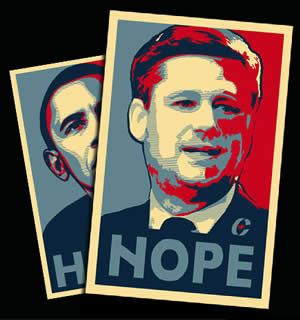
Stephen Harper

Photo credit: One Blue Marble.

Related

Is the world, including Canada, headed for the third great depression, as New York Times columnist Paul Krugman argues? Watching the results of the G8/G20 meetings was like hearing news that a giant comet is heading for earth and we are just waiting for impact. Those meetings of the world's largest and/or growing economies committed governments to massive deficit reduction in spite of the real concern that we are facing a the possibility of a so-called "double-dip" recession. That possibility is now a certainty.

Leading the charge on this ideological lunacy was none other than free-market Ayatollah Stephen Harper whose passion for diminishing the role of government is unmatched by any of the other leaders who showed up in Toronto. Of course, Harper does not really care about deficits per se -- he actually needs them because the provide him with the crisis he needs to rationalize what he wants to do, which is to slash the social democratic state. People forget that this man once headed up the National Citizens Coalition (motto: "More freedom through less government") which was founded by an insurance agent to fight the implementation of Medicare.

There seems to be no prospect in the current configuration of national politics of a party campaigning for increasing taxes to deal with the deficit so Harper, Stockwell Day and Jim Flaherty will have a free hand to make massive cuts to social and other spending. That should actually concern business given how much government money is actually spent in the private sector. Government is far and away the single largest consumer of private goods and services in the country. But ideology can trump even self-interest.

It is instructive that the increase in government spending to counter the recession was framed as "stimulus" spending as if such spending has not always been a stimulus and a normal part of the economy. We have arrived at a point where new government spending and investment is seen as an aberration. Our municipal infrastructure deficit is still counted in the tens of billions. But there will be no more money for these critical services because the only way the Harper government can justify such spending is to deal with a temporary crisis.

Planning a recession?

The plan to turn government's full attention to deficit reduction is nothing less than a plan to create a recession. While the Canadian economy is doing better than its U.S. counterpart, most of the recent job growth has been in the services industries and half are part-time. The crisis in Europe and the dismal prospects for the U.S. economy still hold serious threats to the private sector in Canada and slashing government spending just adds to the risk.

We have been through this planned recession scenario before, in the 1990s under then finance minister Paul Martin. For most of that decade Martin deliberately kept unemployment at an unconscionable nine per cent in his effort to implement his "labour flexibility" policy -- driving down the cost and power of labour. He used an artificially low inflation target of under 2 per cent to keep interest rates high and it cost the economy tens of billions of dollars in lost production. He also slashed social spending, lopping some $25 billion -- 40 per cent off federal contributions -- over three years.

What saved us from this draconian set of policies was a booming U.S. economy and an extremely low Canadian dollar. As it turned out, the deficit would have been eliminated by these factors without any cuts.

But we won't be saved this time around by a strong U.S. economy or a 65 cent dollar -- those days are over. And once the massive stimulus spending in the U.S. dries up, it will get even worse. In addition, Canadians are now drowning in personal debt, which even the bankers agree is unsustainable. A consumer-led recovery can't be done on credit cards at 22 per cent interest.

Make the poor pay

In the past 20 years, Canada has witnessed the greatest transfer of wealth from the poor and middle classes to the rich in our history. It's a process that will continue unabated with the current policies.

The money that the working and middle classes used to earn and spend now goes into the pockets of the wealthy, who can only spend so much. So more and more of the wealth of the nation ends up in the bank accounts and stock holdings of the rich where it is fodder for the casino economy. Everyone else borrows endlessly to maintain the lifestyle the advertisers say they must have to be happy. The banks get ever richer from outrageous interest rates -- but they sit on the money because businesses aren't borrowing: people have quit spending as much, and there is little new investment. So that means that the corporations' retained earnings get larger and larger with nowhere to go. (In the U.S., non-financial companies have accumulated a record $1.84-trillion in cash -- the biggest horde in 40 years.)

In short, we have bales of cash backing up in the bank accounts of the rich and the coffers of the banks and other large corporations -- while the people these same corporations need to be spending have less and less money.

Shrinking horizon

One might ask what on earth the capitalist economic planners are thinking, but of course there are no economic planners any more, especially in Ottawa. Despite the recent global economic disaster, nothing has really changed. The prevailing ideology and government policy still preaches self-regulation and laissez-faire -- and when the next disaster occurs, we will bail the scoundrels out again with short term "stimulus."

It would be comforting to think that many more middle-class people would begin to examine their compulsive consumer lifestyles when facing long-term economic hardship. That would start to form the basis of an economy based on prosperity without growth. But the figures on personal debt are not encouraging. It will take more than personal financial crises to change a culture and an economy headed for the cliff edge. In the meantime we can sit on our porches and watch the nation shrink.  [Tyee]

33  Comments:

Login or register to post comments

  • CanadianLatitude

    1 year ago

    Well get used to it, he will

    Well get used to it, he will get his majority in the fall thanks to the liberals and their weak leader and Canada will never be the same.

  • Glen Murtz

    1 year ago

    It's important to parse...

    what's being acknowledged in the business section nowadays... like when a company "wants" to hire workers but whines and snivels that it can't find people with the right skill set - a tacit acknowledgment that the company doesn't want to pay enough to attract the candidates they so desperately want.
    Because as any member of the Gordon Campbell swines-at-the-trough parade will tell you, "you have to pay top dollar" to attract the right personnel.
    Right guys?

    Oh - and one last thing.
    Word has it that a very large provincial union is being asked to slash it's younger $20+ dollar an hour workers down to $12 or so, while the management is seeking increased stipends for themselves.
    Stay tuned.

  • Noggy

    1 year ago

    How much blatant deceit can a society take ?

    I guess we are going to find out, on a provincial and federal level. There is no going back to yesterday, because yesterday was the beginnings of today.
    I no longer have a full life in front of me, but I sure as hell feel concerned for my children and their children.

    Thats if we survive long enough.

  • freebear

    1 year ago

    I remember an article in the 80s (recession then too)

    that pointed out that European countries; Asian; etc. averaged 100-700 houurs of training per employee, annually - in Canada less than 7! Not even a full day of training!

    But, then how long does it take to learn how to 'service' a customer!

  • freebear

    1 year ago

    Oh and Harper experimented with shrinking civil liberties

    to see if enough people cared! Not that many seem concerned that he created a temporary police state during the G8 and G20 self backslapping conference!

  • Luck

    1 year ago

    It can get worse but

    The question on the bus was...

    so when are we going to have our first political assination of many.

    I bet real soon.

  • wiley

    1 year ago

    socializing the costs, privatizing the profits

    Seems to me that the $16 billion snatched from Canadian taxpayers for new fighter jets socializes the costs of Herr Harper's empire-building dreams.

    That's nearly $500 taken from every man, woman and child in the country for noisy killing machines that burn 80 gallons an hour. We are being lead to the poorhouse by dinosaurs.

  • max von smartt

    1 year ago

    lapdog harper must go

    that yankee plant and fundamentalist borderline nazi has to go. so does that dog obama.

  • Jeffrey J.

    1 year ago

    Concise and Accurate

    Dobbin once again delivers a powerful, articulate analysis of the ideology driving our neoconservative leaders. Like Harper (and Campbell). Very frightening times.

    Great coverage!

  • morechatter

    1 year ago

    Banking on It

    Canada is Oil.
    Harper is King.
    Regulations were yesterday
    Today banks are backing slow boats to China
    as dollar rides on oil prices.
    200 million and you to can have your own boat to China as filled to the brim as HST drills the way and banks loan the way.
    As Canadian banks take Credit for being a rock and yet all they are is a pump.

  • rantnic

    1 year ago

    The Americans Have it Right.

    OFFENSIVE COMMENT REMOVED. -- TYEE MODERATOR

  • rangergord

    1 year ago

    No economic sense in this

    No economic sense in this article. Great rant against Harper though (Don't you just love to hate the guy? I do.) On the one hand personal debt is decried but somehow government debt is a good thing for the economy. The first round of stimulus should never have been approved. It bailed out the mortgage bankers and auto companies at the expense of you and me. The should have let the bastards go bankrupt. Asset prices should have been allowed to drop like a rock. There would have been pain. Now there will be much greater pain later. The government deficits in Canada are just as high on a per capita basis and as a percentage of GDP as the US deficits. When bondholders become nervous they will cease to lend and quantitative easing (money printing) will be the order of the day. No mention in this article about the monetary system that enslaves every person and legal entity in a web of debt. No mention of how government has given away its powers of monetary creation to the criminal central bankers and substituted taxation and debt as its only sources of revenue. As for the no growth economy mentioned as desirable by the author we will have one again as soon as this false recovery is over. A no growth economy leads to recession and depression. This is because our monetary system requires growth in order to pay all the interest on the the endless loans people clamor for. A truly sustainable economy starts with money that is sound and not based on debt. It allows deflation to lower prices slowly over time instead of inflation that destroys your net worth. It gives governments the power to regulate the monetary system so it does not have to steal from its citizens via taxation, indebt future generations or default on its obligations. Paul Krugman is right, stopping the stimulus will lead to a double dip recession and even all out depression but he is wrong to suggest that more debt is the solution to a problem caused by years of cheap credit. Canadians are in for a rude surprise.

  • zalm

    1 year ago

    goodness me, rangergord

    I have trouble reconciling your first sentence with all the others.

    If you have truly read Krugman, you would have known that when the bailouts of the credit system occur and asset prices drop like a rock, that interest rates go through the roof to compensate. this makes the cost of borrowing for businesses trying to recover market share or expand into the spaces left by bankruptcies prohibitive, as the dollar also slides. This has the added effect of making our assets cheaper for other countries to buy, and we end up owning none of our own assets, and often find ourselves saddled with the debts of others as capital (read: the ability to place collateral debt obligations on capital assets anywhere in the world) ebbs and flows where it will. It also worsens our balance of payments, which reinforces the slide of the dollar. The whole mess is on giant negative feedback loop, not a self-correcting mechanism.

    Everything is linked to everything else. I may not like the banks and the insurance companies that run our country (what, you thought it was government?) but I recognize that they were the linchpin that held this economy together, and when the conga line of trucks and ships and airplanes stops because there's no business to be done at a price people are willing to pay, then you simply have to remember that we only have about a week's worth of food in our stores here in the whole country. After that, Canada turns into South Park on a bad day....

    If you want to deconstruct the financial system and redo it along different lines, there are better ways than walking into a forest fire to light your cigarette.

  • zalm

    1 year ago

    Training?

    100-700 hours per employee? I doubt it. I remember similar claims, though not so high, but emphasizing that Europe put roughly triple into its labour force what North America did.

    However Asia does pretty much no training whatsoever. In fact, when super-factories like Foxconn are held up as model enterprises, one sees the Asian model is to have employees pay for their own training at a Foxconn "university", then start work as an intern at no pay while they are training up for the job that will eventually have them working 15 hours a day under the harshest of rules, without one whit of labour law to protect them.

    I'm sure, that even if you include Japan and Korea, that training totals are far lower than Canada.

    Besides, nobody likes training here. Witness all the whining and snivelling about teachers getting 10 pro-d days a year, where they actually have to sit in a classroom and learn shit for themselves, and not go golfing or sailing or whatever....

  • zalm

    1 year ago

    And now, on to the article...

    It's hard to disagree with Dobbin, except I fear he is incorrect on two counts. One is planning a recession: there will always be ways to plan a recession, and ways to steamroller out of it. As long as Canada has assets to sell off (and there are plenty - we don't have to sell our children just yet!), there will always be the continuous cycle of credit-driven boom and bust. (How long before we have our own brand of Canadian Wahabism, just like Saudi Arabia? Maybe we already do....) Whether the people actually wake up and refuse to allow any further corporate debt to be loaded onto their own personal backs is another conversation entirely, and not one that has anything to do with Ottawa.

    The second is that Harper actually has something to do with this whole mess. No more than Paul Martin or Jean Cretien did, Harper is merely the latest in a long line of cheerleaders for the corporate sector. The Economist thinks he's a lucky idiot - people who get struck by lightning and live, generally don't the second time. When Canadians step up and demand alterations to the corporate model of shedding responsibility by banning the corporation, politicians will follow there too, and at least some of the tremendous distortions of the economy in favour of the rich will be eased.

    http://www.economist.com/node/16059938

  • Rolf Auer

    1 year ago

    Harper's version of democracy

    $16 billion on fighter jets, $5 billion on prisons, $1 billion on G20 security, $2 million on a fake lake for the G20 meeting, the only Western country without a national social housing program, missing a national child care program--this is Harper's version of democracy. And it's MINORITY democracy--imagine what he'd do with a majority.

  • freebear

    1 year ago

    Will they wear brown shirts, or black!

    I hope at the bext G8 ; G20 security budget boondoggle all of the demonstrators stay home and sit-in their MP's office; de-cerntralizing protest and making miltary-like (and expensive) security moot!

  • Jerry Munro

    1 year ago

    Wakey, Wakey...

    The "social democratic state" model of late capitalism was a product of ruling class fears of "communist revolution" that grew out of the last Great Depression, the civil war in Spain, the war against capitalist fascism in Europe, and the power of trade unions that was as well a working class response consequence of this period. The ruling class of capitalism sought to head these forces of revolution in the post war period off at the pass, by being increasingly amenable to and co-opting the policies of "social democracy", or "capitalism with a human face." (Which was the other competing ideas force for working class loyalties, leading it toward a "compromise" with capitalism.)

    While these "social democratic policies" certainly did work for as long as this "social contract" lasted, as we now only know, it was doomed to ultimate failure of course. Working class militancy however, waned under this "social democratic state" influence, petering off into timidity, and loyalty to capitalism, with a "class collaboration" sentiment also rooting itself into the working class psyche, including labour unions. The ruling class, in turn, was emboldened to first, increasingly undermine trade unionism and its leadership of the working class, then nibble away at and claw back those concessions it had earlier made to the working class, as part of the social democratic state.

    All of which, as the post war reconstruction of Europe "prosperity period" passed as well into history, gathered momentum and reached its climactic moment with the rise of neo-liberalism in economic theory, its adoption as policy by the ruling class and its minions, and the building of the new Neocon (quasi-fascist) State out of the ashes of the old Social Democratic State order.

    The Social Democratic State had served its purpose. It had helped save capitalism one more time. With that task accomplished and new economic realities and opportunities for global riches before the newly emerging "globalized ruling class", it was time to end the pretence, undo it, and put back on the real Old Order "profit obsessed face" of capitalism.

    The old class war against the working class, which had really always been there and never really gone, was launched with a new vengeance. Which period we are only now fully entering into... along with increasing signs of a gathering environmental crisis, all the consequences of which are just now beginning to really settle in upon and impact what had become over the Social Democratic State period, a "sheeple working-class."

    Wakey, Wakey time, kiddies! EDITED FOR OFFENSIVE COMMENT - EDITOR and grab your socks. It's wakey, wakey time again.

  • rangergord

    1 year ago

    If you have truly read

    If you have truly read Krugman, you would have known that when the bailouts of the credit system occur and asset prices drop like a rock, that interest rates go through the roof to compensate. this makes the cost of borrowing for businesses trying to recover market share or expand into the spaces left by bankruptcies prohibitive, as the dollar also slides.

    Actually I have read Krugman and many other economists as well. Bailouts of the credit system do not cause asset prices to drop. They attempt to prop asset prices up and at least slow their fall. Interest rates do not rise because asset prices fall. Asset prices rise unsustainably because interest rates are too low. Now when interest rates rise it will cause havoc, bankruptcy and foreclosures. There is no way out of this mess. We will face the pain sooner or later.

    This has the added effect of making our assets cheaper for other countries to buy, and we end up owning none of our own assets, and often find ourselves saddled with the debts of others as capital (read: the ability to place collateral debt obligations on capital assets anywhere in the world) ebbs and flows where it will. It also worsens our balance of payments, which reinforces the slide of the dollar. The whole mess is on giant negative feedback loop, not a self-correcting mechanism.

    No question about it, a debt based economy is an unstable beast that will deliver to Canadians its bitter harvest.

    Everything is linked to everything else. I may not like the banks and the insurance companies that run our country (what, you thought it was government?) but I recognize that they were the linchpin that held this economy together, and when the conga line of trucks and ships and airplanes stops because there's no business to be done at a price people are willing to pay, then you simply have to remember that we only have about a week's worth of food in our stores here in the whole country. After that, Canada turns into South Park on a bad day....

    Yep, the food system is already on the verge of crisis. It will not get better any time soon. You can stay where you are and apologize for the corruption or you can expose it to the light of day.

    If you want to deconstruct the financial system and redo it along different lines, there are better ways than walking into a forest fire to light your cigarette.

    I didn't start the forest fire but I cannot pretend its not there.

  • Jerry Munro

    1 year ago

    The Forest Fire...

    "No question about it, a debt based economy is an unstable beast that will deliver to Canadians its bitter harvest."

    I disagree with some of your analysis here, and wish I had time to really get into it with you. Maybe later. (Mrs Coyote is demanding to be fed.)

    But principally it's with the positiveness with which you seem to see the status quo financial system, when its functioning "properly". The emphasis on "when" of course.

    Though especially its with your apparent caveat to some of us... though I may be reading your critique direction wrong here.

    "If you want to deconstruct the financial system and redo it along different lines, there are better ways than walking into a forest fire to light your cigarette." you wrote.

    Whereas, with my anti-capitalism ilk's perspective, we would reply, that whereas deconstructing the financial system, especially its ruling class controlled format basis is essential to the future wellbeing of the rest of us, along with creating a new economic foundation itself, the historical evidence thus far says, always subject to new evidence of course, that there is "no choice", for serious social transformers/revolutionaries, but to walk into the forest fire to light our joint.

    Though you are correct, we didn't start the forest fire either. They did. The ruling class and its serving political minions. (Which includes ongoing chickenshit "social democracy".) It's left to us, all the "other" class strata of society, to deal with it in the final analysis, to put it out. And to ensure, this time around, that these pyromaniacs never get the opportunity to start it again.

  • rangergord

    1 year ago

    If you do decide to get into

    If you do decide to get into it coyoteman, keep in mind that much of the above are the words of Zalm and my replies to his support and apology for the status quo.

  • Des

    1 year ago

    Mistakes Always

    have consequences. Some are easy enough to foresee - going into a forest fire to light your joint (as if you need a joint that badly). But this civilization's primary mistake (believed at the time to be just common sense) was going off the Gold Standard. That single policy pitted every financial instrument against every other financial instrument globally rather than allow their competition against a common standard, the price of gold.

    Out of that kind of instability, the gamblers took over, and took power from shareholders by bribing them to look away from responsible oversight - getting richer by making the shareholders (and the public) believe that corporations have no function other than "making profits" constantly.

    The corollary for politics is that nothing counts anymore except "getting votes." One way to do that is to promote the idea that voting itself is a loathsome chore that will provide no real change to the way that things are done. We do deserve the government we get when we allow governments, controlled by corporations, to govern for the benefit of those corporations.

  • zalm

    1 year ago

    Major errata...

    Now that I've undressed myself for rangergord, you can all have a look too. What I meant to say was:

    "...when the bailouts of the credit system do not occur and asset prices drop like a rock, that interest rates go through the roof to compensate..." This should make the argument flow better.

    The instructive example is Argentina's default. Though now there is evidence that international banks such as Citibank, were using a hidden financial transaction clearing house called Clearstream which ultimately caused the forex disparity that led to the Argentinian default, the original story (and still major cause) of the default was the failure of the government peg of the peso to the dollar and consequent overvaluing of the economy (printing money). This is a classic example of how economies get into trouble - it's happened dozens of time sin the last two hundred years with nearly as many nations.

    Argentina lost financial credibility, inflation rose, interest rates with it, the currency depreciated, and when investors felt it was safe to come back into the market (because Argentinians were desperate for imports lost during the crisis) they found their currencies bought three times what it did before, and brought not only good s to sell, but profits to buy capital with - stores, factories, antiques, banks, property - you name it. As a result, within three years, the Argentine government had to carefully manage its balance of trade to prevent overvaluing the currency again due to the large amount of foreign currency flowing into the country.

    And that's what happ3ens to a country that can't afford to pay only one third of its government debt! What happens when it's private debt, and the amount is twice that?

    [...]

  • zalm

    1 year ago

    Part II

    And that's what happens to a country that can't afford to pay only one third of its government debt! What happens when it's private debt, and the amount is twice that?

    That's where we look to the US. A completely different situation from most other defaults, here private commerce defaulted and threatened to bring down the national economy with it. Had there been no bailout, the default on private debt would have immediately caused the failure of some businesses that depended on that credit (through no fault of their own) and raised the price of credit for others not yet affected. Having already set interest rates near zero and abandoned its ability to lend credit in favour of the private banks, the government had no flexibility to alter credit demand for private companies that were still financially sound. It's like a game of musical chairs - only one seat is taken away, but the resulting scramble when the music stops means a lot of people are knocked over and a lot of damage is done.

    That's why Harper is so idiotic when he boasts of Canada's security, as if he had something to do with it. Through laziness and inertia, as well as a modest dose of protectionism, Canada's economy remained sound only through uncompetitiveness. Too flabby to be taken over.....

    Now that I have corrected myself, I trust that all will see that rangergord and I disagree only in the examples we used to demonstrate our arguments.

  • zalm

    1 year ago

    ...except...

    ....except in the first sentence of rangergord's first comment. I think there's a lot of economic sense in this article. And that's what started this whole thing.

  • zalm

    1 year ago

    coyoteman

    In rejecting the bailouts (because they're still going on, and will for some years yet), rangergord postulated a manageable destruction of the financial system in favour of a return to locally-based or national credit, production and consumption. I said it isn't in any way manageable. Your bone ought to be picked with me.

    First thing you can do is toss our pensions into the garbage. There wouldn't be enough left for a pack of cigarettes for any of you, and I'm not just talking about the CPP. They're all basing future value on current investments, and you've just incinerated their foundation. It'll take years to rebuild that foundation again, and then to create the value enough for pensions to be paid? Well, maybe for your kids. Maybe.

    Then, as something as simple as a financial letter of credit becomes a hideous ordeal to assemble and transfer, international trade comes to a halt. No grapes, lettuce, tomatos, cukes, beef, pork, lamb, sugar, most spices, prepared foods, fast foods, except if you are fortunate enough to be able to bid high enough for the few of those items we do produce limited amounts of. You can live on bread and butter, pasta and milk. No ketchup - we don't produce any of it any more as it all comes in by tanker-car to Hamilton, Aylmer and Richmond from elsewhere.

    The only people who might be able to get trade going again quickly might be businesspeople with experience in dealing in riba and sukuk and used to methods of tawurruq that bridge the trust in business dealings normally occupied by banks of all sorts. Won't that just poke Harpo in the eye with a sharp stick!

    As private credit collapses, so does business, without access to pay either for imports (to earn income) or to ship exports (and pay the float). As business comes to a standstill, so does the whole economy., This is one situation where old WACky Bennett was right - the economy consists of making those dimes whirl around faster and faster so we all benefit. When those dimes stop whirling around, we all suffer, some worse than others.

    And as always, the people who suffer most will be the ones who can least afford it. I'd encourage anyone who owned a home but whose mortgage was underwater as a result of a financial crisis to stay in their home and dare the bank to come a take it. But what about all those renters? They'd just be booted out. The elderly in their nursing homes? Booted out. I don't want to go on - it's too depressing to think about.

    I agree, we certainly need a disengagement from the principles of private credit to finance the operation of the country, at least for assets and goals of national ownership. But it has to be very, very carefully done, because if we screw it up, someone will take advantage of us, and we'll only hurt ourselves.

  • zalm

    1 year ago

    See, we took a good thing...

    ...and ran it into the stratosphere. David Ricardo's theory of comparative advantage, more than two hundred years ago, said that those communities of interest good at doing something through advantage of access to resources, capital or labour, ought to do what they are best at, and trade the surplus for the other things they need, rather than trying to be self-sufficient in all things.

    Every country in the world has specialized in something (even if it's only the enslavement of others), and as a result we are now all massively dependent on each other. It took hundreds of years to get this way, and it can't be unwound in a few days or weeks.

    My favourite example of this kind of capitalism is from a novel that I can't remember now (I just went to my copy of Catch 22 and that wasn't it), where a character named Stok says "You know what is capitalism? That's where one village makes a living fishing in a piranha-infested river. They catch enough fish to eat, and a few extra. And the fish they don't eat, they trade to the village up the river that specializes in making wooden legs. That's capitalism."

    We've all lost a leg in this economic system of ours. It wasn't our fault, but we simply can't kick it out from under ourselves, or we'll get no more wooden legs to stand on.

  • Jerry Munro

    1 year ago

    The Approaching Intersection 1....

    "Now that I have corrected myself, I trust that all will see that rangergord and I disagree only in the examples we used to demonstrate our arguments."

    I must be really quick here, as I have a horse I'm needing to run into the vet's in town this morning. ( Another story of economics and capitalism. :-) But...

    You will not get an argument from me re the necessity of the bailouts to at least forestall the collapse of capitalism entirely, in a chaotic, people harming kind of way. (Though this may happen anyway.) We, the working class, have ourselves allowed the ruling class of capitalism to construct this global house of cards around us. Ignorance is not an argument anymore than timidity is. And though the capitalist ruling class always decries bailouts and other "public interferences", the fact is, capitalism would not and could not exist without the backing of The State to create and enforce the favourable class and other conditions within which it can function... and to bail it out when the greed system that drives it, gets it too deep into shit.

    When it all comes undone, as capitalism has a number of times across its some three hundred year history, it has always been "the people" who have been called upon to make the sacrifices needed to get the ruling class ship afloat again, for one more crossing of the economic waters.

    And, strange as it may seem, on one level I accept that necessity, except... there needs to be a price tag attached to that "advance of capital and wage cuts etc." by "the people", in bailing out the "over-valued" private sector again and again. And this no less than there would be a transfer of stock, outright ownership, or board of directors positions etc, in the case of the "capital" relations between corporations/companies themselves. In short, "the people" need to be attaching "demands" for ownership share and "power" over the decision making processes of the economy to their "bailout advances" to capitalism, of "value for money", including our increased taxation share.

    Continued next post...

  • Jerry Munro

    1 year ago

    The Approaching Intersection II

    Continuing from previous post...

    And if that seems unreasonable to anyone, there is no major global corporation , bank or other institution of capitalism that would think for one second of advancing capital or market concessions to any other, especially in its time of crisis, even collapse, without ownership share and decision making powers being exchanged. Without that, "the enterprise" would simply be allowed to fail, and sold off piecemeal. Neither should "the people" be expected otherwise. (Though instead of allowing a "significant" enterprise to fail, I suggest that "the workers" and "communities" simply "democratize" it.)

    Be as careful and cautious as you want, for "the people" are as yet insufficiently organized to do otherwise, to say nothing of the mass level of understanding as we come out of the late "prosperity capitalism period" of the postwar. But in the end, it remains my view that a final "power tussle" for "right of way" is unavoidable along this road, approaching that intersection up ahead. For which folks should certainly prepare thenselves in advance, in a defencive driving kind of way.. For in the final analysis, cute analogies and metaphors are only of limited usefulness. :-)

    A good day. I must be gone.

  • Des

    1 year ago

    Analogies and Metaphors, Cute or Not,

    are the only way to get people to understand how the simplicity of an idea can be perverted into complexity.

    Simple Capitalism, which is ultimately based upon the single principle of "private property," is a circular system of trading goods for goods, goods for labour, goods for value, and back to goods for goods. Essentially, it is a equable system, of benefit to all participants.

    But we have made it into a complex vertical system, a pyramidal tower in which rewards accumulate at the apex, and do not descend back to those in the bottom rows who support it.

    There are no "intersections" in a circular system. Can we build a round-about in the middle of that Highway of Destruction that Coyoteman and Zalm see ahead of us?

  • John Corman

    1 year ago

    Mr Dobbin's Confusion

    Mr Dobbin is often entertaining with his hatred of any economic activity not government initiated. But, sometimes he appears to forget to consider basic reality. His comment that "The banks get ever richer from outrageous interest rates -- but they sit on the money because businesses aren't borrowing: people have quit spending as much, and there is little new investment." is, quite frankly just plain silly.
    Does anyone actually believe that the banks (1) could be getting richer without lending money and(2) could have tons of money in their faults and yet interest rates are high. Has he never heard of the ole supply-demand concept?

  • zalm

    1 year ago

    Well...

    ...more to the point, have the banks? Credit-card rates being only one example. Banks make plenty underwriting other transactions that don't involve lending, such as equity trading and debt underwriting for corporations and foreign states. Consumer debt, though major, is not the biggest part of any bank's business, as a brief glance at their balance sheet swill show you.

    Hell, even consumer fees at branches make up a significant part of the balance sheet, and the TD admitted more than a decade ago that their fees from branch activity were enough to pay for the labour costs of the whole banking corporation. Yet even after that, I never heard of banks lowering fees for more than a few months at a time. Hasn't anyone else wondered why Davis & Henderson remains so profitable in a paperless banking society?

    Outrageous interest rates are the gravy that allow banks to pay the top level bonuses of millions to a thousand so-called "v-p"s each year. Stick up for that kind of behaviour if you like, but be honest about it. Otherwise, someone will suggest that it's not Mr Dobbin that needs a little review of banking practices in Canada.

  • sicntired

    1 year ago

    Harper and the neocon philosophy

    Harper is a died in the wool neocon and we have seen what the neocon way of thinking has done to the world economy.He can thank his lucky stars that he was ignored when he tried to deregulate our banking system to be in line with the US.If he ever does get a majority government this country will be unrecognizable.You had better learn to build prisons or work in one because this country will be worse than the united states of amerika.I don't know who votes for this bunch of born again fascist but I imagine it's the same bunch of geniuses that put Gordo and his pack of thieves in power once again.They lie and turn the screws for three years and then they pretend to change for a year and it fools the nether lands yet again

    • The discussion for this story is closed. No more comments can be added.