
News

A Tyee Series

Shale Gas: How Often Do Fracked Wells Leak?

When industry says hardly ever, that's a myth. It's a documented, chronic problem. Third in a series.

By Andrew Nikiforuk, 9 Jan 2013, TheTyee.ca

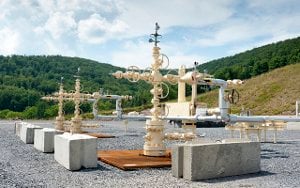
Pennsylvania-wellhead.jpg

Tight as a drum? Shale gas well head in Pennsylvania. Photo by Jeremy Buckingham MLC via Creative Commons license.

Related

One of the boldest claims made by the shale gas industry goes like this: oil and gas companies have drilled and fractured a million oil and gas wells with nary a problem.

In other words fracture fluid or methane leaks are "a rare phenomenon."

But industry data disproves this dubious claim says Cornell University engineer Anthony Ingraffea, the main source for this series, who has studied the non-linear science of rock fractures for three decades.

Moreover industry studies clearly show that five to seven per cent of all new oil and gas wells leak. As wells age, the percentage of leakers can increase to a startling 30 or 50 per cent. But the worst leakers remain "deviated" or horizontal wells commonly used for hydraulic fracturing.

In fact leaking wellbores has been a persistent and chronic problem for decades. Even a 2003 article in Oil Field Review, a publication of Schlumberger, reported that, "Since the earliest gas wells, uncontrolled migration of hydrocarbons to the surface has challenged the oil and gas industry."

Going up

Methane, by its very lightness, wants to go up. Where ever drillers have not properly sealed and cemented wellbores in deep shale rock, the gas will escape and move through rock fractures (existing or industry-made ones) into groundwater, stream beds, water wells and even the basements of houses.

Aging can affect leakage too. Old and decaying cement jobs largely explain why offshore oil wells in the Gulf of Mexico report leakage rates as high as 60 per cent after 16 years of service. Abandoned wells also can become major pollution portals.

The Norwegian Petroleum Safety Authority reports that 18 per cent of its deep offshore oil and gas wells have integrity problems, while Australia struggles with chronic leaks from fractured coal bed methane wells.

"Anything that ages starts to fail," explains Ingraffea. "I'm 65 and I've had a knee replaced."

How much of Alberta is leaking?

Based on industry reports to regulators as opposed to independent audits, about five per cent of Alberta's 300,000 oil and gas wells now leak. But a 2009 study by Alberta scientists Stephan Bachu and Theresa Watson found that so-called "deviated wells" (the same kind right angling used for fracturing shale gas and tight oil formations) typically experienced leakage rates as high as 60 per cent as they age. Moreover "high pressure fracturing" increased the potential to create pathways to other wells, the atmosphere and groundwater.
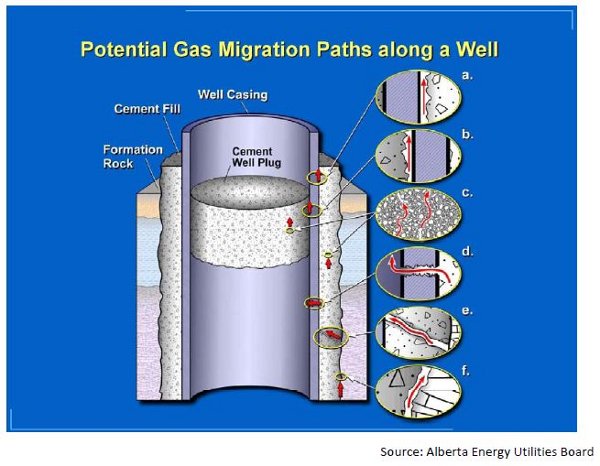
gas-migration-paths.jpg

The many ways methane can escape a natural gas well. Source: Alberta Energy Utilities Board.

Theresa Watson, now a member of Alberta's Energy Resources Conservation Board, also disclosed that an increase in the number of water wells in heavily fractured oil and gas fields would increase "the likelihood that gas, due to migration through shallow zones, can accumulate in buildings."

Alberta's energy regulator does not yet keep track of leaking wells in a rigorous or transparent fashion but it does note in a 2011 Field Surveillance Report that leaks and methane migration are routine items of "high risk noncompliance" that companies voluntary disclose to the regulator. In Alberta the industry remains largely self-regulated.

Leaking of toxic fracture fluids is also common because only 25 to 60 per cent of diluted chemicals and water used to blast open shale or coal formations are ever recovered.

In a 2004 report the U.S. Environmental Protection Agency factually noted that "if fracturing fluids have been injected to a point outside of the well's capture zone, they will not be recovered through production pumping and, if mobile, may be available to migrate through an aquifer."

The failure rates of shale gas wells in heavily fractured jurisdictions with transparent regulation has now become a significant issue. During the shale gas rush in Pennsylvania more than 75 companies drilled thousands of wells and fractured rock formations throughout the state in 2007. Due to a rising number of accidents, spills and leaks, the Department of Energy started to compile and publish open public statistics.

What 16,017 inspection reports said

In 2012 Ingraffea and colleagues read through 16,017 inspection reports filed over the last four years. What they found was a significant and steady rate of methane leaks at the wellbore or what is known in industry jargon as "bubbling in the cellar."

In 2010, 111 of 1,609 wells drilled and fracked failed and leaked. That's a 6.9 per cent rate of failure. In 2012, 67 out of 1,014 wells leaked -- a seven per cent rate of failure.

"We looked at violations and not comments," adds Ingraffea. Quite often inspectors would note that a well was leaking like a sieve but that violation was pending. As a consequence the seven per cent figure represents a dramatic underestimate of methane leaks, says Ingraffea.

Moreover, the seven per cent figure only includes leaks at the wellhead. It does not include leaks that sprouted up in stream beds, water wells, or ponds often 2,000 feet away from the well site after steady fracking operations.

'That's a lot of leaking wells'

In 2009, Cabot Oil and Gas drilled 68 new Marcellus wells in Pennsylvania that the state's Department of Environmental Protection concluded resulted in extensive groundwater contamination for nearly a dozen families in the town of Dimock. State regulators cited the company seven times for "Failure to report defective, insufficient or improperly cemented casing within 24 hours or submit plan to correct within 30 days."

But this common problem will only get worse. Industry has proposed between 150,000 to 200,000 new wells to develop the Marcellus Shale in Pennsylvania, West Virginia and New York. Given current practices that means 10,000 to 20,000 new wells leaking methane into the atmosphere or groundwater and many more over their lifetimes. "That's a lot of leaking wells," says Ingraffea.

Evidence is also growing that toxic fluids used for hydraulic fracturing can also migrate into adjacent water bodies. A 2012 study in the journal Ground Water warned that hydraulic fracturing opens more pathways for the movement of both fluids and methane. And a recent study by the US Environmental Protection Agency in Pavilion, Wyoming, found that toxic fluids had contaminated local water supplies.

So what is it, myth or reality, when industry claims that leaks are rare?

The scientific truth is irrefutable says Ingraffea: "Fluid migration from faulty wells is a well-known chronic problem with an expected rate of occurrence." Inadequate well construction and monitoring remains a persistent industry problem.

The health implications are also serious. The migration of methane or fracking fluid has repeatedly contaminated groundwater across North America or polluted the atmosphere with methane, a potent greenhouse gas.

Tomorrow, last in the series: How clean is natural gas?  [Tyee]

27  Comments:

Login or register to post comments

  • Hakuin

    23 weeks ago

  • Hakuin

    23 weeks ago

    Damn touchscreens

    "Learn"

  • S. Thomas Bond

    23 weeks ago

    Shale gas problems

    The easy stuff is gone. Not only shale gas but much other attempt to get unconventional carbon fuel is dangerous. Mountaintop removal mining for coal, offshore and Arctic drilling run prodigious risk. The fear from BP's Mocondo well was that they had opened a path from the oil reservoir to the surface outside the pipe, which could not be stopped.

    Since I was in college nearly 50 years ago, knowledgeable scientists have known fusion power was the ultimate goal in energy production. Unlimited fuel, almost no radiation, no disposal problems and orders of magnitude greater energy production.

    One of the tragedies of the present situation is that although there is unlimited capital for extension of the old routine methods of production, there is no mechanism to put together the capital needed to develop fusion. There are several avenues that should be explored by an effort like the one that developed the atom bomb in WWII.

  • ModestyBlaise

    23 weeks ago

    ...EMERGENCY !

    We all know that it has been absolutely proven that Global Warming is going to be our downfall. Deniers might still exist but if we don't stop burning fossil fuels immediately the seas are going to rise in a couple of years and we will loose coastal cities. Millions will die and be millions more will have to find higher ground. The earth will be scorched and food production will grind to a halt. The air will not be fit to breathe. Deniers must be jailed!

    http://www.express.co.uk/posts/view/369564/Surprise-Surprise-Global-warming-has-stalled-admits-Met-Office

  • pippatch

    22 weeks ago

    modesty.............

    you are kidding of course!

  • Fiat lux

    22 weeks ago

    Here in the Cariboo we

    Here in the Cariboo we haven`t had -40 since 1995, whereas before that we used to have even lower, every winter, for weeks, BC`s forests have been destroyed by the bugs because of the lack of cold to kill the bugs. This morning we had -7 C and some of the hottest summers in the past years.

    Australia is burning up, yet some brainwashed idiots still claim there`s no global warming, but cooling.

    http://www.commondreams.org/headline/2013/01/08

    Ed Deak.

  • Skywalker

    22 weeks ago

    Modesty's interpretation is based on...

    ... a report by the British MET Office. Here is the first three paragraphs of their findings.

    "The U.K. Met Office lowered its forecast for warming temperatures over the next five years, citing natural variability in the global climate.

    Global average temperatures from 2013 through 2017 will probably be about 0.43 degree Celsius (0.77 degree Fahrenheit) above the 1971 through 2000 mean, the Met Office said in its latest near-term climate forecast. That compares with the 0.54 degree rise predicted in December 2011 for 2012 through 2016.

    “The latest decadal prediction suggests that global temperatures over the next five years are likely to be a little lower than predicted from the previous prediction,” the Met Office said late yesterday in a statement. “Temperatures will remain well above the long-term average and we will continue to see temperatures like those which resulted in 2000-2009 being the warmest decade in the instrumental record” back to 1850."

    To interpret this as anything other than, "it IS warming but maybe not as fast as we originally predicted" is just plain idiotic.

  • Hakuin

    22 weeks ago

    Look at the time it takes

    to even get them to admit anything, much less stop doing it. Any new fracking communities can expect nothing to improve in their lifetimes. The only defense is to not let the vampire over the threshold from day one.

    http://en.wikipedia.org/wiki/Love_Canal

    http://en.wikipedia.org/wiki/Minamata_disease

  • NickS

    22 weeks ago

    Australia's bush fires have been part of its ecology

    for millions of years:
    http://www.csiro.au/en/Organisation-Structure/Divisions/Ecosystem-Sciences/BushfireInAustralia.aspx

    So the present fires don't prove a thing, especially since there is record cold in Southeast Asia.
    http://vietnamnews.vn/Miscellany/234961/long-period-of-cold-weather-disrupt-lives.html

    Even the UK's Met Office has revised it's prediction downward.
    http://hockeyschtick.blogspot.ca/2013/01/uk-met-office-cuts-projected-2017.html

    Methane in the basement is a big worry, but a bit more methane in the atmosphere is of no consequence whatsoever. There is no "greenhouse", and the Sun controls Earth's climate.
    http://www.climatedepot.com/a/18995/New-paper-finds-another-mechanism-by-which-the-Sun-controls-climate--Published-in-Geophysical-Research-Letters

    The dunderheads who insist that humans control climate, in spite of all evidence to the contrary, only seem to flourish in order to keep the Carbon Tax in place.

  • Fiat lux

    22 weeks ago

    Anybody who claims that the

    Anybody who claims that the millions of vehicles on the roads, the 100,000 ships carrying products that could be made locally and the 100,000 or more airline fights every day don't effect the climate has serious mental problems, or is ideologically warped to promote imaginary "growth" and GDP.

    We who live in the forests have been seeing the effects for many years. Not to mention the dozens of chemicals in everybody's blood and the cancer epidemics, that never existed before, especially in kids, all over.

    Ed Deak.

  • Hakuin

    22 weeks ago

    great, now we have two professional, paid denialists

    trying to warp a thread about the health impact of fracking into more free space to push their Heartland Institute oil company rubbish. Remember, they are not here to debate, educate or discuss - no more than a yeast infection would be.

  • NickS

    22 weeks ago

    Yes Ed, it's called the Urban Heat Island Effect

    and it effects LOCAL climate and warps the statistics.
    http://drtimball.com/2011/the-urban-heat-island-effect-distorts-global-temperatures/

    Yes, the Earth warmed for a few years, but temperatures have been flat for the last 16 years.
    http://junkscience.com/2013/01/09/nytimes-admits-no-global-warming/

    Keeping the climate nonsense going allows numerous outrages, like useless windmills to kill bats and birds. How about those wonderful smart meters, keeping track of us while irradiating everything with microwaves.

    "In twenty-one chapters of this 2012 update, 29 independent scientists and health experts from 10 countries assess about 1800 new research papers (from 2006 to 2011) regarding possible risks from wireless technologies and electromagnetic fields. They hold 10 medical degrees (MDs), 21 PhDs, and three MSc, MA or MPHs. Among the authors are three former presidents of the Bioelectromagnetics Society, and five full members of BEMS. One distinguished author is the Chair of the Russian National Committee on Non-Ionizing Radiation. Another is a Senior Advisor to the European Environmental Agency."
    http://www.powerwatch.org.uk/news/20130106-bioinitiative.asp

    Now, that is something real to be upset about!

  • Fiat lux

    22 weeks ago

    Nick.... I've heard

    Nick.... I've heard scientists praising Hitler, Stalin and Mao. Where are they now?

    Nobody denied the nazi holocaust right after the war and I have seen some results of it. The denials started 10 years after the war now holocaust denial is a "science", while the North and South Poles melt away.

    I'm in daily contact with scientist friends in the field of sustainability and they're worried stiff. Apart from the fact that, unlike people who live in mega cities, we can see the changes and destruction caused right on our doorsteps.

    Ed Deak.

  • NickS

    22 weeks ago

    Argue facts Ed

    Your "scientist friends in the field of sustainability" are mostly worried about keeping grant money flowing, and your doorstep is not the planet.

    As for your comparisons to the mass murderers of the last century, look to the statements by such AGW luminaries as Maurice Strong.

    "We may get to the point where the only way of saving the world will be for industrial civilization to collapse."

    And who says warming is bad anyway? The same people who are profiting from the hysteria.
    "A new study indicates that global warming may actually benefit Arctic animals and ecosystem, by expanding their ranges and increasing biodiversity in the area as warmer-climate species move north.

    They found that warming will actually bring in more species from further south, increasing biodiversity in the region. And, even in their worst-case scenario, they expect at most one species to go extinct: the Arctic fox. But, they suspect that this worst-case scenario is just that, a nightmare scenario unlikely to unfold"

    http://frontpagemag.com/2012/dgreenfield/new-study-says-global-warming-is-good-for-polar-bears/

  • Skywalker

    22 weeks ago

    NickS

    I doubt anyone would think that the stuff you get from the right-wing think tank Freedom Center would be considered fact. Nor would a silly article written by a fellow of the Freedom Center or david Horwitz be given any more credence than Bill O'Reilly, Ann Coulter, or the Ezra Levant of Sun News.

    I hope you are not naive to suggest that the interests of climate change deniers are NOT motivated by oil money.

  • NickS

    22 weeks ago

    Smear, smear smear...but never a fact to be seen

    Ask Dr Tim Ball how much this nonsense has COST him.
    Ask the people who lost jobs or resigned, rather than spout the nonsense.

    The "Big Oil Funds Deniers" smear is especially funny.

    The WWF’s Vast Pool of Oil Money

    The World Wildlife Fund’s first corporate sponsor was Shell oil – which continued to fund it for the next four decades.
    http://nofrakkingconsensus.com/2012/04/11/the-wwfs-vast-pool-of-oil-money/

    or how about:
    Masters of Hypocrisy: the Union of Concerned Scientists

    A new report funded by big oil and big tobacco has the chutzpah to complain about corporate influence on the climate debate.
    http://nofrakkingconsensus.com/2012/06/08/masters-of-hypocrisy-the-union-of-concerned-scientists/

    The trouble with you Climateers, is that you know nothing, and couldn't care less about it.

    Oh yeah, I almost forgot about Gore selling out to Big Oil.

    Current TV staffers lash out at Gore
    “He’s supposed to be the face of clean energy and just sold [the channel] to very big oil, the emir of Qatar! Current never even took big oil advertising—and Al Gore, that bulls***ter sells to the emir?”
    http://www.nypost.com/p/entertainment/tv/current_situation_XLE3W50v6I9Gbyqe6Z4pFP

  • Hakuin

    22 weeks ago

    Don't feed

    The trolls

  • Cool Hand

    22 weeks ago

    Oil/Natural Gas - Natural Leakage

    Quote:
    offshore oil wells in the Gulf of Mexico report leakage rates as high as 60 per cent after 16 years of service.

    What about natural leakage/seepage in the Gulf of Mexico, for example?

    Does anyone here even know that that the Gulf of Mexico experiences TWICE an Exxon Valdez spill worth of oil seeps into the Gulf of Mexico every year???

    That equate to ~500,000 barrels of oil per annum.

    Along with natural gas from fissures in the ocean seabed?

    http://earthobservatory.nasa.gov/Newsroom/view.php?id=20863

    What about Coal Oil Point near Santa Barbara, California? An estimated 2,000 to 3,000 gallons of crude oil is released naturally from the ocean bottom every day just a few miles offshore from this beach.

    http://oils.gpa.unep.org/facts/natural-sources.htm

    Even up on Graham Island in the South Queen Charlottes here in BC, oil seeps along the shoreline from vast shale oil deposits.

    So what do enviro loonies suggest? That we nuke mother nature in order to stop this problem?!

  • Hakuin

    22 weeks ago

    That includes

    ALL the trolls

  • Skywalker

    22 weeks ago

    I do get a chuckle when people post links on the Tyee that...

    ...direct you to a Rupert Murdoch owned newspaper/birdcage liner. To have a news paper that boast a very conservative bias and owned by Rupert Murdoch quoted as a source is too hilarious for words.

  • Hakuin

    22 weeks ago

  • Eeric

    22 weeks ago

    Go forward planning..

    WOW, getting a little off topic? Holocaust...global warming..good topics but here? Being the planet has moved through a number of ice ages in its history is this not the evolution of the planet? Agreed we are contributing and perhaps even speeding the process but are people really suggesting we stop the planets natural cycle?
    There is one comment in the article I could not agree more with" Inadequate well construction and monitoring remains a persistent industry problem".
    As statistics go, they have to be based on history and previous data collected. There is no mention of the progress made with changing the way things are being done and specifically the cementing of the wellbores in the current environment.
    There has been a fundamental change in the understanding of cement matrix and usage. Understanding that a class "G" cement previously used in cementing practices will break down over time if set in an environment hotter that 120c (deeper wells)is a good note of point.
    Schlumberger and other companies have developed cements, see "micromatrix and squeezecrete" cement for details but long story short, due to the composition of the cement, it literally has the ability to squeeze into micro fractures that water alone will not for shut off of gas migration and especially in the abandonment of a wellbore.
    There are a number of wells in Northern Canada in the Zama region that had been noted to have "bubbling cellars" but ultimately through gas analysis by AGAT labs, an independent lab, it was discovered it is a naturally occuring Methane Gas as a result of the wells having been drilled through 12m of Muskeg on the way to TD or Total Depth. The gas is now following the path of least resistance up along the casing.
    That is not to say there are not problems but SOME can be attributed to natural environment.
    Another drastic change in the past few years in the procedures required with the abandonment of a wellbore by the ERCB (previously AEUB). It is now required when "cutting and capping" a wellhead at surface after the downhole requirements proving Hydraulic Isolation between zones have been done, now require 1 way check valve installed at the top of the casing stump SO, if there is gas migration past plugs or cement, it will be noted at surface being the wells are regularly inspected (yearly) for migration to surface. If it is found that there is a problem, the owner current owner of the well has 90days to repair the problem or be found in non-compliance with the borad. The ERCB in Canada also approves all drilling permits so if a company is found in large scale non-compliance, the drilling permits are pulled unitl the problems are fixed. Australia is another story . Being their industry is just getting started, they are running under the mining acts of the country. They are regularly sourcing people from Canada to move over and help get things on the proper track and try to learn from some of our previous mistakes.

  • Hakuin

    22 weeks ago

    Is the story about the technology, Eeric?

    Or the people running the technology? I personally think the latter, and I think they are motivated by profit only to the point the would use human blood as fracking fluid if it were the cheapest they could get.

  • Eeric

    22 weeks ago

    The story of Tech

    Man the 3000 character limit is a pain.
    The human factor and economics will always play a role in the development of any industry and there will always be sectors that are "motivated by profit only" Unfortunately unless individual people are prepared to contribute their own hard earned money after taxes, schooling cost, food etc then the only other option is this big private sector business' involved in the development of alternate energy. Unless of course we want the government to do this but everytime there is talk of increased taxes there is a public outcry and the high percentage of the population does not have much confidence for all the obvious reasons.
    I would love to see the dependance of oil and gas drop but to think we will do away with it all together is obsurd. Solar panels and wind farms are not built out of wood. The plastics or Polymers required come from oil by products. I agree with most that mass transportation is a great idea but that still has a bus or train in the equation.
    I simply beleive the Oil and Gas industry is an ingrained and required part of our lives. And futher more to think that the GDP of a country is not something people should be worried about is crazy. No GDP-No hospitals or facilities for the aging, mentally or phisically disabled and so on.
    This is not 2000B.C. and as a culture we all depend on each other in one degree or another just as our international commerce depends on each different government and industry.
    The world has become a lot smaller place with the Internet and population grown and we have a much deeper influence on other countries as they do us than alot of people are prepared to sit down and consider.
    I will say your statement "the point the would use human blood as fracking fluid if it were the cheapest" is cold. I hope you were kidding. I have yet to meet a monster or anyone that has come out in a private or public meeting with intentional malice intended. I have seen good people make unintentional bad mistakes but again this plays back to the human factor. Its not from lack of trying.

  • Hakuin

    22 weeks ago

    All I have to support my case

    Is thousands of years of human history.

  • 07stiltd

    22 weeks ago

    It is well-known that oil

    It is well-known that oil seeps are used to prospect for potential reservoirs.

    What we suggest is to not needlessly add to the natural amount of hydrocarbons released to the atmosphere.

  • 07stiltd

    22 weeks ago

    Hey Cool Hand, How about we

    Hey Cool Hand,
    How about we don't add to the problem through inaction or irresponsible practices? Is that even an option in your world view, or do we just drill, frac and produce no matter the damage caused?

    I work in the oil industry, I put food on my table by finding hydrocarbons and even I don't want to do it wastefully and without regard for the environment. I am certainly in the minority in my professional environment. If there were no regulations or responsibility, would you really want to live near and oil producing area? I wouldn't and I don't. I wouldn't live near an oil or gas field if my job depended on it. Luckily it doesn't and I travel up to 1500mi one-way to work so that my family doesn't have to be exposed to the spillage, waste and leakage.

    People have used oil seeps to prospect since the begining of this industry and will into the future. Many deepwater prospects are found through the use of satellites that can detect oil sheen on the ocean that is a few microns thick. Doesn't mean we have to coat the ocean in oil no does it?

    • The discussion for this story is closed. No more comments can be added.