

 SHARE:
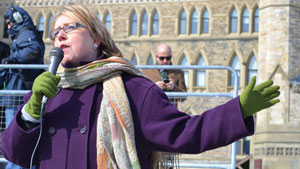
It's something every major political party promised in some form around last year's federal election. Call it what you will: reducing the rancour, halting the heckling, cutting the catcalls -- but as politicians revel in the summer barbeque circuit, we ask: Whatever happened to basic politeness?
Some say it simply never existed in the first place. Look at Britain, the forebear of our modern parliamentary system. Its House of Commons often resembles a barn of comically agitated, lowing farm animals before a thunderstorm.
If you watch media coverage of Parliament, there seems to be a decidedly mean tone to federal politics these days. Whether it's accusations of Hitler salutes directed across the aisle, MPs imitating gunfire against their opponents during the long-gun registry vote, or pointlessly one-upping fellow opposition parties, the House of Commons seems to have less in common than ever. Others insist that much of the time, politicians do, in fact, manage to work together despite their differences -- but the public only hears about the scandals, gaffes and conflicts.
"The most colourful things that attract media attention tend not to be the collaborative, consensus-building things," says John Weston, Conservative MP for West Vancouver-Sunshine Coast-Sea to Sky Country. "When those things happen, they're notorious, and they tend to provoke a large amount of outcry or discussion. The everyday cooperative gestures that occur aren't so newsworthy.
"The Lone Ranger is not made for the legislature, in my humble opinion. My parents taught me at an early age to work on the things I can be responsible for... Perhaps that will point people to follow suit. The example I have are Canadians in everyday life who are forging partnerships... Why shouldn't we be doing the same thing in the legislature?"
But the issue of cooperation in Parliament today comes into even sharper relief outside its walls, with Ontario's Etobicoke riding heading into a court-ordered byelection. In that riding, Conservative MP Ted Opitz beat the Liberal frontrunner by only 26 votes. But Green Party leader Elizabeth May's calls for New Democrats to not contest the razor-thin vote were quickly rejected. An election is an election after all, and the New Democratic Party (NDP) says it will put forward the "most progressive" candidate -- and aims to win the seat.
The finger-pointing goes every which way, with no shortage of deflections or objections. While every politician who spoke to The Tyee praised cooperation and lamented acrimony, few concrete solutions emerged.
Godwin in the house
Each political party has its own take on the matter of inter-party cooperation, and point the blame for today's polarization in different directions.
"Yes, British parliamentary systems lend themselves to this kind of heckling and such," admits Hedy Fry, Liberal MP for Vancouver Centre. "But there's heckling, and then there's really bad behaviour.
"We've gone past heckling right now. What we're seeing is a great deal of anger coming up in the House of Commons, and that actually stifles the ability for all parties to work together on things of common interest."
When asked for concrete examples, Fry immediately points to the government's Budget Implementation Bill, Bill C-38, when opposition parties forced the Conservatives into an overnight marathon voting session as they stalled its inevitable passing. As each of nearly 500 amendments were overruled -- not a single one adopted by a Conservative -- Fry claims Tories were giving each other high fives.
"It's something I'd never seen in my 19 years as an MP until now," she said. "When the government knows it's going to win anyway... there's a deep sense of outrage from the benches across from them.
"I think the NDP has created a lot of this polarization. I think they would love to see the Liberals go, as would the Conservatives, and so they target us. The working together that we used to do, up until we were official Opposition last year has actually, to be honest with you, shifted a bit. The working together doesn't happen anymore the way we used to do."
Politics in Canada, Fry laments, have become "very, very polarized." She says that no previous majority government -- not under Jean Chretien or Brian Mulroney, at least -- has behaved as today's does. Recalling the 1990s Liberal rule, Fry claims that the government offered the NDP party status and full committee participation, for instance, even though it only had nine seats. Something, she says, has been lost today.
Of course, the whole Budget Implementation Bill debate became Godwinned -- a cyber-term for online comment threads' unfortunately frequent descent into crude Hitler comparisons -- when Conservatives accused Fry herself of giving Prime Minister Stephen Harper a Nazi salute during the voting, and demanded an apology. It's something she vociferously denies.
"For me to make a Hitler salute is so ludicrous," she insisted. "Something that I would never, in a month of Sundays, do. It is really ludicrous. This is the kind of stuff that creates anger and animosity between people."
'Whole new level' of attacks: Cullen
In the neighbouring Opposition benches, the perception is equally dire. But the NDP denies it is responsible for the heckling. That honour, the party's House leader told The Tyee, rests with Conservative "bullying."
"I've never been one for taking passion out of Parliament -- we should have passionate debate -- but we should be respectful," says Nathan Cullen, NDP MP for Skeena-Bulkley Valley, and the Opposition House leader. "This government... scraped by with a 12-seat majority, and act like the Roman Empire. People are frustrated with the lack of accountability, and the lack of broad representation.
"Parliament was always partisan, but the current government has taken it to a whole new level of personal attacks. There's a mean-spiritedness that seems to wash over into the House, onto committees, and into how people work with one another."
It's become "all politics, all the time," Cullen says, admitting he'd hoped that winning its first majority might calm the Harper Tories somewhat. "I was wrong," he sighs. "The meanness of it was never seen in previous Conservative governments. Even in the worst days of the Mulroney government -- it was Conservative, but Conservative then didn't mean quite so personal and Republican in the sense of U.S.-style attacks."
One of the most egregious examples of this, Cullen said, was when Conservatives pushed through their dramatic repeal of the long gun registry last year. Holding a majority, the bill was certain to pass -- since (pun intended) the Tories had been gunning for it for years. But the vote was controversial, particularly amongst women and voters in Quebec. Canada's gun control laws were strengthened in the aftermath of the Dec. 6, 1989 École Polytechnique massacre in Montréal, when 14 women were murdered by a man who hated feminists.
According to Cullen, several Tories celebrated the bill's passing by imitating machine gun fire with their fingers pointed across the aisle to Opposition benches. Media then reported that the long-gun bill's passage was followed by a victory party.
"I'm not aware of it," Weston said, when asked about the alleged gestures. "I really can't comment.
"When you have 308 hard-working people together in a room, where there's a high level of passion -- and they're egged on by the presence of television cameras -- it's not surprising that people would do or say colourful things."
The Tyee approached House Speaker Andrew Scheer -- at 32, the Conservative MP is the youngest speaker in Canada's history -- to invite him into the conversation, but his office declined to be interviewed.
All party hostility
But while some might see rancour as natural, or at least inevitable, between smaller parties and a majority government, there's another view of the conflict -- a view from a lonely seat nestled amongst the opposition benches.
"We're running it as though it's an ongoing form of warfare, where the gladiatorial contest is the election, but the hostilities continue between elections," said Elizabeth May, MP for Saanich-Gulf Islands, and the sole Green Party representative in Ottawa. "It's really distorting and destroying democracy in Canada.
"The worst part of this I've encountered is the NDP-Liberals -- the hostilities. That's where it doesn't make any sense to me. If we can't work together..." the first-time parliamentarian paused, audibly frustrated. "Look, we should be focusing very clearly on the threat that Stephen Harper's agenda presents to Canada. I get very annoyed with my colleagues because although I like them all, I really don't think there's much point in the NDP wasting political capital attacking the Liberals."
One such "attack" was during the passage of the government budget this spring, when the NDP's Peter Julian occupied nearly the entire allotted time to respond to the legislation by reading a lengthy tome of tweets, emails and Facebook messages. He was simply, Cullen said, trying to bring the voices of Canadians to bear on the budget discussion -- it wasn't designed to slight the Liberal finance critic's ability to speak. But Liberals were outraged.
The rancour isn't just in the House of Commons either. Fry, Cullen and May say that even at the committee level, it's become almost impossible to work with the government, or even to be heard or considered. Reports are issued without taking into account dissenting witnesses' views, they claim, and even benign amendments are rejected outright. (As Cullen jokes: "No wonder it's harder to find places to still work with these guys -- even when you're working with them, they're punching you in the face!")
One rare exception is the Shannen's Dream bill, a law passed recently calling for improving Aboriginal education on reserves, where students are severely underfunded compared to other Canadian children. The bill was championed by the NDP's Charlie Angus, but received the unanimous support of all politicians.
A little respect
Amongst opposition parties, at least, not all matters are acrimonious these days. May points to inter-party talks that happened around Bill C-38, when the Liberals backed her in proposing nearly 500 amendments, stalling its passage in order to raise public awareness of the bill's contents.
"The positive message from Bill C-38 was the ability of opposition parties to cooperate in fighting (it)," May recalls. "That was just fantastic.
"By the time we finally got to vote on the amendments to Bill C-38, the NDP, Liberals, the Bloc and Greens were all working together -- it was really good. I hope we can take that message forward and find ways to work together more. Depending on the issue, quite often you can get cross-party support."
The solution, she added, is quite simple.
"When you treat people with respect, and in a non-partisan approach, you get that back from people quite often," she says.
Across the aisle, Weston believes he's had more success passing private members bills as a result of collaborating across party lines -- working with someone of different party and views, he said, offers a "wiser and more prudent other half," he laughs.
But when it comes to concrete examples, the biggest impact may come from unconventional initiatives that are quietly trying to build better rapport between MPs. Shortly after Weston's first election in 2006, he launched a non-partisan fitness training group for MPs. The politicians run or walk together every Tuesday, and swim together under a coach's guidance every Thursday.
"It directly impacts decorum in the House," he says. "Because when you're teaching an NDP member how to do a spin-turn in the swimming pool, you know that decorum is going to reflect that when other things come around.
"I work hard to work with members of all parties ... and the results have been concrete and not that surprising, I think, for most Canadians who understand the value of cooperation and do it everyday." ![[Tyee]](/design-article.thetyee.ca/ui/img/yellowblob.png)
Read more: Politics









Tyee Commenting Guidelines
Comments that violate guidelines risk being deleted, and violations may result in a temporary or permanent user ban. Maintain the spirit of good conversation to stay in the discussion.
*Please note The Tyee is not a forum for spreading misinformation about COVID-19, denying its existence or minimizing its risk to public health.
Do:
Do not: