

 SHARE:
Will a voice from beyond the grave help end Canada's long standing trade in toxic asbestos?
Anti-asbestos campaigners have issued an open letter to a Quebec cabinet minister, urging him to honor a dying woman's final wish and take a stand against any more provincial government subsidy for asbestos mining and export.
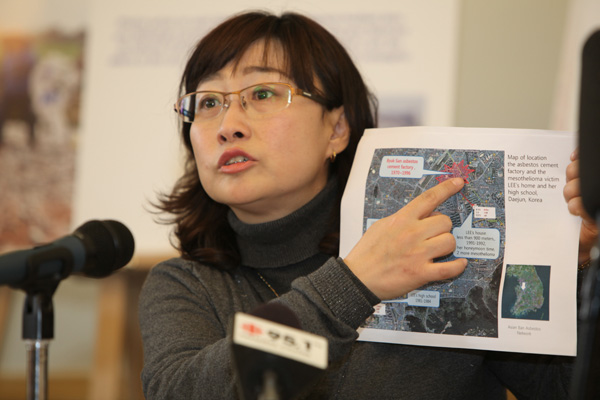
In 2010, Rachel Lee, a Korean woman dying of mesothelioma because of exposure to asbestos, was part of an international delegation to Canada, organized by A-BAN, the Asian Ban Asbestos Network. On Dec. 9 of that year, Lee met with Clément Gignac, Quebec's minister of natural resources and wildlife. Citing her own terminal condition, Lee called on Minister Gignac to promise that Quebec would not continue its policy of subsidizing asbestos production in the province. Specifically, Lee and the other members of the delegation asked the minister to commit to blocking any more provincial funding for the Jeffrey mine.
The Jeffrey mine in Asbestos, Quebec, which is currently inoperative, has been at the centre of a fierce public debate during 2011. As reported earlier in the Tyee, critics have charged that Canada, by allowing asbestos mining and export, is in part responsible for 100,000 deaths a year worldwide. Critics point out that asbestos use in Canada has almost entirely ceased because of the substance's proven toxicity, and say that if the province of Quebec provides the loan guarantees necessary for Baljit Chadha, a local entrepreneur, to re-open the mine, it will be flying in the face of calls from many medical and human rights groups, including the Canadian Medical Association and the Canadian Labour Congress, for a total ban on asbestos.
The international delegation that visited Quebec last year issued a statement that read, in part:
"We are here today representing asbestos victims, trade unions and health organizations in Asia. We are horrified by the plans of the Government of Québec to provide a $58 million loan guarantee to develop new asbestos mine. It has been predicted that if this project goes ahead, the new Jeffrey mine will produce over 5 million tonnes of asbestos in the next quarter century."
'Are our dead not enough?'
Since the delegation's visit to Quebec, the provincial government has granted the financiers behind the plan to re-open the Jeffrey mine several extensions of deadline for their efforts to raise $25 million in private investment for the mine project, and continued to indicate that if the private funding is secured, the province may provide loan guarantees of up to $58 million to subsidize the controversial mine re-opening.
Lee suffered from mesothelioma, a lung condition that only occurs in patients who have been exposed to asbestos. Lee lived close to a factory that produced cement products using chrysotile asbestos. On Dec. 21, 2011, Lee died of the mesothelioma that may well have been caused by chrysotile asbestos from Canada.
Although South Korea announced a ban on asbestos imports in 2009, before that date, nearly 60 per cent of the asbestos imported into South Korea came from Canada. The day after Lee's death, Canadian anti-asbestos campaigners addressed an open letter to Minister Gignac, reminding him of his meeting last year with the asbestos victim, informing him of her tragic death and asking him to honour her memory by blocking any provincial support for the pending request for loan guarantees for the Jeffrey mine.
"When Ms. Lee spoke at a press conference at the Quebec National Assembly last December, she could not help crying when speaking of her two children who would become orphans and her husband, who would become a widower. The tragic outcome she foresaw became reality yesterday," the activists' letter said.
"Mr. Minister, you met and you heard the appeal that Ms. Lee made to you personally that your government not fund the re-opening of the Jeffrey mine and not create more asbestos victims. She asked you the question: 'Are our dead not enough?'
"We ask you, and the new Minister of Economic Development, Sam Hamad, and Premier Charest, to restore the honour of Quebec, to honour the appeal made to you by Rachel Lee on behalf of asbestos victims around the world and not fund the Jeffrey mine. In this way, the tragedy of Rachel Lee's death, and the deaths of thousands of other asbestos victims every year, will have served some purpose," the letter concludes.
No response yet from minister
By Dec. 30, Minister Gignac had not responded to the open letter, which was signed by Dr. Fernand Turcotte, MD, Professor Emeritus, Department of Social & Preventive Medicine, Faculty of Medicine, Université Laval, Kathleen Ruff, author of Exporting Harm: How Canada markets asbestos to the Developing World; Éric Darier, Ph.D., Director of Greenpeace Québec, and Micheline Beaudry, Ph.D., retired professor of public nutrition, Université Laval. In fact, Ruff told the Tyee that Minister Gignac had not responded to a letter sent to him by the A-BAN delegation more than a year ago.
The minister did not respond to Tyee requests for comment on this story.
In a Dec. 28 email, Ruff told the Tyee that:
"At great personal self-sacrifice and in spite of herself suffering from a deadly asbestos disease (mesothelioma), Rachel Lee came to Quebec in December 2010, to bring a message on behalf of all asbestos victims around the world and appeal to the Quebec government not to finance a new asbestos mine. Minister Gignac met with Rachel Lee that month, but he did not respond to her heartfelt, personal appeal. Likewise, he did not respond to the irrefutable evidence put before him by Ms. Lee and the other members of the Asian delegation that asbestos exported by Quebec causes suffering and loss of life overseas.
"A year later, now that Rachel Lee has herself died from having been exposed to asbestos, Minister Gignac continues to maintain a heartless silence. It seems that he has neither heart, mind nor conscience and is deaf to the facts and deaf to the voices of victims."
[Tags: Health, Labour and Industry.] ![[Tyee]](/design-article.thetyee.ca/ui/img/yellowblob.png)
Read more: Health, Labour + Industry





Tyee Commenting Guidelines
Comments that violate guidelines risk being deleted, and violations may result in a temporary or permanent user ban. Maintain the spirit of good conversation to stay in the discussion.
*Please note The Tyee is not a forum for spreading misinformation about COVID-19, denying its existence or minimizing its risk to public health.
Do:
Do not: