News

A Tyee Series

'Carbon Neutral' Goal Spurs Projects

Whatever its flaws, BC's quest for carbon neutrality is getting some things done in the public sector.

By Tom Barrett, 1 Dec 2011, TheTyee.ca

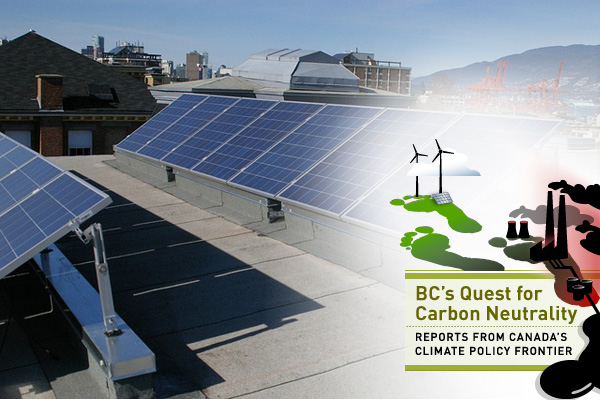
Solar panels, Admiral Seymour

Solar panels on roof of Admiral Seymour School in Vancouver. Photo by Rob from Your BC: The Tyee's Photo Pool.

[Editor's note: This is the latest in an in-depth Tyee Solutions Society series, "BC's Quest for Carbon Neutrality: Reports from Canada's Climate Policy Frontier." Find the series so far here.]

Even its staunchest supporters admit that B.C.'s strategy to make government carbon neutral has some flaws. But the scheme has also brought benefits. By forcing public sector organizations to measure their carbon, and putting a price on those releases, the program has sparked greenhouse gas reductions throughout government.

The public sector's interest in cutting emissions is reflected in the numbers. From 2008 to 2010, the government's Public Sector Energy Conservation Agreement, or PSECA, gave out $75 million for capital projects that would reduce public organizations' carbon footprints.

The program received a total of 852 applications, only 250 of which were approved and completed. While some of those applications were rejected because they didn't meet program criteria, the level of interest was obviously high.

COUNTING CARBON

$18.2 million: Total amount the B.C. public sector paid the Pacific Carbon Trust to offset 2010 emissions.

729,782: Number of tonnes of carbon offset.

1: Percentage of total B.C. emissions those offsets represent.

$75 million: Amount the Public Sector Energy Conservation Agreement gave to public sector organizations for emissions-cutting capital investments.

35,600: Number of tonnes of carbon the government estimates those improvements will prevent from being emitted annually.

$12.6 million: Energy costs the government estimates those grants will save annually.

Source: LiveSmart BC Carbon Neutral Report

Even without the subsidies, public sector organizations have been working on cutting their GHGs, in part because they don't want to pay to offset their emissions. To that extent, the carbon neutral government program has worked.

School District 27, in the Cariboo-Chilcotin, received a total of $750,000 in PSECA money. With two PSECA-funded projects and a host of other initiatives, the district figures it has eliminated almost 1,000 tonnes from its carbon footprint -- a cut of 16 per cent, said district secretary-treasurer Bonnie Roller.

She said at least three-quarters of the cuts were prompted by the carbon neutral government strategy.

Emissions-reducing projects completed or planned in School District 27 include:

• A geothermal heat pump system at Mile 108 Elementary School;

• A high efficiency boiler at Williams Lake Secondary;

• Four solar hot water systems at different schools;

• A "solar wall" to preheat ventilation air at Williams Lake Senior Secondary; and

• Biomass boiler systems at two rural schools that burn wood pellets, which are considered to be carbon neutral fuel.

"In addition, the biomass fuel will come from local sources further reducing the transportation carbon production and aiding the local forestry industry," Roller wrote in the district's environmental report.

Leaders

School districts are going to cut their emissions to some extent even without a carbon neutral government strategy, Roller said in an interview. "Being in the education system, we very much want to be leaders."

The energy projects teach students the importance of reducing emissions and how it can be done, she said. Science students, for example, will get an up-close opportunity to learn how solar hot water systems work.

Roller credits the district's former manager of facilities, Doug Gorcak, who developed an early expertise in energy-saving systems. When the PSECA money was offered, S.D. 27 was poised to "get our foot in the door," she said.

Gorcak has moved to Penticton, but the Cariboo-Chilcotin district is committed to continuing what he started, Roller said.

She said the energy efficiency projects have probably saved the district more than $200,000 over the last five years. Unfortunately, she adds, that money has been swallowed up by higher fuel costs for school buses.

Which brings up the downside of carbon neutral government from the school districts' point of view.

District 27 has written to Victoria, asking that the carbon neutral government strategy be reformed. Under the strategy, when public sector organizations are unable to reduce their actual emissions further, and need to bring their carbon balance down to zero through the purchase of offsets, they must pay $25 per tonne of emissions to the Pacific Carbon Trust. The Crown agency uses the money to pay private sector companies to reduce their emissions. District 27 thinks that money should stay in the district, to fund more energy-saving projects.

For 2010, the first year of carbon neutral government, S.D. 27 sent $85,000 to the Pacific Carbon Trust. That’s a tiny portion of the district’s total operating budget -- about 0.2 per cent. But Roller said it’s still a significant sum when dollars are too short to start with.

"When we budget, we budget out every penny," she said. "Over the last two years our unrestricted surplus has been right around the $150,000 mark. Which isn't very much when you're considering a $54 million budget."

Bigger budget, same gripe

The University of B.C. bought a lot more offsets than the Cariboo-Chilcotin school district -- more than $1.5 million worth in all. But in relation to the university's total operating budget, the amount is about the same, 0.2 per cent. And it's money UBC as well would like to see come back.

"We would love to take those offset dollars and invest them in our own projects for sure," said Nancy Knight, UBC's associate vice president, planning.

UBC began reducing its carbon footprint in the 1990s, long before the provincial government declared war on climate change. It's already met the Kyoto target of a six per cent reduction in emissions from its 1990 level.

And it has pledged to further reduce its emissions by 33 per cent below 2007 levels by 2015. That's five years ahead of the provincial government's target.

The university has won awards for its commitment to sustainability. Its ECOTrek energy retrofit project -- a six-year initiative launched in 2001 -- saves $4 million a year in energy costs and is described by UBC as the largest project of its kind in Canada.

More feasible

The university is currently working on three more "really big projects," Knight said:

• An $85 million project to convert steam heating facilities to hot water is expected to reduce greenhouse gas emissions at the Point Grey campus by 20 per cent. "You don't really need steam for heat," Knight said. "Hot water is a much better source now."

• A $27 million biomass project, to be completed next year, is expected to cut the university's natural gas consumption by 12 per cent.

• A "continuous optimization" project, in partnership with BC Hydro, will regularly monitor and reduce energy use in 72 academic buildings. "Buildings are like vehicles," said Knight. "They go out of tune." This program aims to keep the buildings in tune, resulting in an expected 10 per cent reduction in GHG levels.

While UBC's longstanding commitment to sustainability suggests that at least some of these improvements would have happened without the carbon neutral government strategy, Knight said the price the scheme puts on carbon makes them more feasible.

The steam-to-hot-water conversion project "would have been a tougher project to make the business case for without the carbon tax and the offset requirements," Knight said. "I wouldn't say that without those we wouldn't have done it. But I think they made it a heck of a lot easier for our board of governors to see it was the right thing to do."

UBC generally supports the carbon neutral government strategy, she said.

"I think there's wrinkles in the policy and the programs, as there always are when you introduce new things. We look forward to continuing to work on those with government."

So putting a price on carbon emissions can have positive effects. But when public sector organizations pay the price, does it make sense -- in terms of either policy or politics -- to give their money to the private sector?

In the next piece in this series, running Monday, we'll look at how and why this happens, and what it means.  [Tyee]

15  Comments:

Login or register to post comments

  • Granville

    25 weeks ago

    Add: Dover Bay (Nanaimo) School's solar panel

    Won by the Eco Club in a contest, saved thousands of dollars in energy bills. The kids did that with their own effort. We can save all kinds of money with conservation and innovation, but it sometimes takes children to see that we actually can do it -if we want to.

    What really gets my attenton is the advertising program that claims a car can travel 1,500 km on a tank of gas. Even if that is grossly exaggerated, my Jeep can get about 400 km per tank. That sends a very powerful message to me that I am pissing away a lot of money on my Jeep. How far can your car go on a tank of gas?

    We recycle. My daughter doesn't. Age isn't always the determinant.

  • Mark Crawford

    25 weeks ago

    Fairly Positive reviews

    Thanks Tom for a balanced piece of reporting. As a graduate of School District 27, I know that a lot of energy has been wasted during those cold (colder than the coast) winters.

    At least the energy savings have covered the increased fuel costs of the school buses. That is about all that can be expected at this stage, and in general this program seems to be successful by the standards of many public programs.

  • Luck

    25 weeks ago

    WE MUST RECYLE OR........

    AT THE HOUSEHOLD LEVEL WE NEED TO GO GREEN AND RECYCLE MORE OF OUR GARBAGE GOING TO THE DUMP SITES.

    WE ALL INDIVIDUALLY (7 BILLION PEOPLE TO DATE) MUST COME TO REALIZE THAT THE WORLD IS NOT OUR OWN PERSONAL DUMPING GROUND.

    THE OCEANS ON THE PLANET ARE A FINE EXAMPLE OF OUR JUNK COLLECTION WITH DEBRI FIELDS LARGER THAN PROVINCE OF BC AND GROWING.

    THE DEBRI FIELDS ARE DAMAGING OUR SEA LIFE WHICH HAPPENS TO BE OUR FOOD.

    IT WILL HIT HOME HARD ONCE THE DEBRI FIELD IN THE OCEAN COMES ASHORE AND DAMAGES OUR PERSONAL HUMAN HABITAT.

    WE ALL MUST AGREE THAT KEEPING OUR JUNK AT HOME AND RECYCLING LOCALLY IS THE ONLY WAY TO GO.

    YOU WILL SOON SEE THAT THERE IS BIG MONEY IN TOTAL RECYCLING OF OUR THROW AWAYS THAT CAN BE CONVERTED INTO ANOTHER USE FOREVER.

  • JosephPallant

    25 weeks ago

    Eye on the ball

    Good article, and great to see $75 million dollars of extra funding being provided to schools and other public organizations. Goodness knows they can use it.

    I believe that $75 million equates to more additional money being given to public organizations than they are having to pay out for offsets. If so, it is great to see the budgets of public service organizations such as schools actually benefiting from the governmental goal of Carbon Neutrality. Though in any one year, some school districts would benefit and others do less well, I would imagine the system can be run to equalize out benefit to all.

    As for the public/private issue, this article lays out well that there is broad action and economic engagement in the public sphere, in addition to private sector clean tech and offset generation. My take on the prototypical British Columbian and Canadian is that we see the role for public and private sector in our lives and economy. Pairing smart government (PSECA) subsidies and beneficial efficiency measures in the public sector with cost efficient emissions reductions from the private sector sure sounds like the right approach to me.

    The model works well for daily life. I reckon it's a sound path for our fight against climate change.

  • freewilly

    25 weeks ago

    how do they determine a carbon footprint?

    I thought most of these public buildings at UBC were powered by hotwater boilers and electricity we get from hydro electric power (dams) ?

    What kind of carbon foot print can that possibly leave behind? Maybe they also use natural gas to heat the boilers I get that.

    What sort of formula do they use to determine a building's carbon footprint?

  • Langley

    25 weeks ago

    It's great to recycle...

    yes it is.

    But why isn't industry required to use recycled materials? Sure we can put every aluminum can in the blue bin but why aren't Coke or Pepsi Co. required to cut down considerably on making brand new cans and bottles?

  • freebear

    25 weeks ago

    Because Coke needs to sell more

    'new' cans to grow their business.

    Will the economy ever shrink to a sustainable level of activity?

  • Granville

    25 weeks ago

    Where does Peter McKay's use of helicopters rank?

    Is that carbon neutral?

    The economy will shrink to a sustainable level, but humans are like any other species; we would rather crash and burn that change our ways.

    If we changed our energy consumption, the planbet would sustain ten billion of us. It would be less fun than life today, but we would survive. I think we will destroy ourselves fairly soon. Billions will perish, but a billion or so will be left, picking through the garbage piles for a few scraps. A bit like "The Postman" in fact, without Kevin Costner.

  • Driftwood

    25 weeks ago

    Last I heard

    Tumbler Ridge had just opened their legs to underground coal developers from China. Not only do we pollute the environment carte blanch, but they are bringing in all their own workers to work the mines. Excuse me Christie our revered leader, but what the hell do we get out of this except contributions (al la BC Rail) to the unmentionable parts of the anatomy of your party?

    They are already here, they won't hire me or my truck or anybody else in town, because they have the sense to buy their own equipment to cut their costs. They have bought a former hotel in town and use it to house all the equipment they have bought to develop their mine. What do I get out of this? Nothing. Take your globalism and blow it out your asshole! China profits while I sit home drinking beer and being pissed off. Treat them like fucking kings. The 'new saviors' and all that shit. Well, if BC had half a fucking brain (which they don't) they would see all this need for raw materials which we have as an opportunity to grow. Instead of an opportunity to work for Chinese employers. Blow it out your asshole.

  • igbymac

    24 weeks ago

    Driftwood

    One effect of globalization is to impoverish the middle class of the developed world by having it subsidize the ruling class of the developing world. It's rampant, it's world wide, it's global.

    We are not being lead by politicians, for they are just a load of 2nd rate thinkers fully gorged on the propaganda of the day, and are they banking-corporatist cartels high priests and priestesses, passing the BS along with full conviction.

    Everything the government does is for an ulterior purpose to the needs of the people of its nation. It is done through threat of force, with coercion ever present.

    But, hey, we can all still vote, right? That's bound to change things because there is no democracy quite like voting for the fascists enslaving us through financial oppression. /sarcasm

  • pwlg

    24 weeks ago

    public sector vs. private sector

    Before engaging into another system based on commodity trading (speculation) we should look at what we are trying to achieve and legislating that goal. This should not be a province or state initiative but a national or continental agreement. We should create simplicity and a system that can be effectively monitored. Shifting pollution from one site to another through trading seems to me fundamentally flawed and unethical. Replanting lands in Costa Rica with trees for atmospheric destruction in California just doesn't make sense.

    To effectively reduce sulphur dioxide from coal fired power plants scrubbers were introduced which cost the consumers of the electrical energy produced by the plant a 1% increase in their bills. This is far less of a cost to the consumer or citizen than the current carbon tax in BC.

    Is the technology to reduce carbon emissions from coal fired power plants, flared gases from well sites, etc, safe and proved to work?

    In terms of local initiatives we could find ways to reduce the emissions from cement plants in the region as well as the dairy, chicken and pig farms through legislation and in terms of the agricultural industry funding the necessary changes that will reduce their emissions. The cement mfg industry profits do not require public incentives.

  • igbymac

    24 weeks ago

    pwlg

    What we need is for a REAL government to lead the way and, at this juncture, probably through rather strict means akin to the War Measures Act. We need to turn the oil consumption off as fast as possible. We need a government that can see the connection between living within our means both economically and ecologically, and to stop funding the ongoing destruction, again economically and ecologically, with warfare spurred on by the capitalists.

    But that isn't going to happen. And the likelihood is virtually zero that we will save ourselves from this catastrophe brought on by our behavior.

    Climate change is not the issue -- it is a natural feedback. The topic may be controversial, but it is not contentious. The science is in. Our scorched earth approach is coming home to roost.

  • Driftwood2

    24 weeks ago

    See that I've been banned again

    As Driftwood, so am now addressing you as Driftwood2.
    You can get banned here for many things, but the most important one is questioning the orthodoxy. Make fun of the way things are and you're outta here. How ironic for a site which bills itself as 'alternative'. No real change here folks. Nothing to see. Move along now.
    The issue I was going to address is that we will never have democracy or prosperity until we have the right to vote the issues instead of voting the system which oppresses us. And they probably won't ban the 'new' Driftwood2 for saying that, but they will ban him for making fun of them in any way whatsoever.

  • Driftwood2

    24 weeks ago

    And if that's not the case David Beers

    I invite you to debate it openly and publicly right here.

  • Driftwood2

    24 weeks ago

    Because we all know

    That censorship is just another brick in the fascist wall. Just another way for you to relate to your old Canwest employers.

    • The discussion for this story is closed. No more comments can be added.