
Inside BC classrooms where every student has a laptop or iPad, and the learning is 'child-centred.'
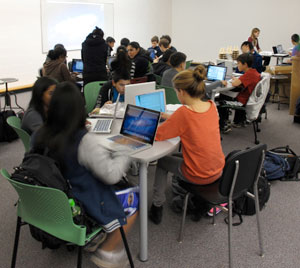
Students at John Oliver Digital Immersion Minischool work off brand new Mac laptops. Photo: Katie Hyslop.

-
A BC teacher reports from the front lines of the open source education movement.
-
A teacher learns from the best educators he can find. A Tyee Solutions-Reporting Fellowship Series.
-
Premier Campbell vows all Grade 4 students will achieve at their age level in five years. Educators disagree about where to start.
For over a year the Ministry of Education has been hinting at a change in direction for the province's education system.
It all started in mid-2010 with murmurings about "21st Century" or "child-centred" education, with little to no explanation of what that meant, leaving educators, trustees, and parents to banter about ideas on blogs, listserves, and the Twitter-verse.
Even the recent launch of B.C.'s Education Plan has few answers -- just a plan to have a plan after engaging with education stakeholders.
But some schools are way ahead of the curve. By using technology, giving students the opportunity to choose what they want to study, or even just allowing teachers to deviate from the curricula norm, these schools have already taken education to the next level and waiting for the ministry to catch up.
Rise of the machines
Librarian Moira Ekdahl is quick to correct anyone who says John Oliver Secondary School in East Vancouver has a library. It's a Learning Commons now.
Stacks and reference materials have been replaced by laptops, iPads, and interactive white boards. There are still books -- Ekdahl swears they will never disappear under her watch -- but technology is taking over.
"It's really driven by giving kids multiple ways of accessing resources and information, and the tools to shape their own learning, and also to support new ways of teaching, because I think teachers need that support as well," she told The Tyee.
While any teacher can make use of the technology, there are two particular programs that use technology as a main tool in the classroom: the Digital Immersion Minischool and the iPad Literacy Cohort.
Running from Grades 8 to 12, the Digital Immersion Minischool has been running from John Oliver since 1997, taking in students from across the district interested in expanding their online skills. Though the technology has changed, the main objective never has: teaching students how to operate in an Internet world.
When The Tyee visited the Digital Immersion 8 class in early November, students were just getting their brand new Mac laptops, a requirement for the course. Working in groups, they negotiated the definition of "social citizenship" with the aim of creating a wiki on the topic, and ultimately establishing six concrete rules for a class code of online conduct.
"I think we've always been teaching those skills. I didn't grow up with this at school, but we were still required to learn how to critically think, how to problem solve, how to articulate our thoughts, how to present," explains teacher Zhi Su.
"The way we access and interact with information is different. If you look around you, you don't see students standing by the bookshelves and accessing books, they're all on computers, and that's what they tend to gravitate towards. It's up-to-date, latest information, whereas some of these books are older than I am."
Literacy: there's an app for that
Across the Learning Commons another group of Grade 8s are using the latest in technology as part of their curriculum. The iPad Literacy Cohort is 30 students reading three to four years below grade level, each using their own iPad as a learning tool in almost all of their classes.
"I like how it engages kids in a tactile sense, and I also use it to basically give them ways to explore learning on their own," explains James Francom, who teaches the group English.
When The Tyee visited, the topic was subject-verb agreement, co-taught by Francom and iPad literacy counsellor Paula Saor. After Saor explained the concept to the students via an old-fashioned lecture -- using 21st century technology like the interactive white board and digital video presenters -- the students completed quizzes via iPads found on Francom's blog, and found YouTube videos describing the concept to present to the class.
At John Oliver's iPad Literacy Cohort, tech 'engages kids in a tactile sense... gives them ways to explore learning on their own.' Photo: Katie Hyslop.
"We spent time going through the nuts and bolts of grammar, but that's really boring, and that's where [the iPad] comes in, that will let them use their tactile senses, will let them use searches in the classroom just to kind of enhance their learning," says Francom.
"They're working, they have control of their education, they have control of their learning, and it's a lot more engaging for them."
It's not just for English, either. There are iPad apps for science, math, and social studies -- the basic essentials of a good education according to the ministry of education.
"We have a lot of different apps on just getting those basic skills down. Details and learning, separating the main idea from the supporting details is, for some students, very difficult, and so they can go in here and practice and they don't have to show to the other kids that they don't get it. It's very private," says Saor.
Don't just count on technology
David Wees doesn't like to use the term 21st century education, since the idea of child-centred learning has been around for almost a century already. But the information technology learning specialist at Stratford Hall, a private school in Vancouver, is using 21st century technology to show his students how math isn't formulas to memorize, but a process you engage in every day.
"I'm not afraid to use technology in my teaching whatsoever. So I'll use graphing programs, and simulations, and whatever tool I can find that will help my students understand. In some cases, I'll build the tool myself if I can't find anything useful out there," Wees told The Tyee in an online conversation.
Students in Grades 8 to 12 use their own laptops to tackle mathematical puzzles that Wees designs, or create videos using their webcams or the school's video cameras to explain how they understand a particular math problem.
"I've frequently found that if students have more opportunities to demonstrate their understanding, that it also gives me more insight into their reasoning," he says.
"My students spend more time doing mathematics, which I define as more of an exploration and a way of thinking than a mechanical operation."
Wees stresses that success isn't about the best technology, but the quality of the teaching. Before he taught at a private school in B.C., Wees worked at an inner city school in Brooklyn, N.Y. with little money for technology. He made do by engaging kids in the building waterslides after school, which they used the next day for mathematical modeling.
"Some of those students had never held a hammer or a saw in their hands. The experience of creating stuff with their own hands was very empowering," he says, adding that he often works with students with weak math skills.
"I've found that some [students] enjoy mathematics for the first time, and feel like mathematics is an activity they can do, rather than something they have to memorize or struggle with."
Real learning is personalized: Wejr
Kent Elementary in Agassiz isn't relying on technology to update their teaching styles: they're cashing in on the extracurricular hobbies of teachers to bring out different strengths and talents in their students.
The Choices Program allows kids to pick from a list of courses outside the curriculum, such as knitting, theatre, gardening, sports, the arts, and even Crime Scene Investigation, they take every Wednesday for six weeks each semester.
Courses available are based on the interests of the teachers and staff in the school, since everyone, from the administration to the classroom educators, gets a chance to teach.
"Part of our goal has been to develop confident learners. For students to understand that they may struggle in math, they may be a great learner in other areas. So we wanted to offer things for students to develop their passion in, and also for teachers to teach in an area that they're passionate about, too," says principal Chris Wejr.
Now in its fifth year, the program has expanded to at least one other school in the Fraser-Cascade District, and has become very popular among students and parents. Wejr says there are still some teachers who aren't convinced of the merits of teaching children how to knit or dust for fingerprints, but he's pleased with the program.
"A key part of the 21st century education learning is personalizing it and for me, in order for us to actually have real learning, it's got to be personalized: it's got to be meaningful, it's got to be relevant, and it's got to be autonomous," he says.
"This is a perfect example of where kids have the autonomy to choose an area of their interest in which they can learn and explore their passions. This helps students to develop in a way that they understand that they can be a learner."
Government hand-me-downs
The overhead costs for the Choices program are minimal, with supplies often coming from within the school or through funding from the local parent advisory council.
But the students at John Oliver are not so lucky. Unlike previous years where Digital Immersion students would lease the laptops from the school, kids were expected to buy them this year at a heavily subsidized price of $1,000.
"We tried to supplement it through the fundraising initiatives that they put forward. So although they put $1,000 forward for it, it usually comes out paying about $600 for it by the time all the fundraising comes round and we give it back to the kids," explains principal Gino Bondi.
The iPad Literacy class got their technology at a steal through a two-for-one deal from Apple, paying $250 per device, and the transformation from a library into a Learning Commons was made possible by donations from John Oliver alumni, money from Parent Advisory Council casino nights, vending machine money, and GST rebates, all at a cost of about $115,000.
Although Stratford Hall is a private school, Wees says some parents struggle to afford laptops for their children. If kids can't get secondhand computers or hand-me-downs from older siblings, Wees says the school will quietly purchase a computer for the student. Not that Stratford's technology budget has much wiggle room -- most of their funds go towards upgrading the technology they already have.
None of these schools have received funding from the Ministry of Education for their initiatives.
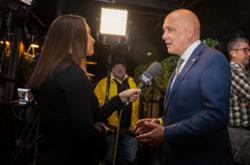
At the opening of Revelstroke Secondary School last week, a reporter asked Minister George Abbott how poorer districts would be able to afford the technology required to update the education system. Abbott pointed to the non-profit Computers For Schools, an Industry Canada program that refurbishes old computers to sell to schools for a fraction of the original costs.
"There is an approximate three year refresh for major corporations, for the federal government, the provincial government -- we're all now on three-year refreshes to keep our technology current. What Computers For Schools will do is take our old technology, whether it's iPads, smart phones, computers, desktops, all of this stuff, they will refurbish them, and they will sell it at nearly no cost at all to schools," he replied.
Whatever the plan for the future of B.C.'s education system, districts not pleased with second-hand technology from government and corporations will need to foster creativity not only in their students, but in their school trustees who will be forced to think outside the box to find the funds to supply schools with the tools students need to be prepared for the 21st century workforce. ![[Tyee]](http://thetyee.cachefly.net/ui/img/ico_fishie.png)
Katie Hyslop reports on education for the Tyee Solutions Society, and is a freelance reporter for a number of other outlets including The Tyee.
34
Login or register to post comments
Dan the socialist
1 year ago
Yet many can not even spell
Yet many can not even spell due to spell checkers. Most come out of school 'dumbed down' with no critical thinking skills and everyone passes as failing kids hurts their feelings even if they should be held back..
tierra y libertad
1 year ago
Two-Tier Here We Come!
The most telling sentence in the entire article?
"None of these schools have received funding from the Ministry of Education for their initiatives."
Without support how the hell does anybody think this educational shift will happen?
More empty platitudes from an out of touch government.
What about the kid whose parents cannot afford the lap-top? "Go sit in the corner and scribble with some crayons while we learn?"
I like the line about the school "that quietly pays for the computer" if the parents are poor. Why stay "quiet" about the fact that there are probably LOTS of BC families that can't afford a lap-top.
Unless something is done by government to give EQUAL ACCESS to all, this is just another BC Liberal scam to offload responsibilities away from government and onto the "customer". More and more the privileged will be "educated" and the majority will be "trained".
Fiat lux
1 year ago
So, what will those kids do,
So, what will those kids do, when there are no buttons to push to tell them the answer to 2+2=?
What can they do, what do they learn, apart from pushing buttons?
Ed Deak.
David Wees
1 year ago
Fiat Lux
That's a reductio ad absurdum argument. You've assumed we don't teach a skill because we didn't specifically mention it. If you are going to insult the work of hard-working educators, try and stay clear of logical fallacies in your arguments.
David Wees
1 year ago
Spell checkers and spelling
"Yet many can not even spell due to spell checkers."
Dan, do you have proof that spell-checkers make it harder for people to learn how to spell? I think some people have ALWAYS struggled to learn how to spell, but the advantage with spell-checkers is that those people get more words spelt correctly, and get more immediate feedback while using a word processor on their spelling.
freebear
1 year ago
Most come out of school 'dumbed down' with no critical thinking
The creation of a perfect consumer and voter!
freebear
1 year ago
Most come out of school 'dumbed down' with no critical thinking
The creation of a perfect consumer and voter!
freewilly
1 year ago
extinction of cursive writing
I understand that cursive writing is no longer taught in school. That is ashame. I read an article about writing, thoughts and ideas are formed differently when someone uses a cursive style. In fact people can write much faster than they type. The brain operates on a different level when hand writing is used
A world where the hand written font has gone extinct seems kind of sad. We'll need specialists to decipher old manuscripts and books. Its like throwing away a language.
Heck I guess they don't teach shorthand or latin anymore either.
Even when I was going through high school in the 70s there was an obsession with getting more computers and learning machines in the school. I remember this ghastly french lab where the teacher would sit at a control panel and the students would listen to french lessons with headphones. I failed.
toquer
1 year ago
Digital lipstick on a tired pig
First off, to those dinosaur cries lamenting the emergence of spell-check, calculators, and typing: carving on stone tablets was very tactile, and involves a different part of the brain too. So what? I can't work a slide rule on account of being born in the age of the calculator. Doubtless the slide-rule receptors in my brain lay dormant. So what?
My kid goes to a school recently converted the the '21st century' approach. While the theory is promising, in practice it has simply become the same old tired cirriculum delivered in flashy ways. The elephant in the room in this regard is teachers: in my experience, most older teachers don't have the chops to teach this new style. Same old banality, but delivered wirelessly.
A child can only be supported in what they want to learn if the teacher can stay ahead of them: I've seen far too many teachers who know less than their students when the cirriculum veers outside the box.
macsasquatch
1 year ago
Transparent technologies...
Way, way,(way) back in my century we had a technology in the classroom called the pencil sharpener. We needed the pencil sharpened, we stood up, walked over, sharpened it (while wondering whether or not working on conjugating these berbs would help us in "real life"), then return to the desk - without bugging Clarence - and slip right back into out work. That technology, the pencil sharpener, was transparent. We used it without thinking about it too much. Any technology, using the dictiionary as a matter of course, using the index in the text book, had to be learned step by step at first. Watch a student who knows the way around tools in a wood shop, and you will see a student to whom many of the technologies there are transparent.But, like most other of our uses of the things we make, our technologies become transparent.
Of course, like Marshall McLuhan on electronic technology, we are interested on whether or not there is an adverse long term effect in a technology.
But, usually, we are able to learn how the things can work for us, and use them for our jobs, or, in this case, our education.
And teachers, with the students, given the chance, will work out how to use whatever comes along.
Sometimes, though, technologies change, and can change quickly. If a school buys a fancy set of beta video machines, they might actually be taking their students down a very quiet street. Over the years I saw a few storage areas filled with technologies that were fairly expensive when bought, but were used hardly at all.
verity
1 year ago
Yet Silicon Valley execs send their children to non-tech schools
I find it interesting that this NY Times articles describes the CEO of a high-tech Silicon Valley firm sending his children to a school that does not use any technology in the class at all. http://www.nytimes.com/2011/10/23/technology/at-waldorf-school-in-silicon-valley-technology-can-wait.html?pagewanted=all
And as for what happens when you don't use certain areas of your brain, they atrophy. http://www.bbc.co.uk/news/technology-11263559
And you are absolutely right toquer, some teachers will not want to incorporate new technologies into their classrooms, but that doesn't mean they are bad teachers. It seems to be a case of the cart before the horse. I have no idea how we are going to afford $1000 laptops for every child that have to be replaced every 3 years, which is pretty typical for computers. Refurbished old computers are not going to cut it - they won't be able to run any new software at sufficient speeds, and having technology get in the way of learning (such as waiting for a program to load or process) is not going to enable students at all. I guess we will just have to cut out some of those useless employees, maybe we can cram a few more special needs students in every class and have one teaching assistant bouncing from room to room. Or maybe just get rid of the teachers and send all those kids home to learn with their home computers...I'm sure that would work...
freebear
1 year ago
And yet with no electricity........
Useless! A hard copy book, paper and pencil-no electricity to make use of it!
freewilly
1 year ago
toquer
"First off, to those dinosaur cries lamenting the emergence of spell-check, calculators, and typing: carving on stone tablets was very tactile, and involves a different part of the brain too. "
funny!
Dont get me wrong here, Im techno junkie. When I purchased my first personal computer I had to learn to code before I could get the damn thing to do anything. Usually draw pretty circles and random squares or a try to write a pong game
"I can't work a slide rule on account of being born in the age of the calculator."
Nothing wrong learning to use a slide rule an abacus or studying turing machines, to learn some powerful math concepts
Im particularily fascinated with languages, especially computer languages. I dont know how much exposure kids get to scripting in school, not enough from what I can tell. The reason I say this is because I used to work with young people (16- mid twenties) at a technical support call center. Some were quite brilliant but most couldn't understand the most basic html.
I figure computers serve teachers more than students, in that they can mark exams quickly and also cut down on the expense of books. They also complicate things, the more parts (ie fancy learning aids) you have, the more likely something will break down.
I'll say one thing about kids, is that they are much better multi-taskers than us old farts. Seriously good at handling several problems at once, as far a focus, I dont know.
gsarahs
1 year ago
Laptops at... "heavily subsidized price of $1,000"?!!
No wonder if you are going to insist on using Macs! This article and the programs described comes across as pushing Apple products at the exclusion of other makes, despite the high prices.
The article mentions "six concrete rules for a class code of online conduct". We too had all our students sign a computer use agreement at our school, but that didn't mean that many teens don't feel entitled to do whatever they want to whenever they think that they can get away with it. Our district network slowed to a crawl due to the number of students using Facebook, along with YouTube to a certain extent, when their use in courses was almost non-existent at the time. Educators need to watch out that what they are doing is relevant and not just the "flavor de jour", as it will often be seen as just gimicky by students. The computer and electronics infractions invariably had nothing to do with education, but were gaming, texting, YouTubing, Facebooking, Tweeting and of course inappropriate use of cellphones.
I built up an animation and multimedia program from scratch along with drafting and design, over a 15 year period. The result was a good number of my students going onto related field careers over the years. Even though we had up-to-date hardware, software and curriculum, there were still a few students who felt like doing whatever they wanted to when my back was turned. Anyone who thinks that this isn't happening is deluding themselves!
cw
1 year ago
Why not check out the world's #1 rated education system?
Finland's education is considered by those who undertake such considerations to be the world's best.
Teachers are trained to and paid at the same level as doctors and lawyers. They are continuously monitored and mentored throughout their career. Only one in ten applicants for teacher training are accepted.
Students enter the education system at age 7. Their days are shorter. Their homework often consists of watching the videos and searching for information that here take up class time.
There is no standardised testing, and there are no hard-ruled curricula.
Technology is used not as a substitute for teaching but as a tool for assisting the process of teaching. It's not whether you use technology but HOW you use this tool(set) to aid in developing progress in learning.
This system is rated above all others in outcomes. And it's ignored by most of the rest of the world.
"Whassup wid' dat?"
P.S. To the Tyee - Captcha for Preview, and then again for posting?!
Christophe
1 year ago
Never mind the technology; start with the bus drivers
Today in Nanaimo, the bus driver would not even drive into Bowen Park with his kids. No reason, except that he is a union member and he can do whatever he wants. They had to walk, even though there was a brand-new turnarond waiting for the first bus. Are all district bus drivers a$$holes?
All I see with computers in the classroom is fewer real teachers. On one hand, computers might actually teach kids to spell correctly, with spell-checker. On the other hand, I can see some small towns with the teacher in the next city, 50 miles away. Who would need a teacher in Tumbler Ridge when Chetwynd is so close, electronically?
I can also see a computer programmed to give the kids a switch over the backside if they misbehave. Ditto the bus drivers.
KHyslop
1 year ago
@gsarahs
On the point about Macs: the school also has a bank of PC laptops for students to use, Apple products just happen to be used for those two classes.
As for kids goofing off, that was addressed, too, but didn't make the cut because I was trying to keep my word count down. But kids--myself included--have always goofed off, whether it was passing notes, talking, doodling, or even just daydreaming. Technology isn't going to fix that, but I don't think it's going to make it worse, either. Thanks for your comment!
OwlRol
1 year ago
Media Literacy is much more
Media Literacy is much more important than learning to use new technology. Should be introduced along with the 3Rs in elementary school. Just because Wikipedia says it doesn't mean its true.
Likewise mental math & estimation. Never forget a gr. 12 student who asked to get a calculator to multiply 18 x 2 and then 36 + 9. Or the girl at the store till who handed back a quarter from a $5 bill for a $4.38 item. "That's what the machine said." Garbage in, garbage out.
Stopped in a 30 computer school lab at lunch. 29 kids on line gaming or in chat rooms, 1 kid actually doing research.
Student centred learning and choice cannot co-exist with an overwhelming number of mandated (non voluntary) "Prescribed Learning Outcomes" for each course, especially senior, provincially examinable courses. (That's why many teachers don't want to teach those courses.)
Don't talk about multitasking, some are better at it than others but nobody is good at it, especially with electronics. That's why cell phones and texting while driving is illegal.
Ever try to have a significant conversation with someone while their eyes are glazed over looking at a screen?
Old refurbished computers when your buddy has the latest iPad or Android phone, ha, ha. Maybe I'd be a bully and steal it.
I agree with gsarahs, just more opportunities to go off task.
Katie H., recent research shows that those important "aha" moments, for science, literary, philosophical or personal problem solving mostly happen when one is, what you call "daydreaming", but has been renamed "mind wandering". Frequent focus on electronic communication has similar effects to sleep deprivation. Put the 2 together and we turn our kids into zombies.
"Yes master, I won't question, can't even think of any." Perhaps that's a stretch for many, but I've seen it all too often.
And addiction. "I couldn't live without my cell phone" is too often repeated. Bad enough cars.
KHyslop
1 year ago
@OwlRowl
Not against daydreaming. Still do it all the time.
raging senior
1 year ago
I think we are missing the point?
Computors are in our world as long as we have electric power and fully charged batteries. Years ago everyone wanted their kids to be Doctors and Profesors, everyone should go to university. Well not everyone was cut out to be an academic, some were destined to be Tradesmen and some will be Labours. We need all of these diverse people and our world would not be the same without them. The 21st education can function for all the afore mentioned, we just have to come to grips with the fact that we do not all fit into the square holes some of us are round and rectangular. I have watched the education system for over 60 years and the tools are different but the system is the same - someone has to teach!!!
freewilly
1 year ago
reading the manual gsarahs
"Educators need to watch out that what they are doing is relevant and not just the "flavor de jour", as it will often be seen as just gimicky by students."
So true, last year our school district thought they would save money by using an opensource operating system Ubuntu. A noble ideological and money saving measure that ended up going horribly wrong. It might have worked had they enough staff educated on the linux platform. Maybe if they had sent everyone back for a night school course or just hire a nut like myself to figure it out, and teach it back to them. in fact such job positions exist these days
If I had the money I would buy a Mac myself but they are just too much money. My 'man cave' is a museum and tribute to the mac, to a time when a mac actually did much more than the PC, but that has all changed.
Steve Jobs was one of the greatest marketeers of our time. Selling computers at inflated prices. I remember taking night-school courses decades ago when all the schools and university labs used Mac pluses, mac 840av's, centrises, even some Next computers (which were around 33,000 dollars)
all wonderful, ahead of their time, but way too much money.
I wish I had drafting software when I was in highschool. I failed drafting because I wasn't neat enough. My drawings had too many smudges and I wasnt using the right sort of pencil. Even when i studied graphic design later in life, i got into the same trouble, a dirty designer. Everything was pasting stuff neatly together, not my thing. SO I went into sculpture, perfect for my temperament. I would have been in heaven with the tools we have today.
Software is funny, especially design and drafting software. there is always an underlying metaphor, if you are a draftsperson the terminology in the program needs to apply, if you are in the movie industry, a different metaphor and lingo applies, even though the software can create the same 3d graphics.
Say for instance you were to teach someone how to use Maya properly. You would learn all the terms used in the film industry, have a firm grasp of the terms used in physics and some of the math, you would know how to create a building or landscape of any sort, with a few lines of code. Can you teach this shit to a 13 year old, why not. Will they want to learn? Sure as long as the metaphor is of interest to them.
luis
1 year ago
http://Utubersity.com
Computers are only assistants and a good teacher’s will always be needed.
However social networks such as facebook and YouTube as well as great resources including Wikipedia and Wolfram-Alpha are here to stay so that educators must use them in the teaching process.
Many academics are posting great educational videos and materials online.
The only problem is to sort the good ones from the rest and present them in an organized manner.
Online Self-learning is becoming fast the perfect choice of learning, especially with so many great educational videos available for free. The only problem is to sort the good ones from the rest and present them in an organized manner.
This effort is being done by: http://Utubersity.com which presents the best educational videos available on YouTube in an organized, easy to find way to watch and learn.
They are classified and tagged in a way that enables people to find these materials more easily and efficiently and not waste time browsing through pages of irrelevant search results.
The website also enhances the experience using other means such as recommending related videos, Wikipedia content and so on. There's also a Spanish version called http://utubersidad.com
This is a project that YouTube should embrace itself, with curated content from academics and maybe using a different URL (Youtubersity?) so it won’t be blocked by schools.
BurnabyTeacher
1 year ago
A growing gap
I teach kids who come to school with no breakfast, no lunch and no pencils. I buy pencils out of my pocket for these kids, but not computers. The resources are not equally distributed and the rich get richer. Our school has great resources for mainstream classes, but Learning Disability + Poverty = Marginalization. There's a ton of great resources to help, but we don't have access to them because upper middle class parents want their kids ready for the jobs of the future, while poor kids are going back to the coal mines like they did in the 19th century.
Christophe
1 year ago
I hear ya, Burnaby Teacher
Here in Nanaimo the resources are unevenly distributed too. My contention is that all schools should be as good as the best, rather than vice versa. But I am an idealist.
Wake Up
1 year ago
David Wees is a little touchy...
"If you are going to insult the work of hard-working educators..."
Fiat Lux did not directly insult anyone. The comment is a general one which we oft hear, and which is rhetorical. Call it hyperbole if you will; but I believe it was meant to question and worry about a possibility that our kids will not learn the value of learning outside of fancy devices.
I think he has a point. I also think that it sounds like you do a great job in your work and your students are very lucky.
However, the simple act of thinking through a problem, unaided by "buttons" and I would add movement and colour, is not as prevalent as it was when I began teaching 20 years ago. It has upped the ante of education to the requirement of having "fun". I'm all for having fun, but fun based on knowledge and understanding doesn't necessarily happen every day. Nor should it.
Wake Up
1 year ago
BurnabyTeacher is right. All
BurnabyTeacher is right. All kids need to feel confident with technology, or they will always feel behind and not as good as others. However, what they also need to know is the secret not often told.
Young people can actually go far and achieve great things WITHOUT technology. Doing well on "tests" and basically learning, means immersing oneself in knowledge, and becoming passionate and creative about a topic or career involves more of same - volunteering, reading, being active. Research can be done on the internet at the learning commons.
A lot of money and talk is being spent on how technology is going to personalize education; now that is reductio ad absurdum if you ask me.
When a computer breaks down in my district, it takes days to have it fixed. If software is needed to be installed, it takes weeks. New computer system? What's that? Microsoft word update - huh?
Powerpoint presents information in a fantastic way and to display it on the wall is super too. The thinking that goes into that ppt still must occur, and lots of time just ends up going into appearance not argument/good references/connections.
etc. etc.
And by the way, I work with technology and promote it heavily and understand it. And kids love to use it. But it has its limits. And people who provide critical arguments should not be ignored; perhaps the techpushers could tone down their rhetoric and take off their rose coloured glasses.
I believe that if there is to be a true shift in education it is not going to happen with $$ being poured into the technology business.
gnam
1 year ago
A bank of PC's?
I'm not exactly convinced that you quite 'get' the significance of what gsarahs is drawing our attention to, albeit in his/her own roundabout and fuzzy sort of a way.
The issues that arise with heavy support of MAC products in public schools, in addition to the prohibitive costs associated with that brand of machine (for both students and the public at large), are numerous and, apparently, poorly understood by those you suggest are "way ahead of the curve." Or, at any rate, no one you interview seems to have much to say on the matter, though I suppose the idea of a 'learning commons' implies some movement in this direction.
Moreover, the casually dismissive manner in which you reply to gsarahs' post suggests that you don't really think that at least some reporting might be worthwhile on what corporately owned proprietary hardware/software is making its way into our public school curricula under the rubric of the '21st century learning' cheer touted by a government with a clear privatization agenda. Also, your response to gsarahs seems to suggest that some superficial modicum of "consumer choice" suffices to clear up any concerns that arise with brand dominance making its way into the BC curriculum. And, by the tone of your comment (admittedly I've got little to go on here, but your article doesn't really even begin to address this stuff) you appear to think that having 'a bank of PC's' in schools clears up the concerns that might arise around just what can and cannot be taught with respect to 'technological literacy' given the inherent limitations of one OS or piece of software over another. To be clear, I am not making a blanket statement suggesting that no proprietary equipment should be used in public education, but I would be prepared to argue that when possible we should make some effort to use publicly owned and accessible material in our public system. Such options exist in the world of technology.
A model that had a real interest in making technology relevant to a public and equitable education for our children, would, I think, attempt to do more than simply administer quizzes via the internet. This latter approach, it seems to me, is just a historically blinkered educational version of Mary Poppins' sugar with medicine bribery - an interim fix available to tekkie teachers (and good for them, but hardly a (r)evolution in education). A model that was really ahead of the curve might try to integrate traditional elements of the curriculum into the technology, but this seems a much less pressing educational concern than trying to help students to understand the ways that our technologies shape society and psychology... encouraging a private, traditionally hierarchical, and proprietary disposition toward learning and technology; or alternatively, encouraging an open, transparent, collaborative approach to education and technology... and moreover, to social, political, and family life.
OwlRol
1 year ago
Yup, many kids need healthy
Yup, many kids need healthy eats more than electronics. And West Vancouver has much prettier labs, with all the bells and whistles, than a school lab on the downtown east side.
As to international students, they don't want to pay to go to the latter. As an example, appearance is everything among many Chinese, they partly learned that from us. (Not a racist comment. I have numerous Chinese mainland friends and acquaintances who surely agree, just check out the Shanghai uber culture.)
Computers also made the teachers' life more difficult in some ways, as they replaced dept. secretaries and such. Much less time to be creative with lesson plans when all that administrivia was downloaded onto them, besides the usual report cards and other such duties.
YouTube is great for research videos, everything from comparing juicers to space ladders to environmental mitigations. And luis is correct about separating the good from the trash.
But this is why that part of Media Literacy, dealing with electromic communication, starting early on, is essential. By the time they are teens, many students turn off parental and teacher wisdoms.
And "online self-learning" works well with a number of curious and motivated adults who find the time to do it, but less so with tweens and teens. Consider the kids who know all the hockey stats but few of the basics. Have to focus on many things, not just what most interests you.
cw, if only. The Finns do it right, but we're stuck in that conservative, originally Prussian, compulsory system, much like military conscription. As raging senior points out, we're still doing the business model, trying to pump out widget clones as quickly and cheaply as possible.
What turns so many kids off, usually sometime between Grades 3 and 10?
Highly motivated educators are part of the solution, but they are so dumped on that many count the days and years to retirement.
The educational system needs a complete overhaul before we can get a real, student centred, self motivated, excellent and cherished system.
As in another article today, too many managers, many who have never been in the classroom.
Katie's article above highlights some of the possibilities and starts, but these are few and far between. The reality is still a long way off.
Fii
1 year ago
I tutor a 19-yr old UBC
I tutor a 19-yr old UBC student (not an easy school to get into, no??) and she is currently working on a research project for one of her classes. I help her sort through the research and organize her ideas. She needed academic resources and we were looking online but most of the ones from journals and such were locked or you had to pay for them. So I suggested she jot down some titles (after reading the abstracts to see if they fit with her topic) and then go to the UBC library and look for them... or um, just do some research in the library WITHOUT first looking online- imagine! She then turned to me and said "Good idea- when can you meet me on campus this week to do that??"...???!!
I was dumbfounded. Was she joking?? Being computer savvy is great and all but when a 19-yr old can't figure out how to go to a good ol' fashioned library and look up a few books on her own... WOW.
jazzman
1 year ago
What do we need?
We need more students able to access internet connected devices in their own classrooms so 21st century critical thinking (internet search) and 21st century creativity (projects that integrate user created audio, video, images, writing) can be integrated into learning on a regular basis. This technology integration takes place right across the curriculum. At the same time the value of not using computers on a regular basis is recognized for K-2, the Arts, PE and some tech ed. We need a balance. At the moment most of the province is out of balance with pitifully poor access to digital technology in clasrooms. Personally, I want my own children to have dedicated teachers monitoring and helping them learn that search on the internet is really an exercise in creativity and that computers are amazing tools for creativity and collaboration.
jazzman
1 year ago
oops
correction on the last sentence of my last post -
...search on the internet is really an exercise in CRITICAL THINKING and that computers are amazing tools for creativity and collaboration.
verity
1 year ago
Fii & UBC Library
Fii if your student is going to UBC she has access to a high number of scholarly journals right from her computer at home or on campus - she doesn't have to waste her time sifting through free online resources on the Internet. She just needs to log in her CWL account to download all those scholarly articles she needs, without paying for them (it's part of her fees). http://www.library.ubc.ca/welcome.html
If she's confused about how to search the library catalogue, she can go to the "Get Help" page http://help.library.ubc.ca/ or contact a librarian via phone, email, chat service or even make a appointment for an in-depth consultation on her research topic.
There is also a Learning Commons at UBC as well as many reference librarians to help her. She just has to walk up to the reference desk, or ask at the Learning Commons. The UBC Library does have "good ol fashioned" books too, but it also has kept up with the move to digital information, like most libraries.
And for those of you not going to a college or university, the public library has free online resources too. I never cease to be amazed by how many people that pay for items on the Internet when they can just log in with their library card and get it for free...
VivianLea Doubt
1 year ago
thanks, verity...
There are, of course, millions (maybe billions) of scholarly articles available online, many more than I had access to as an undergraduate in the 80s. And that is part of the wonder and magic of online education: it doesn't have to be limited by available space, dollars, or gatekeepers...
Excellent teachers/tutors will always be needed, but the most effective thing they do is to instill a love of learning. Daydreaming and having fun are a huge part of this...and tools are just tools, whether a pencil or a computer. After all, most of us use both.
I personally don't see how we can inculcate a love of learning in those who are hungry, though, and we know there are many of them. The psysiology of hunger is not only pressing, but for young students it will also affect their ability to learn throughout their school career. First things first, hey? Breakfast before Macs.
Fii
1 year ago
Thanks for that info, Verity!
Thanks for that info, Verity! I will definitely pass it along...