


 SHARE:
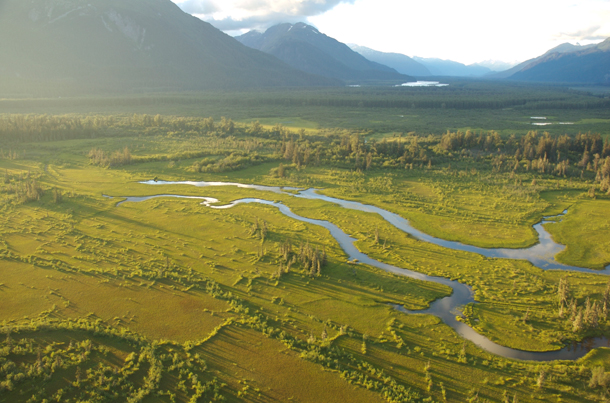
There's a sucking sound coming from B.C.'s northwest corner, barely audible now, but sure to crescendo as the electrical grid is extended beyond the city of Terrace into a vast copper and gold rich hinterland after 2013.
The source is the Alaska-B.C. intertie -- a scheme planned and feverishly promoted yesterday in Juneau, Alaska -- that would connect the Alaska Panhandle to the North American power grid through northern British Columbia. (See a map here and the sidebar to this story).
Positioned by Canadian and U.S. federal governments as a green infrastructure project to combat climate change, this Alaska-driven plan is paving the way for a new resource haul road through the Iskut River valley to Alaska tidewater.
Related Document
Activists and at least four northern B.C. mayors have warned that Bradfield Road will one day provide a closer and more economical route to funnel B.C. minerals and timber through U.S. ports, shifting the axis of trade away from Stewart, Kitimat and Prince Rupert.
Nathan Cullen heard all about the Bradfield Road during his first year as the federal MP for Skeena-Bulkley Valley in 2004. "Some Alaskans approached me and said, 'Here's the project, and we'll put this road in for free, and we'll ship all your goods as a nice courtesy,'" he says. "If anybody offers you anything for free, especially from Alaska, you should be worried. The idea of cutting off Canadian ports from being involved in the resource sector is not on, and we'll resist it."
But the Northwest Transmission Line (NTL), (see map here) when fully built out, will extend the North American grid to within 35 miles of the Alaska-B.C. border. Once the grid connection to Alaska is established, says Chris Zimmer, a Juneau Alaska-based campaign director for Rivers Without Borders, a resource haul road to Alaska is next.
"The grid intertie is going to need a right-of-way and access roads, so the next step is formalizing that road into a resource haul road," says Zimmer. "The Bradfield Road is an Alaskan road designed to drain future resources out of B.C. at a frantic and unsustainable rate."
Alaska-BC grid connection moving forward
The B.C. right-of-way for the future Alaska grid connection is already being explored. In Nov. 2010, the BC provincial government issued an "investigative use permit" to North Coast Power Corporation to explore about 25,000 hectares of Crown land -- a long narrow strip of land extending from the future B.C. grid terminus to the Alaska border (see map. The expressed purpose of the permit was "investigating the feasibility of a utility line intertie between B.C. and Alaska."
The goal of this intertie, says the Alaska Energy Authority is to "provide the energy needed for economic development in southeast Alaska resulting in jobs for Alaskans and providing reliable, less costly alternatives to diesel generated electricity for Alaskan communities."
Canada's federal government strongly supports the grid connection: the opening sentence of Stephen Harper's Sept. 2009 press release announcing a $130 million contribution to the NTL referred to the intertie. As part of the Canada/U.S. Clean Energy Dialogue initiated at the same time, Canada touted the NTL as "...a key step in a potential interconnection between southeast Alaska and the North American transmission grid via British Columbia."
(Infrastructure Canada and Natural Resources Canada would not comment on any specifics about the intertie or Bradfield Road.)
The position of the B.C. government on the intertie and road remains ambiguous. Former Alaska governor Frank Murkowski has met with Premier Campbell to discuss the project. BC Hydro, which completed a study on the intertie in 2006 (they estimated it would cost between $30 million and $120 million to build the B.C. section alone) met with Alaska intertie lobbyists early last year.
"BC Hydro does not have a position on the B.C.-Alaska intertie," BC Hydro director of economic development Chris Heminsley told The Tyee. "However, if this project was to ever move forward, there could be benefits, particularly around coordination of generation."
Wrangell's century-long dream
The loudest support for the Alaska-B.C. grid connection has come from the City and Borough of Wrangell, which encompasses about 2,500 square miles of the central Panhandle to the Canadian border, including the future right-of-way for the project.
The town of Wrangell, located at the north-western tip of Wrangell Island, is also the headquarters of the Alaska-Canada Energy Coalition (ACE), a cross-border lobby group tasked with building political support for the Alaska-B.C. intertie.
"It's been a dream for years to make that connection to the North American grid," says Paul Southland, ACE spokesman and 2008 Wrangell candidate for mayor.
Southland says the Alaska-B.C. intertie will bring badly-needed jobs to an area devastated by downturns in forestry and fishing: beyond building the power line, there will be construction work on myriad small power projects, including Cascade Creek hydro, which he says has permitting in place to develop three run-of-river hydro projects (70 megawatts total capacity) near Petersberg.
The capacity of the Alaska-B.C. intertie to export Alaska power will be small, he says: fully built out, the intertie will only be able to carry the 70 MW generated by the above three projects. (By comparison, B.C.'s nearby Forrest Kerr hydro project will have a 200 MW capacity.)
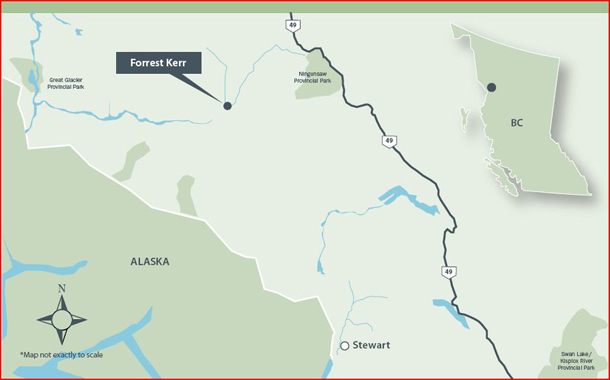
Is a resource haul road following the transmission line right-of-way also part of this vision of economic development? "In the past that's always been a goal, or at least a construction trail would be the cheapest way to build a power line," says Southland. "But our goal is that power line, and if there's any other economic development prospects, then that's up to others to drive that."
Resource road as the endgame
Chris Zimmer says Alaskans continue to downplay the Bradfield Road while promoting an Alaska-B.C. grid connection; and while current discussion focuses on the mutual green benefits of a small-capacity power line, an Alaska-legislated right-of-way for a haul road has existed for years.
A 2005 agreement between the US Forest Service and the Alaska Department of Transportation and Public Facilities (referenced on page 52 of Wrangell's 2010 Comprehensive Plan) granted the necessary "reciprocal rights-of-way and easements" for a road along the Bradfield route to be enacted into law. Alaska's Department of Transportation "now has a corridor to enable to the Bradfield Road and utility corridor among other corridors in Southeast Alaska"
Wrangell's 2010 Comprehensive Plan, written to guide Wrangell area growth over the next 20 years, anticipates the Bradfield Road, "coupled with a deep water port on the Bradfield... would be the closest transhipment point for mines at the Galore Creek, Red Chris or Mount Klappan Coal deposits." (These three are BC's most advanced north-west mines.)
The 2010 Plan calls for the following action item on the Bradfield/Iskut Road: "Promote development of a lower cost, 'pioneering' or 'first stage' road limited to commercial/industrial use."
Town with most to lose
For nearly a decade, Iskut, B.C.'s James Bourquin has been sounding the alarm about the Bradfield Canal Road. A wilderness river guide and environmental researcher based in the heart of the Stikine country, Bourquin formed the Protect Our Ports Committee in July 2002, and within about two years, had received resolutions and motions of support from four local governments and more than 500 signatures on a petition.
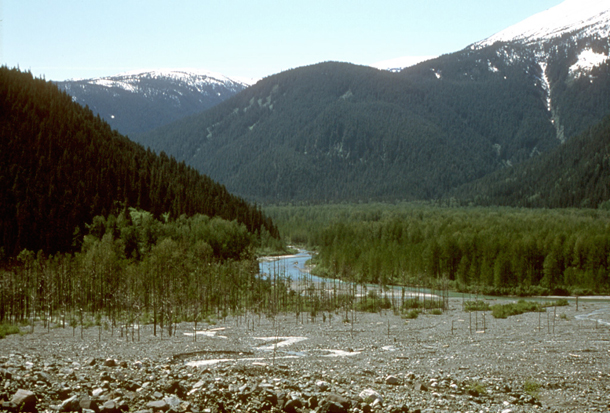
While this effort was being mounted, BC Liberal MLA Dennis MacKay spoke at a Jan. 2004 Juneau conference, assuring Alaska politicians of his support for the "Bradfield/Iskut road." It was MacKay who was later entrusted to present the 500 signatures to the Premier Campbell.
One of Bourquin's first visits was to Stewart, B.C., the port town with the most to lose if the resource road moves ahead. Stewart is the natural port of the Stikine watershed and entire Stewart Cassiar Highway 37 corridor; to illustrate the vast hinterland it serves, the two biggest port customers at present are the Huckleberry copper and silver mine near Houston (a five hour drive to Stewart), and the Wolverine mine in the Yukon -- both of which ship their minerals by diesel truck from opposite ends of the highway.
"The benefits have to stay in B.C.," says three-term Stewart Mayor Angela Brand Danuser of B.C.'s coming mining boom. But she's worried too, because she understands the bottom line pressures mining companies face when shipping ore to Asia. "When you're crunching numbers, maybe it makes sense to provide a [shorter Alaska] haul road, it doesn't even have to be a paved highway like we have, it just has to be a bush road and these trucks can use it."
Brand Danuser's position is similar to many other mayors who signed on to support Protect Our Ports -- the recession of the early '90s never ended in the B.C. north, and their communities desperately need the economic boost of the NTL.
Related Document
"We're not necessarily opposed to hydro, but we would be opposed to a connector resource road that we could potentially lose the resources flowing into Wrangell versus coming into our ports," says Mayor Cress Farrow of Smithers, another community that wrote a letter of support to Protect Our Ports in 2010.
If the Alaska-B.C. intertie is really about connecting Alaska to the North American grid, says Bourquin, there are alternatives that will better benefit British Columbians.
"The Bradfield [intertie] route could never have a great deal of capacity. If southeast Alaska really wants to develop its several thousand of megawatts [in undeveloped green energy], it needs HVDC marine cable down the coast," he says.
An example of this is the early-stage Triton Project, a scheme to run an under-sea HVDC cable connection from Ketchikan in southeast Alaska to the North American grid along the coast.
"Ultimately the B.C. government needs to decide which route is of greatest benefit to BC Hydro rate payers," says Bourquin. "There are ratepayers all along the Skeena Valley to Prince Rupert, as well as the north coast and mid-coast sustainable development opportunities that would benefit from a marine cable with southeastern Alaska."
Roads and rails to ruin?
From Chris Zimmer's perspective in Juneau -- the only state capitol in America without road access -- the Bradfield Road is a bad idea, and for better reason than it will piss off northern British Columbians.
He says the cost to build a port and road through such rough topography is plainly prohibitive in an era of fiscal restraint. There is also the environmental cost of building a power-line and road through "a wide swath of relatively intact, very productive wildlife habitat," including B.C.'s Craig Headwaters Protected Area, which was created after much deliberation at a B.C. land use planning table.
Nathan Cullen doesn't think British Columbians have much to worry about. "If there's not a lot of companies pulling for the [road], other than a few mayors and chambers of commerce, then it's never going to get its legs under it."
The project that is much more likely to integrate B.C. and Alaska, says Cullen, is a proposed rail link from northern B.C. to Alaska via the Yukon, a project conceived by WAC Bennett in the early '70s but abandoned after seven years of extremely expensive right-of-way construction. Crumbling remnants of this infrastructure -- one of B.C.'s biggest taxpayer boondoggles ever -- still snake across the B.C. north today).
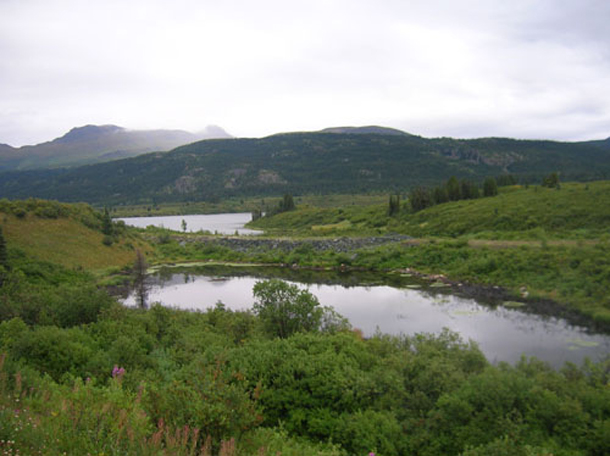
But like the Bradfield Road, such a scheme will come at dear cost to the province, even though it is northern B.C. that is endowed with much of the actual wealth. A feasibility study of the rail link funded by the Yukon and Alaska governments -- entitled "Rails to Resources to Ports" -- bears this out. The opening paragraph reads:
"[This report] provides a quantitative outlook on the potential for a rail connection through Alaska, Yukon and northern British Columbia, linking North Pacific Rim markets in the shortest trade corridor between North Asia and North America -- through a U.S. port." ![[Tyee]](/design-article.thetyee.ca/ui/img/yellowblob.png)
Read more: Energy




Tyee Commenting Guidelines
Comments that violate guidelines risk being deleted, and violations may result in a temporary or permanent user ban. Maintain the spirit of good conversation to stay in the discussion.
*Please note The Tyee is not a forum for spreading misinformation about COVID-19, denying its existence or minimizing its risk to public health.
Do:
Do not: