- Ms Kaye is a Tyee Builder. You can be, too.
- Mary Carlisle is a Tyee Builder. You can be, too.
- Prem Gill is a Tyee Builder. You can be, too.
- Nancy Flight is a Tyee Builder. You can be, too.
- Justin Everett is a Tyee Builder. You can be, too.
- John Westover is a Tyee Builder. You can be, too.
- Nora Etches is a Tyee Builder. You can be, too.
- Edward Henderson is a Tyee Builder. You can be, too.
- Bharadwaj Chandramouli is a Tyee Builder. You can be, too.
- Dean Chatterson is a Tyee Builder. You can be, too.
- Marius Scurtescu is a Tyee Builder. You can be, too.
- Robert Parkes is a Tyee Builder. You can be, too.
- James Murton is a Tyee Builder. You can be, too.
- Susan Doyle is a Tyee Builder. You can be, too.
- Vincent Strgar is a Tyee Builder. You can be, too.
- Helen Spiegelman is a Tyee Builder. You can be, too.
- Subir Guin is a Tyee Builder. You can be, too.
- Kimball Finigan is a Tyee Builder. You can be, too.
- Joanne Manley is a Tyee Builder. You can be, too.
- David Leach is a Tyee Builder. You can be, too.
The Milk Warriors of British Columbia
From raids to writs, how did selling unpasteurized milk become a battle now raging all the way to BC's Supreme Court? A special report.
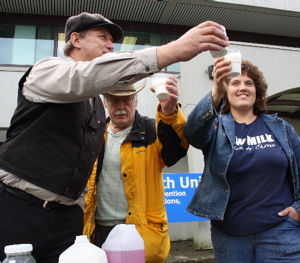
Michael Schmidt, left, and Alice Jongerden protest health authorities in Chilliwack, B.C. Photo: The Valley Voice.
Three agents wearing HAZMAT masks and gloves arrived at the restaurant on 1600 MacKay Road in North Vancouver flashing badges. They demanded that the staff lead them to the back. They seized some samples, and dumped the rest down the drain and down the toilet.
The agents were from the Fraser Health Authority, and the place was Barbara Schellenberg's Ethical Kitchen.
The contraband was milk. Raw milk.
A day later a second group of agents executed a similar search and destroy at Schellenberg's other location, the Controversial Kitchen on Commercial Drive in East Vancouver.
Though neither location used or sold raw milk, both offered a space for private raw milk exchanges, beyond the gaze of the authorities.
That was until Schellenberg's restaurants became targets of a country-wide crackdown on the distribution of unpasteurized milk -- a product considered hazardous by government and mainstream food scientists, but considered an immune-boosting, natural health product by raw milk enthusiasts.
Schellenberg's source of raw milk -- a Chilliwack dairy farm called Home on the Range, formerly run by Alice Jongerden and backed by more than 450 shareholders -- became the scene of another crackdown.
On her leased property in the Fraser Valley Jongerden milked 20 Jerseys, filtered the milk, jarred it, and then her husband, Bert Jongerden, would deliver it to depots throughout the Lower Mainland where shareholders could pick it up.
In the last two years the health authority served Jongerden with two cease and desists and the courts eventually charged her with contempt of court for continuing to distribute milk to the depots. She resigned as manager of Home on the Range. But the courts still found her guilty of contempt on Dec. 2.
The raw milk movement did not succumb. Instead it accelerated, and last week, on Jan. 20, Jongerden raised the fight to a new level, filing a constitutional challenge to the Supreme Court of B.C. that, were it to succeed, would change the public health act, and open the door to a legal raw milk industry.
How did British Columbia become ground zero in the battle over where the government belongs when it acts to get between what's raised on a farm, and what goes into people's bodies?
A biologist's perspective
Kevin Allen, a microbiologist at the University of British Columbia, says pasteurization -- the process of heating milk near its boiling point -- kills off milk-transmitted diseases like tuberculosis, typhus and Q fever, and extends its shelf life.
Allen says that at the beginning of the 20th century, food-related outbreaks were much higher than today, with an average of 26 documented outbreaks a year in the United States -- most caused by raw milk. By the 1980s, the U.S. suffered only a couple of raw milk-related outbreaks annually.
In the last two decades, though, raw milk-related outbreaks resurged, says Allen. As interest in the benefits of raw milk grew, more farmers started pumping it for willing drinkers. As consumption rose, so did the number of outbreaks caused by pathogens like e. coli 0157:H7, salmonella, campylobacter and Listeria monocytogenes (the same pathogen that causes problems in deli meat -- remember Maple Leaf's headache a few years ago?) These days, there are around five or six major raw milk-related outbreaks a year in the U.S.
Allen, who once worked for the food processing giant Mead Johnson testing milk quality for infant formula products, says people with weak immune systems like small children, the elderly, cancer patients or people with HIV, could get sick if they drank raw milk.
"When we look at a lot of the deaths that have actually been attributed to raw milk in the past decade, almost all of them are linked to Listeria monocytogenes," Allen says, adding that the mortality rate from that disease averages 30 per cent.
"I think we've been cooking foods since we were hunter-gatherers," he says.
Raw milk enthusiasts, many inspired by the Weston A. Price Foundation's campaign for real milk -- a raw milk advocacy initiative out of the U.S. -- believe that the benefits of raw milk greatly outweigh its dangers, though they warn that you need to trust your farmer and their milking conditions. The foundation collects a dizzying amount of literature, including a 132-page report challenging dozens of studies critical of raw milk.
The main thrust of the foundation is to show how raw milk's pro-biotic nature boosts the human immune system, and how raw milk can defend against conditions like arthritis, asthma, and digestion problems. They also link to a list of nearly 20 raw milk sources in Canada. (Most are in B.C. and Home on the Range is on the list).
"The only issue I have with those [views] is I think a lot of it is based on misconceived ideas," Allen says. As far as he knows, there hasn't been much scientific proof that raw milk is any better than pasteurized milk. He acknowledges that there are immune-boosting qualities to raw milk, but he says the antibodies are bovine in nature and probably have little effect on a person’s immune system.
"Your stomach is gonna destroy probably about 90 per cent of these things," he adds.
"I really do get the farmer's perspective," he continues. "You know the dairy farmer has been drinking this milk for decades, their families had it." (He suggests that I, having grown up on a dairy farm, probably have an unusually robust immune system since I was exposed to so many microorganisms on a regular basis.)
"You drink this milk, no issue," Allen says. "You bring me out for an afternoon to play with you -- say we're seven-year-olds -- I drink that milk and next thing you know I'm in the hospital on dialysis needing a kidney transplant."
'A real fiasco': raw milk seller Schellenberg
Schellenberg's Ethical Kitchen deli/café sits off Marine Drive in North Vancouver marked by a blue awning and a hand-painted sign advertising "Stabilizing food culture." Just beyond the patio grow corn, carrots and other vegetables near a statue of Buddha.
An old blue bus sits in the parking lot. Schellenberg wants to use it as a motor home during her trips to the family ranch and abattoir, located west of Williams Lake in the Chilcotin -- the source of many of the Ethical Kitchen’s organic meat and poultry products.
As Schellenberg closes the restaurant for the evening, she recalls the raw milk raid as "a real fiasco." She says that after the raid the authorities told her not to keep raw milk on the premises. She capitulated, but came to an agreement with the Jongerdens and let Bert continue distributing the raw milk in her parking lot.
Fraser Health said if anyone got sick then Schellenberg would be liable because it's her property, she pays the insurance. It's like she's selling it. The Jongerdens suggested she complain to the health authority that it overstepped its jurisdiction, but she resisted.
"I have a business, and I intend to stay in business," she says. "I don't want to have enemies in the health authority if I can help it."
Schellenberg parted ways with the Jongerdens -- she says they were making a spectacle out of the issue. But the health authority continued to harass her by showing up for inspections every couple of weeks.
"I was called into a meeting with [the health authority] and I was lectured about how dangerous this is," Schellenberg explains. She says she was scolded for putting the public at risk, and they warned that if she continued to do it they would have her business license revoked.
The Ethical Kitchen started getting strange phone calls, and visits from shoppers they hadn't seen before, asking about the price of the raw milk. "It seemed like they were fishing for something," Schellenberg says.
At one point, agents camped out across the street in their car watching the place. "It got to the point where we had to be rude to people [asking about raw milk], even if sometimes they turned out to be legitimate shoppers."
Healthy or hazardous?
Home on the Range is situated on Prairie Central Road, on a 24-acre leased property, tucked among some of the largest commercial dairies in the entire country. What began with a single cow in Alice Jongerden's back yard developed into an operation pumping nearly 1,800 litres of raw milk a week for private shareholders.
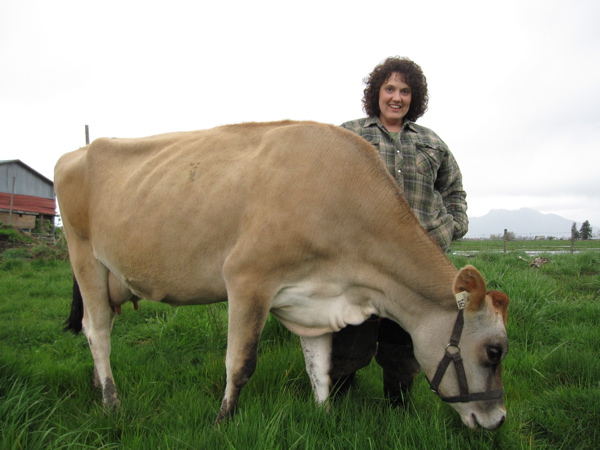
Alice Jongerden with one of her Jerseys: Headed for court. Photo: E. Duggan
In June of 2008 an inspector from the Fraser Health Authority dropped by to check things out. Following the inspection, the health authority slapped Jongerden with a cease and desist order for distributing a hazardous product.
Home on the Range continued to pump milk and by December 2009, the health authority struck Jongerden with another injunction. In court, presiding Justice Miriam Gropper said there was no doubt that Jongerden breached the Public Health Act, and that it wasn't up to the courts to decide if raw milk was hazardous, (a special B.C. regulation in 2009 deemed raw milk as such).
Jongerden argued she was not providing milk for human consumption (they even wrote that on the milk jars), and she also claimed that she wasn’t distributing the milk to the public because Home on the Range was a private cow share and the milk was owned by each individual member.
Justice Gropper didn't buy it. Nor did she accept precedence from a similar Canadian case, where Michael Schmidt was acquitted of 21 charges stemming from a raid at his own cow share operation in Durham, Ontario in 2006.
In January 2010 the Ontario courts decided that Schmidt's cow share was a private operation and in no way constituted harm to the general public.
Schmidt had been advising Jongerden throughout, and hearing of the contempt charge, he could wait no longer. Fresh off his own victory (it's currently under appeal), Schmidt burst onto the B.C. raw milk scene eager to help Home on the Range, as part of his mission to carve out a safe place in the Canadian dairy industry for raw milk farmers.
A 20-year fight
Michael Schmidt looks out the window of my car as we drive past the largest dairy farm in the province, down the road from what used to be known as Home on the Range. "That's where the problems start," he says, pointing at the monolithic glass, steel and concrete structure home to more than a thousand Holsteins. Dairies like that, he suggests, are too big for their own good.
In many of B.C.'s commercial dairies, herds spend their entire lives on concrete, indoors no matter the season. That lifestyle often causes hoof problems, and despite industrial-scale efficiencies, farmers afford less time to individual cows and their needs.
Jongerden and Schmidt believe that smaller, manageable herds, like theirs, benefit from fresh air and produce a better product. In fact, cows that pasture do often render higher quality milk and lactate more times throughout their lives.
Jongerden says her shareholders appreciate personally knowing the cows and the farmer that provides the milk.
In 1990, Schmidt started a raw milk cow-lease program. At its peak, over 200 families paid into the lease to drink his milk.
"We got raided the first time in 1994," Schmidt says. At the time they had 600 acres and 50 cows. A year and a half later, after legal fees, fines, and lost revenue due to the raid, Schmidt had lost all but three cows and 100 acres.
Quickly, Schmidt regained a herd and rebuilt the business -- this time a cow share with members investing in the cows directly as part owners. This ran smoothly until 2006 when more than 20 armed officers from Ontario's Ministry of Natural Resources stormed the farm.
"They came in uniforms and HAZMAT suits and basically ransacked us," Schmidt says. "They had put a mole into our operation." Probably one of the shareholders, he speculates. Though he won, Schmidt suffered through another round of costly litigation. "We never broke the law."
Schmidt says that different regulations in Ontario and B.C. (specifically one in B.C. that deems raw milk as a health hazard and disregards whether it's distributed privately,) gave Jongerden no way out. He believes that officials in B.C. were watching his situation closely and didn't want to lose control of raw milk in their province.
Cleopatra Bath Wash
In order to maneuver around provincial regulations, Schmidt and business partner John Schnurr took over Home on the Range, pulling it under the umbrella of Cow Share Canada. Jongerden resigned as manager, and they started labeling the milk as enzymatic bath lotion called Cleopatra Bath Wash -- a cosmetic product they say will fall under federal, not provincial, jurisdiction. It's a temporary solution.
With hopes of building an alternative raw milk national industry, the pair is touring the country visiting cow shares in every province. Schmidt and Schnurr are hosting meetings, making plans, talking to the media, and developing a framework of regulation.
"If you suddenly have a national organization which involves 5000 people, you become an entity [the government] has to deal with," Schmidt says.
The minister of raw milk
By uniting as many raw milk cow shares as possible, Schmidt and Schnurr hope to shield individual farmers from tedious and expensive litigation whenever health authorities or the government decide to step in.
Cow Share Canada is going to regulate how and where cow shares access cows. It stipulates how to feed the cows, how to milk, how to process the milk (into bath wash), and how to bottle and transport it. Schmidt says members make decisions as a group.
Yet the Canadian milk industry is already monopolized by a powerful network of provincial marketing boards and by the federal Canadian Dairy Commission.
In B.C., like in other provinces, marketing boards manage the supply of milk by licensing dairy farmers and facilitating transfers of total milk production quotas between farmers.
It's a system that has stabilized the price of milk and has kept the Canadian milk industry protected from foreign dairy products since the 1970s. It has also kept the price of quota on a steady increase ever since -- sort of like a milk stock market, without the crash, (and for licensed farmers only.)
The board oversees production, transportation and processing, and works with the federal government to ensure that enough fluid milk is turned into cheese and ice cream and other dairy products.
Schmidt thinks that system is unfair and that he can create a better one, only his would be for raw milk. So far he's had little response from the marketing boards.
"It's not automatic that raw milk is a safe product," Schmidt readily acknowledges. "It's the way you produce it that makes it safe or not."
Indeed, raw milk can get contaminated at the dairy in many ways including pumping milk from a cow that has just given birth (they have high bacteria counts), by milking in dirty conditions, or by including milk from a medicated cow.
Which is why he wants to bring the raw milk movement into the official light of day. He says the worst-case scenario would be if people continue to set up underground cow shares to avoid the wrath of the authorities only to do it improperly. He says that's when people will start getting sick.
A glass half full?
Barbara Schellenberg worries the desire of Michael Schmidt and others to keep escalating the controversy over producing and selling raw milk may prove counter-productive.
She says after Schmidt got involved, the raw milk activists became as aggressive as the health authority. She wishes the activists could have gone about their business more discreetly rather than make a national debate out of it.
"I'm probably considered a health freak myself by many people," Schellenberg says. "But people in this community, I think, routinely discredit themselves by radical opinions and really radical actions."
Schellenberg could be talking about a September 28 protest when Schmidt and Jongerden posed together in front the Fraser Health Authority drinking and serving glasses of raw milk. (The health authority didn't respond.)
Things have quieted down lately for Schellenberg and her day-to-day business in ethical foods. She's had enough of big brother, but she's also fed up with raw milk activism. "It's just making a lot of conflict, and conflict isn't healthy for anyone," Schellenberg says.
Jongerden and Schmidt disagree. For them, it's a matter of constitutional rights and the freedom of choice. In her January 20 notice of application, Jongerden challenged the ruling that upheld the Fraser Health Authority’s injunctions against her and set her contempt charge in motion.
She also called on the courts to overturn the portion of the public health act that deems raw milk hazardous and outlaws its distribution. ![]()


30
Login or register to post comments
pianosaurus rex
1 year ago
food control for humans nothing more
Interesting story.
Interesting that Mr. Allen makes the accurate claims about the disease killing properties surrounding pasteurization, but fails to note, or state, the good qualities in milk that disappear within the same process.
It is true that the majority of contamination comes from a faulty process of withdrawing the milk from the animal; the fault being improper hygienic conditions.
Raw milk consumption is somewhat similar to the abortion issue; if not allowed into public use unpasteurized milk will go underground; that is where the disease and mistakes will start sources of infections and contamination. People will not know the source of the milk nor under what conditions is this product extracted from the animal.
Rather than the CDC ignore and outlaw this process better, to allow so that they can keep watch and regulate the use of this product. This product is not going away so deal with it properly would be my view…..
We drank unpasteurized milk on the farm as kids in the 50’s-60’s; no farmer that I knew of on the dairy farms of South Western Ontario would milk a cow for human consumption if the animal was under medication; (this usually meant penicillin treatment for mastitis)
The dairy business in Canada is a dirty and corrupt business; the statements regarding the slanted activities of the milk marketing boards and the Canadian Dairy Commission are accurate; the marketing board system in Canada for cash crops of all kinds is open to corruption by payola.
I know this because my family had several wars with both of them. We owned a national dairy company for more than 50 years in Canada, Silverwood Dairies.
The raids with members in HAZMAT suits and other big displays of over-reactionary nonsense are typical of organizations that have become somewhat impotent in their own mandate.
This is another example of the now-evolving and up-coming (world-wide) struggle over food and water for human consumption; who controls it and who dispenses it.
Watch the 2008 Oscar winning documentary Food Inc. This film will give you an idea of where we are heading……
Fiat lux
1 year ago
I grew up with, and spent
I grew up with, and spent close to 40 years, almost to half of my lifetime on raw milk, including from our own cows.
Our granddaughter, married in Spokane has no problem obtaining raw milk, as are millions in the US. In Canada we must be more "health conscious", or do the milk factories make bigger donations to our governments?
Never heard of anybody getting sick, or dieing of raw milk when we were kids and there was nothing else.
Of course, all kinds of foods can be poisonous if and when handled improperly and without sanitation.
When we were milking, the cow's teats were washed with warm water and soap every time, twice a day, and the conditions were always clean.
The main reason for this anti farm produce hysteria, like milk, meats etc. is the long planned destruction of the family farm system and its replacement with the big, agribiz, corporate mafia by "conservative" governments. That's all.
Interesting, that officials, and scientists, are making ridiculous these health claims, while we get major, country and continent wide recall campaigns of poisonous foods from the dirty conditions of the corporate mafia food giants, totally ignored by governments.
If a small producer happens to make a few people sick that's a major cause for hysteria, but when the big guys poison hundreds, or thousands, and are found out, that's a proof that the health care system is working.
We still sell fresh farm eggs to private people from chickens running free on a half acre, bushed yard. The eggs are washed and sorted, beautiful and clean.
Years ago we used to sell eggs to a health food store, until the owner phoned and canceled the orders. An "inspector" came to the store and banned our eggs, because they weren't "inspected". We had to kill and feed 200 birds to the coyotes .
Now how in hell do you "inspect" eggs? And how are cleanly packed fresh eggs any worse than the pathetic garbage coming from the egg factories, handled by machinery, untouched by human hands and 6 months old before get into the stores ?
There were times when we were forced to buy store eggs for some reason and couldn't eat them, tasted so lousy. The same for feedlot beef. Full of chemicals, steroids, antibiotics, hormones, etc, making people sick and fat like pigs, but our politicians love it..
Ed Deak.
Rhea
1 year ago
Factory farms are filthy
"It is true that the majority of contamination comes from a faulty process of withdrawing the milk from the animal; the fault being improper hygienic conditions"
Factory farms are filthy places. I've been on and around farms all my life, and I can tell you that most of the large scale operations (several hundred animals) are revolting - much dirtier than a well run small operation. I also find it interesting how the health authority touts handwashing as being the single best thing to prevent the spread of disease, seeing as how a good milker washes the udder and their hands, sterilizes the bucket and follows good hygiene from start to finish. You think they do this in a factory farm, or routinely check for early signs of mastitis or scrapes/illness during the twice daily milking? Not to mention the increase in disease when the animals are crammed together in the barn 24/7.
I trust a small operation to take care of their animals a lot more than I would a factory farm, simply because the farmer has more time to look after the welfare of each animal, which results in a decrease in disease and medication.
I make the effort to buy farm gate eggs, meat from a family friend who does his own raising and slaughtering, and milk that's not from Dairyland. I've never gotten sick from any of these products, and the taste is not even comparable to the supermarket crap.
With climate change and peak oil gaining speed, we're heading for a retooling of how we get food. Small farming may very well save a lot of people from starving in the future, since the fuel inputs to run and transport factory food aren't going to be there. I support local farmers not out of sentiment, but self-interest.
Fiat lux
1 year ago
Rhea is correct....Factory
Rhea is correct....Factory farms are the most environmentally damaging, and filthiest places. All the managers are permitted to think about is increasing sales and profits.
For the sake of "efficiency" of course, which in today's terms means the highest profits and stockmarket benefits.
What nobody dares to mention is that young employees in the milk factories are using the milking machines as the ideal masturbation devices, that doesn't matter when it goes into the milk from a hundred, or often hundreds, of cows and the "inspectors" don't know. Everybody else does.
Ed Deak.
pianosaurus rex
1 year ago
agreed
This is completely accurate, this statement;
-----------------
“Factory farms are the most environmentally damaging, and filthiest places. All the managers are permitted to think about is increasing sales and profits.”
--------------------------
If any poster or reader here has doubts about this assertion have a look at the movie I suggested Food Inc. Been on the telé a couple of times now…you can rent it; very revealing information about the sources of food and the sources of contamination in food.
pianosaurus rex
1 year ago
a little secret
One more thing I missed and then I have to boot it to the shop; this is a tip for all the milk producers out there.
With our herds we used an old trick to rid the milkers of mastitis, which can be a re-occurring problem with them. Part of the problem with the antibiotic injection into the udder is that when the hypodermic pierces the wall of the udder that point will not produce milk any longer. Too many injections for re-occurring mastitis results in the udder eventually becoming useless for producing any volume of product.
If you feed the cows raw turnips with the storage alfalfa, either white or yellow turnips, this reduces the mastitis to almost zero.
Bytesmiths
1 year ago
Corporate Food + Government = Fascism
Whatever happened to "informed choice?"
And I don't mean that bunk that Allen claims -- almost all claims of illness from raw milk are either 1) anecdotal, or 2) from raw milk that was intended to be pasteurized.
In "The Untold Story of Milk," naturopath Ron Schmid documents the first case. Public health authorities have an unquestioned bias against raw milk. Their "statistics" are not based on peer-reviewed studies; they are based upon rumour and innuendo. When a doctor treats an infectious illness, he asks, "Have you been around any farms lately, or consumed raw milk or eggs?" He doesn't say, "Have you eaten any bologna or deli meat?" This is "observer bias," and it is propagated through the health system, until suddenly, the "records" are brimming with unsupportable raw milk illness!
The second source of raw milk illness actually hints at the real source behind this crack-down: factory dairies cannot produce safe raw milk! When they accidentally ship raw milk, or when their pasteurized milk gets contaminated by their raw milk, illness results. It is hardly fair to tar those who carefully produce raw milk intended for human consumption with the same brush used to indict faulty industrial processes!
Let me say it again: factory dairies cannot produce raw milk safely. And yet, there is a huge demand for this product. So they react the only way they can to protect their market: they (in the form of monopoly milk-marketing boards) collude with public health departments to ban a competing product that they cannot produce. This is the essense of fascism, or "the merger of corporate and government interests," as Mussolini himself described Fascism.
(continued below)
Bytesmiths
1 year ago
Corporate Food + Government = Fascism
(continued)
And why is there a demand for raw milk? Because it is fundamentally a better food. It contains essential nutrients and enzymes that are destroyed by pasteurization. (In fact, one of the measures of successful pasteurization is if all the lactoferrin, a potent anti-biotic enzyme, has been destroyed!)
Then there's the "myth" of shelf-life, thoughtlessly parroted by Allen. Our carefully-produced raw milk is still sweet and fresh-tasting after three weeks; pasteurized milk is a putrid mess by then! And when raw milk does "go off," it ferments into a lovely substance that can still be used in sour-milk baking or cheese making, whereas pasteurized milk is useless for anything except the drain. That's because pasteurization kills the natural acidophilus bacteria that out-competes other, more harmful bacteria. These naturally-occurring bacteria produce lactic acid, which is deadly to e-coli, staph, and other pathogenic bacteria.
In short, raw milk ferments; pasteurized milk rots. Which would you rather take a chance with?
Humans and milk-bearing ruminants have co-evolved over some 14,000 years in a symbiotic relationship that provides a nutritious natural food for humans, in exchange for care and feeding of the ruminants. If your racial stock is from Europe, north Africa, or the Middle East, this co-evolution has given your body the ability to produce lactase, so you can digest milk.
In contrast, pasteurization has only been around for some 150 years, and it was produced in response to poor dairy practices that sickened people needlessly -- a practice that continues to this day, via our "modern" factory dairies.
Let's hope it doesn't take another 13,850 years for humans to co-evolve the ability to live with factory dairies and their public health department henchmen!
Fiat lux
1 year ago
Better watch out, guys,
Better watch out, guys, before the RCMP's Milk Police raids and arrests us as subversive terrorists, daring to question the official line, enshrined by law.
Too bad we can't milk any more. Haven't had any decent milk for years.
By the way, we never tried turnips for mastitis, but have been very successful and wiped it out, with about 2 oz. of applecider vinegar mixed in with the cow's feed.
What no medications ??????
Ed Deak.
Okanagan Orchardist
1 year ago
Wow! You people are really young :)
Back in the late '30's and '40's, when I was young, living on a small mixed farm in Alberta, we had a small milking herd of less than a dozen cows, and a small unheated cowshed. Getting out in a cold winter's morning was a chore in itself. What's this "washing a cow's udder" about? No cold water available, let alone warm water. We drank the milk whole or separated and shipped the cream to Burns in Calgary, and put the rest into the pig slop. Burns never complained except on the rare occasion when there were spots of blood in the cream. We still got paid so I guess they just sent that on to some cheese factory (adds a little color :). The only time the cows were innoculated was for "blackleg," as I recall. I don't think that stopped us from milking them. Also the milk made the best "yugort", with some hard-boiled eggs.
But, of course, all of us were "hardened" on mother's milk. We siblings are all in our 70's and 80's now, but admittedly all suffering from back problems due to all the hard work. (And, I might add, none of us are overly obese.)
Love all this nostalgia.
Mikemah
1 year ago
milk
Raw milk was fine for hundreds of thousands of years UNTIL someone decide they could make MONEY by pasteurization. I drank it, billions of people did, and hundreds of millions still do. [OFFENSIVE MESSAGE REMOVED. -MODERATOR.]
TYRONE
1 year ago
Credibility?
Kevin Allen, a microbiologist at UBC says pasteurization - kills off milk-transmitted diseases like tuberculosis etc -
First off, the present medical paradigm with the notable exception of its surgical accomplishments, is living in the "Neanderthal" period. Louis Pasteur was, to put it mildly, WRONG! -
Tuberculosis bacteria are Mother Nature's surgeons and need to be present within our bodies before they are needed to remove a cancerous tumor. A Significant Biological Special program is initiated by Nature, at which point they multiply at the same rate as the tumor grows and are inactive until a biological conflict gets resolved. At that time they are activated by the brain and they remove the tumor, healing the cancer. There is no such thing as an immune system per se. However, we harbour all manner of bacteria within our bodies and Mother Nature uses them selectively to keep us healthy and our bodies repaired.
> By the 1980s, the U.S. suffered only a couple of raw milk-related outbreaks annually. These days, there are around five or six major raw milk-related outbreaks a year in the U.S.<
REALLY!
And this is the reason for the Gestapo to move in on businesses?
I say it is high time, that our laws reflect reality and get changed to foster free choice.
Dahlia
1 year ago
raw milk
Pasteurization kills all enzymes, and probably causes the common lactose intolerance. All foods naturally contain enzymes that help digest them. That makes the milk easier to digest.
I recall that back in Europe in my childhood many years ago cows were inoculated against TB. (So were children, actually).
And as Ed Deak says, cows' udders were washed with soap before milking. Was this just in those two neighbouring countries? I doubt it.
When we came to Canada, and lived in New Brunswick in the 1950's my folks were surprised that there was some infection (called something like undulant fever?) that you could get from unpasteurized milk. They had never heard of it, and we got raw milk from friendly farmers all through the War.
I was back in the old country in the 1960's and friends sent me to a neighbouring farm from their cottage with a pitcher to get milk. This milk was straight from the cow, and I again relived that delicious taste, as I carried it back. Could have drunk the darn 2L pitcher all by myself on the spot! I understand that in the 1930's raw milk was used to heal all sorts of diseases.
It sounds to me like creating uncontaminated and healthy raw milk is not an unsurmountable problem, if the will was there. If it were legally available, the health of the cows, and sanitary conditions could be easily inspected. Where there's a will, there's a way. So clearly it's the will that is lacking among officialdom.
Dahlia
1 year ago
Another thought
I understand that Canada pasteurizes milk at unnecessarily high temperatures.
One above writer says that raw milk sours to a delightful sour brew (sort of like Kefir), which is true. However, I found during that visit to the Czech Rep. in the 60's that their pasteurized milk would still sour to a delicious drinkable milk, something like buttermilk here.
I agree our "expired" milk in BC is only good for the drain it doesn't sour gracefully. Could it be the difference in the pasteurization temperatures? The Czech dairies pasteurize only to the absolute necessary lowest temperature. Probably some enzymes are still alive at the end of that. Pathogens are killed at lower temps than what we subject the milk to here.
That way we waste a lot of potentially good naturally fermented milk
TYRONE
1 year ago
Another thought - Mastitis.
Mastitis is a condition any female suffering from a biological 'forceful' separation conflict would be familiar with: Ductal Breast Cancer!
When an offspring gets forcibly removed from its mother, she suffers this biological conflict, which ulcerates her milkducts in an effort to help drain unused milk. At the same time she suffers amnesia to forget her offspring to get on with her life. When this biological conflict gets resolved, the milkducts are being rebuilt and the resulting (painful) mastitis is being treated (inappropriately) with antibiotics.
snert
1 year ago
My kids were raised on raw milk.
That was a gamble that the farmer we bought the milk from knew what she was doing and was lucky enough to catch and isolate any cows that may have become sick.
This farmer ran a small herd of dairy cows and this is where things can go wrong as opposed to one or two cows that only supply a family.
Raw milk fans assume everything will go right. It won't, it can't, Murphy's Law says so and it may be your kids that get sick.
Pasteurized milk was brought in for a reason and if you choose to ignore that reason then you can wind up paying the same price as those who choose to ignore vaccinations and become debilitated or dead from a preventable disease.
IMHO This whole performance is just a dance to get around milk quotas which is a whole other issue.
Oh, and FWI raw milk will occasionally taste way worse than store bought if it comes from a smallish farm.
timewilltell
1 year ago
Milk carries dis ease
We drank unpasteurized milk as kids on the farm.
My brother recently had chemotherapy which resulted in his immune system unable to combat the tuberculosis germ which had been sitting dormant in his body for fifty years. Now he is on a strong chemical therapy to fight the tuberculosis.
IS this what we want to offer to our children, knowing there is a better way?
RickW
1 year ago
So, if raw milk is bad and must be banned from public use....
....then it is only a matter of time before tobacco is banned. Right?
And then there is marijuana.........but let's not go there.
snert
1 year ago
RickW
Right again, Rick.
Okanagan Orchardist
1 year ago
Check this out...
Someone sent me this web site on off farm milk sales in Germany. Perhaps a concept we could adapt in the warmer regions of Canada??
http://www.flickr.com/photos/mejuan/5385375642/
Bytesmiths
1 year ago
snert wrote: "a gamble that
snert wrote: "a gamble that the farmer we bought the milk from knew what she was doing and was lucky enough to catch and isolate any cows that may have become sick."
Let's play with that a bit: "a gamble that the factory farm we bought the milk from knew what they were doing and was lucky enough to catch any problems in their process so that they didn't sicken 200,000 people, killing 18, as happened with contaminated pasteurized milk recently."
What's the difference?
Life is full of risks. Some will chose their risks based up a faith in a 150 year old technology; others prefer to put their faith in 14,000 years of co-evolution.
"This farmer ran a small herd of dairy cows and this is where things can go wrong as opposed to one or two cows that only supply a family."
So a factory farm that runs 5,000 head and which is absolutely dependent on industrial processes is therefore "better?" So now we not only ask farmers to be wise practitioners of animal husbandry, but they must also be electrical engineers, process specialists, and software experts?
No thanks. I'll take the old way.
"Raw milk fans assume everything will go right. It won't, it can't, Murphy's Law says so and it may be your kids that get sick."
This sort of argument just slays me. So much can go wrong with industrial processes, and yet folks who choose to follow a simpler, older, tried-and-true practice are chastised for assuming things will go right.
Again, just turn this around: replace "raw" with "pasteurized" in the previous quote. Many more kids have been sickened by pasteurized milk than raw milk -- but don't believe me, do the research, rather than just spouting off what the milk cartel tells you!
"Pasteurized milk was brought in for a reason and if you choose to ignore that reason..."
Here, we must agree to disagree. You have your belief about the "reason" for pasteurized milk, and I've stated what my research has uncovered for the "reason." We'll have to let the readers of this dialogue decide. At least I've provided references.
"... raw milk will occasionally taste way worse than store bought if it comes from a smallish farm."
Coming from a self-professed enemy of raw milk, the irony of this statement is too rich for comment... :-)
Most of the arguments snert attempts could be addressed by a certification program. In Europe and many US states, raw milk is tested and certified, and consumers can be assured that it meets standards for healthfulness. Only if you keep it underground does any of snerts assertions have any validity.
info@eatkamloops.org
1 year ago
Looking for Some Kind of Choice
I am the Weston A Price Foundation Chapter Leader for Kamloops. I would like to see raw milk available in Canada for people interested in consuming this nourishing traditional food. I also want to follow the laws of Canada to the best of my ability. I have been following the raw milk issue for over two years. I have been deeply saddened that people still cannot get access to raw milk.
When people contact me about finding a source of raw milk in Canada, I have to tell them they really only have one choice. They have to get their own cow, goat or sheep and milk the animal themselves. Unfortunately, most people live in cities and towns. Urban zoning regulations usually restrict livestock in single-family zoned properties. If your property zoning does not allow livestock, the person will have to lease a property with appropriate zoning. The person would have to live close the the leased property so they could care for the animals and milk twice a day. I know this is not an easy solution, but it is the only one left for raw milk drinkers in Canada.
I mentioned earlier that I was saddened by the acts of prohibition against raw milk by our supposed protectors. Well, I am also scared for our farmers who are taking the brunt of these enforcement actions. The producers of our food are scapegoats and we are just watching the State slowly roll over them. Hell, I am scared for my own food supply. When will the State come in and take my milk cows away saying I cannot feed a "health hazard" to my family?
I belief that people interested in buying food directly from the farmer or contracting a farmer to do work for them need to take political action now. We need to draft legislation such as a Farmer's Bill of Rights. This legislation would allow farmers and their families to grow and consume their own food and sell their products to their community without onerous government interference. Legislation like this might save the family farm from extinction and ensure a healthy local food supply for our children. Unfortunately, history teaches us that the ruling class rarely give up their power without a fight.
Bytesmiths
1 year ago
Oppose the proposed "Animal Health Management Policy"
info@eatkamloops.org wrote: "I belief that people interested in buying food directly from the farmer or contracting a farmer to do work for them need to take political action now."
High on your list of political action should be to oppose the "Animal Health Management Policy" being considered by the Ministry of Agriculture. This would subject all who keep livestock -- industrial-scale as well as small farmers and even subsistence farmers -- to onerous animal tracking, inspection, and surveillance requirements.
Until January 31, you can read the proposed policy and submit comments via: http://www.agf.gov.bc.ca/ahc/ahb/
Following is what I sent them. (Sorry for hijacking this thread; it is related!)
----------------
I am distressed at the total lack of recognition in this paper that small farming is fundamentally different than industrial farming. Almost all large-scale animal health issues come from large-scale farms, and yet no mention is given that the two have completely different animal health management needs.
Nor was any recognition given to subsistence farming as an important life-style. Are these policies to be applied to the family with a milk cow, a dozen chickens, and a couple pigs?
"Animal health management" of a 50,000 bird egg farm are FUNDAMENTALLY DIFFERENT than that of the 99 hen "back yard" flock. Huge monoculture animal herds are particularly susceptible to pandemics; a diverse patchwork of small producers of different animals, breeds, and varieties is particularly resilient to pandemics.
At a time when reduced carbon emissions, improved food security, and increasing food sovereignty is being promoted by all levels of government, this policy paper stands in stark contrast.
Just as recent changes in abattoir regulations have decimated the local production of food, aggressive implementation of the animal health management policies outlined in this paper will reduce our food supply locality, diversity, and resiliency. Farm-gate sales, farmers' markets, and even local food production advocacy groups (some of which have been infiltrated in the name of "surveillance") may be endangered by a strict and aggressive implementation of these policies.
Please start over, with the primary goal of prevention, based on diversity and resilience -- neither word appears anywhere in your paper.
RickW
1 year ago
Pasteurisation......
....allows sloth among industrial producers. In the corporate world, it's called "externalizing costs", and is much desired by the political parties that depend on corporate donations.
snert
1 year ago
Bytesmiths
I don't think you've thought this all the way through.
There is inherent risk to unpasteurized milk. It can be minimized, certainly but it is still there and still a higher risk than for pasteurized. Now if the raw milk people get there way there is nothing to say that there couldn't be a 5000 head raw milk dairy corporation where one cow can now contaminate a far greater quantity of milk.
Pasteurization at least eliminates that probability. Because of this the milk is safer and less is wasted if there is an issue.
No doubt about it, if the animals are healthy and the facilities are spotless then there's not much problem either way. When things aren't kept up food safety is likely to go downhill faster with raw milk.
Like I said before I think this is more a milk board quota issue than anything else. There is absolutely no advantage to raw milk other than reduced processing costs. Why not be safer. Nobody gets autism from drinking pasteurized milk.
Bytesmiths
1 year ago
We'll have to agree to disagree
snert doesn't think I've "thought this all the way through."
I can assure that I've put years of research and practical application into this. Contrast this to snert's implication that raw milk causes autism. If he had ever done any research on the issue at all, he'd know that autism and raw milk have never been correlated!
In fact, had he bothered to simply google "autism raw milk," he'd find that the top two hits are, contrary to snert's implication, using raw milk to treat autism! And the third link implicates pasteurized milk with autism!
http://www.google.com/search?client=safari&rls=en&q=autism+raw+milk&ie=UTF-8&oe=UTF-8
So if anyone is not guilty of "thinking this all the way through," it appears to be snert.
quietdevious1
1 year ago
As someone who has worked in
As someone who has worked in a lab with biohazardous waste I have to comment - wear HAZMAT suits and then dump it down the drain? Methinks the gear is only for show.
info@eatkamloops.org
1 year ago
Safety or Control?
My friend Bytesmith, we are already in the world you are worried about. I have to fill out paperwork every time I move my cows. Woe, to any farmer that brings an animal to the slaughter house without proper paperwork and ear tags. The regulations are already onerous. In my opinion, many of these regulations have nothing to do with "safety" and everything to do with "control."
I have written about how new slaughtering regulations has destroyed artisan methods of butchery and meat processing. (I wont go into the effects of regulation on artisan raw cheese production.) You can read about it here. Slaughtering regulations is one of many serious issues involving food freedom:
http://eatkamloops.org/archives/797
http://eatkamloops.org/archives/1711
Raw milk is just the whipping boy in the battle over if a person has the right to choose what goes into their body or if the State, in its greater wisdom, gets to choose for everyone. Raw milk is the tip of the iceberg. Under the water, is the right to slaughter your own chickens in your backyard or or even the right to have a few chickens in your yard for eggs, meat and fertilizer. Its about the right to produce a traditional fermented food that doesn't fit nicely into "Food Safe" regulations or even grow your own garden on your own property. If you think this is extreme, I can give you examples in the US where people have been fined for having an organic garden in contravention of local zoning bylaws. You can read about it here:
http://www.cityfarmer.info/2010/10/04/the-economist-reports-where-growing-too-many-vegetables-is-illegal/
DerrickA
1 year ago
Milk is highly overrated
Milk is the worlds most highly overrated nutrient. Most of what you heard about the "goodness" of milk probably came from your mother (or a dairy industry ad). Sorry, it's largely not true.
It's a medical fact that countries with the highest milk consumption have the highest incidences of heart disease, osteoporosis, breast/prostate cancer and Crohn's disease. Though milk is high in calcium, it's actually a poor source of bio-available calcium (the kind your body can actually absorb). Get off milk, get on a Mediterranean style diet and get healthier.
http://www.notmilk.com/
http://www.scientificamerican.com/article.cfm?id=rebuilding-the-food-pyram
Leslie C
1 year ago
listeriosis
Mr Allan, the microbiologist quoted in the article, says this: "When we look at a lot of the deaths that have actually been attributed to raw milk in the past decade, almost all of them are linked to Listeria monocytogenes,". The FDA, in an assessment of risk from foodborne listeria, ranks deli meat as the #1 for high risk of contamination on a per serving basis. Raw milk doesn't make the top three.
(see p.17)
http://www.fda.gov/downloads/Food/ScienceResearch/ResearchAreas/RiskAssessmentSafetyAssessment/UCM197329.pdf