
News

A Tyee Series

Canada's Fight to Stop States From Lowering Fuel Carbon Levels

How Alberta, Ottawa and oil sands corporations are teaming to oppose climate change laws across America. First in a multi-part series.

By Geoff Dembicki, 7 Dec 2010, TheTyee.ca

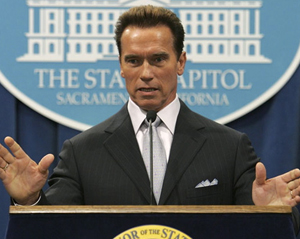
Schwarzenegger opposing Prop 23

California governor Arnold Schwarzenegger: 'Their black oil hearts.'

Related

In late September, California's outgoing Republican governor declared all-out war on a fossil fuel cabal opposed to his state's landmark climate change laws. "They are creating a shell argument that they are doing this to protect jobs," declared Arnold Schwarzenegger to a crowd of several hundred at the Commonwealth Club in Santa Clara. "Does anybody really believe they are doing this out of the goodness of their black oil hearts -- spending millions and millions of dollars to save jobs?"

That proved to be the dominant narrative in the struggle over Proposition 23, an oil refiner-funded ballot initiative asking Californians to suspend some of the planet's most stringent global warming legislation. Hollywood itself couldn't have dreamed up a better story: a former action movie hero-turned-environmentalist doing battle with Texas-based oil magnates during the hottest year in recorded history. Green observers heralded the electoral defeat of Prop 23 this November as a clean energy triumph.

Yet one crucial plot point ignored by most onlookers may carry implications far beyond state lines. A key climate change policy now being implemented in California could someday wipe out huge profit margins for Alberta's greenhouse gas-intensive oil sands industry and the American refineries that depend on it.

A sophisticated lobbying effort led by Canadian officials, fossil fuel lobby groups and several of the world's largest oil companies is targeting policymakers and consumers across the United States.

On several fronts, it appears to be succeeding.

At stake: green regs in 24 states

The goal of this lobbying push is to defang a climate change policy being considered or adopted in 24 U.S. states. That policy, known as a low carbon fuel standard (LCFS), aims to clean up the fuel being pumped into cars, trucks and motorcycles. American drivers fill their tanks with energy from all over the globe. Though vehicle engines generally release the same amount of greenhouse gases no matter what they're combusting, some fuels have much higher carbon footprints than others.

In Alberta's oil sands, a thick substance called bitumen is clawed or steamed from the frigid northern muskeg, then cooked at high temperatures and diluted with chemicals. By the time the fuel is dripping from a gas station nozzle, it's already been responsible for 82 per cent more greenhouse gas emissions than, for instance, smooth-flowing light crude from Texas, according to U.S. Environmental Protection Agency estimates.

The intent of a low carbon fuel standard is to set clear limits on these types of emissions, and then let the free market figure out the rest.

"What makes me excited about an LCFS is that it lets all fuels compete," said Peter Taglia, a scientist helping to develop a regional standard for 10 Midwestern states. "You're not picking a technology winner"

Schwarzenegger's gambit

But as The Tyee first reported this summer, a dense network of Alberta oil sands producers connected to U.S. refineries by pipeline sees a blatant attack on its bottom line. With active support from the Canadian government, it's been targeting American climate policies from coast to coast.

In early 2007, the world's first low carbon fuel standard was signed into existence by Arnold Schwarzenegger. "Greenhouse gas (GHG) emissions pose a serious threat to the health of California's citizens and the quality of the environment," read the executive order's opening words. Legislation proposed a 10 per cent carbon emissions cut by 2020 across the entire road fuel sector. Regulators would track all the different fuels entering the state and assign a carbon footprint to each one. It was expected that suppliers, in order to meet emissions targets, would avoid fuels from Alberta's oil sands and other high-carbon sources. Market pressures, meanwhile, could induce major investments in clean energy.

The Canadian government intervened formally at least five times in the policy's development, citing a wide range of oil sands-related concerns, according to a recent Climate Action Network Canada report. And oil industry resistance was fierce, even after California officially approved its low-carbon fuel standard last January.

Two fossil fuel lobby groups and a national trucking association are currently suing to repeal it, arguing the policy would "harm our nation's energy security by discouraging the use of Canadian crude oil."

If the oil-refiner funded Prop 23 had passed in early November, it would have suspended low carbon fuel standard legislation along with other state climate policies, earlier Tyee reporting explained. "Because that proposition failed by about a 6 to 4 ratio, we assume that those climate change provisions are in effect," Iris Evans, Alberta's minister of international and intergovernmental relations, told the provincial legislature the day after its defeat. "We'll still have a lot of work to do on low carbon fuel standards."

Domino effect?

Given that fuel from the Alberta oil sands powers only a tiny percentage of California's vehicles, why so much opposition?

In Nov. 2007, about 11 months after California first proposed its low carbon fuel standard, 10 Midwestern states began considering a regional policy. The next year, looking explicitly at California's model, 11 northeastern and mid-Atlantic states did the same.

Low carbon fuel standard frameworks being developed right now could soon regulate 50 per cent of America's transportation fuel market, a recent Ceres-RiskMetrics Group report concluded.

But the real nightmare scenario for Canada's oil sands industry is the pressure that would put on the U.S. Congress to enact national laws.

Though Alberta has the second largest known oil reserves on Earth, it sells exclusively to American markets. A federal low carbon fuel standard, as the Ceres-RiskMetrics report argues, could potentially reduce U.S. oil sands demand a full one-third by 2030.

And that's assuming industry players invest billions of dollars to reduce their carbon output, purchase carbon offsets and blend their products with renewable fuels.

"In the unlikely event that no options were available for Canadian oil sands producers to comply with the LCFS," the report reads, "the U.S. transportation market could conceivably disappear."

"There’s a lot of 'ifs' in there," co-author Doug Cogan told The Tyee, insisting that a global decline in oil supplies combined with escalating demand still plays very much in Canada's favour. "But the fact that these scenarios exist is what drives [the Canadians] to go to California and to say 'this could have real implications for the growth of our industry.'"

Tomorrow, part two: Inside the expensive public relations campaign to win American citizens' support for oil sands crude.  [Tyee]

31  Comments:

Login or register to post comments

  • seth

    2 years ago

    Nuke the tar sands

    After replacing all the natural gas based steam in tar sands production with the clean and green nuclear variety, tar sands oil will be the best of a bad lot on GHG emissions per gallon of product.

    Problem solved with a excellent return on the gas to nuclear investment.

  • Waltz

    2 years ago

    Ashamed to be Canadian

    This policy on climate change and a string of ill-conceived environment-related policies of both the federal government and the BC provincial government make me ashamed to be a Canadian.

    We need to regain our international reputation for peace, fairness and justice. God forgive us for our waywardness, conceit and greed.

  • mopled

    2 years ago

    Jeez. I can't believe you are still trying to ride this nag

    http://notrickszone.com/2010/12/07/climate-science-scandals-list-of-gates-balloons-to-129/#more-6767

    Do watch the video put out by 10:10.org on the page. They called it "No Pressure" but it has also been referred to as "Splatter Gate".
    Not only are Warmists wrong, they are also nasty.

  • poetician

    2 years ago

    Who's your daddy?

    Yet more proof that we've (Canadians) become the oil companies' bitch

  • bfearn

    2 years ago

    Jeez. I can't believe the ignorance and arrogance out there.

    Proven oil reserves are about 1300 billion barrels. At the present rate of consumption this will last about 40 years. If we find 5 times this amount of oil, unlikely, it will last about 200 years, even more unlikely.

    We have already wasted much of the billions of barrels we have burned so far and in 200 years we will be in big trouble because oil is used to make so many essential things, other than heat. Reducing our consumption of fossil fuels is essential, now.

    To suggest that burning billions of barrels oil and billions of tons of coal is not affecting our atmosphere is simply foolish.

    To suggest that our energy use is fair to future generations is simply greedy.

  • Sask Resident

    2 years ago

    Another Market

    Which is a good reason that western Canada needs another market, such as Asia via the pipeline to Kitimat. Make the pipeline an issue of national security and start building it.

    BTW, the high carbon, heavy oil in California is excluded from the law, against the rules of NAFTA. The best replacements for Canadian oil would be Saudi Arabia and Nigeria but Venezuela oil would be shut out.

    Oil sands oil is generally low in sulphur so is actually cleaner than many other oils.

  • mopled

    2 years ago

    You seem to belong to the "It must be doing SOMETHING"

    school of thought. In fact the extra 3% CO2 that human activities add to the atmosphere just helps produce more bio-mass. For every 1 ppm atmospheric CO2 gos up, the earth produces 6% more bio-mass.
    Even if we did go through oil reserves in 40 years,by that time something will have replaced our dependence on petroleum. Hint...it won't be wind or solar.

  • morechatter

    2 years ago

    Another World

    Canada's environmential record is pathetic along with being rejected to sit on the UN.
    Tar Sands good for the environment is like saying Sask is the best place on the earth to live.

  • morechatter

    2 years ago

  • Greg in Calgary

    2 years ago

    Additional CO2 Does Not Increase Biomass

    mopled: This is incorrect. While increasing CO2 temporarily increase conversion to biomass, the effect is small and short-lived - plants just adapt to higher CO2 conc. This has been known since before I heard about it in Botany 101 in 1979.

  • istvan

    2 years ago

    oil sands\tar sands.

    Why don't we use these for gas diesel etc ,plastics .Shiping it of to China dosn't do us any good.

  • mopled

    2 years ago

    Greg, there is an enormous body of experiment

    to back up the fact that higher CO2 levels lead to faster growth done for the international greenhouse industry, among others. "Get used to it" is not an apt phrase to describe plant behavior under conditions of increased CO2.Try looking here on the C section.
    http://www.co2science.org/
    for more references that back me up after looking through some of these.
    http://www.co2science.org/subject/g/grasslandswholecom.php

    An ex-cathedra statement, with no reference to back it up, falls under a brand new title for Believer musings recently categorized by Christopher Monckton as
    "febrile fatuities of the forecasters of fashionable fatalism ". It's a fun read, for us Deniers, anyway
    http://wattsupwiththat.com/2010/12/07/moncktons-mexico-missive-2/#more-29027

    Since CO2 can't change climate, adding more to the atmosphere is only good.

  • RickW

    2 years ago

    mopled

    Quote:
    Since CO2 can't change climate, adding more to the atmosphere is only good

    Got any stats on the tolerance level for humans breathing increased CO2?

    Or is it OK for us to run around in wheelchairs?
    http://www.logico2.com/Documents/ACGIH%20recommendations%20for%20CO2.pdf

  • RickW

    2 years ago

  • mopled

    2 years ago

    No problem

    Normal CO2 Levels

    The effects of increased CO2 levels on adults at good health can be summarized:

    * normal outdoor level: 350 - 450 ppm
    * acceptable levels: < 600 ppm
    * complaints of stiffness and odors: 600 - 1000 ppm
    * ASHRAE and OSHA standards: 1000 ppm
    * general drowsiness: 1000 - 2500 ppm
    * adverse health effects expected: 2500 - 5000 ppm
    * maximum allowed concentration within a 8 hour working period: 5000 ppm

    The levels above are quite normal and maximum levels may occasionally happen from time to time.
    Extreme and Dangerous CO2 Levels

    * slightly intoxicating, breathing and pulse rate increase, nausea: 30,000 ppm
    * above plus headaches and sight impairment: 50,000 ppm
    * unconscious, further exposure death: 100.000 ppm
    http://www.engineeringtoolbox.com/co2-comfort-level-d_1024.html

    The recommendations you found are pretty much what I found. There is no way human activity could raise atmospheric levels to any where near even uncomfortable because both land and oceanic plants utilize the extra 3-5% CO2 humans may add quite rapidly.
    P suspect you didn't bother to read your own reference.
    The important thing is the correlation, or not, of CO2 to temperature
    Half a Billion Years of CO2 and Climate
    Reference
    Rothman, D.H. 2002. Atmospheric carbon dioxide levels for the last 500 million years. Proceedings of the National Academy of Sciences USA 99: 4167-4171.

    "The author states that it is "interesting to ask what, if any, correspondence exists between ancient climate and the [newly derived CO2] estimate." Indeed, it is very interesting to ask that question; for the political future of the entire world rests on the validity or invalidity of the climate-alarmist supposition that changes in the air's CO2 content are major determinants of changes in climate. So what do the new results show?

    Rothman reports that the CO2 history he derived "exhibits no systematic correspondence with the geologic record of climatic variations at tectonic time scales." In another place he writes that "comparison with the geologic record of climatic variations reveals no obvious correspondence." And in yet another place he says that although the most recent cool period corresponds to the relatively low CO2 levels of the present, "no correspondence between atmospheric CO2 concentration and climate is evident in the remainder of the record."

    If the truth be told, however, a simple visual examination of the author's plot of CO2 and climate vs. time clearly indicates that the three most striking peaks in the atmospheric CO2 record occur either totally or partially within periods of time when earth's climate was relatively cool. Hence, not only is there no proof for the climate-alarmist contention that higher CO2 concentrations tend to warm the planet, there is evidence in this study to suggest that just the opposite may be true.

    http://www.co2science.org/articles/V5/N19/C2.php

  • Mathieu Y

    2 years ago

    Climate Change (and how we can't avoid it)

    The fact that we are an entire world dependant on oil can not be avoided. As hamfistedly as Fubar 2 stated it, the fact is without oil we could not use our current vehicles to accomplish... anything! And what is anything?

    Building wind turbines, solar panels, safe nuclear power, hydro electric dams, natural gas deposits, and every other conceivable form of renewable energy. The transportation and installation of these commodities still requires oil, further proving that it is perhaps the most rightfully valued commodity on the planet at this point.

    Saying we don't need oil right now is saying we don't need progress towards a more sustainable future. We are going to have 9 billion people on this planet in 50 years. How are we going to accommodate them all if we deny ourselves the most effective energy resource we currently have? Especially since this will obviously deny future projects for more efficient energy resources.

    In summary, use what we have now to put our energy dreams in to action. That's all

  • dave49

    2 years ago

    John Baird is running Environment Canada. What should we expect?

    Look, John Baird is running Environment Canada. What should we expect? He is probably the most loyal and intense attack dog on the Harper team.

  • morechatter

    2 years ago

    What IF?

    And it is a big if, as the US is getting set to send Western Canada's Oil to China.
    I don't think it is going to be that easy even with Big Old Investors pulling the strings and they all came tumbling down.
    Reminds me of my sister's husband who was retiring at 35 because of all his investments in Oil but then there was the bust. He now sets up rigs around the world and although he could retire the industry is his life and the travel isn't half bad.
    Western Canada is hot and the rest of the country is not, and Environment Canada is a loser and Harper's G20 another farce.
    Inflation is biting but interest rates stay at historic lows and the dollar is rising but its value is inflated leaving the rest of the country in toil all thanks to Alberta's Oil.

  • morechatter

    2 years ago

    We may not be able to avoid Climate Change

    However that dosen't mean we have to treat it like a race to finished for good. Who says the world needs to function on oil and it is way of life? Ways of reducing climate change should be the norm not countries like Canada who goes out of its way to do the maximum amount of harm it can do the environment for profits for a few. It dosen't matter, posioning the water, the wildlife, the fish and we haven't even gotten to dieases created by contaminated waters as many people are sick. Canada dosen't even have the ability to clean up after a major spill taking those extra risks because do Canadians really think they matter when profits are to be made.

  • mopled

    2 years ago

    Hey Guys, it has fallen apart and people are scrambling

    to look like they knew all along that most of the "downside" of a warming world were exaggerated or plain out wrong.

    "CO2-induced Vegetation Growth Slows Global Warming," says A research team of scientists from NOAA, NASA, and the University of Maryland.
    http://www.worldclimatereport.com/index.php/2010/12/08/co2-induced-vegetation-growth-slows-global-warming/

    Greenland ice sheet flow driven by short-term weather extremes, not gradual warming: UBC research
    http://www.publicaffairs.ubc.ca/2010/12/08/greenland-ice-sheet-flow-driven-by-short-term-weather-extremes-not-gradual-warming-ubc-research/

    Climate change: Met Office halves 'worst case' sea level prediction
    http://www.telegraph.co.uk/earth/environment/climatechange/8182278/Climate-change-Met-Office-halves-worst-case-sea-level-prediction.html

    Cancun COP16 attendees fall for the old “dihydrogen monoxide” petition as well as signing up to cripple the U.S. Economy

    http://wattsupwiththat.com/2010/12/08/cop16-attendees-fall-for-the-old-dihydrogen-monoxide-petition-as-well-as-signing-up-to-cripple-the-u-s-economy/

    It sure would be nice if you wake up and notice the cold....It's going to be here for a while. That's why "Global Warming" morphed into "Climate Change".
    http://www.c3headlines.com/2010/12/us-decade-plus-long-cooling-trend-sinks-further-to-a-minus-91-degree-per-century-rate.html

    This is one of my favorites, since it come from one of the chief Believer journals.
    http://www.guardian.co.uk/environment/2010/dec/03/wikileaks-us-manipulated-climate-accord

    "WikiLeaks cables reveal how US manipulated climate accord

    Embassy dispatches show America used spying, threats and promises of aid to get support for Copenhagen accord "

    Are you sure you want to continue thinking that this CO2 stuff is on the up and up?

    Just asking!

  • RickW

    2 years ago

    mopled

    Oh, I read it. Eventually you will paint yourself into a corner.........
    http://news.mongabay.com/2005/1124-climate.html

  • mopled

    2 years ago

    You are toooooo funny RickW

    Is posting that silly article the best you can do? My answer to it is a big fat SO WHAT!
    Whatever the amount of atmospheric CO2 may be, humans only account for 3-5% of it and it is still plant food.

    Speaking of corners, how about this little tidbit found in an article about the demise of the Chicago Climate Exchange.
    "The biggest losers are CCX's two biggest investors, Al Gore's Generation Investment Management and Goldman Sachs, that champion of sound money management that serves as the farm team for administration staffing.

    Other CCX founders include former Goldman Sachs partner David Blood, as well as Mark Ferguson and Peter Harris, also of Goldman Sachs. In 2006, CCX received a big boost when another investor purchased a 10% stake on the prospect of making a great deal of money for itself. That investor was Goldman Sachs, accused of selling financial instruments it knew were doomed to fail.

    A mechanism for extending carbon trading on the exchange to residences was purchased and patented by none other than Franklin Raines, who was CEO of Fannie Mae at the time. Raines profited to the tune of some $90 million by buying and bundling bad mortgages that led to the collapse of the American economy.

    His interest in climate trading is curious until one realizes cap-and-trade would make housing, like energy, more costly. Cap-and-trade and carbon regulation extended down to the homeowner level would have raised the cost of homes and homeownership and made him richer that way and through his patent.

    CCX's collapse was inevitable as both the enthusiasm for cap-and-trade — and the world itself — cooled. After the e-mail exchanges from the Climate Research Unit at the University of East Anglia reveled the extent to which global climate data were being manipulated to "hide the decline" in global temperatures, hopes for profiting off the scam with another scam evaporated."
    http://www.investors.com/NewsAndAnalysis/Article.aspx?id=553236&p=2

  • YCSTS

    2 years ago

    Oil is much more expensive than Nuclear Energy.

    Mathieu, yes it is certainly true we need our present Oil supply. We also need to reduce our consumption of Oil as quickly as possible. Even if you are a Triple Denier, like mopled, who rejects both accepted AGW science & Global Peak Oil predictions and believe a serious War in the Middle East is impossible. The effects of that on Oil Price are just frightening.

    The simple fact is that Crude Oil currently at 5.4 cents per kwh, including processing & shipping about 7.2 cents per kwh. That will inevitably rise sharply as demand in the Developing World continues its exponential growth. This is an economic catastrophe in the making.

    It is entirely economical to begin a rapid phase-out of Oil by use of NG->liquids-> transportation & heating fuel. And Nuclear Energy replacing most NG heating applications and all new Electricity Generation, except NG is good for Peaking Power plants.

    The Chinese Nuclear costs are heading to $1.3k per kw or 2 cents per kwh. Maybe half that with CHP. No other energy source can compete with Factory produced Nuclear. The cost of fossil fuel energy will inevitably continue to rise, we MUST begin the transition to a Nuclear Powered World Economy.

  • RickW

    2 years ago

    mopled

    Quote:
    Is posting that silly article the best you can do?

    I might ask you the same of your lopsided links....

  • mopled

    2 years ago

    RickW, that's an retort on the level of

    "So's your ol'man!"

    Serious war in the Middle East is what the US wants, so switching to CNG isn't going to derail the war agenda, YCTS. Remember Old lady Rothschild once said, "If my sons didn't want war, there wouldn't be any." Getting rid of the Banksters makes more sense than getting rid of the Tar Sands.

    I fail to see how shutting down Albeta prevents an ME war.

    Oil prices are rising because it is priced in the $US, which is falling. Nukes can't save it. There are countries which want nuclear power,like Iran, which aren't allowed to have it.

    Nuclear power is supposed to save the world from what exactly? No warming and plenty of oil?

  • plebe

    2 years ago

    poor mopled

    Rather than gumming up the comments section with links to other peoples opinions, why doesn't mopled think for themselves, make a *rational* argument, and provide a peer-reviewed link that backs up what they are saying?

    What's that mopled? Can't find any peer-reviewed articles "debunking" the radiative properties of CO2 in the atmosphere, or the human fingerprint of global warming?

    Then go troll somewhere else.

  • mopled

    2 years ago

    Let's turn that around, Plebe!

    Where's the peer-reviewed paper that shows CO2 can change climate?

    Here's a link to all the peer-reviewed one could possibly ask for that shows it CO2 is plant food and has little effect on temperature.Try educating yourself
    http://www.co2science.org/subject/c/subject_c.php

    Here's one of the very latest papers.
    Bounoua, L. et al., 2010. Quantifying the negative feedback of vegetation to greenhouse warming: A modeling approach. Geophysical Research Letters, 37, L23701, doi+10.1029/2010GL045338.
    http://www.worldclimatereport.com/index.php/2010/12/08/co2-induced-vegetation-growth-slows-global-warming/

  • Mathieu Y

    2 years ago

    To YCSTS

    Where did my status as a "triple denier" come from? If you are going to use personal attacks, at least point them on some form of evidence. In fact, I would like to know the definition of a "triple denier."

    And in reality, we would have to use MORE oil to achieve our goals to be oil independent. More construction, more transportation, highly powered computer and labs for the research, extraction of resources, etc. It's not going to be easy, or clean, to get to a clean future.

    As individuals, you can lower our greenhouse gas emissions and dependence on oil, but how can I? As a member of the lower class I have minimal appliances, fluorescent light bulbs, and walk more often than I take the bus. Please tell me how I could possible lower my oil dependency (seeing as it is obviously a resource intended for the middle and upper class).

    What I would like to see to address the oil extraction in alberta is oil refinement in Canada as well. We are losing too much of our diversity and our work force to outsourcing because of the slight profit we'll make, including the transportation of goods. The pipeline to the BC coast, to ship oil to China, to ship it back as a refined good, for example is absolutely ridiculous.

  • YCSTS

    2 years ago

    Nuclear can readily replace Oil Consumption. An economic Bargain

    Mathieu, I didn't claim that you ARE a triple denier - one who denies Peak Oil, Global Warming & Oil Supply Insecurity. If you read my comment, it implies that EVEN a triple denier, cannot escape the fact that Oil is just too expensive to support a growing World Economy. Just the basic supply-demand economics of a rapidly modernizing Developing World combined with growing population, makes Oil a very bad choice for the World's #1 Energy Source (37% of World Energy Supply). Coal is #2 @ 25% and NG is #3 @ 23%. The fact is conventional Oil production has already peaked, and rising demand will ensure, at the very least, a steadily increasing Oil price - making the predominant Energy source, by far the most expensive significant Energy source.

    By all Logic, our #1 priority should be to replace Oil consumption as rapidly as possible. That means NG -> liquids & a rapid Nuclear expansion. Instead our governments are on some NUTTY plan of ignoring Oil consumption, and focusing on Electricity with worthless Renewable Energy and wasting NG on Electricity Production, when we should be using Nuclear for all new electricity production, and also for process heat & building heat.

    A rapid buildout of Nuclear can easily replace Oil consumption, and provide much cheaper, cleaner, domestic source, reliable Energy to drive our civilization. Happy coincidence, Global Warming Solved, Peak Oil Solved, Oil Wars Prevented, Oil Security Issues Solved. See how France greatly replaced Oil Consumption with Nuclear during the 80's:

    http://www.iea.org/stats/pdf_graphs/FRTPES.pdf

  • plebe

    2 years ago

    CO2 and vegetation

    mopled: thanks for the link to an interesting paper. Not sure if you read it or not, but they ran a climate model with and without a vegetation feedback (more evapotranspiration in a warmer and wetter climate) in a 2 X CO2 world. The results (look at Table 2!) showed that without this vegetation feedback, mean global temperatures rose 1.94 C (which is on the lower end of climate warming simulations). With the feedback, mean global temperatures rose *only* 1.68 C, a reduction in warming of 0.26 C.

    Related to the current article, we'll blow past a 2XCO2 world in no time if we burn natural gas to extract all the tar sands oil, and the slight negative feedback (remember, its only offsets the warming by about 10%) from vegetation will matter very little...

  • Mathieu Y

    2 years ago

    Nuclear power

    Agreed. In the long term we should definitely be considering nuclear power as a viable alternative. If only these fucking flower children wouldn't raise sucha fuss about it.

    • The discussion for this story is closed. No more comments can be added.