
News

Canada Helps Create an Oil Sands World

Alberta is showing the way for nations with similar reserves. Brace for a global 'age of tough oil.'

By Geoff Dembicki, 9 Sep 2010, TheTyee.ca

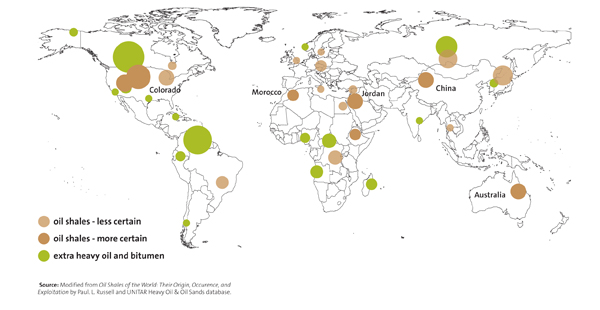
Map of unconventional oil reserves

Modified from 'Oil Sands of the World: Their Origin, Occurrence and Exploitation' by Paul L. Russell and UNITAR Heavy Oil & Oil Sands database.

Related

Efforts to develop oil sands in Alberta are serving as a model for many other nations eager to exploit similar reserves within their borders.

Huge unconventional fuel reserves -- extra heavy crude, oil sands and oil shale -- lie untapped across the globe. These resources emit much more carbon than regular oil, causing green groups to call them climate killers. So far, only a small fraction of the planet's unconventional oil has been tapped. Most countries lack the necessary capital, technology and expertise.

But Canada is helping to change that. The Alberta oil sands -- where sludgy bitumen is mined or steamed from the ground, then cooked or diluted with chemicals -- have become an unconventional oil extraction classroom.

Energy companies from around the world are learning valuable lessons in the northern muskeg. They're now eyeing reserves in Africa, Europe, Latin America, the U.S. and the Middle East. Some operations have begun producing. Others could start shortly.

Pushing the trend is a growing consensus that conventional sources of fossil fuels will become increasingly scarcer. World leaders are already failing to curb fossil fuel demand. Coming years will likely see more cars on roads every year combusting dirtier and dirtier fuel.

"Time is critical," reads a recent report from Friends of the Earth Europe, an international green group. "Unconventional oil resources are about to go global."

Era of high carbon fuels?

This May, that group released a dire warning about the planet's energy future, one virtually ignored by Canadian media.

Large-scale unconventional oil operations have so far been confined to Alberta's oil sands. But the industry is now poised for global expansion. That trend risks "tipping the world over the brink in terms of climate change," the Friends of the Earth report claimed.

Oil can be divided into two general categories. Conventional crude -- like that bubbling from the ground in the Beverly Hillbillies -- is still the mainstay of the world economy. Production from existing fields, though, could decline nearly 50 per cent by 2020, according to the International Energy Agency (IEA).

Unconventional crude is generally heavier, thicker and more difficult to extract. The resource must undergo an intensive refining process before it can flow smoothly in pipelines. All this emits a lot of carbon.

Take Alberta's oil sands. Extracting, refining and combusting a barrel of oil from there produces 82 per cent more greenhouse gases than conventional crude, the U.S. Environmental Protection Agency recently estimated.

By 2020, total carbon emissions from the Alberta oil sands could be nearly two times those now released by New York City.

Alberta is home to the world's second largest proven oil reserves, yet produces only a small fraction of total planetary supply. Most other unconventional deposits lie untapped.

That could change rapidly in coming decades. The IEA estimates high-carbon oil sands, oil shale and extra heavy crude will account for 11 per cent of global oil production by 2030.

"The problem is that the public is not informed about it," Friends of the Earth Europe campaigner Darek Urbaniak told The Tyee. "Our decision makers are not informing them."

Kuwait, China seek Albertan expertise

This June, Kuwait Oil Co. set up a lavish booth at Calgary's annual Global Petroleum Show. The state-owned energy firm had no product or service to pitch. It came merely to network, intent on learning "new technologies and techniques" for extracting unconventional oil.

"We thought the good practice is to be close to the champion, or the leaders in this area," a senior company engineer, Bader Al-Matar, told the Canadian Press.

Production from Kuwait's conventional oil fields -- which comprise about nine per cent of global reserves -- is set to decline. The country is now eyeing carbon-intensive heavy crude. It hopes to someday produce 270,000 barrels a day, but has little hands-on expertise.

Kuwait is talking potential partnerships with major oil sands producers Royal Dutch Shell, Total SA and ExxonMobil.

The oil-rich emirate isn't the only country looking for Canadian know-how. Trinidad and Tobago could have anywhere from 900 million to two billion barrels of oil sands-type crude. Its former energy minister was keen to follow the Alberta extraction model.

Chinese wealth funds and state-owned firms have pumped billions of dollars into Alberta oil sands projects over the past year.

The communist country presents a familiar story: dwindling conventional fields, soaring energy demand and untapped heavy oil reserves. Some analysts suspect recent Chinese investment is partly about education.

"What they would want to do is buy in with a partner that explains the technology to them," University of Calgary business professor Bob Schulz told The Tyee.

"They would send their engineers over here to figure out what we're doing in Canada, then go back to China and try to implement the Canadian technology on the Chinese fields."

Venezuela's heavy oil the 'biggest prize'

This July, Venezuelan President Hugo Chavez announced his country could soon have the biggest certified crude oil reserves on the planet. Governments regularly survey their energy deposits. A new study will likely wrap up this fall.

But Venezuela's reserves -- even if they do prove to be the world's largest -- are by no means easy to extract. Most untapped crude there is a thick substance comparable to Alberta bitumen. It must be heavily refined and diluted with chemicals before it can flow through pipelines.

"The most obvious environmental issue," reads the recent Friends of the Earth report, "is the sheer size of the deposits being explored, which will mean the release of huge amounts of [greenhouse gases] into the atmosphere."

Right now, Venezuela's unconventional reserves are not being developed at anywhere near the same scale as Alberta's. Many analysts blame the Chavez government, which nationalized much of the oil industry in recent years.

The state oil company, PDVSA, has been accused of mismanagement. And most American oil companies -- with the exception of Chevron, a major Alberta oil sands player -- refuse to invest in Venezuela.

"As long as this government is in charge, you run the risk of the rules of the game changing in the middle of the game," said Jorge Pinon, a research fellow with Miami's Florida International University and former oil company executive.

There's little doubt in his mind, though, that someday the country will become an unconventional oil superpower.

"Venezuela is the biggest prize out there," Pinon told The Tyee. "You and I know that conventional reserves throughout the world are declining -- and the world's appetite for oil continues to be there."

The new oil sands frontier

Scattered across the globe are many smaller, still tantalizing prizes. The African island nation of Madagascar -- considered one of Earth's most biodiverse regions -- may hold nearly 11 billion barrels of oil sands-type crude.

Production has so far been minimal. But Houston-based Madagascar Oil and Alberta oil sands player Total are actively appraising two fields. If deemed commercially feasible, the resource will likely be developed via open pit mines and deep steam injections. (The latter is a process pioneered over 30 years ago in Alberta).

In 2008, Italian energy giant ENI signed agreements with Republic of Congo leaders to explore for bitumen in the country's southern regions.

And Shell -- which operates a massive oil sands mine north of Fort McMurray -- partnered in 2007 with a Russian oil firm to develop unconventional reserves in Tatarstan.

Further on the energy horizon, oil shale development in Jordan, Morocco and the United States could add trillions of barrels to global fossil fuel reserves. But the process -- whereby a substance called kerogen is blasted from solid rock, then heated at high temperatures -- is extremely costly, water dependant and carbon-intensive.

Green groups regularly lambast the Alberta government for the speed, scale and environmental impact of oil sands development.

"In countries with weaker political and environmental governance frameworks," reads the Friends of the Earth report, "the consequences of [unconventional oil] expansion are likely to be devastating."

'Age of tough oil'

This February, U.S. military planners flagged declining oil supplies as a top security threat. The predictions came in a report on international security trends, prepared by the Joint Forces Command.

It estimated global energy demand will rise nearly 50 per cent over the next 20 years. Unless production keeps pace -- which the report deemed unlikely -- a "severe energy crunch is inevitable."

That could have major consequences, none good. Planners warned of future military conflicts in Africa and elsewhere, protracted recessions and even total state collapse.

"One should not forget," the report stated ominously, "that the Great Depression spawned a number of totalitarian regimes that sought economic prosperity for their nations by ruthless conquest."

But here's the conundrum: meeting energy demands won't necessarily improve global security. In past decades, most oil came from large, shallow reservoirs -- it merely had to be pumped out of the ground.

We've now entered what Michael Klare, a professor of peace and world security studies at Hampshire College, terms the "age of tough oil." The world's energy increasingly comes from difficult geological formations (Alberta), unstable dictatorships (Sudan) and deep offshore reserves (Gulf of Mexico).

"All of these remaining options present cost problems, political problems and environmental problems," Klare told The Tyee.

Ultimately, he argues, countries will have to switch to more renewable forms of energy. But the transition will be rough.

"It's probably going to take more disasters like the one in the Gulf of Mexico and higher costs," Klare said. "We'll need greater efforts by political leaders to educate the public about these risks."  [Tyee]

38  Comments:

Login or register to post comments

  • CanadianLatitude

    2 years ago

    Call it what it is instead

    Call it what it is instead of the company line. it is the Tar Sands!

  • realisticman

    2 years ago

    Canada Leads - again

    Yet another example where it makes one proud to be Canadian. We don't generally hoist our flag as readily as do some other nations but in this instance it is clearly that Canada is the place to be for the technology and expertise, as the world moves into the next century of oil development.

  • cyberclark

    2 years ago

    At what price do we pay for our Alberta Oil?

    Alberta is presently collecting the lowest prices in the world for royalty on the oil. This is because of Conservative dogma rather than operational efficiency.

    This Government stated target years ago was 16% of the world price based on NY prices. They announced a new energy program which did nothing other than change Alberta's take from US dollars to Canadian Dollars a loss to Alberta at that time of 18%!

    The pushed for bitumen up graders started when the press pushed for more Alberta Involvement and pressed for more Alberta Jobs.

    The Government complied and invented "payments in kind" in which producing companies sell their Bitumen to Alberta for 48 cents per barrel to pay their royalty. This is less money than we get for returning pop bottles!

    I would place our take at about 6% now and when you consider we pay for their power lines water and all their infrastructure, Alberans are paying the oil companies to take the resource out of province.

    This is why we have run away building and a total rip off of pretty much everything in the province!

  • Van Isle

    2 years ago

    I'd hate to tell ya this

    I'd hate to tell ya this realisticman but the technology for refining the Tarsands isn't owned by our Federal or Provincal Governments, it's owned by the oil companies. Not like in Norway where the technology to extract the oil from the seabed is owned by the Norwegian Government which has benefitted the Norwegians tremendously (for one, Norway has no national debt). What does Canada do? Why they give billions of dollars to the oil companies to start up the Tar Sands and let them keep the technology. That's not smart is it?

  • Ed Seedhouse

    2 years ago

    Tar sands!

    Please call them what they are, which is "Tar sands", not "Oil sands", which latter is just a damnable spin.

    Tar is not oil. Oil is only one of the things found in tar. Peanuts contain oil but a peanut isn't oil. Tar is not oil either.

  • G West

    2 years ago

    Nice to see

    Nice to see an increasing number of commenters taking issue with the equivocal attitude of the Tyee concerning calling things by their historically correct labels.

    I'm with writer in residence Andrew Nikiforik - they're the TAR SANDS.

  • Lia_K_N

    2 years ago

    focus on demand

    I believe that reducing demand is our best strategy to limit the production of dirty oil. Investing in transit and cycling infrastructures in urban centres (where most Canadians live) will ensure that people have a choice to opt out of driving. In addition, investing in green transportation technology such as electric or hydrogen powered vehicles will give those who choose (or need) to drive a better alternative.

    Much like the narcotics trade, as long as there is demand for oil, someone will supply it, regardless of the environmental or social costs. We need to reduce demand by making alternatives to gas powered vehicles a more convenient and affordable choice.

  • YCSTS

    2 years ago

    Get Real Folks

    This Rape-and-Pillage of the Earth for increasingly filthy, CO2 spewing, environmentally destructive fossil fuel energy sources will ACCELERATE as long as the people & gov't refuse to embrace the only alternative - which is of course Nuclear Energy.

    Curious how the Friends of the Earth quoted in the article are happily accepting big fat multi-million$ donations from Big Oil/NG foundations. Any organization that blocks Nuclear Power is promoting these disastrous Fossil Fuel energy sources such as Tar Sands and filthy Brown Coal(the Green Party's main source of Energy for Germany).

    If you have no alternative to fossil fuels - then fossil fuels will be burnt - that is just harsh reality.

  • Des

    2 years ago

    R'man

    talks foolishly about Canada's patriotism (flying the flag over a pile of destruction) and even more foolishly about "the next century of oil development." There is not a hundred years' worth of water (fresh water, that is, the oil solvent preferred by Big Oil) left within the Earth's land-based glaciers, the major source of DRINKING water around the world.

    Without water, and plenty of it, refining petroleum in any form will become extremely expensive. Perhaps that exigency will be the incentive for all of us to stay home, wherever that may be. Except that other people will want to come here "for the water."

  • realisticman

    2 years ago

    Des

    Do you think we should tell China to go back to the bicycle, just as we are in Vancouver? How about Venezuela, can't we convince Chavez to abandon the oil?

    "China's annual automobile production capacity first exceeded one million in 1992. By 2000, China was producing over two million vehicles. After China's entry into the World Trade Organization (WTO) in 2001, the development of the automobile market further accelerated. Between 2002 and 2007, China's national automobile market grew by an average 21 percent, or one million vehicles year-on-year. In 2006, China’s vehicle production capacity successively exceeded six, then seven million, and in 2007, China produced over eight million automobiles.[4] In 2009, 13.759 million motor vehicles were manufactured in China, surpassing Japan as the largest automobile maker in the world.

    The number of registered cars, buses, vans, and trucks on the road in China reached 62 million in 2009, and is expected to exceed 200 million by 2020.[5]

    The consultancy McKinsey & Company estimates that China's car market will grow tenfold between 2005 and 2030."

    That's easily 50 million cars per year, in China alone. In 2007, worldwide production reached a peak at a total of 73.3 million new motorvehicles produced worldwide. About 250 million vehicles are in use in the United States. Around the world, there were about 806 million cars and light trucks on the road in 2007; they burn over 260 billion gallons of gasoline and diesel fuel yearly.

    What will be the number in just 20 years time, 2030?

    Boeing estimates that the number of passenger aircraft worldwide could approach 32,000 by 2019. That's a 42% increase from current levels. Those are thirsty puppies too and as long as it's only around $500 to fly across the Pacific and $150 from Glasgow to Spain the price of oil will have to go up quite a bit before it becomes unattractive.

  • snert

    2 years ago

    Tar Sands - Oil Sands

    Ain't semantics fun.

  • Frank

    2 years ago

    r'man

    What do you suggest? That China should consume all the world's water via tar sand development?

    If that's your preferred scenario I think you need to take a longer view of things and perhaps you'll see the little problem the rest of us see. If you don't life is going to be awfully uncomfortable for you in the future.

    Unless you have it on good authority there's a water pipeline from Uranus on the drawing board.

  • SharingIsGood

    2 years ago

    Frank - what a riot!

    "Unless you have it on good authority there's a water pipeline from Uranus on the drawing board."

    Now that's the funniest one-liner I have read in months! With decades of Federal NeoLiberals/Conservatives and even worse running Alberta and BC, I'm becoming so cynical.

    SIG

  • realisticman

    2 years ago

    Water

    Don't worry Frank. If China actually decides that it wants the water there ain't much you or anyone can do about it. 'specially if your NDP get into even a foot-in-the-door power, since they'll cancel all military expenditures and anyone that wants anything will just walk in and take it.

    On the other hand, if the fresh water is something to be preserved the Chinese might just build a pipeline from the Arctic Sea and pump that in, or build a desalination plant if only fresh water is needed. Either way, once they get into gear, as anyone who's been to China knows, projects like that only take a few months or so.

  • Frank

    2 years ago

    r'man

    And when that's gone? What then?

    I assume you'll no longer be drinking water yourself and will instead donate your share to China?

    POE

  • Frank

    2 years ago

    Long term

    As I said above, people need to think about long term solutions which means longer out than the time it takes to drive to Tim Horton's.

    Which means we won't find any solutions from conservatives unfortunately.

  • realisticman

    2 years ago

    Frank

    I only drink wine Frank. What's your solution? Sell the truck and bike to work with 50kg of equipment strapped on your back?

  • Frank

    2 years ago

    r'man

    Wine only? Nothing but wine? That explains everything.

    As you were.

  • realisticman

    2 years ago

    Frank

    Have you called Chavez yet? You've gotta tell him that oil is passeé and we're all buying bikes.

    C'mon Frank, don't be shy. Tell us your solution.

  • Frank

    2 years ago

    r'man

    China should use its own oil and water. As should other countries. If they can't support their populations without taking other people's resources maybe they should consider the source of their problems.

    But that argument would be lost on you since you're drinking wine all the time and think the 20th century is ancient history.

  • realisticman

    2 years ago

    Frank

    So what you're saying is that if you live in Switzerland you should never eat seafood because you ain't got no seashore. No more oranges and lemons for us northerners. If you can't grow it you can't eat it. If you're born in Poland you can burn coal since it's in your mines but you can't have any iron ore to make metal because you ain't got none in the ground there. No bauxite, no aluminum. No oil, no plastic. If you live in Jamaica then no bread for you because our wheat is only for us and since you can't grow wheat stick to bananas.

    You know what Frank? It's all bananas.

  • Frank

    2 years ago

    r'man

    Not at all, its quite logical.

    Much more logical than living in air conditioned houses in Arizona burning energy imported from Canada at a cost of 4 barrels of water per barrel of oil and importing your toilet water from 1,000 miles away.

    My idea is sustainable and takes into account little things like geographic reality.

    Yours ignores reality which is probably why you drink alcohol all day.

  • realisticman

    2 years ago

    Frank

    I didn't say that wine has any alcohol in it. Don't jump to conclusions, again.

    How about the wheel Frank? It has been invented and it's often fitted with rubber tires. In the northern countries, like all of Europe and North American, do we have to go back to wooden wheels since the rubber tree comes from Asia?

  • Frank

    2 years ago

    r'man

    Does your wine have water in it? If so, any ideas on how that will continue given your propensity to wreck the world's water supplies?

    Are you going to come up with a single solution grounded in reality or are you going to continue to live in fantasy land?

  • realisticman

    2 years ago

    Frank's Fantasy Land

    I'm on your side. We get rid of all our cars. Close down all our mines. Close our airports. Then China and India will say, yes that's the nice way to live, we should go back to bicycles and donkeys too. Simple, eh?

  • Frank

    2 years ago

    r'man

    Is it the wine that makes you incapable of having a serious discussion?

  • Frank

    2 years ago

    Just one

    If I could get just one serious idea from you I would be happy.

  • Frank

    2 years ago

    Too much?

    Its not like I expect a lot from you Charles Adler/Glen Beck supporters.

    If even as a group you had one real idea and all claimed it for yourselves I would accept that.

    But then I look at your leaders like Harper, Campbell, Palin, Bush and realize I'm flogging a dead horse.

    I'll even accept something you read on the side of a bottle.

  • G West

    2 years ago

    @ Frank

    Serious ideas from some interlocutors are passeé

  • G West

    2 years ago

    The saddest part of this story

    Is that things will get a lot worse before they get better

  • Frank

    2 years ago

    GWest

    That's the saddest part of a lot of stories around here.

    The subsidies, both direct and indirect, the environmental destruction, are huge costs borne by the public.

    Companies profit, their shareholders, many foreign, get rich and some workers make high salaries for a few years. But nothing compared to the damage caused.

    The overall cost to taxpayers and the environment exceeds the return. We'd be richer by leaving the land as it was.

  • zalm

    2 years ago

    R'man's drunk

    "didn't say that wine has any alcohol in it. Don't jump to conclusions, again."

    By definition, wine has alcohol in it. Fermentation's products always include alcohol. Even dealcoholized wine has half a percent or so left.

    But after Frank rubbed your nose in your own shit thirty-odd times in a couple of hours, I'd expect you not to be able to smell too good, although I'm surprised you don't think too well either. As I recall, you had a bit of an education from our socialist education system that your parents didn't personally have to pay one thin dime for if they didn't want to.

    Well, don't let me hold you up - you're probably itching to try the new reality-enhancing properties of water from ...mmmmppphhh..... URANUS as much as I'm wanting to watch you...

  • realisticman

    2 years ago

    zalm

    Thanks for pointing that out. You're right, once you get really into the third gallon you start to feel that half percent. I'm reformed now. Now I'm really into this great juice stuff. It's called Happy Planet, which I really like the sound of and, I don't know what's in this stuff, but man - I am pumped!

  • macdonald

    2 years ago

    great topic, but...

    Hi Geoff. I have been on this trail for awhile now, but there are a few major issues with this piece. First, the government of Trinidad and Tobago has changed hands. Conrad Enil is long gone. The new government has not made any statements as to whether or not this plan has the go-ahead. They have, however, already produced bare minimum levels of In-Situ in a different part of the island, so they know it is possible.

    Madagascar has likely 20 billion barrels of recoverable, and has already produced, again, in-situ tar sands bitumen. They experimental strip mining is just completed and by 2018 they predict just under 200 000 b/pd.

    Venezuela is very hard to get real numbers about, but they are much further along than you imply. They are already producing at minimum 300 000 b/pd.

    And, perhaps most disturbingly, Jordan and Israel are looking to team up on the operation of strip mining the Jordanian tar sands deposit and the Negev deserts oil shale deposit, that are almost on top of each other. They have even stated a willingness to collaborate on getting nuclear reactors in Jordan for the power to do this.

    At any rate, yes it is Canada-- in most cases-- providing the technology, but to say corporations won't go into Venezuela is simply false. In fact, Shell is operating a large in-situ operation where they brag about using the technology available at their Peace River plant in Alberta. They don't also brag about the fact that in Peace River the highest rates of water use for any tar sands operation have been recorded.

  • G West

    2 years ago

    @macdonald - Dirty OLD oil industry

    Good points...we could add several others to support the obvious fact that Canada is 'leading' the world as it goes down the rabbit hole toward environmental ruin - which is similar to saying that Iran leads the world in exploring ways to expand the range of methodologies available to practice capital punishment. In some arenas, as they say, everything old is new again…

  • Sockeye

    2 years ago

    aahh

    It's called Hubbert's Peak and it's going to hit us hard!

  • geoffdembicki

    2 years ago

    re: great topic, but...

    Hi Macdonald,

    Thanks for your comments. Reader input is always appreciated. Your point about Trinidad and Tobago is well taken. A correction will be posted shortly. I took the Madagascar figures from the Friends of the Earth report, which in turn referenced field summaries on Madagascar Oil's website. The Bemolanga field has "in excess of 9 billion barrels of oil reserves in place." http://www.madagascaroil.com/about_developmentprojects_bemolanga.php
    The company estimates 940 million barrels for the Tsimiroro field. http://www.madagascaroil.com/about_developmentprojects_tsimiroro.php
    As for Venezuela, my article simply states production is not "anywhere near the same scale" as Alberta. Even 300,000 b/pd is much less than the 1.5 million b/pd produced in Canada, especially considering the potential scale of Venezuela's resource. Multinational oil companies would love to invest huge in the region -- as Pinon points out, it's the "biggest prize out there" -- but the Chavez admin is a real disincentive. "They are desperately inviting people back in, but no one's going there," Shell's Chief Financial Officer Simon Henry said this March. For space reasons, I didn't go into specific details on Jordan's unconventional oil reserves. But if anyone is interested, I provided the link to the Friends of the Earth report, which has excellent info.

  • wiley

    2 years ago

    EROEI

    The one factor not emphasized enough here is EROEI - energy return on energy invested. That's a more accurate way to describe "tough oil". Shallow wells of sweet crude were 100 to 1, but now we are already mining and steaming gritty bitumen with an EROEI of at best 5 to 1. By the time we get down to the utterly pointless 1 to 1 grade of junk, it will be too late for a fix anyway - we will have boiled all the frogs on this planet, without finding another one ready to move to.

    It's time we invested all our energy in preventing our impending extinction, not hastening it.

    • The discussion for this story is closed. No more comments can be added.