
News

Why Europe Could Decide Fate of Canada's Oil Sands

Tories and petro firms worry oil sands restrictions in Europe will spread to other key nations. They're lobbying hard to prevent it.

By Geoff Dembicki, 20 Oct 2010, TheTyee.ca

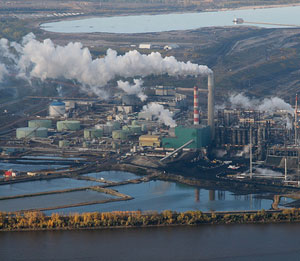
SuncorPlant

David Dodge, The Canadian Parks and Wilderness Society.

Related

High-ranking Canadian officials and several of the world's largest oil companies are fighting attempts by the European Union to deal with climate change. They're lobbying heavily against a fuel standard provision proposed last year, which they fear will restrict energy imports from Alberta's oil sands, a high emitter of greenhouse gases.

This informal coalition scored a major victory earlier this March, and is now doing all it can to defend it.

What makes the lobbying push unique is that very little Albertan fuel actually gets sold in Europe. And yet European officials are getting the regular hard sell from oil sands firms and their friends in Canada's government.

"It is not because we are protecting a customer base [in Europe]," Alberta Environment Minister Rob Renner said, "but because we respect the fact that decisions in Europe find their way into other policies around the world."

Previous European emissions initiatives have been copied in China and India, suggesting oil sands restrictions could set a global precedent. Canada is right now trying to set a different one. Ongoing trade negotiations with the European Union -- which are entering their fifth round in Ottawa this week -- may result in the most comprehensive free-trade agreement of all time, as early as next year. Canada's EU ambassador Ross Hornby confidently predicted this vision of open markets would "send a strong signal to the rest of the world."

Will Europe enact tough climate legislation, or appease its Canadian trading partners? Green observers in Brussels and beyond worry an international reputation is on the line.

"If we miss this opportunity," Jos Dings, director of the sustainability group Transport and Environment, told The Tyee, "I don't know where Europe's credibility stands."

Larger carbon footprint for oil sands fuel

The story begins in 2007, when the European Union proposed a revised law designed to reduce the carbon footprint of road travel. Policymakers recognized that extracting fossil fuels from the ground, processing them in refineries and combusting them in car engines releases lots of greenhouse gases.

By 2020, the Fuel Quality Directive mandates that suppliers must shrink the combined carbon footprint of all transport fuels used in the European Union six per cent below 2010 levels. The proposal became a major lobbying issue for Canadian officials and big European oil companies once policymakers got specific about how targets would be met.

Most of a fuel's carbon footprint comes directly from the car or truck engine where it's combusted. These so-called "tailpipe emissions" vary little from fuel source to fuel source. Any significant disparities come from the extracting and refining stages.

Take Alberta's oil sands, where a viscous substance called bitumen must be clawed or steamed from the ground, then cooked at high temperatures and diluted with chemicals. The U.S. Environmental Protection Agency estimated the process creates 82 per cent more emissions than that for conventional oil.

European policymakers last year proposed measurable carbon footprints for each fuel type it uses. In theory, suppliers would seek out lower-emissions energy, giving producers incentive to become more efficient. With the exception of coal-based road fuels, oil sands got by far the largest footprint, a full 20 per cent bigger than standard petrol. Cue the lobbyists.

Canada ambassador, oil firms press together

A new Fuel Quality Directive draft this March dropped all reference to the oil sands. Green observers were aghast. What reason would suppliers have to source lower-carbon fuels, they argued, if under the law all were considered equal? Twelve environmental groups even warned that the reversal could "undermine the whole purpose of this landmark piece of legislation and therefore put its future in jeopardy."

A tersely worded letter two months earlier from Canada's EU ambassador Ross Hornby to the head of the European Commission's environmental department likely played a role. He cited studies putting the carbon footprint of oil sands crude at "only 5 to 15 per cent higher" than conventional oil -- and lower, even, than some fuel already entering Europe.

"A separate category for oil sands, therefore, is not science-based and would amount to unjustifiable discrimination," Hornby wrote.

Canadian officials weren't the only ones concerned. European oil heavyweights Shell, BP, Total and Statoil all have investments in the northern Alberta muskeg. Voluntary lobbying records -- though in obvious ways incomplete -- give some indication of fossil fuel influence. Shell, for instance, reports it spent 400,000 to 450,000 Euros "representing interests to EU institutions" in 2009.

Transport and Environment's Dings, currently based in Belgium, said the Dutch fossil fuel giant is "red hot" on the Fuel Quality Directive. "They have a very well-organized, very deeply-entrenched lobby in the [European] capitals and Brussels," he said. "They make sure that their presence is heard."

Eager to block green precedent

Early this October, facing pressure on all sides from green groups, Canadian officials and petroleum multinationals, European policymakers delayed a decision on oil sands fuel until late 2011, when in-house scientists will release their own emissions study.

Bearing in mind that almost all Canadian energy goes to the United States, why so much commotion?

"It's very unlikely that oil sands crude will be exported to the European Union anyways," said Jason Langrish, executive director of the Canada-Europe Roundtable for Business, a group representing more than 100 chief executives pushing for greater free trade. "But [the Fuel Quality Directive] establishes a precedent, and when that precedent gets established, then perhaps the United States could also follow."

That kind of forward-looking fear helped motivate two overseas trips by Alberta cabinet ministers over the past several months. Iris Evans, minister of international and intergovernmental relations, travelled to London and Brussels last April. Records show she met with one of the European Commission's top climate change officials "to discuss Alberta's concerns with the draft European Union Fuel Quality Directive."

This May, environment minister Rob Renner schmoozed with EU policymakers in Brussels, between stops in London and Strasbourg, France. "The direction that we see, wherein Canadian oil sands are not specifically targeted, is one that makes sense to us," he told European Voice during the trip. Both politicians talked up Alberta's green credentials, likely including a $2 billion investment in controversial carbon capture and storage technology.

"We found that in working with the EU, there was still a knowledge gap that needed to be addressed," Renner wrote in an email to The Tyee.

The pipeline connection

Fears of restrictive oil sands policies spreading from Europe to other parts of the world are perhaps not unfounded. The European Union, though still one of the world's largest greenhouse gas emitters, began initiating a series of automobile air pollution standards in the mid-1990s. These limits on exhaust emissions for new vehicles have been growing more stringent -- and influential -- ever since. "With a couple of years delay, they're copied virtually everywhere in Asia, except Taiwan, South Korea and Japan," Dings told The Tyee.

Consider now that Enbridge's proposed $5.5 billion pipeline to B.C.'s west coast is based on the tantalizing prospect of shipping oil sands crude to buyers in China and beyond. A world of open markets is clearly in the best interests of both Alberta's fossil fuel industry and the provincial and federal governments it bankrolls. Such a world is being created in ongoing free-trade talks between Canada and the European Union, which entered their fifth round in Ottawa this week. Policymakers ultimately aim to eliminate most non-tariff barriers to trade, including, apparently, a Fuel Quality Directive that targets oil sands, or anything like it.

"We would oppose that type of [fuel emissions] legislation because it goes against the spirit of the [free trade] agreement that we're trying to negotiate," Langrish told The Tyee. A comprehensive trade deal, said to be worth $12 billion to Canada's economy, could be signed as early as next year.

Canadian officials hope foreign policymakers take notice. "It would reinforce the message to the rest of the world about the importance of further liberalizing trade," Ambassador Hornby said in a speech this June.  [Tyee]

34  Comments:

Login or register to post comments

  • RickW

    2 years ago

    Maybe......

    .....if the tar sands lobbyists distributed a little maple syrup.......?

  • Jeffrey J.

    2 years ago

    Government Shouldn't Support Free Enterprise

    Remember the theory behind bare-knuckled capitalism?

    Government should stay off the backs of the citizens (and the backs of corporations). Government shouldn't pick winners and losers. Government shouldn't subsidize one industry at the expense of another.

    If a group wants to organize for a local bridge to be built, or a co-op, or a machine shop, they are all "free" to do so, and as long as government stays out of the fray, the cream will rise to the top. The strong will survive. This is the theory and principle behind the policies of Harper, Campbell, Bush, Stelmach, Preston Manning and the Fraser Institute.

    Based on their "strong, principled" stands, how principled are they? A number of answers come to mind. Hardly. Barely. NOT. Unprincipled. Completely deceitful.

    This article explains the real principles behind bare-knuckled capitalism. There are none, except greed and power. If the government is a friend of your industry (Big Oil, fish farms, banks, insurance), it's all good. If not a friend (everyone else), it's bad.

    This is pretty much how the rest of the non-democratic world operates. So I guess we're not alone.

    Great coverage.

  • Glen Murtz

    2 years ago

    Oh - this sad day.

    I've been counting the days until even the most progressive of news outlets falls for the steady application of convenient phrasing by vested interests.

    Sadly I see the Tyee has succumbed.

    These are TAR SANDS - not Oil Sands.

  • Illahie

    2 years ago

    Don't worry, be happy

    1 The science of oil sand extraction is evolving rapidly.

    2 Global Warming is dead.

    3 The globe, or at least the Pacific Ocean is now cooling rapidly.

    4 The resource is huge, and so is the demand.

    5 C02 is a nutrient, not a disease

  • Jerry Munro

    2 years ago

    Europe and Oil

    Probably nowhere in the world, including the US, is more in need of and dependent on "foreign" oil supply than Europe. Which would tend to make one think that they, of all places, would likely be more ready to receive tar sands oil.

    "Oil:
    45% of EU oil imports originate from the Middle East;
    by 2030, 90% of EU oil consumption will have to be covered by imports

    Gas:
    40% of EU gas imports originate from Russia (30% Algeria, 25% Norway);
    By 2030, over 60% of EU gas imports are expected to come from Russia with overall external dependency expected to reach 80%.

    Coal:
    By 2030, 66% of EU needs is expected to be covered by imports. "

    Taken from:
    http://www.euractiv.com/en/energy/geopolitics-eu-energy-supply/article-142665

    But the other reality about Europe is... they have the immense reserves available, piped and at their doorstep, of the old USSR and allied states. Such that their need and capacity to be some choosy is "perhaps" greater than one might think. (There are complex issues re the "surety" of this supply however, as the recent problem of the Ukraine pointed to.)

    Though, as current capitalist Russia continues to recover from the collapse of the old Soviet Union, and to further develop and "modernize", assumedly... Though much is contingent on the economic fates of Western and global capitalism generally. Currently not looking or moving in an overly optimistic direction. ...but anyway, generously assuming, one can expect them to utilize more and more of their supply at home, and what is made available to export to become more expensive for Europe. In all likelihood.

    Which is why, after being squeamish and resistant in the early days of the US inspired Iraq and Afghan war, they are there helping the US Empire cause nonetheless. It's called covering your ass and leaving other options open in case, by not totalling alienating themselves from the major imperialist player in the region, the US. They just MAY need to call in that card, and hopefully get something of a "share" if the US, against all current appearances, ever does finally succeed at tapping into the oil supply of the Northern 'Stan states, and is finally able to complete that oil pipeline through Afghanistan to the Arabian Sea, and Empire tankers.

    In short, Europe's strategic "oil supply placement" in the global capitalist arrangement is complex. It is not without its strategic vulnerabilities. But currently at least, and relatively, their situation seems more or less good, which may win them to what they probably idealistically and practically would like to do, say, "No." or impose severe restrictions on our tar sands export supply. (As big a problem as air pollution is for ourselves, it is an even bigger and more immediate problem for Europe, I would think.)

    Nonetheless, as occurs everywhere in "endless growth" capitalism, economics WILL be the final deciding factor.

  • freebear

    2 years ago

    Energy Super Power dreams

    of Harper will be pursued; we already are a 'petro dollar'!

  • Talon

    2 years ago

    Global Trade and Trade Agreements

    It seems to me that in all things political, economical, and social, the planet must rank first. All decisions should be based on whether the idea under discussion is good for the planet or not. If the idea is good for the planet and leads to increased sustainability, our species will survive. The current trade-agreement negotiation between Canada and the EU does not favor the planet nor does it increase further sustainability of our species.
    That's 30 from Talon on the West Coast.

  • Jerry Munro

    2 years ago

    Dichotomy of The Ideal and The Real...

    "All decisions should be based on whether the idea under discussion is good for the planet or not." Talon

    As much as I agree with you that this is the "ideal", the "reality" is more likely that given the pressures of this self-interest (in the narrow sense) driven, "endless growth" need of current capitalism, likewise a "narrow definition" economic interest will continue to function and dominate along with it. Which is not to say that it is not useful or even desirable that, for so long as "the system" continues to rule, there should not be maintained pressure on it to behave in the broadest "planetary interest. Such pressure certainly should be maintained, even grow, such that it simply cannot be ignored by the real powers behind "The System".

  • G West

    2 years ago

    @Glen Murtz - don't give up the ship!

    Actually, the Tyee is schizophrenic with respect to the usage they employ on that score.

    You'll find Dembicki uses 'oil sands' more or less exclusively while writer in residence Andrew Nikiforuk almost always says 'tar sands'.

    I think Beers explained the strange dichotomy once upon a time when I brought it to the attention of the editors - it seemed a poor excuse then and, to my thinking, still does.

    The term, historically, is TAR SANDS and, as Nikiforuk points out in his book by the same name, that usage comes closest to describing the product and its noxious associations.

    'Oil Sands' on the other hand, is almost exclusively the usage chosen by those who wish to downplay the environmental costs of the whole resource play in Northern Alberta.

    Suffice to say, I think you're correct AND, as you too seem to think, it's a battle worth fighting at every opportunity.

  • Paddon Developments

    2 years ago

    " Sask. Heritage Fund?" Alberta.

    I really like our oil and gas industry. We have to direct it. We can ask the UN, EU, and other OAS to protest for enviro. water use, but they can't control our resources and Agriculture is also our resource. A block, industry or an agricultural block that " BLOCKS US AND OUR ECONOMY," no Thank You, Anna Paddon

  • RickW

    2 years ago

    Jeffrey J.

    Quote:
    If a group wants to organize for a local bridge to be built

    Ah! And therein lies the "problem" with "bare-knuckled capitalism". SOMEBODY has to decide where the bridge should be built, and well, shucks, whoever does decide should darn well subsidize it then...........

  • Jerry Munro

    2 years ago

    another shape shift...

    Just to calrify, so there is no mass confusion, I be the coyoteman, who has simply decided to use his real name.

    No, I really don't know why. Just decided to.

  • sdgreen

    2 years ago

    Fuel It is

    The fundamental issue here is the need for fuel to keep industries, transportation, home heating and so forth available. Right now petro carbons in one form or another is the fuel of choice.

    Whether we like it or not, the Tar sands are a resource to provide that fuel. Until somebody comes up with another type of fuel that is our choice.

    Wind power, solar power, tidal power at this point just does not make the cut small or big. Nuclear is sustainable and likely cleaner than the tar sands, but there seems to be too much opposition for that to fly.

    Europe in my view will have zero effect on the Canadian market. If the EU imposes too many rules and regulations, they will simply be left out in the cold that is the reality.

  • RickW

    2 years ago

    sdgreen

    That is much like saying that old people should be euthanized - because they are going to die anyway...........

  • sdgreen

    2 years ago

    RickW

    Ok let us immediately stop using petro-carbon based fuels.

    What is your solution?

  • Jerry Munro

    2 years ago

    What is your solution?

    "Ok let us immediately stop using petro-carbon based fuels.
    What is your solution?" sdgreen.

    It can't be done immediately, of course. That's unreasonable, I think. But we do need to move posthaste, facing square up to the realities of peak oil and our growing polluition of the planet... our ever more shitting in our own nest, and begin to deal with the "endless growth" imperative built into a greed based economic system.

    1.) We need to "democratize" the economic system, in order to give the whole citizenry a stake, sense of ownership and control over the outcomes and effects there, instead of ever feeling they have no options save surrendering to the will, whims and caprice of a very small ruling elite. Additionally to share at least more "equitably", as will alone ensure greater relative "social harmony/peace" without ever present class warfare (strikes etc.) as:

    2.) Programmes to maintain in some cases, and in others to reduce, but overall to get to a quanititative place of and maintain more "sustainable" human population levels and allow greater "bio-diversity"... Over the course of which religious doctrines that like capitalism seek "endless growth" in fulfilling the commandment of their Deity to "multiply and fill the earth" with people, however crammed cheek by jowl and crowding other species to extinction, must be up front challenged and dealt with. (They may want the arrival of an early date End Time, but most of us will not.)

    3.) In short, based upon the principles of the fullest democracy, equity and non-exploitation, we need to arrive at a place of more moderate populations AND more rational, sustainable consumption. The dynamic of Endless Growth built into capitalism, which has been of some great "modernizing" use historically, needs now to be extinguished/controlled, and in its place a socio-economic system based on equity and sustainability introduced.

    Conclusion: Short of which, the above, all techno fix solution attempts in equipment or design alone, be they however "green", will, IF endless growth capitalism is allowed to continue, sooner or later in turn be overwhelmed by continued endless growth in numbers, prodution and consumption. It is a kind of suicidal insanity. (Consider Easter Island, the Mayans etc.)

    Which does not mean that we/humans should not continue to attempt to improve all the ways in which we do things, aiming for a planetary closed loop system that is hopefully, endlessly sustainable for the time of the planet's life expectancy anyway. Nor does it mean, I don't think, that we should not continue to aim for the stars.

    Don't know what a closed loop system is?
    http://en.wikipedia.org/wiki/Closed_loop

  • Jerry Munro

    2 years ago

    Spelling...

    My apology. In the above piece, I neglected to run spellcheck.

  • Conductor274

    2 years ago

    UN security council seat

    It's easy to see why Europe and most other nations in the UN rejected Canada's bid to have a seat on the UN security council. They are at odds with most of the world because Harper and his crew don't believe the science on global warming. Instead they lobby on behalf of the dirtiest oil production the world has ever seen.

  • G West

    2 years ago

  • Jerry Munro

    2 years ago

    Mr. Laughy's Highway 12

    That's one of those stories, re Mr Laughy, that tells you, the American people are certainly far from all bad. He reflects the new morality that needs to and is awakening.

    The Empire Heartland, over populated and over developed as it is, though also having rid itself of much of its heavy industry offshore, still has a great "junkies fix" need for oil, no doubt, that may in the end win out. But, and it's a big "but"it comes up against that growing awareness in the US, the same as throughout the "developed" western world.

    Interesting link GW.

  • sdgreen

    2 years ago

    Jerry Munroe - What is your Solution?

    Very interesting post!

    Just about every normal person of what ever political stripe acknowleges that something needs to be done to stem the exploition of not only hydro carbon based fuels, but also a number of other resources.

    Your position is:

    1. to 'democratize' the economic model
    2. to limit human growth, and
    3. to establish a socio-economic model of sustainability.

    All good points, but, this must be an entire package and adopted worldwide. Will such happen in the short term? In the long term? I thing not as humans are way too competitive, and indeed how would one stop the 'black' market?

    There was a gentleman some 45 years ago who said (at that time) that the economic status of the world could not be sustained. HIs solution was for the creation of a world currency, assignment of world production of goods, food, and whatnot, restricted by country; e.g. Canada wheat, Iron, Spain refigerators/wine, United States airplanes etc. Perhaps he was ahead of his time. (can't find the reference to this chaps ideas, but such were published in the major newspapers for several years).

    How to control human reproduction is a major challenge in any given political system. But your point is well acknowledged. There is no question in my mind that we are witnessing the certain upheavel as the world population grows.

    This brings us back to the question of energy consumption, and that will be very difficult to reduce.

  • the real ODB

    2 years ago

    PLEASE!

    Earth to Illahie. Earth to Illahie. Come in dammit! You've been infected by a mutant neocon gene. There's no hope for you. Abort! Abort! The Humanity!

  • G West

    2 years ago

    Thanks Jerry!

    Tip of the hat to you too...

  • RickW

    2 years ago

    sdgreen

    1] Voluntarily stop using oil - and suffer the consequences;

    Or

    2] Have it stopped - and suffer the consequences.

    It doesn't much matter to me. But to find a so-called "solution" that keeps things running the way they are, is not a solution at all.

    Jerry Munro posted in another thread that it's time to look at everything 90 degrees from the way we view it now. He is right, and anything else merely encourages the unsustainable march we are on now.

  • samuidave (not verified)

    2 years ago

    That which cannot go on forever...

    doesn't.

    I don't recall who said this first, but that is our predicament. The longer we delay moving in a direction which can be sustained, the more fallout we will be faced with.

    So who is going to step forward in our political system and lead the way against the globalist Empire and military-industrial complex?

    Yeah, just what I thought. /sarcasm

  • samuidave (not verified)

    2 years ago

    That which cannot go on forever...

    doesn't.

    I don't recall who said this first, but that is our predicament. The longer we delay moving in a direction which can be sustained, the more fallout we will be faced with.

    So who is going to step forward in our political system and lead the way against the globalist Empire and military-industrial complex?

    Yeah, just what I thought. /sarcasm

  • Jerry Munro

    2 years ago

    National Self-Sufficiency vs Corporate Globalization I

    "All good points, but, this must be an entire package and adopted worldwide. Will such happen in the short term? In the long term? I thing not as humans are way too competitive, and indeed how would one stop the 'black' market?" sdgreen

    I'm less certain than you that it is an entire, world wide package that must happen. I see no reason why not, if we dispense with the "globalist economic notions" of the gentleman you refer to, and instead turn to a "maximum self-sufficiency" model, that one country alone could not at least "begin" movement in the direction I suggest.

    There are "security" issues/risks with my model proposal, that come from places such as the US, for sure, but they and the world are fast changing in the emerging socio-economic environment. Keep in mind that already, in the prevailing crisis environment that global capitalism is already moving into, there is increasing talk and measures being contemplated and taken to "protect" national currencies and economies. Increasingly, countries are discovering that this "global capitalist development direction", while it serves some such as the US, China, Japan and Germany very well, is in fact destructive of much of the economies (and environments) of the rest of the world. I would argue, our own included.

    We shall have to see how this all continues to unfold of course, but it is more and more appearing that a return to "national self-sufficiency" rather than the "corporate globalization" model MAY in fact be the real future that happens here. (Which does NOT mean zero future global trade, but that it is tamed and put in its more proper/appropriate place and perspective. Folks, while prudently protecting their own economies, and maximizing their own "self-sufficiency" are still going to have and need things unavailable to themselves... hence some international trading will always be there. But not as everyone's "reason for being", as in the current corporatist model.)

    And some parts of the world that MAY just be irretrievably environmentally and resource destroyed MAY just have to be abandoned, for a greater or lesser time, to human habitation. Tragic but true. As a species too, we do have to expect to pay for our crimes.

    continued next post...

  • Jerry Munro

    2 years ago

    National Self-Sufficiency vs Corporate Globalization II

    from previous post...

    So, while I appreciate your interest in my analysis, I think you are wrong re your assumptions on the absolute necessity, unavoidability of continuing with the corporate "globalization" model. It is a solution to nothing. It is, in fact, a big part of the source of the problem... endless growth and expansion.

    Though doubtless, the global relationship of people will continue to evolve and mature, just in a different direction than those of corporate "free market" assumptions.

    For I do tend to agree with the "contrarian"view of the world, which says, "If the herd is all going this way, you may at least want to consider going the other." :-) And in this case, I think the contrarian view has it.

    My view... not a claim to biblical revelation though. :-) We shall have to see what time and further development reveals to us. :-)

  • Jerry Munro

    2 years ago

    Who, What, When, Where, Why and How...

    "So who is going to step forward in our political system and lead the way against the globalist Empire and military-industrial complex?" samuidave.

    Nobody else seeming to dare to step forward to speak to this most important question of all questions posed by samuidave, I will take a stab at it.

    As yet, no persons or group yet powerful enough to have credibility has stepped forward to take up "The Cause", which goes fair begging for action. Certainly NONE, nada, zilch of the parties to Canadian capitalism. They are mute or muted. Certainly the organized labour movement has surrendered its sword and contented itself with the status quo. Nor any group of learned scholars. Nor virtually anyone, save a few of us here, fair bleating like lambs in the wilderness. :-) Eh, my friend?

    Which does not bode well, to be sure.

    Still, we are yet early days into this developing crisis of the capitalist economy, if deeper into peak oil and the evidence of larger environmental and climate issues. Though in the final analysis, people will, I suspect, be moved to act on the latter environmental issues, only when the former economics of capitalism are impacted more serious even than currently. The oil crisis in the form of gas prices and effected economic activity, obviously yet has some distance to run before people become alarmed enough to act.

    And you may be right. It may by then even be too late. We shall have to see.

    Sometimes a whole lot of talking about a thing AND being smacked up the side of the head by a 2X4 has to go on and occur first, before most folks will even start to fidget and maybe think about it. That's just the human way. (Even then, it's only a "critical mass" that's needed, not 100%. The rest, we just need to neutralize... convince to at least not support the enemy. :-)

    And we're still just, in still relatively small circles, at the talking about it and analyzing stage. Hot air is cheap. :-)

    On the other hand, like I've said elsewhere, shit can suddenly go down fast and folks suddenly start moving. It last happened in the 60s around Vietnam, and before that during the Great Depression and the War Against Fascism. The point being, that "stuff" can sometimes go down real fast, and the world turn virtually overnight.

    This is something that isn't going to be able to be ignored forever. You know that. The only questions are, how much pain is there going to have to be first, and will it be too late or not?

    For which answers there are no really accurate crystal balls of which I know. :-)

    Peace and the revolution, bro. Despair certainly gets you no where.

  • sdgreen

    2 years ago

    Jerry Munroe - you do amplify the courageous.

    Jerry, I have always taken your contributions with a stroke of focal thought and new synthesis on the subjects at hand. We have proposed local versus global application to the issue at hand, and I say without reservation that the only way to solve this issue is global. We can no longer discuss local application in any economic subject in any column. The fact is all the world is in a global system, and that for better or worse, is the reality for every commercial activity on this planet.

    Energy issues are paramount for human existance, and we need to find effective solutions to this issue. This is NOT a Political issue on a local platform; it is a global problem. Politics of the right or left simply are not value added.

    I do think however that politics have severely hampered the solutions to the issue and we do need another avenue for the comman person to deal with the issue.

    I am a right wing chap, but I do find your concepts of great interest, most of which do not fit in the right/left of the spectrum.

    I take interest in your posts.

  • Jerry Munro

    2 years ago

    Agreeing to Disagree I :-)

    Thank you for your compliments, sdgreen. I from time to time, especially when busy with other things, skim down a comments column, looking for names I consider worth reading. Your name is one of those rwing names I always stop at and feel I must read... and respond to. :-) Which says something. :-)

    We are disagreed on capitalism, which is fundamentally why we disagree on this "globalization" issue. I understand that, and the "imperative" that is driving capitalism in that direction.

    That said, I accept also that a "global" relationship between all nations and peoples is a fact of life. It will doubtless continue and evolve. And some, I would argue reduced "levels of trade" will always go on between us. (Once the issues of "cheap labour" motivation and imperialist "theft of resources" are removed from the driving equation, such as exists.) Though I also place greater emphasis on the importance of "maximized" economic self-sufficiency of nations too, for many democratic, practical environmental and wellbeing reasons, that are not so important when "private profit" is the dominant issue.

    (Some agreements on "sharing" of resources may also evolve in future as well, especially as over-populated parts of the world, such as the US, China etc, Europe, bring their populations down to more rational levels in relation to what their land bases will actually independently support. Such states however, must certainly not be allowed to "assume" the right to other people's resources by military or other means, however they veil their true motivations.)

    There may even be, over time, a growing kind of at least "interaction" occur at the level of the UN, for example. (Assuming too that Big Power bullying and special veto and other rights are finally dealt with, so that there is a greater degree of "rep by pop" and "regional" equity rather than simple military and economic power criteria as the dominant factor. The Security Council has got to go for example. It is merely a "control" and "imperialism legitimizing" instrument of the big capitalist powers, particularly the US Empire.)

    But outside of that, sovereignty and control of national "democratic institutions" and "economies" needs to rest, as the most actually effective and "democratically desirable", in my view, the closest to home, closest to local, in the historically evolved "nation states"... at least for the future so far as I can see. Even then, issues of more local representation and control over national distances and varying interests can be strained enough. (BC and Ottawa. Alberta and Ottawa.) Which become even greater, the more remote, and less amenable to local/regional citizen control when you attempt to make that "leap of faith" to "international control institutions". (Even a big and growing issue in Europe.)

    Continued next post...

  • Jerry Munro

    2 years ago

    Agreeing to Disagree II

    From previous posting...

    So, we disagree on globalization my friend. Certainly on the levels and forms of it. Which to say again from my view, arises out of our attitude to the current capitalist economic system and its notions of "elitist ownership and control", driven by the "endless growth" needs built into that system. Additionally, where lower class issues of democracy and control, and equity, are viewed with more, let's say it, "contempt", even outright "hostility".

    My view being that "decisive democracy" always will need to be held closest to "the ground", where it is made to serve the lives of the working class citizens in ALL countries, in the broadest sense of that "class", from the burger flipper to professionals. And while, again, "international" relationships are and will be needed between peoples, caution and control needs to be exercised, certainly lower to the ground at the level of nations and their communities, over the "elites" that are given the task of acting there. Certainly they must not be allowed control, as even now exists, over national economies and interests, or issues of population.

    By the by, I am a left winger, still, a "rational right" and a "rational left" SHOULD, in my view, be able to work though the socio-economic "transformation/revolution" that will be needed to get to that place I advocate for. I would hope at least, even if I am not optimistic... given the alternative. :-)

    A good day.

  • Jerry Munro

    2 years ago

    Gotta Say...

    I've got to speak to something, re this subject of right, middle and left in politics... to which there are deniers, I understand. :-) Still, I hold to the value of the "reference points", though there is this one "point of view" that's bugged me for awhile, such that I feel I need to speak to it.

    First, I am not the only person, for sure, to note that there is a "kind of similarity" between the "serious" right and the serious left. (The "middle" or centrists, on the other hand, are constantly tripping over themselves and mugwumping over. See mugwump below.) And that similarity, in my view, arises because essentially, the serious right and left "both" tend to identify the "root" of socio-economic/political problem or issue. (Whereas the centrists just can't screw up the courage to speak plainly about anything. It's always a "skate" with them. Current NDP behaviours.)

    So both often wind up, in their own separate ways, speaking "a particular language", which TENDS to enhance the accuracy of their analyses, at least insofar as "identification", and at least not to be ambiguous about it. (Again, whereas The Centre always talk like they have a brain and a mouthful of marbles.)

    Where right and left divide into a sudden and widening schism is, in the two distinctly different "class based" solutions they advance and seek to primarily serve... one seeking to serve and make peace with ruling class/ status quo economic and political interests, while the other speaks and arrives at its solutions from the counterpoised working class perspective and set of "objective" interests. Which for what makes them "similar" in some initial regards, in the final analysis renders them diametrically opposed and implacable opponents.

    More or less, the way I see it. :-)

    Mugwump: It is a term from the late 19th and early 20th centuries. It was used in the era of muck rakes and reform of political appointment system. It referred to a person who sat the fence on a politicial situation. They would not decide one way or another. Their "Mug" or face was on one side, and their wump, butt , was on the other.

    http://wiki.answers.com/Q/What_does_mugwump_mean

  • dorothy

    2 years ago

    That' the way I always understood it

    "If the government is a friend of your industry (Big Oil, fish farms, banks, insurance), it's all good. If not a friend (everyone else), it's bad."

    Hello! isn't that how Canadian Democracy works? Those folks paid good money to put governments in place that would help smooth their path, didn't they? No pain, no gain. All those complaining can just pony up their own donations, can't they? So it's still a free country, as no one forbids them to scrape up and hand over the stuff. History is written by those who show up, isn't it? What's the problem, folks? I wasn't born here, but I sure learned the ropes soon enough after settling. Everyone told me this is how it works, so it must be right.

    • The discussion for this story is closed. No more comments can be added.