
News

Pipeline Plan Slams into $120 Million Coastal Eco-Pact

BC's Great Bear Rainforest deal was a landmark mix of public and private investment. Oil tankers, say backers, weren't part of the bargain.

By Geoff Dembicki, 4 Oct 2010, TheTyee.ca

Great Bear photo

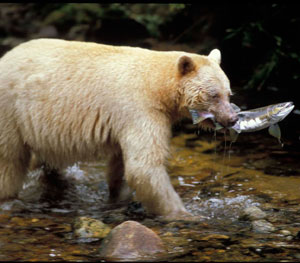
Kermode bear (a sub-species of the black bear) in region covered by Great Bear Rainforest agreement. Photo: Pacific Wild

Two Calgarians and one Ontario aboriginal will help decide the economic future of coastal B.C. They've been appointed to assess one of the most controversial energy projects in the province's history.

Their recommendations could determine whether federal policymakers approve plans by Calgary-based Enbridge Inc. to build a pipeline from Alberta's oil sands to the west coast, and then ship fossil fuels on supertankers to Asia. The proposal carries huge environmental risks. It also revives a fiery economic debate.

How do you develop a pristine eco-system? Or do you develop it at all?

Green groups, First Nations and logging companies fought bitterly over these issues during the decades-long campaign to protect the coastal Great Bear Rainforest. A land-use agreement was finalized only last year. It suggested to a global audience that development, if done right, need not compete with conservation. Nearly $60 million in taxpayer money -- and another $60 million from private donors -- is committed towards that model.

Under Enbridge's current proposal, 220 supertankers laden with fossil fuels could sail right through the Great Bear Rainforest region each year. The provincial government has publicly declared its support for each project. Yet a fast-growing Enbridge opposition sees a large and complex business deal being undercut.

"When people gave their money to this region, there was the vision that they were contributing to protecting the area and developing an economy that had a light touch on the landscape," Merran Smith, a director with Tides Canada, told The Tyee. "I don't think anybody was envisioning that there would be oil supertankers going through the area."

Fossil fuels and sustainability?

Perhaps no group feels such disparity more than the Coastal First Nations. The alliance, which represents nine nations along B.C.'s north-central coast, is the main beneficiary of two regional endowment funds worth approximately $120 million.

The money came out of nearly a decade of land-use negotiations concerning the Great Bear Rainforest. The province and feds agreed to each contribute nearly $30 million for "sustainable" and "community-based" First Nations economic development. All taxpayer money is supposed to be spent by 2014. (That's only two years before Enbridge anticipates shipping its first crude oil to Asian markets.)

Government funding has thus far supported shellfish aquaculture, eco-tourism and alternative energy ventures, among others. It's unclear how many such projects would survive a major oil spill.

"So here's a federal and provincial investment, jointly of $60 million, which is being jeopardized," Coastal First Nations executive director Art Sterritt told The Tyee.

Even that is only half the money endowed to the region. A second Great Bear Rainforest investment currently worth $56 million came from private donors, most based in the United States. This "conservation fund" is intended to maintain the region's pristine eco-system in perpetuity.

Enbridge's pipeline proposal is still in early stages of federal review. Approval could leave the region's philanthropic investors scratching their heads. "It would certainly alter what people understood they were investing in," Tides Canada's Smith said.

'We need for you guys to resolve this'

During the mid-1990s, an environmental battle on B.C.'s remote north-central coast attracted international attention. Clear-cut logging threatened one of the last major tracts of temperate rainforest anywhere. Activists christened it the Great Bear Rainforest -- named in part after the Kermode Spirit Bear, an all-white subspecies particular to the region.

Articles appeared in major European and American newspapers, helping transform the struggle into a metaphor for the global loss of nature. International market wars raged unabated for years. Environmental groups attempted to convince consumers not to buy forest products derived from coastal British Columbia. Logging firms fought back, arguing their operations followed best practices, and besides, were entirely legal.

The climax came in 1999, when Greenpeace escorted representatives from Germany's papermaking and magazine publishing industries through threatened areas. Afterwards, the German delegation convened a meeting in Vancouver with activists, logging firms and provincial government officials.

"They basically said, 'We need for you guys to resolve this,'" remembered Patrick Armstrong, a land-use negotiator closely involved in the Great Bear Rainforest region. Affected parties -- including First Nations -- began a nearly decade-long planning process.

"Globally significant" is how Armstrong called the resulting land-use agreement, finalized only last year. "Groups of people and individuals and organizations that had been antagonists for some time were able to set aside their arguments and jointly craft a solution," he told The Tyee.

Can industry and greens be friends?

Not everyone felt the same way. The negotiating process created divisions over strategy and values within B.C.'s conservation movement. Some players felt way too much was given up -- others, that resources were diverted from less visible, but equally important campaigns.

For groups such as Greenpeace, the Sierra Club and ForestEthics, last year's land-use agreement was historic. They saw it as a game-changing compromise between ecological needs and economic growth. Provincial authorities formally banned logging in over five million acres along the north and central coast -- or one-third of the entire region.

Land-use designations allowed low-impact First Nations activities, tourism and mining within specified areas. Outside protected zones, timber firms were mandated to preserve 50 per cent of natural old-growth forest across the region -- an approach known as "lighter touch" logging -- with plans to increase that in coming years. And in theory, the agreement formalized a new working relationship between First Nations and government.
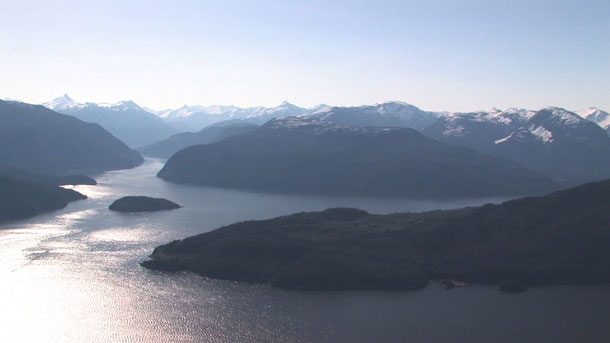
Aerial view of Enbridge route tankers

Aerial view of route tankers would take to meet proposed Enbridge pipeline. Photo: Damien Gillis.

Serious issues remain. Grizzly bears, mountain goats, tailed frogs and others may still be at risk of extinction, for instance. Yet activist proponents envision the founding of a new "conservation economy." Even senior government officials appear to agree.

"[It's] a strong marriage that balances the needs of the environment with the need for sustainable jobs and a strong economic future for coastal communities," B.C. Premier Gordon Campbell announced last year.

'Pipelines will be needed': BC energy minister

Evidently, hundreds of supertankers carrying what has been referred to as the "world's dirtiest oil" also figure into the province's Great Bear Rainforest vision.

Enbridge, Canada's largest crude oil transporter, proposes to build a pipeline 1172 kilometres from the Alberta oil sands to coastal Kitimat. Mammoth ships would then navigate treacherous northern waters en route to ports in China and beyond (all passing within view of Hartley Bay, a tiny First Nations fishing village which The Tyee recently visited.)

The project -- named "Northern Gateway" -- is undergoing full federal environmental assessment. A three-person Joint Review Panel -- two from Calgary, and the other, an Ontario aboriginal -- just wrapped up preliminary public hearings in several northern B.C. towns. The panel will submit its recommendations to Canada's environment minister and elected Cabinet officials, who have ultimate authority over Northern Gateway's future.

Enbridge has a few things working in its favour. The pipeline firm currently pays two lobbyists to communicate directly with Ottawa policymakers about its proposal. It contributed $50,290 to B.C.'s ruling Liberal party between 2005 and 2009. It boasts a $100-million war chest donated by anonymous oil sands producers and Asian investors. And provincial policymakers are quite vocal about their support for the project.

"You don't totally turn away from something that is first of all an economic opportunity for the people who live in the province and the people of Canada," B.C.'s Energy Minister Bill Bennett wrote in an email to The Tyee.

"As B.C. is Canada's gateway to the pacific, we have to accept that ultimately pipelines will be needed as energy demand continues to grow overseas."  [Tyee]

16  Comments:

Login or register to post comments

  • Barryeng

    2 years ago

    Enbridge's Claims

    Enbridge's claims about their pipeline's economic prospects for BC are suspect at best. They say somewhere between 1,000 and 15,000 construction jobs, and their estimate of permanent, full time jobs vary between 30 and 700 depending on the day of the week and who they are talking to.

    If even the Union of BC Municipalities can pass a resolution opposing this pipeline, then BC's politicians have to realize that it is just not worth the risk. Or, do they care any more?

  • ezroller

    2 years ago

    Hopefully Not Going to Happen

    This article is excellent! It provides great background and really lays down the issues.

    I travelled to Prince Rupert recently and it seems most locals around there don't believe it's going to happen. The line passes through too many First Nations territory's and Enbridge hasn't offered nearly enough assurances and deals to get it done. I hope what I've heard is true. There's huge opposition from numerous NGO's and recent events at the UBCM are positive as well.

  • boondoggle

    2 years ago

    A line in the tundra

    This oil industry joint review panel proceeding is an in your face affront to the democratic process. Don't kid yourself folks, this nightmare will proceed as planned unless enough world citizens and first nations join forces to stopped it. If we are not willing to put everything on the line to prevent these corporate environmental psychopaths from getting away with yet another crime against humanity and mother earth we will lose it all. It's time to draw a line in the tundra and put a stop to this madness.

  • Cool Hand

    2 years ago

    If Enbridge Doesn't Go Ahead

    For the past approximate 5 years, Encana has been importing condensate into the Methanex tanker terminal in Kitimat. Tankers with a carrying capacity of 350,000 barrels and greater deliver this condensate.

    http://www.encana.com/news/newsreleases/2005/P1161205051598.html

    Condensate is toxic and if a spill would occur it would probably have the same environmental impact of an oil spill. But nobody seems to care.

    The condensate is then shipped via CN tanker trains to the Albertan oil sands, which is also riskier than shipping same through a pipeline. Just look at CN's derailment record.

    And if the Enbridge pipeline doesn't move forward, oil sands producers, the Albertan government and CN Rail are now also looking at transporting the crude oil to Kitimat via CN tanker trains - "Pipelines on Rail". At the end of the day, it's still a zero sum game.

    http://www.cn.ca/en/shipping-north-america-alberta-pipeline-on-rail.htm

  • Skywalker

    2 years ago

    Methanex?

    "Methanex permanently ceased production at its Kitimat manufacturing plants November 1, 2005 due to the prevailing high cost of natural gas in North America. For more information please refer to our press releases.

    Today, Methanex uses the Kitimat terminal facility to import methanol to supply customers in western Canada.

    Located on Canada's west coast, Kitimat is an ice-free tidewater port accessible to all but the largest ocean-going vessels."

  • mountnman88

    2 years ago

    get it right

    the caption under the Kermode photo indicates that these bruins are a "white coated Grizzly" and of course, they are Not, they are a sub-species of BLACK Bear,,, do your research

  • pipeup

    2 years ago

    Oil and water don't mix.

    Oil and water don't mix. Supertankers and the Great Bear Rainforest don't mix either. Enbridge's proposal will be catastrophic if it goes ahead.

    The key is for everyone to lobby your MP for a federally legislated tanker ban - this would effectively kill Enbridge's proposal as well as the CN Rail one and others. It would prevent any crude oil tankers for traveling this ecological gem of a coast. The NDP and Liberals have already verbally committed support - they just need a push to take further action and get this ban going (despite Enbridge's full time lobbyists in Ottawa - politicians care more about your vote!).

  • David Beers

    2 years ago

    Administrator

    mountnman88, thanks!

    appreciate the correction. I'm the one who wrote the caption and I actually know better, so blame a misfiring synapse late in the evening. Kermode "Spirit" bears are white-coated Black bears, as you say, and it's been fixed. Grrrrrrr.

  • samuidave (not verified)

    2 years ago

    The ecology is not here to negotiate ...

    with man's self-deception and greed.

    This is simply guaranteed to end in disaster if tankers start moving up the channel.

    "[It's] a strong marriage that balances the needs of the environment with the need for sustainable jobs and a strong economic future for coastal communities," B.C. Premier Gordon Campbell announced last year.

    As usual, Gordon Campbell the sociopathic neocon who is about as stupid and as a bald-faced liar our province has ever encountered, talks BS. The man is beyond contempt. He should be in jail for his repeated breached of public trust. His idea of 'future' is absurd. Do not believe a word he utters.

  • samuidave (not verified)

    2 years ago

    "You don't totally turn away

    "You don't totally turn away from something that is first of all an economic opportunity for the people who live in the province and the people of Canada," B.C.'s Energy Minister Bill Bennett wrote in an email to The Tyee.

    FIRST OF ALL, this is an ecological disaster waiting to happen. That takes precedent in any sane mind, one not possessed by economic dogmatists like Bennett.

    "As B.C. is Canada's gateway to the pacific, we have to accept that ultimately pipelines will be needed as energy demand continues to grow overseas."

    WE DO NOT HAVE TO ACCEPT ANT SUCH THING. Who voted for ths ignoramus? Therre are alternatives to oil, and overseas needs are for them to figure out, not our duty to fulfil. Asshat!

  • Jeffrey J.

    2 years ago

    Ask the Experts

    One of this years BEST videos is the joint press conference with former CIBC executive Jeff Rubin and Alberta's own (and Tyee regular) Andrew Nikiforuk, author and journalist.

    Watch it. You be the judge.

    http://www.tvo.org/TVO/WebObjects/TVO.woa?videoid?619399276001

    Great article as always.

  • x4estworker

    2 years ago

    Betrayals Started Long Before Pipeline Idea

    The latest massive betrayal of the public interest in the mid coast forest of British Columbia (what is the so-called Great Bear Rainforest? There is no such area of British Columbia.) took place several years ago when environmental groups and forest companies put together a secret backroom land use deal with virtually no public input, and the B.C. Liberal government rubber stamped it.

    Before that, the previous massive betrayal of the public interest involved the forest companies and the B.C. Liberal government caved in to an economic blackmail campaign by sleazy environmental groups such as the horribly misnamed ForestEthics, and those masters of the cheap publicity stunt, Greenpeace.

    There have been plenty of betrayals of the public interest in land use planning in the mid coast of British Columbia. The plan to build a pipeline through there, which is now going through a very public process, isn’t one of them.

    Funny how public input is so important to environmentalists when they want to try and manipulative a land use planning process through stacking public meetings, etc., but underhanded secret backroom deals are just fine when that will get the greenies what they want.

  • SharingIsGood

    2 years ago

    This Morning's News from Environment Canda

    "North Coast - coastal sections
    7:20 AM PDT Tuesday 05 October 2010
    Wind warning for
    North Coast - coastal sections issued

    Southeast winds of 90 to 110 km/h are expected over the Queen Charlottes and coastal sections of the north coast this morning.

    This is a warning that potentially damaging winds are expected or occurring in these regions. Monitor weather conditions..Listen for updated statements."

    http://www.weatheroffice.gc.ca/warnings/report_e.html?bc49

  • Driftwood

    2 years ago

    Here is a link to the Georgia Strait Alliance

    It shows the email addresses of the federal and provincial environment ministries, and other people in the government you might want to let your concerns be known to:
    http://www.georgiastrait.org/?q=node/973

  • plg

    2 years ago

    Navigation beacons

    Could someone tell me if the feds have already accepted the Enbridge pipeline proposal? If not, then why is one of its government agencies installing a further series of navigation beacons on the central and northern coasts that will aid supertankers navigating narrow inside passages?

  • plg

    2 years ago

    rail tanker car 'pipelines'

    If Enbridge Doesn't Go Ahead...

    Cool Hand makes a point that if Enbridge doesn't build its pipeline then CN will use its rail corridor and tanker cars to create a rail rolling 'pipeline'. CH then states that if CN carries the heavy crude by rail then we can expect a similar disaster if there is a derailment. CH writes "Just look at CN's derailment record."

    I did just that. I could not find any record of a CN derailment in its northern BC corridor where there was a ruptured tanker car and its product being released. In 2007 a train carrying grain derailed however none of the cars released their product into the environment to the chagrin of pigeons.

    There is a big difference between a punctured rail car or two releasing its product and a ruptured 36" diameter pressurized pipeline releasing its contents.

    The largest rail tanker car can carry 600 barrels of oil. The 36" pressurized pipeline Enbridge is proposing in Northern BC will carry 525,000 barrels of oil on a daily basis. This is almost two times the amount of oil that the Exxon Valdez spilled into Alaskan waters.

    The oil pipeline proposed by Enbridge will be pressurized by using ten pumping stations spread across 1150 kms. When a pipeline ruptures not all of its product is released. During a decrease in pressure in a pipeline head valves are designed to close to prevent all of the product from being released. One needs to know how much oil will be released when pumping stations are stationed over 100 kms from each other.

    Enbridge claims that the oil in its pipeline will take 12 days to travel from Edmonton to Kitimat. Given that the line will carry 525,000 barrels of oil a day this means that over 6 million barrels of oil will be in the line at any given time. Just how much oil will be released if the pipeline ruptures? If there is nothing between two pumping stations to prevent the oil between those stations from spilling out then that means over 600,000 barrels of oil will spill into the environment or 1000 times more than a rail tanker car.

    This is hardly a zero sum game.

    I think the big issue here is why are we hell bent on getting as much oil out of the ground as fast as possible and why are we thinking on trading this valuable resource to a country where we have a massive trade deficit with? It doesn't make environmental sense but just as important it doesn't make economic sense for Canada and Canadians.

    • The discussion for this story is closed. No more comments can be added.