
Mercer Blasted APEC Protesters with Pepper Spray
Commission slammed Mounties' hair trigger use of force at 1997 summit. Third in a series profiling the 2010 Olympics' top cop.
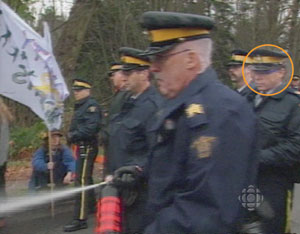
APEC, 1997: RCMP Staff Sgt. Hugh Stewart in foreground, pepper-spraying, with Bud Mercer closest behind his right shoulder.
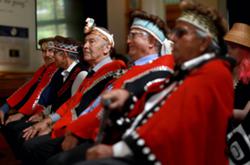
Eighteen Pacific Rim leaders posed in their shiny, leather Roots jackets given as a gift from prime minister Jean Chretien at the University of British Columbia Museum of Anthropology on Nov. 25, 1997.
It was the obligatory "class of 1997" photo at the end of the biggest, most-expensive private meeting in Canadian history.
But as it turned out, the sight of RCMP officers pepper-spraying anti-globalization and pro-human rights protesters instead became the everlasting image of the Asia Pacific Economic Cooperation leaders' summit.
And one of the faces in that advancing line of Mounties belonged to Cpl. Gary Russell "Bud" Mercer, now the top police officer in charge of maintaining order and security at the 2010 Olympic Games in Vancouver and Whistler.
'Tight and intimidating security zone'
The ill-fated summit was organized by Robert Vanderloo and his deputy Mary McNeil (now B.C.'s minister of state for the Olympics) and drew 75 internationally protected people. A dozen -- like U.S. president Bill Clinton -- required the highest-level of security available. Some 23,000 people were accredited, including 8,600 delegates and media, 1,000 volunteers and 3,000 police.
The security operation, coordinated by RCMP Supt. Wayne May, had to ensure the foreign dignitaries' safety and security from their Vancouver International Airport touchdown to takeoff and everywhere in between. A team of 90 motorcycle cops led motorcades and closed streets so the dignitaries could glide safely between nine hotels, Vancouver Convention Centre, B.C. Place Stadium and, of course, UBC.
"They imposed a tight and intimidating security zone in the middle of campus, featuring miles of fencing, helicopters buzzing classrooms and rooftop snipers," remembers anti-globalization activist and UBC law student Alissa Westergard-Thorpe. "I don't think they expected that nothing gets out a very apathetic student population like having to deal with a line of police in order to get your coffee. So that was actually something that worked in organizers' favour, which is something I imagine might happen around the Olympics as well."
Pre-emptive strike on protestors
Nonetheless, tensions between activists and RCMP had been building steadily over the last year. In late 1996, news of the impending summit led radical student leader Jaggi Singh to form APEC Alert. It preached an anti-globalization message to anyone who'd listen, postering "Fuck APEC" signs all over campus and even crashing a mini diplomatic conference.
An altercation between Singh and a campus security guard set the grounds for a pre-emptive arrest before the summit. "An anti-APEC group, APEC ALERT, have several planned demonstrations which may involve civil disobedience from now until the conclusion of APEC on 97/11/25," RCMP Staff Sergeant Lloyd Plante wrote to four Lower Mainland detachments on November 13, 1997. "It is our intention if we can obtain a 'no-go UBC' with respect to SINGH, we may basically 'break the back' of this group."
On November 24, the day before APEC dignitaries arrived, four RCMP officers surrounded Singh on campus. They wrestled him to the ground in plain view of students. They locked him in handcuffs and led him to an unmarked car.
'Peppergate' begins
Friction between cops and students started in low-tech fashion on November 25. Police removed a Tibetan flag from the Graduate Student Society Building and arrested law student Craig Jones for refusing to remove paper signs from a security fence outside the Green College residence. Jones was locked in the same Richmond RCMP jail cell as Singh, whose arrest on specious grounds a day earlier prompted Jones to act.
"I hadn't expected my three little signs, that said 'democracy, human rights and free speech' would actually get me arrested. I thought I'd hang them up and get on with my day," said Jones, who resisted police orders to go to a less-visible, designated protest area.
More than 2,500 protesters gathered at noon. Organizers planned to walk to the barricades near the museum and give themselves up peacefully in front of the media. Police watched as protestors approached the rickety security fences near Rose Garden Plaza. Several people climbed the structure. It swayed, then buckled. What followed were a series of violent clashes with police -- dozens of students and activists groaning in agony as pepper spray cleared from their eyes. And the arrest of 48 protesters, who were later released.
Mercer 'saved my bacon that day'
On November 25, veteran RCMP Staff Sgt. Hugh Stewart commanded 170 officers assigned to quick response teams. Among them was then Cpl. Gary Russell "Bud" Mercer who, like Stewart, was armed with a pepper spray canister. He told his side of the story to the Ted Hughes' inquiry into RCMP misconduct on Feb. 9, 2000 as witness number 117. He was questioned about two incidents: the arrest of student activist Jonathan Oppenheim and the aggressive pepper-spraying led by Stewart, his superior.
Oppenheim was suspected of knocking down a temporary fence to incite activists. He was arrested while addressing a crowd of about 300. One witness testified that Oppenheim was trying to calm the crowd. Mercer, then a Sergeant, assisted Const. Richard Rollings, and took hold of Oppenheim for "a matter of seconds," according to the Hughes report.
Mercer testified he barked a warning when the crowd surged forward and repelled the crowd with a one-second blast of pepper spray. "Const. Rollings said he believed that Sgt. Mercer's actions 'saved my bacon that day,'" Hughes wrote.
Hughes didn't buy Oppenheim's excessive force complaint and found the conduct of Mercer and his comrades appropriate. His words were decidedly stronger about Mercer's and Stewart's actions later that day.
Olympics security boss sprays protestors
White-haired and mustachioed Stewart's biggest mistake was firing the bitter, burning liquid right into the lens of a CBC cameraman Robb Douglas, making it the enduring image of the biggest diplomatic event in B.C. history. CBC reporter Terry Milewski's archived video report shows a younger Mercer over Stewart's right shoulder moments before Stewart became "Sgt. Pepper."
"I wasn't selected to be standing beside S. Sgt. Stewart, that's just the way it worked out," Mercer said recently.
Like Stewart, Mercer was equipped with a Mark 46 pepper spray canister. Stewart, who headed the quick response teams, was ordered to clear Northwest Marine Drive for motorcades to pass and testified that he waited nine-seconds between speaking and spraying. Five protesters remained on the road and he wanted them gone, according to testimony.
"Sgt. Mercer accepted that the time between the conclusion of S. Sgt. Stewart' s directive to the protesters and S. Sgt. Stewart's use of pepper spray could have been about one second." Hughes wondered whether one second could possibly be enough time for the crowd to obey.
"I disagree with you," Mercer testified. "While he was giving the order that he was giving, we were watching people link arms and hold things up over their face. I don't think that any time after that was required. They had already made up their mind." Mercer sprayed over the heads of the seated crowd, hoping to "make the intersection an uncomfortable place to be." Mercer claimed he was 10 feet from the nearest protester when he sprayed. Hughes believed it was likely Stewart was "even closer, given the results."
'Pepper spray was not required'
Mercer admitted "conversation and open hand" are supposed to be used before pepper spray. He defined open hand as "physically lifting, pushing, leading." Stewart's use of pepper spray "was not a justifiable or appropriate use of force," concluded Hughes. He would've been better off -- not to mention the protesters -- if he'd employed the open hand technique that Mercer spoke of.
"I have no difficulty with the three officers taking the three large canisters to the line with them," Hughes said. "At least one minute could have been given in addition to the one or two seconds that passed after S. Sgt. Stewart completed his warning to the crowd." Ultimately, the former Saskatchewan judge said, "Pepper spray was not required to move the protesters. It should not have been used."
Ted Hughes' Commission for Public Complaints Against the RCMP inquiry evaluated 52 complaints of police wrongdoing and, in many cases, found the conduct "inconsistent with the Charter and not appropriate for the circumstances." Crown counsel didn't recommend charges for any of the RCMP members.
Hughes' 2001 report recommended proper training of police assigned to public events, protesters be given a "generous opportunity" to see and be seen and that police "brook no intrusion or interference" from government officials.
APEC repeat?
A dozen years later, Mercer is an RCMP assistant commissioner and heads the Vancouver 2010 Integrated Security Unit, which includes five times more police officers than APEC had.
Last July, he stood at the city council podium, addressing councillors and spectators, wearing a finely tailored suit instead of his RCMP uniform. If you saw him on the street, you'd never guess he was the top cop of the 2010 Winter Olympics.
He showed the room images he found on the Internet, like cartoon drawings of masked people with torches, burning tires and slogans like Riot 2010. He spiced the July 7 presentation with references to the killing of 11 Israeli athletes taken hostage at the Munich 1972 Olympic Village and the Atlanta 1996 Centennial Olympic Park pipe-bombing where two died and 111 were injured.
He also mentioned the 1997 APEC summit. He suggested Vancouver could experience a repeat during the 2010 Winter Olympics. He didn't mention that he was on the front lines twelve years ago.
Lessons for the Olympics
The legacy of APEC is alive within V2010 ISU planning, Mercer claimed in a recent interview. The Hughes Commission report's key recommendation was for safe areas where protesters can be seen and heard by those to which they dissent. Mercer volunteered that he supports the idea of locating such a zone during the Games outside the Vancouver Art Gallery, where Vancouverites traditionally gather to exercise free speech.
"It's been an area that has been frequently used by those that have a differing voice or differing opinion," he said. "It's important that be kept for what it is today and not be used for other things. For me that's a safe assembly area."
Ultimately, Mercer says events like APEC build camaraderie and character among those on the front lines.
"I draw on those experiences in my capacity as a leader. I've been there, done that, got the T-shirt, got the scarves, got the hats. I know what the staff are going through, I can predict sometimes how they're going to feel. It's those experiences that prepare people for leadership positions."
Tomorrow: During BC's 'War in the Woods,' Mercer led an RCMP raid on a tree sitters' encampment. ![]()


Glen Murtz
21-10-2009
Same old Same old.
LOL.
I love this stuff.
See kids, the way it works is that the cops and security forces have the full and compete support of the elite. It's entirely politically expedient to "waste" one every now and then; fire him, do whatever.
But by and large the police are off limits to accountability measures for Joe Average.
Because their job is *NOT* to protect Joe Average - it's to make sure that "the people" don't get uppity. While the media screams constantly about criminals dealing drugs, a company that kills 15 people through slack regulation of meat processing plants walks away - to continue to do business... while he media screams about pot growers or gang members, a former member of the police board (and a "friend" of former police chief Jamie Graham) assaults and confines a drug addicted woman.
No friends - the police are not here to "protect" you or me - they're here to protect the monied and the well to do.
So what if every now and then they have to hold some bullshit commission and wag their fingers, saying "don't do it again". It's all in a days work.
There will be abuses of police powers during the Olympics - after all, why should the Olympics be any different than the regular, ordinary day to day?
And when it's all said and done, reprimands and "cautions" will be issued and nothing - NOT ONE SINGLE THING - will ever change.
Have a nice day.
And keep your head down and mouth shut.
monty
21-10-2009
what a lot of revisionist history here
I worked as senior bilingual secretary at APEC. The number of delegates is grossly exaggerated. Burrard Street, Hastings and the area around the old convention centre were fenced. Jaggi was picked up at the APEC building on Howe Street at 4 pm on a Friday. The delegates had arrived or were arriving over the weekend. Jaggi was questioned by the copŝ on the 11th floor and released. The next week he was picked up on campus and as a result the students staged a big protest. It was Stewart who was featured as the pepper spraying person on TV.
If you cannot get the facts correct, you should not be paid for writing this mythology. Contact Jaggi who is probably still in Montreal and he will tell what is correct.
sebastian toombs
22-10-2009
spoils of war
thank god he got his souvenir tshirt... now that hes running the show, i hope he remembers those special touches that matter so much to the floor staff.
Jeffrey J.
22-10-2009
Glen Murtz
What Glen Murtz said.
geoffdembicki
22-10-2009
re: what a lot of revisionist history here
Hi Monty,
I helped report and write this story. First of all, I appreciate the feedback -- journalists need to be held accountable just as much as the figures they report on. But I'd like to offer a polite rebuttal. You say the amount of delegates was exaggerated. The figures Bob and I cite come from the APEC - Commission Interim Report, which can be viewed here: http://www.cpc-cpp.gc.ca/prr/rep/phr/apec/apec-05-eng.aspx
Our account of Jaggi's arrest on November 24 is validated by two sources. NDP MP Svend Robinson mentions the incident at a 1998 sitting of the House of Commons. The incident also appears in Ted Hughes' APEC report. http://www.cpc-cpp.gc.ca/prr/rep/phr/apec/apec-17-eng.aspx
Thanks for the input!
The Blackbird
22-10-2009
Glen Murtz
You're a skilled writer and I like the agressive, punchy style. And it is obvious to everyone that some police conduct is entirely unacceptable and that there should be citizen oversight in cases of alleged police misconduct. But when you take such a strong one-sided a view and slam them as harshly as you do, won't you find it a little difficult picking up the phone, if you get the chance to, when your home is invaded or when a group of meth-ed up punks sees you as a quick source of income as you approach a suburban Skytrain station? If you're lucky enough to make the call, you'll have backup on the way in minutes. Hopefully it you'll have that long.
Glen Murtz
22-10-2009
Thanks Blackbird
I'm pleased that the tax dollars I spend enable me to call upon people to do the job they're paid to do with my money - just as the wealthy are pleased that great wealth enables them to extract greater "considerations" when they're enabled, by ever greater wealth, to contribute time or money to causes initiated by he police. Like say, being a billionaire and sitting on the Police Board.
Consider this classic...
"The law, in its majestic equality, forbids the rich as well as the poor to sleep under bridges, to beg in the streets, and to steal bread." - Anatole France
It's not "angry" or unappreciative to note that law invariably favours the wealthy. It's stating the painfully obvious.
And one further note of interest...
Here's a little something from today's Vancouver Sun...
http://tinyurl.com/yj4ng9g
Here's a quote from the article...
"The city argues the areas are there for the protesters' safety and convenience..."
Do you see anything funny about this quote? It would be very easy to infer from it that "the city" feels that protestors wouldn't or won't be "safe" if they protest on non-designated spaces. And I can't help but wonder why the city feels it would be unsafe. Do they know of threats to protestors? Have there been threats made to people who've expressed an interest in protesting? And if there has, have the police visited those people threatening potential protestors at their place of work or paid a early morning visit to their homes due to mysterious 911 calls originating from their residence? (see David Fields recent experience)
Somehow I doubt it. Somehow I think we're just having ever more smoke blown up our asses as the elites get ready to have a party on "the morons" dime.
Every political party in this province is saying to Joe Average, "Suck it up, shut it up and go f*** yourselves - while we party with your money and bust your head open if you get uppity about it..."
Deal with it.
VivianLea Doubt
23-10-2009
thanks Glen Murtz...
for 'stating the painfully obvious' in such a refreshing way.
It's funny, but I have not heard a single resident of the city say that potential olympic protesters really scare them... now tainted meat, that's another story...
The Blackbird
23-10-2009
Glen Murtz
Don't you believe it is inconsistent for you to write that the job of the police "is *NOT* to protect Joe Average - it's to make sure that 'the people' don't get uppity," and then - being Joe Average yourself - to write that you are "pleased that the tax dollars I spend enable me to call upon people to do the job they're paid to do with my money." It seems to me the two positions are incompatible. Either the police are there for you, Joe, or they are there for the creme de la creme.
Police enforce law. Government enacts law for police to enforce. The work police do, and public interpretations of it, are a reflection of the direction they are given by government. Certainly there are cases of misconduct by individual officers. This will be the case regardless of what political philosophy guides government policy because police officers are human and make errors. I have suggested greater accountability will be gained by installing civilian oversight in investigations of such misconduct.
There is no doubt that neoconservative and neoliberal governments enact legislation which protects economic elites. Change will come when the lawmakers change so, instead of complaining about the police being little more than a pack of attack dogs trained and owned by a wealthy and powerful master, a more constructive approach might lie in finding ways to force government to bend to the will of the people.
One way this may be done is to expose government attempts to use the police to serve the interests of the elite at the expense of the citizenry whom, as you pointed out, pay their wages. Because BC will host the Olympic Games in a few months, government and police forces in the area have never been as sensitive to public opinion as they are right now. Success, for them, is measured - in a big way - by how smoothly the event unfolds. What government presently wants to avoid, perhaps more than anything right now, is embarrassment on the world stage. This provides you, as a member of the public, with an excellent opportunity to force government to enact changes in the legislation it has proposed that will determine how the police will behave during the Games period. Pushing for realizable changes in the law is, therefore, the more constructive path. Simply bitching about the big, bad police will get you nowhere.
Perry
23-10-2009
A few bad apples?
Blackbird wrote: "Certainly there are cases of misconduct by individual officers."
That 'few bad apples' argument doesn't hold any longer in relation to police misconduct in Canada. The problem is far larger than just misconduct by individuals; it is systemic, a product of their training and culture. The various examples of police "misconduct" captured on camera over the last few years are certainly just the tip of the iceberg when it comes to police brutality.
Glen Murtz
23-10-2009
Sadly, no.
"Don't you believe it is inconsistent..."
Sadly no - I do not believe it to be inconsistent. If we were to examine the behaviour of police forces at large, we'd note that thousands (THOUSANDS) of tickets were being issued for relatively minor bylaw contraventions in the last few months in the DTES. And yet you can stand at most any intersection in this city for an hour or so and watch hundreds of vehicles violate traffic laws. Speeding, undue care and attention, etc etc etc...
In this instance, we could reasonably conclude that the police prefer to harass and bully the poorest members of society (with little chance of extracting the fines) rather than make an effort (with much greater opportunity for realizing a monetary return) to go after shitty - if wealthier - drivers.
The police forces choice of which laws to enforce on any given day are evident at any intersection in this city. Ask a pedestrian.
Now lets go further up the social chain...
The same principle can be seen in the absence of arrests of money launderers. I mean, if gang activity is endemic, then money laundering is endemic and you should expect to read on a nearly daily basis about arrests for converting illegal money into "legal" money.
But we *never* do.
Has it never occurred to you why that might be?
You seem to want to fixate on what the police DO (and are obliged to do) - where I suggest it is at least as valuable and maybe more so, to note what they DON'T do.
"Pushing for realizable changes in the law is, therefore, the more constructive path. Simply bitching about the big, bad police will get you nowhere."
I call bullshit on that. I also vote. And I have never voted (by any stretch) for the status quo. It's called the status quo, because I'm always outnumbered. But just because you and perhaps millions of other people don't trust in what I believe to be true, does not mean that it isn't.
All I can do is vote for change.
That's the only option I have and you better believe I exercise it.
So I retain and cherish my right to "bitch" all I want - though I'll continue to happily call it "pointing out the obvious."
The Blackbird
23-10-2009
Cop Out
If you believe the only thing you can do is vote for change, your creativity is hindered or you are plain lazy.
Allow me to share some examples of other things you can do to force government to change its positions and, by extension, the laws which police are obliged to act within.
You mention all of the tickets that were being handed out in the DTES. This was a product of the previous Non-Partisan Association-dominated City Council's Project Civil City initiative. It created policy, enacted by-laws and then gave direction to police to step up ticketing. It was part of how Mayor Sullivan, his lock-NPA Councillors and Civil City Commissioner Geoff Plant, in consultation with local business improvement associations, police and private security firms, had planned to reduce homelessness by 50% by 2010, i.e., make life as unwelcoming and intimidating as possible for "undesirables" so they would be encouraged to move on. Free, one-way airfare anywhere in Canada was offered to anyone who'd had enough.
The ticketing blitz remained in effect after last autumn's election, so Vision Vancouver didn't appear to be in any hurry to shift gears. But the articulate, loud and incessant voices of people working with Pivot Legal Society and the BC Civil Liberties Association, along with critical independent media coverage in The Tyee, the WestEnder and Megaphone Magazine, and citizen protest marches and demonstrations, made the policy too embarrassing for City Hall to continue with so it called off the police. Change has come on that issue. The ticketing blitz has not been in effect for a few months and that is down to the industry and creativity of some highly dedicated people. These same people have also caused enough ruckus tp forced the current Council to order City legal staff to revisit its Olympic By-law to eliminate or rewrite sections that might otherwise lead police to infringe on Canadians' freedom to engage in political protest during the Games.
As for the absence of arrests for money launderers, again we must look at government (federal) policy, the laws it creates and enacts - federally in this case - that make it possible for those looking to clean drug profits to do so and not commit any crimes, at least not on the books. Morally, they are still crimes. But there are back doors that allow laundering to occur legally. If a crime is not committed, then the police cannot arrest anyone. As such, it is unfair to blame police for the lack of money-laundering charges.
So, what do we do? We get active and vocal. We attract attention to issues by exposing corruption with evidence. We organize and develop strategic actions aimed at forcing government to address issues so they will change law or face unpleasant consequences. It's up to us, the common people, to take care of ourselves.
If all you do is vote and bitch, you really are Joe Average. To build a just society, we need more Joe Above-Averages.
chenolan
23-10-2009
the way things work
i must say that from all of my experiences and research, glen murtz has it right on. anyone who doubts it can go and do the research about how the elite exercises its control on citizens via the police. there is no shortage of proof for that. APEC is the perfect example. the prime minister's office told the police to violate the constitution and they did it. no one has ever been held accountable for this grievous violation of national and international law, because that's the way things work. notice that despite hughes's watered-down condemnation of the RCMP, when he did find fault with their actions, Crown declined to press any charges whatsoever.
i appreciate the blackbird's gentleness in making a point that is usually spitefully driven home: as much of a problem you have with the political functions of the police, they are there for you when you need them. this ignores the fact that we have few other options, and that the situations we call on the police for when we have few or no other options are themselves created by a militarization and criminalization of individuals and public spaces. we throw a bunch of armed folks out there to deal with addicts and theives (usually one and the same), because those making these decisions are closing the treatment centres and community centres and social services that would prevent us needing a militarized presence in the first place.
i think the revelations in this article suggest a far more chilling tone and conclusion. we're talking about an officer who participated in violating the charter at the behest of the prime minister('s office). what do you think that's going to look like for the olympics? so far, mercer has been apparently unable to separate the two words: criminal and protest. obviously this mentality can only lead to violence against those who wish to peacefully protest. not just in a little box around the art gallery, but, exercising their constitutional rights -- god forbid -- in the streets.
The Blackbird
23-10-2009
Based on what we've read in the articles ...
... the curling stone is in AC Mercer's rink. Clearly, he must ensure discipline amongst his troops. And, sir, if you are reading this, free speech zones, or whatever you want to call them, are an embarrassment to and our image as a free and democratic nation. Salt Lake may have accepted them in the watered down post-9/11 democracy the United States has devolved into, or in the totalitarian Chinese regime where two grandmothers were sentenced to 6 months in reeducation camps (later suspended) for applying to protest in a Beijing protest zone, but this is Canada and we have no need for them.
Cancelling the whole idea of free speech zones of any kind will go a long way toward easing tensions between activists and the police and show the world why Canada is so different, beautiful and free. If you decide to stick with the idea, know that it is unlikely any protesters will use them.
Finally, I acknowledged that elites control the police in my first comment. What I am trying to get across is how to constructively and creatively attack their selfish policies so they don't get the opportunity to use the police as though they belonged to them. It can be done and I have offered recent factual evidence of this. My point is, it takes more than voting and bitching. And it's way more fun. :)
Glen Murtz
24-10-2009
Finally.
"If you believe the only thing you can do is vote for change, your creativity is hindered or you are plain lazy."
I see.
I'll move past your rude remark and ask what, exactly are you asking for? You seem to be saying that if people get together and protest and organize, the existing political landscape will shift.
And you're completely wrong.
Your approach has been tried and is tired. They did all this 40 years ago - remember?
Remember how the Boomer generation was going to effect change by demanding it, then they got a little older and made a new plan based on "change from within?".
And what exactly happened there?
Seen any new, socially conscious political parties forming lately? (And don't get me started on the Work Less or Vision bunch... talk about "same old", "same old")
I congratulate David E. and Sean C. etc for their work, but I can't help but notice that you say this - "... develop strategic actions aimed at forcing government to address issues so they will change law or face unpleasant consequences."
See what you wrote there?
You are stating that the consequence of unequitable applications of the law are ultimately... VOTING THE POWERS THAT BE OUT.
So you can wave placards and I won't disparage you. You can force the political powers to shift policing priorities by your protests and I'll give you a big thumbs up. You can make photo's of Quatchi lying in a sleeping bag at a shelter and I'll have a laugh and "get it". Sean and David (and Anil) can continue to bring matters to the publics attention and I'll be grateful and thankful they're doing it.
But when it all comes down, change is effected in one of two ways. One is violence (that's the one the state chooses to use in both legal and illegal ways - as will be seen during the Olympics), and the other is voting.
I prefer to vote.
The Blackbird
24-10-2009
If you believe ...
the only way you can be effective is to vote, the inference is we have successive dictatorships for three to five years and government can not be manipulated to change direction in policy or create and implement new and better policies in response to pressure brought by public exposure of error, negligence, corruption, etc..
I repeat, I have referenced some recent local actions, and there are others - the restoring of funding to the MAP Van, for example - but in your responses you completely ignore these facts and I'm guessing it is because it they don't support your argument that there is nothing short of violence that can be done between elections.
You, sir, are the one who is completely wrong.
There is a recall movement going on in BC right now. That is a tangible exercise that could very well end up toppling the BC Liberals before the next election. But it takes effort and time and an acceptance of the reality that as hard as people might work toward achieving that goal, they may still be unsuccessful. It takes inspiration, desire, faith and commitment. And if you want to call me rude for suggesting your point of view indicates you may be lacking in these qualities, go ahead. It's not sticking.
macadavy
25-10-2009
I've been there, done that,
I've been there, done that, got the T-shirt, got the scarves, got the hats. ~ Cpl. Gary Russell "Bud" Mercer
And you may be sure he's got backup from our very own JTF2: http://en.wikipedia.org/wiki/JTF2
Blackbird, bye bye!
The Blackbird
25-10-2009
Things will never change ...
unless we do our utmost to work together.
Door's always open, macadavy.