
The New National Chief, and His Corporate Suitors
Energy firms eager to build bonds with Canada's First Nations.



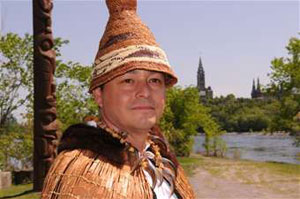
New national chief Shawn A-in-chut Atleo.
New national chief Shawn A-in-chut Atleo.
This week's General Assembly of First Nations set many precedents, not least the election of 42-year-old Shawn A-in-chut Atleo as the youngest national chief in history. Calgary was at times a surreal setting for the event. In the corporate heartland of our energy industry, 3,000 native visitors simply took over the neighborhood where the voting took place, filling entire buildings like the Hyatt Regency and the Marriott Hotel at the foot of the Calgary Tower. Delegates strolled in and out of the Telus Convention Centre, scene of all the action. They stormed the patios lining Stephen Avenue, window-shopped on Centre Street, and held a magnificent pow-wow in the Olympic Plaza, which had its pond drained to make room for all the dancers. You could almost hear the Indian Act's authors turning in their grave at the sight of all those feathers so far off-rez.
The headdresses are a ceremonial thing, by the way -- at street level it's damn near impossible to tell a chief just by looking, so it pays to give everyone respect. That's all anyone's asking for anyway; it can take the form of money, or an apology, or a legal amendment, but it all comes down to the same thing.
And so words like culture, tradition, environment, and sensitive permeated the speech of TransCanada's president during the opening night's tribute to Phil Fontaine. Four days later, at Atleo's first reception as Fontaine's successor, it was the president of Enbridge who deployed the same vocabulary for the same reason: to keep the oil and gas dollars flowing.
The fact that the vast majority of this aassembly's million dollars in sponsorship came from the energy sector (you only had to look up at the names emblazoned on Calgary's skyscrapers for an idea of who was signing checks) said it all: we're entering an era in which First Nations land and treaty rights can no longer be bought for a song. The equation of those rights with oil and gas money was something each of the five candidates made clear, and Atleo will push it too. A series of Supreme Court decisions in the last decade or so, beginning with Delgamuukw in 1997, has put the law on his side; the corporations know it too, and are scrambling to make friends of potential adversaries.
Schmoozing or respect?
"I'm still not sure they get it, though," said Lee Ahenakew, a Saskatchewan Cree who chairs the board of directors for the National Centre for First Nations Governance. Ahenakew, whose uncle David became the AFN's first chief in 1982 (though he's more famous today for a 2002 videotape on which he spoke in favor of the Nazi Holocaust), was referring to the fact that none of the corporate presidents were seen mingling with the crowd during the week. At most they spoke a few words on stage, then disappeared and left their Aboriginal relations staff to schmooze the assorted chiefs. "To me that shows a clear lack of respect, and it's something they'll likely regret when they find their projects getting bogged down for a few extra years. Those guys have no idea what's coming. Every bridge or road they want to build on treaty land, they now have a duty to consult with the Nation and give it a stake. This applies particularly to resource companies -- if they so much as touch a tree on treaty land, we have to be consulted."
According to Ahenakew, the Environmental Assessment Act provides an especially strong legal tool for First Nations Communities to apply the duty to consult. "Not all of us know how to make it happen, but I do, and I can help others to figure it out."
Ahenakew was typical of many of the First Nations I met over the course of the week: young, educated, and equally comfortable with western and Aboriginal traditions. A newly emerging cadre of leaders was on display, networking day and night. They operated both amongst each other and the corporate community -- in some cases, they even represented the corporate community.
Building ties to corporations
"Our problem as First Nations is that we have a huge resource base but almost no capacity," said Lloyd Martel, a former campaign manager for Phil Fontaine who now works in aboriginal relations for Nexen, a Calgary-based oil conglomerate. "Both sides want a partnership, but there are so few trained professionals in most aboriginal communities that it's just not possible yet; it's going to take years to develop." Nexen, he claimed, was setting the stage for this by designing long-term partnership contracts that included a date -- say, 30 years hence -- on which Nexen agreed to walk away from the project and leave it in the hands of the host community.
People like Martel walk a thin line analogous to that of the AFN (which gets all of its funding from the federal government): they are accused of collaboration, in precisely the same spirit as the French resistance accused the Vichy regime during World War II. Terrance Nelson, the most strident of the candidates running against Atleo, articulated it best: "How do you expect the AFN to change government policy," he asked, "when it's being paid to implement government policy?" This shadow of mistrust hung over the entire assembly, and Shawn Atleo has his work cut out to overcome such a deeply held suspicion of white money and power.
On the other side of the fence, our non-Aboriginal leaders might put a little more energy into explaining that mistrust to Canadians. Many of us still seem perplexed by it. It's worth recalling, for instance, that Canada's reserve system served as the model for South African apartheid. John Ralston Saul, the Canadian philosopher, has eloquently described how South Africa's government repeatedly sent agents to Canada to learn from our talent for segregating and marginalizing indigenous communities, a collaboration the Canadian government endorsed from the late 1800s to the 1960s.
Yes, yes, the counterargument goes, but that was all back then. Why can't those natives stop feeling sorry for themselves and get on with it? We've formally apologized, after all, and we give them all kinds of money and preferential access to universities and the like -- what's holding them back in the 21st century?
The New National Chief, and His Corporate Suitors: Page 1 of 2
What have we missed? What do you think? We want to know. Comment below. Keep in mind:
Do:
Do not: