News

Shootings Spook Voters

How the parties are politicking on the issue of public safety.

By Irwin Loy, 22 Apr 2009, TheTyee.ca

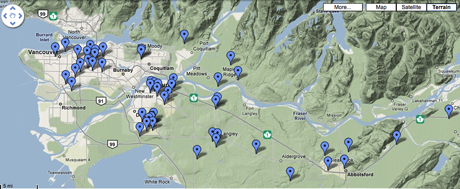
Map of shootings in the Lower Mainland

Where shootings occurred this year in the Lower Mainland.

Keith Roy is feeling nostalgic these days.

The Vancouver realtor recalls the good old days in his city, when the only gun that went off was the nine o'clock cannon in Stanley Park.

These days, Roy feels like he reads about a new shooting almost every morning.

"That's not the city I grew up in," says Roy. "I shouldn't have to be concerned about driving at 10 o'clock at night and going to the store and worrying about being in the wrong vehicle at the wrong time."

In late January, a gunman opened fire on a passing car near a busy commercial area of Abbotsford. The car skidded into a restaurant parking lot off South Fraser Way.

Since then, a review of police and RCMP reports suggest there have been upwards of 50 shootings in the Lower Mainland -- almost one for every other day so far this year.

Not all have resulted in death or injuries. Nor are they all directly gang related. But for many, the wave of violence has cast a shadow over the region, one that, according to at least one foreign news report, has swapped Vancouver's "cuddly, eco-friendly" image for one of "blood-spattered streets littered with shell casings and corpses."

"I'm tired of waking up every morning and hearing about another shooting in Vancouver," Roy says.

And it appears he isn't alone.

Spurred on by the ongoing violence, crime has vaulted to become one of the top two issues in this election campaign, recent results from two polling firms suggest.

A Mustel Group poll conducted early this month suggests B.C. voters think crime is the number two issue in this election, behind "the economy."

And an Angus Reid Strategies poll also pegs "crime and public safety" as the number two issue -- at 19 per cent, it's well back of the 36 per cent attributed to the economy, but noticeably higher than perennial favourites like health care, taxes and the environment.

While it may be a stretch to say that crime will be the ballot-box question in this campaign, at the local level, it's an issue that could galvanize support one way or another in a few key urban ridings hit hardest by the violent shootings.

Whichever party is able to convince voters that it can best deal with fear for public safety stands to swing key seats in its favour.

Violence where voters live

One of those ridings is where, on a sunny day in February this year, a bizarre scene unfolded before horrified residents in a South Vancouver neighbourhood. By the time the afternoon was over, one man had been shot in what family members insisted was a case of mistaken identity, while another man's dead body lay in plain view in the middle of the street, covered by a police tarp.

Weeks later at a community centre a few minutes away, the B.C. Liberals announced veteran police officer Kash Heed would run for office in Vancouver-Fraserview.

This South Vancouver riding is extraordinarily diverse, with almost 70 per cent of residents older than 15 identifying as first-generation immigrants, according to 2006 census figures, more than double the provincial average. A higher-than-average percentage of seniors also live in Fraserview.

And, with the departure of MLA Wally Oppal to run for a seat in Delta South this year, it's a riding with no incumbent -- and one of several potentially problematic ridings the B.C. Liberals must hold on to. Not surprisingly, Heed has been leaning heavily on his law enforcement reputation to leverage votes. In a world where strategists must limit their messages to a few keywords, the words "gang," "safety," and "crime" appear no fewer than 21 times on his campaign website.

Just one day before the South Vancouver shooting, a woman was shot dead behind the wheel as her Cadillac passed through an intersection right beside a popular Surrey park. Particularly horrific in this case -- the woman's four-year-old son was sitting in the back seat.

The shooting falls right on the border of the new Surrey-Fleetwood riding. NDP MLA Jagrup Brar will nudge over from his old Surrey-Panorama Ridge riding to contest this battle. Although he won his old riding handily enough in 2005, outdistancing his nearest competitor by double-digits, this new riding is drastically different, containing none of his old Panorama stomping grounds and almost half of the former Surrey-Tynehead riding.

Inversely, the electoral boundary redistribution now complicates B.C. Liberal MLA Dave Hayer's re-election campaign to the north, with a chunk of neighbouring Whalley now a part of Surrey-Tynehead.

It's a riding that hasn't escaped this year's violence either. On an early Tuesday evening in February, 21-year-old Raphael Baldini was gunned down in his white Range Rover, parked in the Guildford Mall parking lot. The shooting had a link to another chilling murder: The October 2007 "Surrey Six" slayings, in which two innocent bystanders also had their lives ended. Baldini, investigators say, was named on the lease of the apartment in which the murders took place.

Mapping the Violence: Surrey ridings hit hardest by shootings

Comparing this year's Lower Mainland shootings with a map of 2009's electoral boundaries suggests there are a number of ridings where a tough on crime message could win votes. [Go here to see an enlarged map of shootings this year in the Lower Mainland.]

Ten ridings were home to two or more of the high-profile shootings:

Surrey-Newton: 5
Surrey-Whalley: 5
Abbotsford-South: 4
Vancouver-Kingsway: 4
Fort Langley-Aldergrove: 3
Langley: 3
Maple Ridge -- Pitt Meadows: 2
Surrey-Fleetwood: 2
Surrey-Panorama: 2
Surrey Tynehead: 2

While it's difficult to imagine ridings like Fort Langley-Aldergrove changing hands this year -- B.C. Liberal Rich Coleman doubled his closest opponent here in 2005 -- the issue of crime has the potential to affect the outcomes of urban ridings where the races will be tighter.

This year, crime and public safety simply can't be ignored, says Mario Canseco, a pollster with Angus Reid Strategies. "There are a lot of people who are going to be first time voters in this election. Either they're turning 18, or they are new citizens. There's a new constituency out there that definitely wants to hear more about who's going to deal with crime." -- Irwin Loy

Dueling crime platforms: Libs and NDP

This year, 10 ridings were home to two or more high-profile shootings (see fact box and click on map).

But which party is best able to grasp the issue? Winning votes on crime isn't so much a cerebral debate on policy; it's a nebulous topic that plays to voters' fears and sense of personal security.

And this year, voters may have a tough time distinguishing between the B.C. Liberal and NDP platforms.

In their 55-page platform booklet, the Liberals promise to crack down on gangs and guns. The party's seven broad, key points:

  • More police officers, including 168 officers hired with federal funds
  • More prosecutors
  • More jails and secure courts
  • Tougher laws and sentences
  • Crackdown on illegal guns
  • Outlaw armoured vehicles and body armour
  • New gang hotlines and rewards programs

The NDP's 56-page platform, meanwhile, points out that the Liberals have overseen closures of B.C. jails and courthouses. But the NDP promises are nearly identical, right down to the number of officers it wants to hire:

  • Hiring 168 new officers
  • Creating an anti-gang prosecution team
  • Cracking down on "the revolving bail door" for gang members
  • Tougher laws and penalties for gang-related crime involving guns, body armour and armoured cars
  • Studying the feasibility of regional policing in Metro Vancouver
  • Sending out-of-province criminals back to their home provinces to face outstanding charges

It's left criminologist Rob Gordon feeling underwhelmed.

"There's nothing here that sets me on fire," says Gordon, a professor at SFU's criminology department, who calls the focus on new hires without looking at fundamental organizational issues "pre-election posturing."

'I'm not taking it anymore'

"What is required to deal with organized crime is a proper organized crime agency that is going to focus its efforts on organized crime activities on a regional basis. We don't hear anything about that," Gordon says.

University of the Fraser Valley criminologist Darryl Plecas, meanwhile, is happy with what he sees as a rare consensus on crime from both parties.

"I can't recall where we've seen the public being more in-your-face about these things," Plecas says. "The public has said, 'I'm not taking it anymore,' and politicians have responded."

But politically, it doesn't leave voters with a clear choice.

"I thought to myself, crime is certainly not going to be an election issue, because [the B.C. Liberals and the NDP] seem to be on the same page."

That may be a problem if or when either party decides it needs to gain ground on the issue.

"It's like neither party is trying hard to win the crime issue," says SFU political scientist Kennedy Stewart.

The caution isn't necessarily unexpected.

"In a two-party race, both parties have to run towards the middle. You say what your opponents say on most issues. They're both deciding that crime probably won't be the thing that they'll fight the election on."

How many new cops?

Voters can be forgiven for being confused over basic questions, like which party is more committed to hiring additional police officers.

Both the NDP and the B.C. Liberals have used a figure of 168 new police officers.

For the NDP, it's a promise to hire.

For the Liberals, it's a recap of a February promise, itself a response to the wave of violence that was just beginning to engulf the Lower Mainland. The figure was an announcement of how the province would spend previously allocated federal funds; at least 90 of those 168 officers have already been hired.

The Liberal platform also touts some 1,100 new officers hired across the province since 2002, a figure that includes 560 new hires by municipal forces, which approve new expenditures through city hall’s yearly budget process

But Solicitor-General John van Dongen insists it's fair for the province to take credit for the hires, since the province redirected traffic fine revenue to the cities for policing.

"It's a lot of money -- $210 million over five years," van Dongen says. "It's money the province has forgone."

Toughest on crime?

While the Liberals and New Democrats are proposing similar ideas on crime, the poll results suggest it's the left-of-centre NDP that must make up ground if the party wants to fight for the issue.

According to the Mustel Group poll, 49 per cent of respondents associated the B.C. Liberals with doing the best on crime, with 25 per cent picking the NDP. Twenty-one per cent of respondents were undecided, while five per cent picked the Greens.

The Angus Reid poll, too, suggested the Liberals' Gordon Campbell, at 31 per cent, was better suited to tackling crime, while 21 per cent chose Carole James.

But NDP MLA Mike Farnworth, whose Port Coquiltam riding has also seen a high-profile shooting death this year, bristles at suggestions that his party isn't likely to win the crime issue.

"I don't see crime as a right-wing or left-wing issue," said Farnworth, the NDP's critic for public safety and the solicitor-general.

"I think that the NDP needs to be talking about these issues. We need to be letting people know we take gang violence seriously, that we are concerned about it, that we do believe it is an important issue."

Although the Angus Reid poll suggested more British Columbians trusted Campbell to tackle crime, the firm's Mario Canseco points out that almost half of respondents, 45 per cent, were unsure who would be best.

"That leads us to believe there's a big group out there waiting to see what happens. They're trying to figure out who's going to provide safety specifically in these urban areas," Canseco said.

"It's an issue that's out there for the taking. It depends on what the leaders convey to the public and who can connect."

Related Tyee stories:

 [Tyee]

18  Comments:

Login or register to post comments

  • Wilfred Laurier

    3 years ago

    The one thing

    The one thing not being mentioned is the need for a Metro police force.

  • Dan the socialist

    3 years ago

    How would that help?

    How would that help? Wouldn't it be the same officers as we have now?

    I don't think a metro force wil ever happen.

  • David Beers

    3 years ago

    Administrator

    metro police force

    Actually Wilfred Laurier, our reporter lists this as an item on the NDP's platform:

    "Studying the feasibility of regional policing in Metro Vancouver"

    Here's an article The Tyee published on the idea two years ago:

    http://thetyee.ca/News/2007/03/08/Police/

  • Grumpy

    3 years ago

    I take a different approach to Gang shootings........

    .......... history has shown, when the rule of law is flaunted by the rulers of the land, the bottom feeders of society think they are above the law as well.

    In BC, it is no secret that the ruling BC Liberal Party is up to its proverbial teeth in conflicts, questionable acts, and police investigations, so much so that they collectively show a utter and complete disregard to the rule of law in the province.

    The gangsters and general 'bad boys' of BC now think that they are too above the law and resorted to summery executions to secure their grip on the illegal drug trade. There is no surprise in what is happening and more police or a 'metro' police force will not solve anything. In fact more police means there is more of a chance that they will investigate those in charge!

    It is the rule of law that protects society and why politicians think that they can act above the law is the root of the recent spat of shootings. What is sauce for the goose is sauce for the gander, so to speak.

  • MichaelT

    3 years ago

    when they ended prohibition

    when they ended prohibition in the 30's the murder was immediate cut in half and did not reach the same levels it was during alcohol prohibition until recently due to our current prohibition.

    anything else shows total bias in the media or stunning ignorance or both. The other deadly demon in all this is the religious belief of many in the media right and left who are dogmatically opposed to the evidence if it conflicts with their beliefs.

    Not an attack on Mr. Beers but everyone in the media seems to be playing from the same hymn book on this matter...Mr. Beers - any comment? Thanks!

  • MichaelT

    3 years ago

    I have a crazy busy long day

    I have a crazy busy long day starting now so will check back much later tonight - after 8:30pm and if you like I will write a piece on these stats, etc.

  • Jabberocky

    3 years ago

    Regional force

    Dan the Socialist:

    Right now, one of the problems that our police forces face is jurisdictional issues. Namely, it becomes difficult for a force in a particular municipality investigate crimes that may take the investigation outside of the municipality.

    This is why we have seen the advent of IHIT and a couple of groups targeting organized crime (e.g. OCA).

    I don't necessarily buy into the idea that a regional force would be a more cost efficient way of delivering police services. But I doubt that a regional force would be more expensive.

    Also, you have to look at things like displacement - where one force cracks down on a particular crime but the net effect is to displace that crime to an adjacent municipality, thereby not actually "taking a bite out of crime."

    A regional force would allow for greater strategic planning around easily displaced crimes.

    Finally, the only real hold-up here is likely coming from the politicos, especially the municipal poobahs who probably like having a measure of control over their obedient little dobermans.

    But if you think about it, if we were to start from scratch today, we would never, ever build the mish-mash of forces that we have today. It just wouldn't make sense. So why should we let our history get in the way of our future?

  • David Beers

    3 years ago

    Administrator

    MichaelT

    You make a good point. The politicians aren't offering a deep analysis of the roots of crime in BC. I'd welcome any substantive post by you on the topic -- as I would from any of our readers.

    The goal of this piece was to discuss how the parties were reacting to the fact that 'crime' rates high on recent polling on citizens' concerns. We wanted to document the ridings where it might be higher given number of shootings and report what the parties were saying on the campaign trail and in their platforms. Reporter Irwin Loy also quotes an SFU expert who is frustrated with the lack of depth in either parties' proposed solutions.

  • crh

    3 years ago

    this increase in shootings and crime

    happened under the Campbell government. Yet voters think that this same corporate shill will be the man to fix it. What is everyone smoking in Vancouver and the lower mainland?

    Anyone willing to take on the closing of casinos?

  • leem

    3 years ago

    4 years ago in toronto, a

    4 years ago in toronto, a 'wave' of shootings hit the city. average citizens were reported as being 'afraid to go out', and were lamenting the days when the streets were 'safe'. toronto's mayor had much to say about the violence, but little was done, except for america-bashing (all the guns came from across the border, RIGHT! lol!), and a toronto councillor suggesting that police search all cars driven by black people, in case they were carrying guns to be used in future violence...(like the movie Minority Report)
    am i the only person who sees that, for desperate people with little education, violence is a means to an ends? if my choices, at 20, involve working in the fast-food industry for $9/hr, versus making hundreds of dollars potentially each day, selling drugs, or driving criminals around, or some other 'gang-related' work, i would like to say i would chose burger king over drug kingpins, but i can't answer that honestly because i haven't been in that situation. with violence, guns, drugs, alcohol and cheap sex glorified on tv, music and movies, why do you think that gangs seem to be growing in numbers? our social welfare system is terrible; jobs for undereducated people are lousy; the political system is so corrupt the cracks are beginning to show; unemployment is hitting blue-collar families hard; 2012 is playing on many people's minds. you can blame drugs, and guns, and immigration laws, but the real culprit is our broken culture.

  • Fiat lux

    3 years ago

    More police is not going to

    More police is not going to solve the gang problem, when governments actively encourage the multinational corporate mafia to take over and collectivize economies, depriving millions of decent living.

    If stealing a candy bar, or holding up a store is a crime, why isn't it a crime when corporations take over whole slew of stores, or mills, or any other businesses and fire people by the hundreds and thousands to rehire some at starvation, minimum wage, part time jobs.

    All I can see in our supermarkets are ads for part timers. No such thing 30 -40 years ago, when people were making wages with good buying powers and we had no crimes, or gangs.

    The organizations of multinational corporations, like the Bilderbergers and the Trilatelars, not to mention the NAFTA, etc. are in reality criminal gangs organized to collectivize, colonize and exploit humanity and the whole world.

    Not visibly with guns, but with the perceived power of imaginary capital "created" from the air.

    This is the example followed by the gangs in more crude and primitive ways, but always based on the simple rule:

    "WEALTH CAN NOT BE CREATED, ONLY TAKEN FROM OTHER SECTORS, THE ENVIRONMENT, AND THE FUTURE"

    As long as "wealth creation" is a permitted and taught principle, the violence will rise. Perhaps one day our professors and politicians may just stumble of simple, long known physical facts. SURPRISE!!!!!!!!!!!!

    I grew up in a police family in a European country, impoverished by WW1, then the great depression, then WW2. We were dirt poor, but had no crime, or juvenile delinquents, or violence to speak of, and nothing was stolen in the schools, although we had no lockers and our coats, major expense for any family, were hanging out in the hallways.

    Figure it out.

    Ed Deak.

  • Skywalker

    3 years ago

    I think the course was set in the 60's

    Those were the boom years. Land developers ruled, growth was the only thing that kept the economy going. BC was ripe for the picking. Vancouver, and I lived there, was a nice city. Today it is place I avoid. The sad thing is that the whole mentality that created today's Vancouver moved like a cancer east through the valley. Why anyone would live there is beyond me.

  • Lynda T

    3 years ago

    prevention

    I am very frustrated with the knee-jerk response to this issue always being more police officers and tougher sentences. If that really worked, wouldn't we have fixed it by now? We've had more "law and order" governments in BC and Canada in the last few years than in the previous 30, and clearly, the situation is getting worse.

    The biggest problem is that all of the proposed solutions are after-the-fact, closing-the-barn-door-after-the-horse-is-gone approaches.

    As a teacher, I believe the root of the problem is the underfunding of education, resulting in higher classes than ever at secondary when kids are making the decisions that will impact the rest of their lives.

    In Surrey, where I work, nearly all of the over-sized classes (upwards of 1000 at last count) are at secondary. I think people have this idea that secondary students can fend for themselves, and they don't need as much attention. Teaching is not just about passing the test.

    With my own teenagers, I feel that they crave that one-on-one attention more than ever. They want to be acknowledged as real people, and they want someone to show that they care. If you are a secondary school teacher, working full time, you can easily have upwards of 200 students in a year. If your seven classes have only 30 each, you'll have 210. I don't think that is a situtation that lends itself to making personal contact with students of a very meaningful kind. The fact that so many secondary teachers succeed is an amazing testament to their commitment and hard work.

    Gang membership is about a feeling of belonging, and that is exactly what we are losing in underfunded secondary schools.

    It is no accident that we are having this problem in BC, where after 8 years of Liberal cuts, we have the highest pupil-teacher ratio in the country, and the worst funding.

    Education is the best investment for crime prevention AND for the economy.

  • Fiat lux

    3 years ago

    We've lived in Vancouver for

    We've lived in Vancouver for 24 years between 1955 and 79, had our own business, house, etc., but even by the late 70s the city was becoming a bloody mess.

    I haven't been back to that worldclass dump since 1988 and my wife since 1980. Every time we see it on TV we shudder and thank our lucky stars that we managed to get out in good time.

    Ed Deak.

  • JodieEmery

    3 years ago

    BC Greens offer only real solution

    Anyone concerned about crime should vote BC Green Party. The NDP and Liberals offer the same old solutions: stiffer sentences, more police, longer prison terms. But we cannot imprison our way out of the crime and gang problem. The USA has tried and is far less safe than Canada, even though 1 in every 100 citizens is behind bars.

    If increased law enforcement and imprisonment worked, then the USA would be safer than Canada. But it’s not. Imprisoning people does not stop the gangs or violence. When a gang member is jailed, someone replaces them, and gang members recruit while in prison.

    Building prisons and jailing people relates to symptoms of the problem, not the cause of the problem. The cause of the gangs’ turf violence is the lucrative finances earned under drug prohibition. We have to end prohibition to end the gang violence, just as ending alcohol prohibition stopped the gangsters’ shootings in the 1920s and ‘30s.

    We must move the illegal drug industry out of criminal control into a taxed and regulated system. The BC Green Party understands that ending prohibition will properly address the crime and gang problem, so concerned citizens should vote Green on May 12th.

  • MichaelT

    3 years ago

    I'll do what I can...have to

    I'll do what I can...have to take care of many things today but maybe for next week or sooner if I can find some time tonight but likely weekend

  • penmachine

    3 years ago

    Real risks

    Obviously the shootings are disturbing and the pattern of crime is worth addressing at its roots, but I also have to wonder what the real risks are.

    What I mean is, for your average person living in Greater Vancouver, how likely is it that a gang-involved shooting is a danger, compared to any number of other risks, from car crashes to air pollution? Are we going to throw a lot of money at this issue, in possibly ineffective ways, that might actually save more lives if directed elsewhere, or more intelligently at the causes rather than the symptoms of the problem? And, importantly, what does actual evidence from other jurisdictions (such as Portugal, where even hard drugs have been legalized) suggest?

    A few years ago I would never have considered drug legalization as reasonable, but it seems to me that a significant proportion of the misery in our otherwise wonderful city is driven by a drug market that runs underground. I doubt more police and more enforcement will do much on its own. The unfortunate fact is that many people use drugs, and will get them however they can, directly or indirectly via gangsters if necessary.

  • rangergord

    3 years ago

    Prohibition and Police more of the same

    Excellent commentary Jodie. This article proves that the NDP and the Liberals are completely ignorant and beholden to vested interests. As long as prohibition continues the Court of Bang Bang will be the only avenue to resolve disputes between drug market players. The governments and corporate interests have decimated the job economy, and the forest sectors. A job in organized crime becomes very attractive under these circumstances. Legalization is the only moral solution.

    • The discussion for this story is closed. No more comments can be added.