
News

Campbell Wants to Repeal Waterways Access Law

1882 Act protects citizens' right of access to rivers, lakes, ocean inlets.

By Andrew MacLeod, 23 Feb 2009, TheTyee.ca

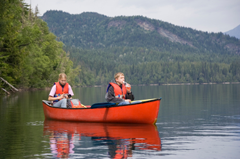
Canoeing

Recreationists worry about impact.

The premier of British Columbia, Gordon Campbell, wants the federal government to repeal a major piece of legislation that helps protect the environment.

The attack, which comes at a time when the federal government is already trying to weaken the act in question, at first appeared inconsequential. It rated just one sentence deep in Feb. 16's 40-page speech from the throne.

"The federal Navigable Waters Act [sic] should be repealed and replaced by legislation that meets the legitimate needs of the 21st century," said the speech, which sets out the government's priorities. "A unified major project review process will speed up job creation in mining, energy, resort development and other areas."

As it happens, the B.C. government had the name of the federal act wrong, leaving out the word "protection" from the Navigable Waters Protection Act.

The act's primary purpose is protecting people's right of access to rivers, lakes and any body of water it is possible to travel by boat or ship, an environmental lawyer explained. By helping protect waterways, the act has the side benefit of keeping them in their natural state.

That law's too old: Campbell

Reporters, curious about why the provincial government dislikes the act, got little help from Campbell during a scrum in his office.

"Let's put this in context for you," said Campbell responding to a question from CKNW's Sean Leslie. "That act was passed in 1882. I would suggest that the world has changed dramatically in the 21st century from what it was like in 1882."

The act slows development, he said. "Right now across the West, literally every economic development minister will tell you that the federal Navigable Waters Act [sic] is a huge impediment to investments and to jobs."

He added, "If there are legitimate needs for the Navigable Waters Act [sic], put them in place in a 21st-century bill, but don't hold up 21st-century investment and jobs because of a 19th-century piece of legislation."

Just what projects are being slowed by the act?

"You name it. Name a project that's a significant project. If it involves any kind of watersheds, it could do that, sometimes if it involves an agricultural ditch it, may be called on."

The act is supposed to ensure people can travel the country's waterways, he said. "We're capable of doing that in British Columbia without checking with the federal government."

'Profound misunderstanding'

Campbell's right that the Navigable Waters Protection Act is old, said Will Amos, a staff lawyer for Ecojustice in Ottawa. That's not a reason to get rid of it, he said, asking rhetorically, "Is the Constitution outdated?"

In fact, the principle the act is based on goes back much further, he said, to the Magna Carta, signed in 1215. Since then, common law in many countries, including Canada, has protected the public's right to use waterways.

The public has that right, said Amos, and the federal government is mandated to protect it.

"The suggestion of a repealing of the Navigable Waters Protection Act is ridiculous and inappropriate," said Amos. "It's a legally and historically incorrect view... It's a profound misunderstanding of navigation history and law."

Amos said he can, however, understand why Campbell wants it killed. "The provinces don't like any federal environmental regulation and enforcement."

Or as Linda Duncan, the MP for Edmonton-Strathcona and the federal NDP's environment critic, put it, "Provincial premiers always want to get rid of the federal government."

Told of Campbell's comments about the age of the act, she said, "Yes, they are very old laws. People have guarded them."

Environmental assessments

The Navigable Waters Protection Act will trigger an environmental assessment whenever a structure goes over a river or a lake, Duncan said. "It sounds like a minor thing, but it's an important part of federal responsibility," she said. "This is not an insignificant law."

In B.C., for starters, thousands of salmon streams could be affected, she said.

Campbell's are strange remarks from a premier working on his green reputation, she said. "He's showing his true colours. Unbelievable he would single it out."

That leaves observers wondering why exactly Campbell wants the act gone.

"It's a major trigger for the Environmental Assessment Act," said Andrew Gage, staff counsel for the West Coast Environmental Law group. It affects proposals such as a controversial one now being debated to add a marina to Victoria's inner harbour.

Provincial NDP environment critic Shane Simpson said Campbell has all kinds of reasons to oppose the federal regulations. The act affects run of the river hydro projects, gravel extraction and aquaculture, he said. "This could certainly relate to issues around oil tankers."

"I think it really does have to do with beginning to reduce environmental oversight," he said.

Last week's B.C. budget cut the province's environment ministry by 11 per cent, said Simpson. "Instead of putting resources in to deal with these in a more thoughtful way, the other option is just get the rules out of the way totally."

Federal threat

While repealing the act is not something on the federal agenda, the Conservative government is in the process of significantly weakening it.

On behalf of various clients, including environmental groups and Mountain Equipment Co-op, Amos will appear before the House of Commons Standing Committee on Finance today (Feb. 23) to oppose the changes, which the Conservative government announced with the budget in late January and detailed in the Feb. 6 Budget Implementation Act.

Harper's proposed amendments would make it easier to skip the approval process and environmental assessments, said Amos, who wrote an Ecojustice memo on the issue. "The [Transport] minister will be able to exempt whole classes of waterways and works from the approval process and environmental assessments."

The minister could, for example, decide that aquaculture projects are no longer subject to the approval process, he said. He or she could do the same for micro-hydro projects, a controversial topic in B.C..

For such projects there would no longer even be any need to notify the public, Amos said, threatening both long-standing access rights and possibilities for protecting waterways. With the stroke of the pen, he said, "They could do a lot of damage and nobody would know."

The Harper government argues the changes are needed to accelerate infrastructure spending, said Amos. "Wrecking the environment to stimulate the economy is not the direction we need to go."

Sneaky bill

A better way to accelerate approvals would be to invest money in the government departments that do the work, he said. "They could do that and they ought to do that." Instead ,Harper is choosing a deregulation approach. "We saw where deregulation got the U.S. economy. We don't need to go down the same route with the environment."

That Harper's government has brought the changes forward as part of an unrelated bill is outrageous, he said. "The real problem is we weren't consulted," he said. "There's a lot of people really concerned about this... We're finally going to get the opportunity to be heard."

Stories are starting to emerge from the paddling community, and there is concern among environmentalists, though the issue has received little media attention.

Amos said he'll tell the Feb. 23 committee meeting the amendments are contrary to the interests of many Canadians, including those in the ecotourism business, sport fishers and outdoors stores. "You're going to hear more about this soon."

The NDP's Duncan said bringing the changes forward as part of a budget bill is sneaky. "It should be done in an open forum so people can understand what they're up to," she said. "Shouldn't they come forward in a way the public can discuss and debate?"

The federal Liberals were in a position to ask for the amendments to be removed before they pledged support for Harper's budget, she said, but failed to do that.

Green edges

Campbell's attack on the federal laws is just another sign his commitment to the environment is weak, said the provincial NDP's Simpson. "It was always very narrow," he said. There was the introduction of the carbon tax to show Campbell's interest in the environment, but little more. "If you looked past that there's not much in the way of green initiatives that you can find on the agenda."

While Campbell has received credit for the carbon tax, a lot of environmentalists have ignored his brown side and what's actually happening on the land, said Vicky Husband. A long time conservationist, Husband describes herself as a "free radical" since her parting a few years ago from the Sierra Club.

In a recent e-mail, she listed a number of things the Campbell government has done: subsidizing the oil and gas industry, promoting coal bed methane exploration, encouraging "ruin of river" private hydro projects, funding advocates of offshore oil and gas development, allowing the removal of land from management under tree farm licenses, removing control over forest industry practices, promoting fish farms, ignoring the evidence on sea lice and salmon, proposing pipelines across Northern B.C. and building more highways in the Lower Mainland.

"A lot of the leading environmental groups are caught up in climate change and if there's a carbon tax, things are good. I've always said, 'show me,'" she said. "It's a total sham... He's going green around the edges and that's it. There's no green in the centre."

Pressing Harper to get rid of an act that helps protect waterways is just one more example, she said.

Related Tyee stories:

 [Tyee]

49  Comments:

  • Luke Skywalker

    22-02-2009

    Perhaps a "Real" Reason to the Proposed Changes???

    Quote:
    The Navigable Waters Protection Act will trigger an environmental assessment whenever a structure goes over a river or a lake, [NDP MP for Edmonton-Strathcona] Duncan said.

    And in my mind Navigable is the key phrase in the existing statute.

    BTW, when I first heard about the statute the first thing that came to my mind was exactly what Linda Duncan stated above and herein.

    To further clarify, the Fraser River is under the jurisdiction of the Act and, as a result, new river crossings such as the Golden Ears Bridge and Port Mann Bridge are required to be built as "high-level" structures adding $hundreds of millions$ to their cost although I doubt any major freighters head east of Annacis Island (just west of the "high-level" Alex Fraser Bridge) these days.

    Even the Mission Bridge, built circa 1974, is a "high-level" structure although I doubt any major freighters headed up the Fraser River that far even back then.

    The new Pitt River Bridge, while permitting river navigation, certainly is not a "high-level" structure saving $hundreds of millions$ in the process.

    The Fraser River requires "high level" bridges, while the Pitt River requires "low to mid-level" structures.

    Reminds me of the "high-level" Granville Street Bridge over False Creek constructed circa 1954, in contrast to the much cheaper "low level" Cambie St. Bridge over False Creek constructed circa 1985.

    I dunno, just my perceptions of perhaps some of the real motivations behind the proposed changes to the Act.

  • seth

    22-02-2009

    Greenies for Gordo

    Thank you David Suzuki, Andrew Weaver.

    Instead of correctly denouncing Gordo's green tax as a cynical redistribution of taxpayers money to Campbell's big corporate campaign donators, you instead praise it giving all those "low information" green voters the go ahead to either vote for one of the most environmentally destructive governments in the western world or vote for the Greenie Party ie the same thing.

    Can either of you two you say "fish farms"

    Carol James who promises an end to fish farms, run of the river power and other green initatives routinely gets attacked by these "useful idiots" as Gordo and gang affectionately and privately refer to them.

    According to the last Mustel poll the Greenies are well on the way to once again electing Gordon Campbell.

  • Tbarnston

    23-02-2009

    Thin Edge

    I consider this an attack on what makes us Canadian. As a nation, we have agreed that all citizens have a basic level of access to the resources of this country. Campbell and Harper are essentially looking to rewrite one of the founding principles of this country.

    If this gets through, it will be a lot easier to commercialize and privatize our water resources.

  • dorothy

    23-02-2009

    It IS about the fundamentals, dead right!

    "The suggestion of a repealing of the Navigable Waters Protection Act is ridiculous and inappropriate,"

    ” I consider this an attack on what makes us Canadian.”

    Er, this is GORDON CAMPBELL we are talking about. What did you think? By the way, he is not really trying to do anything evil. He and the gang just want their pie, even in hard times, whatever it takes, and the reason he is the face is that he can manage to do the more shameless things in such a slip-the-needle-under-the-skin-this-won’t-hurt-a-bit way so swiftly, that people don’t know what hit them, and they even keep voting for the miserable man and his cohort, in the mistaken belief that Joe next door not getting anything for free or getting away with anything somehow makes my situation better, or at least more bearable by comparison, and I might even get to lick a spoon!

    Only when we work ourselves out of this sycophantic BIRG thinking, will we get enough voters with backbone, who can stand up and throw this set of agendas where they belong: on the trash-heap. Interesting to note also, that Gordo and friends threw hospital workers out of their job and replaced them with privateer cheapies, because ‘the government is not in the laundry or catering business’. I would respectfully submit that the resort and other enterprises this same crew now support so tenderly entails a good deal of laundering and catering, and it seems the government conduct a whole lot of businesses, they’re just very, very selective in whose businesses. Should we make a list to cast light on the thing?

    It’s about remembering what they say and putting it together over a long time, and the situational ethics will stick out a mile. I think our fair province deserves better. Are you listening, Carole? You cannot play nice with the Greens or anybody else. We’re relying on you here! United we stand, divided we fall. Get it?

  • Van Isle

    23-02-2009

    Just watch closely what

    Just watch closely what Campbell will try and ram-rod thru before election day. Those pesky internal polls that the Liberals conduct probably show that there's a good chance that Gordo is going to loose or damn close to it, so do the damage now and to hell with the consequences. As for the Navigatable Waters act, if my memory is correct, didn't Bennet tried the same trick by making the Georgia Strait an internal sea and thus would take it out of Federal jurisdiction? Then the Province didn't have to get permission from the Feds to do what ever they want with the Georgia Basin. Oil and gas explotation, no more high tide rules and thus private beach front. Oh, it goes on and on what the possibilities are if people with no ethics got hold of the Geogia Basin.

  • puppyg

    23-02-2009

    Assault

    Campbell's time in office has been one assault after after another on everything I hold dear in BC and in our society.

    I want to see him turfed from office.

  • Curt

    23-02-2009

    There's more to this than meets the eye.

    The secretness of this government says to me that there's something they're trying to hide and they need to keep people from being able to keep an eye on them. Why else would you try and get rid of a law as old as this one? They don't like the fact that people are free to go wherever. Harper is no better than Campbell.

  • Rod Smelser

    23-02-2009

    Must be a very odd day

    It must be a very odd day. Luke Skywalker is basically right.

    The Navigable Waters Act requires the BC Govt to build higher bridges over major water bodies, at greatly increased expense, or else provide draw spans which can be opened on demand.

    In the case of the existing Pitt River Bridges this meant for years that the Fraser Harbour Commission insisted that the bridge be opened during rush hours so that a tug pulling a load of gravel could go through when it pleased.

    I will never forget a phone call in the late 1980s to one of the Fraser Harbour officials asking him the reasoning in holding up thousands of commuters for the sake of one barge. What's the economic rationale, I asked naievely. He told me the value of the commerce on the water versus the highway didn't matter a damn, historically the river traffic was here first, so it gets priority, no matter what!

    Only after years of painful negotiations was the BC Govt able to obtain an agreement with Ottawa that the bridge will only be opened at night and during mid-day periods.

    The ridiculous part in some ways is that the new Pitt River Bridge, which is needed to provide more capacity, has a road bed only twenty or so feet higher. And yes, the new Golden Ears Bridge had to reach a certain height over the water in order to accommodate imaginary shipping traffic.

    I wonder if any of the outdoor or environmental groups can point to even a single case where Ottawa has used the Navigable Waters Act to prevent industrial or urban pollution, or to maintain recreational passage on smaller waterways.

  • dorothy

    23-02-2009

    (sigh)

    Commuters: Have you tried instead asking why it is, that you cannot afford a home closer to where you work, not having to cross a bridge?

    River traffic was here first, and my guess is it will be here last. You figure it out. The explanation is too long and consists merely of huge amounts of totally basic stuff.

    Our constitution, which has not yet been declared obsolete, states in its preamble that Canada is based on the Rule of Law. Let me iterate what that means. It means that the law is there to be followed, not to be attempted circumvented by greedy smartasses and then 'used' to smack them down. Therefore, a law that has been 'used' is one that people do not respect. This one is not, from what you say, one of those. Must we really do the completely stupid thing: remove it and survey the damage after any number of years, when the vultures have been there and taken theirs and then put it back, so we can 'enjoy' the dry, scattered bones of our former fair province? I think not.

  • quarry bay

    23-02-2009

    Rod

    What makes you think a river crossing would be cheaper if the bridge was lower?.

    A flat crossing would require multible river posts,considering mt neighbor was the engineer who built the original port mann crossing.
    We have had many conversations about the bridge,because of a soft river bottom and fast moving water,that is the reason for the ARCH.....

    The arch is the strongest,most stable type of structure,a flat rigid crossing wouldn`t be any cheaper,you have no idea how difficuly it is,or would be to put in footings in the fraser river.

    Even a draw bridge would be completely impratical,think of the back-ups it would cause,and for your imformation many large vessels go up the river that far or more.

    Even sail boats,fish boats,have you seen the height of these masts.

    I suggest you keep to items you have knowledge about,river crossings and navigatable waters act are not your expertise.

    P.S. (ROD)--There is always the tunnel option but that creates a whole new set of problems.

    Lastly,here is a little history lesson, the Pattulla bridge burnt causing a shut down for 2 weeks,why did it burn? Answer,because it was built with wood in that section
    Why was it made of wood? Answer, because the ground is so soft they built that section out of wood so they could continually adjust it,because it never stops sinking/ just like that island airport in (I think Kobe)which has hydraulic jacks under every building post on the island(for continual adjustments)

  • SharingIsGood

    23-02-2009

    RE: Luke being right

    Luke is only right about part of the reason. The other part of the reason would be to allow the the further destruction of our rivers and wild salmon. If a stream that is currently navicable no longer needs to be, then that opens more doors for diverting even more water through privately-owned electrical energy turbines.

    The Ministry of the Environment has just taken another 4.9% cut with the new budget. This new cut is on top of previous 35% cut implemented in 2002-2005. The Campbell government gives lip service to the environment but does not fund its protection. For 2007-2008 there was an over-all increase to the Ministry of the Environment of 15%, but that did not offset the inflationary costs accrued over the 7 years previous to that (like normal wage increases for maturing staff at maximum salary, gasoline and heating costs etc.). Additionally, much of the Ministry's money was to be spent on mountain pine beetle issues. What little increase may have been put into enforcement, was moot: loggers, miners, developers and rancher/farmers had already been allowed to self-regulate for 7 years! Unless someone blew the wistle, there was no-onwe in the Ministry of the Environment any the wiser. Further, I don't even know if all of the 07-08 money got spent. In many Campbell Ministries, money had been budgeted, but not necessarily spent.

    http://www.peak.sfu.ca/the-peak/2002-1/issue5/ne-h2o.html

    http://www.straight.com/article-201840/bc-government-budget-cuts-some-ministries-boosts-spending-other-areas

  • Rod Smelser

    23-02-2009

    They would be substantially cheaper

    quarry bay
    What makes you think a river crossing would be cheaper if the bridge was lower?.

    They would be substantially cheaper. That's why the BC Govt in the 1950s and 1970s built the Pitt River Bridges as lower level draw spans, to save money.

  • quarry bay

    23-02-2009

    Give your head a shake man.....

    The Pitt river crossing is tiny in comparisan from burnaby up the Johnstone hill to Surrey, your trying to compare apples to oranges.

    The Pitt is considered a minor river,compared to the mighty Fraser,back in the 50s that area was considered low density rural,it still is,and by the wat I have sat waiting at the Pitt river for 100 plus foot masted sail boats to pass.

    And your not considering,ice floes/log jams/record floods/floods caused by by ice,there are many reasons for high crossings.

  • Mikemah

    23-02-2009

    Gordon Campbell

    I believe this is just one more way of attempting to control the resources of BC for special interests. (Look who his supporters are and remember the Private jets etc.) They won't be happy until the whole province is laid to waste and all of it's resources exploited to the last penny.I suppose he would like nothing more than to see the Natural fishery die off so he can sell his farmed fish.Gordon Campbell his cronies and greedy people like him around the world are responsible for this recession \ depression.Hopefully people have learned from this.

    Just look at the Olympics with the lies and the huge deficit they will leave. We need to kick him out of office before he can do any more harm.(and no this is not pro NDP this is basically anybody but him) If not you will get more of the same. Tons or money for a handful of people and very little for the majority.

    I don't believe he knows the difference between right and wrong.His drinking driving conviction, while Premier, should have convinced people of that.

  • dorothy

    23-02-2009

    Look deeper.

    "..The Campbell government gives lip service to the environment but does not fund its protection."

    This is not about anything as global and vague as 'the environment'. It is about one of the inalienable rights in our constitution: security of the person. Imagine some natural or other catastrophe, where the only way out of many interior places might be the 'navigable waterways'.Then imagine that our unquestioned right to access to these had been 'alienated'. Imagine meeting with a concession stand blocking your way to the boat launching ramp and someone (who donated to a politcal party, which shall remain unnamed) asking for a four-figure amount of dollars to let you sail, or you can just stay and be fried/poisoned/starving, or whatever. This is the kind of fundamental right we are talking about. Think that won't happen? Then read the fine details of the pay-for-resque stuff that went on in New Orleans not so long ago. If you break the rules and sail 'unauthorized', i.e. without a paid-for ticket? Your guess is as good as mine...

  • kootenay

    23-02-2009

    Federal Act

    The "Navigable Waters Act" is a Federal Act and applies to all Canadians. All this talk about saving money building low level vs high level bridges is a red herring.
    Simple Google the act, here is a link to the BC Wildlife Federation that can give you some insight.
    http://www.bcwf.bc.ca/documents/s=478/bcw1232900990320/

    Here is a quote from their website.

    "The proposed changes will no longer protect navigable water that does NOT meet the following proposed amended definition. Navigable water (a) must be, for at least three consecutive months on the year, capable of supporting typical transportation, commercial or recreational type floating vessels that draw "a draft of at least one metre". If this definition becomes the yardstick under which development applications are fast tracked; literally thousands of rivers, creeks and wetlands across the country would be excluded from protection."

    This yet another attempt to deregulate our water and allow corporations to make money while destroying our environment.

    Here is a copy of the Act if you're into reading the actual facts.

    http://www.canlii.org/ca/sta/n-22/whole.html

  • kootenay

    23-02-2009

    Here's another interesting Link

    http://www.waterkeeper.ca/2009/02/11/research-conclusions-regarding-the-amended-navigable-waters-protection-act-as-included-in-the-budget-implementation-act-bill-c-10/

    Here is a quote from that article.

    Specific concerns with the legislation

    1. The new Navigable Waters Protection Act (NWPA) eliminates environmental assessments for development projects on Canadian waterways, with very few exceptions.
    2. The new NWPA means decisions about Canada’s waterways will be based on politics and financial clout rather than science or long-term socio-economic needs.
    3. The new NWPA divides Canada’s rivers into those worth protecting and those not worth protecting.
    4. The “class” lists may be drafted by the Cabinet in secrecy, with no public consultation, scientific basis, or opportunity for appeal.

    Bigger picture concerns:

    1. The legislation fails to recognize that navigation is a public right, stemming from both Aboriginal and European history. The new NWPA mistakenly presumes that the Government of Canada and its friends, rather than Canadians, own and control our rivers.
    2. The legislation is part of an ongoing attack on science, transparency, and fairness when it comes to making decisions that affect Canada’s environment. We are seeing similar efforts to gut the Fisheries Act, environmental assessment legislation, and the Environmental Bill of Rights among others. This attack blames “red tape” for standing in the way of progress. In reality, these laws are the only things standing between citizens and a massive sell-off of our waterways from coast-to-coast, be it through pollution, development, or diversion.

    Recommendations:

    1. Decouple the new NWPA from the Budget Implementation Act, 2009 so that there can be proper, thorough, and transparent consultation with the public.
    2. Restore the environmental assessment trigger.
    3. Remove the Minister’s discretion when it comes to major projects, such as the four named works in the existing legislation: bridge, boom, dam or causeway.
    4. Eliminate the system for dividing up Canada’s rivers or classifying different types of “works”. In the alternative, create these classes only after significant public consultation and scientific review, allow for exemptions in special cases, and explicitly maintain the existing common law and traditional right to use navigable waters.

  • kootenay

    23-02-2009

    Here's another interesting Link

    http://www.waterkeeper.ca/2009/02/11/research-conclusions-regarding-the-amended-navigable-waters-protection-act-as-included-in-the-budget-implementation-act-bill-c-10/

    Here is a quote from that article.

    Specific concerns with the legislation

    1. The new Navigable Waters Protection Act (NWPA) eliminates environmental assessments for development projects on Canadian waterways, with very few exceptions.
    2. The new NWPA means decisions about Canada’s waterways will be based on politics and financial clout rather than science or long-term socio-economic needs.
    3. The new NWPA divides Canada’s rivers into those worth protecting and those not worth protecting.
    4. The “class” lists may be drafted by the Cabinet in secrecy, with no public consultation, scientific basis, or opportunity for appeal.

    Bigger picture concerns:

    1. The legislation fails to recognize that navigation is a public right, stemming from both Aboriginal and European history. The new NWPA mistakenly presumes that the Government of Canada and its friends, rather than Canadians, own and control our rivers.
    2. The legislation is part of an ongoing attack on science, transparency, and fairness when it comes to making decisions that affect Canada’s environment. We are seeing similar efforts to gut the Fisheries Act, environmental assessment legislation, and the Environmental Bill of Rights among others. This attack blames “red tape” for standing in the way of progress. In reality, these laws are the only things standing between citizens and a massive sell-off of our waterways from coast-to-coast, be it through pollution, development, or diversion.

    Recommendations:

    1. Decouple the new NWPA from the Budget Implementation Act, 2009 so that there can be proper, thorough, and transparent consultation with the public.
    2. Restore the environmental assessment trigger.
    3. Remove the Minister’s discretion when it comes to major projects, such as the four named works in the existing legislation: bridge, boom, dam or causeway.
    4. Eliminate the system for dividing up Canada’s rivers or classifying different types of “works”. In the alternative, create these classes only after significant public consultation and scientific review, allow for exemptions in special cases, and explicitly maintain the existing common law and traditional right to use navigable waters.

  • Curt

    23-02-2009

    Who the hell ...

    Who the hell does Campbell think he is?
    These laws are there for the good of all Canadians and our great country and our" resources. Not for the highest bidder.
    He must go!!
    And they better being raising hell in Ottawa too with Harper. He is no better.

  • dp

    23-02-2009

    Not Just Bridges

    This is not just about bridges - it's about:

    "[...] if you or any company, organization, government agency or Crown corporation is planning the construction or modification of a work in, on, over, under, through or across any navigable waterway. Such works include a wharf, dock, pier, dam, boom, bridge, overhead cable or pipeline."

    As much as it's about river crossings and run-of-river plays, it is also about Gordo's buds phoning him up and wondering why he can't clear the way for a big ol' dock in front of their summer place.

  • TYRONE

    23-02-2009

    Federal and provincial politicians

    I think it is high time, that ordinary Canadian citizens take a more proactive interest in so called politics. (that is poli- = many and -tics = bloodsucking insects!)
    Every time I take a look at politics as practiced by our(?) politicians I have to ask myself: WHAT PLANET ARE THEY ON? Do we have such bad judgment to vote in the low life of our species and actually fail to hold their feet to the fire when they come up with such utterly stupid statements as "these laws are too old". Look at 'Mother Nature's' Laws and just imagine if 'she' would change 'her' laws every so often! I am also deeply disappointed in Harper! How dare he hide environmental law changes in a budget! The arrogance of this moron is mind boggling! I hope more people come forward with their objections and demand honest government, After all THEY DEMAND OUR TAXES! As for Campbell, I will do my best to end his moronic reign come May 12, 2009!

  • The discussion for this story is closed. No more comments can be added.