
News

We Tried to Count the Homeless

Why today's homeless number is an undercount.

By Monte Paulsen, 8 Apr 2008, TheTyee.ca

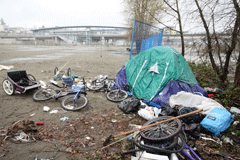
Homeless Tent Shelter

Homeless encampment, False Creek flats. Photo Rob Kruyt/24Hours.

[Editor's Note: This story was updated at 11:20 a.m. with numbers from the homeless count.]

I was one of the more than 600 volunteers who helped conduct the 2008 regional homeless count, which found 2,592 people living without homes in Metro Vancouver.

Street homelessness rose in every community within the region, though the cities of Vancouver and Surrey continue to bear the brunt -- and the tax burden -- of sustaining three-quarters of Metro Vancouver's homeless population. The regional total squares with a recent SFU study that estimated province-wide homelessness at up to 15,500.

But my experience as a volunteer suggests that today's number falls well short of the actual total of homeless Canadians living in Vancouver.

"The street homeless count really only captures part of the visible tip of the iceberg," agreed Michelle Patterson, an SFU scientist and lead author of the recent province-wide estimate by the Centre for Applied Research in Mental Health & Addiction (CARMHA). "We know homelessness goes a lot deeper than that."

Guys in vans

My counting partner and I were assigned to survey the industrial area that extends west of Clark Drive, south of Venables Street, and north of Great Northern Way. It was a rough territory; perhaps that was my comeuppance for writing stories about the homeless hell hole beneath Science World and Vancouver's worst drug hotel. In hindsight, it was hubristic to expect any two people could effectively canvas such chaotic terrain.

We were a bit too timid to wade into the underbrush while it was still pitch dark, so we began by knocking on the door of a twenty-year-old motorhome we found parked on a side street. Its occupant was quite gracious. He told us he'd been living in such campers for years, that he worked a variety of odd jobs, and that he considered himself better off than many of his van-dwelling neighbours because his motorhome was still drivable.

As we completed the one-page interview, he pointed us to the next motorhome on the block. That resident pointed us to a third, and so on. By dawn, we'd discovered an entire subculture of guys who live in vans and campers. Most were more than 50 years old and most worked odd jobs; some of their vehicles ran, and some didn't; a few said they shared meals and helped their neighbours out from time to time. None had any other place to go.

Ten agreed to be interviewed for the homeless count. We counted another 14 motor-homes that look lived-in -- condensation on the windows was our main clue -- but at which no one woke to answer the door.

We also knocked on the window of a late-model minivan with Alberta plates. After a moment's confusion, the clean-shaven man inside assured us that he was merely a budget-minded tourist. He was quite amused to have been taken for homeless.

'Perceived homeless'

No one had suggested knocking on motorhomes during the otherwise excellent training sessions that my teammate and I had attended. My guess is that as a group, guys in vans were undercounted in Metro Vancouver.

Likewise, we were unprepared for the flood of men staggering out of the bushes at daybreak. We interviewed the first group we saw: three men who said they'd been rousted from their camp by city bylaw officers. As we listened to them, we saw others emerge from nearby campsites. But by the time we'd finished with the trio, most of the others were gone.

We can only hope that those other campers spoke with other volunteers later in the day, perhaps at a service centre or soup kitchen. The count is scrupulous in its efforts to avoid counting anyone twice. The first and most important of the 17 questions we were trained to ask was, "Have you already answered this survey?"

Our paperwork did include a section for "people observed to be homeless but not interviewed." These will not be included in the total, but will be reported separately as "perceived homeless."

People who refused to be interviewed were also listed as "perceived homeless." Twenty-seven per cent of the individuals we contacted refused to be interviewed.

Most memorable of these were a couple sleeping heavily in a tattered blue tent near the southern boundary of our territory. After they did not respond to several inquiries, I grew worried. I prodded their feet lightly. They stirred. I felt relieved, and vowed to check on them again later in the day.

Overwhelmed by volunteers

My partner had to return to work midday. We volunteers were under strict instructions not to do anything dangerous by ourselves. I bought a cup of coffee then staked out the parking lot of the bottle depot on the corner of Evans and Glen, just north of the Grandview Viaduct.

Spotting the homeless customers was not difficult. While others wheeled into the parking lot in SUVs and station wagons, the homeless arrived like jesters -- balancing dramatically oversized bags of bottles and cans atop bicycles and shopping carts.

Most consented to be interviewed. All of the bottlers I spoke with professed deep disgust toward homeless shelters. Each told me how long it had been since he'd spent a night in one, and most wore the number of cold nights they'd survived on the streets like badges of honour.

All but one claimed to be drug addicts, and most said they were mentally ill. I was startled by their blunt honesty. The questionnaire asked nothing about their future plans, but each man I spoke with volunteered the news that he would be quitting soon. They said it in the precisely same way my office mates promise to diet after New Year's.

I was surprised that no one had been assigned to stake out the bottle depot exclusively.

Robyn Newton is research manager for the Social Planning and Research Council of BC (SPARC), which manages the count on behalf of the Metro Vancouver Regional Steering Committee on Homelessness.

"I don't think we were quite ready for that many volunteers," said Newton. SPARC planned for half of the almost 700 who sought to volunteer. Newton suggested that SPARC could have handled assignments better.

"It did become a bit of a logistical nightmare," she said. "Not everyone was well placed."

Night walkers

After meeting with some fellow volunteers for lunch, I joined up with City of Vancouver street outreach coordinator Judy Graves. Together, we returned to the site of the blue tent.

We found the couple awake. They were tending to a small pot atop a camp stove that was burning inside the tent. They appeared to be cooking crack cocaine. Flames from the stove licked the nylon tent fabric. They made it clear that they were not interested in being interviewed, or receiving visitors of any kind.

I followed Graves down to First United Church on East Hastings Street, where dozens of homeless Vancouverites spend their days sleeping in the sanctuary. Graves knew they'd be waking shortly, and wanted help interviewing them before they left the building.

While nearly all of the homeless I'd interviewed that morning were middle-age white men, the crowd at the First United mission included quite a few women, youth and Aboriginals. Most told me they'd smoked crack or crystal meth the night before. Some of the women had prostituted themselves. Some of the men had committed property crimes; one offered to sell me a car stereo. Like the men at the bottle depot, they spoke of their lives calmly and without much apparent judgement, as if they were talking about a television show around the office water cooler.

When First United closed its doors, I returned to the territory to catch the just-before-closing rush at the bottle depot.

Couch surfers

Among the closing-time rush, I recognized some of the same binners I'd met that morning, as well as a handful I hadn't seen previously. These included several who were relatively well-washed and wore clean clothes.

These men told me they were staying with friends -- or "couch surfing." They'd lost their own apartments, or had been thrown out of family homes, as a result of their escalating addictions. But they hadn't yet burned through all their friends. There was a nervous edginess to these men. They were weeks or maybe even just days away from sleeping on the streets themselves, and they knew it. But like those with whom they were rubbing shoulders, they planned to begin the agonizing process of quitting drugs either tomorrow or the day after.

They are also the cohort that most confound the homeless count. They are the hardest to find, and they represent much of the unseen portion of the "iceberg" described by SFU's Patterson.

"A lot of the people you see on the street are older single men. But we know that the fastest rising groups are women, youth and refugees," Patterson said.

"Women and youth are more likely to couch surf for longer periods of time. Immigrants are more likely to double up with other families. Neither of these groups feels safe sleeping on the streets."

A patch of burned grass

By dusk, we'd spoken with 38 people, of whom 27 agreed to be interviewed for the homeless count. Twelve had spent the previous night outdoors, 10 had slept in motorhomes or cars, three had crashed on someone's sofa, and two had slept in shelters.

Due to the refusals, the paperwork we handed in enumerated only 71 per cent of the homeless individuals we contacted. If we were to figure in the unanswered knocks on motorhomes, the bush campers we missed at daybreak, and the hours during which no one was at the bottle depot, I would conservatively guess that we failed to account for half the homeless population living in our little patch of East Vancouver. Other volunteers shared similar experiences.

I offer these anecdotes not to fault the count organizers, but to give a sense of how crude these counts really are. SPARC's Newton agreed.

"This is an undercount," she said. "I never pretend this is an accurate total. This is just a count of the people we were able to find in a given 24-hour period who were willing to tell us they were homeless."

"It is flawed social research," agreed SFU's Patterson. "It's a good start, but there's a lot more sophistication we could bring to this if resources were available."

Oh, and I did stop by the little blue tent one last time on the way home. The couple was gone. So was the tent. On the ground where it stood was a patch of burned grass, and a few shreds of melted nylon.

For now, that couple will simply have to remain in the "perceived homeless" category.

Related Tyee stories:

 [Tyee]

31  Comments:

  • Gary

    08-04-2008

    And by the way

    I don't just blame the Liberals for this problem. I blame every government, provincial, municipal,and federal since I started voting in 1963. The problem here is that under this provincial government the problem has increase more than tenfold since they came to power.

  • City Person

    08-04-2008

    No Political Leadership

    Quote:
    All but one claimed to be drug addicts, and most said they were mentally ill.

    Like Gary, I started voting in the 1960s. It is waaaaay to easy to blame the present government. The problem started long before this provincial government came into power. And I also think that Mr Peru makes some good points.

    Deinstitutionalisation was all the rage in the 1990s. "We have to help the mentally ill have a better life integrated into the community." This led to closure of mental heath facilities all over North America, not just the Lower Mainland. It was all the rage. Just put sick people in group homes run by NGOs and everybody will be happy, free and the the government will save tons of money.

    What is going to be need is a government with some real guts and leadership to tackle the issue,

    Quote:
    Treat the homeless in a labour camp in Northern BC where land is cheap so the govt can focus funding on treatment rather than expensive real estate

    This is the way it used to be done right up until the 1970s. Hardcore drunks and druggies were sent to work camps up north to dry out and get healthy. Most didn't like it very much and most didn't want to go back. It served as a very effective deterrent.

    Treatment centres in urban areas are useless. If the addict wants to walk out the door, he or she can, and immediately get high again. Go look at the "safe injection site" (now there is an oxymoron) on Hastings; it is a junk supermarket outside.

    Build addicts housing? They'll bust in the walls and strip out the copper pipe and wire.

    There really isn't anything new under the sun. In the past, homeless were picked up as vagrants and sent to work camps. Mentally ill were sectioned under the mental health act and put in institutions. Some sort of similar system seems to me the only one that will work. It is pretty obvious that closing Riverview had a terrible affect on people all over the province.

    Now here is the rub; would any government have the political guts to build 5000 beds to house the mentally ill and addicted and give them the help they need? The addicts and the sick would not particularly want to go there. Civil rights activists would howl and various groups would scream for more government funding for their particular cause. It would be, politically, an absolute no win situation.

    I for one really congratulate governments which have the leadership to do difficult things. For example, Chretien did what had to be done in the 1990s. It was painful and critics wailed but he won three majority governments. The homeless issue is another that requires strong leadership to fix, and it sure needs fixing.

  • Bobby Peru

    08-04-2008

    So Holier than thou aren't you?

    I'm trying to formulate real, workable solutions that address the problem within our limited resources. Unlike some of you, I'm not asking working Canadians to change their life or pay any more taxes to subsidize the homeless with ineffective programmes.

    What are you doing? Preaching to people about selfishness and demanding more welfare? The former is trying to change human nature and the latter isn't coming because Canadians don't want to pay anymore taxes.

    Now here's an interesting comment in one of the letters in the 8 April edition of Vancouver Courier:

    "Courier letter writer Paul Baumann is part of the simple solution which includes Mr. Monte Paulsen of The Tyee and Ms. Anne Livingstone of VANDU. Both Monte and Anne have said in public forums this past year that they have or would invite the street homeless into their homes and if each of us would follow their lead this would potentially solve the homeless problem. Each time I heard this I want to tar and feather. Monte is an award-winning journalist and "expert" in homelessness. Anne ran for city council last time and she is unfortunately the voice of VANDU.
    Yes, Mr. Baumann, I have on numerous occasions invited street homeless individuals and groups of up to three to crash at my place. And on each occasion I was robbed or worse. Maybe not on that particular day but later they would come back. One came back because I had phoned the police on him as I suspected him of an overdose (he lied and said he didn't do drugs) and he came back after hospitalization wanting to kill me.
    How Anne and Monte can invite street homeless into their homes when both have small children is reckless, dangerous and inexcusable. The state should seriously consider criminally charging both of them for putting their children at risk. I only hope that the public is smarter than they are.
    The reason we need shelters is to protect everyone. By the time the homeless get into shelters they have nothing of value to steal.
    The homeless become devoid of common morality when on the street. And we, society, have created this dysfunctional subculture by the lack of housing and targeted help for them. This subculture perpetuates when church-like people like "Mother Theresa (Anne)" speak of naive solutions. And new homeless experts like Monte announce this solution to his audience."

    If the real problem and solution is lots of housing and drug treatment then my first posting above is the best solution. Cheap land to build cheap housing all in a managed facility to enforce drug treatment. Such cheap land is available way up north.

    And whoever wrote that druggies were 'enticed' into their habits knows nothing about free choice and personal responsibility. Just say no.

    The silent majority of Canadians you rail about are tired of weak kneed, left wing thinking that blames society for all individual woes.

  • alive

    08-04-2008

    what to do?

    Some people are poor and homeless because they do drugs, others are equally poor because they gamble or drink or get themselves divorced too many times!
    Let us not forget that there actually are people who have lost their jobs, something we tend to not talk about!
    Should they all be sent to a labourcamp?
    Which part of the heartland should get the "bonus" of this development?
    Maybe we should turn a blind eye to areas where "shantytowns" could develop?
    We could of course quit supporting big business and instead help those who have had bad luck for whatever reason? but that would smack of communism, eh?

  • Monte Paulsen

    08-04-2008

    My home is not an appropriate shelter

    I haven't seen the issue of The Courier cited by Bobby Peru, but I do not recall offering to shelter the homeless at my house.

    It's an interesting idea. (Peru's post is the first I've heard of it.) If every block in the city were to pitch in and sponsor one homeless person, we'd not only end homelessness but learn a lot about the failings of our social safety net in the process.

    That said, I agree with Peru that my home is not an appropriate shelter. First, it's way too small. Second, because I am a proud father of two young boys, our floors are often strewn with a dangerous mixture of dinosaurs and fire trucks.

    Many of the street homeless need not only a safe room of their own, but also long-term treatment for mental illness and addiction. My home offers neither.

    The most appropriate providers of these services -- and most cost effective for taxpayers -- are our governments. There is a role for citizen volunteers, but providing housing is not that role.

  • Bailey

    08-04-2008

    Deinstitutionalization

    The closure in the 90s of the institutions housing the disabled and the mentally compromised was certainly a disaster, both for the clients who were then abandoned to their fates and to the communities who received them. But the institutions themselves had become disasters in their own rights.

    They were understaffed, underfunded, undersupervised and largely just invisible places where almost anything that could occur seems to have occurred. The clients coming out exhibited behaviours that speak of great stress in everyday life.

    The closures were absolutely necessary, but the saving money part was just silly. Clearly providing appropriate service to these victims in the community was going to be more expensive, not less, than keeping them all incarcerated in central housing. The failure to provide these services in any effective way has led to the present situation under discussion here.

    Rebuilding institutions and locking up people in them again is not the solution. The solution is to actually step up and fund proper housing, complete with community based programs that support and treat and enclose people in the actual life of the community, with professional teams of whatever types of professionals are needed by each client.

    With this approach, although long neglect has made it expensive to start up, the costs to the system should eventually shrink as the clients heal and begin to rejoin society in whatever way they are capable of.

    Even so, it's gotta be cheaper to deal with this mistake than to pay the price forever of our failure to deal with it.

  • Bobby Peru

    08-04-2008

    There are no winners

    Like cop sez on 'The Wire' about law enforcement on drugs: "There are no winners. Some just lose less than others."

    And so it is with govt policies and solutions. There's no magic potion and anyone touting great solution like drug legalization doesn't realize that solutions you can't politically implement for whatever reason isn't a real solution.

    Monte, most citizens think they pay enough taxes so asking them to fork out more money is a losing proposition. And what do you mean by 'sponsoring' a homeless person? It can't be like 'sponsoring' the education of a kid in a Third World country where you buy text books. You can't give homeless, drug addicted people money and expect them to morally use it because on drugs they have no morals. They will sell their mother to get their fix. They need a controlled environment where treatment and rehabilitation are imposed upon them.

    For the average, honest Vancouver citizen - who is beleaguered by home invasions, grow ops and burglaries driven by druggies, we need to get the homeless and addicts off the streets quickly and effectively. Forcing them to stay in and receive treatment in a facility on cheap to use land in Northern B.C. is a smart idea. The money you save on land versus what you would pay to build social housing in expensive Vancouver can be directed towards treatment.

    And I mean real, mandatory drug rehab treatment not handing out free needles or free heroin. Yes, the latter is a solution- basically managing addicts into their grave while minimizing the spread of HIV and hepatitis through clean needles. But, ultimately, everyone benefits if they can reform themselves and re-enter mainstream society. Enabling them only adds to the problem.

    And no, I'm not an unqualified fan of big business, but I support all businesses that create jobs because jobs are what keep people off welfare and generate the tax revenue needed to solve our community problems. BC's ardent Marxists don't care where money comes from- it's easy for them to tax 'the rich' or 'big business' or whatever boogie man they dream up. But as Glen Clark showed, the modern economy is flexible and if you want to oppress the most successful members of our society their money will simply leave. It's better to work with big business than fight them at every turn.

    And what's with this absolute opinion that law enforcement doesn't work AT ALL? You seem to think that police are only good for traffic management and chauffering the homeless or criminals to social counsellors. Some amount of effective law enforcement and punishment is necessary and does work.

    I find it an appalling joke that Canada's criminal code is so weak that it's so difficult to put away bikers who we all know are seriously involved in the drug problem. In the US, RICO and IRS and Patriot Act would have been nails in the coffins for these guys. Heck, even defending against a RICO charge would have broke them.

  • Fii

    08-04-2008

    Just one point

    I tend to disagree with the implication that "immigrants (who) are more likely to double up with other families" are homeless. I don't think they would consider themselves to be homeless. Many are coming from perhaps poor, but community-oriented countries where essentially, no one is really homeless. I think our sense of individualism is part of the core problem of homelessness in our society. We are very selfish and greedy people, let's face it. Why do we have so many addicted people? Where does that stem from? Hm- could it be our values? Is it simply a case of 'survival of the fittest", that those individuals who can't hack the rat race fall to the wayside, turning to drugs?

    Do we have any obligation to them?

    Why do I see far fewer smiling faces in Vancouver on any given day, than I did walking through slums outside Kathmandu years ago?

    Just food for thought.

  • G West

    08-04-2008

    Bobby - you don't know what you're talking about

    Do you have any idea what proportion of the US male population is in jail?

    Spend a little time mulling over these statistics before you think you know anything about the ridiculous US solution to drug, drug use and crime.

    And when you finished brushing up on the facts about the US as the world's biggest jailer - consider this:

    The US incarcerates by far the largest proportion of its population of any country in history, accounting for a quarter of the world’s prisoners in its corrections system. The US also has the most actions criminalized of any country, and routinely doles out mandatory sentences lasting decades. On any given day in America, more than 7 million of its residents are under some form of supervision of the corrections systems.

    Since the late 1970s, when many “tough on crime” measures were adopted, the national prison population has increased sixfold. The most dramatic increase occurred in the past decade, coinciding with the economic polarization and dismantling of social programs during the Clinton and second Bush administrations. Minor theft, property and drug crimes have been “combated” with aggressive mandatory sentences. As social infrastructure and industry has crumbled, the richest 1 percent have accumulated unparalleled fortunes.

    According to the BJS report, the incarcerated population has increased at an average rate of 3.4 percent annually in the decade between 1995 and 2005. The number in custody of the federal system expanded by 7.4 percent, state prisons increased their populations by 2.5 percent, and the number of inmates held in local jails grew by 3.9 percent over the decade. The incarceration rate over the decade is even more damning: overall, the state incarceration rate rose by about 14 percent, and the federal rate rose by 72 percent.

    During this period, despite a drop in violent crime, the prison industry ballooned into a $40-billion-a-year industry thanks to the punitive “war on drugs” targeting the nation’s poorest and minorities. More essentially, the rise in incarceration—like the prevalence of drug addiction—is a result of the erosion of economic opportunities, industry, access to education, health care, and drug treatment programs, and the consequent despair of large numbers of the working class. This deterioration is coupled with fundamental changes in the legal system itself. Funding has significantly shifted away from public defense and rehabilitation toward more aggressive prosecution and policing. Simultaneously, legislatures have imposed rigid, severe sentencing policies, effectively removing much of the flexibility and thus independent power from the judicial system.

    and when you're done with that, I have another couple evenings' work for you learing about the utter failure of the US War on Drugs.

    Fact is, you don't know what you're talking about.

    Period.

  • ME2

    08-04-2008

    Gimme money, honey

    Sorry, I wasn't trying to upstage you GWest. I had started writing my post before yours came on-line.

    But there are yet more responses to Bobby Peru's neocon solutions which, as you have pointed out, always begin with writing and enforcing more laws.

    The first is that ALL these "Wars Against...." are directed primarily against the common people, and are simply PR responses to calls that govts "Do Something". In the end, they accomplish nothing except to turn society inward, against itself,

    A prime example of this is seen in the positions of the various ultra-consevative National Medical Associations which were the first to sponsor spurious "Studies" re Marijuana, all which have proven to be concocted solely to prove injurious effects, ignoring all other evidence. Almost fifty years later, and despite numerous gov't commissions advocating legalisation, they still oppose even legal provision of Marijuana to their own patients.

    Nothing can be done to rationalise our approach to drugs until the Pot question is properly dealt with.

    The second major problem is that while the law becomes increasingly oppressive for the poor and not-so-poor, it has become increasingly lax in enforcing laws regulating the rich and near-rich.

    Following the Enron derivatives scandal, financial analysts not in the business of sales were were warning of the upcoming meltdown in the sub-prime derivatives mortgage market. Even at my lowly level of market awareness, it was even then obvious that it was an illogical house-of-cards.

    But it was allowed to happen anyway, and it turns out that some companies had leveraged 30 + the value of the real assets they held. So in come gov'ts all over the world to "loan" banks and brokerage houses public money to buy them out of the hole.

    It's estimated the losses will be in the trillions, enough to put all the various cities' homeless in Shaughnessy-style housing. Besides gov't treasuries, the losers will be various stockholders, primarily such as pension funds.

    But with losers there have to be winners. So where did all the money wind up? Did it all go to fraudulent "bonuses" etc, for CEOs? Is somebody going to try and collect all this money? Of course not.

    And so it goes, all the way down to small fish like John Les, who may or may not have snagged a few grand in inside dealings. But you can be sure of at least one thing, the very last thing that the people who want more laws REALLY want, is laws which will keep the rich honest.

    And there lies the root of the problem, one result of which, as GWest's Anglican News Letter too politely pointed out, is homeless people on our streets.

  • Luke Skywalker

    08-04-2008

    Hmmmmmm...

    Author:

    Quote:
    All but one claimed to be drug addicts, and most said they were mentally ill. I was startled by their blunt honesty.

    Excellent response comment Bailey:

    Quote:
    The closure in the 90s of the institutions housing the disabled and the mentally compromised was certainly a disaster, both for the clients who were then abandoned to their fates and to the communities who received them.

    That's one part of the homeless equation.

    Then there are also those traditionally from the east who head westward until they reach the west coast for a variety of reasons: the economy, the better weather, etc.

    Still recall the massive camp-out at the old Four Seasons site at the entrance to Stanley Park in the early 1970's.

    The more things change the more they remain the same.

    Only the financial co-operation of all three governing levels, federal, provincial, and municipal can put a dent into this problem.

  • kc

    09-04-2008

    Corrections needed

    Re > "... by knocking on the door of a twenty-year-old motorhome we found parked on a side street. Its occupant was quite ..."

    1) I usually try to be friendly and gracious. And the two fellows on bikes - seemed pleasant enough, so I agreed to help them out with the 'survey'...

    2) My motorhome is in fact 34 years old, and not 20 - as stated in the article.

    3) I've been in this motorhome for just about 4 years. Paid cash for it ($8,500). This was possible, because I lived in a camperized Chevy van for 3 years and was able to save the money.

    4) I've rented various studio spaces for the previous 25 years and I finally got tired of the waste.

    5) I usually tell people (if they're interested) to start off by living in a van. Having it camperized is of course better, but not necessary. Then they will automatically save about $800 per month by not helping the landlord become a millionaire by paying off his mortgage.

    Now you have wheels and can drive anywhere to work. So besides some gas, insurance and food, one should be able to save a pile of money, by year end.

    Maybe the desire for a shower, hot and cold water, a big bed, fridge, freezer, toilet and stove comes to mind. The next step is a motorhome.

    It has all this and more. I sometimes fix houses and they contain the same darn things :)

    Of course the house costs on average maybe $500,000. As for a motorhome, one could probably find a decent one for around $10,000.

    6) At least in a van, there is protected storage of one's possessions. I did see on my 3 inch bw tv, the recent CTV evening news story, about the 'city' crushing the contents of a few carts. Now the gentleman has to start over again. That story should be posted on uTube for global distribution.

    We need to share to the world, some unique aspects about 'Vancouver'...

    7) I 'guess' I'm better off, than those who have vehicles that don't run :)

    To them, perhaps getting drugs is more important than fixing the transmission. Last summer and within a 7 month period, my motorhome required two transmissions, which cost me about $3,500 in total. Guess that proves that I'm drug free :)

    8) My agent has been waiting for years for me to send in my creative output. If things go according to plan, within a few years, I should back to making $100,000 a year again. Then I'll probably spend about $60,000 on a newer motorhome. The rest on gas and food while I travel North America. I 'might' even visit Vancouver and park overnight in front of City Hall.

    9) I drove to Calgary on the weekend to attend a family funeral. Technically I'm out of the 'city', so those bean counters should subtract 1 (one) from the total homeless count.

    10) Maybe I'll use the air horn 3 times as I cross Port Mann bridge to announce my safe return :)

    11) Hopefully my fellow comrades also have computers with WiFi connections and will add additional notes to this posting.

    12) Thanks for reading. Signed 'homeless'.

  • Monte Paulsen

    09-04-2008

    treatment costs less than homelessness

    My deep thanks to "homeless" for his thoughtful contribution.

    I enjoy a healthy debate. But I would like to address just one of the errors presented by Bobby Peru: Just as I never suggested taking anyone into my home, I also never suggested raising taxes.

    Taxpayers spend an average of $55,000 per year per homeless person, according to recent studies. This is an average. We taxpayers spend virtually nothing supporting gentlemen like "homeless," but we spend up to $200,000 a year treating HIV-infected Canadians who suffer from acute mental illnesses.

    It would cost us roughly $40,000 a year to provide housing with support services (such as treatment for addiction, HIV, mental illness, etc).

    So we'd save taxpayers an average of $15,000 every time we take one of these people in. That's a tax savings, Mr. Peru, not a tax increase.

    And as for where those people receive treatment, the evidence shows that we taxpayers can provide treatment more effectively and at less cost by providing stable housing first, then providing support services for their medical and mental health needs. Shipping all those people and all those services up to the Yukon would cost far more than the $55K per person. So in fact, it is you, Mr. Peru who has repeatedly suggested raising taxes.

  • The discussion for this story is closed. No more comments can be added.