
News

Birth of EcoDensity Backlash

Angry residents demand voice in upped growth plans.

By Colleen Kimmett, 21 Sep 2007, TheTyee.ca

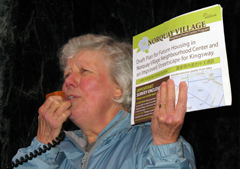
Jeanette Jones

Protesting Norquay resident Jeanette Jones with draft plan. Photo C. Kimmett.

[Correction: An earlier version of this piece mistakenly attributed quotes by Vancouver city councillor David Cadman to UBC professor Patrick Condon. We fixed the error at 2 p.m. on Sept. 25, 2007, and apologize to Cadman, Condon and Tyee readers.]

Does Sam Sullivan risk becoming the victim of his own success in pushing his EcoDensity brand?

The mayor who tried to trademark the word EcoDensity has promoted the idea that raising populations in low-rise parts of town will cut down on driving and make neighbourhoods more liveable.

Sullivan's re-election next fall may ride in part on whether voters decide his vision for growth can make their lives better.

But at a rally outside city hall Tuesday night, residents from neighborhood associations across the city slammed EcoDensity as an excuse to rush development through while leaving unanswered questions about parks, amenities and transit.

And the top planning official at city hall refused to stick the EcoDensity label on controversial plans to re-zone and densify an East Vancouver neighbourhood.

Norquay Village controversy

Many residents at the city hall rally were from the Renfrew-Collingwood and Kensington Cedar-Cottage neighbourhoods. They expressed angry concern about a city draft plan to develop Norquay Village, an area encompassing about six blocks on either side of Kingsway Drive from Nanaimo to Killarney Street.

The area consists mostly of single-family homes. Under the plan, about 2,400 of these homes would be re-zoned to allow courtyard row housing, as many as six units on a single lot. This zoning is proposed for approximately one-third of Norquay village, and is focused around schools, parks and the perimeter of Kingsway Drive. Proposed rezoning along Kingsway itself would allow for mid-size apartment buildings 12 to 14 storeys high, with commercial space on the ground floor.

Brent Toderian, Vancouver's director of planning, denied that this development is EcoDensity in action.

"EcoDensity is something new and still something very much in the idea phase," he said. "We are in the process of operationalizing the city plan and the community visions."

"If this isn't EcoDensity, what is it?" asks Lance Berelowitz, an urban planner who chaired Vancouver's planning commission. "You're trying to put more people on less land. It looks and smells and tastes like EcoDensity."

Berelowitz is a champion of Sullivan's EcoDensity initiative, but says the mayor and council are right to fear backlash.

"They know that neighbourhoods generally don't want it, says Berelowitz. "If given the choice between densifying and staying the same, most will vote to stay the same. But if [ecodensity] is done carefully and respectfully, it could really be cutting edge, it could really be out there."

'Shocked' at re-zoning

Toderian says the Norquay draft plan is the result of 18 months of consultation with a steering committee made up of city planners and local volunteers and business leaders. The plan is the "operational phase" of the city's community vision program, a program that was intended to give residents a greater voice in planning.

However, residents in Norquay say the re-zoning plan isn't respectful of residents, and doesn't represent a consensus on growth in the neighbourhood. When a copy of the Norquay draft plan landed on the doorstep of Jeanette Jones's Winona Street home in June, she was "shocked."

"They give us justification for this plan, that they are implementing community vision," says Jones.

"But this isn't it. "

In fact, it was a far cry from the Renfrew-Collingwood community vision document that had been approved by council two years earlier, Jones says. That document stressed the importance of maintaining the character of Renfrew-Collingwood, stating, "Most of the area that is now single family... should be kept that way."

Among the mixed housing options discussed in the vision, which also included duplexes, low-rise apartments and small houses on shared lots, sixplexes and carriage row houses received the least support, with approval ratings of 32 per cent and 36 per cent respectively.

Condo affordability concerns

"I've been door to door, and I would say about 90 per cent of the people in this neighbourhood are very concerned," says Jones.

"About 30 per cent of households here are low income, and we don't see low income people continuing to be able to live in this neighborhood," she said.

"I've looked at real estate ads... $600,000 and $700,000 condos and townhouses are not affordable for a lot of people."

"And this is just a zoning plan," she says. "We have heard nothing about amenities; there is no plan to give us more parks and services as a result of more residents."

Toderian says those issues are being addressed, but not at a neighbourhood scale.

"It's the finer grain of detail that you get at that neighbourhood centre scale, like a new greenway or improvement to the shopping streets, or relatively small things. The bigger picture issues, parks and recreation centres, transit, get dealt with in city-wide plans," he says, adding that maintaining these services as the city grows is "admittedly, hard to keep up."

He stresses that the draft is not close to going to council for approval. It was distributed to residents with an attached survey, but the strike has delayed any analysis of those survey results.

"That will be task one once the strike is resolved. Our next step is usually to continue the dialogue to resolve the issues as best as we can. At this point we're just testing ideas. All input is good, but for the input to be useful, it has to be free of fear."

'Playing out all over city'

David Cadman, a city councillor with the opposition party COPE, says residents' fears stem from uncertainty about whether community visions will actually be implemented.

"There is fear that there isn't enough dialogue going on with the community, and their vision that they worked really hard on is being distorted to satisfy the mayor's goal of reaching density," he says.

According to Berelowitz, concerns about adherence to community visions aren't limited to the Norquay neighbourhood.

"I don't know the specifics of [the Norquay] plan and any gaps, perceived or real," he said. "I do know this is playing out all over the city, and I think part of the problem really is the community visioning process set up expectations that [communities] wouldn't have to grow, or not very much at all. People are realizing... this is a lot more growth than we thought."

Alicia Barsallo, who has lived in Renfrew-Collingwood for over 30 years, was part of that neighbourhood's community vision process. She says when plans for a community centre area were being discussed, it was smaller than what has been included in the Norquay Village boundaries.

"This is not the neighbourhood centre, it's one-third of the neighbourhood," she says.

Jones also sees disconnect between that vision and the new plan.

"What was talked about was a small one-kilometre stretch of Kingsway with denser housing to be built. What came out in this plan was a huge area covering about one-third of Renfrew-Collingwood, plus part of Kensington," she says.

Toderian agrees the size appears larger, but says the community centre discussed in the vision was intended to be "conceptional." He says the space grew to allow for more amenities.

The city has identified 18 other "community centres" that will serve as shopping, service and transit hubs for surrounding neighbourhoods. Citizens from some of these neighbourhoods attended Tuesday night's rally, worried what will become of their own community visions as more concrete plans for EcoDensity are laid.

"The mayor and this council are leading a head-on assault on the things we value most in our neighbourhoods," said Dan Murray of Dunbar. "Let's move to an open, democratic dialogue of the future of this city."

According to Cadman, neighbourhood reactions like this aren't going to go away.

"Basically, people are beginning to say, stop it, we want to see the full package of our visions including the benefits of parks and recreation facilities," he says.

However, the money for those services has to come from somewhere, says Berelowitz, most likely from private developers, through taxes or cost levies. Unless those public amenities are delivered as part of the project, he argues, residents are not going to get them.

"The city successfully delivered those in central Vancouver. But it's very hard to do, extremely hard to do."

Related Tyee stories:

 [Tyee]

50  Comments:

  • Grumpy

    21-09-2007

    Ecco density, by the way want to buy some Bre-X shares

    Ecco-density is a gimmick to inflate property values for the property pimp crowd.

    Inspired by the SkyTrain mini-metro to increase ridership on the obsolete mode, densification has become the great industry in the GVRD.

    In Europe and the USA the massive high-rise apartments are being torn down for more user friendly 3 or 4 story garden style apartment.

    We are not Hong Kong, but it is certainly Asian money behind our politicians drive to make Vancouver one of the most densely populated cities in north America and with that densification is more and more gang activity, depopulated schools, and increase poverty, do to the high cost of living. Of course let us not forget massive profits for shoddily built mega condos.

    Want to know why all the hype and hoopla, just follow the money from developers to the politicians.

  • skeptikool

    21-09-2007

    Sweet deals included

    Clearly, any city's areas of single residences, under pressure of increasing population, will become vulnerable to planning alterations that won't please all the current residents but will, undoubtedly, be sweet deals for some, including developers and contractors.

    Quote:
    "You're trying to put more people on less land. It looks and smells and tastes like EcoDensity."

    Regardless of how it's named, and its authors, it is using less land. With sustainability so much the topic and goal today, is this a bad thing?

  • Fiat lux

    21-09-2007

    Why do we have "union

    Why do we have "union bosses", but "business leaders"? Who elects those "leaders" ?

    If any of my guys had called me "Hey leader!" , when I was an employer, I would have been very suspicious of his mental state, as I am when I hear that "business leaders" have been consulted.

    What "business leaders", in what businesses, and why?

    In any case, looking at his actions, or the lack of them, Sullivan is a bit of an ideological maniac and will hopefully fade into some lucrative directorships with other "business leaders" when his disastrous term is over.

    Ed Deak,

  • realisticman

    21-09-2007

    Density

    Less homes = less product = higher prices.

    Less density = more sprawl = more pressure on agricultural land.

    More homes = more product = lower pricing.

    More density = less sprawl = more retention of agricultural land.

    Seems fairly straightforward.

  • puppyg

    21-09-2007

    buzz words

    When the buzz words are out, it is time to beware.

    There is little that is 'eco' about forced densification while greenspace goes unprotected.

    Are today's urban forests and adjacent farmlands simply tomorrow's development projects held in reserve? Judging by how 'Eco-Density' and 'Smart-Growth' are unfolding in the Fraser Valley, one would think so.

    I predict 'Eco-Doom' for agriculture, trees and wildlife.

    I foresee goons poking people in the chest to demand,

    "Are you the one who doesn't like density?"

    "Who doesn't support the troops?"

    "I hear you won't won't wear the ribbon?"

    .

  • NicS

    21-09-2007

    More Greenspace = Higher Buildings?

    An old concept of about 100 years old, when taller buildings were first being built argued that with taller buildings we could have more green space. Is it possible to have our eco-density cake and eat it too?

  • Fiat lux

    21-09-2007

    The worst buzzword is

    The worst buzzword is "consumers".

    We can't "consume" things, only convert them into other forms, pollution and garbage.

    The word has been invented by PR hacks to mislead people into more wasteful lifestyles, so they ignore the mess they make.

    Land can be used very effectively for everybody's, including the ecology's benefit, if and when people set their minds to make themselves useful, self sufficient and grow things.

    What we have here now are 5-10 acre lots with a house, but no garden, no nothing, and people commuting with 2-3 cars over 100 km. each. per day, buying everything, as they would in a city apartment.

    This is just as much of a crime as the PR garbage of "eco-density"

    Ed Deak.

  • Tsolum

    21-09-2007

    High Density

    I will believe in high density being good when the developers, mayor and premier of the province get out of their single family homes and live in high rises with the people.

    If it is good enough for the great unwashed it should be good enough for them.

  • puppyg

    21-09-2007

    developers and politicians

    Ah! This good quote from Straight.com sums it up nicely.

    Former city councillor Tim Louis was at the rally, and he told the Straight that the move to densify the city is all about freeing space for property developers. "Follow the money," Louis said. "Most of the councillors in this council belong to parties that are funded in the main by big developers."

  • crash

    21-09-2007

    Response to Grumpy

    To say that "Eco-density is a gimmick to inflate property values for the property pimp crowd." is just political rhetoric and ignores the realities that Vancouver is facing. That fact is, Vancouver's population is growing and along with it demand for housing, yet the growth in housing stock has remained relatively flat (see 2006 Census Metropolitan Figures). Add to that a 0.7% rental vacancy rate (3% is considered healthy) and a decrease in the availability of non-market housing, and it is obvious that housing is perhaps one of the biggest issues facing the city.

    EcoDensity, despite being overhyped and probably poorly presented to citizens, is a novel effort to deal with this very real challenge. How, for example, can we even begin to deal with homelessness issues when residential property in general is so scarce The fact is we have two choices ahead of us: 1) Do nothing and accept that housing will continue to become scarcer and property prices inflated as demand far outstrips supply; or 2) Change the way we plan residential property and do more with less land - ie densify.

    You mention massive high-rise apartments, yet the example given in this article is not advocating high-rise apartments but street level strip housing.

    Finally, you assert that with densification comes more gang activity, depopulated schools, and increased poverty. This assertion seems illogical to me. Density by itself does not cause social dysfunction - high levels of marginalization does. The most severe type of marginalization occurs when people cannot afford a home, whether owned, rented or through social assistance. Unless we do something about the lack of housing availability across the board, this is exactly what will happen.

  • puppyg

    21-09-2007

    5-10 acre lots...

    Fiat Lux... I'm not sure I get your stab at small acreages. Could you clarify?

    I live on one such, a little 5-acre farmstead with tiny house in the valley, and I am feeling the encroachment on all sides.

    We keep our pond wild for the amphibian life. The woodlot goes unharvested. The little home business growing trees is a bit of a bust as our overgrown fields are returning to jungle... our bit of paradise.

    When we had it up for sale two years ago, half of prospective buyers who called were sizing it up for clear-cutting the trees, bull-dozing the pond, planting berries and renting the house for 5-7 years until it could be rezoned for commercial or residential for a ten-fold gain in property value. The prospect of it made me sick and we decided not to sell, but it is coming.

    I can tell you this for sure. There are no economic incentives for a farmer to keep a forest standing in the Fraser Valley. What pays big is clearing the land of all trees, dumping thousands of truckloads of fill until dumping fees earn you back your purchase price, followed by planting of a berry crop or laying out a cement slab for a mushroom or chicken barn to lower taxes until the big cash-out... selling to developers after a zone change. This is happening all around us. The Agricultural Land Reserve (ALR) is in its death throes and governments at all levels have been deaf to expressed local concerns because it is all so richly rewarding.

    Our moving away from here would only mean death to all the trees I have planted, death to the frogs and salamanders and the expulsion of all other wildlife life. There doesn't seem to be a way out because the momentum of development appears unstoppable.

    So, I am feeling protective of small acreages, having seen the alternatives. What do you think?

  • realisticman

    21-09-2007

    Deciphering

    Tsolum

    Quote:
    I will believe in high density being good when the developers, mayor and premier of the province get out of their single family homes and live in high rises with the people.

    Last I heard both the mayor and the premier were living in high-rises.

    Fiat lux

    Quote:
    In any case, looking at his actions, or the lack of them, Sullivan is a bit of an ideological maniac and will hopefully fade into some lucrative directorships with other "business leaders" when his disastrous term is over.

    Quote:
    What we have here now are 5-10 acre lots with a house, but no garden, no nothing, and people commuting with 2-3 cars over 100 km. each. per day, buying everything, as they would in a city apartment.

    Seems contradictory, Ed. You're saying large unused lots and long commutes are a crime but when the mayor suggests lower size lots you say he's an ideological maniac. Which is it to be? Large lots and consequently high prices or smaller lots that are more affordable?

  • frank2

    21-09-2007

    puupyg wrote "Our moving

    puupyg wrote
    "Our moving away from here would only mean death to all the trees I have planted, death to the frogs and salamanders and the expulsion of all other wildlife life. There doesn't seem to be a way out because the momentum of development appears unstoppable."

    Puppyg: don't despair. You can ask the Land Conservancy if they are interested in a bequest of the land -- you might even be able to donate it now and keep a life tenancy, with covenant for preservation in perpetuity. (And reap generous tax credits in the while you live.)
    http://www.conservancy.bc.ca/

  • puppyg

    21-09-2007

    land conservancy

    Thanks for your input, Frank2.

    The Land Conservancy website is interesting. Alas, I fear I would be dining on dog food in my golden years were I to follow through with your suggestion of making a donation of my home. It is nice to think that it works for some.

  • jimmy_laroux

    21-09-2007

    Grumpy: Quote:Inspired by

    Grumpy:

    Quote:
    Inspired by the SkyTrain mini-metro to increase ridership on the obsolete mode, densification has become the great industry in the GVRD.

    You think Sullivan would risk the ire of the Vancouver electorate just to help past Socred/NDP/Liberal transit planning look better (by increasing ridership on the skytrain)?

    Quote:
    In Europe and the USA the massive high-rise apartments are being torn down for more user friendly 3 or 4 story garden style apartment.

    You are being disingenuous (as usual), as I pointed out in the thread for this story:

    http://thetyee.ca/News/2007/07/31/Coleman/

    And what about the West End? Any plans to tear those high rises down?

    Quote:
    ...densification is more and more gang activity, depopulated schools, and increase poverty, do to the high cost of living.

    Yeah, Coal Harbour is a pretty rough neighbourhood. And now density causes increased poverty and depopulated schools? Surely cutbacks to social services wouldn't increase homelessness. No, it must be densification, right?

  • jimmy_laroux

    21-09-2007

    The population of Vancouver

    The population of Vancouver is increasing. Depending on the planning choices we make, people will either move to sprawling single-family housing in the Fraser Valley and commute in to Vancouver or Burnaby across the twinned Port Mann bridge, or the housing stock in Vancouver will be increased and they will live and work in denser neighbourhoods with greater transit options. Either way, developers will make money. But I think that the latter scenario (what is, in effect, just changing zoning designations in existing neighbourhoods) is obviously preferable, despite the cheesy label that Sam Sullivan uses for it.

  • Fiat lux

    22-09-2007

    puuppyg..... We're strong

    puuppyg.....

    We're strong environmentalists and have a small ranch of 120 acres, mostly undeveloped forest and swamps. Our oldest Douglas fir is about 400 years old and
    2m wide, but we also have a number between 2 to 300 year old trees.

    As we're getting old, 80 and 79, and our children don't want the land, had we sold it, there wouldn't have been a tree left within 2 weeks, as it happens with all the lands sold around here, so we gave it away in return for being able to stay here till the end.

    Very much can be done on a few acres without ruining the ecology to feed a family with real, unadulterated foods, but it takes a bit of work and ingenuity. A half acre can produce a lot of good, healthy food, instead of the chemically pumped up garbage from the supermarkets and a small chickenyard, enough for a family only takes up hardly takes up any room.

    Our organic cattle improve the land with their grazing, manure and hoofs. We feed about 50-60 people with meat, and about 100 with the best eggs from free running chicken on a half acre, heavily bushed yard.

    Every one of our animals is subsidized from our pensions and free labour, as the prices paid to producers are controlled by the corporate mafia, who, at the same time are jacking them up in the stores.

    People with 5 or 800 head of cattle are forced to go broke, so the agribiz mafia can pick their lands up for monoculture.

    There's no market for organic beef and we're forced to sell our calves at the
    auctions for pennies. Last year we got $295. each, for 2 pregnant cows, 4 and 5 years old. Imagine the profits somebody made on them.

    When the buyers load the animals on their trucks, they're being shot full of antibiotics, growth hormones, steroids and fed with corn in the feedyards, and this process is repeated every time they change hands, until the public is sold junkfood meat with 5-6 times the recommended dosages, as there are no controls to prevent this criminal behavour.

    Then governments are surprised why children and people are becoming fat pigs.

    Ed Deak.

  • switek

    22-09-2007

    Read the comment from Crash in response to Grumpy

    One of the problems in politics these days is that if we happen to dislike a politician or his or her party; we decide to attack every idea they have without really or fairly thinking about it first.

    Let’s for a moment all agree; Sam Sullivan has been a dismal failure as a mayor and few even within his own ranks will dispute that. However that does not necessarily mean that every idea that results from his time in office should be condemned simply because we don’t like the source, being Sullivan.

    As Crash has pointed out; increased densification has many advantages. From a long term perspective having more people live in smaller units sharing the same land footprint can reduce energy costs considerably and also reduce the amount of individual service connections. Think about it. One master sewer connection instead of hundreds to maintain as is the case with single family residential. Consolidation of recycling, potentially one tar and gravel roof (or whatever material) covering hundreds of heads instead of hundreds or roofs that end up in the landfill every 20-25 years. No need for hundreds of different siding materials that again end up in the landfill every 20-25 years. Much less paint and or stucco being required for maintenance due to the reduced surface area of one large building versus hundreds of houses with low density. 3-4 large building is enough to support local businesses and small family grocery stores that people may well just walk to instead of driving to. Not to mention potentially fewer transit stops with hundreds of people in one building instead of hundreds spread over several blocks.

    No matter how you look at it there some advantages to increased density; to dismiss these simply because Sam Sullivan agrees is very juvenile On top of that let’s also recognize ulterior motives; aside form political agenda’s there will also be the Nimby’s that would like to forever maintain their less efficient low density lifestyle’s, as is the case here.

  • puppyg

    22-09-2007

    your story

    Fiat lux...

    Thanks for sharing your insights. Farming amid the hard realities can still be a joy if one resists the worst of it. Yours is a good life and your land bequest is noble, almost unthinkable to the average person, but a solid choice upon reflection.

  • puppyg

    22-09-2007

    farming on the brain

    switek...

    Your point struck home... once I have felt burned by a politician, I tend to judge harshly their every initiative thereafter. I am not proud of this tendency, but I do get a sense of the beast early on.

    When I see a chalatan at work, a snowjob in progress, I want to stand up and point, "I know who you are!" (Harper, Mulroney, Campbell, this means you.)

    switek... when I was reading your post, I had farming on the brain, and while your logic was sound, I felt a shudder. There was a sense that you could have been a chicken rancher laying out the logic for changing over from a free range operation to one of battery cages stacked to the sky.

    "Think of the efficiency! Think of the space saved! Think of the profits!"

    It all sounds good unless your happened to be a chicken.

    Sometimes I think that is all we are to bad politicians laying out big plans.

    "Three to a cage, boys!"

  • switek

    22-09-2007

    Fair comment Puppyyg BUT....

    Fair enough Puppyg, but a low density free range Chicken farm is not adding all kind of additional waste to our landfill is it ? And you know what the greatest threat to that free range Chicken Farm is? Urban Sprawl. Because Urban Sprawl will drive up the land prices and taxes until the free range Chicken Farmer has no choice but to move up to those “batteries of cages” that you so fear. The farmer of course would have do so for his or her economic survival.

    How do you stop Urban Sprawl ? Increased densification of the Urban Areas. In other words you grow up instead of growing out. Let’s not forget when you grow out you than need the so-called “Gateway” solutions to move all of that traffic back and forth. If we truly want to protect and preserve our farmers and those free range chicken farmers let’s get over the fact that increased Urban densification just so happens to be supported by Sam Sullivan, and accept it is reality and we all should be supporting it.

    To me someone NIMBY interest trying to protect their low density lifestyle is no different than a greedy corporation refusing to share it wealth’s with the workers. The greater public good must prevail as sound public policy.

  • BLONDE PITBULL

    22-09-2007

    My two cents....

    I miss the trees, the green, the quiet of "low density" living areas every time I go into "high density" areas.

  • Moat

    22-09-2007

    Whoa! Have a look... at the 'burbs

    BLONDE PITBULL WROTE:

    Quote:
    I miss the trees, the green, the quiet of "low density" living areas every time I go into "high density" areas.

    Have you see Mary Hill lately? Parts of Surrey and Langely? Kelowna suburbs?

    Even in some of those small towns up north, I get a kick out of those people who own large properties and cut all the trees down just so they can conquer their yard with a riding mower.

    Low density does not mean more trees and green.

    Developers will build parks if we allow them to build up a little more. If they can build golf course with developments, I am sure they would be willing to build a park as long as they could make a buck off of it in some way.

    We simply need to be creative with how we do things. Trade land, zoning, etc.

  • inwonderment

    22-09-2007

    Questions

    Two questions - Why does this region have to grow any more - why not aim for zero population growth, wouldn't that be good for sustainabilty and the enviroment. I doubt that would hurt a productive economy.

    What is the carring capcity of the this region - including the Fraser Valley. 4 million, 6 million, 10 million?

  • realisticman

    22-09-2007

    Zero pop means higher prices

    inwonderment

    Slow down construction and prices of existing properties will continue to rise, since there's no possible way to stop people coming here to live - unless we become a dictatorship with settlement programmes like they had in China under Mao. Reduce immigration and, unless there's a growth in the domestic birth rate, there won't be enough tax payers and workers to support an aging society.

  • BLONDE PITBULL

    23-09-2007

    Moat....

    Yeah, buddy I have seen the development of the burbs and I'm not impressed. Can't undo it. Can't stop it. Can miss the peaceful space that was here where I grew up and learned to love the rain.

  • IAMC

    23-09-2007

    Settled Science ???

    I am shocked, I thought the science was settled on Anthropogenic Climate Change, especially when it affects their backyard.
    Doesn't it make sense, no matter what side of the debate you are on, to use one acre of land to house 300 people, rather than two or three?
    Build towers that go miles into the sky, complete with residential, commercial, bus stops, bicycle storage, a pub, a drug store, a food store, clinics, hair dressers, restaurants, everything you need, perhaps including employment.
    Keeping the rush hour tolerable, less pollution, everything could be done on an a few acres of land, rather than forcing people out to the suburbs, commuting and polluting.
    This seems like a no brainer.
    Is it only because Sam Sullivan is in favour of this that you detractors are against this sensible idea.
    It's the only way to go.
    Does someone have a sensible argument against this?

  • realisticman

    23-09-2007

    Shocked

    I wouldn't be shocked IAMC.

    Quote:
    Jim Sinclair, president of the B.C. Federation of Labour, says he's not surprised by early talk of potential mayoral candidates to run against Sullivan. Sinclair said that he expects more names to surface in addition to Robertson, Louie, and COPE councilor David Cadman.

    "Before this is all finished, there'll be a whole lot of names floating out there," Sinclair told the Straight. "There should be. There's an opportunity to take back the city in the next election. We have an incompetent government right now. This discussion is positive."

    Whether an idea is sensible or not is immaterial, for some. The importance is determined on from whom the idea comes from, for some. More product, ergo lower prices for homes, takes second place to ideological priorities.

  • freebear

    25-09-2007

    All Mighty Growth God!

    Why is the idea of a limit always responded to as 'communist' or 'socialist'?

    What is wrong with a steady state economy?

    Of course without continued growth would we still need to look for a new planet to rape?

    But why pursue density when you facilitate sprawl with road surface and wider/more bridges?

    So you can see to be doing something while at the same time providing land speculator profit opportunities!

    Just like the Owe-lympics perhaps?!

  • jimmy_laroux

    25-09-2007

    realisticman, Quote:Whether

    realisticman,

    Quote:
    Whether an idea is sensible or not is immaterial, for some. The importance is determined on from whom the idea comes from, for some.

    Except that this idea is an old one. Vancouver planners have been advocating, and creating, denser, less car-dependent neighbourhoods for many decades. The West End is an example which goes back around forty years. "EcoDensity" is just the same product in new packaging, just PR so that Sullivan can pretend to be innovative or whatever. If you don't have any ideas of your own, it's best to take credit for others ideas.

  • homegrown

    25-09-2007

    This "ecodensity" is doing

    This "ecodensity" is doing nothing but raise the cost of living for everyone who lives in Vancouver! Rents are atrocious and the cost of real estate is too! Who will be able to afford to live here soon?

  • realisticman

    25-09-2007

    Explain, please

    homegrown, can you explain how to make housing less[i] expensive. It certainly won't be with less product on the market. More density means more product, more choices. If there are 100 homes for sale and 100 buyers the price will be 'x'. Make it 200 homes and 100 buyers then the selling price will be determined by the oversupply. ie 'x' - what less the sellers are prepared to take based on only 50% of buyers available. Sellers have always been prepared to take whatever the buyers will pay, whether housing or anything else. I remember this in the Vancouver market just ten years ago. Some sellers were auctioning remaining properties in some developments to get rid of them.

  • The discussion for this story is closed. No more comments can be added.