
News

Coleman's Gambit

Riverview and Little Mountain sales a risky bid during a housing crisis.

By Monte Paulsen, 31 Jul 2007, TheTyee.ca

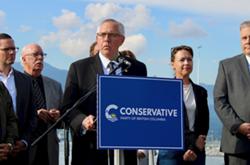
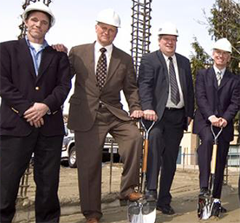
Coleman and others with shovels.

Where to live while they dig?

Rich Coleman is among most ambitious ministers in Premier Gordon Campbell's cabinet. In his two years as Minister Responsible for Housing, the Fort Langley-Aldergrove MLA has moved more than 1,400 British Columbians onto a new rental assistance program, established homeless outreach teams in 18 communities, purchased 623 rooms of low-income housing in 11 aging residential hotels, and committed millions of dollars toward the construction of many hundreds of new units of social housing intended for the province's elderly, homeless and off-reserve Aboriginal populations. In his spare time he serves as Minister of Forests and Range.

But those accomplishments could pale by comparison to Coleman's plans to redevelop the land beneath Riverview Hospital in Coquitlam and Little Mountain Housing in Vancouver. Both projects would create public-private partnerships -- or P3s -- in which landmark public properties are sold to private developers.

If successful, these P3 deals could return hundreds of millions of dollars to taxpayers, while at the same time leading to the creation of unique communities that integrate social housing, affordable housing and market-rate housing into environmentally sustainable urban centres. If successful, these are the kinds of deals that could help propel Coleman -- a former RCMP officer and real estate consultant -- into the premier's office.

There are plenty of ways these deals could turn sour, however. Coleman has been taking fire from Coquitlam politicians since his Riverview proposal surfaced late last week. And the optics of demolishing social housing during an affordability crisis could backfire should homelessness become a major media theme during the 2010 Olympics.

"There's no doubt that Rich Coleman wants to be premier," said MLA Diane Thorne, who serves as housing critic for the New Democratic Party. "He's taking a calculated gamble. He could go places with these plans. But he could also fall flat on his face."

From X-files to Yaletown

Coleman floated his idea to redevelop the Riverview lands in a Vancouver Sun article published late last week. He told reporter Miro Cernetig that he'd instructed his staff to explore ways to build more than 7,000 homes on the 98-hectare site; and said that as many as 1,100 of those units could represent social housing or supportive housing for addicts or the mentally ill.

At that size, a redeveloped Riverview community could rival the 9,100-condo Concord Pacific Place on the north shore of Vancouver's False Creek for its self-proclaimed tile as "North America's largest master-planned community."

Coleman was unable to return The Tyee's request for an interview on Monday, but told CKNW radio host Bill Good that: "It's a site that... could set an example internationally and throughout the world for what you can do if you sit down and look at the integration of a site with mental health, addictions and the developmentally disabled." Coleman went on to add, "Frankly, if you're smart about it you actually try and look for a market base that will pay for the institutional side to save the taxpayer money."

The Riverview property itself was purchased by the province in 1904. Back then it was named "Essondale," after the cabinet minister who advocated construction of a new psychiatric hospital, which was a state-of-the-art facility when it opened in 1913. That original building (now known as West Lawn) features such a classic institutional look that, after it was decommissioned, became a popular location for shooting films and television dramas such as Smallville and X-Files.

In 2002, Riverview began a phased closure of its aging facilities, with patients moving to much smaller facilities located throughout the province. Earlier this year, patients remaining in the North Lawn building were re-located to the Valley View building while awaiting placement.

Little Mountain, big-time condos

The Riverview proposal is strikingly similar to a major deal that Coleman struck with the City of Vancouver late last week.

At Little Mountain, BC Housing will demolish 224 units of aging social housing, then sell the 15-acre property to a private developer. That developer will promise to replace the 224 units as part of a new neighbourhood centre totalling as many as 2,000 condos.

Little Mountain sits on an L-shaped property between 33rd and 37th avenues, just west of Main Street. It was until recently home to about 570 neighbours, living in 176 apartments and 48 row houses. The modest stucco buildings are set apart from one another by large lawns and big trees that lend the family housing project an unusual sense of tranquillity.

BC Housing seeks to build far more units, and at much greater height, than current zoning would allow. Under the terms of its deal with the city, BC Housing has committed to building a "socially inclusive and environmentally sustainable community that will... provide a range of housing options for Vancouver's growing and changing population."

In addition, BC Housing has committed to reinvesting the "net proceeds" from the land sale into the development of social housing. Sources close to the deal suggested that number could run as high as $100 million. Half of those proceeds will be invested in social housing within the City of Vancouver.

Vancouver City Council approved the Little Mountain deal despite objections from residents, community members and housing activists. Council approval followed curtailed public testimony -- only three of 18 citizens signed up to speak were willing to cross the CUPE picket lines -- and Non-Partisan Association councillors were impatient at the end of a marathon all-day council session. NPA councillor Kim Capri rolled her eyes as Vision Vancouver councillor put question after detailed question to BC Housing regional director Dale McMann. Knowing his party had the votes to carry the deal, Mayor Sam Sullivan repeatedly muttered off-mic, "Let's vote. Let's just vote already." Afterward, Capri hailed "this process" as "a model for future sites."

Bad deal for Vancouver?

About a dozen activists opposed to the Little Mountain redevelopment protested outside city hall, while chatting with city workers on the picket lines.

Opponents of Coleman's deal complain foremost that BC Housing is relocating residents prematurely. They agency has already persuaded the tenants of 65 apartments to vacate voluntarily, and reports that another 31 units will be empty at the end of August. Noting that construction may not begin until 2010, opponents question why it is necessary to vacate the buildings now.

Resident Ingrid Steenhuisen, who chairs the housing subcommittee of the Riley Park/South Cambie CityPlan Community Visions program, argued that BC Housing's plan is backward. Rather than relocating residents and then consulting the public, Steenhuisen said BC Housing and the city should consult residents and the community first, approve a plan second, and then relocate only after the project is fully permitted.

"It will be at least five years before there are new buildings on the site, and probably longer for the social housing. So the existing tenants will have new lives, and won't be able to benefit from the new place," said Jean Swanson of the Carnegie Community Action Project.

The second most oft-voiced criticism of the Little Mountain plan revolved around the deal Mayor Sullivan cut with Minister Coleman. Activists and politicians have asked why Sullivan allowed half the value of the property to leave the city, and why only 224 replacement units will be built. If the total condo count runs as high as projected, that could represent as little as 11 per cent of the total project. Vancouver requires private developers to commit to 20 per cent social housing.

"The deal Mayor Sullivan signed was sub-standard," said Vision Vancouver Councillor Raymond Louie. "The NPA has been a willing partner in allowing 50 per cent of the value of the Little Mountain site to leave our city."

"As we move forward to rezoning this property, it is Vision Vancouver's intention to advocate for more affordable housing and more moderate income housing at this site," Louie added.

Diane Thorne, who served as a city councillor in Coquitlam before becoming an MLA, agreed. "Why not take the opportunity at Little Mountain to triple the number of social housing units?" Thorne asked. "It's the one place Coleman wouldn't have to face NIMBYism."

The first of many

Riverview and Little Mountain may be the first of many such P3s to come in BC.

The provincial housing strategy, Housing Matters BC, calls for obsolete buildings built on under-utilized land to be redeveloped. Built in the 1950s, Little Mountain is oldest public housing development in British Columbia. It is one of at least 57 social housing properties transferred from the Government of Canada to the Province of British Columbia, under a deal intended to streamline administration and allow BC Housing to provide one-stop shopping for housing services.

Housing activists are critical of both deals.

"This provincial government is using homelessness and poverty as an excuse to set up deals that are going to deliver massive profits to developers," Swanson said. "This whole exercise at Little Mountain and Riverview are schemes so Coleman can tell the media 'See, we're building social housing' when in fact all he is really doing is helping out his developer friends."

Swanson said there are now more than 2,000 people homeless in Vancouver alone. As many as 9,000 Vancouverites are reportedly waiting for social housing.

"Look, if Minister Coleman really wanted to help the thousands of homeless in British Columbia, he'd take the $250 million he's got socked away in a bank account and build housing," Swanson said. "Homeless Canadians are getting sick and dying, while Minister Coleman sits on their money. It's a crime. He is responsible for their suffering."

Opposition critic Thorne agreed.

"These are nothing but lucrative development deals with bits and pieces of social housing thrown in to make them more palatable to the taxpayers," Thorne said. "Rich Coleman is selling off government property as if it were his own. It's a good deal for the developers. But pretty soon, taxpayers won't have any government land left in British Columbia."

Related Tyee stories:

 [Tyee]

13  Comments:

Login or register to post comments

  • Working Man

    4 years ago

    Little Mountain and Density

    I live not far from the little mountain housing and I have to say that although the little clap board houses are cute, they must cost a forture to maintain and heat. There is simply not enough density to use the land effectively.

    Vancouver is still hanging onto the one building one family dream. In an area as congested as Vancouver, that is a formula for excluding families altogether. I live in Fairview, the only area with any kind of density in the West Side. There are actually kids, families and a thriving community here. Compare Fairview to Kerrisdale, where the same people who opposed higher density are now taking their last trips to heaven while wealthy Asians build monster houses on the land with two or three people in them.

    Of course housing "activists" are opposed to the changes. They, as socialists, are opposed to any kind of change at all. Putting more density on little mountain is an excellent idea since it sits between the Canada Line and the Main bus route, which has just been upgraded. You can also bet that most of the new occupants will be new Canadians. Perhaps there is where some of the opposition of the socialist-conservatives lies.

  • Grumpy

    4 years ago

    Density, the new mantra

    When I hear one speak of density, I know they haven't a clue what they are talking about because Vancouver today is a very densely populated city. Creating more density will only create social chaos.

    In Europe, high rise social housing is being abandons and torn down, with new housing being built that would equal what is now in Riley Park. Density in effect created social problems.

    What density means here is massive profits for the property pimps, by up-zoning viable public and residential property to massively densified instant slums.

  • G West

    4 years ago

    couldn't resist

    Quote:
    ...the same people who opposed higher density are now taking their last trips to heaven...

    Just wondering how their 'first' trips there were organized. I had no idea return tickets were available for that destination.

  • BC Dude

    4 years ago

    land pimps are in dictator

    [OFFENSIVE COMMENT REMOVED. -TYEE EDITOR.]
    Question How did Sam really get into the Mayors office?
    Where did James Green come from and where is he now? Why did Sam's group pay for James Greens bus and office $70,000. as this was in msm? Where did this money come from?
    Who and where was Sam's PR main man/people come from? Why did Sam allow Wal-Mart in when the taxpayers voted NO many times to keep this vile corporation out of the GVRD?

  • BC Dude

    4 years ago

    BC Rail Scandal and BC

    BC Rail Scandal and BC Legislature Raid in 2003
    Dec. 27, 2003 - B.C. Solicitor General Rich Coleman calls Premier Gordon Campbell, who is on vacation in Hawaii, to tell the premier to expect an important call in the next days. Coleman says later he did not give Campbell any details. Yeah, right?
    A pi--ed off law abiding BC taxpayer!
    http://www.cbc.ca/news/background/bcraids/
    How can a man who is under a cloud of suspician still be making bad decisions about publicly owned lands?
    Why has it taken almost 4 years for this the biggest scandal in the history of BC to be delayed over and over again and again? Why is there silence in our local rags CanWest about court times and the extream roadblocks put in the way of FOI?
    http://bctrialofbasi-virk.blogspot.com/
    Check the archives on this site!
    Freedom of Speech http://bettysearlyedition.blogspot.com/2007/02/bettys-final-submissions-to-madam.html
    RIP http://sisis.nativeweb.org/sov/allnahan.html
    I rest my case!

  • jimmy_laroux

    4 years ago

    Grumpy: Quote:When I hear

    Grumpy:

    Quote:
    When I hear one speak of density, I know they haven't a clue what they are talking about because Vancouver today is a very densely populated city.

    No. Vancouver is dense only in a few small pockets. The vast majority of residential land in Vancouver is zoned for single family housing.

    Quote:
    Creating more density will only create social chaos.

    What do you mean by "social chaos"? Crime rates? Crime rates have decreased as density has increased in Vancouver. And Yaletown does not seem very chaotic to me in any way.

    Quote:
    In Europe, high rise social housing is being abandons and torn down, with new housing being built that would equal what is now in Riley Park.

    Clearly not all dense development in Vancouver is social housing. In fact very little. But this is an argument against Chicago-style "projects" rather than denser development in general.

    Quote:
    What density means here is massive profits for the property pimps, by up-zoning viable public and residential property to massively densified instant slums.

    Coal Harbour is an "instant slum"? And the North Vancouver waterfront too? You've got to get out of Delta more, buddy, or at least look up what a "slum" is in the dictionary.

  • Grumpy

    4 years ago

    The myth of European density

    There is a myth that in Europe, cities are far more dense than in Vancouver. Not true, certainly, like Vancouver, European cities have some densely populated areas. The truth is, there is a whole lot more European cities the size of Vancouver or larger, per given area.

    The density myth was created for SkyTrain by the Socreds and BC Transit (now TransLink) because the metro was just too expensive to extend into the burbs.

    The density mantra has now been taken up by UBC and SFU and a whole new eco-density package is being sold to public by charlatans.

    What densification means is huge profits for landowners, assembling land for high-rises.

    the sociologists and public health officials I have talked to have indicated these hugely densified areas are spawning a lot of social and health ills.

    Just a note:

    In Sheffield, the LRT company was forced to build a very expensive short spur line to connect to a cluster of high-rise public housing, built on top of a hill. Soon after the line was opened the 4 or 5 towers were demolished to make way for less dense, garden style apartments.

    The same is happening in many European towns.

  • realisticman

    4 years ago

    Silly Me

    I always thought the integration of differing levels of society into neighbourhoods rather than ghettoizing was preferred by the socially conscious. Perhaps I was wrong.

  • switek

    4 years ago

    Nimbyism ?

    I grew up right around the corner in New West. and will always have a soft spot for this area. Over the past 25 years I have watched devlopment companies like Fraserview come into the community with massive subdivisions that are not unlike what is being proposed here. I don’t remember anyone protesting a Frserview Devlopment even when they were digging up skeletel remains while trying to pour a foundation.

    It seems if a potential devlopment includes market housing and housing for those with mental health and addiction issues there is a new found desireto “save” the area as is.

  • Step easy

    4 years ago

    As working man correctly

    As working man correctly pointed out, only some areas of the C of V are dense. It seems you have either mile-high condos, or way too big houses, with way too big lawns. There are some mixed use, and where you have that, it is easy to see that it works. And density? People, you haven't seen density until you've visited Japan. Now that country knows how to create efficient, livable, workable (albeit overly dense at times) cities and towns that work! That country invented the concept of efficiency. The problem with Vancouver is that it is located in the country of Canada where we have more land than we generally know what to do with. Thinking, as Canadians do, that with lots of land, we can build huge houses on enorumous, unproductive lots. In the pat it has worked because of our relatively small population, but it's time, way time to downsize our homes, not to mention our egos, and begin constructing much smaller houses, built closer together, with smaller roads and laneways, in mixed use neighbourhoods. And as far as public transit, Vancouver is about fifty years behind. The planners should've prepared and planned for expansion long ago. If the Minister for Housing, Coleman, should take a trip to Japan and visit, not just the bigger cities, but smaller ones too, he would probably come back with many great ideas for 'densifying' which could work terrifically in Vancouver. I mean, if just one change were made such as rezoning areas of traditional single housing, allowing for smaller units, built closer together, as well as narrower roads, imagine the extra housing we could accomodate? (not to mention the increased use of smaller vehicles). There are many many ideas and condos are not the only answer.

    and one more thing, what this city really needs, more than social housing, co-op housing or any other, is RENTAL APARTMENTS!! Not everyone can afford to own and have you seen the state of your local rental apartment building lately? They're falling apart! None of these developers see profit in building rental units anymore, how do we fix that? No rental units = no service workers, students, many seniors, and also many single moms. We're not all software developers or politicians.

  • jimmy_laroux

    4 years ago

    Grumpy: Quote:There is a

    Grumpy:

    Quote:
    There is a myth that in Europe, cities are far more dense than in Vancouver. Not true, certainly, like Vancouver, European cities have some densely populated areas.

    No myth. Again, Vancouver is very dense in a few small pockets, but the vast majority of the land area of Vancouver is low density single-family dwellings.

    GVRD density:

    http://www.gvrd.bc.ca/growth/census-bulletin/2001ctpopdensity.pdf

    GVRD land use:

    http://www.gvrd.bc.ca/growth/pdfs/GVRDLanduse2001-map.pdf

    Quote:
    the sociologists and public health officials I have talked to have indicated these hugely densified areas are spawning a lot of social and health ills.

    You brought this up in your previous post but you seem unable to actually give any examples.

  • village

    4 years ago

    Habitat revisited*... circa 2006,

    Indeed from the perspective of having had the United Nations Conference called HABITAT.. dealing with HUMAN SETTLEMENT ISSUES.. ( way back when ).. and furthermore thinking of how the issue was revisited 30 years later*.

    Well ladies and gentleman.., as Ray Spaxman discovered when he prepared some public meetings around the RIVERVIEW LANDS question, a decade or so ago.., he amongst others , suddenly discovered that there was a deep attachment to these lands by the locals.. who view this ''OASIS '' much like the CITY OF VANCOUVER holds Stanley Park.., in their hearts .

    Hence , what seems to be at stake here as per the RIVERVIEW LANDS themselves , is whether our HUMAN SETTLEMENT ISSUES can be dealt with in the spirit and principles of HABITAT*, such as it was espoused not only in the original UN Conference of 1976 , but later re-affirmed last year circa 2006 right here in Vancouver when the UNITED NATIONS , revisited the site of the HABITAT birthplace*..

    It's time to tap into our undercurrent spirit and energy*.. to tap into our CREATIVE FORCES , OUR CREATIVE ASSETS..

    We have in B.C. a magnificent heritage and legacy when it comes to stepping over the line- so to speak.., TO in effect in a defiant way.., and with a '' defiant imagination'' , dare to make all of our lives and the lives of those that will follow us, a better place, a liveable place.. a beautifull '' HABITAT''. in the spirit and meaning of those earlier years. ( When SETTLEMENTS were indeed the very building blocks of the CITIES , VILLAGES and overall seeds of the COMMUNITIES we live in today.)

    We managed to stop a huge highway to run right through the CITY OF VANCOUVER.. way back then, and now it's up to this province and specifically the GVRD itself., ( and by that I mean all cities and villages ( municipalities ) that make up the lower mainland.., ) ,it's time , as I was saying for the surrounding COMMUNITIES to realise the '' Stanley park of RIVERVIEW LANDS.., which provides not only the OXYGEN so badly needed , but provides and OASIS of.. , calm , an oasis of a spiritual nature..

    Within the REGION I live in, there is at this moment of truth , a battle of survival , for those of us , who value .., quality of life itself.. such as clean air , and a Community spirit in the making.

    A place to rest our weary bones from the day to day hustle and bustle of our daily lives and modern living lifestyles..,

    Come and visit .., This September , there will be a celebration of trees.., within this wonderful site*.. within also a wonderfull CITY and COMMUNITY which is at it's point of re-exploration and re-discovery..

    It's called TREEFEST* , think COQUITLAM, think CITY OF TREES..*

    and come and visit!
    VILLAGE,

  • BC Dude

    4 years ago

    My blog above was about Rich

    My blog above was about Rich Coleman and why he was given two very big and important Ministerial leaderships rolls?
    Has no one on this blog not wondered this same question?
    R Coleman is involved in the BC Rail, Basi Verk scandal that is why I'm very curious.

    • The discussion for this story is closed. No more comments can be added.