
Life

Poetry for Remembrance

Words shape how we remember war, and the right ones heal. Plus, a poem for today.

By Fiona Tinwei Lam, 11 Nov 2011, TheTyee.ca

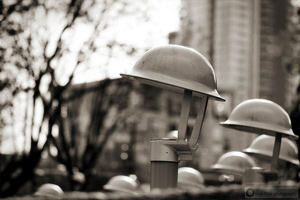
Victory Square helmet

Art for remembrance: Eleven steel helmet lights encircle the war memorial at Victory Square Park in Vancouver. Photo by PiscesDreamer in Your BC: The Tyee's Photo Pool.

Related

When I was in Grade 1, I wanted to invite all the girls in my class to my birthday party. My mother refused to let me invite Naomi, a friend who happened to be of Japanese descent. Upset and confused, I asked her why. She sat me down, and for the first time told me of her childhood memories of the Japanese invasion of Hong Kong.

The Imperial Japanese soldiers had kicked her large family out of their home, forcing them to relocate from place to place, and eventually become dispersed. Living in constant fear, her family was often forced to scrounge for food. She mentioned the infamous Rape of Nanking, where over 190,000 Chinese civilians were massacred, an estimated 20,000 girls and women were brutally raped, and homes and businesses looted and burned by Imperial Japanese soldiers over a six week period.

I went back to school the next day, troubled and pensive. My teacher, Miss Burton, called me over to her desk to ask what was wrong. After listening to my story attentively, Miss Burton looked me in the eye. "Tell your mother," she said firmly, "that the war is over." Relieved, I ran home after school and jubilantly told my mother, "Miss Burton says the war is over!"

After a long pause, my mother quietly agreed to let me invite Naomi to the party. It was a turning point. Although she continued to bring up Japanese war crimes, the foundation of her longstanding prejudice had begun to dissolve.

She started focusing on news reports of more current American war atrocities in Vietnam, a country where her grandfather and father had lived and worked. A few years later, she took private flower arranging lessons from a Japanese-Canadian woman, and then decided to take a few Japanese language lessons. One day, she took the family out for sushi for the first time, more than a decade before it became popular in Vancouver. She even arranged for our family to visit Tokyo briefly on our way to Hong Kong.

From that experience, I came to understand two things: the extent of war's devastating toll on civilians, and also the power of the right words to bring about change.

Beyond Flanders fields

At Remembrance Day ceremonies at school and afterward, I would always think about both military and civilian casualties of war -- particularly those soldiers who tried to defend and protect civilians from invading armies, as well as the mass numbers of civilian victims across the globe. In the First World War, it is estimated that there were approximately 10 million military deaths and 7 million civilian deaths. Of the total deaths during the Second World War, it is estimated that 22 to 25 million were military (including deaths of about 5 million prisoners of war) and that 40 to 52 million were civilians (including 13 to 20 million from war-related disease and famine).

From early on, it struck me how significant poetry has been in commemorating the war dead during Remembrance Day events. Most well known, of course, is Canadian Dr. John McCrae's poem, "In Flanders Fields," from which the widely recognized emblem of the red poppy is taken. The Act of Remembrance that is recited at most ceremonies is taken from the middle of a seven-stanza poem by Laurence Binyon.

What also comes to mind in the days leading up to Remembrance Day are the many less well-known yet extraordinary poems written about civilian casualties of war -- for example, Polish poet Anna Swirszczynska's poems about the civilian resistance in Warsaw, "The Last Polish Uprising" and "Building the Barricade."

There are many powerful and harrowing poems about the Holocaust, such as Auschwitz-survivor Primo Levi's "Shema." Polish-born poet Tadeusz Rosewicz joined the resistance during the Second World War and wrote of the horrors committed against civilians by the Nazis. One short, stark yet tender poem "Massacre of the Boys" employs the voices of frightened children taken to be killed in the gas chambers. Another of his poems, "Pigtail" is a similarly distilled depiction of the effects of war, although in this case using the central image of the hair shaven from women prisoners in concentration camps.

There are excellent poems about the U.S. bombing of Hiroshima and Nagasaki; for example, American poet Carolyn Forche's "Testimony of Light." Turkish poet Nazim Hikmet's poem "I come and stand at every door," also known as "Hiroshima Child," is written in the voice of a seven-year-old girl, a victim of the Hiroshima bombing who calls for peace after her death. The poem became popular as a song sung by a variety of artists, including Pete Seeger, Paul Robeson, and The Byrds. Local poet Cathy Stonehouse has a sequence of poems about the atomic bombing in Hiroshima in her latest book of poetry, Grace Shiver. American poet, Victoria Chang has written a few poems about the Nanking massacre in her book, Salvinia Molesta.

One of my favourite poems about the effects of war on civilians is Israeli poet Yehuda Amichai's poem, "Diameter of a Bomb," which depicts the unforeseen consequences or repercussions that can arise from the deaths and injuries caused to ordinary people by any single bomb. Another favourite is Canadian poet Steven Heighton's poem about the infamous My Lai massacre during the Vietnam War, set out below.

A superb place to find acclaimed international poetry on the theme of the effects of war is Carolyn Forché's anthology, Against Forgetting: Twentieth-Century Poetry of Witness, which gathers poetry from 140 different poets spanning over five continents and covers both world wars and the Korean and Vietnam wars, among others. There are also many strong Canadian poems on the theme of war and its aftermath in the anthology Crossing Lines: Poets Who Came to Canada in the Vietnam War Era, edited by Allan Briesmaster and Steven Michael Berzensky. The Canadian Poets Against War website has scores of poems about war and peace in its archives, including a few of my past poems about Remembrance Day, and the wars in Iraq and Afghanistan.

Recall the intent of remembrance

Perhaps one or more of these poems, together with articles and books written on the subject, might cumulatively make some difference -- word by word, reader by reader. Of course, it's hard to be optimistic when hearing about the huge midnight launches in several cities across the world this week for Activision Blizzard's new video-game, Call of Duty: Modern Warfare 3. According to the CBC, "the game, the eighth in the series, will add to the Call of Duty franchise's already monstrous take of 100 million units sold and more than $5 billion in revenue earned."

Some of my friends have felt conflicted about Remembrance Day, concerned that it glorifies and promotes war, and fosters the recruitment of more soldiers to engage in international conflicts that are fueled by corporate, political or economic interests that in the end have little connection to the rhetoric of justice and human rights used to justify military intervention.

But in light of the popular mass appeal of increasingly violent and stimulating video games that dehumanize the "enemy," desensitize boys and men to violence, and turn war into a form of entertainment that has no relation to the reality and scope of human suffering, I wonder whether it isn't more crucial now than ever to commemorate Remembrance Day in terms of the original intention of marking the 1918 Armistice -- the significance of a cessation of hostilities between nations after a long series of brutal and often senseless battles, and the time to consider and mourn the monumental and often meaningless loss of life of both combatants and civilians.

And now, a poem

ANOTHER OF THE JUST: WARRANT OFFICER HUGH THOMPSON, MY LAI, 1968

By Steven Heighton

Years later, sober, or from inside the snub barrel
of a shot glass, you spoke out about it softly,
not reticent but baffled, still: how Calley

and his men appeared below you, butchering
the villagers, and down you banked your recon
chopper to light between him and the enemy

women, toddlers, crones. Ordered your door-gunners
to fire on any comrades who'd resume that riot
of infanticide, mob rape -- and then, from a midden

of twitching limbs, your crew pried free a gore-smeared child
and bore him beyond harm, as if to save was also labour
for male arms, as if love were the one flag you'd salute.

(Not quite -- you were a keen recruit, proudly hailed patriot.)
You're gone now, cancer, my sad captain, while Calley --
a few years' house arrest for four hundred dead -- lives

in Atlanta, retired. Don't do something in hope of reward,
you said, it might never come. Just lynch mail, roadkill,
razored strays splayed at your door. Still, in the Agent

Orange skies, your archangelic contrail lingers -- you
at the flightstick, bearing the one child. Forget the pen,
forget the sword: the strongest hands hold neither, but they hold.

From Patient Frame by Steven Heighton (Toronto: House of Anansi Press, 2010). Reprinted with permission of the author and the House of Anansi Press.  [Tyee]

11  Comments:

Login or register to post comments

  • cboo44

    28 weeks ago

    A Soldier Died Today

    He was getting
    old and paunchy
    And his hair was falling fast,
    And he sat around the Legion,
    Telling stories of the past.
    Of a war that he once fought in
    And the deeds that he had done,
    In his exploits with his buddies;
    They were heroes, every one.
    And 'tho sometimes to his neighbors
    His tales became a joke,
    All his buddies listened quietly
    For they knew whereof he spoke.
    But we'll hear his tales no longer,
    For old Bob has passed away,
    And the world's a little poorer
    For a Soldier died today.
    He won t be mourned by many,
    Just his children and his wife.
    For he lived an ordinary,
    Very quiet sort of life.
    He held a job and raised a family,
    Going quietly on his way;
    And the world won't note his passing,
    'Tho a Soldier died today.
    When politicians leave this earth,
    Their bodies lie in state,
    While thousands note their passing,
    And proclaim that they were great.
    Papers tell of their life stories
    From the time that they were young
    But the passing of a Soldier
    Goes unnoticed, and unsung.
    Is the greatest contribution
    To the welfare of our land,
    Someone who breaks his promise
    And cons his fellow man?
    Or the ordinary fellow
    Who in times of war and strife,
    Goes off to serve his country
    And offers up his life?
    The politician's stipend
    And the style in which he lives,
    Are often disproportionate,
    To the service that he gives.
    While the ordinary Soldier,
    Who offered up his all,
    Is paid off with a medal
    And perhaps a pension, small.
    It is not the politicians
    With their compromise and ploys,
    Who won for us the freedom
    That our country now enjoys.
    Should you find yourself in danger,
    With your enemies at hand,
    Would you really want some cop-out,
    With his ever waffling stand?
    Or would you want a Soldier--
    His home, his country, his kin,
    Just a common Soldier,
    Who would fight until the end?
    He was just a common Soldier,
    And his ranks are growing thin,
    But his presence should remind us
    We may need his like again.
    For when countries are in conflict,
    We find the Soldier's part
    Is to clean up all the troubles
    That the politicians start.
    If we cannot do him honor
    While he's here to hear the praise,
    Then at least let's give him homage
    At the ending of his days.
    Perhaps just a simple headline
    In the paper that might say:

    "OUR COUNTRY IS IN MOURNING,
    A SOLDIER DIED TODAY."

  • Arbutustree

    28 weeks ago

    Today's poetry

    Thank you for offering so many links to incredible poetry today. All of them were extremely powerful writings. No sense is made of war, but the poetry helps soften the blow, and opens our hearts to greater understanding.

  • Jerry Munro

    28 weeks ago

    Having spent much of my

    Having spent much of my working class youth in and around the military, finally in the navy, typical for young males of my time and neighbourhood, I have ever since thought we spend too much time thinking about and honouring war and too little on peace. And one of the things out of which wars arise and at the end, or during the course of, result in is Revolution... an upheavel attempt upon the part of effected masses to extricate themselves from, and/or prevent the further re-occurance of war. So it is, since my "military service" time, I have been preoccupied with Revolution... the transformation of society such as will eliminate the drift and drive to war of especially greed driven ruling classes. For it truly is, as Ed Deak has said here on Tyee many times, that while all too often "folks", especially young males, and now females, follow "their betters" into war, were it left to them and certainly those left at home who already knew real war, the thought would likely never occur to them in the course of their everyday lives.

    The Revolution

    The irony is,
    It was my dad’s dis,
    “That worker’s are their own
    worst enemy.”
    He a Bible thumping
    anemone.

    The Revolution is Coming.

    Though I’m sure on thought,
    That’s how it seemed fraught,
    At the end of the last upheaval
    show,
    Now another rising tide and
    wind’s blow.

    The Revolution is Coming.

    It’s there in the sand’s line,
    All know but none sign,
    Until it is en masse all step
    across,
    And Hell breaks loose without
    a sense of loss.

    The Revolution is Coming.

    To present roses,
    ‘fore window closes,
    And finally complete the Project
    Grand,
    Across the breadth and length of
    All The Land.

    The Revolution is Coming.

    Though much old grown,
    Time’s Wing flown,
    As such it may be that I will
    miss it,
    Save to see this early New Morning
    bit.

    The Revolution is Coming.

    Grant the gift of time,
    Ye Nature Sublime,
    That I may get in even one small
    blow,
    To topple the High and
    raise up the Low.

    The Revolution is Coming.

    It has been so long,
    The wine is near gone,
    Though yea it goes on,
    ‘til the final song.

    Jerry Munro
    October 17th, 2011

  • lynn

    28 weeks ago

    "It's there in the sand's line"

    A powerful piece of poetry, Jerry, made more so by the heart and unique voice found within it.

    A recent report from the US said a veteran attempts suicide every 80 minutes. The silent, unacknowledged face of war.....far away from the more obvious battlegrounds.

    So your words about thinking about and honouring peace could not be more true, or more necessary....as here we are again at the very brink of losing all our freedoms.

    It was truly ironic in the most painful way to watch the presence of Harper & Co. at the Remembrance Day Ceremony...

    Yes.... we are again - in that old battle, as Fiat Lux often writes, between the oppressors and the oppressed.

    Yes....in your moving words:

    "Grant the gift of time,
    Ye Nature Sublime,
    That I may get in even one small
    blow,
    To topple the High and
    raise up the Low.

    The Revolution is Coming."

  • Skywalker

    28 weeks ago

    Remembering them all.

    Fiona raises some issues which have been troubling me for a long time. Remembrance Day is all about the Victorious. I know that at times in passing we mention civilians but that is about all. Some 23 million persons were displaced at the end of WW II and the Potsdam Conference decreed that they would all be sent back to their homes before the war started. Refugees from the Soviet Union had had enough of Stalin and did not want to go back. For a while they Allies helped Russia get their hands on a lot of people who were summarily executed or sent to Siberia where most died from the hardship. Few were sent back to their homes as promised because they had been "exposed" to ideas foreign to communism. To a deranged thug like Stalin that was enough.

    It has always grated at Remembrance Day that my grandmother as well as a number of relatives were those sent back against their will. Most died from the hardship. The Allies trusted a despot who made Hitler look like a pussy cat by comparison and they should have know better than to return any refugees, The mass graves in the forests of Katyn are a testimonial to their gullibility but they are only one.

    I would like Remembrance Day to focus on all the casualties of a war. Not all the tactics of the victorious are noble some are downright stupid and we would do well to remember them as well.

  • igbymac

    27 weeks ago

    To the soldiers generally

    To the soldiers generally, I have both pity and contempt.

    I have pity for the majority of them, preyed upon by the sickness of leaders who will forfeit life itself for power and material gain.

    And I have contempt for them all, prostituting themselves against all this is humane at the rattling of a sword behind the banner of silk cloth.

    If we want to honour our soldiers, let's do so as human-beings behaving humanely.

    First, let's honour them by giving them the comprehensive psychological, medical and economic support we righteously claim they are due.

    Let's honour them by never leaving our sovereign nation to fight anyone, anywhere.

    Let's honour them by never allowing a government in this nation to ever send us into war unless under attack at home.

    And most importantly, let's honour them by wiping our minds of the vile sickness which tells us war is an option if we cannot have our way.

    There is never a way to sanitize murder. "We nobly speak of dying for our country. Why do we not hear of murdering for our country?"

    Peace and only peace. It is our only enduring hope.

  • G West

    27 weeks ago

    Suicide in the Trenches

    I knew a simple soldier boy
    Who grinned at life in empty joy,
    Slept soundly through the lonesome dark,
    And whistled early with the lark.

    In winter trenches, cowed and glum,
    With cramps and lice and lack of rum,
    He put a bullet through his brain.
    No one spoke of him again.

    You smug-faced crowds with kindling eye
    Who cheer when soldier lads march by,
    Sneak home and pray you'll never know
    The hell where youth and laughter go.

    -Siegfried Sassoon

  • pianosaurus rex

    27 weeks ago

    Newbolt, Henry

    My late father, a high ranking British military officer had to recite this poem every morning at school.

    Probably the best known of all Newbolt's poems which was written in 1892, and for which he is now chiefly remembered is Vitaï Lampada. The title is taken from a quotation by Lucretius and means 'the torch of life'q:Lucretius

    It refers to how a future soldier learns stoicism in cricket matches in the famous Close at Clifton College:

    There's a breathless hush in the Close to-night
    Ten to make and the match to win
    A bumping pitch and a blinding light,
    An hour to play, and the last man in.
    And it's not for the sake of a ribboned coat.
    Or the selfish hope of a season's fame,
    But his captain's hand on his shoulder smote
    "Play up! Play up! And play the game!"

    The sand of the desert is sodden red -
    Red with the wreck of a square that broke
    The gatling's jammed and the colonel dead,
    And the regiment blind with dust and smoke.
    The river of death has brimmed its banks,
    And England's far, and Honour a name,
    But the voice of a schoolboy rallies the ranks -
    "Play up! Play up! And play the game!"

    This is the word that year by year,
    While in her place the school is set,
    Every one of her sons must hear,
    And none that hears it dare forget.
    This they all with a joyful mind
    Bear through life like a torch in flame,
    And falling fling to the host behind -
    "Play up! Play up! And play the game!"

    Henry Newbolt

  • North of Hope

    27 weeks ago

    Miss Burton

    I believe the teacher, Miss Burton, deserves a lot of credit. She showed remarkable insight to realize something was wrong and she gave advice that not only solved the problem but also gave Ms. Lam an avenue for remarkable insight. We all gained from this.

  • igbymac

    27 weeks ago

    The Universal Soldier

    and he really is to blame

  • Jerry Munro

    27 weeks ago

    Pianosaurus Rex...

    No doubt pianosaurus, one can see that stiff upper lip, this red line, British Empire Loyalist, over the top mentality there. Very interesting. :-)

    • The discussion for this story is closed. No more comments can be added.