- Ms Kaye is a Tyee Builder. You can be, too.
- Mary Carlisle is a Tyee Builder. You can be, too.
- Prem Gill is a Tyee Builder. You can be, too.
- Nancy Flight is a Tyee Builder. You can be, too.
- Justin Everett is a Tyee Builder. You can be, too.
- John Westover is a Tyee Builder. You can be, too.
- Nora Etches is a Tyee Builder. You can be, too.
- Edward Henderson is a Tyee Builder. You can be, too.
- Bharadwaj Chandramouli is a Tyee Builder. You can be, too.
- Dean Chatterson is a Tyee Builder. You can be, too.
- Marius Scurtescu is a Tyee Builder. You can be, too.
- Robert Parkes is a Tyee Builder. You can be, too.
- James Murton is a Tyee Builder. You can be, too.
- Susan Doyle is a Tyee Builder. You can be, too.
- Vincent Strgar is a Tyee Builder. You can be, too.
- Helen Spiegelman is a Tyee Builder. You can be, too.
- Subir Guin is a Tyee Builder. You can be, too.
- Kimball Finigan is a Tyee Builder. You can be, too.
- Joanne Manley is a Tyee Builder. You can be, too.
- David Leach is a Tyee Builder. You can be, too.
The Poem and the Poppy
Reading 'In Flanders Fields.' And choosing to wear the flower.
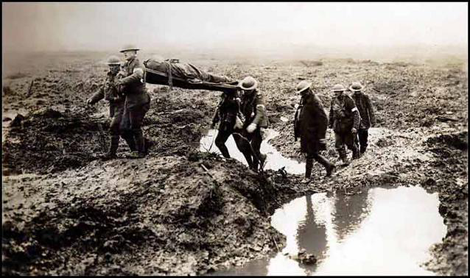
Flanders Fields, First World War
[Editor's note: This essay by Stephen Osborne, editor-in-chief at Geist magazine, signals the start of a new collaboration between The Tyee and Geist -- two leading independent voices in B.C. Watch this space in the future for articles, reviews, cartoons and more -- all from Geist contributors.]
Early in the 20th century on a Saturday afternoon in New York City, a woman from Georgia who worked for the YMCA Overseas War Secretaries found two dozen red silk poppies in Wanamaker's Department Store, after searching for them all afternoon in the shops along the stretch of Broadway known as the Ladies' Mile. Her name was Moina Michael and she was 49 years old. That evening, on the ninth of November, 1918, Moina Michael distributed her poppies to a gathering of friends and colleagues, an event she later described as the "consummation of the Flanders Fields Memorial Poppy," the artificial flower that millions of people fasten to their lapels every year in the second week of November.
According to her memoir, Moina Michael had conceived of the Memorial Poppy that Saturday morning at 10:30 a.m., after reading the poem "In Flanders Fields" in The Ladies Home Journal and composing a poetic response entitled "We Shall Keep the Faith" on the back of an envelope. Then she went out to search for poppies.
"In Flanders Fields" is remembered today in fragments by generations of schoolchildren and former schoolchildren, and is often dismissed by critics who object to the soft imagery of larks bravely flying, foes quarrelling, and sunsets glowing.
The name of the poet, less well remembered, is John McCrae, a Canadian doctor with a literary bent, and his poem, a rondeau of 13 lines that opens with an image of poppies blowing, or growing (as we try to recall the lines now, between crosses row on row, and then the lark and something something down below), is one of the best-known poems in the English language. The often misquoted first stanza can be found in the fine print on the Canadian $10 bill:
In Flanders Fields the poppies blow
Beneath the crosses row on row
That mark our place and in the sky
The larks still bravely singing fly
Scarce heard amid the guns below.
The verses that moved Moina Michaels to action on the streets of New York were composed on the battlefield in Belgium during the engagement known as Second Ypres, in 1915, after the death of a young lieutenant named Alex Heimer who was blown up by an enemy shell.
Alex Heimer had been a friend of John McCrae's; that evening McCrae performed funeral rites over those of his friend's body parts that could be recovered and wrapped in a blanket and put into the ground. Next morning McCrae was observed sitting on the back of an ambulance with a notepad in his hand, looking out at the cluster of wooden crosses marking the improvised graveyard where Alex Heimer now lay in a broken field of new poppies. Later McCrae showed what he had written to one of the other officers, and then he crumpled up the page, and the officer (a man named Scrimger) had to persuade him not to throw the poem away. Later that year it was published in Punch, a popular British magazine, and within months it had become the best-known poem in England.
McCrae learned of his poem's popularity when he overheard his own words being recited by recruits trudging through the mud on their way to battle, an event that must have resonated eerily for the author of a poem whose collective "voice" emerges from the grave:
We are the dead. Short days ago
We lived, felt dawn, saw sunset glow,
Loved and were loved, and now we lie
In Flanders Fields.
Second Ypres lasted 17 days; it was the first engagement of Canadian troops (6,000 of whom were lost) in the Great War. By the end of that war, 60,000 Canadian soldiers were dead and another 160,000 were wounded or maimed. These were enormous numbers for such a small country (Canada's population was only eight million): they amounted to one casualty for every three Canadian families. Not a single body was returned to Canada for burial, and the empty tombs that appeared as memorial cenotaphs in every town and city in the country became for most Canadians their only recognition of a great public and private loss, in a war that by its end had lost any "meaning" that it might once have had. That war remains as a vacant space in the heart of a nation.
Dreams and memory
By giving material form to an image in a poem, Moina Michaels gave the world a way of marking and masking the incomprehensible destruction of human life set in motion in Europe in 1914. Such a simple act required a complex transformation: the poppy had long been the symbol of forgetfulness and dreaming: the Greek god Hypnos holds a poppy in his hand as he gestures toward the world of dreams. Now the poppy was to signify its contradiction, which is remembrance -- remembrance subsumed into the iconography of chivalry, and given the added burden of vigilance, duty, and unspecified faith.
What McCrae's poem overlooks, as do the memorials erected all over the country, is the moment of transition between life and death (how did "we" come to be lying in Flanders fields?): the heart of the poem, like the heart of the cenotaph, is an empty place.
The poppy refashioned by Moina Michaels is the token of the phantasmagoria into which a generation plunged and through which we continue to stumble as if drugged: we are the future that the dead are talking to. Today the poppies blow in the fields of Afghanistan. The poppy, with its implicit promise of oblivion, has become the proper emblem of the unspeakable. "In Flanders Fields" closes with a threat uttered by the dead, who, we are reminded, are not yet really dead:
Take up our quarrel with the foe:
To you from failing hands we throw
The torch; be yours to hold it high.
If ye break faith with us who die
We shall not sleep, though poppies grow
In Flanders fields.
Emptied bottle
John McCrae studied medicine at McGill University, where he became a member of the Pen and Pencil Club, a group of artists and writers who met in a studio and once a year ate a ceremonial supper. He went to South Africa as an artillery officer to fight for the Empire against the Boers, and in February 1900 he met Rudyard Kipling, who told him that he talked "like a Winnipegger."
McCrae emerges from his letters as a man who loved horses, dogs and fox hunting. His poems, some of which appeared in The University Magazine, were works of sturdy versification: he was not afraid to compare Quebec to Helen of Troy; his poem on the Battle of Trafalgar contains the line: "rang the cheers of men that conquered, ran the blood of men that died"; and often he speaks for the unfortunate dead, on whose behalf he says (in a poem called "The Unconquered Dead"): "Not to us the blame of them that flee, of them that basely yield."
When I began to understand what the shock of the Great War was for those who disappeared into it, and their families, and what it must have been for my grandfathers, both of whom survived the trenches in Belgium and France and both of whom remained silent about what happened to them there, I was nearly 30 years old, and had always refused to wear a poppy in November.
One of my grandfathers was dying and he didn't know who I was when I went to see him in the hospital. The other lived in Winnipeg and I hadn't seen him for years. I went to Winnipeg one hot, mosquito-filled afternoon and we sat in his cool, dark, mosquito-free rec room, and drank a bottle of gin; he sent his dog, a black lab, out to the store for groceries. We didn't talk about the war. He told me that you can always get 80 drops from an empty vodka bottle: this was something he had proved "scientifically" when he had been an engineering student, in the time before the war.
Now I always wear a poppy in November, and when I pin it to my lapel, I think of my grandfathers and the generations of plain people like them who go to wars made for them by others for the obscurest of motives. John McCrae died of pneumonia in 1918; he did not see his poem subsumed into communal memory. His poppies blowing and his larks bravely singing have entered the repositories of kitsch; they are immortal. The team motto of the Montreal Canadiens retains the impossible semicolon: "To you from failing hands we throw the torch; be yours to hold it high." The quarrel and the foe are forgotten by schoolchildren as soon as they commit them to memory, but the poppies stay with us; the torch remains uncaught, and the dead, for the foreseeable future, remain undead.
McRae's poem fails to tell us what that war was, but it serves well enough to mark the terrible void at its heart: it has proven itself to be a poem that sticks. Moina Michael's poppy, although often associated with traditions of militarism distasteful to many (including both of my grandfathers), is taken up every year by millions of plain people willing to register a claim in the empty fields of war. The poppy is our acknowledgment of those who go into the void.
Related stories in Geist:
Related Stories in The Tyee:
- Magnets for Memory, by Charles Campbell
- Why I Don't Wear a Poppy, by Clay McLeod
- Do Draft Dodgers Like Me Need a Monument? by Don Gayton


58
Login or register to post comments
Alcibiades
5 years ago
Comments on "The Poem and the Poppy"
Might I suggest an alternative poem to McRae's, which is, unfortunately, in the end not much more than a slogan - a way to tug at the heart strings and bring more young men off the street and into the recruiting office.
Anyway, for your consideration, Isaac Rosenberg's
"Break of Day in the Trenches"
The darkness crumbles away.
It is the same old druid time has ever,
Only a live thing leaps my hand,
A queer sardonic rat,
As I pull the parapet’s poppy
To stick behind my ear.
Droll rat, they would shoot you if they knew
Your cosmopolitan sympathies.
Now you have touched this English hand
You will do the same to a German
Soon, no doubt, if it be your pleasure
To cross the sleeping green between.
It seems you inwardly grin as you pass
Strong eyes, fine limbs, haughty athletes
Less chanced than you for life,
Bonds to the whims of murder,
Sprawled in the bowels of the earth,
The torn fields of France.
What do you see in our eyes
At the shrieking iron and flame
Hurled through still heavens?
What quaver - what heart aghast?
Poppies whose roots are in man’s veins
Drop, and are ever dropping;
But mine in my ear is safe,
Just a little white with the dust.
Alcibiades
5 years ago
And, one from the Second World War, now even colder, more impersonal and mechanized.
Randall Jarrell's
The Death of the Ball Turret Gunner
From my mother's sleep I fell into the State,
And I hunched in its belly till my wet fur froze.
Six miles from earth, loosed from the dream of life,
I woke to black flak and the nightmare fighters.
When I died they washed me out of the turret with a hose.
calamostreet
5 years ago
... from dt harris
Flanders Fields, 2006
through seas of blood
our civil lives still float --
it's time we came ashore
and left behind this boat
Working Man
5 years ago
McCrae, it is worth noting, also did not survive the war. He died of pneumonia in early 1918.
It is also worth noting that one third of all Empire war deaths have no konw resting place. They are commerated at the Menin Gate memorial at Ypres.
I plan take my children to the Vimy Memorial when they are a little older. It is a very impressive site.
BC Mary
5 years ago
Next one, after "Flanders Fields" comes this Australian war song ...
When I was a young man I carried my pack
And I lived the free life of the rover.
From the Murray's green basin to the dusty outback
I waltzed my Matilda all over.
Then in nineteen fifteen the country said, "Son,
It's time to stop rambling, there's work to be done."
And they gave me a tin hat and they gave me a gun,
And they marched me away to the war.
And the band played Waltzing Matilda
As our ship pulled away from the quay,
And amidst all the cheers, flag-waving and tears
We sailed off to Gallipoli.
And how well I remember that terrible day,
How our blood stained the sand and the water.
And of how in that hell that they call Suvla Bay
We were butchered like lambs at the slaughter.
Johnny Turk he was waiting, he primed himself well,
He showered us with bullets, and he rained us with shell,
And in five minutes flat he'd blown us all to hell,
Nearly blew us right back to Australia.
But the band played Waltzing Matilda,
As we stopped to bury our slain.
We buried ours, and the Turks buried theirs,
Then we started all over again.
Now those that were left, well, we tried to survive
In that mad world of blood, death and fire.
And for ten weary weeks I kept myself alive,
But around me, the corpses piled higher.
Then a big Turkish shell knocked me arse over head,
And when I woke up in me hospital bed
And saw what it had done, well, I wished I was dead.
Never knew there was worse things than dying.
For I'll go no more Waltzing Matilda
All around the green bush far and free,
To hump tent and pegs, a man needs both legs,
No more Waltzing Matilda for me.
So they gathered the crippled, the wounded, the maimed,
And they shipped us back home to Australia.
The armless, the legless, the blind and insane,
Those proud wounded heroes of Suvla.
And as our ship pulled into Circular Quay
I looked at the place where me legs used to be,
And thanked Christ there was nobody waiting for me,
To grieve and to mourn and to pity.
But the band played Waltzing Matilda
As they carried us down the gangway.
But nobody cheered, they just stood and stared,
Then they turned all their faces away.
And so now every April I sit on my porch
And I watch the parade pass before me.
And I see my old comrades, how proudly they march,
Reviving old dreams of past glory.
And the old men marched slowly, all bones stiff and sore,
They're tired old heroes from a forgotten war,
And the young people ask,"What are they marching for?",
And I ask meself the same question.
But the band plays Waltzing Matilda,
And the old men still answer the call.
But as year follows year, more old men disappear,
Someday no one will march there at all.
Waltzing Matilda, waltzing Matilda,
Who'll come a-waltzing Matilda with me ?
And their ghosts may be heard as they march by the billabong,
Who'll come a-waltzing Matilda with me ?
BC Mary
5 years ago
Working man: I've been to Vimy Ridge, then Ypres, and the 8:00 PM Remembrance which happens every day since WWI (except while under German occupation) at the Menin Gate. Every Canadian should be there, at least once.
The Menin Gate straddles one of the main roads into the town of Ypres. The gate is plastered with names carved into it, the names of soldiers with no other grave. And not including the hundreds of other names already engraved on the Vimy memorial.
What can reduce strong men to tears, however, is the way Belgium has remembered. Each day as 8:00 PM approaches, uniformed firemen (I think it's firemen, but could be policemen) march briskly into this street, stop all traffic. Then 2 or 3 other uniformed men take up their silver bugles and, under the vault of the Menin Gate, play "The Last Post."
This was the road which carried young men and their munitions into the nightmare battles of WWI ... the road they traveled back, in fewer numbers, afterward. There are ghost spirits everywhere. I was comforted somehow, just being there.
shmendrick
5 years ago
a slogan?
it is a description of a scene written by a man in a moment of grief.
it was this poem, I think, that gave me my first real understanding of war as a child.
It is simple, vivid, and sad as f@ck.
I'm sure I have different ideas than John McCrae had about who is the foe, and what is the quarrel, but for me, this poem carries a lot of weight.
Alcibiades
5 years ago
Wilfred Owen's:
Disabled
He sat in a wheeled chair, waiting for dark,
And shivered in his ghastly suit of grey,
Legless, sewn short at elbow. Through the park
Voices of boys rang saddening like a hymn,
Voices of play and pleasure after day,
Till gathering sleep had mothered them from him.
*
About this time Town used to swing so gay
When glow-lamps budded in the light blue trees,
And girls danced lovelier as the air grew dim,-
In the old times, before he threw away his knees.
Now he will never feel again how slim
Girls' waists are, or how warm their subtle hands;
All of them touch him like some queer disease,
*
There was an artist silly for his face,
For it was younger than his youth, last year.
Now, he is old; his back will never brace;
He's lost his colour very far from here,
Poured it down shell-holes till the veins ran dry,
And half his lifetime lapsed in the hot race,
And leap of purple spurted from his thigh.
*
One time he liked a blood-smear down his leg,
After the matches, carried shoulder-high.
It was after football, when he'd drunk a peg,
Someone had said he'd look a god in kilts,
That's why; and may be, too, to please his Meg;
Aye that was it, to please the giddy jilts
He asked to join. He didn't have to beg;
Smiling they wrote his lie; aged nineteen years.
Germans he scarcely thought of; all their guilt,
And Austria's, did not move him. And no fears
Of Fear came yet. He thought of jewelled hilts
For daggers in plaid socks; of smart salutes;
And care of arms; and leave; and pay arrears;
Esprit de corps; and hints for young recruits.
And soon, he was drafted out with drums and cheers.
*
Some cheered him home, but not as crowds cheer Goal.
Only a solemn man who brought him fruits
Thanked him; and inquired about his soul.
Now he will spend a few sick years in Institutes,
And do what things the rules consider wise,
And take whatever pity they may dole.
To-night he noticed how the women's eyes
Passed from him to the strong men that were whole.
How cold and late it is! Why don't they come
And put him into bed? Why don't they come?
murdock
5 years ago
sadly, around this time of year, 'the dreaming' is activated...for both good and ill.
Working Man
5 years ago
It is firemen who perform the ceremony at the Menin Gate.
Interestingly, the Germans did not deface war memorials in the west during their occupation. Their polices in the east, ahem, were rather different.
Zippythedodog
5 years ago
There's a better Owen poem that should be a companion piece to Flanders Field: Dulce et Decorum est. The last stanza:
If in some smothering dreams you too could pace
Behind the wagon that we flung him in,
And watch the white eyes writhing in his face,
His hanging face, like a devil's sick of sin;
If you could hear, at every jolt, the blood
Come gargling from the froth-corrupted lungs,
Obscene as cancer, bitter as the cud
Of vile, incurable sores on innocent tongues,--
My friend, you would not tell with such high zest
To children ardent for some desperate glory,
The old Lie: Dulce et decorum est
Pro patria mori.
(Dulce et decorum est/Pro patria mori: It is good and honourable to die for one's country.)
This is not to say there aren't just wars or good reasons to fight; there are. But to go marching off to war for a flag -- regardless of the aims of the war -- as some have certainly done and some are certainly doing now, is misguided at best.
Alcibiades
5 years ago
zippythedog
I could not agree more wholeheartedly.. It's that patriotic crap in Flanders Fields that turns my stomach too.
The Owen poem is certainly superior. What I like about the Rosenberg one is the use of 'other' imagery - the rat in place of the lark for example and the repetition of the idea of dust and death and crumbling, things falling apart. I made a typing error in the second line of the first stanza I now realize - it should be
'as' and not 'has'.
It was written in the summer of 1916 when the sun was hot and the air was full of the dust stirred up by artillery fire.
Rosenberg too died in the trenches - he was killed on April 1, 1918.
That recruiting slogan tone of McCrae’s poem develops after the first two stanzas, which are quite evocative.
But when he starts off with this:
Take up our quarrel with the foe:
To you from failing hands we throw…..et al
He loses me and I can’t help but think of that stupid public school stuff of Sir Henry Newbolt. You know the one:
Vitae Lampada
There’s a breathless hush in the Close tonight –
Ten to make and the match to win –
A bumping pitch and a blinding light,
An hour to play and the last man in.
And it’s not for the sake of a ribboned coat,
Or the selfish hope of a season’s fame,
But his Captain’s hand on his shoulder smote –
‘Play up! Play up! and play the game!’
The sand of the desert is sodden red,-
Red with the wreck of a square that broke; -
The Gatling’s jammed and the Colonel dead,
And the regiment blind with dust and smoke.
The river of death has brimmed his banks,
And England’s far, and Honour a name,
But the voice of a schoolboy rallies the ranks:
‘Play up! Play up! and play the game!’
This is the word that year by year,
While in her place the School is set,
Every one of her sons must hear,
And none that hears it dare forget.
This they all with a joyful mind
Bear through life like a torch in flame,
And falling fling to the host behind –
‘Play up! Play up! and play the game!’
Could the parallels be much more apparent? And appalling?
dolphin
5 years ago
My grandmother's brother caught a bullet during the battle of Vimy Ridge. His widow never remarried. My grandfather spent june-oct 1916 at the Somme battlefront, until being shell shocked when a "whiz bang" landed on top of his bunker. He was there the first day tanks were used, and drew a little sketch in his diary. After General Haig and the King paid a visit to their canteen, they put up a sign saying "Patronized by Royalty!" My uncle crashed his Spitfire during a training run in 1942 and didn't make it. A cousin was one of only 4 commandos (of 16)to survive 4 months behind enemy lines in Burma, and another uncle flew supply planes from India to China.
In our northern town, there are 59 names on the cenotaph for the Great War--the entire population then was only 500--in other words practically a whole generation of young men were wiped out.
It's why I wear the poppy.
G West
5 years ago
Me too. Much the same thing in my background - but bugger all to do with passing the torch to the next generation of poor buggers who'll bleed for some politican's idea of what's important.
I remember and honour the dead - but I'll not cheer for the next draft of soldiers clicking their polished heels in anticipation of the next great opportunity to die for one's country, God or empire.
Canada, strangely enough, seems to have a very different idea about memorials.
There's an interesting book on the subject called Death So Noble - by Jonathan Vance that looks at the role of the First World War in shaping the character of this country. It's probably out of print, but worth a look.
Working Man
5 years ago
More pilots were killed in training than due to combat, a statistic no government wants to let out.
BC Mary
5 years ago
What I dread to hear, especially from fresh-faced youngsters wishing to honour the armies which died: "They gave their lives for our freedom." they say. And it's such a rotten treacherous lie.
World War I ... for freedom? and the British veterans were left to sell pencils on the streets, for enough money to live.
The young join the armed forces past and present for a dozen different reasons.
Hard to imagine men less likely to be fooled about protecting other people's freedom than the Vancouver unemployed who staged one of the first-ever sit-ins in Vancouver's main post office during the Great Depression. Vancouver Mayor Gerry McGeer read them the Riot Act, then called in the police who tear-gassed them.
And within months, knowing this, these men joined the army. Ya think they didn't understand?
Alcibiades
5 years ago
Aye, Mary, then as now - they needed a job, some training, 3 squares, a trade, a second chance. Not many of them were dying to be dying for a cause -- or a country, that hadn't given a tinker's damn for them all through the 30s.
One young fellow from my neck of the woods - thought he would like to
learn to fly and joined the RAF before the RCAF could get its act together.
He got his wish and died in the wreckage of his Blenheim on August 13, 1940 in the ill-fated daylight attack on Aalborg airfield by Squadron No 82. Green as the new grown grass with the war not even a year old. There's a lake in Northern Saskatchewan named in his honour and a marker in Vadum cemetary.
http://www.flensted.eu.com/194018.shtml
pure
5 years ago
My father-in-law had go to overseas in world war 2 but when he go bombed his health was never the same. I asked him questions about the war but he did not like talking about it because he had lost 5 years of his life from age 19 to 24 and was never healthy again.
* I have the poppy on me at this time of year to honour the troops that died for us.
BC Mary
5 years ago
In the spirit of sadness (war) and respect for those who stand against the brutality of war, I'd like to share this news item from BC's Coalition of Strong Communities:
Granny occupation.
Although the media was remiss in covering this event,Â*a dozen or more VictoriaÂ*Raging Grannies yesterday peacefully occupied the recruitment office for the Canadian military in Victoria.
They were supported by some local activists outside the building in their demand that no more Canadian youth, and Afghani civilians, be sacrified to the meat grinder of war.
They were treated with kid gloves by the military police until they made their decision after an hour of occupation to peacefully leave the building by the back door. This was necessary because some one had placed a bicycle lock on the front door and their bolt cutters (Canadian military equipment) were not up to the task of removing the lock.Â*Â*Â*
Â*
By the way, if you are worried about CSIS attending your events and filming you, their vehicle on Vancouver IslandÂ*is a white van with the license number 294-DKN.
CSIS didn't film the Raging Grannies.
Â*
Coyote
5 years ago
I'll repost this here from a much older thread, to here where it is actually more appropriate I think.
The defining war in the history of this country, to the extent any war defines a country, is that of the War of 1812 to 1814, which culminated in British and Canadian forces, including Indian tribe contingents, burning down Washington, DC. (The Native tribes involved on the side of the British and Canadians were the Potawatomi, Kickappo, and The Sac and Fox.) Had that war ended differently than it did, with at least the temporary defeat of US dreams of Manifest Destiny, for US hegemony over the entire North American continent, we would today already be Amerikans and not Canadians.
This was the war, to which veterans on this Remembrance Day we should most honour, which allowed that this country would develop independently from the United States and the imperialist power it has become. All the other wars of this country, though the defeat of Fascism in the Second Great War undoubtedly had its universal aspects, were largely fought around European centric interests and competing Empire ambitions. (And I understand the desire of people to not think that any of their wars might not have actually been their own.)
Still, if we are ranking the wars of this country in their importance, it is to the veterans of this war, 1812 to 1814, we should possibly be paying the greatest homage, for allowing this country to be at all, truly. And fought defending the actual territorial homeland of Canada, not that of Europe's.
And though the Manifest Destiny ambitions of the US continue to pose a threat to this country, in many and diverse forms, economic and political as well as military, it is the veterans of this war, fought on this continent, who first allowed Canada to be at all, and demonstrated for us, that the US is neither infallible or unbeatable.
These are the war veterans I most honour today.
Coyote
5 years ago
Perhaps check out the historical information on this war, which can be accessed through:
http://coyote-thepeoplesvoice.blogspot.com/
Right to Bear
5 years ago
Granny occupation.
Although the media was remiss in covering this event,ªa dozen or more VictoriaªRaging Grannies yesterday peacefully occupied the recruitment office for the Canadian military in Victoria.
Thanks BC Mary... Good on the Grannies :- )
More Peace, and thoughts of our losses to war...
-Bear
Frank
5 years ago
The only wars mentioned today at the cenotaph was WW1, WW2, Korea, Vietnam, the Gulf War, Bosnia and Afghanistan.
I realize the local minister probably doesn't read military history but there's a grave in that cemetary of a guy who died in 1937 fighting in Spain. And I realize Canada didn't officially enter that war but we didn't go into Vietnam either and I think the Mac-Paps deserve recognition. Hopefully next year Spain will be on the list.
As should the War of 1812, the Fenian Raids and the Boer War.
If young men hadn't found a reason to join the armed forces when Canada needed their services there simply wouldn't be a Canada.
IAMC
5 years ago
Thanks Frank, your words speak volumes. Apparently during UN sponsored peacekeeping missions, we have lost 116 warriors. It's another statistict. I am sure these brave young soldiers have calculated the risk to their lives. They are a volunteer group of young Canadians we should all be very proud of.
snert
5 years ago
Alcibiades
Amongst rational human beings there is no justification for war. It's when you have to deal with irrational human beings that you need the patriotic crap.
Alcibiades
5 years ago
As usual, snert, you don't get the point.
That quotation refers to a particular sentiment expressed in one 'part' of McCrae's poem.
Your textual analysis skills are a little deficient.
snert
5 years ago
No, I think you missed my point. Instead you take offence. Carry on.
Percy
5 years ago
It is just and fitting to honour our war dead. However, with the hindsight of a century, it is difficult to see WWI as a war with any sense or purpose. That's just an observation: Canada had no choice in the matter. The vengeful and unjust peace which followed (at the behest of France, the main beneficiary, mostly ungrateful, of our war efforts) created the conditions for the second war, in which Canadians claimed as allies Stalin's Russia, the most murderous empire in human history. I see the poppy as focus for memory, through which we try to validate personal sacrifice while acknowledging the purposelessness of the war.
Frank
5 years ago
I know I'm probably in the minority but I have always felt that the Treaty of Versailles was fair. Yes, the Germans lost territory and population and were supposed to pay reparations.
Yet how is that any worse than the peace they imposed on Denmark in 1864, on Austria, Bavaria, Hanover et al in 1866, on France in 1870, and in WW1 on those they conquered, especially Russia?
Germany did not have the right to rule Poles and Alsatians. The fact that they did was due to conquest.
The Treaty of Brest-Litovsk imposed worse conditions on the Russians than the French and Brits imposed on them at Versailles.
If at Brest-Litovsk the Germans had taken the stance of "bygones will be bygones, let's build a new future together etc" then sure, Versailles would have been too harsh. But that wasn't the case.
BC Mary
5 years ago
France at the administrative level may have been ungrateful, Frank, but I've been surprised at Dieppe by the loving memorials they've made especially for Canadians.
Not the regimental monuments erected by the regiments themselves but that little park, just below the castle, built by France, is incredibly touching. Can't recall the exact words, but something about "our cousins who came so far to help us in our hour of need ..."
I remember too, the way the French faces softened to smiles, when they saw the Maple Leaf I wore ... Dieppe (did you know?) was the port from which so many Canadiens embarked for the New World. One of the docks still called Bassin du Canada.
I'll tell ya what shocked me. I did research in the British Public Record Office, at the Imperial War Museum, at Oxford and Cambridge and Southampton universities, and talked to some nifty old Colonels. Scratch some of them and you'll uncover a resentment which is beyond all understanding. Screws up their boast, of course, that "Britain stood alone!" if they have to admit that Canada had troops in Britain as of December 1939 who put in all their southern shore defences ...
Having said this much, I must also add that I owe certain Brits a great deal for their assistance in my research on the Dieppe Raid of 19 Aug 1942 ... but, goddamit, I'd never have had to do that 7 years' effort if it hadn't been for the British historian who denounced the Canadian soldiers sent into that blood-bath ... can you imagine a British soldier-historian saying that, on the 50th anniversary of the Dieppe Raid? Talk about the ungrateful ... !!
Frank
5 years ago
Which historian Mary?
You spent 7 years on the subject?
I've never been to Dieppe myself.
Frank
5 years ago
Mary,
I think you meant this for Percy.
Alcibiades
5 years ago
Frank
I'd be interested in exploring your reasoning for suggesting that Versailles was not more concerned with revenge and repayment than rapprochement.
I thought that that sentiment was universally agreed upon. I don’t think there’s any doubt that the treaty was more in keeping with the settlements of the 19th century – and that, clearly, was the problem.
Let’s imagine that Wilson’s initiatives had been more successful. Isn’t it possible to imagine a world where it could have led to a kind of Marshall Plan of the 20s and 30s and the creation of a League of Nations that could have actually prevented the Second World War?
Alternate history is a mug’s game of course. But fun. You’re clearly taking a tack I haven’t been on before. Go for it!
Frank
5 years ago
Alci, what gave Wilson the right to declare himself the arbiter of European affairs?
Why should Britain and France have agreed to not do to Germany what Germany did to everyone else?
Frank
5 years ago
This isn't my point, my point is why shouldn't it be about revenge and repayment?
Frank
5 years ago
Why? Germany got off pretty easy after WW1 as it was. France and Belgium suffered heavily from the war. German cities were untouched. They didn't even pay back their reparations. Yet Germany still initiated the second world war.
Alcibiades
5 years ago
I'm not saying you aren't right. Although I'm not convinced you are. Taking away the Ruhr had to be a pretty effective way of destroying Germany as an industrial power and, we know that the Marshall plan did work after the second round - for the whole of Europe (that was an American led effort too).
Anyway, I just think it's pretty much conventional thinking that Versailles was a main cause of what happened in the late 30s and that the approach to a broken economy after the 1940s unpleasantness seems to have had a better result than the Paris solution did a generation earlier.
Seems to me that if you're going to argue the 'hard' approach is the right one then you have to get the Brits and the French to sit up and take notice when the brown shirts walked back into the Ruhr.
There aren't many contemporary accounts of post WWI Germany that describe the period as being 'easy' although there was a short period when the Weimar Government appeared to have landed on its feet.
Saskatchewan just scored a td and came back with a fumble recovery - maybe worth another look.!
Frank
5 years ago
But a lot of French industry was in the area overrun by the Germans. Lille and the areas further south were the industrial and resource heart of France. As I said, Germany was untouched, I think France had the right to take the Ruhr as the reparations weren't forthcoming.
Conventional wisdom isn't necessarily accurate :-) How's this, Germany was left untouched after WW1 and it led to WW2. In WW2 German cities were reduced to rubble and there was no WW3? Perhaps the Allies should have been much harsher after 1918 and occupied Germany a la 1945?
They're not mutually exclusive arguments.
The british blockade was very effective. But if Germany had been allowed to keep its eastern conquests Germany would have been fine. But no one supports that option, right?
Alcibiades
5 years ago
?
Dunno about that, can't imagine the Poles would have been any happier as a German fiefdom than they were as part of the Soviet bloc. What are we talking about?
Danzig and the Sudetenland - Hitler certainly wanted them back but there's no indication that he'd have been satisfied if that had been part of the Paris treaty either, is there?
I think Ferguson's hypothesis is much more interesting. He claims that Britain would have been much better to give WWI a pass. Have you read Pity of War?
Frank
5 years ago
No, not Danzig, that was German prior to the war, as was much of Poland.
Germany's conquests in the East ran down to the Black Sea and included Poland, the Baltic states, Byelorussia and the Ukraine. Romania (oil and grain) was conquered and basically a German province.
Germany was very harsh on the Russians at Brest-Litovsk and Romania.
Pity of War? Nope. But I have read that side of the argument including John Mosier who I think sourced his book from Pity, he certainly didn't do any primary research of his own. You know that Fergusson is out of step with many other writers on the war?
Alcibiades
5 years ago
Sorry - I knew I'd goofed as soon as I posted that - meant East Prussia.
I know Ferguson is a bit of a square peg but the economic argument is pretty persuasive. But that's the advantage of what ifs - hard to disprove.
My Dad's mother came from Odessa. She swore till her dying day she was German and not Ukrainian.
The Rider revival was short lived. I think Barrett is toast.
Frank
5 years ago
When you look at Brest-Litovsk you'd have to agree that the Allies were far nicer to the Germans than the Germans would have been to them if the shoe was on the other foot.
Keynes, a person I admire greatly, wrote against Versailles. But as I read more and more on the era I changed my mind and came to the conclusion that Versailles did not lead to WW2 except that perhaps it wasn't harsh enough and that the Allies failed to stand behind it which led in part to the "Big Lie" put forward by the Ludendorf and Hitler's of the world. Too many Germans came to believe that they really hadn't been defeated, that they had only put down their weapons because of Wilson's promises and then they had been stabbed in the back at Versailles. Which of course ignores the reality that their army was beaten in the field and the Allies could have and should have invaded Germany.
Frank
5 years ago
Congrats to any BC Lions fans here. Too bad about the Riders but that's why they make next years.
Alcibiades
5 years ago
Frank,
Yep! Go Lions, they certainly deserved the win today.
First, I definitely agree you can't hang all the blame on the treaty. However, a lot of commentators also fail to note that, instead of moving into Germany after 1918, the west was more inclined to support the White Russians in the East and come in against the Bolsheviks in the Russian 'civil' war. I often think that much of the negative attitude in Russia toward the west must have stemmed from the fact they felt they were pretty badly treated as well.
I haven't read much Keynes of late but I'd wager he felt that the reparations were far too high - especially given the economic meltdown of '29 and thereafter.
Had the west been willing to prop up the Weimar governments of Muller and later Bruning, I think it's probable that Hitler never would have gotten really underway. Of course the whole world was in a huge economic mess so I suppose it could hardly have turned out otherwise.
Just seems to me that Hitler and his thugs would have had a much harder time if the second economic meltdown in a decade hadn't hit the average German family so hard.
And, as I remember it, Keynes was pretty much in agreement on that score.
Still, your theory's interesting. Are you aware of any historians who've taken the same view?
Frank
5 years ago
Keynes wrote his disagreement with Versailles immediately afterwards. So he didn't know about the depression beforehand. But he said it was too harsh and would lead to revenge. Very convincing, at least for me at the time.
As for the RCW and germany and 1919, I think we demobilized too fast. Although, the mood sort of made that mandatory.
The thing is, Britain and France weren't really any stronger than Germany after WW1. So I don't know how much they could have done. Somethimes I think things turn out the way they do because that's the way it was and "what-ifs" often ignore important factors.
Off the top of my head? Nope. But I'd have to go back and check Keegan and others. Its been awhile since WW1 was the focus of my reading.
Alcibiades
5 years ago
I just finished the first volume of Hew Strachan's THE FIRST WORLD WAR and he's barely out of 1914 after 1100 pages plus notes. I started it a couple of years ago so God knows how long it'll be before I finish Vols 2 and 3.
I like Keegan too but he's a little too close to the action for my taste - which was why I enjoyed Ferguson.
Of course I've totally skated over the fact that the real failure of the League was a fait accompli after the US Congress failed to support Wilson. Had his health held out and the Americans decided to invest more of their earnings from staying out until late 1917 then I think we might have had an earlier version of the Marshall plan to rebuild all of Western Europe.
I'd have to haul out some books but I think the German losses WERE far less than the French, British and Belgians combined and the war certainly wasn't fought on German soil.
Alcibiades
5 years ago
Here's some interesting data from Ferguson, which would certainly support your theory (although the US figure seems bizarre):
He compares the National debt of the 5 main protagonists in 1922 as a percentage of the 1914 level.
USA 1,749
Britain 996
France 428
Italy 286
Germany 106
Now of course this doesn’t reconcile their various different economic policies which could account for a lot of the difference, but still , it does support your argument that Germany wasn’t exactly on its knees in 1922.
Frank
5 years ago
I'm going to be picking up Strachan very soon myself. been on my Chapters wish list forever :)
He also wrote Financing the First World War did he not? Another must read someday
I've been a Keegan fan since Face of Battle. I guess I like reading the action stuff :)
Yep, but its debateable if a Marshall Plan in the 20's would have been politically possible.
Alcibiades
5 years ago
Speaking of action plans, DO you have any idea where the late independent MLA from PRince George Omineca now hangs his hat?
Frank
5 years ago
say what? What are you talking about?
Alcibiades
5 years ago
Paul Nettleton, I'm trying to find the guy.
I'll post something on the Group website - doesn't really belong here.
BC Mary
5 years ago
To Frank (6 hours ago): the British historian was Professor M.R.D. Foot.
The outrageous article he wrote appeared in the August 1992 issue of the scholarly British periodical, History Today.
I'm convinced that he knew better than to write what he did about the Canadian soldiers, but I never found solid evidence of why he had written as he did.
Foot himself had a distinguished war record, and had written the official history of the British S.O.E. in WWII. By special request of the British government, hoping the S.O.E. exploits in Occupied France would soften the stubborn resistance of France against British entry into the Common Market at that time.
I think, before our private little war was over, Professor Foot wished he hadn't said those things, as evidenced when he wrote to me one August 19 saying, "I write to you on the anniversary of the deaths of so many gallant Canadian soldiers ... "
Frank
5 years ago
well done Mary, I believe that if Foot had seen your Leg Raid website he would've steered clear of you from the beginning :)
Thanks for the name by the way!
Alcibiades
5 years ago
Isn't Foot one of the two authors of the Oxford Companion to the Second World War?
It was published in 1995 and I think the article in it is much more even handed with respect to Dieppe. He puts most of the blame on Mountbatten although he still says it was partly a response to Canadian pressure to have our troops see action.
I do think he'd reconsidered.
BC Mary
5 years ago
Thanks, Frank ... and yes, Alci ... M.R.D. Foot was co-author of that big fat book which I can't lay hands on, without pulling my over-stuffed bookshelves apart.
He lifted almost in whole, a Canadian article by Professor Brian Loring Villa (Ottawa) for the Dieppe entry, which pleased me enormously at the time. It was as close to a capitulation as a proud Brit could come.
I met a young protege of Professor Foot who was working at the Imperial War Museum. He helped me locate some of the Dieppe records and, in conversation, Foot's name very soon came up. I can still see his eyes widen with astonishment, as he replied (ever so respectfully), "But he never specialized in Dieppe studies!"
I remember as we said goodbye, asking the young historian to pass my greetings along to Foot. "Tell him he did me one of the greatest favours of my life. I wouldn't have missed these studies for anything."
Just in passing: I went into those studies a pacifist; I emerged 7 years later even more of a pacifist. And The Dieppe Raid of 19 August 1942 is a cameo of all the misbegotten Deciders and the poor bloody infantry who, like it or not, must -- must -- carry out their orders even knowing the orders are impossible.
DJT
5 years ago
I watched the Remeberance Day service on Global (11) on Saturday. They kept switching between Vancouver and Victoria and in the end I had not seen much of either. What a botch job. Who the hell were the morons at Global who thought of this? It ruined the coverage and I ended up turning it off. C'mon TV folks, get a brain (and some respect for our veterans).
Alcibiades
5 years ago
Absolutely bang on Mary!
If you want the book, let me know - I'll lend it, in return for a reasonable ransom.
I'd love to hear more about your adventures in the stacks.
Jack's
5 years ago
Right on, BC Mary...
How often freedom is used as a justification for war.
To quote Napoleon Bonapart...
"History is lies, agreed upon"