

 SHARE:
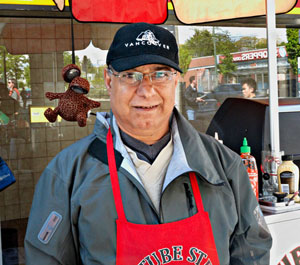
Twenty-nine years ago in Fanuj in southern Iran, Mehrab Arbab, a high school teacher who today operates the Mr. Tube Steak hot dog stand at the Broadway SkyTrain station in Vancouver, escaped from the Revolutionary Guard of Ayatollah Khomeini, when they took 26 teachers from the school at which Mehrab Arbab taught English, history and geography, and killed them all. Mehrab Arbab and five of his colleagues were attending discussion groups in the nearby city of Iranshahr; when the killing squad came looking for them at the wrong house, they fled into the foothills of White Mountain and lay low for three months among the sympathetic Baluch population before crossing into Pakistan with the help of a professional smuggler. Since that day in 1982, Mehrab Arbab has never been back to Iran.
In early February 2011, while he prepared an All Beef Smokie for me, with fried onions and a little extra toasting on the bun, he pointed out that of the executions in Iran, which had been taking place at the rate of three a day since the beginning of the year, one-third of the victims were from his home territory of Baluchestan, where the oppression, which began under the regime of the shahs and intensifed under the Ayatollah, has never ceased. I went around to the other side of the stand to dress my Smokie with sauerkraut, relish, mustard, sliced peppers. Zahra Bahrami, the Dutch-Iranian woman who had returned to Iran after an exile of some 22 years, had just been hanged in Tehran after a farcical trial: she had been protesting the rigged elections of 2009. That is why I never go back, even after 29 years, he said; they will kill me just like they killed her.
Powerful winds
Mehrab Arbab has five children, some of them grown up with children of their own. The youngest is in grade 9; the eldest have graduated from university. He and his wife own a large house in Coquitlam, where three generations of their family live together. When he fled to Pakistan in 1982, he had to leave his wife and two children in Fanuj; eventually he was able to move them to Islamabad, Pakistan, and then he had to move on alone to Dubai to find work, and to begin saving money for foreign travel papers. He was 27 years old. He had a younger brother of 17, who was picked up by "recruiters" during the Iran-Iraq war and put into uniform along with several other young men from his neighbourhood, transported into the mountains and shot to death at the side of the road; photographs of the corpses were exchanged for bounty money supplied by agents of Saddam Hussein.
Mehrab Arbab's eyes filled with tears as he told me this story. I searched several times on Google Earth for the city of Fanuj but failed to find it until I discovered the correct spelling, and even then I could never get down to Google Earth street view without the image breaking up into pancake-like fragments. Apparently there are no Google cameras working at street level in Baluchestan, which renders in Google Earth as an undulating sea of brown and grey mountains, ragged plateaus and what appear to be dry riverbeds.
The web page IranTourOnline names several winds of Baluchestan, among them the seventh wind, the 120-day wind, the south wind and the north and west winds, and the humid wind from the Indian Ocean; there is very little water in Baluchestan, which seems from a distance to be a country scoured with wind and dust. Mehrab Arbab speaks warmly of the Fanuj of his youth and the nearby mountains: a very beautiful country, he says; he has never mentioned the wind. His attachment to his homeland is evident in his face whenever he speaks of it. His family and the extended Arbab clan had been farmers in Baluchestan, he says, for more than three generations, growers of dates, figs, pomegranates, melons, grapes, rice and vegetables.
Google Earth provides a hallucinatory rendering of the Broadway SkyTrain station and the umbrella that marks the Mr. Tube Steak stand: a corona of red and white petals resembling a bull's eye from the Google viewpoint in the sky; even the baseball cap worn by Mehrab Arbab can be seen clearly as you zoom down in Google Earth to street level, where the Mr. Tube Steak stand reappears face-on beneath its colourful umbrella. A small group are gathered before it and Mehrab Arbab can been seen tending the barbecue, but there are only a few passersby in the picture, no sign of the thousands of passengers moving through the system every hour at the SkyTrain station; the nearby eateries can also be seen from the middle of the street: McDonald's, Quiznos, Fresh Slice Pizza, Megabite Pizza, Uncle Fatih's Pizza, A&W -- all conjoined by a few stretches of grey concrete and black asphalt.
The smuggler's route ends at Broadway
Mehrab Arbab worked at odd jobs in Dubai for ten years to raise the $4,500 he needed for papers and passage to Sweden. When it was time for him to depart, complications led to the flight being cancelled; his ticket agent, or smuggler, had taken a liking to Mehrab Arbab, he says, and found him a replacement package for Canada -- which normally would have cost $10,000 -- at no extra charge. The smuggler's route took him to Sofia, Bulgaria, and then non-stop to Ottawa, where, in April 1992, Mehrab Arbab was awarded refugee status.
Later that year he moved to Edmonton, where a friend from Fanuj, another exiled schoolteacher, ran the Mr. Turtle's Pizza near Northlands Coliseum, where Mehrab Arbab found his first employment in Canada. In Edmonton, his sinuses deteriorated in the cold weather and a doctor recommended that he move west to Vancouver, which he did in 1994, 12 years after leaving his hometown of Fanuj, and on March 31 of that year, a day that he refers to asthe happy day, he was reunited with his wife and children at Vancouver International Airport. They found an apartment on Broadway near Main Street, and then a house on Beatrice Street near Kingsway.
Mehrab Arbab worked as a gas station attendant and then at Johnny's Pizza on West 4th. Sixteen years ago, he moved into the Mr. Tube Steak franchise and went hard to work, some would say relentlessly, to work at the SkyTrain station. He can be found there today six days a week, rain or snow, a father, husband, grandfather, homeowner and entrepreneur.
Absent from the Google Earth view of the Mr. Tube Steak stand at the SkyTrain station are the street people to be found in great abundance on a sunny day such as the day in May depicted in Google Earth street view, who along with the usual stream of commuters seem to have been removed or airbrushed out of the picture: the panhandlers and sidewalk sitters with their large sleepy dogs; silent Jehovah's Witnesses holding up copies of the Watchtower, elderly anti-abortionists with their placards and handouts, evangelists holding out their tiny brochures, the vendor of used books in plastic bags set out against the wall of the Bank of Montreal; the Aboriginal artist who displays his cards and paintings against the wall of the Canadian Imperial Bank of Commerce, the skinny guy pacing up and down, riffling two or possibly three packages of cigarettes through the fingers of one hand as if they were playing cards, intoning without emphasis: smokes five bucks a pack, smokes five bucks a pack. Some days a tall man strides through the crowd with a pigeon on his head; one afternoon I observed him break off a piece of a hot dog purchased from the Mr. Tube Steak stand and pass it up to the pigeon.
What will you have, dear?
Mehrab Arbab is often visited at the Mr. Tube Steak stand by fellow Baluch, dignified men who shake hands when introduced; Mehrab Arbab keeps a stack of All Beef Smokies at the back of the grill for his Muslim clients, who like them well done, he says. In 2009, during the street demonstrations in Iran, he told me that he thinks of himself as Iranian as much as he might be Baluch. Persian is my second language, he said. But I like to speak Baluchi. What will you have, dear, he says to all who approach the stand, and here you go, dear, he says when he hands over the Tube Steak in its bun and paper wrapper, with a napkin.
He suggested that I look into the life and death of Daad Shah, a prominent Baluch rebel who had opposed the Shah of Iran in the 1950s. Mehrab Arbab's necessarily fragmented accounts of the history of his country, which I obtained during many brief conversations interrupted by customers buying Smokies, Tube Steaks, soft drinks and fruit juice, or passersby asking directions, implied that the CIA had figured in the fall of Daad Shah, whose death was ordered by the Shah after the assassination of a CIA agent. Daad Shah was killed in 1957 in a battle between Baluch factions struggling for position under the regime installed by he CIA in 1953, during Operation Ajax, when Mehrab Arbab was one year old. Operation Ajax was a botched intervention that should have failed; its accidental success led the CIA on to further interventions, as Mehrab Arbab put it, in Guatemala, the Bay of Pigs, Vietnam, Chile, El Salvador and the more recent fiascos that punctuate U.S. foreign policy. All of that began in Iran, he said. Mehrab Arbab was kin to the wife of Daad Shah, herself a heroic figure of resistance who lived into old age; one of Mehrab Arbab's brothers-in-law was nephew to a leader of the opposing faction, who was killed in the opening salvo in the factional battle of 1957.
A history of the CIA in Iran written by James Risen and published in 2000 in the New York Times confirms the fragmentary account that Mehrab Arbab provided me during my visits to the Mr. Tube Steak stand over the course of a year. The skepticism that Mehrab Arbab and his friends felt toward the likelihood of democracy ever emerging in Iran were founded in recent history: the CIA, the Mossad, the agencies that invented the torture squads and the secret police under the Shah of Iran, would never allow democracy, he said; they want their own strong man. The oppression in Iran today is as bad as or worse than ever; the only hope that Mehrab Arbab feels for his homeland these days is in the Iranian proverb "There is fire beneath the ashes" -- the power is still with the people, he says, and he points to the barbecue. Under the layer of ash, the fire waits to break out.
'The greatest'
Mehrab Arbab drives into the city every morning in his Nissan van, hauling the Mr. Tube Steak trailer, which contains the barbecue, side burner, propane tank and distinctive red and white umbrella. A few days a week, he stops at Costco to renew supplies of condiments, buns and hot dogs; the other sausages he picks up as needed from specialty suppliers.
He unhitches the trailer and pulls it into position in the shade of the SkyTrain tracks at about ten and raises the umbrella. By 10:30 or 11, the battery-powered refrigerator and the cooler filled with pop and dry ice are in position beside the trailer; the condiments are set out: ketchup, hot sauce, three kinds of mustard, chopped onion, relish, sauerkraut, mixed sliced peppers.
He switches on the barbecue, lays out sausages on the grill, spreads onions in the frying pan. He plugs his iPod into a fur-covered speaker designed to look like ET. The iPod is loaded with pop music selected by his oldest son, who refreshes the selection every couple of months. Mehrab Arbab will still be there under the SkyTrain station at seven or eight in the evening, as long as the demand lasts. When he gets back to the house in Coquitlam, he puts in a final hour cleaning the equipment and the utensils. Then he is ready, he says, for another day.
Partisans of the Mr. Tube Steak style of hot dog can be found on the I Love You Mr. Tube Steak Facebook page, which lists three "officers" in Vancouver and one in New York City, and a "creator" in Victoria. Many are devoted to the Smokie filled with cheese and jalapenos: "the greatest jalapeno and cheese sausage hot dog on the street," writes one fan; another says, "Oh I love you, Mr. Tube Steak."
Mehrab Arbab takes his own lunch to work every day: vegetables, cheese, flatbread made at home on the stove. But he too is a partisan of the jalapeno cheese dog; every two weeks he allows himself one Spicy Smokie smothered in fried onions, sauerkraut and pepper slices. In February this year, he watched a Persian-language documentary of an Iranian engineer who fled from the Revolutionary Guard and landed in Germany, where he is now a vendor of hot dogs on the street. Mehrab Arbab was pleased to report that the title of the documentary is The Engineer and the Hot Dog Man. ![[Tyee]](/design-article.thetyee.ca/ui/img/yellowblob.png)
Read more: Rights + Justice


Tyee Commenting Guidelines
Comments that violate guidelines risk being deleted, and violations may result in a temporary or permanent user ban. Maintain the spirit of good conversation to stay in the discussion.
*Please note The Tyee is not a forum for spreading misinformation about COVID-19, denying its existence or minimizing its risk to public health.
Do:
Do not: