Mediacheck

'We Are Iran'

Blogging, where the act can be a 'cyber crime' .

By Nasrin Alavi, 13 Dec 2005, TheTyee.ca

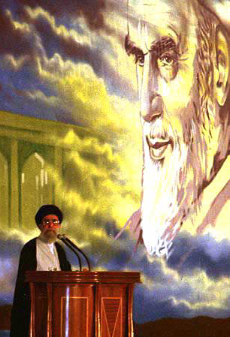
khamenei

[Editor's note: Nasrin Alavi breaks two new kinds of ground in We Are Iran. She creates an archive of the impact of 64,000 blogs on the children, religion, culture, gender, politics, activism, revolution, media and law of her country. She chronicles the experiment in democracy, and in doing so, she presents not only a set of facts, but an alternative history.

She also creates a new genre. Alavi provides glimpses into the lives of Iranians by including blog entries along with the blog addresses and contact information. Readers of the blogs (online and in the book) can continue the discussion about Iran's past and future with the blogging revolutionaries themselves.

What follows is an excerpt from the introduction to the book.]

In September 2001, Hossein Derakhshan, a young Iranian journalist who had recently moved to Canada, set up one of the very first weblogs in Farsi, his native language. (For the uninitiated, a weblog or blog is a kind of diary or journal posted on the Internet.) In response to a request from a reader, Hossein created a simple how-to-blog guide in Farsi. With the modest aim of giving other Iranians a voice, he set free an entire community.

Today, Farsi is the fourth-most frequently used language for keeping online journals. There are more Iranian blogs than there are Spanish, German, Italian, Chinese or Russian. According to the 2004 NITLE Blog Census, there are more than 64,000 blogs written in Farsi. A phenomenal figure, given that in neighboring countries such as Iraq, there are fewer than 50 known bloggers.

Blogging in Iran has grown so fast because it meets the needs no longer met by the print media; it provides a safe space in which people may write freely on a wide variety of topics, from the most serious and urgent to the most frivolous. Some prominent writers use their blogs to bypass strict state censorship and to publish their work online; established journalists can post uncensored reports on their blogs; expatriate Iranians worldwide use their blogs to communicate with those back home; ordinary citizens record their thoughts and deeds in daily journals; and student groups and NGOs utilize their blogs as a means of coordinating their activities.

17 November 2004 I keep a weblog so that I can breathe in this suffocating air … In a society where one is taken to history's abattoir for the mere crime of thinking, I write so as not to be lost in my despair … so that I feel that I am somewhere where my calls for justice can be uttered … I write a weblog so that I can shout, cry and laugh, and do the things that they have taken away from me in Iran today …

The worst that could happen to a blogger in the West is that they might be looked upon as self-absorbed 'cyber-geeks' or 'anoraks', but in Iran - a country that Reporters sans Frontières called 'the biggest prison for journalists in the Middle East' - honest self-expression carries a heavy price. In the last six years, as many as 100 print publications, including 41 daily newspapers, have been closed by Iran's hardline judiciary.

In April 2003, Iran became the first government to take direct action against bloggers. Sina Motallebi, a journalist behind a popular weblog www.rooznegar.com, was imprisoned. His arrest was just the beginning and many more bloggers and online journalists have been arrested since. As Reporters sans Frontières put it: 'In a country where the independent press has to fight for its survival on a daily basis, online publications and weblogs are the last media to fall into the authorities' clutches.' They add that, through arrests and intimidation, 'the Iranian authorities are now trying to spread terror among online journalists' (16 October 2004).

Intimidation such as the arrest of Sina Motallebi's elderly father or the accusations of adultery against online journalist Fershteh Ghazi. According to Reporters Without Borders, five other imprisoned web journalists, 'Javad Gholam Tamayomi, Omid Memarian, Shahram Rafihzadeh, Hanif Mazroi and Rozbeh Mir Ebrahimi are expected to be accused of having sex with her. Some of them are said to have been forced to sign confessions. Such accusations by the authorities are common against political prisoners in Iran' (29 October 2004). Adultery is a crime punishable by stoning.

In October 2004, while several Internet journalists and bloggers were held in undisclosed locations awaiting trial, Ayatollah Shahrudi, the head of the judiciary, announced new laws expressly covering 'cyber crimes': anyone 'propagating against the regime, acting against national security, disturbing the public mind and insulting religious sanctities through computer systems or telecommunications would be punished'. This announcement was accompanied by a number of articles in state propaganda newspapers, such the Keyhan daily, which 'exposed' the Iranian blogosphere as a 'network led by the CIA conspiring to overthrow the regime'.

The crackdowns suggest that the regime is determined to curtail freedom of speech in cyberspace. Yet faced with a judiciary prepared to stone someone to death to silence them, an increasing number of blogs are now written anonymously. Additionally, many political Internet sites have gone underground, making them even more radical and critical.

Yet, despite the very real risks, there are some bloggers who still write under their own names. Bijan Safsari was editor-in-chief and publisher of several independent pro-democracy newspapers -- all of them shut down by the regime. Each time one of his newspapers was closed down, it quickly resurfaced under a new name. Eventually, this game of cat and mouse got Bijan thrown in jail and now that there are no other venues where he can write or publish, so he keeps a blog.

18 February 2004 There are those such as [Muhammad-Ali] Abtahi [the Iranian Parliamentary ex-Vice President] who have called our virtual community too political and have said that we should use weblogs for their intended use … that is to say, for clichéd daily diaries … So what if we use our blogs in ways not intended for or defined during the distant conception of this medium? At a time when our society is deprived of its rightful free means of communication, and our newspapers are being closed down one by one - with writers and journalists crowding the corners of our jails … the only realm that can safeguard and shoulder the responsibility of free speech is the blogosphere.

According to data from the World Bank (2001), Iran has more personal computers per 1,000 people than the regional average. Estimates of the number of online users range from four million to seven million and growing. However, experts maintain that these figures do not reflect the current reality, because every month, thousands more Iranians buy computers and go online. The number of Iranians online is likely to more than double again in the next five years, in a country where two-thirds of the population is under 30 and many are already technologically savvy.

Interestingly - even ironically - thanks to the education policies of the Islamic Republic, those who enter further education tend to be from a wide cross-section of Iranian society; and many of these students throughout Iran, all of them from very different social and regional backgrounds, have access to the Internet at their place of study.

20 July 2003 Has everyone noticed the spooky absence of graffiti in our public toilets since the arrival of weblogs? Remember the toilets at university we used to call our 'Freedom Columns'?

1 May 2003 My blog is an opportunity for me to be heard … a free microphone that doesn't need speakers … a blank page … Sometimes I stretch out on this page in the nude … now and again I hide behind it. Occasionally I dance on it … Once in a while I tear it up … and from time to time I draw a picture of my childhood on it … I think … I live … I blog … therefore I … exist.

12 January 2004 This is a personal note of gratitude to Hossein Derakhshan, the 'Godfather' of Iranian blogs, who opened up the world to a society … proving that even a 30-year-old Iranian, with merely the aid of a notebook and a connection to the Internet, can make a difference … So much so that according to a Guardian newspaper report [18 December 2003] he is deemed one of the top 15 international figures 'whose weblogs have caused the biggest stir both in and outside the blogsphere'. Within only a two-year period his tireless efforts have led to tens of thousands of Farsi blogs … a phenomenon that I believe will eventually influence our awareness, our personas and our lives …

In recent decades, analysts, academics and journalists have had little or no real access to Iran. So they have, at times, relied unduly on partial inquiry and the images presented by state propaganda. Dan De Luce, the Guardian's correspondent in Iran for more than a year, was expelled from the country by the Iranian government in May 2004. As he puts it: 'Stifling the flow of information means that the nuances of Iranian society are often obscured to the outside world. Any foreigner who visits Iran is struck by the gap between the reality of Iranian society and the image cultivated by the regime.' (Guardian, 24 May 2004) Yet through the anonymity that blogs can provide, those who once lacked voices are at last speaking up and discussing issues that have never been aired in any other media in the Islamic world.

30 October 2003 Islam is compatible with democracy*

*Subject to terms and conditions

Iran's burgeoning online communities have been able to evade the cultural and political restraints regarding speech, appearance and relations between the sexes; restraints which are strictly enforced in public. As researchers, such as Babak Rahimi, have revealed, websites and blogs have made it possible for young Iranians to express themselves freely and anonymously - especially young women. The Internet, 'as an advancing new means of communication, has played an important role in the ongoing struggle for democracy in Iran', says Rahimi, and 'has opened a new virtual space for political dissent'.

Nasrin Alavi grew up in Iran and studied and taught engineering in Britain and the USA. She divides her time between Tehran and London.

From We Are Iran: The Persian Blogs by Nasrin Alavi. Copyright 2005. Reprinted with permission of Raincoast Books. To purchase the book, click here.  [Tyee]

20  Comments:

Login or register to post comments

  • Fiat lux

    6 years ago

    Comments on "'We Are Iran'"

    Although I'm a dedicated promoter of soft technologies, as everything can be overdone and hi tech in our age has become a curse in may areas, I have to admit that personal computers are the greatest power ordinary people ever held in their hands.

    The control of information has always been the most important power in the hands of ruling classes and religions. The neocon movement planned their worldwide rule, they first took control of all levels of the newsmedia and entertainment, to capture and mislead the population into servitude.

    The power of ordinary people, informed through the use of computers and the Net, first manifested itself in 1996 and 97, when we were fighting against the Multilateral Agreement on Investment, the MAI.

    The MAI talks began in Paris between the governments of the 29 nations of the OECD, including Canada, who wanted to sign and pass it in virtual secret, by 1998. The first copies of the draft treaty were leaked late in 96 and arrived in North America in early 97. I first heard about the MAI in Jan. 98 and was shocked of its fascistic plans for control .

    It was a disgusting piece of market economy filth, that would have overruled all levels of democratic decision making in the partaking nations and replaced it with the unlimited power of investment capital, overruling all other laws.

    I had the whole text in my computer by May and offered it to our Reform MP, who refused it, as the Reform Party, together with the Liberals, were in full support of it, without ever having read any part of the approx. 375 pages. Some hack in Preston Manning's office wrote to me that the MAI was an important wealth creating instrument, etc.

    However, the Net was working and as the outrage of the informed public grew, the French government got cold feet and backed off, fearing revolution and so the treaty collapsed, only to reappear in every free trade agreement since, including in the now negotiated GATS, FTAA and the EU Constitution, again shot down by the French and Dutch peoples, but accepted by all other governments.

    The collapse of the MAI was the first fully negotiated treaty in history that was wiped out by public opinion and it was definitely through the instant, uncensored and controlled communications provided by the Net.

    Let us hope that this power will grow all over the world and one of these days the same will happen in Iran, and perhaps even here in North America, still controlled and misled by the wealth creating, or rather stealing, power elite counting on the support of the braindead.

    Ed Deak, Big Lake

  • murdock

    6 years ago

    Excellent piece!

    The rage is no longer against the machine(s).

    The rage is, at long last, directed towards the correct place, unscrupulous and self-interested human leaders.

    I can only hope that we, in North America are paying attention and can be watchful enough to make sure we do not find ourselves in the very same situation.

  • skeptikool

    6 years ago

    I do agree, Ed, that the Net has put a potentially awesome power into the hands of Joe and Jill SixPack, but let us not become complacent. It is very much under attack by powerful forces threatened by the medium.

    I was puzzled, a while back, when the major media appeared to be giving much attention to blogging - even to have columns on it. Then it occurred to me that the idea was to steer away from the message board/forum format. A visit to a blogging link will show the vast majority of messages have no, or few, responses. In effect, there are millions of bloggers out there who are writing messages to themselves.

    The media may give exposure to an active one occasionally - active but safe.

  • POC04746160

    6 years ago

    Ongoing Public Servants' Education: The F-case expands your knowledge of how catastrophic the corruption of public service, justice and whole Canadian society is and educates you on how to improve the lives of children and families in the need of government services, instead of intruding into lives of others and ruining them like ours. A minor case of gross negligence and nasty lies progressed into the most massive cover up, firmly guarded by officeholders, united in refusal to admit and learn from their wrongdoings. (fcase.blogharbor.com)

  • Fiat lux

    6 years ago

    It is quite obvious that the powers have already recognized the potential of uncontrolled information in the hands of ordinary people amd will do anything to cut it back, or destroy it.

    There have already been a number of attempts to curb the power of the Net, usually cloaked under so called "well meaning" actions, like "the elimination of pornography", or "terrorism", etc., all boiling down to information control in the name of goodness.

    The elite can not tolerate any freedom of information, just as, at one time, they couldn't permit the release of religious scriptures into the hands of the unwashed populace, without the appropriate translation by the clergy.

    Today the subject is economics, leading either to people, or elite power, supposed only be translated by the brainwashed clergy of our age, the economists.

    When we were fighting the MAI, and information was leaking out from the talks every day and spread over the Net, one of the Canadian delegates, Toronto U woman professor, whose name I can't recall at this moment, Sylvia Something, was heard exclaiming :"Isn't there a way to stop these people?"

    We had the whole text of the MAI in our computers months before Canadian MPs and the powers haven't forgotten the beating they took to the plans for corporate fascism, which is the same as the religious fascism in Iran, or Ireland.

    I can well remember the days, when I would have been jailed, or shot for this short posting alone, in the name of "freedom and democracy", of course, and will fight for the rest of my life to prevent the resurgence of any kind of power elite giving orders on what I'm permitted to read and believe.

    Ed Deak, Big Lake.

  • Michael Clift

    6 years ago

    Dear Mr. Fisher (POC04746160),

    I do not doubt that your perceive to be unjustly treated by the MCF, but please don't carry through with your threatened suicide.

    Since you are a rational man, perhaps it is time for you to step back from the issue and re-examine at a later time.

    Sincerely,

    Michael Clift

    PS. The Vancouver Crisis Centre is 604.872.3311. That number is answered 24 hours a day by a volunteer who will listen non-judgementally.

  • Coyote

    6 years ago

    Quote:
    "Although I'm a dedicated promoter of soft technologies, as everything can be overdone and hi tech in our age has become a curse in may areas, I have to admit that personal computers are the greatest power ordinary people ever held in their hands." Fait Lux

    Ain't it the bloody truth.

    Excellent posting by yourself this thread, Fait.

    And the warnings about moves already underway to begin to interfere with and control the net, some of which has recently been in the media, are entirely well timed and appropriate. No greater fear have the ruling elites everywhere, than that ordinary people will get together widely and globally, and exchange views, and discuss appropriate courses of action and solidarity, bypassing state and ruling class control of the instruments of information and ideas. (It drives the Wingnuts here to distraction, and desparate misinformation peddling.)

    I am hopeful, if not completely convinced, that out of these times now upon us, new understandings and formations of "the people" will be created and begin to move, and effect their times and societies in ways previously unimagined, including, and maybe even especiallyhere.

    It is possible.

  • POC04746160

    6 years ago

    Dear Mr. Clift, I do not threat anyone, the proof: I was never charged with uttering threats, though a few times arrested and imprisoned for complaining. That Risk Assessment about me experts produced without seeing or speaking with me, in June 2000. And the Crisis Centre last answer at requests for help: "Please stop sending these! We are getting up to 4 or 5 a day! We operate a 24 hour phone line - we cannot help in this matter"! Thank you!", is from August 2000. Thank you for well-intended advice.

  • kurt

    6 years ago

    I visited Iran first in 1973 (then under the rule of the Shah) and was very impressed by the high rate of intellectual curiousity, literacy and multi-lingual abilities of its people — I could easily have stayed there. In Isfahan a young student came up to me on the street and asked if I would debate Sartre with him in French. It's so good to see this continue even under the cruel Mullahs.

  • Bailey

    6 years ago

    If Fiat Lux has it right, and I think he hits the mark in his assessment of the need of power to control thought, and the ways and means by which power accomplishes that control, then this new medium is the first real hope for ordinary people to defend their revolutions against those who would betray them.

    Mr Bush and his fellow travellers, just to use the most obvious example, maintain control of a free population by controlling television. They present false images while carrying out torture, election fraud, and secret police tactics, though such things are clearly no part of Western Democracy and would never be tolerated by their own people, if they knew.

    I hope the Iranian people can succeed in defending this medium. I believe they are in a real war against those who would deceive and abuse them, and betray the very Revolution which might be the vehicle of their deliverance.

    I hope we all can. Stand fast. Speak your truth. Lies can never prevail against the truth revealed by the ones who live it.

  • Fiat lux

    6 years ago

    While not on the subject of Iran, the following is a good example of mind control by the corporate media. Has anybody seen this in any paper, or on TV?

    Ed Deak.

    The future of Canadian Postal Services goes on trial in Washington D.C.

    OTTAWA, Dec. 12 /CNW Telbec/ - The future of Canada's public
    post office will be decided by a private trade tribunal operating
    from the World Bank headquarters in Washington D.C. The hearings
    over our post office will run from December 12-17th.

    The Canadian Union of Postal Workers (CUPW) and the Council
    of Canadians (the Council) are concerned that the tribunal, which
    is looking at a complaint filed by United Parcel Service (UPS),
    could issue a decision that has disastrous implications for
    postal and other public services.

    UPS is using Chapter 11 of the North American Free Trade
    Agreement (NAFTA) to demand financial compensation of $185
    million CDN from Canada's federal government. This amount will
    double if UPS wins damages to date.

    UPS claims its investments are being limited by Canada's
    publicly funded network of mailboxes and post offices. It
    believes this network gives Canada Post an unfair advantage when
    delivering parcel, express and courier services that are in
    competition with private courier services.

    "If UPS wins, Canada Post may opt to get out of the courier
    business which would spell disaster for the longer term
    financially viability of Canada Post. The corporation needs the
    profits it gets from the courier business to provide universal
    service," says CUPW National President Deborah Bourque.

    Ottawa-based trade lawyer Steven Shrybman, who represents the
    groups, says that the UPS case also spells trouble for other
    public services because most compete at least to some extent with
    the private sector. "If UPS succeeds, the case is likely to open
    floodgates to claim by other US companies seeking to break into
    the health care or water service markets in Canada," says
    Shrybman.

    Jean-Yves Lefort, trade campaigner for the Council of
    Canadians, argues Canada must rescind these investment rules
    adding "it is outrageous that NAFTA allows the future of Canadian
    public services to be determined by a private arbitral tribunal
    operating behind closed doors in Washington D.C."

    For further information: please contact Joseph Zebrowski,
    Communications Specialist, Canadian Union of Postal Workers
    (CUPW), (613) 222-3952 (cell)

    © 2005 CNW Group Ltd.

  • Coyote

    6 years ago

    Fait,

    Yes, I have previously heard of this-, if my memory serves, several months ago. Indeed, similar moves are underway as well involving water resources, agricultural products, our socialized medical system and US health corporations, as the soft wood lumber issue is already an attempt to dictate policy and control our forestry resource related issues.

    It is again, one of those measures of the degree to which private corporatist, and especially US corporate interests, armed with the provisions of NAFTA, are attempting to dictate law and social policy to Canada, and extend their control over Canadian economic and political life, no doubt.

    Despite the opportunist stance of Paul Martin making asserive gestures towards Washington in a national election, though it is still a good thing overall by way of elevating the issue and arousing Canadians, not really his intent I think, too few Canadians yet fully understand the implications of NAFTA and how it serves US Empire policy in controlling this country. We are already far down the rode of sliding under US domination, and there is a point at which that will only be able to be turned around by "unusual measures", almost certainly.

    By lowballing the issue and not directly addressing it and raising the alarm unfortunately, much of our politicians and political appparatus, intentionally or not, are facilitating this handing over of the nation to Washington.

    Listen to the boldness of our neocon wingers here, in their support and justification of this, and the NAFTA reality that underpins it. That traitors to the nation can be so daring and open says something about the safety of the environment they feel they are operating in-, that they can do so with impunity. It tells me that the process is already far along and there is insufficient popular wrathbeing manifest as yet, at this betrayal of the nation, already far along, to even act as a caution on these proUS-Canada "integrationist" types in our midst.

    That needs to change, quickly. A national movement needs to quickly evolve, to pressure our collaborationist politicians to repudiate NAFTA, yesterday.(Amongst which group Martin, as an international shipping magnate as well as Liberal politician, has generally been considered and been more proccupied with maintaining good relations with the US/ NAFTA, interpreted by the likes of myself as subservient, relations.)

    (Like repealing the GST, the Liberals as late as 1993 were once also going to repeal NAFTA. Both positions in that electoral aftermath which they simply dropped and themselves became advocates of.)

    Trotting the issue out "just" at election time, more designed to impress immediate electoral outcomes than to actually do anything real about it, is not good enough. We see too much of that in this country, from all political parties which dominate the electoral process.

  • Coyote

    6 years ago

    http://www.parl.gc.ca/36/2/parlbus/chambus/house/debates/013_1999-10-28/han013_1700-e.htm

    From Hansard, on the history of the Liberal policy re NAFTA. Lots of such material out there. Coyote

  • Colin

    6 years ago

    You will notice that the UN wants to wrestle control of the internet away from the US and into the “world”. You can bet that many of member countries will want to be able to control it and not for anyone’s good. The Internet still depends on key nodules that if controlled can truly limit the effect that it is having.

    China is certainly working hard to limit the flow of information on the net and passing through Shanghi recently they seem more interested in CD’s, laptops than Avian flu.

    Lot’s of Iranians and Iraqis where I live and lots of interesting stories, my friend drove ambulances for Iranian army in 80’s and my Iraq butcher has a scar from a RPG on his head from the same war. Their stories are eerily similar to WWI vet stories.

    The Iranian leaders know they are sitting on a boiling pot, you have a huge group of young people being held down by a small group religious radicals, plus many Iranians have relatives abroad and keenly feel what they are missing. If Iraq becomes moderate and non-threatening, then the Iranian leaders have lost their public enemy and they won’t have external threats to use for their own purposes.

    Ed
    Doesn’t the US postal system have similar setup to the Post Canada system for parcel delivery, which would mean that both countries would have the same advantage and muting the issue that UPS is claiming.

    NAFTA was the dumbest thing we could have done.

  • Coyote

    6 years ago

    It's not only in such places as China and Iran either, where there are "official" noises and moves to "control" the internet. In the US and here, largely due to pressure from Washington, officials in recent months (if not weeks, which I did not immediately recall) have been talking about "security concern" legislation to access and monitor people's email exchanges, as well as their internet use, in terms of the sites they visit etc..

    Most of the immediate pressure here, of course, arises out of the same policy stream rationale as the "fighting terror" preoccupations of the Patriot Act and Homeland Defence that are so much of The Empire's obsession in these times. At least it lends itself as a credible excuse to begin to squeeze information and communication access to the public. Which, given the general anxiety of our State and ruling class interests to keep The Empire happy, is having a carry-over effect here in "the colony', with the same kind of talk coming out of CSIS.

    And of course, there is the old shiboleth war on porn designed to silence critics as well. (Which they are perfectly capable of dealing with separately, by forcing content restrictions on "the business" of Internet Providers, be that their real intent. Imagine cold turkey, without some access to porn!! Scarey! So long as most politicians are male eh, not likely to happen. wink wink :-)

    (Bantam rooster posturing with Washington on occassion, by our politicians, still does not alter the fact of our overall subservient relationship and economic, political and military vulnerability. I'm damned sure, though they will not be pleased of course, that Washington does not feel in any wise seriously threatened by this. All they have to do is threaten to close the border or apply another "surcharge", say if it goes on much beyond the election, and our political leaders will snap back into line quickly and smartly enough.)

  • Colin

    6 years ago

    Or even worse, just simply ignore us.

  • Ron Erwin

    6 years ago

    no,no,no Cayote, this is not coming from Washington. It is the UN.
    The only frightening thing the US did, was when the internet masters wanted to make a xxx suffix Washington vetoed it. It wasn't the smartest thing to do I will admit.

  • Yammer

    6 years ago

    Bailey wrote: "I hope the Iranian people can succeed in defending this medium. I believe they are in a real war against those who would deceive and abuse them, and betray the very Revolution which might be the vehicle of their deliverance."

    Are you joking?

    The Revolution has resulted in a tyrannical theocracy (there is no other kind). Nobody wants a return to the bad old days of the Shah and SAVAK, except maybe the Shah's whelp hiding out in Paris, but in this case, the Revolution demands another one forthwith.

  • Colin

    6 years ago

    The popular revolt against the Shah was taken over by the more Islamic parties and redressed as an Islamic revolution. Many of the non-Islamic revolutionaries ended up in prison under the Ayatollah regime.

    The Shah could have headed off the revolt by easing up on dissent and allowing a limited democracy. But he was in to concerned about the fundamental Islamic threat.

    A lot of the Iranians here in Vancouver were supporters of the Shah and had to flee when the Islamic Ayatollah took power.

  • Bailey

    6 years ago

    Yammer; Not a joke at all. Hardly anybody gets two revolutions. If that revolution in Iran suceeded, then why are the people crying out in blogs for the freedom and justice they obviously thought would result?

    And why are the mullahs who betrayed them so adamant that they must not be allowed to speak their truths in their blogs?

    Please answer, I'm interested to hear your thoughts on this.

    The revolution did result, as you say, in a tyrannical theocracy, but nobody sets out to make a revolution to achieve oppression. So what happened?

    I believe the tyranny results from the betrayal of the revolution, not from the revolution itself. That had a very different purpose in the minds of the people.

    They were religious people, so obviously they hoped the ideals of their religion would be part of their new society. This faith made them vulnerable to manipulation by opportunistic fundamentalists, who by lies and hatred stole power and built the horror that we see there now.

    We in the west are in a similar position, we're very vulnerable to the exact same abuse by our own lying, hateful fundamentalists. They hope to achieve power over us to force us to live in fear and to forbid us to disagree in precisely the same way.

    • No best comments selected by an editor for this story yet. To see all comments, click the All Comments tab, above.
    • The discussion for this story is closed. No more comments can be added.